
Attack of the Customers with Paul Gillin
In this August 2015 Free Webinar Wednesday, host Eric Cook (WSI) and co‑host Jeff Simpkins introduce social‑media expert Paul Gillin, author of Attack of the Customers. Gillin explains how everyday customers can launch powerful, often viral attacks that damage brands, using real‑world cases such as Pampers DryMax, Lumber Liquidators, the “pink‑slime” beef scandal, and Bank of America’s fee‑driven “Bank Transfer Day.” He outlines four attacker archetypes—casual complainers, extortionists, committed crusaders, and irritable influencers—detailing their motivations, risk levels, and typical activity. Gillin then presents a playbook for companies: monitor communities (including niche forums like Spiceworks), maintain customer‑focused policies, respond with facts/education, thank and listen to complainants, and avoid ego‑driven silence. He stresses that crises often jump from social channels to mainstream media, that early community engagement (being a trusted member before a crisis) is essential, and that proper preparation (insurance‑like mindset) can turn potential disasters into brand‑building opportunities. The webinar concludes with audience Q&A on why many firms are slow to adopt these practices and how ego hampers timely response.
Chapters
Greetings everybody, welcome to the Wednesday, August 26th, 2015 episode of Free Webinar Wednesdays. This is Eric Cook, and I'm with WSI Internet Consulting, where we work with businesses and organizations on helping them better understand and leverage the power of the internet as a strategic business tool. You can learn more about me and WSI online at www.poweredbywsi.com. Hard to believe we are here in the last week of August, but we are, and it is good to be back in the saddle because we took a couple weeks off. And it is even better to have my good friend and Free Webinar Wednesday partner, Mr. Jeff Simpkins, officially joining me again. Jeff, say hello to everybody out there in Free Webinar Wednesday world.
Greetings everybody, this is Jeff Simpkins and I am with Community Bank Consulting, Inc. You can learn more about me and Community Bank Consulting, Inc. online at www.communitybankconsultinginc.com. communitybankconsulting.com.
Excellent. So as I mentioned, we've been somewhat absent over the past couple of weeks with travel. Anything new or interesting in your world that you want to mention or brag about?
No, I've been all over the place. I think I've been traveling 5 out of the last 6 weeks or something like that. I did notice this morning in the New York Times or on NPR that it's a good thing that you're not in Hawaii this week like you were a few weeks ago because the beach in Waikiki is closed down due to a spill.
Oh my goodness, yeah, that would have made it a little difficult to enjoy that paddleboard. So although we did get to experience at least the very front end of one of the hurricanes that was pushed down to a tropical storm, but it managed to screw up All of our flights, so I got to experience that at least. But oh well, such is life. I don't want to complain. Poor me, I don't go to Hawaii.
I know.
I can just hear the chat room going nuts right now. So speaking of which, let's go ahead and get rolling. Just as a means of housekeeping for those of you that are joining us live, maybe for the first time, We do record all Free Webinar Wednesdays, and they are made available at freewebinarwednesdays.com. You can see I've got the site pulled up here, and when our presentation with Mr. Gillen is available, we'll push it out there, and you will have the ability to watch it again, share it with friends and colleagues and coworkers. Certainly, I'm— I know today's session is going to be a great one. And as you watch today's session, if you have comments or questions or you'd like to interject some thoughts, please feel free to do so. We like to keep Free Webinar Wednesdays somewhat conversational and love hearing from our audience. So use the chat feature. Jeff and I will keep an eye on that during today's conversation, and we've already given Paul a heads up. We might be interrupting him if we get some good questions from the audience. So, so we'll keep an eye on that. We'd love to hear from you. So with those 2 housekeeping items out of the way, I'm going to go ahead and work the magic of GoToWebinar and send the presentation controls over to our guest today, Mr. Paul Gillen. Just a little bit of background about Paul, he'll mention a little bit more about some of his books and speaking and professional background. Paul and I actually were at the same conference, the Michigan Bankers Association. I don't know if I even shared this with you, Paul. a couple years ago up in Traverse City, and one of the tools that I ran for the MBA when the conference was over was a tool called TweetReach, and it measures the impact and magnitude of social voice primarily through Twitter and hashtags. And it was at that point in time I realized that Paul was a social media rock star, because as many tweets as I had done I paled in comparison. I think you had like 130,000 impressions when you were tweeting up there compared to my, you know, maybe a few thousand. So Paul is definitely somebody that's been around the web a while and has got some good social influence. And we're going to talk today about attack of the customers, and I know that's a big concern with a lot of folks, particularly that Jeff and I talk to in the banking space. worried about what people are going to say and should we not be on social media to keep it from happening. And I think we'll find out that that pretty much is, is not an option. So with that somewhat long-winded introduction, Mr. Paul Gillen, aka Social Rockstar, welcome to Webinar Wednesdays.
Well, thank you, Eric. And can you see my screen? First of all, can you see the presentation?
I do see Attack of the Customers.
Okay, great. Yeah, regarding the Twitter following, I get a lot of comments on that. I have about 13,400 followers, I guess, not like anybody's counting. A lot of the secret to that was really just being there early. You know, I'm a joiner, so I was at South by Southwest when Twitter was introduced in March of 2007. I didn't know what it was for, I didn't really get it, but I joined anyway because I just do that kind of thing. I was also one of the first 1% of people, 0.5% of people on LinkedIn. In the early days, it was very easy to gain followers. I think I had 10,000 followers within the first 4 years, and then it's taken me about 4 more to get to 13,000. It's much more difficult now to add followers, I think, for everyone because people are more careful about who they follow. This topic, I appreciate the chance to present this to you today. This topic is something that has always fascinated me about social media. In fact, when I first became kind of enchanted with social media back in 2006. It was an incident that happened that year involving a young man in New York who recorded a very frustrating phone call with an AOL sales rep. He was trying to cancel his account and the rep would not let him cancel his account. The phone call became a theater of the absurd after a few minutes and that wound up being posted. He posted the recording on his blog, it went viral and He wound up on the Today Show 6 days later telling his story and just embarrassing AOL in front of a national audience. And that was back in the days before Facebook was a factor, before Twitter was around. It was just bloggers. And I was fascinated by the idea that one person's actions, one person's experience could become a story that would resonate with so many people and would achieve such broad awareness and exposure so quickly. So this is really something that's fascinated me for a long time. So this is my 5th book about online communities and social media, and it's one where I really indulged this longtime interest in understanding attacks better, why they happen. Certainly they're more of a factor today than I think they have been ever before. We've seen recent examples certainly that have dramatized how frequent and how damaging these contacts, these attacks can be. Back in the spring, Lumber Liquidators, their stock value, the value of the company fell by over one-third. In fact, it fell by half over the period of about a month thanks to a report on 60 Minutes that alleged that the company was distributing flooring that had dangerous amounts of formaldehyde, or at least it had amounts that exceeded the the standards in California. So the 60 Minutes report is what did much of the damage, and Lumber Liquidators has never recovered. Its stock price has never recovered from this story. In fact, Home Depot was later implicated in possibly selling the same product, which came from a Chinese company. So a very damaging media report for this company, and what kicked it off really was a post on an investment site called called Seeking Alpha by a young man who is a day trader. He's from China. Apparently he knew something about the company that was supplying Lumber Liquidators, and he posted back in June of 2013 that the use of these products could be a problem for Lumber Liquidators. Well, that was a year and a half before 60 Minutes picked up the story and it became a huge problem, but 60 Minutes and many other media outlets really are monitoring social media now to get leads on stories that they then develop. So the words of one young blogger working from information that he had turned into a crisis that took out half of the market value of a name-brand company. 25-year-old guy, one person, and this kind of stuff happens all the time. And we see with the amplification power of social media that these events can quickly erupt and become big problems for the companies that are attacked. What I'm going to talk about today is why this happens, how it happens, the different kinds of attacks that occur, and how you can prevent them and insulate yourself against them. More recently, of course, we've seen this tragic case of the dentist who Minneapolis dentist, I believe he's in Minneapolis, who killed this lion. He was led astray apparently by his guide and went on a lion hunt, wound up killing a lion who was dearly loved by visitors to that animal park. And this guy had to go into hiding. He was under federal protection for a few weeks. I believe he has just now begun to emerge again and start his practice over, but this was a a case where social media essentially acted as judge, jury, and executioner for this person's action, which by the way was not illegal. Whatever you may think morally of it, it was not illegal. So this is just another recent example of where social media amplifies outrage and can do a great deal of damage to one person or one institution. So how does this happen and what What causes some issues to take on a life of their own and quickly spiral out of control? Well, let's look at an example that I used in my latest book, Attack of the Customers, and it's something that I gained from— I was on the digital advisory board at Procter Gamble for several years and was able to get some inside information on an issue that they dealt with there back in 2010. And it concerned a new product called Pampers DryMax, which was the result of 25 years of research and was considered to be their biggest innovation for the Pampers brand in 25 years when it was introduced in February 2010. DryMax was a new kind of diaper that was much thinner than earlier diapers. It was much more absorbent, and it used a completely different type of material. Than had been used previously. Now, to some people, this meant that the diaper looked actually cheaper. And in fact, on the face of it, you would think that it was a cheaper diaper because the material was almost like a— almost felt like newspaper in some ways. But that was the nature of the absorbent gel that they were using to replace what had been essentially a cotton lining for many years. And some people thought this was a case of Procter Gamble trying to cheap out, trying to substitute cheaper diapers for the Pampers that they had loved for many years, and they began to attribute negative impacts to the changes that Procter Gamble had made. Now one of these people is Rosanna Shaw, who lives in Louisiana, and she had noticed that her daughter's skin was red and hot to the touch. Daughter had diaper rash. She blamed this on the diaper. Rosanna Shaw— now diaper rash happens all the time. It afflicts almost every child, gets diaper rash at some point in his or her life. But Rosanna Shaw put 2 and 2 together and concluded that the diapers were the cause of the diaper rash. Now it's important to understand a basic fact of biology. Diapers don't cause diaper rash. Diaper rash is caused by by liquid being held too closely to the skin. The diaper may create that situation. It may create— if the diaper is really tight-fitting, it may create a situation that would cause diaper rash. But diapers themselves have no ingredients that could cause diaper rash. Rosanna didn't believe that, so she took to Facebook, and she started a Facebook page called Pampers Bring Back the Old Cruisers and Swaddlers. And this quickly gained a head of steam as other mothers who were wrestling with diaper rash, understanding that diaper rash is scary to first-time moms in particular, they don't know what to do about it, their child is in pain, and there's really no cure for it other than trying to keep the child comfortable until it passes. So they were looking for someone to blame, and they found this Facebook page, and word began to spread. And within a couple months, this Facebook page was getting literally hundreds of new posts every day with moms whose babies had diaper rash who were attributing the problem to Pampers, and Pampers was being crucified up and down. It quickly spread into mainstream media, and what you find, by the way, in these attack of the customers stories is that the inflection point is when the story spreads into mainstream media. It's rare that companies endure lasting damage if a story simply stays in social channels. It's when it makes that jump to mainstream media that things really get out of hand. But understand that mainstream media is now watching social media very closely for clues of what it should report. The mainstream media has been brutalized by budget cuts, and so more and more of their stories are originating in social channels. So what happened is that the mainstream media began watching what was going on on Facebook, began reporting on that, and quickly you had every major news outlet in the US and even abroad was covering this story. It led to eventually to a federal investigation. Procter Gamble agreed to submit Pampers to inquiry by the Consumer Product Safety Commission for investigation, for analysis, because this thing was completely out of control. Hundreds of posts a day accumulating on this Facebook page, and the media was all over Procter Gamble. What they had hoped would be a really landmark new product rollout had turned into a nightmare. Now, to their relief, in September of 2010, the Consumer Product Safety Commission came back with their analysis. There was no link between new Pampers and rashes. And in fact, the sales of Pampers actually recovered and were even stronger after the crisis. And this is one of the sort of silver linings of social media attacks. When the attack turns out to be groundless, companies can often recover very quickly and even benefit from the word of mouth that they get as people become aware of a brand that perhaps they never heard of before. Ad Age reported a year later that the campaign, that the negative buzz over Pampers had actually worked to its benefit and the company was selling more diapers than ever. But as Paul Fox, the director of corporate communications at P&G, said, you can't join a community at a time of crisis. You have to already be invested in the community. This is what P&G learned the hard way. They were not aware of what was going on on Facebook until the situation had gotten out of hand. At that time, they tried belatedly to get involved in the Facebook discussion and to present their point of view. They were shot down. They were not members of the group. They were not respected. They were not really wanted. And so they had no chance to air their point of view. What did work for Procter Gamble was to actually fly in some prominent mom bloggers to their headquarters in Cincinnati and spend a day with them talking about diaper rash and how diapers are made and the biology of diaper rash, and they got quite a bit of positive coverage from that. That, in addition to a media campaign, helped to turn this situation around, eventually capped by the favorable government finding. But they learned the hard way that when they created the media plan for Pampers, all they saw was good things. And my friend Shel Holtz, who has the wonderful podcast For Immediate Release, always cautions that when you campaign, when you develop a campaign for a new product, a new initiative, really any new announcement you want to make, you should always think of what can go wrong, and you should be prepared for that. P&G learned that the hard way, but it's a lesson that I think any company should be aware of when they get excited about a new initiative and they want to roll it out to the public. Let's stop here for a second and see if there are any comments, questions that have come across.
We don't have any questions in the queue, but I just jotted down, and I think that quote Really nailed me right between the eyes, and I like the fact that it reminds you, you know, you can't join a crisis after it's already happened because then you see like you're reacting to it. And all too often that is, I think, so much the case, particularly maybe in the financial services industry. But, you know, being part of the conversation, not because you're doing it particularly because of damage control, But you are aware of it, and then you're not seen as, oh, the only reason you're here now is because you want to save your butt, as opposed to you've been part of the dialogue all along. Now it's nice that you're chiming in because you chimed in in the past and it doesn't look out of character.
Absolutely. It gives you street cred.
It's really powerful.
It gives you street cred, and when people will give you the benefit of the doubt if they feel that they know you, that you have been in the community when there was nothing for you to gain, or no buts to save, they're more likely to give you the benefit of the doubt when a crisis strikes.
Yeah.
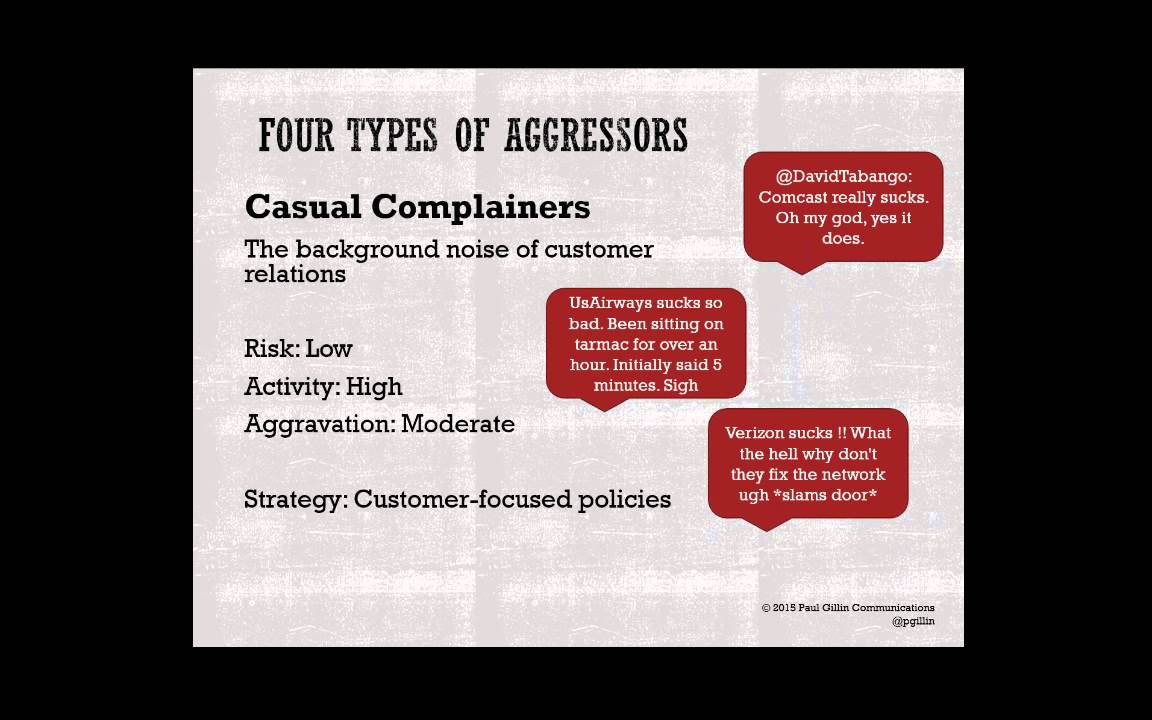
So as David and Michelle Davies of the Webby Awards says, there's never been a better time to be a critic. Crises emerge from all kinds of different places. As the chart in the lower left shows, there are many different channels that spark crises, and they reach mainstream media at a higher speed than they, than they have in the past. So as the Altimeter Group said in a report, companies are quick to deploy the latest social media technology, yet most are not prepared for the threat of social media crisis. We found that more than 3/4 could have been diminished or averted by simply considering the possibility of downside. So when you get your executives all excited about jumping on board with this great new social networking thing, be aware that it's a little bit of a Faustian bargain, because once you get into those social channels, you are responsible for responding to the people who speak to you. Whether those responses be good, those comments be good or bad, you have to be responsive. You can't just be a one-way conduit. Let's look at another example of an entire industry that was caught flat-footed and unable to respond, or responded late and poorly to a crisis that came out of nowhere. I'm sure that many of you remember the pink slime crisis of 3 years ago. All of a sudden, ground beef became evil. It turned out that ground beef contained a product called lean finely textured beef, or LFTB, which is essentially made from the scraps that are scraped off of bones in the abattoir. Those scraps can't be used for anything else, so they are cleansed with an ammonium solution and then they are mixed in with ground beef. There's nothing unsafe about this. This practice has been going on since the mid-'80s, and the USDA has several times reviewed pink slime or lean finely textured beef and judged it to be safe. However, there was a prominent host of a cooking show who didn't agree. He thought that because the product was treated with ammonia that it should not be consumed. He took his case to his cooking show, and there— this was not, by the way, a major market cooking show. It was on a cable channel, but there it took on a life of its own. This became the pink slime crisis. This is an example. I use this as an example because it shows how quickly these these crises can unravel. In March of 2012, ABC World News featured a segment on pink slime. There's that jump to mainstream media again. A week later, Congresswoman Chellie Pingree and 41 Congress members asked U.S. Agriculture Secretary to stop using lean finely textured beef in the school lunch program. A week after that, several of the nation's largest grocery chains said that they would drop lean finely textured beef products from their shelves. 4 days later, Beef Products Inc., the largest maker of lean finely textured beef, suspended its operations in 3 states, laid off 650 employees, and a week after that, the second largest maker of lean finely textured beef, AFA Foods, filed for bankruptcy. So we see in a space of less than 4 weeks here, an issue becomes— that had never been a crisis A product that had been on the market in fact for over 20 years without any problem whatsoever suddenly brought down or nearly brought down the 2 largest companies in an entire industry. And the beef industry was completely unprepared for this. They had no social media presence other than a Facebook page promoting their It's What's for Dinner campaign. There was no social dimension to its website. And there was no one who was deputized to go out into social channels and deal with this. And one of the reasons that I use this example is because it shows how the media world has changed. Now, the responsibility of media has historically been to tell the truth. Media were the organizations that went in and calmed people down by telling— by getting at the facts. In this case, and if you remember back to this story, what the media mainly focused on was the hysteria. There was in fact no major media outlet that did a serious investigation into the facts surrounding pink slime or lean finely textured beef. Had they done that, they would have discovered that this product has been certified safe by the USDA on several occasions, but the media instead was just fascinated by the social media conflagration that grew up around it and really dropped the ball on this. I think it shows how the media is— it's harder and harder for us now to trust the media to do that due diligence to get at the truth. They are increasingly reactive to what they see happening on Facebook and Twitter. So let's look at some of the weapons of choice. Certainly, Facebook has become a primary way that customers, consumers in particular, take their case to the public. In 2011, the Bank of America began imposing fees on customers who use ATM cards, charging them $2 a month to use their cards. One young woman in California, Kristen Christian, was upset about this, and she took her cause to Facebook, where she found a willing audience of other Bank of America cardholders who were similarly outraged. This exploded into something called Bank Transfer Day, in which people were encouraged to close their Bank of America accounts and move to credit unions. Of which about 75,000 people did. In fact, the chief executive of the Credit Union National Association said, I think we may look back in a few years and say this was the spark that caused a lot of people to say, yes, credit unions are a better deal. Well, I don't know if that's the case or not, but that's a matter of opinion. But the fact is that Bank of America, over a $2 charge, faced a large migration of customers away to other banks. And this was all essentially coordinated by one young woman in Los Angeles. She also— there was actually another young lady on the East Coast who had a similar campaign that helped to stoke the fires. But this was another case of where 2 people starting a cause and bringing their passion to the case were able to bring a very large company to its knees. And in fact, Bank of America rescinded that policy quickly. So consumers now are in control. I don't think there's any question about that with all the channels that we now have to share our good experiences as well as our bad. A site like The Consumerist, which is a primary amplifier of people's experiences, will take stories that are submitted to it by its readers, will investigate them, and will amplify them. And very often these crises are the result of a single interaction. Someone's interaction with a customer service representative will become essentially a story that triggers a larger reaction. And this is because of the power of storytelling. You know, if anyone was around when Reagan was president, you know that Ronald Reagan was a master of storytelling. He would come back against mounds of data with a simple story that would essentially contradict his critics, and he would win because he would tell a story that would resonate better with the audience than the mountains of data that his opponents had collected. So stories are very powerful, and individual stories that we have, encounters that we have with people that may irritate us, can trigger large reactions by others who perhaps have had similar encounters. We also have the multiplicative value of sites like Yelp and TripAdvisor, which have essentially become the brokers in some cases of excellence, of good and bad, or success and failure in the markets that they serve. I love the example of if you're going to stay in Denver, you can go to TripAdvisor and see that the Brown Palace Hotel and Spa with 1,182 reviews is the number one rated hotel in Denver. At the other end is the Star Motel, which is the lowest rated of all the hotels that are rated in Denver, with comments like, why isn't this place shut down? Or, do not stay here. Now, if you're the Star Motel, what do you do about this? You can't market your way out of this problem. You can't buy advertising to solve this problem. You've got to fix the problem. And that's why the customer is in control has changed the dynamics of business, where now the customers are— the responsibility of the business is to deliver a superior experience. We can't get away with delivering poor products or poor experiences anymore because people will tell each other about them and we'll lose business as a result. So what TripAdvisor and Yelp and other sites like it have done is become equalizers in their market where they force companies to compete on the quality of the products they offer. When you come down to it, that's what they should be doing anyway. The size of your advertising budget should not be determining your success in the market. It should be the quality of the experience you deliver. Let's look at what I call the 4 types of aggressors. In the book, we outline 4 types of customer critics and how you can categorize them and strategies for responding to them. The first type, and really the most benign type, are the casual complainers. We're all casual complainers at some level. We like to gripe about bad experiences. Certainly, certain industries suffer more than others— airlines, package delivery companies. Banks, in fact, are frequent targets. People just have bad experiences with them because it's part of doing business. Particularly, you look at— I like to look at the example of package delivery companies. Which I say perform miracles every day. They manage to take packages and move them thousands of miles overnight, which I still think is a miracle. And in the process of doing that, stuff goes wrong. It's not always going to work out. And when stuff goes wrong, people go to the Facebook pages and they gripe. So go to the DHL Facebook page, the FedEx Facebook page, the US Post Office, the UPS Facebook page. What you'll find there is lots and lots of people complaining. In fact, almost everything people post on those pages is complaints. These companies have become very good at managing these complaints. They're calm, they're rational, they move the discussions offline, and they resolve the problem because they know that when you resolve the problem, when you listen to the complainer, the vast majority of people will be satisfied. Casual complainers are the background noise of customer relations. The risk is low because they usually are not that upset. They're not going to start a campaign. They're just griping. Their activity is high because some people gripe a lot, and some industries in particular will see a lot of gripes. Their aggravation level is moderate because they're really not going to bring your company down, but they will— they do create a setup of background noise that becomes a source of frustration. The strategy for dealing with these people is customer-focused policies. Which means that your policy should be focused around the needs of the customer rather than your own needs. I love the example of what Lands' End and L.L.Bean do. They say that when you buy a product from them, you can return that product at any time for any reason for a full refund, no questions asked. You buy a pair of jeans, you keep them for 10 years, you send them back to L.L.Bean, they send you a full refund, no questions asked. That is what I call a customer-focused policy. Now, why does this work for LL Bean? It works because nobody ever takes advantage of that policy. Sure, some people do return goods after what we would consider a normal warranty period, but people don't abuse policies like this. That's why when you offer what, what may seem to be extremely generous customer service policies, you're really not taking a big risk because people don't take advantage of you. When people do return a product 5 years later, there often is a good reason for them to do that. When you when you give them a full refund, you're going to delight them so much that they will tell their friends about you, and you will get bonus business from the goodwill that you generate. That's why those extremely customer service-friendly policies work. So look at your customer service policies. When a customer complains and you have to— and you're citing policy as a response, is the policy something that will feel good to the customer? Or is this something that feels good to your legal counsel? If it's the latter, then change it. The extortionists are the most dangerous and the most annoying. These are the people who are motivated by personal gain. They're out to get something for nothing. The good news is that only about, depending on the source, certainly less than 5% of all complaints in social media are driven by this kind of motivation. Most people complain, in fact, because they want the problem fixed, not because they want to get a freebie. That's why giving people freebies, or at least generous freebies, is usually not a good idea. It's usually not necessary. This small group is out to get you because they want something for nothing. So the risk is moderate because they can potentially— they're often very angry and they can touch off a firestorm. The activity is low. You don't hear very often from extortionists. The aggravation is very high. Because they will keep coming back and back and back until you satisfy them. The strategy I recommend is to fight fire with fire, which is don't give them anything that you wouldn't give anybody else. Once you give in to an extortionist, once you make an exception, give them an excessively generous form of compensation, they will tell others about their experience, and then you're going to have to do that for others in the future. They raise the bar, in effect. These people usually are extremists. They don't have that much of a case, but they will press their case very hard. If necessary, and if someone is refusing to listen to your— to consider your offer, if you make reasonable offers to satisfy them and they refuse to consider them, you may have to actually go back in the same social channels they use and tell what you did, what you offered. I think that's a perfectly reasonable response if you are at your wit's end and you can't If you've made 2 offers and they've both been denied and the person is continuing to trash you, it's okay to— well, I would never say trash them back. It's okay to tell the audience what offer you made so the audience can evaluate it on its own merits. Very small group of people but very aggravating. The most troublesome types of people are the committed crusaders, such as Kristen Christian in the Bank of America case. Now I mentioned a young woman on the East Coast, Molly Catchpole. At the same time Kristen was conducting her Facebook campaign against Bank of America, Molly was doing the same thing on the East Coast. 21 years old, recent college graduate, she closed her account and she cut up her debit card and she was filmed cutting up her debit card by media organizations from all over the world. If you search on Molly Catchpole on Google, you'll see what I'm talking about. This young woman created a huge media circus around the Bank of America fees. And she's now a social media consultant, by the way, which it seems what everybody does when they become successful at something like this. Committed Crusaders have a higher calling. Often they usually are not looking for compensation. They're not looking for you to give them anything. They are looking to do the right thing. And so you think of committed Crusaders, prominent committed Crusaders might be Greenpeace. Or PETA, for example. Big organizations, smart people, well-resourced in many cases, very committed to their cause, and they are persistent. They will go at you for years if necessary. So, you know, if you're cutting down forests in the Amazon, committed crusaders are going to target you, and they're going to latch onto you, and they're not going to let go. The risk is very high. Because they are so— because they're smart, they're resourceful, they know how to use the tools, they have media contacts, they're media savvy, and they can hurt you. The activity level is low because they generally only target industries where there really is a significant problem to be addressed. The aggravation level is high because they are so persistent and so smart. The strategy to combat them: facts and education. Which is if you have a reasonable story to tell, then you need to use your own channels to tell that story. You don't want to get into shouting matches with these people. You never want to get into shouting matches for that matter. But if you have a story to tell, be ready to launch a website or to take your campaign through your PR channels to tell your side of the story. It's a good idea, and many smart companies have done this, have registered their brands, domains of their brands with the extensions like sucks, because they can, you know, Bank of America sucks, because they know that the first thing the community crusaders will do will be to try to co-opt those kinds of domains. So be ready. Have a strategy plan in place. Know your vulnerabilities. If you have labor practices that may be questionable, for example, you need to have a strategy that if this blows up, you can launch a counteroffensive to combat it. Also, consider listening to them because sometimes they really have a point, and sometimes maybe you should listen to them and do what they want you to do. You'll get brownie points if you do the right thing, even though you may feel like you're capitulating to a committed crusader. Sometimes doing what's right is the best thing to do. So listen to them, be prepared with a good story, with a believable story of your own, have your social channel, social media and web channels locked and loaded. The final category of attackers are the irritable influencers, and these are the people who have big followings and have irritating experiences, and by virtue of simply their throw weight the volume of people who listen to them, they can be a problem by their individual experience, can become a problem for you simply because they can shout about it. They can achieve such volume of audience very quickly. As Kevin Smith found when he was denied seating on a Southwest Airlines flight, he's a big guy, he wanted to sit across 2 seats. It was a full flight. Southwest said no. Kevin took his case to Twitter, he took it to his podcast, and it created a minor public relations problem for Southwest. Now, to its credit, Southwest stuck to its guns, and this goes back to something I said earlier: have customer-focused, have understandable and customer-focused policies. Southwest's policy was, if we have the space and we have customers who don't fit in one seat, we will do our best to accommodate them. If we don't have the space, we are entitled to deny boarding if they can't fit in the seat. That was their policy. It's a reasonable policy. They fell back to that. People understood it. This problem went away very quickly. So when irritable influencers hit you, the risk is high because they can cause a flash mob to form very quickly just because they have so many followers. The activity level is fairly low because these are mostly busy people who don't have time to get involved in causes like this. Their aggravation is high because they do have so many followers. Remember to remain calm, prepare to fall on your sword, be able to cite customer-focused policies. If you can't do that, be ready to say, we were wrong. The fastest way to get a— to quell a firestorm is to say, we're sorry, we did the wrong thing, it won't happen again. By the way, I want to talk here just for a moment. There is a wonderful book that I read in preparing this book called A Complaint Is a Gift, and if you're in customer service, I highly recommend this book. It looks at the psychology and the sociology of complaints and what are psychologically the most effective response mechanisms. It turns out that apologizing is not the first thing you should do when someone complains. The authors make the case that the first thing you should do is thank them. The reason people complain is not because they want something, they want you to give them something, it's because they want you to fix the problem. They want to be sure others don't encounter the same situation. So when you thank them and you tell them that you find their advice valuable and you will route it to the proper authorities, and when you promise to follow up and give them a resolution of the case, Most people will be happy with that. That's all they want. Also, research done by Dell, which looked at hundreds of thousands of social media interactions they've conducted over the years, they released about a year ago the results of analysis of their response mechanisms and what the outcomes were. Now Dell has a policy of responding to every single negative comment posted in every major social media channel. The idea is that even if they can't fix your problem, they at least want to acknowledge that you have a problem. Dell's research concluded that over 90% of people who complain in social channels can be satisfied, can walk away satisfied by simply having their comments acknowledged and someone listening to them. In fact, it was north of 95%. Even more remarkable was that almost 45% of those people actually turn into raving fans. They actually go from being demotors to being promoters. Why is that? Well, because people don't expect companies to take them seriously. So when you really listen to them, when you really care, when you show that you care about what they have to say, it completely turns them around. They're surprised, they're delighted, and suddenly they become your biggest fan. So all it takes really is listening, acknowledging, and showing openness to what they have to tell you. So let's go into sort of our bullet points about what you do. I'm first going to stop here and say if there are any questions that have come in or any comments you guys want to make, now's the time to do it.
Good stuff. We do have a couple of comments. One listener/attendee makes a comment, with all these good and bad examples, why is this not a no-brainer for companies? Why is it taking so long for people to wake up and smell the coffee? So what are your thoughts on that?
Well, I think it often isn't. It's like insurance. People don't buy insurance until they need it. It's often a crisis that compels companies to take action, a crisis that hits them or hits another company in their business. You know, it's hard to get people to prepare for something that may never happen. That's why a lot of companies don't have good disaster recovery policies. They're not compelled to do so, so they don't want to spend the money, they don't want to take the time. So I think it's just human nature. This is the— they hope for the best, And sometimes that's a good strategy, but it's usually not a smart strategy.
Yeah, and then there was one other question that came in just after the last round of questions. There was a pie chart on that slide that referred to community as a slice, and so I don't know if you can just quickly pop back to that real quick.
Yeah, and the— right. And what you see, this is a bad slide because this slice down here at the lower right is Facebook. But yeah, community is a slice.
So what do you mean by community? Is that in an offline, non-social media arena? Because all of those— Twitter, blog, YouTube— those all relate to social media. Is that something that happens offline, or is it a different—
Yeah, that's a good point. That's a good point. Some of the The less prominent— many of the less prominent problems occur in communities where people of— often people who have a lot of expertise in an area or they're passionate fans gather, and because of their passion and their expertise, they are deeply invested in what each other has to say. So I'll give you an example of this. I worked with a company a couple years ago that was having trouble selling into small businesses. They had a software product that they sold to small businesses. Very brand-name company, everybody would know them. And so we went to a website called Spiceworks, which has a membership of about 3 million small business IT professionals, and we looked at the ratings that were happening there, and they were deplorable. The ratings were, you know, 1 star, 1 star out of 5. And it turned out that the reason people were rating them so badly was because they really didn't understand the product. And so there was an education campaign that needed to be done to reach out to these people who rated them poorly and to tell them what they needed to understand, that they weren't using the product in the right way. Now this kind of activity would have been completely— the company was completely unaware that this negative activity was going on because they weren't monitoring this community. There are many communities out there of enthusiasts where very deep conversations are going on. Ford endured a crisis several years ago through a community of online truck enthusiasts when it tried to shut down some branded merchandise the site was selling. Its lawyers were too heavy-handed, the community reacted negatively, and began a media campaign. It spread into the media of Ford trying to crush some little website owner. Well, it turned out that this community was very passionate. They spent a lot of money on trucks, and they were able to actually materially influence Ford's bottom line. Now, that never hit mainstream media, it never hit the Twittersphere, but it did cause a big headache for Ford trucks in this small community. So the point there is that professional communities, enthusiast communities can often They're great sources of feedback, by the way, but they can also be sources where rebellion is fomented by people who really care. So I hope that helps.
Yeah, that does. Let me see if we've got any other questions that have come in. Okay, yep, we've got one more. How often does ego get in the way of people responding timely and correctly?
How often does ego get in the way? How often does ego get in the way? It happens all the time. And it's really— when you see companies go silent at a time of crisis, it is often because the executives don't want to admit they're wrong. So yeah, it's because CEOs, generally speaking, don't like bad news. And so when you've got a crisis erupting, the CEO is the one who has to essentially say they are, you know, we did the wrong thing here, or they'll deed that to an underling. And the delay is because they aren't ready to admit that they were wrong. We saw this happen about a year ago. JP Morgan inexplicably decided that they would do a Twitter chat with their top executive. Called #AskJPM, believing that customers desperately wanted to know what JPMorgan cared about, what JPMorgan had to say, and mindless of the fact that JPMorgan— for many people who had lost homes or who had been bankrupted during the financial downturn, JPMorgan was seen as the devil. And of course, those people quickly co-opted the #AskJPM hashtag to use it to just slam this company. Now, it was— the company endured this for about 3 days before they finally canceled the Twitter chat and called off the whole thing, during which time I think ego was a big part of the reason for delaying the response so much. And by the way, to this day, the #AskJPM hashtag is being used to slam this company. So ego plays a big part. You need to have— companies that respond most effectively are companies that listen closely to their customers and are really tuned into to getting better and are willing to listen to that feedback and admit when they can do things better. Those companies catch a break, they have the fewest attacks, they have the most loyal customers, and I don't know why more companies don't operate that way.
Yeah, good. Well, I've got a couple of other things, but I'm going to save those to the end because I don't want to take time away, and I know we want to get through this slide, and I think there may be a few more, so let's go ahead and push on.
There are 3 slides 3 slides left. 1 slide left. Have a good monitoring strategy. Monitor Google Alerts, Twitter hashtags. Look for hashtags like fail next to your name. Look for words like sucks, hate. If it's in certain industries, you may want to look for things like blue screen, crash, won't start, overheats. Look for your name when associated with those keywords. Set a baseline of negativity. You know, even Apple, even Apple has about 20% negative social media chatter. So even much-loved companies have a few critics. Don't let it get your goat when a few people complain. That's fine. It's when a lot of people are complaining. You want to look for the spikes in volume that indicate a problem. Monitor the posts by others on Facebook pages you own, remembering— remember that Fauchin bargain I talked about. You set up a Facebook page, you are creating a deal with







