
Capitalizing on Your Niche - The Power of a Vertical Market Strategy
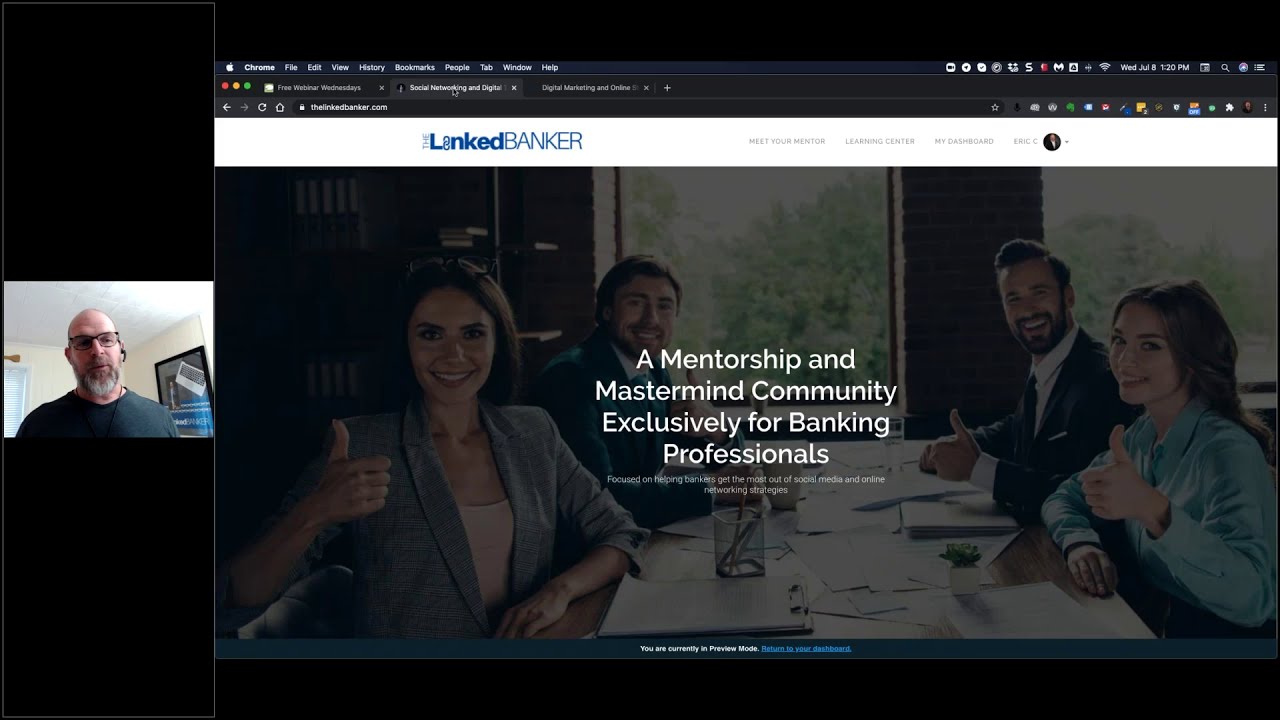
Eric (The Linked Banker) shows how digital agencies can own a niche by focusing on one sector, like banking. He rebranded on LinkedIn, used job-change notifications to reconnect with his network, and built community through private groups and mentorship. Vertical focus makes your value proposition clearer and helps you charge more.
Chapters
Hey everybody, Eric here, and I'd like to welcome you to this week's episode of Free Webinar Wednesday. Today is Wednesday, July 8th, 2020, and I am joining you from beautiful Houghton Lake, Michigan, where I've been pretty much hunkered down since the whole COVID thing hit. Although being at our cottage up in northern Michigan on the lake really isn't that bad of a deal, so I'm not complaining. But, um, still looking for an opportunity to get out and about in the real world and get back on the conference scene. But most of what we're doing these days is digital and remote and virtual, so we're going to continue to do that. Um, today's show, I wanted to chat a little bit about the concept of verticalization. I don't know if that's a word that exists in the English language, but I'm going to create one. And tomorrow, for my friends within the WSI ecosystem, I'm actually going to be featured on an Ask the Experts internal webinar where we get together as consultants and talk about different things. And so I'm the expert that corporate has invited for this month. And so during that webinar, I'm gonna really share my journey post-banking in the WSI world as a digital marketer and an agency owner and talk a little bit about our evolution and how really within the last year, although we've always had some sense of focus on the banking vertical, we did occasionally chase an account that might have been outside of the world of banking. And while oftentimes they would work out okay, in most instances when I go back and I look at the projects that I'm probably not exactly the proudest of or didn't go as smoothly as I would have liked to have hoped, in almost every single instance it's when we've done a project that has actually gone outside of our comfort zone And didn't listen to my guts and resist the urge of saying no and sticking to what we know best. And so, so one of the things that's been evident over the last couple of days that I just wanted to share with you, my Free Webinar Wednesdays audience, is some of the reaction that I've gotten recently within LinkedIn and certainly You know, playing off the conversation I had last week with Scott Augenbaum, the former FBI agent, and certainly he's got a nice vertical that he's developed as it relates to cybersecurity and cybersecurity from a common sense approach. Just like the webinar says, he doesn't get into technology, doesn't get into tools, he doesn't get into apps. It's all about common sense. Use your brain. Think before you click. Think before you act. And that's really his narrow focus. Now he's taking almost, oh, I think it's close to 30 years maybe, um, of FBI special agent training and knowledge and experience to build that. But his niche certainly is very focused in that, and, and so that's what he's writing on, that's what he's educating people about, and it's been very successful for him. So what I wanted to do is just, um, kind of share with you, because I know not everybody that joins Free Webinar Wednesdays is a banker, but you all certainly have experience and likely interact with customers unless you're, you know, just independently wealthy and you've got nothing better to do on a Wednesday afternoon than listen to me rant on a Free Webinar Wednesday, which I don't think is the case. But if you are interested in looking at different ways that maybe you can help your business be a little bit more successful, I just wanted to share some of the observations that I've had over the last year as we ramped up some things within our WSI agency. And maybe there would be ways for you to be able to take some of those experiences back into your own organization and help you get a little bit more focused on really identifying the people that you feel that you can serve the best. And so with that, I'm just gonna do a quick check and take a look Attendees. So during today's show, I kind of got out of order here a little bit, but if you have a question or a comment, if you'd like to use the chat, obviously if you are attending live, you can do that. If you're watching the replay, that's not an option, but you can join us live the next Wednesday that rolls around at 1 o'clock Eastern time. But if you've got a question or a comment or something that I've said might hit home or You think I'm full of crap and you want to challenge me on something, that's totally fine too. Feel free to use your chat and let me know. I love being part of a live event like this because it does give me the ability to interact with the audience and kind of get some of your thoughts on what it is that I'm sharing. But if we take a look at just what's happened in my life over the last, probably the last— Mm-hmm. Couple of days, but leading up to that, um, I made a, a more formal announcement and we've been kind of trickling things out. You can kind of see over my shoulder here, I've got this poster for The Linked Banker. Uh, you may have heard me talk about The Linked Banker before on a prior Free Webinar Wednesdays when I was getting ready to release it, but I'm really excited. Um, and I went out to LinkedIn, um, this week and I made a formal change to my LinkedIn profile. I made sure that send updates to my network was activated. We have a Linked Banker Facebook or LinkedIn page, so it was out there as a legitimate quote unquote job or employer or company. And so what I did on Monday is I went out and worked with a few people on kind of tweaking the description and what it is that I'm specifically doing with the Linked Banker. But I went in and I actually added that as a new job. Now, I didn't discontinue, and I'm still very much doing the WSI digital marketing thing and a lot of other stuff too. But I went in and I added the LinkedIn banker as a formal new position on my LinkedIn profile. And when I did that, I made sure that the send notifications to my network was enabled. And the reason for that was I wanted everybody that I was connected to To get a notification that says Eric has a new job, which would pique their interest, which would cause them to potentially reach out. I think I've got close to 80 comments on the notification. I've gotten at least that many, if not twice as many, direct messages from people that have said, "Hey, congratulations! Tell me about this program." And what it really is focused on is our niche as a digital agency. We really, at the beginning of this year, made a strategic decision to double down and to make sure that whatever we do is really focused. And it's very apparent if somebody visits our website, they read our blog posts, if they see anything that we're posting on social media, that it's very apparent that our focus is really in the banking space. That's what I did for 15 years. That's where we've had our most success. And above all else, quite honestly, that's where we can provide the most value because we know banking really, really well and we know digital marketing really, really well. So being able to tie those 2 things together is a rather unique position that we're in, and it's one that we are very much interested in capitalizing on. So if we take a look at, you know, just our WSI site, we used to talk about, you know, digital marketing services, And we help small businesses and organizations. And a lot of that was well and good until we made the decision that no, we really need to focus and tell our story as it relates to banks. Now, it doesn't mean that someone that comes along might still decide that they're interested in hiring us or engaging with us. And it certainly doesn't mean that any of the clients that we have today that we're serving that aren't banks are going to be you know, pushed aside. That's certainly not the case. But as we look at where our focus is going to be spent moving forward, developing that niche, or as I might have to say in my webinars tomorrow, my webinar tomorrow, since it's going to be hosted with my friends out of Canada, I might have to get used to saying the word niche or just say vertical market, and then I don't have to worry about pronouncing either one of them incorrectly. But being able to really focus on a vertical and ensuring that those that are in that vertical have a clear understanding that I'm talking right directly to them. I did a couple of webinars last week for some credit unions and some banks, and that webinar was all about digital marketing strategies for 2020 and what's working. And one of the things that was part of that webinar was understanding your target audience and who it is that you want to serve. And some people call it, uh, a persona, some people call it an avatar, but whatever that case is in your business, you have an ideal customer or maybe a segment of customers that you want to go after. And it's your job to really get inside of that potential customer or current customer's head What makes them tick? Why did they choose you? What are their pain points? What keeps them up at night? What do they wanna learn about your products and services? What are the things that they maybe wanna avoid? When we talk to banks about doing that for their customers, for example, we talk about a bank might want to attract first-time homebuyers, somebody that's interested in buying a house for the first time. And one of the things that I can tell you Because I lived it as a banker. My dad lived it as a banker for 33 years. I didn't do it as long as he did, but one of the things that was very intimidating before the internet existed is people didn't want to come into a bank. They didn't want to sit in front of a loan officer or a bank manager and feel stupid or feel like they're being made to feel stupid and asking questions. So that's one of the things that When you think about building your persona or your avatar of who you really want to focus on, is think about what they don't want almost as much as what they do want. So, put their mind at ease. Hey, there's no question that you are thinking about that somebody else hasn't asked. There's no such thing as a dumb question. You've never done this before. Buying a house is a very complicated process. There's a lot of steps involved. And whether you're getting the opportunity to talk to that individual or that couple directly, or that's information that you're building that's part of a blog or a video series or some other means of electronic communication where they're able to actually read that or hear that or see that without you having to be physically present or be part of the conversation, those are things that you want to just set their mind at ease. So we went through the whole process of making sure that our website and our digital presence did a better job of really explaining what it is that we want to accomplish as an agency and who it is that we really want to serve. So you can see bringing your bank into the 21st century, digital strategy that's right for your bank. So really kind of telling that story, our testimonials, our banks reinforcing that. for other banks that might be visiting. And so again, without really knowing what industry you're in or what customer base you particularly serve, you can hopefully take some lessons out of this and use that in your own, where, you know, being all things to all people, I guess, in some ways might be a business plan for some businesses because maybe you're large enough To really serve all types of people, but even in some larger organizations, you know, even like, and maybe the airlines is a bad example because they're not really doing a whole lot of air travel these days. But if you think about different airlines, you've got airlines like Delta, which I fly on or did fly on before the whole world decided to stop moving. But I fly on Delta mostly, and the Delta experience is much different than a Spirit Airlines or a Southwest or a JetBlue. Because they've got their own customer segment that they target, whether it's, you know, the Spirit Airlines is the deep discount, the Allegiant Air deep discount, but they only serve, you know, unique or specifically targeted cities. You know, you get to Florida or you get to Vegas, but you're not going to get flights all over the place like you are with the Delta. So even some of the really, really large businesses out there oftentimes will develop a little bit of a niche and go after those customers and serve them really well. If you're looking for a first-class ticket in luxury, or you want to be able to do some business work while you're traveling coast to coast, Spirit Airlines is probably not the airlines that you're going to pick for that trip. But if you're looking for just a quick, hey, I need to get to Florida really fast, and I'm not going to take any bags with me. That might be a more economical choice. So there's always going to be options, but it's just really going to boil down to what sort of a message do you want to convey through your marketing and your online materials and the way that you communicate what sort of value you bring. So as part of that continuation of the banking industry and our interest in serving bankers and making them better at doing what they need to be doing from a digital, from an online, from a web, from an advertising perspective. We made the announcement, and this is where I'm alluding to the LinkedIn update, is formally added the Linked Banker to my profile. And so all of the individuals that I'm connected with now had an opportunity to see that. The notifications got pushed out. And I'll be honest with you, I mean, I'm a big fan of LinkedIn, but I didn't expect that the results or the impact of being able to push those notifications out was going to be as powerful as what it was. And I was pretty excited about it, quite honestly, because it sparked conversations with individuals that I had met at conferences or events or banking schools, and we've connected on LinkedIn and maybe exchanged a couple of messages early on. Hey, thanks for connecting. Great session, blah blah blah. But then really hadn't talked to them in maybe a year or two years or longer. And now linked banker shows up. Eric has a new job. Hmm. Wonder what that's all about. They see the word banker in the title, and they reach out. So I've really enjoyed. It's it's been. I don't want to say distracting because there's a lot of other work that I also needed to get done. But being able to dive in and have those conversations with people. Through LinkedIn and to be able to generate some dialogue. And I am not a fan. Um, I know that people will use automation or other sorts of services that will automatically respond to people or send notifications out or some way of generating some sort of a touchpoint when there's an activity that's taking place. Um, I'm not a fan of those. I think those put your LinkedIn Um, presence or your LinkedIn profile at jeopardy because LinkedIn isn't a fan of automation and it creates more work. And yeah, it would have been nice just to set up a platform and allow it to respond to all of those. Hey, thanks, I appreciate it. I hope you're doing well too, something along those lines. But the genuineness that comes out of those really doesn't hold a candle to the genuineness if you are actually doing it As an individual, as a person, as the the owner of the LinkedIn account, you need to be a part of that. And if you're not prepared to be a part of that, then you know you you probably need to second guess why you're participating in social networking because it's about being social and networking with other individuals. And in my opinion, an automated platform is not going to be able to do that for you. So. Those conversations have been really great, and what they've done for me— again, the banking vertical, the banking niche, focus on that industry. I sent the notification out, it generated, guess what, a lot of conversations with bankers. Now, I had other connections that were part of nonprofits, or people that I knew in banking that left and went someplace else into manufacturing or healthcare or whatever, and they reached out and said congratulations. And a lot of that, I suspect, was some of the automation capabilities that LinkedIn provides natively, where it says Eric has got a new job, send him a congratulations, and then you've got 3 buttons that you can pick where it says congratulations or kudos. Uh, and so some of those came through, and I get that. I mean, at some point, some of the automation that LinkedIn provides is probably okay, although I still resist using that whenever I can. But what it did do is the people that were in banking, those are the ones that I tried to reengage with some conversation. So if I got a note from someone that I knew that's in the healthcare or nonprofit space and they were congratulating me, I might have thrown back, hey, thanks, I appreciate it. Hope you had a great 4th of July holiday, or hope you and the family are good. But that was the extent of it. If a banker or someone in a banking association or somebody that, you know, would be relevant to what I'm doing over at The Linked Banker— I'm interested in building a community of bankers to help them be better at digital and social technologies and to make them understand and appreciate how they can build relationships electronically, online, through sites like LinkedIn and Facebook and Instagram to establish subject matter expertise and to be seen as the go-to expert in their industry. So if it's somebody that I think could be impacted and might be a good fit for the Linked Banker, what I did is I would respond back and I'd maybe toss in the website address and say I'm really excited and give them some ideas of what I'm planning on being to bankers that join the program is, is being a mentor and being a coach and educator and sharing ideas, having some stories where I'll go to a conference and I'll present and I'll have people that'll come up and say, you know, this is great, but if I go back to my bank, we're not really doing this, and how do I stay engaged? And sometimes it'll involve a few emails back and forth and I'll have some conversation, but by and large, They get back to their bank, they get roped back into their workday, and it's very difficult for them to stay motivated to embrace what I've been talking about for a number of years because they might just be there all by themselves. And so this is really going to give them a community to be able to be a part of something and have others help them be accountable and, and do what they feel like they really should be doing. And now they'll have a support structure. So if it's somebody that I think could enjoy that and be part of it and get value out of it, then I started a dialogue and it generated a couple conversations with some bank CEOs, which is great because let's face it, if I can get a CEO for a bank excited about what I'm doing and see the value in bringing people together to help learn these tools and the CEO's doing it, most of the time if there's going to be any sort of a culture shift within an organization I mean, let's face it, it has to come from the top down. So if I can get the CEO excited, if you can get the top-level individual at whatever your target audience is excited about what you do and what you're offering, then that's going to trickle down through the organization and it's going to give them a greater sense of the value that you bring to the table as a business owner, as a consultant, as a salesperson, whatever role you're serving for your business or for yourself. You're self-employed. But then the hope there is maybe that CEO might realize that this is something that my branch staff needs to be involved in. Maybe this is something that my commercial lenders or my mortgage team or my marketing director might be involved in. And now instead of just getting the CEO to join my LinkBanker community, I get the CEO to come on board, I get a couple of loan officers to come on board, I get their marketing person to come on board, So now instead of one individual, I've got 4 or 5 individuals coming into the fold. They're getting value or they're bringing ideas back to their organization and they're learning from other bankers around the country. So building this ecosystem is one that I think I'm hopeful and confident that this is going to be a good move for us in a lot of different ways. Now, does that mean that you need to go out and license a platform like Thinkific, which is what we're building The Linked Banker on, and develop courses? And no, it doesn't. What I've seen some organizations do, and certainly there's a lot of articles out there, and even Facebook at their most recent F8 event, which was last year, talked about the value that they want to try to get their members, their Facebook users, to do through things like Facebook groups and one-on-one chats and private meeting rooms. You could take a subset of your audience, the people that you want to serve, and you could just create a private Facebook group. You could create a restricted access LinkedIn group and you could invite people to that and you could say, hey, we're gonna have some dialogue, we're gonna talk about X, Y, or Z, whatever topics you provide, whatever services you offer, whatever expertise you can bring to the table, bring people in and allow them an opportunity to have conversations, learn from one another. Now granted, if there's competitors that are in the room at the same time, then that might get a little weird. So you're going to need to be careful of that and just building a community doesn't automatically mean that people are going to show up and start contributing. You know, the, the Kevin Costner movie Field of Dreams, if you build it, they will come, that, that doesn't happen anymore online. I mean, not that it probably ever did, but just building a community, creating a Facebook group, launching a site like The Linked Banker doesn't mean that people are going to automatically flock to it and participate and engage. We've got in the Linked Banker for members that subscribe, we've got a forum where you can post ideas and thoughts. We're creating a private, or we have created a private group in the app Telegram, which is a private messaging platform that, uh, that I've come to know through some of the other groups that I belong to, where they use that as a sounding board in a real-time kind of a— they call it an asynchronous communication stream where people can jump in and they can ask questions, but people just aren't going to automatically start using those platforms unless there's some sort of a cheerleader or a rah-rah person or a moderator that's out there tossing out questions, giving people ideas, doing other sorts of things. So as you think about maybe building your own vertical tribe and creating this ecosystem of people that you would like to serve, deeply and intimately. One of the other things that we're doing is when people come on board as part of the Linked Banker, we've developed a survey and we're asking the new members to complete the survey to let us know what is it that you're challenged with, what are the things that you would like to know, what are the technologies that you're struggling with, is it the compliance department in your bank that's resisting this, is it You don't feel like you have enough time. You don't understand the different platforms. You don't think that the world's going to care what you have to say. There's a lot of reasons why people probably don't embrace more of a digital focus or a digital strategy. And so that's one of the things that we're doing very early on in the process is making sure that as people join, we immediately give them an opportunity to tell us, okay, you've joined. What are the struggles that you're having? Where is it that you need help? And that's what we're going to be delivering through the Linked Banker. That's what you need to deliver through your group. That's what you need to publish on your blog. That's what you need to distribute through your email newsletters. You need to answer those questions and take away those concerns, those challenges, those fears for your audience, and to be able to be that go-to person or that go-to organization that's there that's answering those questions and making it better for them. So hopefully that makes sense for you. Again, it would be, it would be awesome if I could see your faces and actually kind of have some dialogue as to, you know, what verticals you think you might be able to serve, what industries do you feel like there may be opportunities for you to go after. If you'd like to throw anything into the chat, I'd certainly love to get some feedback from you just to see what you think. Let me just do a quick little check and see if there's anything that might be coming through. So doesn't look like anything yet, but that's okay. No problem. So, yeah, I mean, at the end of the day, I think Figuring out where you're best positioned based off of your experience and the products and the services. And I think above all else, the passion that you have that gets you out of bed. I mean, it seems kind of weird that, you know, my passion is serving bankers. I mean, it seems kind of hokey, and the banking industry can be seen as somewhat stodgy and conservative. But things are being shaken up all the time. And especially, you know, not that I want to say COVID has been a good thing by any stretch of the imagination. So do not quote me on that. But the thing that this pandemic shift has caused all businesses to do is to rethink how they're serving their customer and what the customer actually is like now versus what they were in 2019. I want to make sure I get the title of this right, so I'm just going to take a quick peek here. But I'm— I was just recently confirmed for a virtual annual convention for one of the state banking associations here in the Midwest and came up with the idea of a completely new presentation. And the title— you have to let me know what you think about this— Not that I can change it because it's already gone to print, but I'm hoping that you like it. But the title is The Genie's Out of the Bottle: Marketing to the New Consumer in a Post-Pandemic World. And the gist behind that, again, for my banking audience, is to really talk about the fact that first off, in all different industries, people are shifting how they're actually behaving with the businesses that they used to behave with differently. So grocery stores, restaurants, um, you know, the list can go on and on and on about how you're interacting with them now versus not. I mean, my in-laws are placing orders at the Super Walmart and driving their vehicle, and groceries are being loaded in the back of their pickup truck, and then they're coming home and putting the groceries away. And they're never going in, they're ordering it online, and, and they're probably one of the last individuals that I would ever have expected to order groceries online, but they've been doing that. And had it not been for this shift and this COVID and the pandemic, I don't think they ever would have even explored, even though Walmart and other grocery stores and convenience locations, the Targets and whatnot, have always had this service available, people just haven't used it. And I think the stigma was, oh, you use that if you're lazy, you know, go to the grocery store, get out, you know, you can, there's no need for that, or ordering online is clunky, or you got to put your credit card in online, that's, you know, oh, there's security issues, which there are not, by the way. But you're seeing all sorts of industries shift, and as consumers are getting more comfortable with that digital shift and doing more online, it's obviously impacting other industries as well. And so if I can do all this other stuff at all these other industries, then I'm going to have that expectation that I can do that with my financial institution. So in that discussion, we're going to really talk about how that has shifted. And with the genie being out of the bottle, you're not going to stuff him or her or it, whatever, whatever gender you want to assign to the genie, but you're not going to stuff them back in the bottle. They're out. And the customer knows now that there's a lot of other convenient ways to do business. And so just looking at our vertical, looking at our customer base, looking at our industry that we want to serve, we're understanding that and learning it and familiarizing ourselves very deeply with how that's impacted our customers and how they're serving. But you need to be doing that exact same thing in your world for your industry and for your customer base so that you can take that and carry it across. And so another little message that maybe you can take some value out of. So, um, that's pretty much it for today's show. I just really wanted to share a little story and kind of give some advice and I've been talking about serving a vertical market within the WSI world for a number of years. I think one of the first opportunities I had to speak at one of our global conventions very early on in my career with WSI, maybe I started there in 2007, so maybe 2009-ish, I talked about developing a vertical strategy because I had started doing Some projects for banks. They appreciated the fact that I understood their terminology: Reg Z, Truth in Savings, EFTs, privacy statements, Gramm-Leach-Bliley—all that terminology stuff that goes on in the banking world. I lived it for 15 years, so they appreciated that. So this vertical market focus has been a drum I've been beating. For a number of years, but I don't think it's just for a digital marketer's perspective. I think any business can really capitalize on a vertical and make sure that you're serving your best customer and being able to put your expertise. And over time, I think you're going to find that serving that vertical is maybe going to get a little bit easier. It's going to get a little bit more efficient because some of the learnings that you bring out of one project or serving one customer Some of that will carry over to others because the industry is gonna have similarities. Obviously, every customer is unique and somewhat different, but there are a lot of similarities that carry across customers in the same vertical that the more you know, the more efficient you can be, the more profitable you can be. So I'm just gonna see that there's a little bubble there, and I wanna see if there was a question, and I thought there was, but there's not. So, okay. So anyway, with that thought in the back of your mind, or maybe in the forefront of your mind right now, in the last half an hour-ish or so that you maybe had set aside for Free Webinar Wednesdays, I would challenge you to not go right back to work. Take 20 minutes, grab a pen and paper, fire up a Google Doc or whatever. Capture mode you have and jot down a few of the verticals that you think you could serve and you could do a really good job of adding value to based off of your experience, based off of the customers that you've already taken care of in that vertical, based off of your passion, based off of how your product or service is really set up to provide it above and beyond value to those verticals and, and think about that. And, um, if you need some help or you're looking for somebody to bounce some ideas off of, certainly welcome, uh, any thoughts or comments. Uh, feel free to reach out to me. Probably the best email, even though you can get to me at eric@thelinkedbanker.com now, um, most people pretty much know me as eric@poweredbywsi.com. But you can reach out to me in email, shoot me a note, let me know what you're thinking, and would love to just see whether any sort of vertical idea inspires you to be able to deploy a strategy out to the rest of the world that focuses on an industry or a particular area that you're very passionate about. So with that, thanks everybody for joining me on today's show. I look forward to seeing you on future episodes of Free Webinar Wednesdays. But until then, focus on that vertical market and reach out. Let me know if you've made a decision or who you're gonna go after and who it is that you feel that you are best suited to serve in your business world. So, have a great week and we will see you online. Take care, everybody. Bye. Bye.







