
Episode 12: Leading by Example - How Two Social CEO's Make it Happen at Their Banks
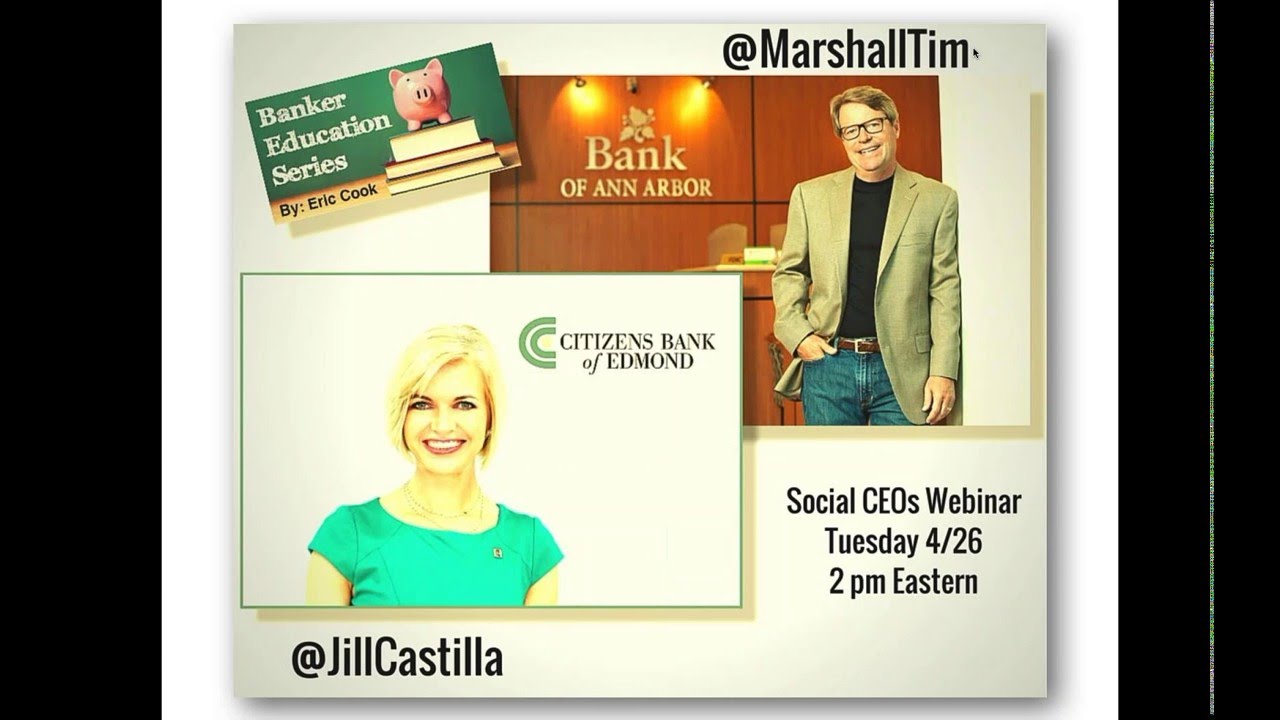
Tim Marshall at Bank of Ann Arbor and Jill Castilla at Citizens Bank of Edmond built social media strategies that work. Marshall uses Facebook and Twitter for community events like Sonic Lunch and sports sponsorships. Castilla turned her bank around after 2009 regulatory trouble by embracing SEO and Twitter, attracting $40 million in new loans and deposits.
Chapters
Greetings everyone. I'd like to welcome you to episode number 12 of the Banker Education Series webinar show. This is Eric Cook and I'm with WSI. We do digital marketing and social strategy and all sorts of fun stuff that you can do online. I am a recovering banker of 15 years and have been doing this since 2007. And One of the great parts about my job is I get to meet really cool and interesting people like the 2 guests that we're going to have on the show today. And we're going to share with the audience different strategies that a couple of very social CEOs are making it happen at their banks, leading from the top down and not being afraid of this big, bad social media monster that I know we need to be concerned about when it comes to compliance and regulation and privacy and reputation management. But Jill, And Tim are going to share their stories and I think provide everybody that is listening live, and if you're catching this as a recording, some excellent insight on how you and your bank really need to make social part of your organizational structure, part of your strategic plan. And you'll hear directly from 2 very busy CEOs that they find time to make it happen. This has become part of kind of their DNA and their personality, and it has reaped rewards. For the both of them. So before we officially turn it over and get them started, I want to point out a couple of things. If you're joining us because you happen to catch, oh, I don't know, maybe a tweet, one of the many that have been going around the internet, or an update on LinkedIn or Facebook, if you'd like to be on the list for future Banker Education Series webinars, you can go ahead and click on the sign up for email reminders link right there. That'll get you go ahead and added to our list. And then when episode 13 and beyond are released, you'll be sure to know what's going on. While you're at the Banker Education Series page, you can certainly browse some of the other sessions that we've had. All of our sessions are recorded and made available, so if you'd like to share today's session or maybe check some of the other ones that we've done out and share those with staff or friends or coworkers, feel free to go ahead and do so. In the control panel, which is located to the right of your screen most likely, you'll notice that there's a section in there called Handouts. We've made both Jill and Tim's bio available for you to download as a PDF, so if If you'd like to go ahead and snag those, you can do that as well. And lastly, we do love, and I suspect we'll have questions and interaction during today's session. So also in your control panel, you'll notice that there's a question or a chat area. If you would like to go ahead and type your question or comment into that area, I'll go ahead and keep an eye on that during today's session. And when there's a break in the action, we'll go ahead and we'll ask your question for you. We're gonna start off kind of with some background. We've got some slides we're gonna show, and then I think the rest of today's time together will basically just be Q&A, lessons learned, observations, kind of freeform everything to give us some really good info. So with that, it is my supreme pleasure, and I'm gonna go ahead and throw it into presentation mode here, to welcome Tim Marshall from Bank of Ann Arbor and Jill Castille from Citizens Bank of Edmond. They are both on the line with me today and going to be sharing their insight as social CEOs. So guys, quick— I guess I should have done quick sound check when we went live, but I'm assuming you're here and listening to all this. And welcome to the show.
Great to be here.
Yeah, great to be here. Thanks, Eric.
Excellent. So this kind of feels a little bit like— I don't want to say old home. I know the two of you get to hang out at conferences and events way more than I get to hang out with the both of you, but it was a real pleasure Seeing the both of you. And as I think back, I really wish we would've gotten a picture of the 3 of us that I could have used for today's show. But at the Bank Social event a couple of weeks ago in New Jersey, but you guys were on a CEO panel and shared some incredible insight that I've got lots of questions from the audience that were there that we'll weave in today's presentation. But I'm really excited and I know I've been reached by a lot of bankers that are signing up for today and they're really excited. To hear what you've got to say, because I think that's the fallacy with a lot of banks is, you know, social media is hard and it's scary and it's dangerous and CEOs don't know how to do it because they're typically older and they're not engaged in social media. And so, the two of you, I think, are breaking the mold, which is really cool. So, we're going to go ahead and I've got a couple of slide decks from the both of the presenters today just to kind of walk through and help them kind of frame their story a little bit. And we'll start with Tim, and then we'll finish with Jill. And then once we kind of do that, we'll keep an eye on the questions if there's anything that you'd like, or we'll just have some dialogue. So Tim, let's go ahead. We'll kind of walk through yours, and we've got some photo collages here that we can share. So if you'd like to maybe start with your story, that would be great.
I'd be happy to, Eric, and thanks again for inviting me to participate. You know, I think as I think about social media and Bank of Ann Arbor, one word comes to mind, and that's it's a differentiator. And being involved in and with your community really helps to build a difference with our bank and and the other, what I commonly refer to as other non-local banks. How do we do it? I think it's an integration process. What some of these slides show is utilizing social media to support organizations by promoting their events on our social media platforms, by having our employees who attend events, you know, take photos, tag BOAA, make some noise at the events. And then, you know, just integrating, you know, both an organization, event, or employee, you know, is a big reason we use social media. Some of these pictures here are just examples of where we might have been participating in an event. On this first page, we've got—
Mm-hmm.
The local soccer team. We've got a morning DJ that does a fall coffee shop tour every year that we participate in. We speak at various events. And if you go to the next slide, Eric. There we go. An example, we acquired a VW bus that we also take around the community. We take it to University of Michigan football games. We take it to events. We host a summer concert series. that we branded Sonic Lunch, which you can find very active on social media. We support 3 different platforms, and I'll show you that on a future slide. But anything that we're doing— the middle slide with the ladies holding up the fingers, that's at a local high school that we sponsor one of their fall football games every year. And then our Sonic Lunch series is down at the bottom of that page. I think that was Joshua Davis, who was a finalist last year on The Voice, and he's from Traverse City, Michigan. So we had him come, and I think he played actually the second Thursday of our series last summer. If you go to the bottom right, for any of those people that are watching The Voice, you'll see Leith Al-Sadi there with the beard and the long hair. And we are the only organization that has been able to book Laith through NBC to play in our concert series, and he's going to also play the 2nd Thursday in June. And so we're hopeful that he continues to proceed. He's now in the final 11. So if you haven't voted for Laith today, you can vote for Laith on The Voice via Facebook. I know he would appreciate it. But it's just an example of we've created events. The middle picture there with the words on the back was our United Way campaign, and it was all #BOAA driven. And so we really, we really embrace the community, and we try to integrate all of those factors in the community. If you go to the next one, I think I've got maybe one more or two more. This is an example of coordinating multiple media sources, but again, we were very engaged when Jim Harbaugh was hired as the new men's football coach at the university. A year ago January, and you can see some of the media coverage that we got, and it was all driven nationally through social media, Twitter, Facebook, and we had a whole series of billboards that we put all over town, but then we used social media to drive the message. If you go to the next one. This one is an example of one of our posts that went viral. As I tell my people, this will just happen. You can't try to make it happen. Some people get too caught up in trying to get fancy to create some sort of viral post. My philosophy is you just post and you make it natural and you make it who you are. If it happens to go viral as this one did, then it does. As Jill and I talked at the last conference, We came back this year and tried to create something that I just couldn't get my arms around because it really didn't give the impression as to who it is that we are and the integrity and the ethics and the honesty that surrounds all of our campaigns. But this was— this took on a life of its own, and it was really exciting to be part of the Bank of Ann Arbor on Monday morning, October 13th, when we declared that Bank of Ann Arbor would be open because— or would be closed because Columbus was in Ohio. And if you go to the next one, that's my last slide, Eric, and I'll turn it over to Jill. These are the examples of the brands that we support, that we integrate very closely together. I would welcome you to visit any one of the 3. We started with Bank of Ann Arbor, have grown it nicely. Then came back with Sonic Lunch when we created our summer concert series, and we put a lot of social media behind that. And then our equipment finance company, we rebranded as Unify, and you can see the combination of likes and follows. We're approaching 45,000 likes and follows, and over the past, I believe it's 13 months, we've created over 55 million impressions of Bank of Ann Arbor Sonic Lunch and UniFi. So you can see the power of social media and, you know, the ability to get your— whatever message it is that you want to get out. So that's a little bit of the background on ours, a little bit of the success that we've had. And I always enjoy listening to Jill's input. So Jill, why don't you take it from here?
Thanks, Tim. Tim and Bank of Ann Arbor have been such a great inspiration to us. I love hearing Tim present and watching what they do. They have such great authenticity and then also a sense of humor. It's profound, the impact it's had for them locally, but I think also on our industry, and it certainly has given us a roadmap to follow at our bank in Edmond. So I'm Jill Castilla, I'm the President and CEO of $250 million Citizens Bank of Edmond. Edmond is an affluent suburb of the Oklahoma City metro. Our bank is 115 years old, we started in 1901 basically with Whenever Edmond started, we were really the lone remaining community— locally owned community bank in our town. Edmond is about 100,000 population, and there's about 50 financial institutions around us. We only have really one location left in downtown Edmond. So our customers have to drive past all these other banks and make it into a pretty contentious parking situation in downtown Edmond to bank with us. And we also have a really low cost of funds, so they also have to be willing to not be paid anything for their deposits and may pay a little bit higher rate on loans to bank with us. So it's not probably the best situation from a marketing standpoint to say, this is the bank that you should bank at. So we try to use social media as a way to really expand beyond our physical representation in Edmond so that we can really connect with our community, connect with our customers, and and connect with small businesses surrounding us, but also connecting with our industry and peers and with people like Tim so that we can become even more innovative and really expand our perspective even further. Our ownership structure in our bank is also a little bit unique. We've been owned by the same family— a third of our bank is owned by the same family for 4 generations, and then a third of our bank is owned through an ESOP by employees. And then a third is owned by about 60 shareholders that have typically had our stock for generations and live around the Oklahoma City metro area. I came back into the bank in 2009 when the bank was in trouble. My stepdad is part of the ownership of Citizens Bank. He's the third generation of ownership, and he had just underwent an examination that was pretty excruciating. And was concerned that they were going to lose the bank. He called me. I was at a bank in northern Minnesota and said that he really, really was concerned that capital was at a point that they would not be able to recover and that they were unsure about what future losses would be in the loan portfolio. So he asked me to come back. I did in 2009 and found the bank even in far worse condition than what the examiners had found. We were rated as low as you possibly could be from a banking standpoint. Whenever you looked on online rating agencies and the regulators themselves, we were a troubled bank and had a lot of problems right from the beginning. As a result, we had a lot of management turnover and some very high-profile articles written, not only just in our local paper, but in the statewide paper and other business publications. Oklahoma at this time had a really strong economy, so the bank Our bank wasn't suffering because of the financial crisis. It was because of some self-imposed issues that we had. And there were just a handful of troubled banks in the state of Oklahoma, so there was a lot of publicity and focus on us. And we really were the only bank in the metropolitan area that was having difficulties. Everyone else was really thriving and doing well, and we were getting some of this negative attention.
Mm-hmm.
Orchestrating the fastest turnaround in the nation without adding capital. And that started in 2009, and we were released from a written agreement in March 2012. I happened to be sitting in a social media session, and we were talking about search engine optimization. They talked about how Twitter could really change your engagement on Twitter, and Google+ could optimize some of your search engine results and perhaps even help you change a story from being a negative connotation, you know, because of historical stories that have been published, to maybe increase the awareness of your current story. And so that really spoke to me and gave me hope. That same day, while I'm sitting in that session, I get a call from our state banking commissioner saying that we're released from the written agreement. So I joined Twitter in March of 2012 on the same exact day we were released from our written agreement. And just a little bit about me. I kind of hijacked my family's legacy and claim to be the 4th generation community banker. It's really my stepdad's family. I didn't grow up in a bank, but really just think that legacy is precious and love being a part of it. And I think just some of my background lends to some scrappiness. I joined the military in the Army. as a young person to pay for college and have had the opportunity to do lots of things as a result of just kind of jumping off on opportunities and taking some risks that maybe not have been typical in the leadership of our bank. From the social and the search engine optimization, and now when you search for Citizens Bank of Edmond, because we've been so engaged on social media, and you see current stories and stories that have gotten the most And now Citizens Bank is talked about being a model community bank whenever you do a Google search. It used to be when you searched for Bank Oklahoma or Bank Edmond, you would see negative stories about our institution. Now you just see really positive stories. Whenever we have earned media that happens about our bank, we promote that on social media, which then drives visits to those sites, which then drives media to write more stories about you. Becomes a self-feeding kind of machine as a result of having social to promote. You can see the amount of activity that we have and the followership. Our YouTube videos that we have done get tens of thousands of followers, and even instructional videos have 1,000, 2,000, 3,000 followers that we get from those in just a relatively short period of time. I would say too, those videos have been instrumental in really facilitating a culture change within our bank. We've had the turnaround, which we're trying to get everyone on a baseline from an ethical standpoint and from a process and procedure, become black and white, doing the right things, not doing the wrong things. And then now trying to transition into a culture where we keep hold of that, but also are innovative and Mm-hmm. Creative and positive in how we engage in our community. Our social media involvement has really helped facilitate some of that improvement. And now you'll frequently see too our team members posting on their own social media about what's happening at the bank and what's happening at Social Thinkin' Event. We encourage and don't restrict social media engagement even during the workday. So we know that our team members are going to be on their phones, but we restrict Facebook and Twitter usage, so we just go ahead and allow them that access via the bank PCs. We really try to engage and lift others up via social media. Our framework as far as if a post is appropriate or not is that we follow this acronym GAP that one of my good friends that's very prolific in social media utilizes as well, and that's to be genuine, to be accurate and to be positive. And if it doesn't hit all 3 of those things, we don't post on social media. You know, it's just a good thing to follow in life to be those 3 things as well. So it then spills over into more of the culture of our bank. And one of the things I think that we do exceptionally well in kind of contributing to that is we started Cash Mobs about 2 and a half years ago where I give Our team members money to go to a specific store on a specific day, and they— we coordinate with the store ahead of time and give our team certificates in order to participate in the cash mob. And all that the team members are required to do is either take a picture with what they bought wearing their Citizen shirt, or take a picture with the store owner and posting it on social media or sending it back to us so that we can post it on the Thanks social media. And that's really again kind of increased this sense of pride with our team because they are now posting about where they work on their personal pages. And because we also promote so much utilizing social media, there is a lot of peer accountability to ensure that we are making appropriate posts and that we are all utilizing social media in a way that we want to reflect kind of the values of the bank. And we have a really strong social media policy that I would be happy to share with anyone. after this call. Also, the organic growth in our team members has been really astounding and something we did not plan for. We just in recent months have hired 5 individuals and have one 6th person coming on board, all of which would have required us to have some type of headhunter or recruiter involved to be able to get the caliber of individuals that we were able to recruit. And 2 of them were commercial lenders that were highly revered in my community that were not looking for a job. I just happened— one was a good friend of someone that I was friends with on Facebook. I posted that we needed a commercial lender and they were able to provide a personal referral to this individual. And we were able to make a very quick hire and a very strong hire just through using Facebook. Another I saw had visited my LinkedIn profile, and so I reached out to her. And she was not looking for a position and actually was adamant that she did not want a position, but was interested in learning more about our story because of what she had seen on social media. Of course, Ann Chin, who was with ICBA and led their social media efforts, and we had a strong relationship via social, and she moved her family to be part of our team here in Edmond. And also, we had now a Chief Retail Officer and our Chief Technology Officer, both joined our team just through Facebook and LinkedIn interactions. Our bank, in kind of the spirit of Tim's Sonic lunch, started Heard on H.E.A.R.D., which is basically a community block party. It's not really that different from a customer appreciation day or community appreciation day that we have at Habitat Bank. We consistently draw over 20,000 people to our event. We have where you buy your own food. We have freebies and food trucks. That come to the pop-up shops or small businesses that we provide space to, and then 3 local bands. Many have been on The Voice, American Idol, featured around the country, but they're all local bands from the Oklahoma City metro area and sometimes throughout Oklahoma. And we use this as an opportunity to really thank our customers for supporting local and that local music, local food, local shopping, and local banking all go together, that we're here to really lift up the community. It's been astounding how much earned media that that has produced for us, as well as just the community goodness and community spirit that is resonating now from downtown Edmond. Citizens Bank, we sold all of our branch locations after our recovery back in 2013 and said that we were going to invest in downtown Edmond, our home where we started 115 years ago, and Heard on Hurd was part of that initiative. It started in October 2014. Really hoped to have 300 or 400 people attend. We ended up having 3,000 to 4,000 people attend that very first one. All the food trucks sold out of food within the first hour, and then it's just grown from there. We have it now every 3rd Saturday, March through October. We had our first full season last year with well over 100,000 people attending. And we utilized a study that showed that we contributed over $2.5 million to the Edmond economy just last year through Heard on Hurd, which is just a 4-hour event, one time per month, 8 times per year. Our bank went through some darkness with the turnaround, but we really have experienced a lot of light recently as a result of that. And I think telling our story via social media and engaging with others and building personal relationships And professional relationships has allowed our bank to really be highlighted in ways that we can never have anticipated. And probably the biggest surprise that we got was the Urban Land Institute, which, you know, we're, as I mentioned, in a suburb of Oklahoma City, the affluent suburbs. And, you know, so not usually the favorite for urbanites that are at the urban core. And yet we were given an Impact Award by the Urban Land Institute. Someone nominated Without us even knowing, wrote an exhaustive application for us without us even knowing, and heard on our community event was highlighted as being so impactful to the Oklahoma City metro, and that really blew us away. But all these things couldn't happen without the social engagement, and really, whenever we're engaging with social, we're not promoting interest rates or specific products, but it's all about this learning from our industry experts, experts, journalists, engaging with business leaders in our community, engaging with our customers. And it has just really been nothing but positive energy that we've gotten from the energy that we invested into it. It's also exceptionally cheap. I'm a really frugal person, and so I spend only about 15 to 20 minutes a day on social media and get huge rewards as a result of it. And heard on heard, for example, we don't We didn't provide any paid advertising to promote Heard on H.E.A.R.D., yet we were able to draw that many people into downtown Edmond in front of our bank. That's about all I have.
I could listen to you all afternoon, Jill. You're amazing.
Yeah, both of you. What do you mean that's all you have? This has been tremendous. We've got lots of questions coming in. I do want to ask one question that I don't know if I even heard the answer I know Jill shared back in March of 2012 the impetus to hop on Twitter. But Tim, what was it that kind of triggered your, I need to get on social, I need to start a Twitter account? Did you start with Facebook? What got you into social? Where did you start and how has it grown for you?
I want to say it was probably my initial start was I think '07, in that time frame. What caught my eye was I had 2 teenage sons at that point in time, and I was intrigued by the community they were building. The community that they were building was growing, it was exciting, it was fun, it was engaging. And as I watched them operate so freely in this somewhat new world of social media, it intrigued me enough to stand up in front of all of our colleagues at a morning breakfast. We host 2 morning breakfasts every year. And I at that point had spent some time on some research. And was starting to track the growth in Facebook usage. And it was remarkable. At one point it was 200 million, and then it was 350 million, and then it was 500 million. And I'm starting to see that this— what could be a fad, but it didn't appear to me that it was going to be a short-term fad. And so I stood up in front of everybody and indicated that, you know, I felt it was important that all of us started to build community and started to join in on a conversation with others on Facebook. And that was the start. People looked at me a little cross-eyed, but you've gotta start somewhere. And that's, that's part of my message to others, no matter how small You just have to start and you've got to promote. And so we started on the Facebook side, and then of course we had Sonic Lunch going, and so that was an excellent medium to promote on social media, on Facebook, with at that point pictures and announcements and schedules and etc., etc. And then Again, I started to hear about Twitter, and so in 2009 I joined Twitter and was just fascinated with it and began to promote that internally. And, you know, as I started to build community internally at the bank, we began to see people that were also equally passionate. And so it's just kind of— it's been one person at a time. When we hire somebody, if they haven't been indoctrinated into social media, we do training sessions for them. We do one-on-one training. Then we do lunch and learns. And we just try to promote the usage. And it's always interesting to me that when people come from other banks, they're amazed at what we're doing via social media. And some of the other banks, they had restrictions, they had lockdowns, so counter to how Jill and I run our businesses, which is, you know, much more freedom, Much more promotion, much more— if you want to get on social media during the day, get on it and just make sure you're providing thoughtful information. That's a long story, Eric, but I've got to give credit to my 2 teenage sons who set a heck of an example for their father. Cool.
I'm sure they're listening right now because like any teenage sons, they probably can't get enough of what their father says. Although they're probably not teenagers anymore, but that's—
No.
Yeah. So along those lines, I'm curious for the both of you, you mentioned other bankers that have come into your organization and maybe the culture that they're used to. And certainly I talk to a lot of bankers that kind of feel that way. Has your process, whether it's you as CEOs or your banks kind of openness to allowing employees to access social during working hours been vetted by the examiners? You know, has somebody from the feds looked at this? Have they looked at your policy? Are they concerned about an employee clicking on a link on Facebook and inviting a virus or a Trojan into the network? That seems to be the biggest thing that people are scared about. And then the productivity issue, I think, is one that can be squished because if you don't give people access to Facebook on the network, they'll just grab their iPhone and do it. So productivity-wise, that's still a risk. But talk a little bit about examiners, you know, and some of their thoughts on your social strategy with both of your banks.
Go ahead, Jill. You can start us off.
Okay. I'd be happy to. Yeah, we have been really working in kind of our social media policy. It's always a work in progress. And so one thing we did that I think was critical to our success as examiners is that we included our internal audit scope and our external audit scope. We included social media with that. So from the very beginning, and so we've engaged our auditors to ensure that we're mitigating risk appropriately. And we've never had a finding associated with social media, and we've never had any concerns expressed by the examiners, even though we've been engaged for some time and had multiple examinations since we started kind of really putting social media at the forefront. What, you know, I think the first question that they're asking is more from a compliance standpoint, because whenever you start using it as an advertising mechanism, There's just not enough space to give all the disclosures that you would need to. And you can also— there's always concerns about how you're handling complaints or if customers are providing sensitive information. We've never had an issue where sensitive information has been shared. We love whenever— I mean, I don't like getting complaints, but I love that our customers feel free in expressing concerns and that we're able to address them very quickly. And so, I think that that's actually a strength that we're able to convey to our auditors and examiners. But also, we do a lot of training with our team members, like Tim was saying. And really, it's on the job, real time. We really don't have a formalized program. So, everyone's really well-educated when it comes to social media and that, you know, that you have to be careful about what you're clicking on. And we do a lot of social engineering tests. So, we have a pretty disciplined group when it comes to How to utilize the internet, email, and social kind of all together and to be aware, you know, and maybe don't download or participate in games and, you know, not to answer a lot of questionnaires extensively on Facebook so that you're not sharing too much information for would-be social engineers. But I think a lot of it is just that awareness and education and having that open environment There's a lot of conversations happening, so as a result, the risk is minimized.
Cool. Tim, anything to add to that?
The only thing that I would add is just an emphasis on your social media policy or guideline. There has been guidance issued on social media media utilization by banks. And when that guidance came out, we embraced it. We created an annual board report that we take to our board of directors that provides an annual update on all of our utilization. Have we made any mistakes? What are the positives? And then just like Jill, it's just— it's a continued topic in terms of utilizing it appropriately and being careful not only with social engineering as it relates to social media, as it relates to email, as it relates to any other medium. There just has to be a high awareness, and we have a company that we've engaged that we use to do social engineering, phishing attempts, that sort of thing with all of our colleagues, and it's amazing to me. We started out a little bit slow, but once we built that awareness— The results have been terrific. Very cool.
Good. Question from the audience, um, do your banks utilize, uh, any sort of product advertising through social media? Is that anything that you do on a regular basis? And if so, does your policy reflect that, or is it more branding, feel-good, know me, like me, trust me? Maybe talk a little bit about your use of product ads.
I'll start off. I think Jill and I are very similar here, but the next product advertisement that we do on social media will be our first. We just don't believe that social media is the place for product advertising. It's about building community. It's about joining the conversation. It's about helping other organizations. It's everything about just embracing other people and not beating yourself on the back to the point that you're breaking your arm. And so the somewhat humbleness that we take throughout all of our advertising campaign Which even externally we don't advertise products. We just promote our brand. So it dovetails with social media. But no product advertising for us. How about you, Jill?
We're the same. So it's all about social media. I think it's similar like if you go to a Chamber of Commerce event or you go to Rotary, you're not going to advertise what your CD rates are there. It's about building community, about building relationships. About lifting others up. I mean, just echo everything that Tim says. I mean, that's the gospel. And I think, you know, bank products aren't that different from one another anyway. So, you know, we don't really— there's not a whole education process there, but there's so much of an opportunity using social to educate about how you're different from other banks. And you can do that in a very positive way, in an organic way where you're not having to Beat your chest, but to rather show it through your actions on social what kind of bank you are.
Yeah, I knew that that was the answer you're both going to give, but I just had to ask the question because it sounds so good coming from CEOs. So, so thanks for not disappointing. The kind of follow-up to that, and this is maybe a little two-part, there's always the concern that bankers have, and I'm sure you've had this this conversation as well is how do you justify the ROI of spending time if you're not selling products? I think that's the traditional way of kind of validating the value of why you're doing something. And kind of the second part of that is, you know, convincing maybe the older generation or the board members that might be looking for that tried and traditional ROI where you spend X to get Getting the older generation on board and then validating your efforts from an ROI perspective.
Jill, I love your answer on this, so why don't you lead us off?
For me, I don't consider social media really being marketing anymore. It's more of what's the ROI of answering your phone, what's the ROI of What's the ROI of responding to email? What's the ROI of going out into your community, walking around and talking with people? I mean, I think if you're not out in this community, you are missing a segment of the population that you are not being accessible to. Also, the cost is so minimal, both from a time standpoint as well as a hard dollar standpoint. I spend 15 to 20 minutes a day, and they're just little nuggets of 30 seconds here and there.
Mm-hmm.
On social media, yet the impact has been beyond anything else we could imagine. We've been on the front page with a full-color picture of a customer holding up a sign saying, we love Citizens Bank, on the most widely distributed paper in Oklahoma. And I spent $300 and used social media. It was a cash mob. You pay $5 to 60 people, and then it showcased the customer's holding the sign up. I can't buy that type of media. You know, Heard on H.E.A.R.D. being able to draw that kind of crowd somewhere with the awareness of our brand with spending hardly any money at all is pretty incredible. But I think where the real ROI can be is that this can make it where traditional advertising isn't really needed anymore because you are able to have such a reach and generate earned media in a way That really has a lot more credibility than putting an ad in the paper. Our advertising expenses are right at $25,000 a year for a $250 million bank. And I don't know how that compares to everyone else on the call, but I imagine just talking with my peers and similarly sized banks, that's a really low amount of advertising, especially when you look at the nearly $1 million a year that we're getting in earned media. Just in our local market, not counting what we're getting from a national standpoint, it's a pretty favorable return.
That—
and Tim, I'm glad that you set her up because I do love the way she answers that. But I know that there's also an underlying dollar amount there that you actually have been able to tie legitimate banking business back to your social media. And you talked earlier about the $2.5 million impact that you've made in your community, but you also shared a story at Bank Social that I'll ask you to share again about the development or the developer that reached out to you just kind of out of the blue, saw what you were doing. So, there is return that you're getting, but maybe share that story about how you're generating actual loan volume and growing your deposits because people are paying attention to all the cool stuff that you're doing for the community.
Right. Yeah. We estimate that we generate about $40 million in loans and deposits. since we started social. The story about the developer, there's a large developer in Edmond that was building around our downtown community, but I didn't know who they were. It was layered with different LLCs, and they weren't really active in our downtown corridor, and the financing wasn't done in the local area. Whenever we started on Heard on H.E.A.R.D., I got an email just through our generic bank email on our website that someone wanted to have lunch with me. And I have lunch with everybody. I am completely accessible if someone wants to have an engagement there. And so I went to lunch with this individual, and they were actually this multimillion-dollar developer in our downtown area that said, we want to start banking with you. We want to start supporting what you're doing, and really viewed our bank as more of doing business with us because it was more of a social cause and seeing the impact we were having in our community. And even said that they understood that we wouldn't be able to compete with their current rates and that they understood that, even though we could. And it's given— there's been deal after deal like that where someone has come to us, even folks that are in kind of inaccessible areas of our city where Edmund wouldn't be the natural choice to bank with, they have moved accounts to us because they believe in what we're doing, not so much because of what our rates are. We've also been able to keep our rates really low while growing deposits at the bank. Our cost of funds is just 0.06%, which is 80% lower than what our peer average is. So we're able to attract deposits without having to do it with a teaser rate, but rather to be something like a feel-good. banking experience because they know they're contributing to the greater good in our community by banking with us.
That's great. Any other examples similar to that that you want to share, Tim?
I think we're both very similar institutions and have generated similar examples of success. have generated new business via the platform, via Sonic Launch, via Heard on H.E.A.R.D. You know, it's such a strong communication tool to assist organizations to build relationships and most importantly to have fun. You know, we just— we never see social media as an extension Yeah. But it does promote a lot of impressions. And I think one of the numbers that I showed earlier, you know, it's— as you can now quantify impressions and users, it becomes a little bit easier to see the type of impact you're You and your team are making.
Yeah, I often say you kind of have to have a leap of faith. If, Jill, if you had started this with the intent of we're going to get into social media to grow $40 million in loans and deposits, it would have failed miserably because people would have known the only reason you were there, your strategic purpose is to generate business. But in both of your instances, you're there to uplift others and to be part of the community and to pat other people on the back. That is what attracts the attention and ultimately the business to you, like, you know, do-good magnets basically. So, I think that's a really important lesson that everybody listening should be taking note of. 2 more questions that I know for sure in the chat box that I want to make sure I get to is, while you certainly have led by example in our killing it in social media. Talk a little bit about how you get your employees involved, particularly at the beginning. And do they have reluctance to participate? Are they worried? How do you encourage their engagement so that while you're doing a great job of getting the word out about what you're doing in your communities, letting other people spread that message themselves? And I think employee engagement is sometimes one of the other big challenges that bankers have.
Go ahead, Jill.
I'll be really fast. From our standpoint, it's because we have activities that are participatory, and it's not we're requiring them to be on social. It's that they're participating in some activities that accidentally may get highlighted socially, and then they want to be a part of it. It's more of them drawing. We still have Plenty of employees that aren't engaged on social media, that they get it now that it's something that is an important facet of our bank to have in order to be really accessible to our community.
Cool. Yeah, I'd agree with that. And I think, you know, another important ingredient is be good role models. And I think that's one of the things that Jill and I So much enjoy is being a good role model, showing passion from our office, and then backing it up with education opportunities, training opportunities, being very welcoming into the social media community. And creating an environment that people do feel welcome and they feel safe. And they've, you know, we encourage to just start at whatever level they feel most comfortable with. But I see some of my marketing folks, you know, going workstation to workstation asking people if they need some help, how they're doing, what are the— are they encountering any challenges. Yeah. And so what makes me smile is I see some of my colleagues that are not what I would consider technocrats, but I see them out there on social media occasionally, and I can see the fun that they're having. And part of the reason is because we've created an environment that That they know they can learn more about it. They can be trained and it all works out nicely.
Yeah.
I think the education part of it is so important. And you talked about your onboarding process for new employees and making sure they understand, you know, we are bankers and we have a box that we sometimes have to operate in because there are things that you can't say in social media that would get you in regulatory and compliance trouble. But giving them the ground rules of what they can and can't do and getting them to understand the boundaries, I think, goes a long way in helping them feel comfortable that I'm not going to say the right thing or I'm going to do something that's going to get the bank in trouble. Reinforcing the whole importance of education and then just providing the environment that's there, I think that's also very important is something you guys both do very, very well. So, one other question that came in, and then I think that's it from the Q&A box, unless anybody has got another question you want to toss in before we wrap today's session. We've got your picture showing here with your Twitter handle. I know you're both on LinkedIn. Are you guys using Pinterest? Are you Snapchatting? Are you using Instagram? And then kind of as a, as a part 2 of that, are there any of those networks that you tend to reserve just for yourself personally, or are you very much an open book and all of your social activity is out there for the world to, to have at and to participate in and to read and engage with?
Well, for us, we're on almost every medium that you can imagine. So we try to experiment with new ones and see if we want to proceed in that direction or not. Pinterest is kind of harder, more difficult for a bank. Instagram has been great, especially when we have Heard on H.E.A.R.D. and there's lots of pictures that are happening. And we use Snapchat, especially during Heard on H.E.A.R.D., where we can have a template There, and that's been really fun and actively used. As far as my personal standpoint, Facebook for me, I am somewhat reserved with it, not overly so. I'll just make sure I've had some interaction with the person, they're a real person, before I accept a friend request. But Facebook for me was kind of my entry point into this To social media. I moved to northern Minnesota and knew one person in a community of about 10,000 people, and I would meet someone and then I would go and send them a friend request and they would usually accept it. And then the next time you met them, you had this greater depth of knowing one another and were less acquaintances and more friends. So I don't try to restrict it too much because I think it misses some opportunities there to accelerate friendships and business relationships. So pretty open book for me.
Cool. Tim?
I would— very similar. I just don't have much privacy, I would say.
It's certainly something you have to be comfortable with though in today's day and age is, you know, are you okay with having the world seeing all of this and understand that it's building your brand and it's giving people an opportunity that That can make some people uncomfortable.
It can, and I know people that share that philosophy, Eric, and— but I was a little conflicted with trying to be the promoter and trying to welcome people to like me or follow me. So I've been pretty open. I am like Jill. If I don't know the person on Facebook, I do have that front door still engaged on Facebook. I've got to accept their friendship or their like. And on Twitter, though, I'm completely open. Anybody can— Anybody can follow me that they would like to. So it's— again, I think Jill and I are fairly similar, and our banks are similar in terms of all the mediums that we use and that we try. And, you know, some evaluations you just say we've We've only got so many resources to try to apply them over every social media platform. At times can liquid— can minimize your effort. So we try to be careful about that. But when we're doing our outdoor shows with Instagram and Snapchat, YouTube, uh, very, very similar.
Yeah, we are— we're getting close to the top of the hour, but I'm going to ask you a couple more questions, and if it goes over, it goes over. People have to drop off, I totally understand, but we're recording this so they can catch it later. Um, but my last question is kind of a pick A or B, so you can either answer the question, what question have you gotten over the years from a banker that we've not asked today that you felt helped them the most, or kind of was the biggest aha moment that you've been able to share based off of your experience? Or if you don't have one of those, for the bankers that are listening that maybe feel that they want to get moving, but they see this as being the elephant and they don't have the ability to eat it all at once, Where would you suggest the next best step would be on their part to help them at least getting going towards the direction of where you folks are at right now? Don't everybody talk at once.
On the aha moment, there's probably been 2 situations. One was A large regional bank contacted me about their social media and what they should be doing. And I went on their Facebook page and they had not been monitoring their Facebook page and they have it open to where others could post on it. And it was riddled with all these— it was basically turned into folks that were leaving the bank and basically giving their last hurrah, not very positively on Facebook. And they literally had over 100 posts of— Just really negative comments. They were wondering how they would grow their social media, yet they weren't monitoring what they had. And just how important it is, kind of going back to Tim's point about getting on different social networks, and that you really have to be mindful that if you're going to jump on there, you're going to have to monitoring it, monitor it and understand your privacy settings and how restrictive you want to have information, because otherwise you can end up getting yourself in an embarrassing situation. And then others that are just kind of considering social, whether they should get on. Many contact me and will say that they think it's a waste of time, and their board doesn't see any use of them being out there. And then while I'm talking to them, I'll just search for their bank on Twitter or Facebook, just using a manual search. And every time I've been able to find information that they wish they would have known. So I think it's important to be out there monitoring, even if you're not going to be active. And that may be the best way First step is just to go out there, open an account, and just do some manual searches to see if you find information about your bank, information about your team members that you might want to be aware of that you can respond to.
Yeah, that's great, Tim.
That's really that's really good. You know the other thing that I hear occasionally, Eric, and at conferences that we attend is you know people say well my CEO. has not engaged like you have. They don't know how— they claim they don't know how to do Facebook, or they don't know how to do Twitter. And what I like to respond is, did your CEO learn to walk? Did your CEO learn to talk? Did your CEO get a college education? It's all about learning. And, you know, through education, through taking small steps, every CEO can participate at some level and at whatever level they're comfortable with. But if the organization believes it's important for their CEO to have some level of participation, then I think you need to reach out and help satisfy some of those fears. some of those barriers to entry. And just one step at a time, I think you'll see, like some of my other colleagues who I never thought would have ever been on Facebook or been on Twitter are now engaged in it just because there were some people that offered assistance to help along the way.
Yeah, that's great. One more question just snuck in, and I want to make sure to ask this. Provide some perspective on who— how big is your marketing staff within your bank and handling your editorial calendar and doing just the bank social media activity?
I can start off with that. We have 3 colleagues in our marketing department. We've got the leader of the group. group, and she's very proficient in social media, very comfortable with it, very advanced. Then we've got a gentleman that we hired to help us with our Sonic Lunch program and other events, and he's a social media rock star. He supports a multitude of different brands, including Bank of Ann Arbor. And then our third person is a millennial, and she's as comfortable as anybody and can help anybody on the learning curve. So we've got 3 people. Our bank is $1.2 billion in assets, and It's a comfortable, comfortable number for us right currently.
Great. Jill?
And for us, until last summer, we didn't have anyone in marketing of any kind. It was just kind of our senior management team trying to do this. We hired Anne last summer. And then we've hired one person since then that kind of straddles more HR and internal communications well as the event planning with Herd on Herd. It's such a big task to take on that we needed more— someone with more event planning skills, so she's been assisting with that. So we have 2, but one is really more of what probably would be a traditional kind of employee relations, internal communication type of person.
Cool. Good, good, good, good.
Well, that concludes the questions, at least the ones that we have time for. Or I could sit here and talk with you guys the entire afternoon and jaw about social media and banking and how it's a big differentiator. But we unfortunately don't have time for that. But maybe that'll be phase 2 for another follow-up down the road. But you guys have been tremendous in your sharing and what you're doing, leading the field, kind of inspiring other bankers. I know that there are bankers that are doing this because of the both of you and they're reaping the rewards. awards both personally and professionally, I'm sure, as a result of it. So, so commend you both on what you're doing, and I appreciate you taking the time to share your story today with myself and the rest of the Banker Education Series audience. This has been, this has been super.
Well, thanks so much, Eric, for including us. It's always a joy to do, and this is the first time Jill and I have done it on participated on a telephone conversation, but I thought we fricked and fracked pretty well, don't you, Jill?
Yes, no, and I just wanted to commend Tim, and I think there's a lot of bankers out there that, as you said, Eric, that benefit from his unselfishness. But either one of us are willing to help anyone answer questions, are very accessible to other bankers, so please have them reach out to us if there's any questions. questions or they want more information.
Yeah. Well, I've put your Twitter handles— I put your Twitter handles on here and not your email address or phone number for the explicit purpose of forcing people to at least get a Twitter account. If the only reason you're going to get a Twitter account is to reach out to Tim or Jill, and you can connect with them and they're very responsive that way. So maybe that'll be the impetus to get people started. So who knows? So, well, With that, episode 12 of BES is in the can, and it did not disappoint. So thank you both so much for your time today and making schedules work and sharing your insight again. So look forward to episode 13 and many more to come. But until then, we'll get the recording up and ready to go and share it, spread the word, and get it out there. I think this is something that can have a significant impact in the banking industry to tell our positive story. So with that, we will go ahead and close for the day. Thanks, guys. Appreciate it both.
Thank you.
Take care. Bye-bye.
Bye-bye.
Bye.







