
Eric and Jeff "Catch Up" This Week and Share What's New
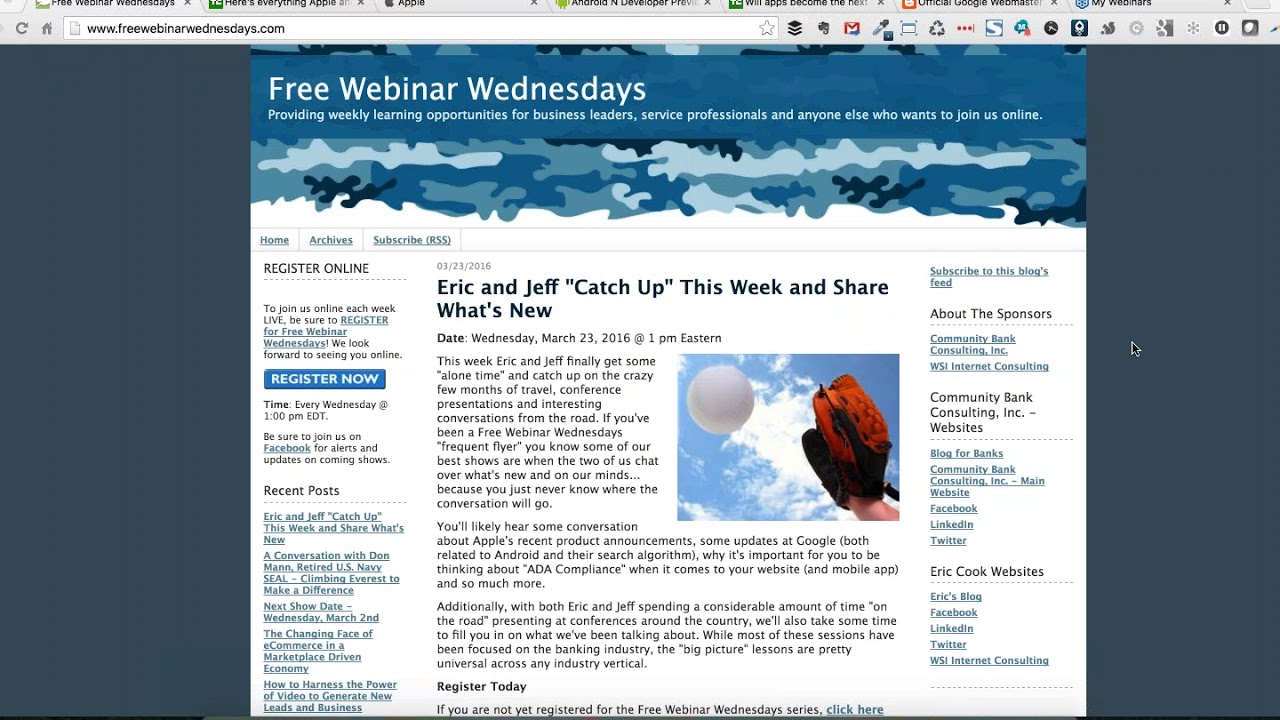
Eric Cook and Jeff Simpkins discuss the universal banker model, where cross-trained employees handle multiple product lines to improve customer experience. They cover omnichannel banking, employee social advocacy, smart-home integration with mobile, and why businesses need to meet customers across channels.
Chapters
Greetings everybody. Welcome to the Wednesday, March 23rd, 2016 episode of Free Webinar Wednesdays. This is Eric Cook. I'm with WSI Digital Marketing where we work with businesses and organizations helping them understand and leverage the power of the internet as a strategic business tool. You can learn more about me and all the cool stuff that we can do here at WSI at www.poweredbywsi.com. Or you can just Google Eric Cook and you might find some hopefully positive and interesting stuff on social media like Twitter or Facebook or LinkedIn or any other places that I'm hanging around these days. With me this week, and I'm very excited that we are back in the saddle, we've had a couple weeks off due to travel and conferences and all sorts of other fun stuff that's taken us away from the computer. But I'm excited that my good friend and Free Webinar Wednesday partner, Mr. Jeff Simpkins, is back with me. Jeff, you're in Free Webinar Wednesday world.
Greetings everybody, this is Jeff Simpkins and I'm with Community Bank Consulting. You can learn more about me and my company online at www.communitybankconsulting.com.
Gotcha. Hey, just as an FYI, you're having some intermittent audio issues and we caught about half of that so I don't know if You've got some voice over IP issues. The lovely internet gremlins are causing problems, or I'm having audio myself and maybe it's GoToMeeting. But, uh, maybe we could just do a quick check for everybody. Same with me as well, huh? Okay.
Could be either of us because I'm getting the same thing on your end.
Lovely. Well, this is going to be one of those interesting shows where hopefully I don't have a slip of the tongue, but we're having some issues with audio. Let me see.
Yep. I mean, we were talking pre-show of not having any issues with your audio.
Yeah, and I've got Mark here in my office saying that as soon as we punched live, there's no issues.
So It's cleared up now.
We'll maybe blame it on— I guess keep us— yeah, both are good now. So thank you, Daniel, for letting us know. Keep an eye on audio. Feel free to use the chat and let us know if we're getting a little sketchy because of course, you know, Jeff and I just think what we're talking about is so important you all just have to hear every single word of it. No, in all honesty, you guys didn't come on a webinar to listen to us, you know, talk like half the time and scratch it. So keep us posted if we're getting audio issues. We may need to try different, but appreciate the feedback on that. For those of you that might be first-time joiners to the webinar, just want to let everybody know that today's session and all sessions are being recorded, will be made available at freewebinarwednesdays.com as a replay, so you can check us out there if you would like. And then we do hope and actually encourage that we've got some interactivity, and I can see there's a couple of you that figured out the chat function to let us know audio issues or Things have been good. You can go ahead and use the chat function. And today's just kind of a catch-up day for Jeff and myself. There's a few things that we wanted to chat about that we've kind of put in the show rundown with regards to what's been on our mind lately. We've been traveling at conferences, so figured it'd be a good idea to kind of give a little bit overview of the stuff that we're talking about these days that might be interesting and/or relevant to your business. And if there's thoughts or observations that you guys have, feel free to go ahead and type it up. We'd love to hear from you. So with that bit of perfunctory housekeeping out of the way, Mr. Simpkins, you probably, I'd say most recently, have returned from a conference. You were in Virginia recently chatting with some fine bankers. What was your topic and What are some of the, I guess, takeaways that might be applicable not just to banking folks but maybe businesses in general?
Virginia Bankers Association Retail and Marketing Conference week before last, and I did an additional version of the presentation last week in the Chicagoland area. For a group of bankers on one of the core service providers. The presentations that I've done recently have been on a position that many banks and credit unions refer to as universal bankers. And a universal banker is an employee that essentially functions in multiple job responsibilities. So the example that I use with my financial institution folks are, think of how you feel when you dial into a company and you get a recording that says, thank you for calling XYZ Company, which is always followed by, your call is very important to us. And with many companies, without fail, the next sentence is, we are experiencing higher than normal call volumes. And then you get the opportunity to press 1 to do this, 2 to do this, 3 to do this, 4 to do this. And so forth. So I sort of tie this in with the level of frustration that one experiences with phone trees that are complex, hold times, and things like that. So universal banker or universal employee essentially is someone that when you go into a financial institution can— oh yeah, Daniel said don't forget our options have changed. Universal banker is—
Calls may be recorded for quality assurance purposes.
Universal banker is essentially an employee that is knowledgeable and empowered to work in many, many different areas of financial services. So when you walk into a branch of a bank or a credit union, rather than having to see someone to perform a teller transaction, open a new account, perhaps get some type of loan product like a consumer loan, a mortgage loan, Perhaps in financial institutions that also have investment products or insurance products. It's an employee that may be able to work with you with all of those different types of products. So it's a much more seamless experience, much, much less need to hand you off from person to person to person and have you tell your story and information over and over. I'll pause for a minute and let you comment or ask questions on that, Eric, and then I want to comment on something else that I think the group may find interesting from the presentation.
Well, I like the trend of the universal banker for a number of reasons, because I've been on the other side. I've been in the banking space myself, and it was always a frustration When an employee, I would hear them say, well, that's not my job. You know, well, I need you to balance my checkbook, I need to open an account. Oh, sorry, I can't do that. You need to go over here, you need to go over there. And it always kind of irked me. And before the concept of universal banker was really thought of, and I don't know, you know, there was always the discussion, well, can't we just train our tellers to be able to do that? And unfortunately, the technology that we used back then was a little bit You know, we kind of made the decision— I think this is where technology is now the great facilitator— we made the decision in the bank that we didn't want tellers opening a new account because it took too long. We wanted the person to go over and sit down at the new accounts desk because it was going to be a 10 or 15 minute process. It wasn't something that could be done quickly. There are things that take time, but technology has sped things up, and it's not just in the banking industry, but it's in all industries. Think about when you've been to a restaurant, been to, you know, a hardware store, oh, sorry, well, that's, you know, that's in the plumbing department. I don't do that. And then they send you on a wild goose chase to aisle 12 when in reality, I've been in other situations where maybe it's a hometown hardware store where the owner just knows everything and you might be in the electrical area and you ask him a question, oh yeah, well, that's over in plumbing. Here, come on over here. This is what you need. This is the blah, blah, blah. And in that instance, you've got the universal hardware store employee as opposed to the universal banker. And I think we'd all agree that that type of experience with any type of business is a much more enjoyable, much less stressful because, you know, I don't know about you, but I hate when I get transferred. I gotta recount reason why I'm calling. Well, why are you calling today? Well, just gave person on the line before my 5-minute spiel about something wasn't right, and now I've got to give it again. So just causing any business to really think about the transaction and the customer experience from the customer's perspective, not what makes it easier for the business, but looking at it and saying, can we leverage technology to streamline the process, to make our employees smarter, to empower them to be able to do more than just one particular or two particular actions, or tasks and really focus on, you know, a pleasant experience for the consumer. You know, I think the banking industry is starting to wake up, but there are certainly other industries that could take a lesson.
Agree. Somebody just said still having audio trouble. Honestly, I think the problem must be with GoToMeeting. Because both of us are having audio issues and it comes and goes. Eric, you sound good now, but I think our challenge is GoToMeeting's audio service.
Darn little GoToMeeting gremlins.
Hey, at least we got logged in with no issues today.
This is true. It's true. You had a couple of things you wanted to chat about.
Yeah. One of the things that ties in with what you just said is the difference. And this doesn't matter if you're in the United States or in Canada or in some other country, but most of our, our participants on this webinar in North America. The way we conduct our business transactions today is different than it was 5 years ago, especially different than it was 10 years ago. In many cases, It's different than it may have been 2 years ago. This is true too. Retail environments, online environments, and so forth. One of the things that is an interesting fact that I've discovered in my research for not only this universal banker concept, but also some others that I've worked with, is for banks, financial institutions, banks and credit unions, 65% of their customers use what the industry refers to as omnichannel. I prefer to use the term multiple channels, multiple ways of interacting with their financial institution, with their bank or credit union. So some examples of how that might take place, and we can tie this in very much with social media and many things that you see in advertising, is if you go to get to— to get a mortgage loan, go to borrow money for a home loan. Many of those processes, you know, 5 years ago, almost without fail, you would sit in front of a mortgage officer and he or she would have a piece of paper in front of them and they would fill out this piece of paper, which would take hours as they ask you questions and got information from you, and you'd leave with essentially a group of assignments of things that you had to get back with them and provide documentation on. Almost all financial institutions and many other, many other companies, for example, Quicken Loans or Rocket Mortgage or companies that provide services online, pretty much can always start your mortgage application process online today. One of the things that a local financial institution can do that's different than some of the online providers is you can start the application process online, and then you could meet with someone in a physical branch and actually get questions answered, turn over loan documents, and things like that. The other thing that technology has done for us on the financial institution side is there are many really, really good platforms that allow you to start a process like a mortgage loan online, get to a certain point, stop, save your information, go collect documents, come back an hour later, days later, weeks later, and upload additional documents. So those are just some examples of things that we're doing differently today. You know, think of the process of depositing checks. Many of you might use your smartphone now and take a picture of the front and back of your checks to make deposits in your bank or credit union, another channel that's used for interacting with your financial institution. Why don't you take a turn and comment?
Yeah, so I'm— I was kind of struggling with the audio issues myself here, and fortunately about half of that came through. But, you know, I really don't have a whole lot more to add on that. I think it's a trend that we're seeing, and I think the businesses that don't get that their employees need to do more and be better— you know, this is an advantage for employees as well. And I think that's one of the things that, you know, initially, like universal banker, and when you start bringing in technology, you may scale back on staff because you might not need to have as many people.
Although—
And you cross-train people, it allows those people to be used in other areas and support growth. And so you can grow without necessarily adding additional employee overhead. And allow those people to do more. And then as you do more as an employee, becoming one of these universal, you know, employees, it makes your value go up. So you could, you know, quite easily garner an additional, you know, a raise, pay increase, bonus, because you're more valuable to the company now. And so I think one of the things that a lot of employees hear when they talk about universal whatever and making people cross-train is there's the immediate fear of, you know, I'm being outsourced, or, you know, I'm the new accounts person, now they're not going to need me anymore. Could very well be you could get cross-trained in the loan side, or maybe process transactions and be able to do more for the organization. So try to make sure if you do move down this direction as a business, you spin it from a positive perspective. And kind of explain where the benefits are going to come from.
Your last statement, we have gone from wobbly audio to echo chamber.
Yeah, echo chamber, exactly. So we're—
Oh, you're good now.
Echo chamber has been turned off. We're good now. Yeah. I'm also multitasking and I'm trying to go over to our friends over at Citrix and see whether there's a way that I can have somebody actually investigate this issue whilst we're talking. So there's a little bit of multitasking going on on my end as well. So, but yeah, so that's good stuff. And, you know, I've had the pleasure of introducing you to a number of my banking groups and having you do that presentation, and everybody has come away with lots of really cool ideas and thoughts. So, but I think it's It's good that the message there is really one that is not only applicable to the banking world, but really any service-related business, in my opinion, could be moving towards the universal employee concept and kind of enriching the experience that their customers are having with their brand.
Yeah, Apple has introduced us to many great things. One of the things that Can be applied in so many industries that have a physical retail space is the concept of the Apple Store. And that's a great example of, you know, a company that's not in banking but has a universal employee concept. When you walk into the Apple Store, generally you're greeted by someone, and if they hand you off to someone else, It's very unusual for you to have to talk to more than one employee to talk about any product in the Apple Store. So it's a great concept.
Yeah.
And one that I'm working with financial institutions on introducing, not only at a staffing level, but for those that are reinvestigating and at a point that they're ready to upgrade some of their spaces also in modernizing their space to look more like that concept. Cool.
Hey, you just caused a squirrel to jump into my head. I'm going to chase it real quick. But I know that in one of our recent shows, I talked about an awesome experience I had in the Apple Store and how they really went above and beyond and took care of me with a service issue that impacted my wife and ultimately got me a brand new laptop. If you'd like to know the details of that story and aren't familiar with it, let me know. I'm happy to tell it. Just get a hold of me later. But during one of those sessions, I also talked about how a company really dropped the ball, and I gave some bad publicity to the folks over at Brookstone. And I don't think it was warranted because it sounds like you've had a similar experience with Brookstone and service and not necessarily— they've got a lot of really cool stuff, but I don't think that they back up their cool stuff with the support structure that they should have. So to kind of give a little bit of the backstory, I got a really cool little micro projector that's about the size of a deck of cards that I can plug into my laptop and blow a screen up about 50 or so inches. And it gives me the ability to do a presentation from pretty much anywhere. And I got that. It didn't work on a mobile. And then it ultimately died on me. And I was very disenchanted. And I called support. And they never returned my call. In my travels around the country, Brookstone has locations in airports all over the place. And I said, I'm going to roll the dice. I'm just going to walk into this Brookstone store and tell the manager my story and whether or not there's anything they can do for me. He stepped up to the plate, pulled it out of the box. I didn't have the receipt. I didn't have the original box. I mean, it was just kind of a whim. They took care of it, no questions asked, gave me a gift receipt and said, if you have any other problems, stop into any other Brookstone and we'll take care of it. We're really sorry you had a problem. You know, so something within that organization either empowered him or he just said, screw it, this is the right thing to do. But I wanted to kind of eat a little bit of my words, even though Brookstone corporate still never called me back and acknowledged the issue. I did have a really good experience with somebody that the manager of the store and, and he took good care of me. So, so I'm liking Brookstone a little bit more these days. And I just wanted to make sure that I made that public. So don't think that'll change your opinion of them, Jeff, because it sounded like you've had some pretty bad experiences. But I think the human-to-human connection was one that certainly helped in this instance. So kudos to Brookstone.
It's a great example of an employee that steps up to the plate and does the right thing.
Yeah.
Yep.
So I was pretty, pretty glad, and hopefully he didn't get in trouble for it, but he took care of me. So I told him even about the webinar and me kind of badmouthing, and I said the next opportunity I make sure to You know, at least tell the other side of the story, and he was appreciative. Of course, it would have been nice if I'd remembered— I think it was the Atlanta store, and I don't remember the guy's name, but it would have been nice to be able to complete the loop with, you know, give him some brag, but I didn't have that. I was so shocked that they just gave me a new one, I was pretty, you know, just kind of walked out and took my new device with me.
Well, if he did get in trouble as a result of doing that, It sounds like he could have a pretty easy time finding another job.
Exactly, exactly. So hey, in the rundown, I know we talked about some Apple stuff, but I just— 2 of the things that I've been talking about as well from my sessions that I think go beyond just banking. One of them is kind of reinforcing the, I guess, whether you call it the necessity or the opportunity employee engagement via social media. And we are calling it employee social advocacy, but figuring out how you can empower staff to play a more active role in any organization's social media efforts. And there have been statistics that have come out that have talked about the lackluster organic reach of Facebook posts by businesses with 6.5% or less percent of your fans ever seeing another post that you make. But I want to encourage business owners and folks out there to, you know, think about how your employees are representing your organization through social media. Are they forbidden from doing it? Are they doing it on their own without any guidance? Or do you have some sort of a training program in place that's been vetted by HR and legal So that you're not saying things that you shouldn't be saying, but are you empowering your staff to be advocates? Because just like the gentleman that stepped up to the plate and actually did the right thing for Brookstone, you know, we want our employees to be doing the right thing in social media because they are the representative— representation of our brand to a lot of our customers because they interact with those folks, not necessarily the official business. So social advocacy is becoming pretty big. And then the other thing that I've been talking about, unless you've got a thought on that, I guess I should pause and see if you've got any comments on that whole concept of social advocacy, Jeff.
No, I think what you said is good. So proceed.
Cool. And so the other topic that I've been talking about, because I know a lot of businesses are out trying to increase their fan base and grow their customers. In the banking world, I suspect that this is the same in all industries, but in the banking world, we just have the luxury of knowing so much about our customers, their behavior, their profitability, the costs associated with each customer, the revenue that they're generating, whether it's through fees that they're paying bank, or maybe using the bank's debit card, so there's interchange revenue. But we're starting to talk to banks about spending time understanding the true profitability makeup, and we call it the persona or the personality of a customer. And when you go out into social media, or when you're spending time as a business advertising for new customers, What we've found with a lot of the banks that we work with is 80% or more of the organization's revenue is basically created by 20% of their customers or less. So it's the old Pareto's rule that 80% of your value is created by 20% of your effort. Well, in this instance, if we have 20% of our customers that are generating 80% of our, of our, of our revenue, It really behooves us first and foremost as any business to know who those 20% are, because we want to make sure that they get treated with white gloves. We want to make sure if we do something special that they know about it. We want to make sure if they're involved, whether it's in social media or they have a blog or something, that we're paying attention to them, because that's really the lifeblood of our company's revenue. But the other side of that is Are there people within the organization, the customers that you have, that maybe match that profile of a profitable customer relationship, but the profitable relationships that they have are at a competitor? And again, to use the banking analogy, if you have a customer that looks like your profitable customers, but all they have is, you know, a savings account for their kid, with $100 in it and it's not charging any fees, or, you know, that's an unprofitable relationship. But the mother and the father have got a mortgage somewhere else, they've got an auto loan somewhere else, they've got a home equity loan, they've got a checking account with a substantial balance, they might be a business owner. And if you've not taken the time to identify that as a potentially profitable customer relationship and make an effort to go out and say, hey Jeff, we noticed that you've got a savings account, but We suspect you probably have other relationships. Is there anything we can do for you? We really love to serve more of your banking needs or more of your whatever needs, you know, insert your business here. And then making sure that your digital strategy supports that, because what I think is happening, and I don't have the evidence to back this up, but from just a logical perspective, if businesses aren't taking the time to understand what a profitable customer looks like, and they're just out in social media or marketing or digital advertising trying to just get customers. If 80% of those customers are unprofitable relationships, those are going to be the customers that you're going to also bring more in, and that's going to be really difficult to grow your revenue. So imagine if you could identify the top niche customer profile and not really be interested in all 10,000 customers in a given market area but only go after the, you know, 400 or 500 really profitable customer profiles that have a high likelihood of being moneymakers for you. And so using that data, because within digital there's so many different ways that you can segment your audience with demographic and psychographic and location, you know, factors to really pinpoint where your message is going and who's seeing what it is that you're doing. So just really trying to reinforce the— are you marketing to the right people with the right message in the right venue instead of just marketing to everybody and hoping that it works? I'll pause there and see if you've got any thoughts or comments on that.
Yeah, many, many people, many businesses, many people that run businesses mistakenly think that if they just buy some paid advertising on social media, that suddenly they're going to be inundated with more business than they can handle. And in reality, as this is your business, Eric, you can tell many stories of spending money on social media not done correctly can be the equivalent of flushing hard cash down the toilet. If you can identify what the profitable customer looks like, and in all of your outreach, all of your marketing, whether it be direct mail, whether it be social media, paid type marketing, you can apply some pretty readily available predictive analytics and really leverage the bang for your buck.
Yeah, the fear that I have most businesses are doing these days is on one hand they're running a campaign, whether it's digital, whether it's traditional, and they might be getting a good response. So let's say I run an ad and I get great click-throughs and I get a lot of people that open accounts. If those accounts are more unprofitable relationships that I'm losing money on, the digital advertising or the, the performance of the marketing campaign looks great because we've generated all this business. But if we don't understand that that business is actually an unprofitable relationship because we either haven't priced our products appropriately or, you know, bundled things to make it a profitable relationship, You can take what may seem like a very successful advertising campaign and actually have it lose you money. So I just kind of wanted to make sure to mention that. And again, I've got a session that really kind of dives into that. I had conversation for 90 minutes with a bank just before today's webinar, kind of going through that in great detail. And you know, I think their eyes kind of opened because. The concept of a profitable customer— well, isn't every customer profitable? And the answer, unfortunately, is no, it's not, because, you know, you have customers that likely are costing you money that you just don't know it until you do the analysis. So, so making sure to pay attention to that and, you know, looking at both sides of the, of the advertising equation, I think, is becoming very, very important as business becomes even more and more competitive.
So one of the issues that we deal with in working with financial institutions is many financial institutions really have a hard time— their average employee has a hard time really understanding what a profitable customer is. There's a perception among many staff that the number of times you see a customer indicates their level of profitability, when in fact the customers that you see most often may be your least profitable. You hit on a really good point, no matter what industry you're in, and that is making sure that you've got a means for determining what business is profitable and can document that type of information. Of course, you and I have talked to a number of clients and prospects recently about the importance of that and have some projects in the works. Helping fine-tune looking at profitability. And the exciting piece of that, and you've said this a time or two, but it's worth repeating, is once you know what that profitable customer looks like, then you can really fine-tune your outreach, your marketing efforts, and find more customers that look like that. So you're consistently bringing in profitable business as opposed to running up your number of customers and running up your costs, bringing in those that are— are less profitable or, or not profitable at all.
Yeah, good. Well, I, I think we beat that horse pretty good, but hopefully everybody kind of gets the idea. Profitable customer is not every customer.
So I think— That's what you and I are both pretty passionate about.
Yeah, get more of those, get more of those. So anyway, Well, I've got teed up some of the other things that we kind of wanted to talk about. I know we all, you know, we're big Apple fans. Of course, I'm an Android guy as well, so I cross over. It's like banking, but then I also do digital. I do Apple, but I also do Android. So I like to keep my feet into different areas that sometimes seem at odds to one another. But a couple of days ago, Apple came out with kind of some announcements. I don't think there was anything earth-shattering.
No.
that they came out with, and I've kind of stumbled upon one of the sources of news that I love is TechCrunch. So this is one that I kind of pulled up. I don't know if there was anything that you particularly picked out of their announcements. I know the security issue is one that, you know, with recent issues with the FBI and encryption, you know, I think that's probably the biggest thing. And I talked a lot, and people talk to me a lot, just because I'm in the digital space and banking. You know, should Apple let people in? Should we, you know, allow that phone? What do you think? I very much think Apple should dig in and not share that. I mean, once the genie's out of the bottle, privacy and security, I don't think, is a negotiable. I think they need to stay where they're at. And they talked a lot About that in their announcement. So to me, that was probably the biggest thing. I don't know if there was anything that kind of came up with you. I know they've announced reduced costs and a smaller phone. And they've got the iPad Pro now in a smaller size. A few other things that came up, but nothing really earth-shattering. I don't know. What were your thoughts on anything Apple announced?
Well, it was so non-earth-shattering that it didn't make the didn't make the morning briefing on the New York Times this morning. One thing that I did pick up, and I can't remember if this was from the New York Times this morning or the Wall Street Journal this morning, but this is kind of surprising to me, and obviously it was. To the editors at one of those papers as well because they considered it newsworthy. Regarding security, Apple has not paid ethical hackers in the past for testing its software. That sort of came up— actually, it came up under an article regarding the FBI and accessing that information. I thought it was very unusual that a company as large as Apple don't use ethical hackers as part of their testing mechanism.
Yeah, it's, you know, and I can't remember the name of the event, but within the last week or so there was an event where, you know, hackers are trying to bust in, and what happens with a lot of companies, you know, Microsoft and Google and some others, they'll actually pay a bounty, $40,000, $50,000, $60,000 if you can you know, demonstrate an exploit. Facebook recently paid a gentleman, I think, $40 grand where he found a vulnerability in the Lite version of Facebook, which is being deployed in market areas where they don't have real high-speed internet connectivity, and found a way to exploit a vulnerability in the Lite version of Facebook that gave him the ability to basically run a bot against a login to try to crack a password, and it didn't time out after 10 attempts like the regular version. And instead of going to the public and revealing it to the rest of the world, he reported it to Facebook, and Facebook paid him $40 grand. So it's, it's a common practice, and, you know, if you're going to be a bad guy and hack, you can let the company know and make some money out of it. Hopefully that You know, is incentive to report it. You can make some money and it makes the product better overall. I'm nowhere near the capability of doing anything that would remotely resemble a reward bounty other than the fact that I might get my computer to crash if I try to do something. Who knows, maybe the folks at Citrix will pay us a bounty for reporting the audio issues on their webinar and figure out a way to compensate us for our time. Although I doubt that's going to happen. But yeah, I didn't see a whole lot on Apple. I know there was a lot of hope that there would be some cool stuff coming out. But the other side of that is, is there anything else cool that Apple could do? How much more crap can you cram into a phone or a watch or a tablet that isn't currently being done right now? You know, I don't know where it would go, but, you know, you've got to have some pretty creative minds to figure out what's next for all these devices. You know, the thing that I heard— Amazon, and we've talked about the Echo and our friend Alexa, my new little girlfriend. Amazon obviously tried to get into the phone business With its Fire Phone failure, that's a lot of Fs there, little alliteration for you English majors. But the the Fire Phone failure, even though phone isn't spelled with an F, I know that. I'm sure I'll probably get a tweet to that extent. But the Fire Phone failure, you know, the reality is they they didn't do anything on the device, but they've skipped the mobile device, and with the Amazon Echo, they're now figuring out a way to tie that into other. devices. So Samsung is developing apps that will allow your phone to communicate with Echo, and Uber now has the ability to communicate with Echo, and Chase— I think Chase Bank, or maybe it's Capital One— you can enable an app and you can ask Alexa what your balance is, or you can transfer money. So there's an interesting— is the phone really the next device, or Is it somehow tied to Apple TV or this kind of desktop intelligent agent that plays music and is always listening? You know, when we went to Florida, we were gone for a couple of months working remotely from my parents, and Amazon Echo— I took Alexa with us, and she was right there playing music and giving us the weather and recounting the news and You know, I travel with her now. So I don't know, it'll be interesting to see.
My friend that got one of the original versions of Echo when they were giving it at a very reduced price, but you had to get an invitation, is so in love with Alexa that she now has 2 of them in her home.
Well, and they've come out with even a smaller version that you can use. It's like the Echo Disc. So it's not as tall, it's a little less expensive, and you can use that in multiple areas, you know, as a bedside alarm clock or whatever you want. So I think that intelligent device, the smart home, the integration, and then using those devices to tie into mobile, I think that's, in my opinion, the next logical step. And so for business owners, bankers, you know, anybody that's out there, How do you leverage that when I'm out and about? What are the things that I would want to have quick access to? And kind of know that these intelligent agents might very well be the next element, whether it's at the house or in your car, or maybe build those into your mobile device and kind of transform again what the mobile device does, because it's way more than just Siri or Google Now, that's for sure.
It's funny, you know, you came out of banking, you've been in a function that supports the banking world for 8 years now?
Almost 9, believe it or not. Time flies, but yes.
For 9 years now. In your days when you were in the bank, and in my experience in working with banks and financial institutions, We used to talk about a 10-year plan, 10-year plan or sometimes even longer than that. When I was speaking at Virginia Bankers the week before last, and we were talking about putting together a plan for implementing the use of the universal banker, I said to the group, really, I have a hard time talking about going beyond a 3-year plan for many types of things, even in a financial institution today, because things change so quickly. And, you know, to put that in perspective, if we look back 3 years ago, we wouldn't be talking about things like the Amazon Echo. And the technology is changing so quickly, the amount of information available is changing so quickly, and many things it's hard to come up with a plan even as long as 3 years today.
Yep. I think one of the most important components of any sort of a strategic plan Is an acknowledgment of the speed at which change is taking place. And having that included in your plan to say, you know, we look at a 1, 3, 5-year horizon, but not being content with just going back and revisiting the plan every 12 months. Because that typically was the case for us, is we go offsite, we do a strategic plan, we'd say this is what we want to do in the next year, the next 3 years, the next 5 years. And we would implement, but we really wouldn't come back as a group and have a discussion about that strategic, you know, conversation until we did our next big retreat. And we came back and said, okay, did we hit our goals for the last year? And we had periodic things. I think, you know, a 6 or even a quarterly, you know, just technology State of the Union is probably worth, you know, putting into a plan that there's a more formal Okay, what's going on with our technology vendors? What's going on in our industry? What's going on outside of our industry that is causing a shift in consumer preference that could have an impact on us? You know, and I oftentimes will go back to Uber, and everybody immediately thinks of Uber as being a displacement for the taxi industry, which it is. But Uber realizes that, you know, when people get together and hang out, They're likely using social apps to communicate, and why don't we make it easy for us as Uber to schedule a ride if people are having a conversation in Facebook Messenger? Because that may be a tool that people are using to get together. Hey, what bar are you at, or what show are you going to? Don't make the customer get out of Facebook Messenger and go to Uber to schedule a ride to pick people up. Be where they are, and they now provide the ability for you to schedule an Uber through Facebook Messenger. They're not kind of of the high and mighty, oh, you have to use our app to do this. They're putting their service where the customer is because it's convenient for the customer, maybe not so convenient for them because they had to figure out a way to integrate with Facebook and coordinate and, you know, do all the things that they needed to do. It's easy for them to just stay the course and require somebody to go to Uber. But they're following the customer, and you can schedule an Uber from Alexa. You can't, you know, so, so thinking about that not just as a banker but any business, where are your customers hanging out? Can you be there in more of a transparent, hey, we're ready if you need us kind of mode, as opposed to, oh, well, we offer a mobile optimized website and we have an app, so just go there? Because people may not think of doing that. They just wanna be where they're at and, and kinda get things done. So, yeah, that's another, I guess, thing to think about. So.
I was at a technology conference. I can't remember if it was earlier this year or last year. I think it was last year. But one of the things that one of the speakers indicated at the technology conference was that many users like having an app for a specific purpose. So for example, if something that's going on in your life is you're about to have a baby or you're about to get married and have a wedding, there are companies that have approached trying to give you an app where you do everything in life in one app. This particular speaker had done some research and had determined that most consumers prefer to have an app in which they accomplish a specific purpose. I like your example with Uber because Uber still has their own app, and if you're— you want to use the Uber app, you can. But I like the example of Really providing a seamless link, a way to also take advantage of some type of service that's provided by probably another app, but doing it within what's going on right now. So it's kind of a hybrid, a combination of I've got apps that are for specific purposes, yet if I need to perform that purpose while I'm using another app, I can seamlessly integrate those.
Yeah, absolutely. Well, since you mentioned apps, I'm just gonna hop over. I'll come back to my Android chitchat here in a little bit, but since you mentioned apps, one of the things that, you know, last year I think there were some high-profile websites that had gotten targeted by disability attorneys and making sure that, you know, the site's not ADA compliant, so they don't provide, you know, alternate text over images, they don't have the ability to use the site with a keyboard. I mean, there's a lot of different things regarding ADA compliance that as a web developer we're paying attention to because we certainly don't want to get our clients into a situation where an ADA attorney swings by and decides that the site's not conducive to a compliant ADA environment. But this article again from TechCrunch talks about, you know, apps being the next target for a disability lawsuit and You know, if you've got somebody that is blind or somebody that can't hear, or, you know, do you have a way for that app? And, you know, one of the things that first hit me with regards to disability and ADA compliance was when we had to put Braille keys on our drive-up ATM machine to support ADA compliance.
Mm-hmm.
And of course, the running joke is, you know, for all the blind customers that are going to be driving up to your ATM, you need to make sure they know how to use the keypad. Of course, you could have somebody that's sight impaired in the back seat, or they could walk up to the ATM. So, you know, discrimination and disability issues are ones with more and more communication and interactivity being done digitally are becoming kind of front and center. So it's not taking some time to do a little research on this and have some conversation with your digital partners. You want to make sure that there's certainly an understanding of what your responsibilities are and what sorts of retrofitting you may need to do in order to avoid being an example for ADA compliance lawsuit. So we see companies mentioned, Quicken Loans, H&R Block, Peapod, online grocery store. Several big companies have been hit with accommodation-related issues. I just wanted to draw attention to that. Not that I want to be a Debbie Downer by any means, but it's an important thing to consider. The other 2 things that I just wanted to also mention. Last year, Google came out with what was being referred to as Mobilegeddon. Where it was making a shift to its search engine algorithm, which determines rankings, that said, hey, you know, starting in— I think it was April— we are now going to start paying more attention to a mobile site. And if we visit your site and it's not mobile-friendly, you could very well start seeing some search implications on a mobile. And what they've continued to find is that Over half of all search activity now takes place on a mobile, whether you're using voice search, you know, hey Siri, where's the nearest ATM, or hey Siri, I need to order a pizza, or you're just manually typing that information in. But they have announced on their official webmaster's blog that coming up in May, they're going to be making another significant shift in the mobile-friendly test and further impacting your search scores. So if you do not know yet whether or not your site is mobile-friendly, they've got a mobile-friendly test here that you can visit. And I'll just kind of give you an example, but if you visit this, you can put in your website, and if you take a look, Google is going to visit your site, it's going to crawl it, it's going to come back, and it's going to determine whether or not you're mobile-friendly. And if you are, you're going to see good, awesome, congratulations. It's going to show you a preview It's going to see what your actual site looks like. If it comes back and you've got a red bar here, that's when you need to be speaking with your web development partner. Give me a call. But, you know, this is becoming a bigger and bigger issue, and you definitely want to make sure that you're paying attention. So mobile is becoming very, very important, and don't want to make sure anybody misses that. So The last—
3-minute warning, Eric.
3-minute warning, okay. And then the last thing is, you know, Apple, Apple, Apple, but Android is coming out. We're in Marshmallow now, which is M. There's really not a definitive what N is going to mean, although I think they've labeled it internally as New York cheesecake. But the Android operating system, if you own a Nexus device, the Android operating system, you can go ahead and do a preview. And they're implementing some pretty interesting things like split screens and proactive notifications and some other stuff. So if you are an Android geek and you have a Nexus device, I've got a Nexus 7 tablet, I think I'm gonna download and play with it just to kinda see what's going on. But, you know, wanted to make sure everybody knows that Google is not staying far behind in implementing continued updates to its operating system. So we'll keep an eye on that and see what's kind of going on there. So with that, those were the things that we wanted to chat about. We crammed it all into 60 minutes, so I think we're, we're good. We wanted to kind of wrap it a little bit early. Both of us have got some commitments coming up at the top of the hour. Any closing thoughts on your part, Jeffrey?
I think our audio problems cleared up at the end of the hour.
Right when I'm getting all fired up to send him a message and tell him how bad it was, but it started to work.
It was fun. I think I am going to take next week as a vacation, so I will see everybody Back in a couple weeks.
Sounds good. And we do have a, a guest scheduled for next week. Amber McHugh, who is an efficiency productivity expert, is going to be joining us. The announcement is going to be posted on Free Webinar Wednesdays here in about another half an hour. So she is going to talk to us about ways that you can get more done and the concept of cloning yourself. I think that would be a good thing for me because then I could just get more done, although I don't think my wife would necessarily appreciate 2 Erics running around. I think I'm enough of a handful by myself, but it'll be a good show because I think all of us would agree that there's never enough time in the day to get everything done. She's going to share some tips and suggestions, and then anybody that attends live is going to be entered into a chance to win a complimentary seat to her Clone Yourself training program, which is a $149 value, I think, is what it normally costs. So if you attend live, you'll get an opportunity to be entered into that drawing, and might be something you could take advantage of. So I will see you next week. Jeff will take the week off, but I'll be back with Amber. And thanks again for everybody joining us live, and we'll see you next Wednesday at freewebinarwednesdays.com. Until then, Have an awesome week, everybody. Thanks a lot.







