
Facebook's "Boost Your Business" Experience and Top Tips for Success
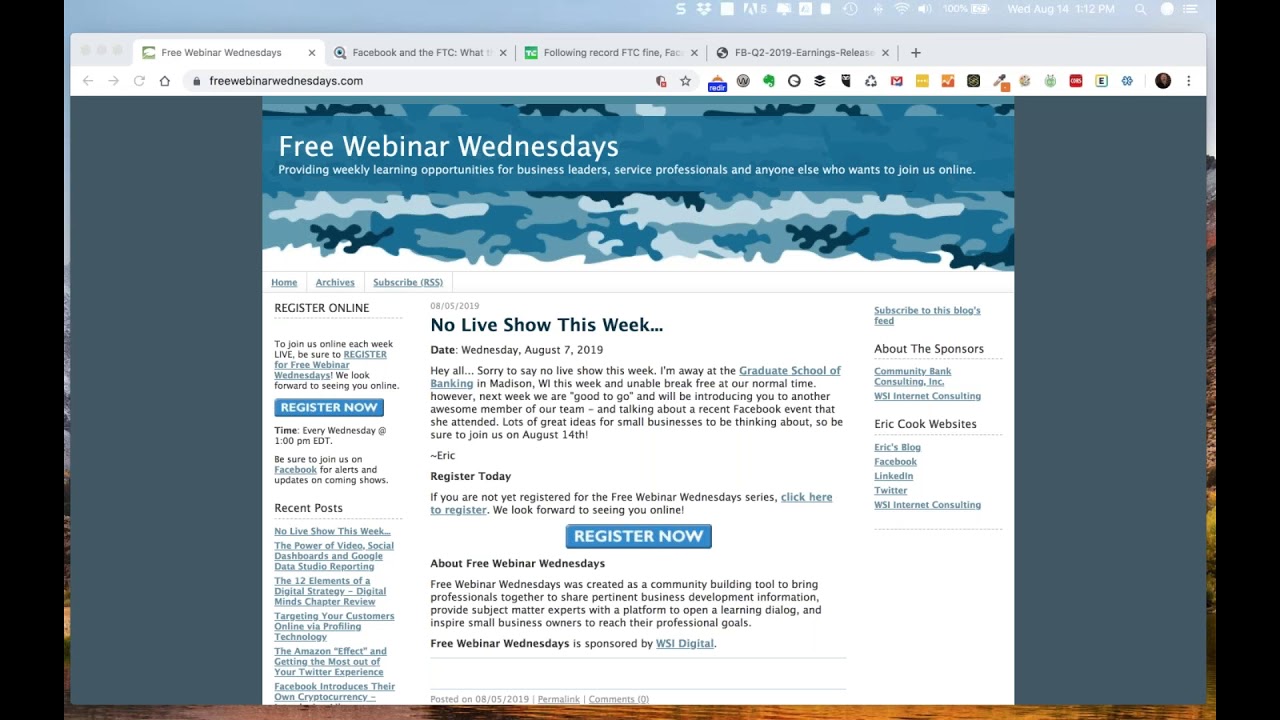
Madison Barner shares Facebook's latest advertising strategies from the Boost Your Business conference. Mobile drives 94% of Facebook's ad revenue, video with autoplay is critical, and organic reach for business pages sits at just 2-3%. The Ads Manager app and custom audiences are essential tools for targeting.
Chapters
Greetings everybody, welcome to the Wednesday, August 14th, 2019 episode of Free Webinar Wednesdays. This is Eric Cook with WSI Digital, where we work with businesses and organizations helping them better understand and leverage the power of the internet. That's our old tagline, but I think it's also still a pretty good one. Otherwise, we help customers connect and engage with their customers online. You can learn more about us and all the fun stuff we get to do here at WSI online at www.poweredbywsi.com. Today's show is obviously brought to you by WSI. I have another face of WSI available for us today who is joining us on the webinar. We're gonna talk a little bit about some Facebook stuff, Madison Barner. But before we officially welcome her to the show, want to remind you today's show and all shows are recorded and made available out at freewebinarwednesdays.com. If you have questions, comments, thoughts, and you're joining us live, please feel free to use the chat functionality for your GoToWebinar, your little control panel on the right-hand side of your screen. We'd love to hear from you. We love the live interaction. And because it's live, you get to listen to me sometimes make little verbal blunders and other sorts of little mistakes. But you know what? That just means that it's a human on the other end, and it's not a perfect Perfect little robot. So with that being said, I've got Madison Barner, who is the newest member of our team. Maddie has been with us— boy, I don't even remember. It feels like years, but I know it's not been that way. So she is a college student of the millennial generation, so teaching this old dog some new tricks along the way. But goes to school, entering her senior year, loves the whole digital, and just really excited to have her as part of the team. So without me just like continuing to ramble on, Maddie, say hello to everybody out there in the world of Free Webinar Wednesdays.
Yes. Hi. It's so good to finally be on after working on this for so long, but Yeah, a little background on me. Like Eric said, I am a senior right now at Xavier University, so down in Cincinnati, Ohio. So I'm pursuing a major in marketing with a focus in digital marketing, and I also have a minor in the Spanish language. So a little different, but I promise I won't switch languages on you.
So I know how to ask for a beer and where the bathroom is in Spanish, but that's about the extent of my español. So Please try to keep that foreign language to a minimum.
Yeah. Um, so yeah, so, uh, what we're going to talk about today, Eric gave me the opportunity to go to the Facebook Boost Your Business conference here in Cincinnati. And, um, I was able to talk with the presenter afterwards and kind of get more information of what I could share with you all today. So yeah, I got a couple of key points I want to dive into.
So before we jump right in, a couple of things. I'm sure everybody on the whole planet, at least in Free Webinar Wednesday world, pretty much knows Facebook. I was listening to a podcast a couple of days ago and it just happened to be on Facebook and their FTC fine. I don't know if you have caught any of that in the news, but just to kind of set the stage, 'Cause I think there's a lot of people that even I talk to that say, oh, all the millennials are leaving Facebook and, you know, they've got privacy issues and, you know, they're gonna have problems. And not that they're gonna go out of business, but everybody, I think, with Cambridge Analytica and some of the things that Mr. Zuckerberg maybe, you know, conveyed during his testimony in DC, There's a lot of thought that they're having problems, and while they may not necessarily be the most attractive network for the younger generation, if given the preferences, because that's kind of where mom and dad and grandma and grandpa are hanging out, the reality is, from a business perspective, Facebook is still generating a ton of money in advertising revenue. And even after the Cambridge Analytica thing broke and privacy was all of a sudden a big concern, There's not been, at least I've not looked at the reports, but I can tell you from the podcast that I was listening to from the folks at Social Media Examiner, and they had Mari Smith on. I've talked about Mari before. She's kind of the Pied Piper of Facebook and really is the go-to expert. There's not been a quarterly earnings release that Facebook has had even since the Cambridge Analytica where their ad revenue has actually decreased. And so businesses are still spending a ton of money with Facebook despite the fact, and if we go in and we just take a look at this kind of little article here, if we look at this from our friends over at TechCrunch, Facebook was slapped with a fine to the tune of $5 billion. $5 billion, that's the largest monetary fine of any technology company, and they're just gonna absorb it and keep rolling right along. So that gives you some kind of a Appreciation for the magnitude of which Facebook has grown, and then the other thing that I thought really stood out is these are their actual quarterly reports. So I found the PDF online, and you can read some of the you know sixteen billion dollars in advertising revenue. But the thing that jumped out at me, and we've always been beating on the drum that mobile matters. Make sure your website's mobile friendly. Make sure you know how to communicate through your mobile. If you're sending emails, you need to make sure it looks good on a mobile device. But when you look at their mobile advertising revenue, they said 94% of the advertising revenue for the second quarter came off of mobile. So all of this money, 94% of the money that Facebook is making off of ad revenue, is coming off of mobile devices. So if there's ever any question as to what your business's mobile strategy needs to be and where you're capturing the attention of your customers and your prospects, Let this be kind of a, a pretty loud shot across the bow that you better make sure whatever you're doing is mobile-friendly. And that means not just the ads are showing up on mobile, but if you're driving somebody back— and we do a lot of work with banks, I think people that attend Free Webinar Wednesdays know that— but if you're driving people back to an online application or you want them to purchase something off of your website, if you're an e-commerce store, or set up an appointment.
Yeah.
You better make sure that that click, that visit goes to a page or an experience on a mobile device that's actually easy for somebody to complete. So I just wanted to get on my soapbox a little bit before I gave you the full microphone, Maddie, and we kind of walk through some of the stuff that you pulled out of your Facebook event. But certainly to kind of frame today's conversation. Kind of a pretty big deal. So, you know, I don't know if that surprises people, but I was, I was actually shocked at that 94% mobile ad revenue. I had no idea that it was that skewed to the mobile device. Really a pretty amazing thing. So that being said, I know you've got probably 4 main points that you pulled out, and I know there were a ton more because I've seen your notes and For those of you that don't know, Madison is an excellent note-taker and does a really good job of documenting conversations and details. But let's just go ahead and start with kind of the first item that you pulled out of the conference, and we'll just kind of walk through your list and have some discussion. And again, if anybody's got a comment or a question, you know, feel free to type it up, and we'll be happy to talk back and forth.
Yeah, okay. Yeah, and kind of going off of what you just said, a lot of what I pulled is all based off of mobile. So I'll share a couple of apps that you can get in order to, you know, track different things within the mobile site. So with that said, so the first kind of kickoff of the conference, we started with video content creation. And we talked 2 weeks ago when we had Ellie on about video content creation through a different platform. But Facebook actually just launched this new feature called autoplay. And what I found really interesting about this is, so autoplay is when you are scrolling on your feed, or on your Instagram feed as well, your videos will automatically play. And you don't have to click them to play, but they don't have audio included. So if you want audio, you have to click. So what they kind of emphasized to all of us was audio is an extra feature. So you are given, you know, maybe 10 to 15 seconds to hook your audience in order to view your video. And if you are solely reliant on audio to sell your message, No one's going to understand and they're just going to keep scrolling to that video of a cat playing with a ball. So I thought that was really interesting. So even if that's words on the screen or just really compelling images, it's just take that extra step and kind of eliminate audio as a sense of reliance. And so With that audio feature, they talked about Facebook Live. And I brought this up to Eric as something we could do on our team as well. And it's growing immensely. I know I follow a couple people who do it daily, weekly, and it's very constant. So like we do with Free Webinar Wednesday, you need to tell your audience, I'm going on Wednesday at 1 o'clock. So that they have a constant that they can hold on to. And they said that it needs to be at least 10 or more minutes. And you need to work on the engagement with your audience. So it's kind of a parallel to what Eric does here is, you know, if you write in the chat and you have a question, you know, really engage with those people and call them out, shout out, you know, thank you for watching. kind of just to grasp on and let them know like they're being heard. Thank you for listening, things like that. And, you know, from video content creation, I was going to dive into content analytics, but Eric, if you have anything more on the video, feel free to jump in.
Sure. So I will tell you, and I think I talked a little bit, Facebook has an annual developers conference that they call FDC. 8, and in that conference they announced some of their main areas that they see a lot of attention. And I think you'll probably get to stories as well, if I'm not mistaken, because I know that was an area that Facebook did a little R&D on Snapchat. And by R&D, I mean rip off and duplicate, and brought some of that capability into their Instagram platform. But as it relates to video, they really talked a lot about live, pulling people into the moment. I'll tell you, since we've kind of announced Jeff's retirement and looking at kind of the future of Free Webinar Wednesdays, one of the things that I've been toying about internally is maybe continuing the webinar format, but then maybe doing a live simulcast on the Free Webinar Wednesdays Facebook page, or maybe blending it in with our Powered by WSI.
Yeah.
Since we're now the title sponsor of Free Webinar Wednesdays. So there's maybe some options there that we can use, but, uh, I've always enjoyed the interaction from a live webinar. I know that's made it difficult to have these consistently, but I think that's kind of added some personality to the webinar that we've done here, um, just on Free Webinar Wednesdays. The thing that kind of was a surprise to me is normally when you say video, you want them to be short and concise and to the point, and what they're finding with live video, like Madison said, is 10 minutes or longer. Because what happens when you go live, if you've not done it before, it'll send a message out to everybody that's following you as a heads up that, hey, Eric is going live, or Madison's going live, or Free Webinar Wednesdays is going live, but not everybody jumps on right away. So you kind of give it a little bit of an intro where you wait for people to show up, and then once you kind of get the ball rolling, then you jump in and you kind of try to carry on more of a conversational video approach. The other cool part about live video is it remains in your feed on a long-term basis. So unlike what we'll probably talk about when we get into stories, it doesn't disappear. So if you have a really good show or a Q&A or you're sharing a thought, it sticks around. And even if somebody couldn't join the live video, it's something that people can watch later. And one of the things that we recommend when you're doing, uh, like a live video is, is when you go to wrap it up, Provide reminders of people. So if you do go live every Wednesday at 1 o'clock Eastern time, or your next live video is scheduled for next Thursday at 3 o'clock in the afternoon, mention that at the end of the video. So anybody that catches the replay, even if they weren't live, knows when the next one is coming up, and there's a higher likelihood that the video will show up in their newsfeed because Facebook knows people really like video. And so you can use it almost as a little promotional tool just to remind people that they can catch your next one at whatever date or time that happens to, that happens to be down the road.
Yeah.
So let's jump into the content unless you've got any other thoughts on that. The next one was in the analytics.
Yes. Yeah. So Diving into content analytics. So as a little precursor, the conference was kind of more emphasized more towards small businesses. So how to gain exposure and, you know, how to put yourself out there. And with that, you know, you need to track who is visiting your page and, you know, what do they like, am I doing well, and things like that. So if you go into your Facebook, and this is also on Instagram as well, just in a different format, but There will be this page called Page Insights. And then the first category that I want to talk about is the Overview. So this is, you know, a little section that will help you measure and understand what your posts are doing well and what didn't go over well with your followers. So, you know, who shared it, who liked it, how many people commented, and things like that. So, you know, who was impressed with this? So. And then with that, you can also measure your demographics. So who is reacting and who is being reached by your post? And you use that to then say, you know, how do I gain future traction with my target audience? You know, what did they like and how can I improve? And what I thought was really cool is the next category is people. And so it will give you your target reach. And reach is You know, a different parallel than what, who's actually reacting to your post. So if your reach is super high, but your reaction levels are super low, it's, you know, very telling that, hey, I need to switch something up. I need to add a little oomph to my post. So yeah, so you'll get a target reach number and that will also, you know, like I said, give you traction. And then it'll dive in a little deeper and say, local. And so you can click on local, and within that it will give you your demographics. So age, location, gender, you know, like what are the peak times in the area that people are located in that you are, you know, succeeding with posts. You know, your most popular demographics. So maybe your age group is 25 through 35, and you can use this number then to either further you know, delve in deeper and create things that will, you know, interest the 25 to 35, or you can use it to diversify who's viewing your posts. So if you already have the 25 to 35 age group, maybe, you know, go a little bit deeper and say, I want to reach 45 to 55 or older or younger. So that was really interesting to me because I kind of felt like, you know, your target audience is your target audience. But you can use this feature then to really excel and create a huger target audience to, you know, really dive deeper with your, with your current reach.
It's funny when you're saying that and, and you say, you know, you got the younger audience and you go into the 45 to 55, my mind immediately said, oh, the old people. And then I was like, oh, wait a minute, that's my age demographic. What am I saying?
Yeah, you don't want to out yourself.
I'm not a, I'm not a millennial. I have to keep that I have to remember that. So, yeah, yeah, one of— yeah, so, so just a couple of kind of thoughts on the insights and reach. One of the things, and I was in Madison last week, which is why we didn't have a show, is teaching at the Graduate School of Banking. And I do a class out there every year that talks about social media and engagement and different ways that people can kind of build their personal brand, but businesses can generate awareness. One of the challenges that a lot of businesses have, and they don't know it because usually when I share it in class everybody's like, oh my gosh, really? But the organic visibility typically for a business page— and what I mean by that is if you have a business page and you have fans that have clicked on the like button and they're following you, when they go on to use Facebook, only 2 to 3% of the information that you're sharing as a page is going to be seen by anybody that's even clicked the like button. And so when you, when you start thinking about the insights that Madison shared with the reach and the engagement, if you're looking at your statistics and you're seeing numbers like 2%, 3%, 4%, you're thinking that's terrible. That's actually kind of par for the course because Facebook knows, one, most people go onto Facebook because They wanna interact with their friends and family and other individuals. They're not necessarily on Facebook because they wanna follow businesses and be sold stuff, even though that may not necessarily be your strategy as a business or a page. That's the way Facebook really perceives it. And then it also knows that businesses and organizations and brands have the ability to spend budget, which is where that $16 billion of quarterly revenue is coming from. that they know, um, that that money is coming out of the pockets of businesses and helping shareholders and everybody else with profit and revenue. So when you see a post that is in this analytics area in your insights that shows big engagement, you immediately want to try to figure out, well, what caused that?
Yeah.
And an example that we recently saw working with a client building out some Facebook pages for their individuals in the loan area. One of their individuals only had a couple of hundred fans of their lender page, but they did a video about a homebuyer seminar that was going to be happening in their local market area, and that resulted in 1,500 views and a tremendous amount of engagement. So somebody saw that, shared it, but now the story or the tea leaves are being able to be read to help unveil that, you know, if you create a video, one, it's going to be more visible, two, it's going to gain attraction and interest, and three, it's something that people are likely going to share with their friends, which is going to increase the visibility of that overall. So businesses can get their employees and maybe customers engaged with those posts and getting them to share that information so that you can start taking some of those posts that the insights that Madison was talking about earlier are getting the extra additional attention that they deserve, so you can really amplify your message. And the good part about that is when you do those things, you don't have to spend advertising money with Facebook. Those are things that organically or naturally just take place.
Yeah.
And yes, I have a— one of our frequent flyers on Free Webinar Wednesday just said, I'm a millennial in my own head. You got that right, Sean. Thank you for the, thank you for the comment.
That's definitely you as well, Eric. But maybe, maybe, yeah, yeah, off of engagement, kind of what you just went into, one of the presenters, they had a panel up and they brought this metaphor out, engagement. So posting those photos, that serves as a Free focus group for you. And I thought that was key. I had never heard that before, and it really resonated with me that, you know, that is completely true. Like, if people are liking or people are commenting, or if they're not, you know, that serves that. It's so easy for you to see like what's going well, what's popular, what's not popular, even with boosted or promoted posts. On Facebook and Instagram. So yeah, that was a nice little metaphor that I kind of took with, and I know I shared that with you, Eric, almost like instantaneously after the conference. But yeah, I thought that was, that was clever. But yeah. With the engagement, they talked about Facebook Messenger, and then there's also the feature on Instagram of the direct message or personal messages. And they said, and I, I mean, I struggle with this just in my personal life, but responding to those. So having someone that that's their sole responsibility, or, you know, that's put on them to respond to those and say, you know, thank you so much for reaching out. Like, I really appreciate hearing from you. It will really leverage your customer growth and, you know, create customer service and engagement with prompt answers. Moving forward with that. So that will also create like a little snowball effect of, hey, this company actually reached out to me, you know, they actually care what I have to say. So that was, yeah, that was pretty interesting as well. And then I guess going into Instagram stories, like we, Eric mentioned previously, Facebook also has stories as well. I know Instagram is popular with the stories as of right now. But, you know, who knows, maybe that'll, maybe that'll switch. But, um, they said, so if you're trying to gain or grow your business on social media or just gain exposure, you know, you need to be posting either once a day or, um, you know, a couple times a week. But also you need to be using the stories because, um, like Eric said, they're 24 hours, so they are going to disappear. And it's kind of just a little like push, like, hey, I'm still here. Or if I didn't post today, hey, like, you know, check this out. And then within that, you can also use different tools. So I know there's a poll. So you can say like, hey, how does my page look right now? You know, vote good or bad. Or, you know, even just to ask like, what are you doing this weekend? And people can type in and then you can share their responses. So it's kind of a Another way to reach out and really connect with your audience. And you can also look on the page insights to see, you know, when's the best time to post those. But in my personal opinion, I think, you know, as many as you can is, you know, the best. And as they are 24 hours, you can now have the ability on your Instagram to post a story and then you go to your archive, which is on the app as well. And then you can save those as a highlight. So, you know, if you are a realtor and you are showing houses and, you know, that would be actually a really smart idea that I just thought of, but, um, on like Facebook Live or Instagram Live. And if you, you know, take a video of what you're doing, you know, the whole process, and then you could save that to a highlight. So people can go back and click through and say, okay, yes, this is what I want, or I want to go back here. And then once I view this, I can, you know, reach out to them. So that was, yeah, that, that was really interesting because I know the highlights are fairly new on Instagram and my assumption would be that they're going to come to Facebook as well. But it's just another way, you know, to reach out.
Yeah. So, Maddie, I'm, I'm not a real big user yet because, again, I just fully disclosed that I'm an old guy in a, you know, millennial mindset. But that doesn't necessarily mean that I've embraced stories. I understand the value of them. Um, I know you do them probably more often, obviously, and do a good job. I like watching yours. But what I've started recommending, because I talk to a lot of bankers and they're also conservative in nature and maybe aren't as, uh, adventuresome as, uh, as maybe what maybe we need to be. But what I've started suggesting, and even when you go into Facebook at the very top of your mobile app on your phone, you're now seeing these tall vertical cards, and you may not necessarily recognize what they are or know what they are. You might see some people's names and some pictures in there. That's where stories are. And one of the usual things about the F8 conference is they rolled out the mobile app updates on Facebook, like the day of F8 when Facebook came out and said stories matter. This, this concept of disappearing content or ethereal content, which is really what Snapchat was known for, and they brought that in as part of their environment. So it's there, it's a brief period of time, it commands attention because you know it's going to disappear. What I've been encouraging people to do is even if you're not comfortable jumping in and starting to create stories and adding stickers and hover-overs and polling votes and what do you thinks, start clicking on those stories and watching what your friends or maybe other businesses are starting to do, just to give you some ideas and some inspiration of what's being done. And if you're on Instagram, do the exact same thing. Click on the profile pictures at the top, see who is posting stories and what they're telling you and what they're sharing. And that could give you some inspiration and some ideas. Every once in a while I'll throw some stuff in there, but I'm not nearly doing it at the magnitude at which it's recommended if you really want to see a bump. But just start exploring and browsing and just watching some things. And certainly if you come across some really cool ones, let me know because we're always looking for examples on our end. Or if you're listening live and you're doing some cool stories, let us know and We'll check those out after the show. But just seeing what other people are doing and kicking it around is probably a good place to start, just getting familiar with what the concept of a story is and how those are positioned differently than just standard posts on the wall or status updates or those sorts of things.
Yeah, I definitely agree with you. It gives you, you know, a little competitive edge too if you're doing stories and say your biggest competitor isn't, you know. I think that would be huge.
Yep, absolutely. So cool. Let's see what, what's next on your list of little Facebook goodies. Oh, we did have a question. What was the official name of the conference that you attended? I know it was in Cincinnati and it was Facebook, but I couldn't remember if there was a specific name to it.
Yeah, so it's called Facebook Boost Your Business.
Facebook Boost Your Business. Gotcha. Okay, thank you very much.
Yeah, and I know they're doing a bunch, you know, it wasn't just in Cincinnati, it's all over. So they are traveling.
But yeah, okay, so the next Facebook roadshow.
Yeah, right. I was like, how do I get on?
But I want on that train.
Yeah. So the next thing on my list is what I kind of talked about previously, was the app that you can get. And this is for both Facebook and Instagram. So there is an app called Ads Manager. And this is with a business profile. So there, within Ads Manager, there is an ads create tool. So this will help you, you know, create your ads. It will give you, you know, some templates, and it'll also help you with what we talked about of tracking your posts, you know, what's been successful. And then what I didn't know but I thought was really interesting is it'll give you different categories of motivation for the ads. So what do you want out of this ad? Um, so there's, you know, branded brand awareness, you know, you can gain exposure, traffic, and lead generation. And then if you dive a little bit deeper into, you know, lead generation, it'll give you advanced targeting. So that's where you can decide, you know, demographics, interests, behavior, or location, and kind of see, you know, who, who is your audience right now. You know, if you don't necessarily know your target audience, You know, this is a good way to understand, you know, what should it be or, you know, how am I doing? And then with the audience sector, you have your custom audience and then a new feature is you can create a lookalike audience. So this is going to target new customers that mirror your older current customer base. So, you know, they'll look just like your current ecommerce client base. And you can even segment that into in-person potential or just ecommerce spending. But that gives you, you know, another opportunity to reach out to different groups of people that are, you know, have the same interests or same demographics and behavior of your current customer base. So you know that your posts would potentially, you know, go over well with them as well. So I thought that was really interesting, and I had never— I know a lot of people at the conference too had never heard of that before, which it's been on there for quite some time. So yeah, those were the couple different apps that I saw that really needed attention to gain exposure and brand awareness and really take Facebook and what they offer to the fullest. So yeah, Eric, I don't know if you have any experience. I mean, I'm sure you do with that, if you want to speak on that. But—
Well, I think, yeah, and when we talk about targeting, and they're actually starting to remove a few of the targeting options, as I learned on one of the podcasts, but a lot of the the metrics or the variables that we're removing are ones that weren't real popular anyway, so not a lot of advertisers are real shaken up about it. But, you know, if I wanted to target everybody that had an affinity towards Metallica, I know band preference or musical group is one of the areas that you used to be able to target within Facebook, and now that's being removed. So I'd have to figure out a different way to target all my Metallica fans out there, but I'm sure there's another way to do that. I would just target like really cool old people that liked heavy metal and, you know, we would get the Metallica audience anyway. But the audiences, if you're in an industry like banking or any other industry that is regulated or has compliance, you just want to be careful because you have so much capability to find specific, and you're not going to get their names, but But you can get ads in front of very specific individuals. You just want to be really careful that you're not unintentionally presenting an opportunity where it could look like you're either being discriminatory or predatory. One example we ran into actually is Facebook's very leery when you talk about advertising of anything that an individual would respond to that would categorize or classify them. So we ran a mortgage advertisement a while ago, and in the mortgage ad, we simply had like a call to action statement that said, are you interested in buying a home? Click here. First-time homeowners, you know. So it was really kind of an innocent message. Facebook actually rejected that image because they said anybody that clicks on that image is acknowledging that they want to buy a house and they're classifying themselves and revealing information that you otherwise aren't supposed to be able to get. So rather than asking somebody to say, are you in the market for a new car? Would you like a new attorney? Are you looking for a new dentist? Um, you, you really want to focus on and pay attention to some of the advertising requirements that exist within Facebook. So rather than getting them to acknowledge and put themselves in a category focused on, you know, dental services or attorneys focused on elder law and allow the message to convey what you do. And then if people click on it, it's not necessarily answering a question and validating that it's somebody that needs an attorney or that somebody needs to buy a house. So there are some of these nuances, and unfortunately Facebook doesn't really make it super easy to figure out when something gets rejected or when something gets denied. It'll just tell you it violates our terms, and then you kind of have to figure it out on your own. Or you can pursue and go back and forth, which usually takes several days if not longer. There's been a lot of talk as a result of the FTC fine and some of the other things being able to, you know, wouldn't it be great if they had some sort of a service area almost like AppleCare? If anybody has ever owned an Apple product where you can call them, you pay for it, but you call them and then they get you an answer. I think maybe if Facebook is listening, that could be a tremendous revenue opportunity because I know I'd pay a couple hundred bucks a year just to be able to have that advantage. And if you've got 2.5 billion people on the planet using your network, that could be another little revenue boost. But lots and lots of data, so you just really have to strategically think What your audience looks like and and kind of who you want to go after. I did find, and you may have noticed I pulled this up on the screen while you were kind of going through some of that stuff. Here's the boost your business information, so you can see that they've got an FB boost hashtag that you can follow if you go to facebook.com/business/a/boostevents, or I just did a search for. Facebook boost your business and Google, and lo and behold, Google found this for me. But you can scroll down and it kind of shows you some information, some events near you. Looks like there's one coming to Livonia, so any of my Michigan friends, if you want to travel over into the Detroit area, um, or if some of my Michigan friends are looking for a road trip, you can get in the car and drive to Fargo, North Dakota. But a few of the events kind of rolling in there as well.
Yeah, I mean, I would definitely suggest it. It was one of the best, well-run conferences I've ever been to, and it was information that, you know, I actually could use and utilize in my day-to-day. So I definitely suggest checking it out. Yeah.
Well, then there were a couple of other site resources that you had shared, so I'm gonna pull those up and bring those over onto the screen. But you want to, um, unless there's other stuff, you want to talk maybe about the Facebook business and the blueprint and the Instagram business? We can bring those over and kind of wrap up talking about those.
Yeah, yeah, that sounds good. Um, so the Facebook Business. Um, it's just facebook.com/business. That gives you a bunch of opportunities, and it's kind of like a help page, honestly. So it'll help you, um, like what's up on the screen right now, create an ad, or, you know, it'll give you other resources for that. Um, the one that I've currently been into is the facebook.com/blueprint. And Eric and I were chatting the other day about Facebook Pixel, and I myself didn't know that much about it. So I logged on there and they actually provide different courses for you to go through. And some of them are audio, some of them are just written, and it just teaches you a bunch of different things on Facebook that you might not have known of. So there are a bunch of different things to choose from, and the courses are free. You don't have to have a business profile or anything, and you can just go through. And it was really helpful for me to understand and then be able to relay that information to the client. So that one was really cool, and I had no idea about that one. Um, and then there's this Other one, unless you have something to add on that one.
Well, the only 2 things that I just want to draw attention to— because I'm logged into Facebook in my browser, I'm not on Facebook to look at my personal stream, but because I'm logged in, you'll notice that that information is being carried across to Facebook. And this isn't just Facebook, but when we start talking about personalization and really making the message on the web— that's probably even more of a topic of conversation as we get into things like marketing automation and customer data and personalization and personas and profiling. But you can see both of these pages automatically recognize that it's Eric that's here, and if Madison were to visit the page, it would say, Madison, we want to see your business grow, and anybody else. So as long as you're logged in, you've got some personalization here. And of course, Facebook now knows that I'm visiting, it knows that it's Eric Cook, it knows what I do. I'll probably see some remarketing and some targeting advertisements reinforcing the business options of Facebook. But as you start looking at websites with some of this social integration, even on the Business Blueprint area, it says, you know, welcome Eric. Here you are. If you want to start doing some courses, very similar to what LinkedIn— we've talked about LinkedIn Learning, their integration with the Lynda.com learning platforms. Same thing, you go into the LinkedIn, go to Learning. Welcome, Eric. What sorts of skills would you like to learn? And LinkedIn can teach you some of those skills as well. So personalization becoming very important. So it's not just an anonymous visitor, but the, the site knows who I am and is greeting me and maybe even going to take the opportunity to To swap some things out and make it a little bit more personal for me versus what you might see when you log in. So the last one you talked about is Instagram.
Yes, so the Instagram one is very similar to the facebook.com/business. So this is just going to teach you, you know, how to create an ad, what is boosting, what is promoting, what will that do for me. And it kind of just gives you, you know, a different way to look at Instagram from a business perspective. So I've been on there a couple times just to, you know, I know they have a blog. So if you scroll down a little bit, yeah. And you can, you know, click on things and say like what we talked about, like how do I make a story, or, you know, read different things from other users on the platform. how stories really impacted their business. So yeah, that one, yeah, that's the ad that I was looking at earlier, but that's very helpful and I've used it, you know, for a different agency that I was involved in a couple of times and it's super helpful. And, you know, I mean, if it's offered, might as well use it. So.
Absolutely.
Yeah.
Cool.
And then the last one that I talked about with you that I just want to throw out there for anyone who's in marketing is on Facebook, there are multiple groups you can add and join. And the one that I have been super jazzed about recently is Advertising Best Practices. And I was talking with you about it, Eric. You know, I had a question about that a client had asked and I could not find the answer for me, like for the life of me. I was looking everywhere and I just simply wrote, um, like a quick update on that page and said, you know, can anyone help me with this? And like almost instantaneously, like 3 people responded with the direct answer, linked to the sources. And it was Phenomenal. And now I have been on there like every day since, answering questions for other people or, you know, asking different questions for other clients that we have. And it's phenomenal. You just make connections with different businesses, you know, people all over, and you can really just support others and let them support you as well. So I, yeah, I've been loving that one.
So the name of that, the name of that group is Advertising Best Practices, correct?
Correct, yes.
Yep. So you just go into Facebook and you do a search for advertising best practices. It'll come up with the results and you'll have the opportunity to join the group. You can submit a request. The moderator, I believe, looks at it just to make sure that you're not some spammy robot that's going to go in there. You agree to the terms and conditions that you're not going to be posting things like affiliate links and all sorts of other things, but you just go to facebook.com and search for advertising best practices, and that's going to get you in once the administrator approves. So I participate, and I know I talk a lot about Social Media Examiner. I'm kind of a fanboy. I love their events. I actually pay for their social media marketing, their society, which is a closed group. We actually pay money to be a part of this, and it's very similar to that. It sounds like the advertising best practices is more of a public forum. You don't have to pay, which is even better because it's free and it doesn't cost you $300 a year. Um, but I'll do that as well. I'll hop into that kind of social media community and I'll post a question. And if I can't get an answer from Facebook, which usually is the case because their customer service and FAQs are notoriously vague and not real easy to follow, I'll go into that platform and I'll post a question about anything social media related and, you know, very quickly get a response, build relationships with people. You know, because that's part of Social Media Examiner, when we attend their annual conference in San Diego, there's opportunities then because those people are also highly likely going to be attending Social Media Marketing World. So there's even some in-person networking opportunities there that are kind of cool to explore. So, but Look for those groups. That's another area that in Facebook's F8 conference, in addition to stories and Messenger, they really talked about groups and being able to build these communities of like-minded interest like advertising best practices. Or I belong to another one that's all about the Winnebago View Class C motorhome, which we are the proud owners of a 2014 little motorhome. And I, I turn myself into the mobile marketer and travel around the country to events every once in a while. But there's a group that I belong to that's all RV people, and if I ever have a question about why something is making a strange noise or what somebody did with batteries or who's installed solar panels on their roof, there's just an almost limitless amount of information that that group was willing to share because everybody's in there because of a passion that they share, which is really pretty cool. So business-wise, I If you think about this, what you could do as an organization, just like Madison's talking about being part of an advertising group that's giving her knowledge, and I'm part of an RV group that gives me knowledge. Does your business have something that it could lead a subject matter expertise topic on and facilitate an environment where you could pull people in, not to sell them stuff, but, you know, imagine if somebody from Winnebago was part of that group just looking for feedback of ways that they could make their product better. And taking feedback, you have to make sure that you're not positioning it as just a blatant sales opportunity. But imagine if, you know, offering feedback or advice or tips, there's tremendous opportunity to build relationships there. Maybe sometime down the road we're looking to expand capabilities and we don't know something. Madison might be able to find somebody in that advertising best practices group that might be interested in a partnership, or vice versa. Somebody wants to work in the banking space, doesn't have expertise, and Maddie builds a relationship and they give us an opportunity. So certainly some business opportunities that you want to make sure that you're at least open to exploring, um, as you kind of go through some of that networking. So awesome stuff. This has been really, really good. Any other kind of closing thoughts or parting words that you would like to share? Depart your wisdom upon us before we end the show.
You know, I would just say like really dive into social media. It's growing and we talk about it every, probably every week on Free Webinar Wednesday, but you know, really take advantage of what they're offering you. And a lot of it's free. So, you know, take advantage of that, grow your business. And, um, yeah, I hope what we shared today will benefit you and you can kind of run with it. And, uh, yeah, just thank you for having me on. I've had a blast.
Cool, sounds good. Well, publicly, like I thanked Ellie for all of her hard work and what she brings to the table, I also want to make sure to do the same for you. I know I bragged about finally getting caught up on all of our videos and making sure that we've got our archives available on Free Webinar Wednesdays. And a lot of that was in large part to you and learning the Typepad platform and getting into YouTube and whatnot. So thanks for being there to help kind of get this back on track and making sure our audience kind of knows what's going on here on the show. So Much appreciated.
Of course, it was my pleasure.
Cool, good. Yeah, so awesome. All right, well, we appreciate your, your input and the millennial perspective, as Shawn says. So very much appreciated, and we certainly appreciate everybody joining us live. And if you didn't join us live, mark your calendars. I will have to double-check on next week's show. There might be an event I have to be at, so I will post a note and let everybody know. But otherwise, we'll continue to see you out there on the webs at freewebinarwednesdays.com. Until then, have an awesome week, everybody. Thanks for joining, and we will talk to you soon. Take care.







