
Free Webinar Wednesdays - All-In to Fight Cancer Webinar
In this March 12 2014 episode of Free Webinar Wednesdays, host Eric Cook (WSI Internet Consulting) interviews his longtime friend Steve Amedeo of TechniX about the "All In to Fight Cancer" fundraiser. The conversation weaves personal loss (Rob Eubank’s battle with colorectal cancer, a young girl named Christy, and Steve’s sister’s lung cancer) with the genesis of a hyper‑local, Texas Hold’em‑style charity event in Charlotte, North Carolina. The event blends a poker tournament, live music, apparel branding, and a celebration‑of‑life atmosphere to raise funds for three local beneficiaries: GoGenGo (financial assistance for single‑mother cancer patients), the Presbyterian Nurse Navigator program, and the 24 Hours of Booty bike‑ride charity. Steve explains the sponsor ecosystem (platinum, table, custom packages), the role of corporate and community partners, and how the event creates intimate networking opportunities for business owners. He outlines the organization’s digital outreach (Facebook, Instagram, LinkedIn, a 5,000‑person email list, co‑promoted partner emails) and a new “Bet on Me” social‑fundraising concept. The dialogue also covers scaling challenges, the importance of hyper‑local impact for transparency, lessons learned from larger nonprofits, and personal motivations such as Eric’s “Pedaling with a Purpose” triathlon. The episode ends with a call to action for donations, future webinars, and a preview of upcoming guest Tom Petty.
Chapters
Greetings everyone, welcome to the Wednesday, March 12th, 2014 episode of Free Webinar Wednesdays. This is Eric Cook with WSI Internet Consulting where we work with businesses and organizations on helping them better understand and leverage the power of the internet as a strategic business tool. You can learn more about me online at www.poweredbywsi.com. My good friend and Free Webinar Wednesday partner, Mr. Jeff Simpkins of Community Bank Consulting, Inc., is unfortunately not able to join us today. He's offsite with a client. So in honor of Mr. Simpkins, those of you that are frequent, frequent flyers of Free Webinar Wednesday know that Jeff and I sometimes will kick off the show with a little weather comparison. Normally I'm stuck in Michigan where it's snowing and cold, and actually just bought some studded ice tires for my bicycle, if you can believe that. But this week I'm coming to you from Charlotte, North Carolina, and it's kind of ironic that Jeff's not here. He's offsite someplace else. But I'm actually coming to you from Charlotte, North Carolina, and I'm visiting a really good friend of mine who I've unfortunately not seen for a number of years, but we're reconnecting. And today's show, I am super excited about. The title, Cancer Sucks, So What Are You Doing About It? And I think it's no surprise that anybody that's had their lives impacted by cancer one way or another can certainly attest To the the title of today's show. Before we get started, a couple of housekeeping items. One, I want to wish my mother a very happy birthday today because she is is turning 29. Although I don't know how that works because I'm certainly older than 29. But my mom celebrates her birthday today, and I wanted to give her a special shout out on the show. So happy birthday, Mom. And two, if you are new to the show. As a reminder to those of you that are also attending again, we record all Free Webinar Wednesday shows and make them available at freewebinarwednesdays.com. And if you'd like to interact during today's session, maybe you've got a comment that you'd like to share, a suggestion, a question, please do so with the chat box which is located in the upper right-hand corner of your monitor. You can go ahead and type in there and, and I'll be keeping an eye on those for today's presentation. Let me get things kicked off. I'm really excited to be with my good friend, Mr. Steve Amedeo. By day, he runs a company called TechniX down here in Charlotte, North Carolina, but he has been impacted, as many of us have, by cancer. Steve and I really have lost touch over the years. We reconnected, and he started this cancer effort fundraiser called All In to fight cancer, and he's been very successful raising some awareness. There's a pretty interesting backstory, and some of you that may know me also know that I've been impacted. A good friend of mine had a daughter that battled neuroblastoma and died at the age of 9, and it just was heart-wrenching to watch anybody, but especially a little girl battle cancer and lose her life. And that caused me to make some pretty significant changes in my life. Starting Pedaling with a Purpose, and our cycling team now has a charitable component to it where all of our racers are required to raise money for charity. And so when I had an opportunity to do a little boondoggle, in addition to it being a little bit warmer down here in Charlotte—
A little bit.
A little bit. It really was a nice opportunity to come down and see how another nonprofit is doing things and really lighting it up. So Steve, and I guess this This is my first in-person live simulcast. Normally I'm in my office, Jeff's in his, we've got a guest connected somewhere else. So we're actually sitting next to each other in his conference room here in Charlotte. So Steve, it's awesome that you joined us on Free Webinar Wednesdays, and thanks for inviting me down.
Yeah, it's absolutely my pleasure, Eric. You know, it's been way too long. We gotta make this happen much more frequently.
Absolutely. So I'm gonna go ahead and send the presentation to the computer that's sitting right next to me, basically. Steve's going to go ahead and fire up some info about his event. He's got a slide deck we're going to walk through, but the whole concept that I want people to walk away with today, and we're talking certainly about cancer, there could be other issues, diseases, funds that you are very passionate about supporting, and the hope is that after today's show it'll inspire you To do a little more, to make an effort, to realize that really one person does have the ability to make a significant impact if they just put their mind to it and leverage the assistance that's out there if you just ask for it. And Steve certainly is a testament to that. So with that, I guess maybe Steve, tell us a little bit about the backstory around All In to Fight Cancer, how it came about, and what inspired you guys to get this off the ground.
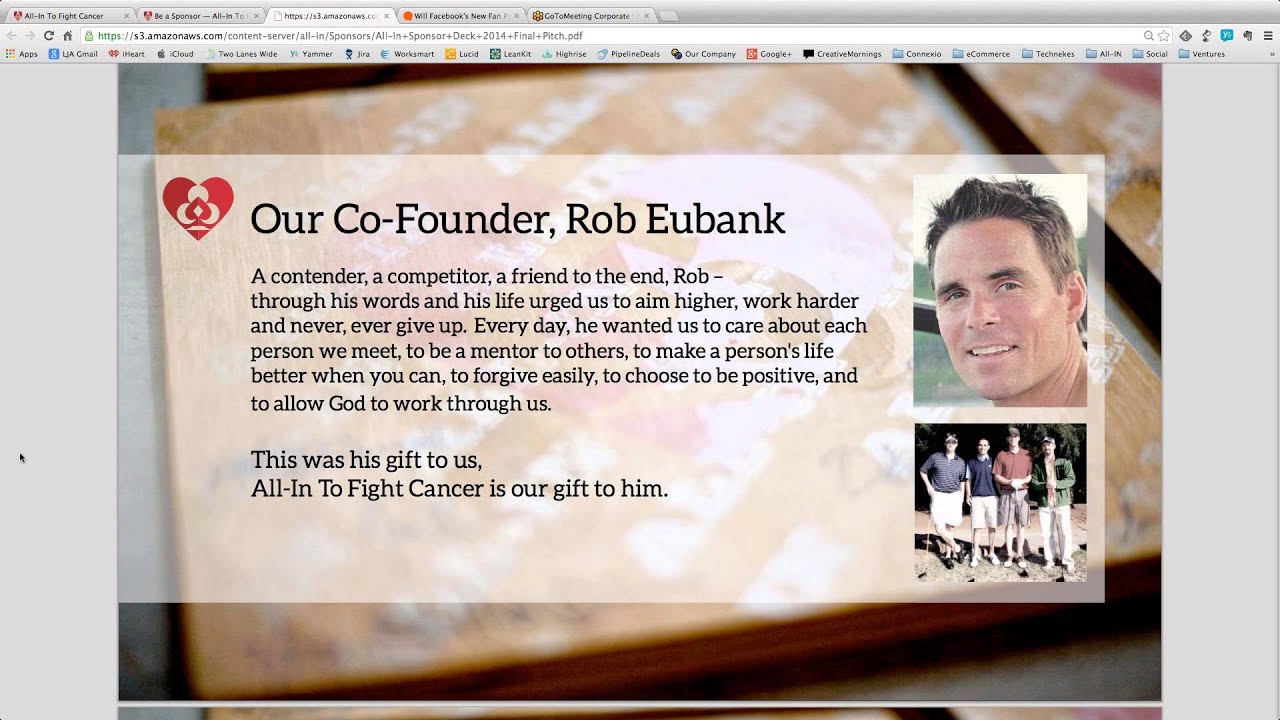
Yeah, sure. It's my pleasure to tell the story. And just so that everybody's clear, the person who's making a difference here is not me. I have an incredible team of people who have contributed to this effort. I'm lucky enough to be running a company where we have great resources. We have engineering talent and creative talent and people that have contributed enormously to the creation of the brand. And the brand has moved forward and helped us to raise raise funds because of their efforts, but more importantly, the real spirit of this thing was a gentleman by the name of Rob Eubank. He was a friend of mine for more than a decade, about 15, 16 years. He was diagnosed at a young age, 38, with colorectal cancer that traveled to his liver, and we lost him about 3 years ago after a 3-year battle with cancer. And to be honest, Everything that we created, everything that we've done, and all the scale and capability that we've been able to accomplish up to this point, about 3.5 years into the process, has been on Rob's back and in his memory. He was just one of those people who everyone who came into contact with him was a better person for it. His glass was half full, even down to the very end. And, you know, we like to say, and it was one of Rob's great sayings, Rob Eubank was a life well lived. And this is always in memory of him. And it's really because of him that we've been able to have any measure of success at all up to this point. You know, All In to Fight Cancer was an idea that Rob and I came up with in the last round of golf that we had a chance to play together about 6 months before he passed. So he's my co-founder. And it's not a super original idea in the context of Texas Hold'em tournaments. And for those of you that are looking to start raising funds or get active and maybe begin something, there are some really interesting things about the format that make it a really useful tool. How Rob and I came to it, frankly, was through experience. United Easterseals had done a very small poker tournament in the weeks before. He and I were trying to spend as much time together as we could, and so we had gone to a tournament, a very small tournament, and had a really good time. And there was a couple of interesting reasons why we had a good time. And for Rob, his cancer was very aggressive and his treatments were therefore very aggressive. He was a young guy, so they treated him very aggressively. And as a result, you know, there's a lot of opportunities to do interesting things, and I would never discourage someone from a 5K or a great bike ride or a long walk or any any vehicle that you can use to try and raise funds for whatever it is that you need to support or that you feel passionate or compelled by, because they all work, and they all have scale, and they all can create great opportunity. But for Rob, the thing that we talked about was he just couldn't physically do that anymore. So he and I decided that it was a really interesting and very intimate experience to sit at a table with a handful of people, be in a room of tables with a handful of people, And to create an opportunity for cancer survivors to interact with folks on a very one-to-one and intimate level through kind of the interactions and the fun that happened, a lot of table banter and energy in Texas Hold'em. And so we kind of tapped into the Texas Hold'em wave and we created a concept that we think is interesting because of the relationships frankly that are created as a result of being engaged in a Hold'em tournament. Now, we've kind of blown up since then and turned it into It's really a night of celebration in honor of Rob and all the survivors. My sister Julie, who is 8 years out of a stage 4 lung cancer diagnosis, she's frankly a medical miracle. She'll end up in the textbooks. And for many, many other people in the Charlotte community and people we've been touched by. But the event itself is a really interesting opportunity to connect people. And, you know, when you're out trying to raise money, at the end of the day, it's no different than, you know, the work that you do. in B2B and in marketing, the work that Eric and his team does, in the end it's relationships. And so unbelievable opportunity to create relationships through this format, and I think that's been one of the driving forces for us.
Yeah, that's awesome. And, you know, I've been to a lot of fundraisers that tend to spend a lot of time looking back and sharing pictures, and I know that that's going to happen tonight, but one of the things that I'm pretty excited about, and I've been to the Fillmore here in Charlotte. I've seen the room empty. I'm gonna see the room packed with people, but it's really all about a celebration and being excited about what we're doing to help fight cancer. So Steve, you got the website up here right now. Maybe walk us through some of the areas, you know, talk a little bit about— you got some great sponsors. I know that there's a little bit of a slide deck here that has a little bit of information about the effort. Maybe we can walk through and, you know, give us a little tour.
Yeah, absolutely. So the first screen you're seeing right there is my friend John Luther, and John is playing in a band for us. We do have live music at the event, and his band is called the Whiskey Dollars. They're a fantastic group, actually super talented. They've been involved from the beginning. The poker tournament has grown to be a poker tournament, and this year will seat about 350 people. So a fun competitive tournament where everyone from first-time players Like Eric will be there tonight, and I'm sure he'll do fantastically. We have 2 or 3 people that will sit tonight who have competed, and one who's actually won the World Series of Poker. And everybody gets to learn and have fun through the process. So the tournament is the core event. We'll be surrounded by 350 poker players, another 250 folks attending, socializing, having fun, listening to music, eating, drinking, winning prizes. Raffles and interacting with our benefiting organizations so that they can understand where our money goes. We're a hyper-local organization, so every dollar of proceeds goes back into the local cancer community to organizations that are directly involved with individuals, survivors, and their families in helping them navigate the waters of dealing with the disease, as well as to the medical community here in Charlotte. So it really is a celebration of life, and I will say that this is also a reflection of Rob, no doubt, in his personality. He did actually say to me, and I don't know, it's been a while ago, so I'm not sure I can quote it, but I promise you it sounded something like, please don't get all my friends and family and colleagues together and sadden them with a slideshow of children and sick people in hospitals and infusion centers. He's like, just don't do that. This has got to be something different. And so, we took that and we ran with it, and we turned it into a party. So, as a great reflection of Robin and the spirit of who he was as an individual, this is a giant celebration. And I think that's interesting because it's created some really unique relationships for us on the sponsor side. It's created an energy and a vibe that is unlike any, we believe, any other fundraiser you'll go to. This has got edge to it. It's got a real brand to it. It's got buzz. It's got huge opportunity to create relationships and to create intimacy. And above all, I think sponsors have been attracted and fundraising has begun to scale because people see it as an opportunity to be engaged in a very fun way. And so sponsors bring clients, they bring employees as a gift for a night out, and they've contributed and they're very excited about the format and the fact that they can do this. and that they can welcome their colleagues and their employees, and everybody can have a really fun and interesting night out, and it really feels like a grand time. And so, that's a really key part of the format. So as I navigate around, I'll show you a couple things. We've got certainly corporate sponsorship, you know, is a really interesting space. I think there's perhaps a, well, you know, The actual statistics or the economics, I want to be careful not to misquote, but here's what my experience is, is that giving keeps growing. So there is a competitive component to the nonprofit space, so I do believe, and it's, you know, as a social entrepreneur and as an entrepreneur who started a lot of businesses, I was even shocked by what can be a competitive kind of feeling. There is a competition out there for every available dollar. So you do have to do your due diligence. You have to create an interesting model. You have to make a connection with people on something that they are passionate about, and you have to tell the story and be impactful, and pull that all the way through to your giving so that there is transparency and that there is an obviousness to the benefits that are being created by the effort. But if you do all that, as you can see from our reel right now that's going across the screen, Sponsorships will come. Is that— I'll just click there.
There we go.
There we go. There's the big board. That's where we sign everyone's name that we're playing in honor and memory of. We've got food and vendor sponsors. That's actually Corey Eubank, who is Rob's widow. We've got consulting companies. That's my sister, who I mentioned earlier, who's a stage 4 lung cancer survivor. We have private equity companies. Pamlico Capital. We have car companies. We have friends of us that own marketing businesses. It's kind of a real interesting composite, and the vibe is really exciting. It's an intersection of entrepreneurs, of technologists, because that's been mine and Rob's background, of corporate folks, and of hardcore— the hardcore poker community. And so, you can imagine this kind of melting pot of a room that is full of energy. and excitement. And so it's created some really interesting experiences and some really interesting ties back to sponsors, and that's been really, really powerful. And of course, there's always our benefiting organizations. Let me see if I can get that right. GoGenGo, you should see on your screen here in a second, a very important organization that provides financial assistance to single mothers who are at the crossroads of a decision You know, do I put food on my table or do I show up at the infusion center and pay the bill for my treatment? Which is, you know, I mean, I get chills every time I say that out loud. It's a horrific decision to have to make. I mean, I just can't imagine it. And GoGenGo has been a benefiting organization from the beginning for us, and so they provide direct financial assistance to that community of folks that are kind of in that position or that situation. So, you know, as you're thinking about getting this thing or that you might be passionate about, or if you have an interest in getting involved, you know, you don't have to start something. Volunteers, we have, we'll have 40+ volunteers this evening to pull this event off. It can't be done on any individual's back. You can volunteer, you can spend time with these organizations through time in their programs, actually delivering the benefits. We have many people that have since coming to our event volunteered for our benefiting organizations to go out and help the actual individuals that we're trying to get financial assistance to. So you can get involved that way, and if you're so inclined and have a bit of an entrepreneurial itch to scratch, then I would encourage you to go out and maybe try and do something on your own. You don't have to do anything big. I mean, certainly in the cancer community, and this is true as Eric indicated earlier, of any community that you're passionate about, You really, I mean every dollar really does make a difference. And when you sit with these benefiting organizations and you see what they go through to try and raise funds to provide these programs to the people who are in need, again regardless of the charity, you realize that every dollar makes a difference. So I hope that you can get excited by what we've done, but I also hope that you can get excited enough to go out and be a part of something as well too, because I do believe that the pie keeps getting bigger and more and more money keeps going to the right places. to try and make a difference. You know, for our tagline, it's, you know, you can beat the odds, or we can beat the odds, you can bet on it. So, you know, I think it's really important for people to understand that while you might be looking at something that looks interesting and at scale, at the end it started with Rob and I, and it can be done, and every little bit has a real impact.
Yeah, that's a, I think, a really important part that, again, I mentioned at the beginning, but I really want to reinforce is, you know, starting with an idea or a concept, and some of it might be just volunteering and actually seeing something with your own eyes and realizing that there is a need out there and a benefit. You know, a lot of the folks that join us on Free Webinar Wednesdays also are business owners, and while we certainly don't want to downplay the charitable benefit because that's really why we do it, as a business participating in this, like a sponsor, or if you show up and you participate, there's networking opportunities I don't know if you've got any stories or examples of a business advantage here, but being seen as a business that supports charitable effort is a good thing. I hesitate even saying that because I don't want people to think that the only reason you participate in charity is because you get the good warm fuzzy out of it, but there are some legitimate business reasons to do this and to participate. There's some good networking that goes on. I don't know if you've got— Any comments about that?
Yeah, I mean, certainly it's not— I don't want to overstate it. It's not at the top of mind for everyone, but corporate and social entrepreneurship is a very important topic. And I can promise you, I work in the B2B space, and my clients have been contributors. They have been very impressed and appreciate deeply because they all have connections to cancer in one way or another, the fact that we take time and energy out of our company to deliver a benefit to our local cancer community. So your existing customers will appreciate it. I can promise you that there are people out there, I deal with them all the time, and corporate people, people that make real buying decisions for whom, you know, kind of we all often work for and work with, who will in part make that decision on the data point about the organizational culture and the corporate or social responsibility that the organizations that they work with feel. There are people who are in charge of social responsibility at larger organizations, and oftentimes, many of them will be at our event tonight, they will look at us differently as an organization because they know that we are committed to a cause, especially if it aligns with a cause that they are also committed to or passionate about. I had a business development call with a very large utility about 3 weeks ago about sponsoring All In. They were very excited about the opportunity and they asked me on the phone, I made no attempt to try and actually sell them anything, I just wanted them to show up at the event, have a good time and donate some money. He said to me, this individual, this is a Fortune 200 company. He said, this event is fantastic, we've experienced cancer in our employee and family community, we want to be a part of that. And then he said, so tell me what you guys do as a business because if you can do this, this well, we're interested in perhaps how you could work with us. And that was unsolicited from their end, which is crazy. So I do think this stuff makes a real, real difference.
Very cool, very cool. Well, before we went live here, we were in our pre-show and you were walking me through some of the other areas of the site. I know that there's slide deck that has some information on it that I want to make sure you get an opportunity to pull up, to take a look at, and certainly talk through it together, but then also kind of chat a little bit about some of the information that's in here. So if somebody wants to come back, we'll kind of reinforce how somebody can make a donation if you're interested in supporting it financially. If you are within driving distance of Charlotte, North Carolina, and would like to show up to the event tonight, we'd love to see you and would That would be really cool, but if nothing else, we want to make sure we get through these slides and kind of talk a little bit more specific about the particulars of the event and kind of what you're doing.
So thank you, I appreciate that. I do want to tell the story as often as I can. And so the event this evening, All In to Fight Cancer, it is primarily, as I indicated, a Texas Hold'em event, but it really is a large celebration of life and of cancer survivors. And there'll be many, many people there from the oncology community, the people that directly support these folks. One of my favorite tables last year, and there's 9 people at a Texas Hold'em table plus a dealer, who's the 10th person, if you guys aren't familiar with the game. One of my favorite tables was a gentleman, Richard, and he was surrounded by 5 research scientists in cancer, his wife, and the rest of the table was filled out by his nurse team. They were— he was in experimental treatment and therapy, and his entire treatment regiment was created as part of a late-phase trial by this team, and they came with him and sat at the event and experienced the event with him. And, you know, it's that kind of thing that we're shooting for. And so for us, that ability to, you know, kind of— let's see if I can scroll this up— tell those kinds of stories is what makes us really interesting. And that's a very— they're in the local community, and I'm showing Hopefully this will transition in a second, the grassroots slide. Is that coming up? There we go. So, this is really interesting and I think important for you all who are thinking or considering doing something. In the first couple years of the event, we raised a couple hundred thousand dollars. We're raising $125,000 just tonight. We're going to go up over $300,000 to $350,000 and pretty quickly to $500,000 here in the coming weeks and months. And it's all been very local, and I think hyperlocal is a really interesting thing. And let's all be honest, there's some big national organizations that have had issues, right? We all know about Livestrong, and I'm an avid cyclist. I know Eric is as well too. And to be honest, Rob got to ride with Lance Armstrong, and it gave him months on his life. It was one of the most empowering experiences that he—
Wow.
that he had. And so, you know, forget your opinion of all that stuff. The big thing is it's very difficult for a large organization to pull through a hyperlocal impact and a benefit. It's very, very challenging. And I think they and other large national organizations have trouble sometimes tying and connecting to the local community. I'm of the opinion, and I learned this from my sister, that a grassroots approach, that a hyperlocal approach is the most highly valued. She's the one that taught me to give back locally, because you want to be able to point your supporters, your sponsors, anybody who's volunteering, you want to be able to point them to the impact that you are making, and that's easiest and best done in the local community. It also frees you of the burden that we have in the 501 world of being excruciatingly transparent with everything we do. And if you are delivering value back locally, it makes that transparency that much easier. So we are a grassroots organization. We are very hyperlocal. We do have an interesting concept. And I actually had the pleasure of sitting with a gentleman yesterday who has come all the way from San Francisco for our event, who is going to help us figure out how to repeat the model in multiple cities and considerably scale our fundraising efforts and go national. So even with a hyperlocal execution model where you are delivering benefits, you can still pick that up and move city to city and create even greater benefits that way. Let's see, let me scroll up here. This is Rob. I'm glad you guys got a chance to see him, and that's a picture of us after that round of golf. If you go to our website, you'll find a link on there called Remembering Rob. Read that story. I'm a terrible writer, but it's something that I wrote because it was a powerful experience. Yeah, do you want to click on that, see if I can get a transition? Thank you, Eric. It was a powerful experience I had with him, and it tells an amazing story. And I think the thing here from a presentation standpoint is the impact story, the passion around kind of the genesis of your idea, is something that will be one of the most important things to you as you figure out how to do this. I know Eric has a fantastic story with his experience with the young girl who had blastoma. Her name?
Christy.
Christy.
Christy Thomas.
Christy Thomas. I like to We say everybody's name as often as we can because it keeps them top of mind for us. That is a really important thing and it's an important tie-in. That seed of passion is kind of what will carry you through and it's a lot of what things are based on. And as I indicated in my opening, you know, this whole thing is on the backs of Rob because he was so powerful and he was so positive and everybody that he came into contact with was compelled by him. And so that's a fantastic thing. So keeping it local. Personal, and to be able to tell an impact story, I think, is really, really important. We did— let me try and transition that in. There we go. We did have a lot of discussion about poker. It's not an accident that we picked poker. It started with that experience that Rob and I had, but, you know, this is a long shot of a venue. We're gonna have 600 people, probably between 500 and 600 people at the event tonight. Which, you know, they go out after event night and they tell this story and they share the fun that they've had and, you know, it's part of how you grow is through, you know, interacting with the people that are supporting you. And it's really, really, it's really interesting for a number of reasons. We talked about the fact that, you know, survivors can do it. We're going to fill this room with folks including, I think tonight based on those folks who are willing to self-identify, we think we'll have in between 30 and 50 cancer survivors in the room. And we'll have another 125 people from the medical community. That are directly serving them. So this is a very intimate format where you can create and enable a lot of really interesting interactions. And you can sit your sponsors and your supporters with these people. I can tell you dozens of people over the last 3.5 years have come to me and said, you know, I came to this event because it was cool. Like the brand is cool. Texas Hold'em is hot. I really dig poker. It's a really fun thing. And I sat at a table where there was a cancer survivor. And they've changed my life. And so I think the thing about Hold'em that's really interesting, and I think the thing that you all should strive for should you decide to kind of head this direction, is intimacy and relationships. If you can create those relationships and create those interactions, then you can have a really significant impact on people's lives. And that's true, like I said, for your supporters and attendees as well as your sponsors. They want to feel connected to the cause too. These folks pay real money. In our case, corporate sponsors pay $10,000 to be a part of the event, which is not a small check. And in order to get that money raised successfully, they need to feel like something really important is gonna happen and they need to feel a part of it. And the fact that we have an event and they can be a part of it, and the fact that they don't have to train for it, you know, I'm— Eric and I are both fitness guys, as I'm sure many of you are, and I love to hop on my bike or go run a 5K. 5K, but not everybody does, right? They can come here and not have to sweat it out, which is kind of nice.
I will guarantee you my Pedaling with a Purpose event is going to be in September, which is National Child Cancer Awareness Month. I do a triathlon, a half Ironman distance triathlon at Cedar Point, which coincidentally happened to be one of Christy's most favorite spots in the world. We rode several roller coasters there together before she passed. I will guarantee you I will come out Much, much less sore and much less sweaty this evening after a poker tournament than doing a triathlon, but yeah, so it— but both good nonetheless.
Yes, yes, no doubt. I do think you have to take really seriously what it is that you create, and you have to kind of create an experience that's meaningful. And again, this can happen in all sorts of different formats, but, you know, an event can be really, really fun, as we indicated, and I have a team that has taken great care with the brand, you know, the artwork, the posters, the color of our apparel and our shirts, the mark itself, the room and the venue that we've chosen to host the event, the musicians that we choose, the color of the flowers that will float in the water on the clear vases on the tables, the color of the raffle tickets, the food selection, These things have been meticulously managed by my team, and because of that, there is a real sense of brand around what we do. And our real goal or objective is to deliver a world-class event. I want someone— so I want somebody to get excited about being a part of this. I want somebody to give to support the local cancer community. But if all someone did was participate, I still want them to leave blown away by the experience, even if in the rare case that they are not moved, And passionate about what we're passionate about, I still want them to engage and be blown away by the experience. And I think, you know, they'll tell the story, and I think the scaling of that and the network effect of that is really important.
Well, you have no idea who they're going to tell the story to that is going to be equally moved, will show up next year, and they're going to be, you know, the hidden diamond that all of a sudden is connected to somebody that's going to make a really huge impact for the organization.
So, and let's talk about business, right, because we're all business people here. You got to deliver sponsor impact, you got to deliver value for these guys as well too. So we've done a tremendous amount of work to try and create a program that delivers reach in the local community. Some of our assets include the experience at the event itself, we do a tremendous amount of grassroots work with partners and partners that are willing to partner with us. Our posters of the event are hanging in about 500 retail locations around Charmeck right now, which has been fantastic exposure. Every piece of literature that we distribute carries our sponsor marks with it, and they're getting, you know, visits and eyes in the community and impressions in the community that are valuable. So there's a whole print and collateral component to what we do, and that's a big part of value creation. You guys on the call here, and certainly Eric, are way more experienced and experts when it comes to social and digital than we are. We're kind of hardcore B2B marketers and techniques, more on the data and technology side. But the reality is, people are online, man. It's like crazy. Let me click that in. So, we've kind of gone to all the typical places that we know, at least as a team. You know, we go to Facebook, we go to Instagram, we've got a LinkedIn page and group. And we're doing Facebook and everything we can socially. We've got an email list now with about 5,000 opt-in users. We have co-promote partners that send another 25,000 to 30,000 unique emails on our behalf to their, their lists. And, you know, digital is definitely the place where you can have extensive reach. And, and this is actually a place where I would say we do very, very well for our sponsors but have not necessarily figured it out for ourselves. This is where some organizations, I think best in class in my opinion would be Movember, have figured out how to scale fundraising through social. And that is something that we are working on and spending a lot of time as a board strategizing, is what's next for us in digital and how do we extend fundraising into digital. Movember is an unbelievable organization. I think the concept is unique and interesting. You should check them out. I look like an absolute moron in my stash every November, and my wife wants to just hang me up. She's like, this is ridiculous, you look like a, I don't know what, like a '70s porn star. It's just terrible. That aside, they're a fundraising, a phenomenal fundraising organization. I think they're going to do, and I don't know the exact numbers guys, but between $50 and $100 million worldwide in 30 days in November, right, by getting dudes to grow mustaches. Like, I don't even, so I'll tell you a great story. And this points to the fact that there's always ways to improve and do things differently, but I'll never forget our first event. As I indicated, we had raised some pretty good money, and I was going to deliver almost a $20,000 check to Livestrong in Rob's honor as one of our beneficiaries. And so we went down to Austin to do it at the corporate headquarters, and Rob, as I said, was a supporter. I had had a great experience with them. So I show up in the office with my $20,000 check thinking that that's pretty important, and it was because every dollar matters. Literally every dollar matters. I happened to be sitting next to the guy from Movember. I said, hey—
Reality check.
Yeah. I said, hey, what are you doing? He says, oh, we're here to meet with the Livestrong guys. We're a big supporter of theirs. I said, oh, that's fantastic. What do you guys do? He's like, oh, we're a charity called Movember. I was like, oh, that's really cool. What's the cause? concept. He said, we get guys to grow mustaches in November. I thought to myself, well hey, that's kind of novel and interesting. I wonder what they're doing there. I went on to say, well, you've got to hear about our event. I told him about our poker event and the night out and the celebration. I said, I think this year we were able to raise a considerable amount of money, tens of thousands of dollars, to which he said, that's awesome, man. You know every dollar counts. And I'll say it again, because it's true, every dollar counts. Of course, he then followed that up with, yeah, we did pretty good this year. I think we're going to do $25 million. To which I then realized that a poker tournament may be the least scalable idea in the history of fundraising.
But every dollar counts.
But every dollar counts.
Every dollar counts.
Every dollar counts. That was very humbling. And so there are, I say that to say there are professionals in this space, and I just met with one the other day who's going to take us to the next level. There are great user groups and communities to be able to figure out how to vet your idea, figure out how to execute on that idea. Again, if you are so compelled or we're lucky enough to compel you to get passionate about doing something, there are some great resources to maybe help you come up with a slightly more scalable idea than I did.
Give yourself credit. You're now 3 years into it. This is your 4th year and you're going to be going over $300,000 in funds raised that didn't exist, that maintained a position in somebody's wallet and didn't go to cancer before you got involved, you and Rob.
Yeah, no, I'm pleased and I'm excited, but I am humbled by some of the other folks.
Yeah, yeah, well, it's always good to have heroes to aspire to.
That's right, I've got lots. One of the other interesting things that we did And again, I'm lucky to have a great creative team. We created an apparel line that we are continuing to extend. And we are looking at some various brand extension opportunities right now to kind of incrementalize revenue and come up with some new revenue streams. But the nice thing about apparel, and this is common, right? You go to the 5K, you go to the bike ride, you get a jersey, you get a t-shirt. And I would say keep doing that, because just now in our 4th event, 3rd year, When I run around town in Charlotte and I'm at the grocery store and I'm at the coffee shop, I'm just now after a few years seeing complete strangers in our gear.
That's awesome.
So that's really interesting and I think it's an angle that people can play out and it's something that people— it's tangible for people to show that they participated, to wear around, to be proud of the fact that they're charitable in their own right through their participation. So we've had a lot of success We've had a lot of success via ecommerce and with distributing apparel to extend and grow the brand.
I will be sporting a nice red t-shirt that with any luck when I return home will not end up contributing to pink towels in my household. So I'll have to make a very conscious effort to ensure laundry is separated. But yeah, you've got some pretty nice swag. I will give you that.
The all in red is a It is a primary red for sure.
Yeah, it is.
Watch out for your tolerance.
But it gets noticed, so that's what you want.
That's right. So what I'm showing now is something that I think again contributes to the business component here, which is how do you deliver sponsor value? Well, you do a lot of things. You do apparel. You print them. You do radio. All sorts of multichannel stuff. But in the end, you also have to kind of present in a very professional way. And so being able to have them tie very easily to what they pay and what they get is important. You know, I ran around the first year, you know, basically being successful raising money because everybody knew Rob. And then I realized pretty quickly that wasn't going to be quite enough.
Yep.
And that I was going to have to get organized. And so one of the things we've done is start to build and vet sponsor packages to segment sponsorships, to deliver sponsor value at multiple levels, because not everybody can write a $10,000 check. As you can see here, our platinum sponsorships that we did this year were $7,500, and our table were $3,000. And we even did custom sponsorships for people that couldn't afford that. So you find very quickly that you have to make a real effort to use your business acumen, which I know we all have and we're all smart folks. But to use it, social entrepreneurship is a business just like anything else. And so you need to be prepared and you need to have a good pitch, because as I indicated earlier, There is a competitive nature to fundraising, and so being prepared and being professional about it is going to help you win some of those available dollars. And then of course, the community aspect here, hopefully you guys can see this, our 3 benefiting organizations this year, Go Jen Go, the Presbyterian Nurse Navigator Organization, and the 24 Hours of Booty, which is a fantastic bike-related charity. They do 24-hour road bike rides. I think 5 or 6 around the US. Go to 24hoursofbooty.org if you want to get involved. And they raise a considerable amount of money on scale, considerably more than we do for sure, by going multi-city, which is where we are kind of following their path. And one of the founders there, Spencer Lueders, who has a board and has a little bit more scale than us, so he has staff, he has been kind of my mentor in helping me figure out some of the finer details of how we might might scale the event, but they're local and we give to them, to a specific program at the Levine Cancer Institute's LCI floor, which is the pediatric floor, floor 2.
Very cool.
Yeah, so we use our local, our benefiting organizations to kind of deliver the impact and pull back through the impact stories that I think are going to matter to people as you go forward. And again, I cannot highlight enough how important the local and the real tangible impact can be for people, because it can really compel them to become a part of the organization. We've also got a few interesting ideas. We've got some concepts, some new concepts. This one is called Bet on Me. I wanted to show this because I do think that nonprofit is in a continuous state of innovation. There's a lot going on, especially around social entrepreneurship. There's a lot more people taking it more seriously as a business. There are some heavy hitters in the space that are really trying to take social entrepreneurship to the next level. And I think that that's going to have a dramatic impact on what was, you know, more traditionally viewed as just the nonprofit world, right? Do well by doing good, you know, and I think that that's a real thing and it's going to be with us for a long time. What that also means though is there's a lot of players in the space and that you're going to have to innovate and come up with new ideas. This is a great idea that was created by actually a team of interns that were here last summer. We had interns from 6 different universities come and participate in a summer project where they did some ideation and then tried to bring some ideas to life. This is a concept that they came up with that will get in play for next year's All In. It's called Bet on Me, and it's a way to scale our fundraising through social actually, which I know you guys are all interested in here. The idea is that for every player, they post that they are attending, they connect their Facebook or their LinkedIn, it goes out to their social network and gives their friends and people that aren't going to participate a chance to bet on them to make the final table. If they make the final table, then that individual and their social network get put into a small pool of folks for grand prize drawings.
That's cool.
So great concept created by a couple of young bright guys and gals this summer, and this is something we're going to execute on later. You are going to have to innovate. It is competitive, and you're going to have to come up with some interesting ideas, but if you do, I think the money is there. As I indicated, I've been blown away by the generosity of individuals and organizations. And that's my dad up there, if you can see him. We're toasting. We've had a lot of cancer in our family, and so my family comes down for the event every year. And that's Erin Fawcett, who is my event director. She's the one that meticulously plans the event experience. And this is how I conclude and how I thank folks for listening. And you know, you're not going to win them all. Not everybody is going to sponsor or get involved, but every chance you get to tell your story creates awareness and amplifies the potential impact that you can have. And so, you know, I would encourage you to get out there.
Great.
Yeah.
That's great. And, you know, we've been talking quite a bit. I think even though we haven't physically been together, which kind of sounds bad, we haven't been in the same city together, I'll put it that way, in the past 20 years. You know, we reconnected in large part thanks to social media. I can't remember if it was LinkedIn or Facebook that brought us together, but it was like, you know, holy crap, where you been?
Yeah.
What's going on? How's life? And you brought this to my attention 2 years ago and couldn't make it. Last year, conflicts. This year I said, I'm going. I'm gonna make this trip down. And so we talked about this, but there's stuff that you shared just within the last 45 minutes that I still didn't even really realize about what's going on. And certainly some awesome lessons and some ideas that I can take back with my charitable effort because, you know, that's the whole goal is to take this And hopefully this inspires you. I know it's done that for me. And Jeff and I have said a number of times, the benefit of Free Webinar Wednesdays— granted, we want to provide content that's interesting and helpful for our audience, but Jeff and I, 9 times out of 10, get so much more than we ever anticipated when we get guests that come on and share their expertise, and we get to sit here and just learn from them. And I'm sitting actually with our guest now, which has never happened, and I'm gonna have to start finding guests in Hawaii and maybe our—
Charlotte's as good as Hawaii.
Exactly. Well, last week we had a gentleman join us from the Virgin Islands commenting on it being 86 and sunny down there. So if you are on the show today and are interested in being a guest, just let me know. I'll have you come down and do a simulcast from—
Provided it's warm.
Yeah, provided it's warm and it's not hurricane season. You know, I was going to mention this actually before we started, and I don't want to put you on the spot, but maybe I'd like to ask you to close with— I know there's going to be an inspirational story that you're going to share on the stage tonight, and one of the things that you had mentioned during this session was the intimacy and the connections that are made at the tables. Um, you know, I overheard you talking to the videographer.
I know exactly what you're referring to. Yeah.
So without, without me breaking down and being a sobbing baby, because I'm going to mute my microphone because it's a pretty impactful story. Maybe you can close with that. And then we'll just kind of wrap it up with that.
So yeah, very interesting. So I have a good friend. My friend's name is Tanner. And Tanner's a young guy. He's in the tech industry. He's a product manager and great at leading teams build software, and I'd worked on and off with Tanner for a couple of years. He's young. He's 28, 29 years old, married, young baby, I think maybe a 1-year-old. He's always been very supportive and very helpful, and I've appreciated everything that he's done to help us get off the ground. He came to the event last year, and he's not a poker player. I think the fact that things— Yeah, like Eric. And I think the fact that, you know, you want to create an inclusive event is important, so he was comfortable coming and playing, but, you know, but it wasn't his thing. But he did pretty well. He is a bright guy, a good math kid, and as a result, he made it to the final table, which was pretty amazing, so he was pretty psyched. So he was at the final table of 9 and ended up coming in 6th place overall in the event, which I think is a super cool story. While he was there, because he's a very, you know, he's a solid individual and he cares a lot for others, he did his due diligence and he spent some time with our benefiting organizations at their tables. And in particular, he was very intrigued by the Nurse Navigator Program because we think it's a very powerful program. It's provided here locally by Novant Health, but also around the country navigation programs are provided by various healthcare systems. And he met one of the women who is actually a nurse navigator. Her name is Pam. And Tanner and Pam kind of became fast friends. He was very intrigued by the work that she does. And the work that they do is immediately stepping in upon diagnosis of cancer, and they become the single point of contact for the individual who's been diagnosed. Literally a bat phone for them to pick up and call them for any reason. Hey, what's going on? I can't get to my therapy. Can you transport me? Why do I feel this way? How do I deal with managed care? What are all these forms and paperwork and why am I getting these bills? I thought this was covered. Do I need a second opinion? Every aspect of a cancer diagnosis is so overwhelming. And what nurse navigators do is they peel that all away. They are the single point of contact for you to navigate the system once diagnosed, and their value is tremendous. And I think, to be honest, Tanner was very touched by that. And so he became kind of fast friends with Pam. Pam's a great gal and a phenomenal navigator. What none of us knew at the time, or did Tanner, he was sitting at the final table at All In to Fight Cancer with an aggressive form of testicular cancer that had been undiagnosed. And it was, as every cancer diagnosis is, devastating. But he's a young guy and he's a fighter, and he started fighting. And he happens to be in the Novant Healthcare System, and completely randomly, he was assigned Pam as his nurse navigator, the woman that he became fast friends with and the woman that he had met and spent time with learning what navigators do. He sat at our final table as a healthy, thinking he was healthy, 28-year-old guy with aggressive cancer and was assigned Pam to help him fight his disease. That connection is the story that we're going to tell this evening and it's incredibly powerful and I think it's most powerful because Tanner will be back this year. He's going to be back this year with the help of Pam. He has successfully navigated his situation. He had radical surgery. And has been through treatment, and Pam helped him every step of the way. And he's going to be returning, hopefully all the way to the final table, and will be at the event this evening. And we'll be celebrating his life and his strength as part of what we do at All In tonight. And, you know, the closer here is simply this: this could be any of us.
Right.
At any time. The numbers are staggering. The disease is overwhelming and it's very likely that each and every one of us who listen to or are on this call or otherwise listen to this webcast will be impacted in some way, shape, or form by cancer. And that happened in real life for us through Tanner. I just think it's an amazing thing to just remind all of us how we need to be vigilant, and we need to do everything we can to help because it really— it could be us at any time.
Wow. Yeah, I got chills when I overheard him saying that, and I just couldn't believe it. I was hoping that— I was hoping you'd be willing to share that on this show, and I'm glad that you did. I'm looking forward I look forward to seeing it again tonight. I'm going to record it, assuming that I've got battery power on my phone.
You will.
Because I'm going to be taking lots of pictures and maxing it out. That was really powerful, and I appreciate some of the comments. Definitely a great story and a great message today. With that, I don't think I can really add a whole lot more. Steve, thank you so much for being on the show.
Thank you.
I know being in person with you is a blessing in more ways than one. So this has been a great day. It's going to be a great evening. We're going to celebrate tomorrow on the mountain bikes, and I'm going to get to ride without ice and snow.
I'm looking forward to it, man.
But if nothing else, we're just looking forward to the event. So if you are anywhere near Charlotte and you'd like to come out and have fun doing some poker— the last thing, and Steve's being modest, but I'm going to make sure you see that big red button up there. If this has touched you and you feel like you want to make a contribution, hit that red donate button. send it in, provide a comment if you're doing it to support somebody or celebrate somebody or remember somebody. And if you happen to throw a little, we heard you on Free Webinar Wednesdays, that'd be kind of cool too. So we're going to take a couple of weeks off. The next couple of weeks I'm going to be actually conference traveling and Jeff's going to be out of the office as well, but we'll post something up. We're going to, I believe, resume back with our good friend Tom Petty, the social media online SEO rock star, not Tom Petty from the Heartbreakers. Tom Petty is going to join us and we've had quite a bit of conversation about Google+, maybe some more advanced tips and how that network is one that maybe we might be able to use a little bit better. We're really excited about bringing Tom back. We will be taking a couple weeks off. We will miss you and we'll post something up on Free Webinar Wednesdays and definitely we're going to get this archive out there. I do hope that you take the time to share it with with your friends and family because I think this is probably one of the more impactful shows that, that we've ever done on Free Webinar Wednesdays. So thanks again, Steve. So with that, we'll see you on freewebinarwednesdays.com. Have a great week, everyone. Bye-bye.







