
Free Webinar Wednesdays - There Is No More Page One in Google!
Eric Cook, Jeff Simpkins, and Tom Petty explain why Google's personalization and localization mean there's no single page one anymore. They cover algorithm updates like Panda and Penguin, Google's shift from Places to Local, and how to build your online presence through content and smart link strategy.
Chapters
Wednesday, September 18th, 2013 episode of Free Webinar Wednesdays. This is Eric Cook with WSI Internet Consulting where we work with businesses and organizations on helping them better understand and leverage the power of the Internet as a strategic business tool. You can learn more about me and WSI online at www.powerinternetconsulting.com. Powered by WSI.com. With me this week is my good friend and Free Webinar Wednesday partner, Mr. Jeff Simpkins. Jeff, say hello to everybody out there in Free Webinar Wednesday world.
Greetings everyone, this is Jeff Simpkins. I'm with Community Bank Consulting, Inc., and you can learn more about me and Community Bank Consulting, Inc. online at www.communitybankconsulting.com.
Excellent. Well, I am greeting everyone today from the Wisconsin Dells. I did a session for the Wisconsin Bankers Association and drove up and down the strip yesterday, and it's kind of sobering to see none of the water parks, at least the outdoor ones, with water in them. So it's a sign that fall has arrived and snow is going to be here before we know it, but it's It's kind of weird to be in the Dells without people running all over the place in their bathing suits and water parks going crazy. So where, where are you joining us from, Jeffrey?
I am sitting in my office at lovely Lake Norman, North Carolina.
Excellent.
Last time I drove through the Wisconsin Dells was in January when I was doing my relo of my corporate apartment from Minneapolis.
I'm sure it looks quite different Yeah, I suspect there was also not very much water in the water parks when you drove through in January, unless they were ice skating. You never know.
I was going to say, if there was any water, it was in the form of ice. I read online this morning that iOS 7 would be released at 10 AM Pacific time, and you heard it here first. I'm upgrading my iPhone even as we speak.
There we go. Well, if you experience any— of course, you're probably not doing that on the network, you're doing that over your Wi-Fi, but if you start crackling, we'll just assume that iOS 7 is causing some bandwidth issues with your download. So we'll give you a pass with that. You'll have to let us know. I think for our Webinar Wednesday friends, we are trying to line up the time to get our good friend Greg McPherson to come back and chat. There have been some Announcements in the Apple camp, some of them good, some of them kind of blah, but there's been things that have changed at Apple. He's our resident Mac geek guru, and we always love chatting with Greg, so we're hoping he can come back and talk a little bit about what he sees going on over at the Mac and the impact of the fingerprint and if the NSA and Obama really is going to be collecting a database of fingerprints on us or if that's That's not something to be worried about.
Probably not something we'll even know at first.
Yeah, that's probably true. Well, let's go ahead and we'll get started. Just as a reminder to everybody, we record Free Webinar Wednesdays, and today's session and past sessions are available barring any technical difficulties. I'll put that little caveat there. But assuming the little technical gremlins behave nicely, we put all sessions out on freewebinarwednesdays.com so you can hop back in and listen and review and share it with friends and coworkers. And we also encourage questions during today's session and very much would like to hear from you. So if you'd like to ask a question and you're attending live, just go ahead and type it into the chat box, and we'll monitor those and ask it when there's a break in the action. Given the fact that the title of today's session is There's No More Page 1 in Google, I suspect that that's going to generate a little bit of conversation from the audience. And so joining us, not from Wisconsin nor from North Carolina, but from what I suspect is sunny California, because the sun always shines there, is our good friend Tom Petty from Bay Area Search Academy and WSI and all sorts of other fun stuff. And Tom is going to share some thoughts with us on SEO and its evolution. And we welcome you back to the show, Tom. Thanks for joining us.
Hey, thanks very much. I really appreciate you guys having me here. And yes, I am in sunny California. We're having beautiful weather out here. It kind of feels like fall has arrived. We had a bit of a heat wave and a big fire here in the Bay Area just a couple weeks ago, and it's cooled back off, so it's feeling good out there. So again, appreciate having you out here. So I think you guys have switched over to my screen, so can you see everything? Or see my screen? Okay.
There we go. And for people that are maybe— I don't want to say disappointed, but if you were expecting the Tom Petty of Tom Petty and the Heartbreakers, you know, Tom Tom is a different kind of rock star, but his talent is in the SEO world, although I don't know if you're a musician or not. I don't know if we've asked you that.
Yeah, I am a musician, but not of the rock variety. My brother is actually an atmospheric physicist and a professor up in your neck of the woods at the University of Wisconsin. They're in Madison, and he has a rock band, and I think he's a fairly good guitarist, and people comment about that, and he goes, well, my brother is Tom Petty, so of course I'm good. So, yeah, different one.
Different one.
Yeah, so I'm a little younger than that one and far less drug abused, so.
Yeah, well, that's probably not nearly as much of a Yeah, yeah.
Well, cool. Well, we're excited. Tom and I just got back a couple, 3 weeks ago from our global convention out in Toronto, and there certainly is a lot of buzz going on about Google and search and businesses maintaining their presence in the search engines and how to impact that and what influences it. So I was really excited when we got to reconnect and Tom said, hey, you need to get me back on the show. And I said, you pick a date and we'll make it happen. And I'm glad we were able to do that. So for folks, I don't know if you've got this covered in one of your slides, but maybe people that don't know of you, maybe give us a little background. We mentioned California, but some of your background, and then we can go ahead and jump in and just see what's new with Google.
Yeah, absolutely. So yeah, I am here in California. I've been with WSI since about 2005, one of the old-timers. And later I joined the Search Engine Academy, got trained through them, and then worked with John Alexander to become one of the master SEO trainers with the Search Engine Academy here in the San Francisco Bay Area. And I see he's online as well, so shout out to John and say hi to him. But yeah, so I've been a trainer of search engine optimization and online marketing since about 2008. And, you know, Google— people complain because it's like the landscape keeps changing, and it makes it a bit of a challenge for people that are doing online marketing. And for those of us who are doing the teaching, it's even more of a challenge because we've got to keep ahead of the curve and try to figure out what is going on in the search engines, and definitely Google keeps making these fairly large changes in the systems that, for those of us that are doing the online marketing for our clients, I feel that it's a good thing because it's taking some of the cheaters out of the system, but it does make it a bit more of a challenge to keep up with that kind of stuff. So that was kind of what I wanted to talk about today, or what I suggested. I wrote a blog post a couple weeks ago that there really is no page 1 on Google anymore. And so that's just— and that's generated a lot of conversation on the social media circuits, on LinkedIn and that kind of thing. And so I thought, well, maybe that would be a good webinar topic to talk about today.
Absolutely. So, well, let's, let's go ahead and dive in and maybe explain, you know, what you mean by there's no page 1, because there obviously still is, technically speaking, a page 1. But the definition of that, I think, is changing significantly. And that's, I think that's some of the mystery that you're going to help unveil during today's session.
Yeah, and I think that some people understand some of this, but I think it may, especially with some of the recent changes that Google's made, and we'll talk about that, it's definitely making it more of a challenge for those of us who are doing online marketing. So kind of the way I introduce this is people always tell me, you know, well, I want to get to the top of the search engines. I want to get to Google, I want to be number 1 on Google. I had a guy that emailed me recently, a friend of mine, and he said, yeah, I want to be number 1 on Google for the term schizophrenia. And the other term that he wanted to be at the top was for mental health because he has a website that he's working on. And I'm like, dude, you're never going to get there. It's just, you know, there's only one position on number 1, but there's lots of other things that we can get you up there onto the search engines for, but just You know, that's just completely unrealistic to just out of the gate show up for those kinds of things. So everybody wants to be number one. There can only really be technically one number one. We want to get onto the first page, and I should have quotes around the word page, of the search engine results page. And there are lots and lots of ways of getting onto the top of Google. You can have local business listings, you can have Yelp listings, those kinds of things. You can do search engine optimization on your website, so it's building good content and, and that kind of stuff within your own website. You can build optimized content on other people's websites that show up on the search engines, and that could be writing guest blog posts on other people's sites. It could be Publishing optimized press releases. There's lots of ways of getting out onto the search engines for your key terms. So everybody wants to be number one, but there can really only be number one. So do you agree with that? Do you hear that kind of thing?
Absolutely. Yep. I think we're singing from the same hymnal on this topic.
Hopefully not preaching to the choir though.
Well, maybe that too. Yeah, so we're on the same page.
Okay, so, you know, I guess one of the questions that people wonder about is, is search engine optimization dead? And again, I probably should have quotes around the word everyone, but a lot of the things that people do for search engine optimization, making sure your keywords are in your title tags on your web pages, is very important for getting up onto the search engines. A lot of people spend a lot of time focusing on the description and the keywords meta tag. And I, I teach workshops as well, and one of the questions I always ask is, what's the most important meta tag to put your keywords in? And a lot of people stick their hand up and go, the keywords meta tag. And I go, wrong, because Google ignores the keywords meta tag. So use it if you want to, don't use it, it doesn't matter. Just don't stuff it full of keywords. And the description tag too does not influence the position on the search engines, but it's a great place to market to your potential customers. So a lot of this kind of stuff people know. People know that they need to have links coming into their website. Maybe they don't understand what the difference between good links or bad links, but they understand that links are kind of like votes, and the more votes you have for your website, the better it helps. WordPress and other tools, a lot of the content management tools, make it super easy to build in your keywords into your URL structures, your page names, your directories, and that kind of stuff. And even the online press release systems like PRWeb allow you to customize the URL that your press release is showing up on so that that can help you. So if everybody knows all the— knows the rulebook and everybody is playing by the same rules, and Google has roughly 5 500 factors that they use to determine who shows up as number 1. Doesn't that make SEO dead? Because we all know these rules. Do you have a thought around that too?
Again, it's like I'm kind of reading my own script because everything that you've got there is dead on. I have a feeling there's not going to be a whole lot that I'll want to take you to the mat on. I do think that what I think is an overriding— I don't want to say a concern, but I think what we're going to see here is what used to be something that you could easily outsource to a third party is really evolving into more of a cooperative arrangement with the business having to play a more active role in the whole concept of content and engagement.
Yep.
Because it's difficult, it's not impossible, but difficult becomes expensive when you want somebody to just do it for you. And the genuineness and the authenticity is really difficult to do when you just say, hey, I want to be the number one for schizophrenia.
Right.
Or I want to be the number one for, you know, whatever the other term was, mental therapy or therapy.
Yeah, mental health.
Yeah, mental health. You know, it's hard for somebody on the outside to do that, and I think what we're seeing is much more of a cooperative strategic partnership approach as opposed to, hey, you're a vendor that does SEO, do this for me and then show me how it works.
Exactly, exactly. And that's a great comment because I've even changed the focus of my business because, you know, it used to be people would say, well, I need you to do SEO for me and I need you to do this for me. And I've stopped quote-unquote doing SEO on people's websites. It's like, okay, yeah, we can fix up all your title tags and blah blah and do all that kind of stuff, but now your work begins because now you need to help us to help you building this content. And that's kind of what we're going to be talking about today.
Yeah.
Because it isn't just, okay, going in and fixing all this stuff. It's like a mechanic tuning up your website, but there's more to it than that.
I've got a question if you want me to put it on the floor at any point.
Yeah, that would be great.
Since Google announced that anchor text in press releases need to be coded nofollow, how do you recommend people use press releases going forward?
Well, press releases to me are a great way of getting the content out onto the search engines. I think that they are less valuable for link building strategies anymore because they know who the press release distribution sources are. The press releases show up in thousands of websites because they get syndicated all over the place. So I don't, I really don't think the link, it's, it's, I don't think it's a good link building strategy anymore, but it's still a valid way of getting one of the positions. on the search engine results pages that then sort of leads back to your front doorstep. I'm not sure if I'm answering your question.
I know we've got a lot of people that are probably familiar or maybe even really familiar with SEO, but maybe for the business owner that just heard that question and said, first off, what the heck is a nofollow link and how does that— I know the name itself says nofollow, but maybe provide a little bit of SEO 101 and explain the whole concept of press release and nofollow just so that everybody can get on the same page.
Sure. So a search engine optimized press release is basically you're building a page of content on somebody else's website, and typically it's on the press release company's website. They often will syndicate or push out your press release to thousands of media outlets. I typically use PRWeb. They're expensive, but they provide to me good value. My clients like it. They get good visibility. The nice thing about press releases is you can build links into them. And in kind of pre-Panda and pre-Penguin, the important thing was to have keywords in your content that you're building. So I'll switch over to Google here and we'll do a search for quality process equipment, which is a pretty generic term. And this is an example of a client where we've done a press release, a press release, a press release, and then here's their website. So they're showing up for 4 of the 10 positions on, on Google, and 3 of these are press releases. So it does give you an opportunity to show up for multiple places, and within one of these press releases they have a keyword link that says wafer-level packaging or, or whatever keywords that they want that are linking back to their website. So Jeff, what your question was, was about the nofollow, where links like this can be blocked or can have a— the kind of the vote value of it blocked from adding any value back to the target website. The link still functions and it still works and it can still lead people back to their website, but it sort of takes away from the value of the link or the keyword value. And so that's what their— Google's recommendation is, is like, okay, lots of people can spew these, these press releases out, but the links really shouldn't have any link value Because in essence, we as marketers are controlling that. So did I— did that cover it?
Yep, absolutely. Well, and just as a follow-up, just to confirm, when we talk about links and anchors, just to maybe clarify that, because that was also part of the question, maybe you could comment on that. What we're talking about from an anchor is really the The text that's being used as the hyperlink.
Yes.
That goes to the third-party site.
Right.
So we've got some jargon we work with in the digital space, so we want to make sure we don't lose folks. And Jeff and I, coming out of the banking industry, certainly are familiar with how jargon can confuse customers. So we want to be careful we're not doing that.
Right. And what I did here is I pulled up the source of this press release, so I can go in and look at the HTML coding on the backend. And sure enough, here's the link. It starts right here and ends right there. Oops, clicked on it. But what Jeff was asking is about the nofollow. So sure enough, PRWeb is adding an rel=nofollow, meaning that the link works but the value of the link is blocked from the search engines. It's telling the search engines don't Don't put any voting value on, on that link. And so they are adhering to what Google is suggesting here. So that's what, that's what that nofollow means.
Good, good. There we got to geek out a little bit. We saw you came out there.
Yeah, definitely.
I feel comfortable now.
Yeah, definitely.
Yeah.
Yeah. So kind of back to the original question here is, is SEO dead? Because it's like, okay, we know all this stuff. Google is changing the rules. Panda and Penguin, for those who don't know what those are, they're not cute fuzzy animals. Panda was an update that came out in 2012, about a year and a half ago I believe, that was also called the Farmer Update. And it was actually named after a guy at Google whose last name is Panda, not the animal. And it is intended to provide— when people do a search, that Google wants to deliver quality content back to the individual and not spun content or content farm created content. So Google wants to try to deliver stuff that's really useful back to people. And so the Panda update kind of chopped a whole bunch of content out of the search results by saying, you know what, this is really just not valuable information. It's just living out there just for the purpose of building links and just having thousands and thousands of pages of kind of spun content out there. So it caused a big change in the rankings of where people were showing up in the search engine results pages. Later, they came out with a Penguin update. I'm not sure why it's called Penguin. Maybe you guys know.
Was not somebody's Google name Penguin?
I honestly don't know.
Maybe they just went, well, the first one was Panda. It's a cute fuzzy animal, we'll call the next one Panda. And it's also a black and white animal.
I don't know.
Who knows?
I was thinking Burgess Merritt from Batman.
Whack, whack, whack, whack, whack.
Yeah.
Yeah, exactly. Little stiletto cigarette hanging out the mouth.
Yeah, something. So the Panda— I'm sorry, the Penguin update was really cutting out all of— or an attempt to cut out all the poor quality links that people were creating by generating a lot of content in lots of other websites and really quantifying or qualifying the value of links that are coming back into websites. Because it's easy to spew lots of content out onto these article marketing sites. They generate lots of links. Press releases generate lots of links. And therefore, the one who has the most links, in theory, wins. And so the Panda and Penguin updates have really cut a lot of the kind of what I call crap content and crap links out so that the results that people are getting on the search engine results pages are far better quality. And so that's good for those of us who are playing by the rules and doing things correctly and not trying to kind of cheat the system.
Cool.
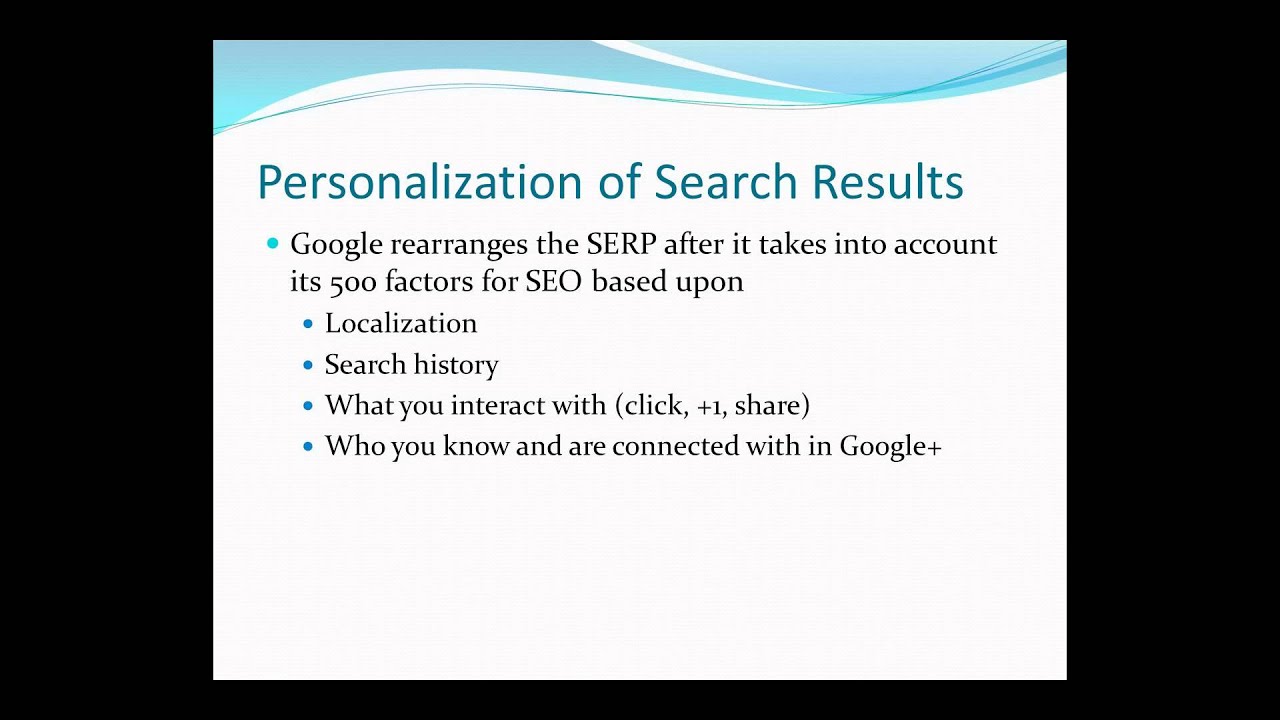
So all of that is good, and, and like I was saying earlier, people want to be number one for Google on the search engine results page, but Google has hundreds of factors that they use, and once they generate those search results, then they will actually rearrange what shows up in your own personal search engine results page, or the SERP, based on a bunch of factors. The common one that most of us see is localization. I've got a couple screenshots of what that looks like, but based upon what Google thinks you're looking for— so if I type in electrician, they assume that I don't want to do business with every electrician in the world, that it's probably that I want to do business with an electrician locally. And have somebody come in and fix my breaker box or whatever it is that I need. And I'm just not going to hire an electrician from New York to come out and work on my house. So they're going to localize the search results based upon some factors, and most of us know that. But what a lot of people don't understand is that Google will also rearrange the SERP page based on your own personal search history. So they're keeping track of what you interact with, what you search for, what you click on, what you +1, what you share, and what is it that you're searching for. So maybe if you're— the example I often use is if you're a fan of bass fishing, and so you always like to look at bass fishing stuff and bass fishing boats and equipment and where to go. Lake fishing and that kind of stuff, and you're not into fly fishing, you're going to interact with different things differently than somebody who is a fan of fly fishing and is going to have different types of equipment and poles and boots and whatever it is that, that they want. So they're sort of keeping track of this, and especially if you're ever logged into your Gmail account or your Google+ account or YouTube account or even your Google Analytics, they're keeping track of you as an individual And they're going to deliver up what they think you are more interested in versus sort of a generic search. And so it is sort of Big Brother-ish, but on the other hand, it makes a lot of sense because I'm more likely to get the results that I'm interested in rather than just random stuff that I don't care about. They're also They— and this is my personal theory, but I think that it holds water— is that Google tried to partner with Facebook, and they tried to kind of get into the inner workings of Facebook. And when Facebook snubbed them and said, no, you can't have access to our inside systems to know who people are connected to and who they're talking with, they said, fine, we're going to go create our own social media platform. You know, thus Google+ was born. And in typical Google fashion, it was a closed system. You could only get in if you had an invitation. And so people were scrambling trying to find invitations. And finally they opened it up to the world and said, okay, come on in. And now they are collecting even more data about us because they know who our friends are, they know who we're interacting with, they know who we're liking stuff or plus wanting things and, and, and all that kind of stuff. So they're sort of building this internal persona or picture of each individual so that they know who we are. Are we married? Do we have a car? Do we have a house? Do we have a dog? You know, we were talking about dogs before we got online. All of this stuff—
Or more than one. Yeah, yeah. Yeah.
You know, and, and so they're, they're building this persona about you because of our interactions and who we're connected with on Google+, so all of that is causing your search results to be different based on who you are as an individual. So far so good?
So far so good. I think therein lies the at least somewhat of an answer to the mystery of the elusiveness of the, quote, page 1, right? Because everybody's got their own, and it's more and more difficult because yours is different than mine is different than Jeff's. So that's, that's kind of the whole crux of today.
So yeah, I mean, that's exactly it. So the point of there is no page 1 on Google anymore is because I've got my page 1, you've got yours, Jeff's got his, everybody has their own They may look fairly similar to each other, but it makes it much more challenging for us as marketers, as business owners, and that kind of stuff. That's kind of what I want to get into today.
Sure.
This is just an example, and I think most people know this. I did a search for residential electrician. I'm sitting in Livermore, California, east of San Francisco. And Google comes up with this page and says, well, there's 109 possible million results for the term residential election, but you probably don't want to do business with everybody. They look up my IP address on my computer and say, oh, it looks like you're sitting in Livermore, therefore you probably want to do business with an electrician in Livermore. I'll get some ads that maybe Tied to my location. Sure enough, there's a map over here with some thumbtacks, and Main Electric and Gentek Electric are the 2 main electricians here in Livermore that are always competing with each other. And it just kills Gentek if he shows up below Main, and it kills Main if he shows up below Gentek, and they're just like always just trying to outdo each other. But for me as a consumer, That's the search that, or the search results that I get. So that was localized for me personally based upon my location. So I have a hosting company that I have a dedicated web server in there in Omaha, Nebraska. So I remote controlled into the server and did the exact same search from that server, which is sitting in a very, you know, out in the Midwest somewhere and did residential electrician, got about the same number of results. But sure enough, now I'm getting electricians in Omaha and Bellevue and those. So this is where— this is personalization for where you're physically sitting or where you're looking for. And most of us know this and how to get yourself listed on here. Google is moving from Google Places over to Google Plus, so more and more you need to start establishing that business location on Google Plus. So, but another thing that Google is doing is based upon our personal search history, based upon who— what they know about us as individuals. And a bunch of other things we probably don't really know, they're changing these search results based upon what they do know about us. So here I did a search for how marketing has changed, and I'm logged into my local account, and I'm sitting in Livermore. It's not really a location-based search term, so they're not giving me location results. But I did get an ad, so I did get a little bit of a localization here. Apparently this is a company that's marketing locally or in the Bay Area or California. I don't, I don't know. And then what I wanted to point out is on the next slide you'll notice that there's this video and then there's a couple of blog posts here. And when I did it from Omaha, Nebraska, now I've got a different result. I don't have the ad up at the top, but I've got a different result that got inserted in between the 2 blog posts. That wasn't there when I was searching on my own ID, on my own computer, versus doing this from the server over in Omaha, which is sort of a pure server because I don't ever do any kind of searches from there. I just did it for this webinar. So the point here is that it is changing the actual results that I'm seeing. And so whatever this article is, they may show up, they may not show up for that search term, how marketing has changed. And as marketers, that makes it very difficult for us to know what to do because we, you know, we can no longer feel confident that what we see in the search engine result page is actually what our customers are seeing. It may be that Yeah, it looks like we're showing up on— at the beginning of Google. It looks like we're on page 1, but why aren't we getting any traffic? Why aren't we getting any traffic to our website for that particular search term? And you don't really have a good answer. So it may not be what your customers are seeing and what other people, even if they're typing in that same phrase. This sort of renders ranking reports as being essentially worthless because a ranking report is doing a search and telling you, yeah, you're in position 3 for XYZ term, but you don't really have any good confidence that that's really what your customers are seeing because again, Google is customizing those searches for that person's individual search results.
We've got a question related to Google+. We were just on that topic, but Linda says, a little confused about Google+ Pages, Google+ Local, Google Places. It seems that Google Places may still exist, and as businesses, if you go in to set up, you may get the option to create a Google+ page for a local business or maybe a Google+ company page and just wanted to know, maybe clarify the difference between those, whether it's from a consultant's perspective setting those up for our clients or for the business owners that are joining the call or listening to the webinar and the recording and they want to go do this themselves. What are the options there?
That's a fantastic question. I wish I had a great answer for that. Because to be honest, it confuses the hell out of me too.
Yeah, ask Google.
Yeah, well, I mean, seriously, it's— I, with my own business, I've had— it used to be called Google Maps, then they called it Google Places, and I used to have a Google Places page, and then I heard, okay, now we need to switch it over to Google+. And so I heard that some people were automagically being migrated over Automagic, by the way, is a technical term.
I use it myself.
Yeah, yeah. That was kind of what I'd heard, and I kept waiting to be magically transported into Google+. It never happened, so I finally went in and made some changes. Meanwhile, I'd also changed my corporate address So I went in and changed that. Well, all my reviews went away. I had 18 5-star reviews and they all disappeared. I'm like, ah, what happened? And I had to reverify my account and went round and round and round and round. So then it's like, okay, forget this. I'm just going over to Google+. Went in, tried to set up the account, and it kept showing up with my old address. And it's a long story, but finally I figured out how to actually get a hold of Google and get a hold of the person And I don't think they even really have quite figured it all out. I think they are trying to move people and herd people into the direction of Google Plus because that's where the social platform is. But I don't think they've quite figured it all out yet on what exactly they're they're. Final strategy is. I mean, I finally got my whole listing straightened out, but, but they basically said, oh, you can't change your address if you have moved your business. You have to start a whole new listing, delete the old listing. Yes, all your reviews go away because that's no longer the same business, it's a new address. And I'm just like, oh my God, it is the same business.
Yeah, that's a crack.
Oh my God. I was just so—
That's a technical term too.
Yeah, yeah. I was just like, really? That just makes no sense. Anyway, I'm sorry I don't have a great answer.
Yeah. I think from a brand new fresh perspective, yeah, we got a frowny face emoticon to that, but we're right with you there. We should probably put in a little apostrophe for cheer too.
Yeah, exactly.
From a starting perspective, the Google+ pages for the local, I think, is more for a business that has a single physical location that you can come to. Then if it's a company like a Motorola or a McDonald's or some big entity, I think they want to try to provide— because that's a different type of an environment than if you ever set up a Facebook page. There's different There's local business pages where you can actually have a physical address and you can check in and it gives you hours of operation. Then there's company and organization pages which are much higher level where you don't really have one location. That's ultimately where they're going, but I agree with you, Tom, that the transition is really clumsy.
Right.
Not even, I think, everybody at Google fully understands how or why they're going to get from point A to B. The journey that's gonna make it interesting.
Yeah, and even when I talked to them, I mean, this was over 2 or 3 phone calls with them, I got different answers. So, you know, the first guy I talked to said, oh no, you need to do XYZ, and then the next guy I talked to said, oh no, no, no, that's not right, you need to do this. And I'm like, yeah, wait a minute, you know, it's like you guys work in the same department. It's like, which is right? So yeah, they're still trying to figure it out. But yeah, you're right, it's like when you— I I recommend that you— well, number one, you need to set up your Google+ page, personal page, and then you need to set up your business or your local listing page in Google+ because I think that's really the direction that they're moving rather than trying to establish the Places page. Just do it all in Google+. If you haven't established those things in Places already, Just go for the Google+. They do give you a choice. It's like, are you a corporation, are you a this, are you a that? Even when you're looking at those choices, you're kind of going, well, yeah, I'm more than one of those, so I'm not sure which one to pick. It's a little confusing. They don't really define which one you're supposed to choose.
There's a follow-up comment. That sounds just awful. It's almost not even worth it for a small business who doesn't have the ability to hire somebody to do this and just doesn't have a lot of computer knowledge. You know, that is a frustration.
It is.
You know, it's one of the things that unfortunately— there's the term the digitization of business. You know, it's one of those things that if you don't do it, is it going to hurt you in the short term? Probably not. But at some point, it's going to be something that you're going to have to figure out. And, you know, If it waits another couple of months or longer, is it going to be terrible? Give the Google folks time to get everything sorted out and figure out what's going on. At least as Tom has said, make sure you have a profile and a Google+ page. Those are relatively simple things to do.
Right.
We've got some questions or at least some requests for the Google phone number. I know you're going to provide your info at the end, so I'll let you handle that and you can determine whether you want to give away Google's secret number. It's probably not secret but not real easy to find.
Well, it's actually not a phone number you can call but when you're setting up your Places page and it took me a little while to find this, you can click help and in the help it says contact us and when you go there, they say enter your phone number and you hit go and then they call you.
Oh, excellent.
Yeah, there's no actual phone number that you can call. As you can see from this local page here, Maine Electric and Gentek are both showing up for the Google+ page. Really, they are migrating over to the Google+ page and that's what's showing up in the local results. If you're a local business, you need to set up your Google+ page because that's where they want to go. Yep.
Christy makes a good point in the chat box. I know we're talking a lot about Google, Google, Google, but for the folks that use Bing and Yahoo and some of the other fringe search engines, What we're talking about here obviously is very Google-centric, but the other engines are doing the same thing because it's all about relevant, related, appropriate search results that are of the most interest to you and not providing a plumber in California when you're sitting in Omaha or vice versa.
Right, right. Yeah, and each of the other search engines, Google and Yahoo, have their own business listings and you They're similar to fill out, you know, name, address, phone, kind of all the same thing. So absolutely take a day, just kind of pound through them. There's a cool webpage that you can go to called getlisted.org, and they can help you to find your business listings and then go claim them or set them up. So, a little off topic, but I want to make sure that that's That's taken care of too. So we've got about 15 minutes.
I was going to say, just a little time check. We're not having any problem running into the hour. I told you there'd be a lot of questions. We're getting good feedback from the audience.
Yeah, and I've got 83 more slides to go.
Oh, sweet. Kidding.
Okay, so personalization of search results. So your ranking reports are no good anymore. And the other problem too is if anybody looks in your Google Analytics, you're going to figure out pretty quickly that Google isn't even telling you what people are searching for and finding you for. So when you go in and look at your Google Analytics, here you can see the kind of standard Monday through Friday hump searches, but out of 2,500 search results, they're saying 2,100 of them, I'm not going to tell you what the keywords are. So 83% of this website's search terms that they're being found for are hidden from us because if you are logged into your Google+, your Gmail, your any Google account, Google's going, well, for privacy's sake, I'm just not going to tell the marketer what those search terms are that they're being found for. So when we're doing our SEO and we're doing all of this online marketing, it's like, well, What am I being found for? And, you know, this number used to be 10%, 15%, 20%. Now, here this screen shows it's 83%. I don't know what the terms are. So it's very frustrating to try to figure out what people are finding us for. So how do we overcome the personalization so that our content, our website is being found for the things that we want to be found for. And one of the things that is really clear in Google's new Webmaster Tools terms and all of the documentation and things they're putting out on their blog and everything else is static websites no longer cut it. It's— we have to have fresh content. And they've sort of been saying this all along, but they've sort of shifted the boat a bit, that it's no longer content with links coming back to it so much. But on our own website, we do need to have good quality content that is engaging, that people share it, they link to it, they comment on it. They +1 it, they put it out onto their Google+ page, and that's kind of what their measure of quality content is. It's no longer having a static 20-page website and I want to show up for the word schizophrenia. It just doesn't work. You've got to be constantly putting out the content, constantly putting out new articles, new blog posts. Posts, whatever it is. Another thing that is becoming more and more critical, and especially post-Panda because there were so many content farms, people that were kind of spewing the content out onto all the WikiHow and eHow and all the other article marketing websites, is Google wants people to establish Google Authorship. They want to tie the quality content that is engaging people back to an individual so that they can say, oh, this individual is an expert in their field. They are providing the good quality content. They're engaging on Google+. People are liking their stuff. People are sharing their stuff. And the more that's done, the more you're going to establish kind of what I'm calling an author So you look at Matt Cutts from Google and a lot of the other guys and gals that are out there writing lots and lots of articles on Google. And I mean, pick any topic. And those are the folks that are creating this Google authorship. And there's a little bit of a process that you need to go through to generate this. The other piece is citations. And Google is calling citations Or they call it citations. It's basically a link from other websites back to a particular piece of information. Maybe it's a white paper, maybe it's a PDF, maybe it's some sort of a printed type article. And I've got screenshots that show what that looks like. So I did this, this is a screenshot, information architecture processes and methods, that was the search term, 6 million results. And right up here at the top, you'll notice that there's 3 links that says scholarly articles for information architecture, and it says cited by so many number of people. So these are actually PDF documents that have links, hundreds if not thousands of links back to these specific articles. And so that's one way that people are showing up at the top of the search engines that is overcoming the personalization because they've got the citations, they've got the votes, they've got the people that are linking to these from other authoritative sites saying this is a valuable piece of information that people should pay attention to. This is also— and people that are on the call have probably started noticing these kinds of things where there are articles with a little headshot next to them. This is my friend Nancy Weigel. Who's also with the Search Engine Academy, and she writes lots of articles about information architecture, and she's a trainer up in Washington, D.C. And the more she writes these kinds of articles, the more she's establishing her Google authorship. So as I mentioned, there's sort of a process that you have to go through so that you do have this Google authorship. It's not hard to do. It's kind of a one-time thing, and you just do it and you're off and running. But the more she does this, the more she's showing up in other people's Google+ circles, the more people are +1ing it, the more people are sharing her articles, the more that's tying the social media signals back to her content. So that she's going to overcome the personalization of the search and just naturally show up at the top of these search engines. Because Google is valuing these articles that are authored by an individual like this and can be tied back to an individual.
Very cool. Question, and I don't know if— because I know we've only got about 8 minutes left. But from a high level, what all would be involved in verifying or authenticating a Google authorship?
So it's actually fairly simple, and if you look at the Search Engine Academy blog, there are several articles in there. But in a sense, the easiest way to do it is you have a Google+ account, your own personal account. Nancy has her Google+ account, I've got mine. And then in your profile, you go in and you say, I am an author.
Right.
Or I'm a contributor to XYZ webpage, and typically it's a blog. So you might link it. In her case, she links to blog.searchengineacademy.com. So she says, I'm a contributor in my Google+ profile, and then on the blog posts themselves or in her little profile box where it says Nancy Weigel is a Search Engine Academy trainer, whatever. It links her profile back to the Google+ page with a— remember we did the rel=nofollow. Her Google+ page is linked with rel=author. The target page has to point back to her Google+ profile page saying she's an author of this website. So if you have those 2 things pointing at each other, then Google is going to come along and go, oh, okay, so her Plus page shows that she's a contributor to this website, the website is pointing back to her Plus page and says she's rel=author, therefore this is validating that piece of information, and this is what's going to establish that authorship. You can have your Plus profile pointing at multiple web pages. I write for 3 or 4 different blogs, my own, the Search Engine Academy, and a couple others. I'm pointing at each of those in my profile, but then each of those is also pointing back to my Google+ profile.
Out of that, it's important that I'm assuming some people may have a business email and a personal Gmail account. You really want to figure out which one of those you want to establish as the authorship because those are going to pull back to a profile which is associated with one email address, or can you have multiple email addresses also as the same author?
Yeah, it's typically one email address, but it's basically your Google+ profile. That's establishing— you've gone through the process of setting up your Google+ profile and that's what they're looking at. The difficulty here, and I just started thinking about this last week because I was teaching my SEO class, that the person I was talking to or one of the people that had this question in the class was, it's like, well, what if I don't want the authorship to go back to an individual because maybe we've got a copywriter that we've hired that is writing the content for the company, but we don't necessarily want to establish it back to that individual. We want to have authorship for the company because if the copywriter leaves for whatever reason then that authorship goes with them? And I said, yeah, I don't know. Google sort of seems to be figuring out the—
Yeah.
Plus business page and possibly the authorship thing for businesses kind of later. So I don't know if that means that at some point they'll say, well, Company X is the author of this, not the individual. I don't know how that Right. So it's sort of a missing piece in the puzzle there at the moment.
Well, it seems based on the questions we've rattled a little bit of a bee's nest where people are asking questions about, show us where you can find that and give us the steps. What that's telling me is there's a good excuse for Jeff and I to invite you back on a future show and maybe we just Exactly. Dig a little deeper into Google+ and pick out 2 or 3 things and walk through those. We'll leave that as a teaser for everybody that Tom will be back and we'll chat a little bit more and maybe pull back the curtain a little bit with Google. We won't profess to know everything because I don't think Google even knows it all at this point.
No, they keep changing.
We can help point people in the right direction. It can change quickly.
Absolutely. Absolutely.
Yeah.
So I've got kind of one more slide that I wanted to show too, because I know we've just got a couple more minutes. And originally I said that Google Analytics is hiding a lot of the search terms that people are finding us for or are clicking over to our website for. But if you haven't established your Google Webmaster Tools with your website and validated your website, you're missing a lot of information that otherwise you would get because Google Webmaster Tools is really giving you a behind-the-scenes look at what does Google see about your website. Where are your links coming from? Are they links from bad neighborhoods? Are they— do they see broken links on your website? Are they seeing terms on your website that don't really match what you think your website's about? Lots and lots of stuff. But one of the things that they are showing you, and you can hook this into your Google Analytics as well, under the search engine optimization section is they are showing you terms that people are searching for, not that you're getting clicked for, but that you are showing up to the party with. In other words, you get an impression, and an impression is that your listing showed up in the Google search page, but it didn't necessarily generate a click. That's also really interesting and valuable data. So, and so these are called impressions. So SEO training, for instance, they did show up to the party a couple thousand times, but they only got 5 clicks. So, you know, is that good or is that bad, or do they need to do something to try to invite more clicks over into the website? So there's— this is valuable information too because it shows how you are showing up to the search engines. They are showing you an average position, so this is where you can sort of get some position reports. It's not a solid, okay, I'm showing up in position 7, but it is showing that you're getting some position for some of these terms, and it's an average position, so you're going to be moving around depending on where people are finding And then what's your click-through rate? So this is really useful information.
Good. Well, I know that there's one more slide you want to talk about, but before people have to drop off, the comments that we're getting, we really appreciate. What I would like to encourage everybody listening to do is to go to freewebinarwednesdays.com and post a comment to the entry that promoted this session and let us know what specific things as it relates to Google+ that you'd like to dig deeper on. Questions on authorship, leveraging video, creating a Places page, the difference between Places and corporate. So if you've got something that you want us to cover on that, post it up into the comments and that will be a good way for us to collect that. And then Tom and I and Jeff will work on putting together a session that will address those.
Sounds like we've got lots of sessions that we could have.
Yeah, exactly. So you might be spending a lot of time on Free Webinar Wednesdays.
Yeah, exactly.
Yeah, so good stuff. So I think you had a final announcement or offer, if it were, that you wanted to share with everybody. So we'll kind of wrap with that and then bring it to a close. So what do we got here?
Yeah, so basically on November 4th, which is a Monday, in San Francisco, and it's actually in downtown San Francisco, I'm going to be holding an internet marketing retreat It's going to be only for 8 people. Basically, it's a one-day thing where you can come in, sit down, we're gonna hash through what are the opportunities that you have to market your business on the search engines. And there's lots and lots of ways— there's SEO, there's social media, all these things— and we're gonna step through all of those processes. And by the time the day is done, at the end of the day you're gonna walk away with a 12-month plan that is customized for your business with the targets for who you want to build the traffic for, that helps you overcome the personalization, helps you to build the audience, and helps you to put together the strategies that you need to attract the customers that you're looking for. You can look on the website, and if you call me and register by this Friday, we'll knock $250 off the cost. And like I said, there's only 8 spots, so I hope you'll take advantage of it because it's going to be a good workshop.
Cool. Plus you get to go to California and be close to wine country.
Oh yeah, absolutely.
You know, you're going there for business, so now you can write it off. So you got a tax deduction, you learn some cool stuff, and you get to hang out with a rock star. I mean, It's almost a deal you can't refuse.
Right, and that's why I did it on Monday so people can fly in on the weekend. They got the weekend to do whatever they want. I live in wine country, so, you know, lots of places to go and see and do. So definitely, that's— and then on Monday we'll have the workshop.
Cool. Well, good. There we go. So Jeff, this is typically the case. I've monopolized the conversation and asked all the questions, but I know you're the strong silent type. Any closing thoughts or observations on your part?
Lots of information. Thanks, Tom.
Oh, my pleasure.
Good stuff. Cool. Well, we are looking forward to bringing you back, Tom. Thanks for all this great info and spending an hour with us today. We'll— and thanks to everybody. We got a tremendous amount of comments and feedback in the chat box. Probably some of the most we've ever had. So kudos to you and kudos to the topic. So we're looking forward to round 2, maybe 3, 4, 5 coming along.
Let me know, we'll do it.
Excellent. So cool. Well, that concludes this, this week's Free Webinar Wednesdays. Thanks for everybody that joined us live, and we'll get this recording up as soon as we can, and we'll look forward to seeing you next Wednesday and every Wednesday here at freewebinarwednesdays.com. Until then, have a great week everyone.
Bye-bye.







