
Navigating the Marketing Jungle Using Guerrilla Marketing to Stand Out
This content was created by Eric Cook. This content was uploaded by Eric Cook. This is a YouTube webinar episode titled "Navigating the Marketing Jungle Using Guerrilla Marketing to Stand Out" (Free Webinar Wednesdays) recorded October 1, 2014. It is an English, multi‑speaker webinar-style presentation and Q&A hosted by Eric Cook (WSI Internet Consulting) with Jeff Simpkins (Community Bank Consulting) and guest presenter Jim Perry (Market Insights), covering guerrilla/ambient marketing tactics, case studies (e.g., Tic Tac, Oreo, TD Bank, Umpqua, Chase), execution tips, measurement, scalability for small budgets, and how to get internal buy‑in. The session includes audience questions and practical examples aimed largely at financial services and local businesses.
Chapters
Well, greetings everyone. Welcome to the Wednesday, October 1st, 2014 episode of Free Webinar Wednesdays. This is Eric Cook and I'm with WSI Internet Consulting where we work with businesses and organizations in helping them better understand and leverage the power of the internet as a strategic business tool. You can learn more about me and my tongue-tied speech at impediment here, at www.poweredbywsi.com. With me this week is my good friend and Free Webinar Wednesday partner, Mr. Jeff Simpkins. Jeff, say hello to everybody out there in Free Webinar Wednesday world.
Greetings everybody, this is Jeff Simpkins and I'm with Community Bank Consulting, Inc. You can learn more about me and my company online at www.communitybankconsulting.com.
Excellent. Well, it's good to be back in the saddle again with you, Mr. Simpkins. We had a little bit of travel and conference and other requirements last week, and we didn't get to do a show, but I was a couple of cool places and did a presentation for the Western Independent Bankers Association where I got the pleasure of meeting today's guest and did some sessions on social media for banks, and he did an awesome session on guerrilla marketing that I'm looking forward to hearing again. And then was at our global conference for WSI and have a ton of really cool things to share at some point down the road, similar to the session that I did when I returned from our European conference in Barcelona. So we've got some amazing new partnerships that we've announced. Just real briefly, we actually had Bing threw a really big party for us while we were down there, and we've already got a partnership with the folks at Google. So WSI now has partnerships with 2 out of the 4 of the world's largest brands, the other 2 being IBM and Apple. But we're now partners with Google and Bing, which is pretty cool. We announced a partnership with the grandfathers and founders and creators of inbound marketing, the folks over at HubSpot. We've got a cool new program we're doing with HootSuite. And for those of you that may have an interest and actually using the GoToWebinar type system like what Jeff and I use every week at Free Webinar Wednesdays. We're kicking off another program with the folks at Citrix and can offer up access to their GoToMeeting, GoToWebinar, GoToAssist, GoToSupport, all the different suite of their online tools. So some really, really cool things that we brought back from our global conference, and I'm pretty excited about all the stuff WSI has got lined up for us to be able to provide our clients. So here's my little commercial. So Jeff, what's going on? What's new in your world?
I was in Atlanta last week at a client site. Looking forward to being in Orlando next week.
Yes, you and I, we're going to set the— in the 5 and a half years that we've done Free Webinar Wednesdays, we're going to do the very first show where we'll actually be in the same room as one another. And we've got a great guest from Constant Contact who's going to join us. We're going to talk about email and its combination with social and complement some of the cool new things because they're one of our partners that we've talked about before. That's going to be a pretty sweet show. I'm looking forward to seeing you. It's been a while other than Skype chat and video conversations. I've not been able to actually shake your hand in a long time, so I'm looking forward to it.
It's been a long time.
Just a reminder to folks that are dialed in by the telephone, if you are in the United States, the number that defaults up is a Canadian number. So if you do not have a Canadian long-distance plan, you'll need to look up the number for the US and dial back in on that number. I see at least one person that's dialed in by phone.
Yeah, you can just click on that additional numbers and that'll bring it up. I believe it's a 312 number. And you can get connected that way. So that's a good point, Jeff. So also we got a hello from Hattiesburg, Mississippi. Looks like we've got some folks joining us from the University of Southern Mississippi College of Science and Technology. So welcome to Free Webinar Wednesdays, and we're glad that you've joined us. And that kind of is a good segue into the fact that we do like comments and questions. So if you haven't found the chat box yet and you'd like to go ahead and ask a question during today's presentation or make a comment, Please feel free to do that. We like to make it interactive and engaging, and my suspicion is you'll have some cool observations with Jim's presentation. And this session and all sessions are being recorded and available at freewebinarwednesdays.com. So if you'd like to go back and check out prior sessions, or maybe this session is one that you'd like to share with a colleague or coworker or friend, you'll have the ability to do that. So just go to freewebinarwednesdays.com, scroll down and find the session that you want to check out. And once we get the recording taken care of, we'll go ahead and Make it available for you. So without further ado, I'm going to find Jim from my little list of presenters here. I'm going to send you the presentation controls, Mr. Perry. And look at that!
Look at that!
Very nice.
So like I said, I I was introduced actually via, and there's a very cool picture of the Chicago skyline.
Sweet, sweet.
One guess where Jim's from exactly. So um. I had the pleasure of hearing actually one of the other folks from Market Insights, Joe Sullivan, present at a conference I was at a couple weeks ago and did a great job. Joe and I know each other from the conference circuit and have been presenters at the same conferences and even had the opportunity to hear him present when I was a banker sitting on the other side of the desk. And we connected and found out that I was going to be in La Jolla, as were you, and he promptly introduced us through Twitter and we got some conversation going and were able to connect and share a cab from the airport.
That's right.
support even. And I just think Jim's a great guy, very personable and very knowledgeable. And his session on guerrilla marketing, I was very impressed with because it's really about what we're trying to do for our clients is get noticed, and that's always the hard part. So I'm really excited that he was able to squeeze us in his schedule and join us today and share some guerrilla marketing ideas. And with that hopefully acceptable introduction, Jim, I'm going to go ahead and Be quiet, and the floor is yours, my friend.
Oh, Eric, that's a brilliant introduction. Thank you. I appreciate that very much. And it's a pleasure to get to share this with you guys.
As you can tell from that initial screen that came up, we are based in Chicago. We're a consulting firm that we've been around for about 20 or so years now. We have offices in Chicago and Seattle.
Of course, the presentation that you heard was focused almost exclusively on financial services, but I think there's a few things I want to be able to share today that folks can apply in just about any field, because as you say, we are trying to help people get noticed. There's a lot of noise out there, and we do our best to help folks figure out the best way to get get attention. So I think with that, let's see if this works. It does work. There we go. Perfect. One of the things that I love talking about when it comes to the issue of guerrilla marketing, I always focus on why do we do it?
Why do we look for other ways to approach how we get our message out?
Because quite frankly, there's so much noise.
We see it around us every single day. Even in the promotion for this webinar, you saw Eric's reference to the fact that we're inundated with marketing messages. It's estimated upwards of 6,000 messages every single day in all different arenas, everywhere you look.
Even the other day when I was in the airport, I'm clicking around on the few games on my phone, and a couple of bank ads pop up in between.
It's like, wow, things are getting pretty sophisticated.
It's out there all the time. And one of the things that I often ask people is, do you know what an exabyte is? Eric didn't know the other day. Jeff, do you know what an exabyte is?
It is a term I believe I've heard, but I certainly cannot tell you what it is.
Okay, it's a lot.
Spoiler alert.
We all know what a megabyte is. We know what a gigabyte is.
An exabyte is like 1 with 18 zeros after it.
So that's a big number. And I often point out that from the beginning of time, from the beginning of the world to 2003, we had created as human beings, 5 exabytes of data.
That's every book, every movie, everything that had been written, thought about, created, written down to 2003.
5 exabytes of data. Since 2003, we've been generating about 5 exabytes of data every 2 days.
That's a lot of information.
As a matter of fact, even the texts that Eric and I were sending back and forth to each other, the tweets, all of the rest contribute to about 2.3 trillion text messages per year that are being generated. All of this to say, there's a lot of information. So how do you get noticed? It's not just about the best email. It's not about the best billboard.
It's not about the best phone message you're trying to put out there.
It's how do you get your marketing messages taken care of. One of the ways that I like to talk to our clients about is guerrilla marketing. You know what? We're not talking about this kind of gorilla, folks.
Saw somebody tweet out gorilla, G-O-R-I-L-L-A.
Nope. We've seen these often enough, and this isn't the kind of attention we want you to get. Guerrilla marketing is actually a term that was coined about 30 or so years ago by a gentleman by the name of Jay Conrad Levinson. He wrote a book called Guerrilla Marketing, which was really inspired by the concept of guerrilla warfare, which is a form of irregular warfare that relies on small tactics by armed civilians that uses the element of surprise.
So the only thing I want you to remember is that the fundamental concept of guerrilla marketing is all about being unconventional and unexpected.
Unconventional and unexpected. Now, one of the examples I often use—
so I'm going to share this quick video with you. A couple of years ago, the company Tic Tac that sells breath mints wanted to get their message out in a unique and different way.
And they wanted people to imagine, what would it be like if you had the worst breath in the world? Since this occurred in France, if you don't have sound right now, it doesn't really matter. I think you'll get the idea.
One of the things we may want to do, because I'm suspecting this is probably on TICTAC's YouTube channel, if you give me the link, we can find it. We can maybe put that up on the website so people can see it, because I know sometimes video Over a PowerPoint or a GoToWebinar might be a little difficult, but I saw this in person and it was hilarious.
Actually, Eric, even if you do a quick Google search rather than break out of my screen on this— yeah, I love this— you should be able to find that YouTube link pretty quickly because that's—
Yep.
So we'll, we'll go ahead and we'll put that up on Free Webinar Wednesdays when we post the video replay of today's session so you can check it out. But the whole concept of the guy opens his mouth and asks a question and everybody around him basically passes out, which you deducted as a result of his bad breath or her bad breath.
Exactly.
And ultimately Someone in the staged event says, try tic-tac, try tic-tac. And so once the guy does it, everyone applauds. Balloons are launched.
The brilliant thing about this particular campaign was not only did it generate a tremendous amount of word of mouth, the video that they created got a tremendous amount of attention. So there are many aspects to not only pulling off an event like this that you can leverage over and over and over again. It's all about telling the story. But this is a very large example. What you have on your screen right now is a couple of other very quick and easy examples of unexpected and unconventional guerrilla marketing. Now, in the upper left-hand corner, you see the ad on top of a city bus that's directed towards disgruntled high-rise office workers, or the street installation of a giant coffee cup showing this great big spill that only Bounty paper towels can take care of, or turning this steaming manhole cover into a steaming cup of coffee, reminding everybody about Folgers Coffee. And one of my personal favorites is doing a wrap around a great tractor-trailer truck, making it look like a giant Mars bar.
Again, it's very simple and relatively inexpensive.
You get a lot of people talking about it very, very quickly. One of the things that I often use as another example happens in the city of Chicago every March on St.
Patrick's Day. Or on St.
Patrick's Day weekend, when they dye the river green. Well, of course, that in and of itself is a standard thing that everybody expects. A couple of years ago, McDonald's decided that would be a great way to promote their Shamrock Shakes.
So they created a huge McDonald's cup that tipped over and actually provided the chemicals necessary to turn everything green.
So with the simple creation of a big plastic cup with a McDonald's logo on it, they were able to get a lot of buzz.
People were taking photos of that, posting on Facebook, tweeting it.
It's again something that catches our attention, that people can talk about. Even last week, or in the last couple of weeks, as people were standing in long lines waiting to get into Apple stores to get their iPhone 6. Chase Bank, they took advantage of that opportunity and deployed food trucks, as you can see in the lower right-hand corner, an image of that food truck, along with their staff wearing the shirts and folks that worked the food trucks.
They were essentially handing out free food.
So like, the brilliant part about what Chase did, as opposed to some other entrepreneurs that were out there handing out flyers or trying to get people that were in line focused on something other than the iPhone 6, Chase gave them what they needed. They'd been sitting there. waiting for the longest time.
They were probably hungry.
They were probably thirsty.
This was a great way to generate some buzz, get people talking, and get people to feel good about Chase Bank on that particular day.
It's the type of thing that we're seeing more often in financial services, and that was one of the most exciting things that I've seen for a while, but I've got some other examples I want to share with you as well.
Of course, the question always comes up, why do we do this? We essentially do it to cut through the clutter.
It levels the playing field, especially in those markets where you've got a lot of competition, especially in those markets where people are throwing a lot of money into Big-budget advertising, big-budget marketing. As I say, there's already evidence out there that suggests our brains, in fact, tune out when something registers as advertising.
Think of how many times now, even on YouTube, you can—
you're all waiting for that button that allows you to skip the ad. We have been so inundated with all of these marketing messages that it's very easy for us to tune out. So now we have to come up with something different, something unexpected. And one of the things that I always suggest when people sit in their offices with their teams talking about, you know, should we do this, why should we do this, what would it be like I always remind people that they have to think of the message that they want to drive home, and then brainstorm as many creative ways as possible to deliver it to your target audience. Because it's going to create buzz. It's going to generate word of mouth. And I have a few more examples of that. But just like any kind of marketing that you do, you have to do your research.
You've got a plan and you've got to execute it well.
And I know if there are any marketers listening, that you apply this discipline every time you approach your annual campaign planning. But fundamentally, here's a reminder: when you start thinking about guerrilla marketing, you've got to base it on your market-specific data.
You have to look at the customers you want to target. You know, are you targeting first-time homebuyers?
Are you targeting young parents? Are you targeting kids in college? Who are you trying to reach? Is it in a rural mix, an urban mix? Those are the kinds of questions that are going to end up informing what works and what doesn't. And you also have to look at the personality of your community. I often remind our clients, what is tried in New York or Boston or Chicago or LA or Seattle doesn't necessarily work in Indianapolis or Dallas or smaller communities or rural communities. Think about the natural affiliations you have in your community, the organizations you work with, the schools, because in Embedded in those relationships are going to be some of the opportunities. But as I say, do your research first, then set your plan. When we talk about guerrilla marketing, and if you ever take a look at Jay Conrad Levinson's book about guerrilla marketing, he actually outlined about 200 different possible weapons he referred to as weapons in the arsenal of guerrilla marketers.
I'm only going to tap a couple of those or talk about a couple of those.
The first one being ambient marketing. Ambient marketing allows a business to create brand recognition without necessarily pushing their product. That's the one that I find people often struggle with the most because we're so used to pushing product. We're so used to thinking about, talking about, and pushing something out to folks without necessarily just getting our name on their tongue.
As an example, a couple of years ago, IKEA, who, you know, if you aren't familiar with IKEA, it's a large Swedish furniture company that has locations in most major cities. They're known for a lot of the products that that they offer that are relatively inexpensive. Put them together yourself, great modern design.
They've got plenty of things they could be pushing in terms of product. But instead, they wanted, in going into a new market, they decided, how can they best get their target audience to pay attention to them?
What did they do?
They put their name on the side of moving boxes and offered those moving boxes for free at locations around town where people would normally go looking for boxes they could use when it was time to move from apartment to apartment to apartment, or from apartment to home. They were out there offering something for free that put their name and their website out where people could access it. It generated tremendous goodwill, got a lot of people into the store, and familiarized a lot of people with their name in a market that they were just opening into.
Presence marketing is another one of the weapons that Conrad Levinson mentioned in his book.
That's always about keeping your name in front of people.
It's about being visible. A couple of years ago, one of the major cities that has a bus line If you've ever ridden in city buses or subways, you know that they generally have wrist grips to hang on to.
Well, one very enterprising watch company decided they were going to get their name out in front of everyone by putting their most famous watch design in kind of a wraparound on these wrist grips. So when you put your hand through the wrist grip, it looked like you were wearing one of their watches. Again, something that was unusual, something that was unexpected, but because the entire bus or the entire subway had a whole line of these wristbands, everybody could see their name, their product out in front of everyone.
Hey, Jim?
Yes.
Question from the audience. While you're talking about those, they're wondering, should there be photos or images of each of those examples, or do you still have just the plan and those are just— we use our imagination? Because if so, there might have been a freeze in the system.
No, I do not have photos of those.
Okay, just wanted to make sure if GoToWebinar was holding things back or if that was by intent.
Nope, that was a great question.
No, those Those are just kind of top-of-mind examples.
One final one I want to talk about is the typical guerrilla signage, which I've already shown you a couple of examples of, where light poles, trees, traffic medians, community boards—
I mean, we're all familiar with the classic sign spinner You know, those poor folks that are tapped to stand on the street corner and try to get you to buy your pizza, or at tax time where somebody's out there dressed in a little Statue of Liberty costume, you know, trying to get you to come in to do your tax return with them.
That's kind of the low end of the spectrum in terms of most effective.
There are a few examples I'm going to highlight a little bit further in the presentation.
Cool.
Choosing one of those weapons is important, but then going through the rest of the aspects of setting a plan where you set your schedule. I always talk to people about ensuring accountability, and what that simply means is make sure that when you're deploying this, one person takes responsibility for it. Because there are always things that can go wrong, or people are going to have questions. Even when something goes wrong, there's opportunity for great exposure as a result.
But you've got to have one person that bears the responsibility for it. Like all your marketing, make sure that you're finding some way to measure it.
That's why tying this to other forms of marketing, other forms of channels such as social media, is pretty critical.
And I'll give you a couple of examples of that in a moment. But ultimately, you've got to connect this to your overarching marketing strategy. Guerrilla marketing should never be thought of as independent or some like rogue element of what you're doing.
Connect it overall to what you're trying to do.
And TD Bank actually offers me a great example of tying to their strategy. Now several years ago, TD had acquired Commerce Bank Corp. It was about 5 years ago.
At that time, Commerce's tagline was America's most convenient bank. So TD Bank, when they merged that entity, they said, how are we going to make that real for the merged entity?
How are we going to deliver that over time? So since that primary message was their fundamental strategy, they said, in terms of guerrilla marketing, we're going to institute a campaign under the heading of random acts of convenience. They wanted to be able to show that this was more than just a matter of how often the branches were open.
They were going to energize their branch staff. They were going to deploy several guerrilla efforts that really emphasized this idea of convenience. And one of the things you'll see demonstrated here was they had TD-branded umbrellas.
Well, sure, we all have umbrellas, we all have things we give away in our places of business, but they went a step further. They actually went to some of the area shopping malls on rainy days, and when they saw people going from their car to the mall without An umbrella, they would walk with them and then give them the umbrella after that.
Similarly, they would deploy their branch staff to go wipe the ice off of people's windshield. But one of my favorite things they did was they talked to local pizza parlors and said, "Look, we're going to." pay for so many pizzas.
So they created these TD-branded pizza boxes. And imagine the surprise and delight of somebody who calls their favorite pizza parlor, orders a pizza, and when it shows up at your door, the guy who's delivering it says, hey, guess what? This is for free thanks to TD Bank. Got a lot of traction.
They actually I forget how many pizzas they gave away, but more importantly, it helped them grow their franchise and get everybody talking about it.
Of course, if you've been watching national news lately, you know that TD Bank actually came up with a very recent guerrilla marketing effort They got tremendous national attention, and international attention for that matter, because this was something they deployed in Canada. This image is not an active video.
If you haven't seen this, I would urge you to go to YouTube, look for TD Bank.
They turned their ATM machines instead of automated teller machines to automated thanking machines. And in particular branches with particular customers, you'll notice in this image on the screen on the left and right side of the ATM, there were actually 2 panels that when certain customers approached, all of a sudden the ATM would start talking to them. And then one of these side panels would come up and a special gift would come out.
It would be flowers for one, it would be season tickets to a customer's favorite sports team, it was airline tickets to—
so a mother could go see her daughter in another country. A series of things that was all about saying thank you. This was combined with an effort that they deployed across their branch network where they were actually giving $20 in TD-branded envelopes out to say thank you to all of their customers.
The beauty of this campaign was because they filmed the reactions They created a film that went viral.
It has now been seen over 11 million times. And as I say, the news, major news outlets have carried this story and generated tremendous buzz about it. But fundamentally, it has always been about connecting back to their major strategy.
And that is something I always encourage my listeners to consider.
Now, when you get to the execution of your guerrilla marketing campaigns, there are 4 aspects of it that I think are very important to talk about. Your campaigns need to be creative, unexpected, interactive, and integrated. Now, imagine you're sitting with your team saying, you know, let's try guerrilla marketing. Let's do something different. One of the first questions I invite people to ask is, how would you market your bank or your product or your service or your business, whoever you are, if you couldn't use traditional mediums such as TV, radio, newspaper, or billboards? Take all those off the table. Use that as the starting point for how you could do it.
Stimulate those creative ideas.
Now, as I mentioned, we're going to talk about each of those elements, but it's also important to be nimble.
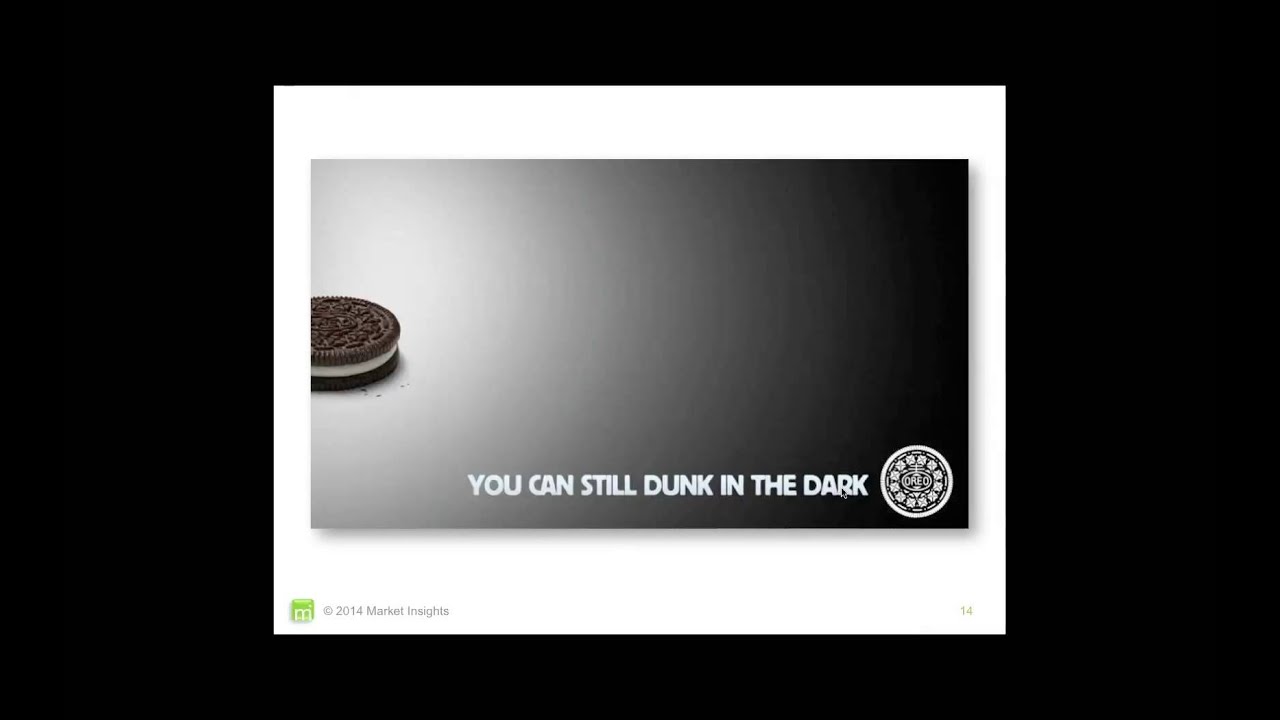
Now, this particular ad from Oreo was absolutely brilliant. A couple of years ago, during the Super Bowl, if any of you remember, there was a huge blackout in the stadium.
Because there was a lot of people following the game on Twitter, on social media, when the lights went out, everybody started talking. Well, Oreo's creative team came up with this ad in moments, knowing that the blackout was being followed by social media. They dumped the image into their Twitter feed with the message, Power out?
No problem. You can still dunk in the dark.
This particular tweet was retweeted 10,000 times within an hour, and that particular graphic was designed, captioned, and approved within minutes. That's an example of being nimble. But the truth here is that while this happened very quickly, It was actually 18 months in the planning from the standpoint that Oreo and their creative team had decided it was important for them to be in social media at least once a day with something that was going to be relevant to their target. That meant paying attention to what was going on in social media. Look at what was trending. Look at who was talking about what. And then again, using that creativity to say, let's get this out there. Now, the thing to remember about this particular campaign, and you should try to bring this into any guerrilla marketing effort, they made it easy for online audiences to amplify their message. It also had perceived effort. It was relevant. It was posted quickly. And fundamentally, it was simple. It wasn't asking all of us in this age of information overload to get it.
We totally understood what was going on.
By the way, Speaking of information overload, there was one term I was going to introduce you all to earlier, and I just have to share this because I think it's so funny. But somebody coined the term infobesity. Remember that, because I think in many ways we're all suffering from it, including all of your customers. When— let's see, Eric, let me check in with you, see if there are any questions at this point. Let's see.
We do have— I don't know if it's necessarily a question, but more of a comment. And I do know that there was a little bit of kind of scuttlebutt about this, but John indicates the TD example was actually something very similar to a Christmas campaign that WestJet did in Canada. They had passengers asking Santa for their Christmas wish before boarding. And by the time they landed, their wishes were bought, wrapped, and delivered by Santa at their destination. So maybe talk a little bit, I guess maybe out of that, a little bit about the uniqueness or, you know, the ability to take somebody else's idea and either— I don't want to say rip it off, but use something similar to that, because I do know that there were a few people that even though the TD Bank, the automated thanking machines was really cool. There were a few people that called them out on it and said, yeah, you're just ripping off what WestJet did, and detracting from the fact, you know. So is it possible to even come up with a totally original idea, or, you know, some of that overlap, if that's good or bad, or just kind of what your thoughts are on that?
Well, one of the things that that really speaks to, I guess, from my standpoint, is that Both of them applied 2 of the very basic elements of guerrilla marketing.
First, do something that's unexpected.
But the other, don't forget a gift, because that's one sure way to get people talking.
So the degree to which one copied the other, yeah, we always say there are no new ideas under the sun. It's only a variation on a theme. Obviously you don't want to do something that looks so completely like what especially your competition has done.
I mean, there are things that will work for one industry that I think can often be modified and deployed in a way that you are reaching different audiences at that point. Okay.
And then—
go ahead. We've got another question, but I'll let you finish your thought there.
No, I was just going to say that the idea of giving, I'll actually talk about in another minute. So what other questions bubbling up?
The other question, and I know that you got this question actually in La Jolla at the conference, because people that were in that room don't have a budget like TD does. So you take a smaller organization that maybe is in a smaller community. Do you have any examples of how you can do this guerrilla marketing but maybe not have hundreds of thousands of dollars in budget or coordination of a TIC-TAC where you bring everybody together in a park in the middle of France or something like that? Can this be scaled down to a really small organization with limited budget and limited audience?
I love questions like that because you've given me the perfect lead-in to a series of examples. Now, one could argue that this particular example, again, was a little bit larger than someone might be able to do, but I think the takeaway here is it's certainly scalable. Umpqua Bank is pretty much located out on the West Coast. They're Portland, Oregon-based. Actually been expanding quite a bit into California, Washington State. One of the things that they've really organized themselves around is being seen as a community bank, even though they are clearly a regional entity. And Umpqua is also known for getting very kind of micro-neighborhood organized so that, you know, they are truly seen as a local alternative as opposed to a larger entity.
And they do that in some very creative ways. Now, in this— on this slide in the lower left-hand corner, you see this tiny little cup that is Umpqua branded with a little succulent plant in it.
That little plant and those plants showed up on everybody's doorstep in the neighborhood where they were getting ready to open a new branch. And one of the things that that card in that particular plant pointed people to was, first of all, the local greenhouse that grew those plants.
So they were automatically linking themselves with one of their local vendors, somebody that was already well-known in the community. They— the card also gave the location of their branch, which they had mirrored on Facebook with a neighborhood branch-specific page for that particular branch location where they were announcing they were giving Area residents an opportunity to contribute, or to vote on who, what organization in that neighborhood should receive a charitable contribution from the bank.
So it was a brilliant campaign. It got a lot of notice, and it was certainly something that I think represents some scalable ideas for folks.
Here they really leveraged partnerships. You know, if I were sitting in anybody's seat trying to think about guerrilla marketing, I would say, who are your most important popular retail locations? Grocery stores, restaurants, beauty salons. Who are you trying to target? What message are you trying to drive home? That's how things like this can become popular. Let me give you another example. Although I talked about unexpected nature of guerrilla marketing, where you're actually having to take it out to the streets like Umpqua did, I wanted to— oh, I forgot, I've added another particular slide that shows a much larger companies doing things on a very small scale. You'll notice when HBO was trying to promote one of the seasons of The Sopranos, they had dumped this fake arm in the trunk of, you know, about a dozen cabs in New York City.
Very easy to get people talking.
get people's attention. Similarly, you see where Axe deodorant had taken a very simple sticker and attached it to existing exit signs, making it look as if women were chasing after the man that was running to the door, all because they were using Axe. That again is an example that, you know, you try with a certain deal of risk, because in those cases they're very, very public, like with the stickers.
You know, there are some communities where you couldn't do that very successfully, but they certainly got a lot of attention. I wanted to use this particular, or show this particular example, of something very scalable, very easy to do, again, caught a lot of attention. This bank that we worked with a couple of years ago down in Central Texas, very small town, they were getting ready to roll out a new product that they wanted to get some buzz about. They wanted to get some attention.
They'd also just gone through a major rebranding.
They wanted to give people a reason to talk about them, so they went to one of their bank clients who happened to own a local restaurant and said, you know what, on this particular day we're going to pay for everyone's lunches.
We'll just insist or ask that these cards, when you deliver the bill, instead of delivering the bill, you deliver this promotional card. And it was like dropping a pebble in a pond. That handful of folks that talked about, or that received these free lunches, told all of their neighbors, told all of their friends. It drove a lot of traffic to the branch and got a lot of people talking about what at the time was, you know, a pretty amazing checking product.
So another aspect of guerrilla marketing that is not always necessary, but it's great if you can incorporate it, and making sure that your marketing campaign is interactive.
It's something that allows a way for you to engage folks As an example, Coast Capital Savings, at a time when everybody was really, really cranky about bank fees. And actually, the stories that were kicking around in the news a couple of days ago about high ATM fees and high banking fees—
again, we might see things like this pop up again. But they decided they wanted to give their customers and non-customers an opportunity to voice their kind of frustration about that. So targeting frustration with the bigger banks for their fees, they created these huge cards, placed them in various public spots— malls, shopping areas, things of that nature—
where people could sign off and say, yeah, you charged us each $171 a year in banking fees. I think that's pretty obnoxious.
They ended up taking that card all over the place, gave people a way to interact. So again, I think that interactivity can certainly help people talk about it. Now, the one hard part about doing something that interactive, it really has to be monitored so closely.
But at the same time, this is also something again that can be easy for people to promote by simply snapping a photo with their smartphone, posting it on Facebook, etc. And nowadays, because this was done a couple of years ago, I would be willing to bet if that card had included hashtag, some kind of message that could be carried further in social media, it would have seen even greater traction. Eric, let me check in with you, see if we have any questions before I give a few final examples.
I don't really have any questions on my part. I know I've been, as typically is the case, those of you that are Free Webinar Wednesday frequent flyers will know I tend to do more of the talking So I'm going to make an effort to invite Jeff to engage to see if he's got any thoughts on this, because he's got a little bit of banking background as well. I certainly don't want to monopolize the conversation here. Mr. Simpkins, is it nice of me to acknowledge that? See, I know where my flaws are, and I'm doing a proactive effort to overcome that. Any thoughts on your part thus far, Jeffrey?
Good information. Thank you for sharing it.
Excellent.
One of the things that I have to say about these types of campaigns, one of the mistakes I see made frequently is that this will happen in a siloed way, and all of a sudden it's as much a surprise to the rest of your staff as it is to your customers, and you don't necessarily want that. So make sure that it's aligned with everything else you're doing.
There are certainly times when you can deploy the same kind of messages that you're trying to deliver through your guerrilla marketing campaign to other aspects of your delivery channels, and I'll give you an example of that in just a minute. But guerrilla marketing can actually even work for internal marketing.
There was a group that was trying to build their internal culture, and they actually deployed a series of guerrilla stunts. Like, they had hired comedians that were dressed up in the bank's kind of uniforms to show up at every branch simultaneously with breakfast treats first thing in the morning. You know, there to get people laughing, there to get people excited.
It was brilliant.
Another client that we worked with at one time did half-day concierge service where every employee was given a personal assistant To help them with anything other than banking.
So there, there are ways that you can turn this kind of idea of guerrilla marketing inward and make it work to build your internal culture as well. But when I was talking about integrating, First Bank gives us another great example. They were trying to promote an idea of They're the best bank for small business.
They collected hundreds of business cards from their various small business clients, and they actually bought space on a kiosk inside their local airport, had all of these business cards kind of pasted up there.
So not only were they delivering a solid message that they care about small business, They actually— that would have been great enough to get people talking because they could see their friends, their neighbors, their coworkers' business cards up here on this particular kiosk. But then they went a step further. They deployed some of their billboard money to promote their customers' ads that were running in Craigslist for simple things like babysitters, lawn service, all the rest, to show, yeah, we really are talking small business. And they went even a step further by creating a microsite where you could, in the area of their branches, actually search for some of the small businesses that they happen to work with as clients.
So it was a very integrated, very, very solid effort that had a guerrilla aspect to it, because again, it was unexpected.
I can pretty much wrap up by saying, you know what, at the end of the day, folks, you've got to avoid some classic pitfalls of guerrilla marketing. Try not to be reactionary.
I mean, how many of you tried too late to jump onto the Ice Bucket Challenge Kind of game.
And by then, it was done. You've got to be smart. Now, a couple of years back, Turner Broadcasting wanted to promote a Cartoon Network show, so they had these little battery-powered LED cards that were placed all around Boston.
Well, guess what?
They too closely resembled a bomb. It ended up costing them about $2 million. So—
There are things you've got to think through, the potential kind of reactions to your guerrilla marketing efforts before you deploy something. Also, again, the whole idea of getting on the bandwagon and doing everything that everybody else is doing, which we commonly refer to as sheepwalking.
Try to avoid those. At that point, guys, that's about what I wanted to say about guerrilla marketing. What's on your mind?
Well, we did get one more question here. We can wrap up with that, and then if there's anything else. But the question is, how do I get around my CEO who might likely think that this is more of marketing craziness or a cost drain, and they think I'm nuts if I'm doing this kind of stuff? So, you know, this is an unconventional form of marketing, and to more of a conventionally focused management team, this might seem like a waste of time or maybe difficult to measure. How do you get around a decision maker within your organization if you've got— maybe you're the marketing person that's listening to today's presentation— how do you approach your boss or your boss's boss to allocate budget or even time to be able to do something like this if it's something that your organization hasn't done before?
I think that goes back to the issue I raised earlier about the planning around something like this. You've got to make sure you've built in some way to measure the results, because oftentimes the C-suite is most concerned about ROI. How are you going to monitor this? How are you going to measure the results?
And often, if your CEO hasn't been used to getting that kind of feedback from your marketing efforts, that can especially complicate it.
But I think one of the best ways around that is by showing them a solid enough plan going in that they see that this isn't just a reactionary tactic. to try to get people talking. Jeff, do you have an idea about that? I think that's a good point.
I think it also ties into a comment you made earlier, you know, you can't try everything. So when you go to the C-suite and present these ideas that are going to going to be unconventional, having a story behind them and illustrating how they differentiate what you are doing from what everybody else is doing, I think, can be helpful as well.
That's a great idea.
Question for you on coming up with these ideas. If an organization decides they want to do this, I know that you go back to the Oreo, for example. They had it planned.
They had an idea.
They had a room full of people sitting around together watching the Super Bowl, being prepared to react because they didn't know what was going to be thrown at them. You know, when an organization says, okay, we want to give this a try, what's the best way to come up with ideas? Do you find pulling a committee together? Do you find, you know, Google searching for guerrilla marketing ideas? Are there other resources that folks can take a look at to help inspire them to come up with a cool idea that they may be able to implement?
Great question, and I'll try not to overwhelm you with an ad for what we do, but of course, obviously—
Feel free.
Obviously, that's something that we help our clients with all the time. So I'll set that aside now and say that oftentimes When people are considering it for the first time, I always say find a couple of folks within your organization, but then tap a couple of your customers.
Tap a couple of people, bring them on the inside, and ask them their thoughts, their ideas, their feedback, because that can sometimes be as unexpected, as unconventional as anything else.
As marketers, sometimes we forget the best way to engage our customers is actually have a conversation with them.
Yeah, very cool. Well, good. Well, looking up, I just realized the reason you're trying to wrap things up is we're at the 60-minute, 2 o'clock Eastern time mark, and that flew by. Holy smokes. But good, good stuff. And it was just as good, if not even better in some aspects, than what I heard you do in La Jolla.
So Thank you, sir. Appreciate that. My pleasure. My pleasure. Yeah, good, good.
Well, as a reminder, the session is being recorded. When it's available, it'll be out to freewebinarwednesdays.com. So we certainly encourage you to come back and check that site out when we are done. Make sure that you have visited us on Facebook at Free Webinar Wednesdays, and we make announcements and show updates there as well. And We will be back next week. As I mentioned, we're gonna have Ron Cates joining us from Constant Contact, which is one of our partners, and they're probably one of, if not the largest provider of email marketing services. And we've had people from Constant Contact on the show before, and they've always been great shows. And I've heard Ron talk at least a couple of times now, and it's gonna be a really good session, and hopefully you'll all be able to join us again next week. So with that, on behalf of my good friend Jeff Simpkins and our guest Jim Perry from Market Insights, this is Eric Cook signing off for another successful week of Free Webinar Wednesdays. We'll see you online and next week and every Wednesday at 1 PM Eastern time at freewebinarwednesdays.com. Take care, everybody.
Bye-bye.







