
Rewire Your Brain: 3 Habits That Will Change Your Life with Lewis Schiff
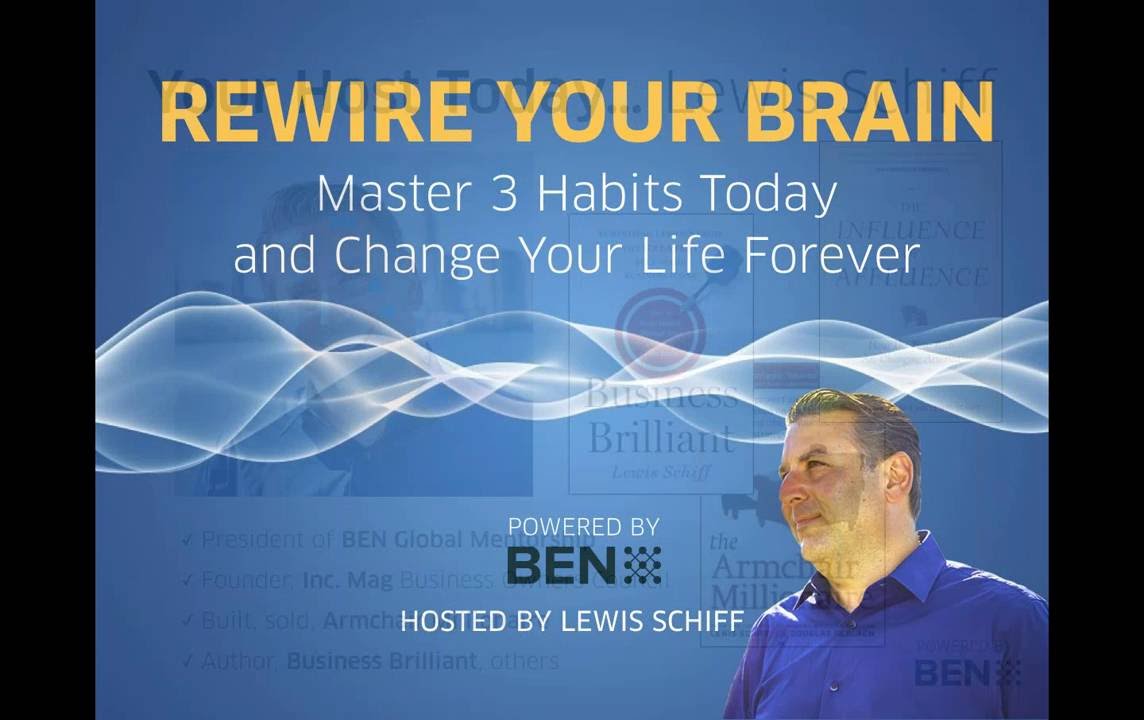
Lewis Schiff surveyed 800 self-made households to identify what separates millionaires from everyone else. The three habits: know your one exceptional strength and focus on it, treat failures as learning opportunities rather than quit, and build a small network of 5-10 key contacts who know each other's goals. He illustrates with stories from Schultz, Buffett, and Gates.
Chapters
Greetings everybody, welcome to the Wednesday, May 25th, 2016 episode of Free Webinar Wednesdays. This is Eric Cook and I'm with WSI Digital Marketing where we work with businesses and organizations on helping them better understand and leverage the power of the internet as a strategic business tool. You can learn more about me and WSI online at www.poweredbywsi.com. With me this week is my good friend and Free Webinar Wednesday partner, and we took a couple weeks off, so it's good to hear your voice again, Mr. Jeff Simpkins from Community Bank Consulting. Say hello to everybody out there in Free Webinar Wednesday world. Thanks, Eric. Hello everyone, this is Jeff Simpkins. I am with Community Bank Consulting, Inc., and you can learn more about me and Community Bank Consulting online at www.communitybankconsulting.com. Excellent. And not that I want to embarrass you or put you on the spot, but a happy couple-day belated birthday, even though I did get a chance to wish you an actual birthday on the day that it happened. But we have a co-host here that has celebrated a birthday recently, so we'll save the rousing rendition of Happy Birthday song, although I understand you can now play that without having to incur royalties. We'll still save that for you. But a very good happy birthday to you, my friend. Hopefully you were able to do something fun and enjoy it with the turning of yet another year, which is always better than the alternative, right? Thank you very much. Yeah, so, and I always remember your birthday because it's actually a couple days before my father's, and not that He's a Free Webinar Wednesday listener because he's retired and he plays golf and tennis. But today happens to be my father's birthday, so I'll tell him when I see him for dinner tonight that I gave him a shout-out for his birthday on my weekly webinar show. I don't know if he'll know exactly what that means, but nonetheless, happy birthday, Dad. We all know how that goes with our parents, so that's all right. So a couple housekeeping items in case we have anybody that is new and joining us for the first time. Welcome to Free Webinar Wednesdays. We did take a couple of weeks off while I was gallivanting around the countryside on vacation, but I'm excited to be back in the saddle again with another show. All Free Webinar Wednesday shows are recorded and made available at freewebinarwednesdays.com. So after today's show, I am certain that you're going to want to go back and relive it, share it with friends and colleagues, because I know Lewis has got some really great stuff Scheduled for us, but we record the shows and they're available. So check them out and share them. And also, we do love interactivity and like to make Free Webinar Wednesdays as conversational as possible. So if you've got a comment, question, or input that you'd like to share with us, please feel free to use the chat functionality in the control panel that's likely floating to the right-hand side of your screen and let us know your thoughts, and we'll. Schedule some periodic breaks through the presentation today, and we'll make sure that we ask those questions for you. So with that, while I work the magic of GoToWebinar and change the presentation over to Louis, just want to provide a little bit of kind of intro for Louis. He'll do some of that himself, but I'm excited to bring Louis Schiff back for a second repeat appearance on Free Webinar Wednesdays. We had Louis on the show Oh, it was a while ago, but talking about his book Business Brilliant and got a tremendous amount of very positive feedback from Lewis and the information that he shared within that. And the whole 3-habit conversation that we're going to be having today is largely the genesis of the conversations that he's had through the years with all of these business professionals and top performers. And I know he's got some great slides, he's got some special offers and some other additional tools and resources. If you didn't have a chance to download his new ebook off of the Free Webinar Wednesday site, go to Free Webinar Wednesdays and scroll to the very bottom of his promo. You can actually get his First Habit book for free off of his site. I have downloaded it, haven't had a chance to dig into it yet, but I am looking forward to that. And so tons of good stuff. So I don't want to take any more time. Lewis, welcome back to Free Webinar Wednesdays. It is so good to have you on the show, my friend.
Hey, good to be here. Thank you, Eric, and thank you to both of you for such a great opportunity to do an encore performance.
Absolutely. Well, we love having good guests back, and usually we have lots of good guests, but you kind of rank right up there at the top.
I feel like Alec Baldwin on Saturday Night Live competing for the number one spot.
You kind of have a resemblance to Alec Baldwin a little bit, I would say. Yeah.
Well, I bring up the reference on purpose.
Yeah, of course.
Of course.
So anyway, it looks like screens are shared. And I know you've got a bunch of great stuff. And we want to make sure we get it all packed in with the hour. So let's go ahead and get started. And the floor is yours.
Well, thank you so much. So I'm going to run through a program that I've been giving with great delightment around the world, and it is really in many ways the sum result of the work I've been doing for many, many years. Last summer, I sat with all of my slides and all the things I've been talking about, and you know, when you're a speaker in front of people, you can tell what rings their bell and what makes them take out their iPhone and start texting people. And so I just kind of decided I'm going to do only the things that ring people's bell and makes them put their iPhone down and pay attention to me. And so I recalibrated the presentation, and that's what I want to share with your audience today. So I hope that's okay.
I think it's perfect. Great.
So just a little bit of background about me. Some of these slides are designed when I'm running these webinars myself, but of course I'm actually a guest today, not a host. But I have had this incredible career, this incredible opportunity to interview some of the most interesting entrepreneurs in the world. Excuse me. And some of the, certainly the most famous, but just also thousands of everyday huge incredible success stories, the kinds of people we all admire. And I've written books about them and I've done original studies on them. And I've built a business community to bring a lot of the owners I know together. It's called the Business Owners Council. And then this year started an online mentorship education program called BEN, BEN Global Mentorship. So you'll see some of that in the background today, but just a wonderful chance to do what I know a lot of us would love to do with our lives, which is hang out with really successful people and try to learn from them. And I'm just skipping through a couple slides. So, and then I started this journey, if I want to describe it that way, about 20 years ago now when I wrote a book called The Armchair Millionaire. Which was, if you're familiar with the study of behavioral economics, it's the study of how decision-making affects money-making, and it's been recognized with Nobel Prizes in the year 2002, and it's about a 50-year-old discipline. And over time, my interest in behavioral economics, or how decision-making affects how we approach our money-making lives, yielded to something that was a subset that I now call behavioral entrepreneurship. How our decision-making muscles affect how we build businesses, not so much money-making, which could be stock market investing and savings and that kind of thing, but behavioral entrepreneurship, that subset, which is how do we instinctively— are we wired to build our businesses? And I put that into a book that Eric mentioned called Business Brilliant, which came out in 2013. And that book really, when it came right down to it, was based on 7 best practices, 7 behaviors that I identified That were commonly found amongst the self-made millionaires that I interviewed, and I'll give you a sense of who I studied in a moment. But much more interesting, I think, than just the 7 best practices was why don't the rest of us do what these self-made millionaires do? Why do we behave differently than them? These 7 best practices are all within reach. They're not expensive. They're not— they don't involve complicated training.
Right.
They're just behaviors. Why don't we practice them? And really, I discovered over time that there were a lot of wonderful human beings around us, including our parents and our families, our teachers in our schools, our bosses and our employers, whose attitude towards us actually prevented us from adopting these 7 best practices. And if I put it another way, I would basically say the conventional wisdom told us to do something, but in fact self-made millionaires do the complete opposite, and I identify the 7 places where that occurred. That's behavioral entrepreneurship, and that's what Business Brilliant is about. But if you want to understand why this is so difficult, I often use this example. You see a steering wheel right now on your screen. We all know that driving a car safely is really the practice of keeping 2 hands on the wheel, driving the speed limit, wearing a seatbelt, checking your mirrors often. And the good news there is that not only is that the conventional wisdom, that's what we're taught by our families and by our driving instructors, it's also statistically true that in fact that behavior leads people to reach their destination safely more often. So, but I want you to imagine for a moment that the statistics came back and after 10 years of study, it turned out that people who drive above the speed limit without a seatbelt, with one hand on the wheel, and without checking their mirrors very often actually reach their destination safely more often than those who follow the conventional wisdom. And ask yourself, gee, what would happen if the data— and I study data, I just study behavioral entrepreneurship— what would happen if the data was in conflict with the conventional wisdom? Would you start driving that way? Or really, more to the point, would you teach your children to drive that way if the data said driving in the way that makes us feel unsafe Statistically proved out. That's what I discovered in my research, which is the data was in conflict with the conventional wisdom. The ways that we're raised are in conflict with what the data tells us actually leads to self-made millionaire success. And so that's, that's the sort of mind-blowing thing that I bring to you today and ask all your listeners and viewers to entertain the idea that they're going to have to look at the world differently. If they want to achieve the kind of success that many of them probably desire. So I'm going to be putting some things in a bonus bag for some of the folks who go forward with this idea that I'll share with you today. And one of them is just this kind of cheat sheet overview to study or to write down and analyze what we talk about today. And I'll kind of mention the contents of the bonus bag at the end. But let me just start with An overview of my survey here. I studied 800 households and about half of them, 49% of them, had a net worth of less than $1 million and I call that group the middle class for lack of a better term. But it's really a designation by a quantitative measure which is net worth, not a value that you feel in your heart, but just a hard and cold measure. And then the next group I studied I call middle-class millionaires which is also the name of a book I wrote in 2006. And these are folks with a net worth of $1 million to $10 million. So, they've hit the 7-figure mark. And they made up about 28% of my survey respondents. The thing is, to be in my survey, you had to be self-made. So, that meant that all my middle-class millionaires had to have created all their wealth. They cannot have received more than $50,000 from their families, including the cost of their education.
Interesting.
in order to make it into my survey. And that's also true of this next group I studied called the high net worth, which had a net worth of $10 million to $30 million, and they made up 14% of my survey respondents. So what's interesting about them is that that's the group that's really experiencing sort of the fantasy life of wealth where you really start to have a very different life experience because of your money. Again, a self-made group was my ultra-high net worth. 9% of my survey respondents are made up of people who had net worths in excess of $30 million. So, here's where people with hundreds of millions and billions of dollars show up. And these are the truly— this is the fantasy wealth that we all dream about and see on television. So, those last 3 groups, middle-class millionaires, high net worth, and ultra-high net worth, are all self-made people and we're looking at the results that we asked a set of questions with them and against the middle class, which we could call the conventional wisdom. So I'm going to share with you 3 habits, 3 behaviors that I learned by studying these people that I think are the most important, meaning if we can address these 3, the likelihood that we'll create a very different outcome in our success profile is the greatest. And these 3 habits are And when I tell you this is 20 years' worth of work to come up with 3 things, you know the famous saying from Mark Twain, I would have written you a shorter letter if I had more time. I couldn't get to this level of understanding without going through all 20 years of research. And I'm very happy to say that I've boiled it and boiled it and boiled it down and I can share it with your community today, Eric and Jeff. So the other cool thing about this that I really love is that there's an element of luck and magic to how these behaviors work. And you'll see that as I discuss it, but you won't really meet a successful person who doesn't tell you that there's not a little bit of luck and magic to how they do their job or how they create success. The thing is, I've been working on where that luck and magic comes from and how these 3 habits actually very intentionally create a synergistic system where that luck and that magic emerges. So I'm excited to talk about that because it's just a fun thing to talk about. So I'm going to start with habit number 1, if that's okay, Eric and Jeff, just to kind of jump in and share with your community what I've learned about rewiring our brains, about transplanting the ideas of self-made millionaires into our brains. So tell me if I got the thumbs up and I should keep going.
You've got 2 thumbs up on my part, so we're good.
Awesome. So learn your language. This is my first habit. What do I mean by this? I spent some time interviewing Howard Schultz in front of a group that I run called the Business Owners Council. So this is a gathering of titans really, of some of the most impressive business people you'll ever know, all business owners of mega businesses. And we get to bring in these great CEOs and entrepreneurs to talk to us. So Howard comes in and he talks about how coffee equals love. And if you look at everything he's done, which is built food supply chains And he's built a store network around the world and he's identified and trained hundreds of thousands of workers. The whole enterprise is entirely designed around his love of how coffee brings people together, how love creates connection, coffee creates connection between people. And if you study his business plan, business model, he really was working from the point of view that in history, coffee plays a role about creating connections between people, and therefore it creates love, it creates friendship, it creates deals, it creates relationships. It all comes back to coffee. And he discovered that along the way and decided that that was his reason for being, that was his purpose on Earth, what I now call his language. So we asked this question, and this is a book that I wrote because I got so excited about learning your language as a first habit, I wrote a book called The First Habit. In it, I identify this quote which is this: You are probably exceptional at something right now just like Howard is. The thing is all the great wealth creators I've ever met are aware of what they're successful at, exceptional at, and they drive a truck through it. Once they figure it out, they build their business around it. That's the difference that most of them have from the rest of us is it's an awareness and then it's building a business around it. So many of us are exceptional but we don't value it because it comes kind of naturally. You might even say it comes easily to us. But the truth is it is exceptional and a lot of the great success stories I know built their business around that exceptional quality. And so when I studied those 800 households, I asked them that question. I said, Do you know what you're exceptionally good at that makes you money? It's a pretty straightforward question. And I got some great answers, so I just invite everyone on this webinar today to think about this question themselves. But when I asked them that question, here's the data I got back in terms of how many of them said yes, just a simple yes or no, I do know what I'm good at. And look at this middle-class number, 55%, just over half. Just over half of the people I surveyed in the middle class category are connected or just have an awareness of what they're good at. So I ask this very simple question to all of us: how can we expect to build businesses or to succeed if we don't actually know what we're good at? To me, it's a fundamental question. You can see from the data that as levels of wealth go up from middle class millionaires all the way up to my mega millionaires, my ultra high net worth, You can see that the connectedness they have to this question also goes up. So this question is a huge question for all of us to ask ourselves. And in the survey, I asked everyone to spend a little time writing down all the things they think they're good at and take some time describing, you know, one sentence or maybe just a few words about what they're good at. And then when they were done with that exercise, I asked them to count up how many things they'd written down. And remember, the question here is, what are you exceptional at? That's the question. And amazingly, for that 55% of the middle class who said yes, they do know what they're good at, they actually wrote down the most things on a piece of paper. And you can see as levels of wealth go up, the number of things that people think they're good at go down. Now this is one of those moments, Eric and Jeff, that I want you to just have like a big block of concrete dropping on your head to realize that this is actually a million-dollar piece of information. Because right now what you're looking at is a function that is easily defined by anyone who looks at this, which would be called focus. People who focus on fewer things and they try to be really exceptional at those few things do better than people who try to focus on a lot of things or spread their focus And it's of course ironic that the middle class who has the least net worth think they're good at the most things and our ultra-high net worth who have the most high net worth, who have the most net worth, think they're good at the fewest things. But in fact, that's a statistical representation of the word focus. So I like to tell this quick story, which is Warren Buffett tells this story all the time. When Warren Buffett and Bill Gates just met each other 1, 2, 3 times, but they weren't friends by any means. And they were in this event, this program with about 20 really rich people, and the guy at the front of the room said, everyone write down on a piece of paper the one word that you think accounts for all the success you've had. And they all read them out aloud, and Bill Gates and Warren Buffett both wrote down the word focus, and they bonded over that moment, and they say that that's actually the moment their friendship began, when they realized that they had a similar approach to business. And again, now that's maybe not a million-dollar idea, maybe it's a billion-dollar idea, but the ability to focus is actually much harder than it sounds. Because when I asked the survey respondents the reverse of that question, which is how hard are you working to get better at tasks you're not exceptionally good at, I got a really interesting answer from them. Our middle-class folks, remember they're doing 6 things that they believe they're exceptional at, although really not having the net worth to demonstrate that. Plus, 58% of them say they're also spending all their spare time— how many of us actually have spare time on the phone right now?— all their spare time trying to get good at everything else they're not good at. And you can see as levels of wealth go up, the likelihood of people spending any time on the things they're not exceptional at goes down all the way to zero by the time you get to your ultra-high net worth. So, this is one of those moments where I say, sure. Focusing is important for sure. We have millionaires and billionaires confirming that focus is important. We also know that we're not terribly in touch with what we should be focusing on to begin with, what we're exceptional at. And then here's the reverse, that not only is focus important, but making sure that you absolutely push off anything that's— that gets in the way of your focus, like your weaknesses, what you're not exceptionally good at, that's also important. And I think about how many times, you know, you've had a performance review by your boss, or maybe you are the boss and you've given this performance review where you identify the weaknesses of the people who work for you and you tell them to work harder at getting strong at them. And in that moment, unbeknownst to you, because that's the conventional wisdom, you are encouraging those people who work for you to become even more mediocre. Even more of a generalist when in fact all great success comes from being a specialist in the right thing. So when we got that advice to work on our weaknesses in our— at our place of employment, we were being encouraged to be mediocre. That's the conventional wisdom, but it's not working for us. And where does that behavior come from? Let's go all the way back to our parents. And we remember when we came home with a bad grade and a bad report card. They told us instead of celebrating our successes, they told us to work on our weaknesses, to get a tutor in that grade or that class that we had a bad score on. So all the way back to when we were kids, we were being told to become generalists when in fact specialists, specialists are the ones who succeed when they choose the right specialty. And so this is the very powerful lesson, and I just wanted to share with you guys that Amber McHugh is a friend of mine, has this great program called How to Clone Yourself Which puts you on the path of taking all those weaknesses and basically getting rid of them, you know, just moving them into another space and allowing you to free yourself up to focus. And so I'm going to talk a little bit more about my bonus bag, but I just want to let you know that that's one of the great items that Amber has contributed to the bonus bag. So that's habit 1.
Hello, Eric.
Oh, go ahead, please.
I was just going to say we've got a question when you get a second, so I'll let you finish your thought and then we can go ahead and get that question in there.
No, I'm going to jump into habit 2, so this is a perfect moment.
Okay, this may sound like somewhat of a staged question given the presentation, but I'll ask it anyway. It says, my wife asks me this question frequently. I'm assuming he's referring to what am I really good at. So how can I help her determine what she is exceptionally good at?
Great, so actually what I'd like to do— there's a bit of a process to it. It's a multi-stage process that I've identified, but I'll give her a really good shortcut. The shortcut is send an email to 10 people that you've done business with and you have some respect for and ask them the same question she's asking her husband. I just want to spend a little time on this question for a moment. The question would be, you've known me for a while. We've done business together. Can you tell me what you think I'm exceptional at, better at than most people around me? And in my book I kind of identify this as the fastest of all shortcuts because hopefully you'll get a good answer. And the opportunity to kind of figure it out by asking your peers, or at least get a jump start on figuring it out by asking all your peers, is as simple as that. And what I think is interesting about that question, Eric, is because I often tell people that exact thing. Go ahead and email 10 people you know. And the first thing they say is, that feels really awkward to ask people what I'm good at. It feels weird. It feels like an ego thing. They don't have the self-esteem to ask that question. So here's a moment where I identify that our conventional wisdom is getting in the way of our success. Because I can tell you that when I talk to really successful people and I ask them that question, They've already got the answer because they think about it, they talk to their friends about it, they ruminate on it, they refine the answer all the time because that question has so much meaning to them. So if that feels like an awkward exercise to email 10 people to ask them what you think you're good at, just recognize that that is a perfect example of a moment where you're not yet prepared or you may be just on the cusp of being prepared. To do the thing that breaks with your conventional wisdom, the way you were brought up, in order to start rewiring your brain for success. There's a more detailed explanation in my book, but that's the short answer.
Yeah. I would say human nature would be more comfortable emailing 10 people and say, what areas would you feel that I could improve upon?
Right, exactly. Right.
And so, yeah, so—
There's a humility to the way you just posed that, right? There's humbleness to it. And my question doesn't come across as humble, but it's in fact the much more important question.
Absolutely. Yeah, good answer. Thank you very much.
So habit 2, practice persistence. And this is another one, right, we've all always told the people we love in our lives, and they've told it back to us, which is, you know, when the going gets tough, the tough get going, and pick yourself up when you fail and dust yourself off and keep moving forward. The truth is, while I love that sentiment, and actually I'm not really going to be in conflict with any of it. It's just that we actually don't practice it. It's advice we love to give but not keep for ourselves. The byproduct of practicing persistence is, is more than just bravado or a bumper sticker that we share with people as a way to, you know, encourage them to pick themselves up. It's actually the best education you will ever get because every single time you stumble, there's a lesson to be learned. So let me tell you a bit about what I learned when I asked people about how they practice persistence. So the first was I spent some time with a guy named Hank Paulson interviewing him for that same group, the Business Owners Council. Hank Paulson was the Treasury Secretary when things went to hell in a handbasket in America in the year 2006 and '07, and by the year 2008 he was winding up his time and handing the reins over to the Obama administration. But he was there as things fell apart in those critical years and months. And when I asked him, you know, how does one lead in the face of all that, he said leadership is about being flexible. And his secret to leading this country through essentially its greatest financial crisis in our lifetimes was, he said, as soon as you understood that whatever idea you had put in place, whatever program, whatever project, as soon as you saw that it wasn't working, the sooner that you saw it, The better, and that you pivoted and try something else. Now that's another way of saying practice perseverance, that the faster you acknowledge your mistakes, the faster you can move on to the next idea, which might be the right one. And he attributes that to helping steer the country through very difficult times. So now I ask all of the folks on the webinar today to think about moments in their lives where they experienced real adversity. Just so they have a little bit of a sense in their head right now, maybe they jot it down on a piece of paper, of all the moments that they experienced real adversity and what we'll call failures for the rest of this conversation. And so the question I asked the survey respondents was, what did you do after a significant career setback or failure? And here's the answers I got. Pretty disturbing stuff, I thought, which is— Our middle-class survey respondents' most common response to adversity is to give up. In other words, the way I read that, having done all this research, is the most common response is to say, there's nothing I can learn from that failure. And that is so the wrong answer. As you can see, as levels of net worth go up, the learning opportunity that comes from failure is obvious to them and the— Loss of the learning opportunity from give— by giving up and not paying attention to what you learned is also dramatically obvious. They say never give up and always try again in the same field because then you can roll over any wisdom you've accumulated into that next attempt. And talk about a contrast in responses. Giving up versus trying again so that you can learn something and roll that experience forward. And I asked the question some slightly different ways. We do this in research to try and find different patterns. And so, I asked the same question. I just kind of asked it in reverse. I said, have failures taught you what you're good at? And our middle-class respondents, 17% of them said yes. And you can see as levels of wealth go up, they also— the number of people who said yes goes up to the point where you're at 95% for the ultra-high net worth.
Failures.
are the learning opportunity. You know, we know this phrase, the school of hard knocks. Failures are the best way to learn what you're not good at. This absolutely points us back to learning your language, which is if you think you're good at something and you actually fail around it, you can refine what you actually think you're good at or discover you're really not good at it at all, which is a good thing to find out. Because you don't want to waste time, as Hank Paulson said, doing things that aren't working. Then we asked them another question, which is, have you had career moves that have failed? And between 83% and 99% of our survey respondents said yes, they've experienced failure. I wouldn't be surprised if 100% of the people who are listening to this today, if you're entrepreneurs, have experienced some kind of setback or failure. That's just the price you pay for being in business, right? So then I said, do you have associates who have had failures? And this is where it gets really weird. Look at this number. 19% of the middle class said they have associates who have had failures, but 83% of them report having had a failure themselves. That number should be much closer to the same. Instead, there's a gap of 64 percentage points, and I've got to explain that gap as a researcher because it doesn't really make sense. And then when I pay attention to how that gap drops as levels of wealth go up to the point where it's almost entirely gone at the ultra-high net worth level, and what I realized was this: you are looking at a very unusual thing. It's a statistical representation of the emotion shame. And that's a really interesting thing. That gap of 64 percentage points can only be explained by the fact that— Our middle-class survey respondents experience shame. And even as you go up in these levels of wealth, shame is still present from failure. But the presence of shame actually disappears or mitigates itself as you go up in levels of wealth. This is— that's a very fancy way of saying the wealthier you get, the more likely you are to talk about your failures because you realize that you can learn from failure. And there's a lot of evidence that people who become wealthy, self-made millionaires, actually move out of the towns or the neighborhoods that they started out in. And this is one of the biggest reasons why. If they're in a community that experiences failure as shame and they can choose to put themselves in a community that experiences failure as learning, they actually move themselves to those communities. And a lot of people think it's because they have the gates and the pools and the fancier neighborhood and they can afford it. There's, of course, all that's true, but there's a significant amount of basically fleeing the feeling of shame that they experience when they fail. And entrepreneurs want to surround themselves by optimism. They want to surround themselves by lifelong learners, and they do that by moving to the wealthier part of town. So, you know, again, what an opportunity for all of us to simply surround ourselves with different people in order to experience a different emotional life and then potentially a different success financial business life. And so this is hard stuff, right? We talked about conventional wisdom, that question earlier was around, you know, how do I find out what I'm good at and the difference between asking what you're good at versus asking what you could use some work on and the conflict around humility that somebody could experience. And so I went to all these entrepreneurs I know and I asked them to share with me some lessons that they had learned along the way that they wish they'd known at the beginning. In other words, accelerate our learning or our wisdom process. And I gathered this book into what I call the Ben Book now, named after Ben Franklin. And I'm just sticking that in the bonus bag for us to talk about a little later. So that's habit number 2, Eric and Jeff. And just maybe I'll pause here before I go into habit number 3 and see if anyone has any questions for you.
No questions in the queue right now. Jeff, any thoughts on your part? Might have caught Jeff with the microphone muted. I had it on the speaker. I picked up the receiver and it was muted. No, this is excellent. I'm actually sitting here listening and making notes and flipping over and looking at your book on the Kindle store. I'm highly engaged. Continue, please.
Well, Jeff, if you hit the buy button on that, that's $2 in my pocket, so that'll be well deserved, I think, for my hour's time here. Well, so this is habit number 3, and I want you to think about all these as synergistic habits, meaning they all work together. So earlier when I said people leave the neighborhoods they started in and move to the fancier neighborhoods, and partly it's because they want to surround themselves with people who view the world the way they do. And so that gets us to habit number 3, which is upgrade your network. And this, I think, is where it kind of all comes together in terms of what you can do next. So I interviewed a guy for the Business Owners Council. His name is Russell Simmons, and he's— they often call him a hip-hop impresario, which I'm sure he hates. But basically, he's an entrepreneur of culture and cool. And when I was interviewing him, he said, Good givers are great getters. So I want to say that again because it's like one of these simple messages that's so profound. Good givers are great getters. Give to the network you create and you will get more than that in return. So how do you create the right kind of network? So this is the question I asked my survey respondents: is it essential to know people who know people. And I want to share with you that I also asked them, is it essential to know powerful people? And is it essential to know lots of people? You see, people think that wealthy folks know the powerful people and they have big Rolodexes. In fact, this is the only question that really rang the bell as being very important to the higher net worth folks I surveyed. So I just want you to think for a moment about who is in your network, who is your closest Go-to business network. You can write down their first name, that kind of thing, and I'm going to test the strength of that network in the next few questions. So the question asked is, is it essential to know people who know people? And how many of them said yes? And you can see from the results here that about half the middle class think that this definition of networking, knowing people who know people, is important, and you can see how as levels of wealth go up, the way that they gravitate towards this particular, and I'll say peculiar, definition of networking goes up. And I say peculiar because actually it's a very funny turn of phrase, know people who know people. And what I'm about to show you is a form of networking, and I'm gonna put a lot of fancy words around it, but in fact it's done naturally by successful people without them ever knowing that these are the words or the social science terms that describe what they're doing. They just do it naturally, and now you have a chance to learn what that way is and decide if it's a muscle you want to build for yourself. So the first fancy word I'll share is nodal networking. A nodal network is what these folks are building when they say that they want to build a network of people who know people. So that dot in the center of the screen now represents you, and I want you to imagine 5 people in your life close go-to business contacts that are your 5 nodes. We're going to call them nodes for the rest of this conversation, and you're practicing nodal networking when you just have a small number of people that you put into that nodal network, that tight go-to close network, as many as 5. It could be smaller, but as many as 5, and if they're all practicing nodal networking, this is what it starts to look like. Not only are you in their network, but they've got a few other people in their network as well. And if that ring of people are practicing nodal networking, it starts to look like this, where it's a network in full bloom eventually, which looks like a beautiful butterfly. And really what you're looking at is a full-bloomed nodal network. Again, why do wealthy people move into fancier communities? Because they want to work with people who understand nodal networking. They will not call it that, but it's a kind of networking where you just focus on a few people in your life and become a really good giver. To a few people and not just you do it but everyone around you is doing it also. Just a few people. Because I want to point out something about this network. Notice that none of these nodes are touching each other in the simple form of your essential network. These are 5 people in your life who you're very connected with but really are not part of each other's network. Oh sure, they may know each other but they're not part of each other's nodal network. That's very intentional because all of your strength, all of your power comes from the fact that you are the central meeting point of all 5 of those nodes, and that you would remember that nodal network in full bloom, there's plenty of overlap, but there's always a center node in every one of those nodal networks. You've got to go places where people practice the same kind of networking that you do, and then the much harder thing is of that small number of people, you have to practice something called business intimacy. What I mean is you really have to know them, not just know them a little bit, but really have to know them. And what do I mean to really know the business people in your network? Well, for example, you think about those go-to people in your network right now. Do you know how much money they make or how much they want to make? If they're in business for themselves or they're responsible for new business, do you know how many new clients they're looking for in order to achieve their annual goals? Do you even know who their ideal client is? These are just a few examples of questions that if you're really business intimate, you should know the answers to these questions. So I will tell you that amongst very successful people who practice nodal networking, it really is not uncommon when they sit down with each other for the first time to say something along the lines of, what's your net worth? What are you trying to do this year? And they'll say, I'm worth $10 million and I'm trying to, you know, bring in 10 new clients so I can get my business up to another million dollars in profitability. I mean, it may sound weird, but I've been in the room enough to know that these are the conversations they have with each other because they're trying to decide whether or not that other person has goals that they want to be part of and has a commitment to nodal networking— good giving equals great getting— that Russell Simmons said that's going to make it worthwhile for them to consider getting more business intimate with them. They're smelling each other out. I also know that amongst the middle class, they don't even ask these questions. They're all considered shameful questions or embarrassing questions. You don't ask someone how much money they make. So the question is not like social media teaches us, which is how many friends do you have on Facebook, not how big is your network, but how small is your network? And when I looked at my survey results, it echoed this. So how many people do you network with to get work done? Notice that as levels of wealth go up, the number of people they work with to get work done— another way to put this would be how many people report to you? And in the middle-class world, the number of people reporting to you, the higher that goes, the more powerful you are. Funny enough, in the world of self-made wealth, the more people who report to you, the less powerful you are. And you know why that is? The less number of people who report to you, the more powerful you are. And do you know why that is? Focus. Just like in habit number 1, if you're wasting time taking care of 10 people who report to you, you're not focusing. If you're really adding value, it's not because you're babysitting 10 people, it's because you're working closely with a small number of people that you're really connected with doing great work. Likewise, your outer network, the network that helps you find new opportunities, similarly, the middle class thinks you need to have a lot of people in your network, and as levels of wealth go up, in fact, the number goes down to the point where we get to that 5 number I just shared with you earlier, and what we're really saying there is You know, how is it that people who generate more business like the high net worth, ultra-high net worth are actually networking with fewer people? And the answer is business intimacy. They're more connected to fewer people. They're bigger givers to a smaller number of people, and that in turn they become great getters. So that's a very different way of looking at networking than I think most of us ever do. That's what I call upgrading your network, but there's a piece of upgrading your network which is actually a lot of fun. And I'll use this to sort of exit out of the webinar today and just kind of share some new ideas with you. And that's luck and magic, which I told you I would mention at the top of this webinar. And I also mentioned that book I wrote, The First Habit. So that was a great question, Eric. That really was a good layup for me because I'm going to put copies of The First Habit in the bonus bag, which I'll talk about in a minute. But what's really cool is I'm actually putting 5 copies of it in. So that you could send this book out to your nodal network candidates and see if they're as interested in focusing on what they do well as much as you want to be focusing on what you're exceptional at. So I'll drop that into the bonus bag. And let me now talk about luck and magic, which are some of my favorite topics. So a fancy word for luck is transitivity. This is a measure of how much of your network already knows each other. I think I mentioned a little while ago, none of these nodes touch each other. The best kind of network is one that I could describe this way: a network of people who don't know each other but need each other. And so imagine the baker, and the baker has as his nodal network, he's got a wedding planner and a corporate events planner and a catering hall and these kinds of people where they need each other but they don't know each other. And that baker is acting as the center point, the point of connection in his or her nodal network, and that's where his power comes from, but it's also where luck comes from. Because when you're able to connect one part of your nodal network, even the full expanded butterfly nodal network, to another, really what you're talking about is giving yourself the opportunity to experience luck. If you ever ask a successful person a lucky moment, it's It's always going to be a piece of information that came their way through their network. It always is. And so that lucky moment is basically a function of your network, and the more overlap in your network, the more everybody already knows each other, the less opportunity there is for you to be the one individual who captures the luck inside that network. And the less they know each other, the more they rely on you as the connection point, the more you can increase the opportunity. For luck to occur. And so luck is really a function of transitivity. Transitivity is a measure of how many people in your network already know each other. A low transitivity score means they don't, and a high transitivity score means they do. This is why you have to upgrade and shake up your network all the time. And then the next is magic. And so magic is a fancy word for social contagion. So social contagion is just like any other contagion. So think about that full-blooming network we talked about earlier, nodal network, and of course contagion, right? Somebody gets sick, and without ever even meeting that person, someone else in the network, because they touched the handlebar of a bicycle that someone else touched and gave you a newspaper, and the next thing you know, you're sick in the network. So social networks and social contagion works exactly the same. So here's a picture of a friend of mine named Darren Janelle. And he took a course, this course that I'm going to share with you guys, and he had the kind of success he was hoping to have— significant growth in his business. And I've asked my friend Leanna Ling to join us today because she's in the network too, and she has done a really good job of capitalizing on the social contagion, meaning there are successful people in one part of the network, she's experienced success in another part of the network, and she understands now that it's because she's hanging out with the right people, practicing the right kind of nodal networking, that the success from OnePart actually stretches all the way over to her. And I've asked Leanna to join us today. I hope she's unlocked audio so that you can hear a little bit from her.
Yeah, thanks Louis, and hi Eric and Jeff again. It's so great to be here on Free Webinar Wednesday. I just wanted to share a little bit because, you know, I am actually in the same network as Eric, WSI, and I think until recently, Lewis didn't even realize what the impact of this had on me until I started sharing what it's really done. One of the things is, and I'm sure Eric, you can attest to this, we're marketers, right? So we're always looking at data and numbers. And one of the things that has really hit home with me is what Lewis is sharing with you today. It's not what he believes. It's not just from his own experience. It's from a survey of several—
Thousands.
What was it, 1,100 people who have followed this formula, who see this and have been super successful. So it's proven. And that's what I love about it because I'm all about following systems and following data. And one of the things is I'm just a small business owner. I'm pretty much, who knows me? I'm an ex-lawyer who lives in Toronto, but for the past over 2 years, I've really been immersing myself in what Lewis is teaching. It's been incredible. Like just this part about the social contagion and creating a smaller network. I was one of those people who I was running around like crazy, you know, when you start a small business, going to like tons of networking events and trying to meet as many people as I could and just booking like tons of meetings and like, you know, running all over the place from, you know, across the city trying to make things happen. And then I just realized— and then when I realized what the formula was, was about having a smaller, more powerful noodle network the way Lewis describes, you know, Today my life is so different and my businesses as well. I actually pretty much only work with clients who just engage and excite me and are the ideal clients. Every day is a joy, literally, to work with the clients that I have. I never thought this was possible, but I actually have now several clients who are multimillion-dollar businesses. Sometimes I have to pinch myself to think, how could I even meet these people? You know, some of my other network I've met, I've met somebody, she's like a super excited person for me and she's just referring me work all the time. She had to slow down because I said, no, no, no, it's too much. And then just even working with Lewis who is part of my nodal network now, I mean, he's opened up this amazing world that I couldn't even imagine. I mean, he's been interviewing like Gary Vaynerchuk and JJ French and like all these other amazing people that I get to meet as well and also network with all these other CEOs of multi-million dollar fast-growth companies. And it's just, I mean, I could go on for hours about how it's enriched my life, but it really comes down to following these habits. And it's taken me over 2 years to figure this out. And that's why I'm so excited, because Lewis has finally been able to boil it down into a presentation like this. So I just hope that everyone listening to this is taking notes. And even though it may sound a bit mundane, like, oh, is this all it takes? I promise you, if you start doing it or even doing the exercise that Louis mentioned in the beginning, the results will astound you. So anyway, that's just what I wanted to come on and share. And if anybody has any questions as well, I'm happy to answer them as well while we're online here.
Thank you so much, Leanna. That's wonderful. Oh, go ahead.
Yeah, I was going to say, while we've got your audio unmuted, I want to kind of acknowledge and recognize you, Leanna, for putting Louis in our laps in making the introduction the first time around. I know you've been a participant and a fan of Free Webinar Wednesdays and, and kind of had the idea with your connection with Lewis at the beginning and said, I think he'd be a great guest for your show, a good guest for the audience, and brought him back around again at this point with new stuff. So I think this is kind of a little petri dish evidence of kind of this little neural network working and bringing this sort of information to the crowd. So we're proof that it actually works, and appreciate the opportunity to be part of this as well.
So petri dishes, where all good contagion takes place, right?
I had to work some sort of a chemistry reference in there for you. So sniffles, culture, a little agar going on. So yeah, we're just incubating here.
Well, I want to make sure that your community gets all the good stuff, so I have a little bit of a sales pitch here. I'm actually going to kind of fly through the sales pitch because I'm sure if anyone wants to talk to us about how to take the next step, we'll find them, they'll find us. But let me just kind of summarize what nodal networking really looks like. So here's Darren Janelle, that guy who was in my course and he got connected to the network and good things started to happen through social contagion, and I became a node in his network, and Leanna is a node in his network now. And in the largest sense of the word, Amber McHugh, who gave us that great How to Clone Yourself bonus, she's on the network. And then some pretty well-known people become part of the network, like Tony Hsieh from Zappos, and I mentioned Russell Simmons earlier, because in our network everyone is sharing information and they are sharing data. Really more importantly, they are sharing wisdom, and everyone's got a network on top of that. Really, when you think about what it would look like to have a brand new network of people and then, you know, let's put Darren out of the picture for a moment. Just imagine yourself in the center of a network like this. If you knew what your language was and if you were prepared to persevere in the face of adversity and kind of figure out what it is you don't know, you would realize very quickly that these 3 habits are in fact a synergistic system that creates great wealth. And so then let's put everyone aside for a moment and just talk about what I do for a living. I do work with some pretty high-level CEOs and entrepreneurs to help them clarify and refine their roadmap. But what I really think of it as is called immersive mentoring, and I've done it my whole life. And in immersive mentoring— I've got a picture of Ben Franklin, which is what Ben Global Mentorship is named after— in immersive mentoring, you're basically saying What if I could transplant the mind of this very successful person into my mind? That's what I mean by immersive mentoring. It's a mind or brain transplant. And so we imagine ourselves then and then after the fact, after the transplant. And imagine today, what are we? We're not focused, we're too busy, and we're afraid of failure when in fact we should be using failure as a learning tool. And then we don't necessarily have the right people around us. So imagine going through this rewiring process and what would your life look like? You know, you'd be focused and engaged. You'd find that decisions are easier to make once you realize that failure is actually a very welcome part of your life. And if you have the right network, all those lucky moments that you might have seen other people have that might have passed you by, they won't pass you by. And then think about what it would look like once you get this all down, it's all humming like a hummingbird, and you're really successful. And really, what's this all about? This is about proving to yourself that you've got what it takes, and it's about proving to your family that all that sacrifice was worth it. And ultimately, whether it's building or being a team member of a business that everybody knows about, that everyone's talking about, that everyone recognizes is a success at what it does. That's what this looks like once you really put yourself into it. I was glad to have Leanna come on to talk about it. So, are you ready to do that? Well, you have to be ready to do things that bust with the conventional wisdom. You have to rewire your brain. You have to be ready to go do some things that are, frankly, will feel uncomfortable. And all I can tell you is that very successful people already do it and have been doing it for years. And so we've got these 3 habits, and if you're familiar with how habits change over time, you know that it takes about a month to master a new habit, and therefore it takes about 3 months to master 3 new habits. But imagine putting 90 days into something that would change your life forever and the power of that. And so in month 1, we're digging deeply into that question that was raised by Your caller about, you know, how do I get my wife to learn how to do this? It's how do you learn your language? We get into it for 30 full days. We focus on how to learn your language. Then in month 2, for 30 full days, we teach people how to take apart adversity and find the learning opportunity in every one of it, using it to reinforce what our language was for habit number 1. So month 2 is building on month 1. Habit 2 builds on habit 1 like a snowball effect. Synergistic system. And then finally, how do you redefine the network around you so that, you know, these— this new habit of learning your language and practicing perseverance in the face of adversity can have their full chance to operate? You become a good giver, and therefore you become a lucky, good, great getter where magic occurs. And we just take 90 days to walk you through all this. In that 3rd month, we're teaching you all about, you know, that important habit of upgrading your network. The way that we increase or enlarge the size of your network is that we bring you content from some of these incredible speakers like Howard Schultz and Russell Simmons who come into my Business Owners Council program and essentially open their kimono and they say, here's how I did it, here's how I faced it, here's what my low moments were. The only other people besides the business owners who are qualified to be in my Business Owners Council are the people who join us in this 3 Habits in 3 Months program. Who get this kind of closed-door content that you would never ordinarily get. I mean, you can go hear Russell Simmons speak probably, but that's not what we're doing. We're having like a working session with Russell where he's just taking it all apart for us so we understand how it all works. And then we do these things called hot seats where we pick people out of the community to work with us and we kind of go through their particular challenges and leverage all 3 habits to help them solve their challenges. We call them hot seats. Every week, in fact, 1 hour after this ends, we have our weekly call with everyone in the group so that we can go over a new lesson, a new part of the project, and then take questions and all sorts of things. But probably the most important thing I want to say is that we've got an accountability team, meaning there's a group of people on the phone and in our community that are basically keeping on you because after all, this is habit changing. We all know what happens when we push up against old habits and we try to replace them with new habits, there's a high likelihood where we'll backslide or regress. And our accountability team is basically trying to make this as fun and as supportive an environment that you can possibly think of. I don't think any of this would work if you don't have accountability behind it. And so people say, you know, how long is it going to take before I get anywhere with this? And, you know, we've got people after 1 week saying that they've had great results, and we've got people after a week 4 weeks saying that they've broken through ground they never had before. And then we've got people who, after the course is over, come back to us and say, you know, everything's changed for them and they have all the business they ever knew, like you heard Leanna talking about. And so there's immediate results, but then the real results, like any real habit, come, you know, as your muscles develop over time. And then I have these additional sprints. I'm not going to spend too much time on this, but we bring a lot of these great entrepreneurs into our community. And we run additional VIP programs for the community members. So in short, our 3 Habits in 3 Months boot camp, which I'm going to basically wrap it up as quickly as I can here, is a 24/7 Facebook environment where you're going to be flexing all 3 of these muscles. The reason why it's on Facebook is because frankly I love Facebook as a place to be with you where you want to be, when you want to be there. In other words, you know, our students are eating their sandwiches and also participating in our program. Our students are riding the bus to work and they're participating in our program. It's a very, you know, habit-changing type of a modality to be where you are when you want us in the format, in the tablet or the smartphone or the desktop that you want us to be in. And that whole idea is that it's paced over those 3 months to really help you change habits. So just as a quick summary, I really don't want to spend too much time here, but it's all designed to help you change your habits. Great wisdom from the closed-door meetings. We are where you want to be when you want to be there. We have these weekly calls, these hot seat accountability teams. I shared with you the Ben book. I shared with you Amber McHugh's Clone Yourself program. I shared with you The First Habit, my new book. I shared with you the idea that we have other entrepreneurs. Add all this together. It's It's about $2,450 is what we peg the value of this program at. It's 3 months of training, 3 months of 3 new habits that will change your life forever. The way we do it is that you pay monthly $97 a month. Each of the 3 habits, it's really 3 payments over 3 months. Cancel at any time if it's not working for you. We definitely don't want to be part of your network if you don't want to be part of our network. That's why we're upgrading the quality of our network. We want people who want to also upgrade their networks. And then what I'm doing with Eric, because I'm just tickled to be asked to be here and part of his community, is not only do we have that whole bonus bag in that program worth $2,450 and the 3 months of life-changing training, but we actually allow you to stay in for an entire year. So you'll actually repeat the training 4 times in the course of a year. And that's really important because this is habits we're talking about. And so the first time you'll take it in, the second time you'll understand it better, but by the end of the year you'll have stayed for free for 9 months and you'll have had a real chance to explore this material. And we totally back it with my own personal guarantee, which is that you shouldn't be there if you don't want to be there. So just— we'll end the billing cycle for those 3 months. You know, after month 1, if you don't like it, we're done. After month 2, if you don't like it, we're done. anything along those lines because we want people there who want to be there. Eric, that's kind of the end of it. My email address is here for people who want to respond. That Fast Action Webinar offer is up there for your community and it's limited to the first 50 people who sign up because we can't make that available to everybody all the time. The bottom of the page has the URL which is poweredbyben.com/3habitsbootcamp-fastaction. special, and it's got that special offer for your community. And I'm going to turn it back to Eric and see how we can move forward from here productively.
Cool.
Yeah, first off, awesome stuff, and I appreciate the opportunity for our Free Webinar Wednesday audience to get this for an entire year. So that was super special, so much, much appreciated. 2 quick questions. First off, you mentioned the recurring calls for folks that are in a corporate day job. Are those set at a particular time of the day, and if so, when are those set?
They are 3 PM Eastern Time on Wednesdays, and they are recorded so that people can listen to them, you know, podcast them whenever they want.
Gotcha, cool. And then the other question might be a little bit more involved, but for those of us that have kind of grown up trying to expand the size of in particular our LinkedIn network to get as many connections. Is there a suggestion to scale back the number of connections and really take a look at pruning the shrub and saying nope, nope, nope, nope, nope, and only having the critical kind of smaller network? Or is it okay to leave LinkedIn the way that it is but just change your mentality kind of on a go-forward basis when you accept and reach out to connect with folks Once you've kind of had the light bulb go off?
Well, you know, all these social media networks are doing, I think, the right thing, which is they're really turning their— what are called networks into platforms. You'll hear this word a lot now. And so it's really a content distribution platform, meaning if I put pictures up of what I ate for breakfast today on Facebook, I'm really distributing content. And I'm going to say, you know, I'm eating at Denny's and here's what I ate, and I'm sending a lot of content through my network. as if they were subscribers to my magazine or viewers to my show. And so you'll always see that, you know, the quality of the content and the quality of the network have to be combined. And you'll hear, of course, people have, you know, how many Instagram followers because they put good content up. So even though we use the word social network to describe that, actually to me that's publishing and marketing. And even LinkedIn has totally figured this out, that the people who publish regularly are the ones whose networks really do the best. So to answer your question, I don't think social media networks are the kinds of networks I'm talking about. I think they're great ways— I'm a very active social media publisher and I like doing it, but I'm using this thing called a social media network to actually spread the word of my own thoughts or my thought leadership. But I don't practice any of that with my small network. With my small network, where I actually kick people out all the time just to have a small network, I'm actually practicing business intimacy. So if you can imagine of that LinkedIn network, how many of them can you answer any of those questions? Do you know how much money they make or how much they want to make? If you look at your 500 connections on LinkedIn, I doubt you know how much any of them make, and you certainly don't know how many of them want to make. And how could you have anything like an intimate connection with somebody if you don't even know their fundamental business goals or what their language is, what they're exceptional at? And the social media networks don't really allow you to get into that level of intimacy, so I just see them as different things.
Perfect, good. One final question and then I think we do have to wrap. And again, if you do have to scoot to your regular job, you'll be able to catch the remainder of this on recording. But just one more point of clarification, we've got somebody that sounds like they're pretty interested, but they're a little concerned that if 3 o'clock on a Wednesday afternoon is not going to work for them, Is that the only— what other interaction capabilities or options or opportunities are there beyond if they can't make these phone calls?
The Facebook group is 24/7. I have a little ritual. I pull the car around and I wait for my son to come out of the house so I can drive him to school. I have learned over time that if I am in the house while he's getting ready for school, we just start yelling at each other. I get the car ready, I wait in front of the house, I take that 15 or 20 minutes and I'm on my Facebook group answering everyone's questions, talking to people. I do that all day long really, it's just like that's my favorite time to do it. The Facebook group is a private group, small number of people in it and we're talking to everyone individually. Anyone in that group who says, I have a specific question for you, Lewis, I guarantee you they'll get an answer. Anyone who says, Do you have 15 minutes to get on the phone with me? They'll get a phone call from me. It's a very high-touch group. That weekly call, which is available as a weekly recording, that's just one of the features. It's really the 24/7 nature of the Facebook group that allows us to do all the interesting work. We post videos up there of content that no one has ever seen before outside the Business Owners Council, my community. It's a very rich multimedia experience. If that person is interested and just says, you know, I need a little extra touch, that's what that community is built for. It's built for that high-touch experience.
Perfect. Good, good, good. Then the last thing I just want to note, you mentioned Amber McHugh and her Clone Herself program. I just want to make sure folks know we had her on the show back in March, on the 30th actually, and that was another great episode with Tons of really good ideas. You can kind of get an idea of Amber, and Louis has got her information available. Leanda just happens to be the connector for both of those. Again, another little petri dish example here, but you can check out Amber's stuff, and that's included with what Louis is offering as well. All really good stuff.
Cool.
Jeff, any closing thoughts on your part? I tend to be the chatty one of the two of us, in case everybody hasn't figured that out yet, but I want to make sure sure to give Jeff an opportunity for final words.
Awesome stuff.
Thanks for being on, Lewis.
Thank you so much. What a great opportunity to spend some time with your quality community, and I love sharing this content. I really love, you know, making people think, right? I mean, what a cherished and honored opportunity for me. I get to spend time with, you know, famous entrepreneurs and also just incredibly successful entrepreneurs who don't want to at all be famous for what they do. But I find them to be the sharpest and sharpest people, and I have just learned so much. And at this point, I have learned that really my language is being the conduit for, you know, one group or one type of entrepreneur to another group or another type of person who wants to create business success for themselves. And I'm just very good at extracting the information from one party and then, you know, in a practical way, applying it to the next party. When it's the right thing at the right time. So every chance I get to share what I've learned with the community is, is absolutely a fulfillment of my language on this earth. So I'm always grateful to get a chance to express that. I thank you for the time.
Cool. Well, good. Well, I can, I can tell you right now, if you come out with any more books, have any other programs, you've got a standing offer here at Free Webinar Wednesdays. And we're more than happy to be your pulpit to continue with your language. So thanks for sharing your info and being part of today's show.
Thank you.
Cool.
Good. Well, that's another Free Webinar Wednesdays in the can, folks. Thanks for joining us. Again, glad to be back after a couple weeks off. We'll look forward to seeing you on future Free Webinar Wednesday shows. Keep an eye out. We'll be posting the replay of today's session on Free Webinar Wednesdays. Very shortly. And, with that, have an awesome week, and we'll see you online. Take care, everyone.
Bye-bye.
Bye.







