
Takeaways from Next Money Chicago 2017
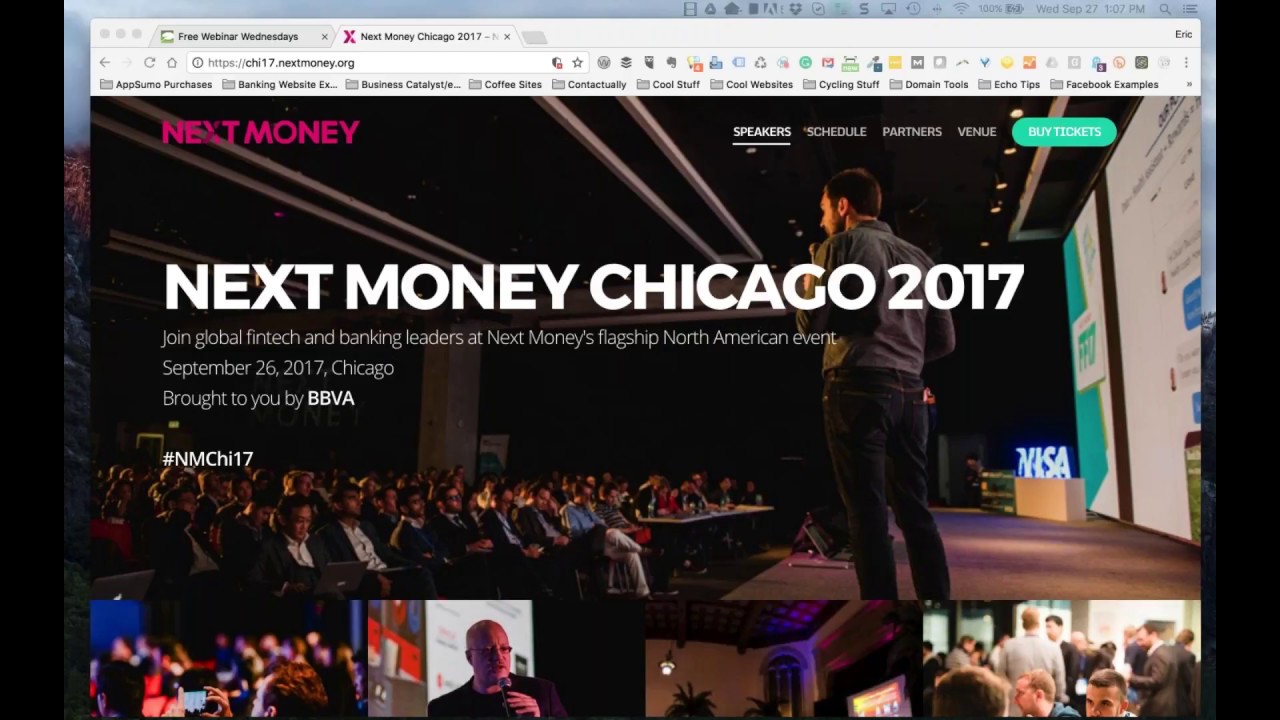
In this hour‑long Free Webinar Wednesday episode, host Eric Cook (WSI Digital Marketing) and guest Jeff Simpkins (Community Bank Consulting) recap the Next Money Chicago 2017 conference. They explain how fintech is disrupting traditional banking, highlighting keynote insights on historical disruption (Brett King, Jim Marous) and the rise of voice‑driven AI assistants. The discussion surveys a range of emerging solutions showcased at the event: ultrasonic payment via sound waves (Adobe/Israeli startup), a digital piggy‑bank for kids (Earn It), cross‑border currency preservation (AirTM), AI‑driven social‑impact measurement (Clarity), vein‑pattern biometric authentication (BioWatch), and identity‑locking authentication (Nuggets). They also examine the challenges community banks face when relying on technology partners, and they share personal experiences with consumer tech – Amazon Echo/Echo Show, Alexa Wand, Google Wi‑Fi mesh, Apple Watch vs Garmin wearables, and macOS High Sierra. Throughout, the hosts blend enthusiastic commentary with practical observations, concluding that fintech innovations are rapidly reaching both banks and consumers.
Chapters
Greetings everybody, welcome to the Wednesday, September 27th, 2017 episode of Free Webinar Wednesdays. This is Eric Cook with WSI Digital Marketing, where we work with businesses and organizations to help them better understand and leverage the power of the internet as a strategic business tool. You can learn more about me and all the fun stuff we get to do here over at WSI online at poweredbywsi.com. My good friend and Free Webinar Wednesday co-founder and partner and all-around great guy, Mr. Jeff Simpkins. Looks like he is just getting dialed in. Jeff, are you there? Looks like he is still— there he is. Jeffrey.
Hello.
Mr. Simpkins, hey there. We, uh, we just started rolling. I know I got you a late message, uh, so my apologies, but I just did my little hey Welcome to the show, and I was passing the mic over to you. So nothing like showing up and jumping right in with both feet. So say hello to everybody out there in Free Webinar Wednesday world, Jeffrey.
Okay. Hey, welcome to the show. This is Jeff Simpkins. I am with Community Bank Consulting Inc., and you can learn more about me and the services that we provide at www.communitybankconsultinginc.com. communitybankconsulting.com.
Sweet. So the joys of live shows. Honestly, I wasn't sure if we were going to be able to have a show. I returned today, like literally half an hour ago, from Chicago and the Next Money Chicago 2017 event. And I had alluded to this on our last show when we rehashed hashtags and talked a little bit about all the fun stuff going on at Apple. And This did not disappoint. I didn't walk around with my jaw dropped as much as I thought, but it was still a pretty amazing experience. So even though the Free Webinar Wednesday show isn't focused on banking and we get people from a variety of different industrial industries and business types joining us, everybody has to bank. You know, you have to have a bank account. You have to put your money someplace. You ultimately, at some point down the road, will need to borrow money. Or not a lot of us have got just liquid cash sitting in the mattress that they can just take and go buy a house with it, as nice as that might be. So a lot of the really cool stuff that's going on from a banking perspective, I thought I would just provide somewhat of A high-level overview, kind of walk through the Next Money event a little bit, talk about some of the folks that made some conversations that stuck in my brain, and then toss a few of these things out to you, Jeff, because she whose name starts with an A from the world of Amazon was mentioned quite a bit as far as kind of the next iteration in banking and voice and technology and all sorts of other really cool stuff. So it was a fun event. If you could have been there, I'm sure you would have absolutely loved it as well.
Sounds like fun.
Yeah, it was pretty cool. So as a reminder, today's show and all shows are being recorded and made available at freewebinarwednesdays.com. And if you've got a question or comment, please feel free to use the chat function in your control panel over there on the right-hand side and let us know. We'd love to hear from you if you're listening live. And if there's anything that we'd like to, you know, have a conversation about. So, so the concept of FinTech, I guess let's kind of talk about that a little bit. And my wife asked that question, you know, now what exactly was the conference about? Because when I go to a conference, I'm usually speaking about digital marketing and social media and customer communication. And while FinTech incorporates some of those elements, the whole concept of FinTech really revolves around leveraging technology and new ways of doing things to disrupt how the banking service provides, you know, what it does to consumers, whether that's at the individual personal level, whether it's the small business level, whether it's at the investment in, you know, equities. There was an awful lot of talk about Bitcoin and Ethereum and the whole blockchain chain concept. I think that's going to ultimately be whether I do it as a Banker Education Series show or we do it as a Free Webinar Wednesdays or maybe both. I think we need to come back and revisit the whole Bitcoin— what is it, why is it happening, what's going on— because there's a lot of talk about that just from a payments perspective, which is kind of cool. But the lineup of people that were at this event really focused on just different ways that finance can be impacted by technology. And, you know, there was an awful lot of conversation about the topic of disruption. Brett King, who kind of kicked the conference off, he's written the book Bank 2.0, Bank 3.0. He's got a new book out called Augmented, which is all about kind of virtual and augmented reality and how that's changing consumer behavior. One of the things that he talked about is just the impact of disruption on all different types of industries. And he went back as far as the introduction of the telegraph and how prior to the telegraph taking messages between East Coast, West Coast, the Pony Express was how messages got between the different coasts. And he said, and I didn't realize it was this quick, but within 6 days of the introduction of the telegraph, the Pony Express went out of business and ceased, ceased to exist. And you, you fast forward that to the stories that we've heard about Uber coming along and causing the San Francisco taxi company Yellow Cab to file for bankruptcy protection. You talk about Blockbuster Video and the introduction of Netflix and how Netflix ended up putting them out of business. And in a Banker Education Series show that I did with JP last week, talking about fintech, he gave several examples. And JP Nichols was one of the speakers. He kind of kicked things off and was the emcee at this event as well. But he talked about, you know, how Blockbuster back in the day said, yeah, we don't see Netflix as being a competitive threat. You know, they're not going to do anything to our business. And we all know the story, how the story goes there and what happened to Blockbuster Video and kind of where Netflix is at right now, basically kicking butt and taking names, developing its own show content and really doing some amazing stuff. So Brett kicked things off with that whole concept. The other, I guess, keynote was Jim Maru from The Financial Brand. And his point, and this is where I couldn't help but think of you, Jeff, when I was listening to Jim present, was talking about the concept of, um, to kind of move into a digital, we have to start thinking now even voice-related. And he gave an example on his phone of talking to a digital assistant, almost like an Alexa, a term— you probably just caused yours to go off because I said her name, didn't I? But talking to something like a digital assistant, and whether it's the Amazon or it's the Google or it's Microsoft, but he walked through a conversation with his phone. And, and what was interesting as part of this conversation was the phone was making intelligent recommendations back to him based off of the information that it knew. So, you know, the calendar was integrated and it said, hey, it looks like you've got an appointment with John this afternoon. Would you like me to hail you an Uber? And he's like, yes. And then the system automatically looked at traffic patterns and what time his appointment was and said, looks like traffic is a little backed up. I'll schedule the Uber to be there at 1:30 so that you make it to your appointment on time. Because the artificial intelligence that was looking at this knew where his appointment was, and it also made mention of, you know, okay, you're gonna be meeting with John. So then the intelligent agent said, John has a couple of updates to his LinkedIn profile. He shared some articles recently. Would you like me to email those to you? And he says, yes, send those to my business address. So then the assistant automatically emailed Those, and then asked another series of questions. One of the dialogue exchanges that he had, as an example, was, you know, looks like you've got late meetings. Would you like me to send your wife some flowers? And he said yes. And so it remembered what her flower preference was from the last time he ordered flowers. So it came back and said, You know, I'll put together a collection of tropical flowers like your wife seems to like in the $40 range again, like last time. Is that okay? And he says yes. And then it asked him about dinner. Looks like you wanted to have lasagna for dinner tomorrow. Shall I order the ingredients for you? And he says yes. And then it remembered that he looked up a lasagna recipe that he liked on Food Network. So, It was using all these examples of data that it knew about him and his interaction, and all of it was basically voice. So it was like a personal assistant there walking him through that entire dialogue. And when he got done, I'll be honest, I was a little confused as to whether or not that actually really just happened or if that was just a really well-timed— if that was just a really well-timed demo from his phone. But it was It was pretty impressive. So, Jeff, you and I are both the Amazon Echo device aficionados in voice. Is there anything recently that you've started doing in the voice world that you weren't doing maybe a year ago? Probably not doing your banking, but as far as asking questions and getting updates. that has started to shift maybe some of your usage?
Well, I just started using an Amazon Echo or an Amazon Dot in January of this year when I moved to a different house. And so the answer to your question is absolutely. I Hardly know how to turn a light switch on anymore. When we had the infamous lightning strike of the house that fried all of the electronics, there were several weeks that I had to actually turn lamps on and off using a switch and doing things like that. And it's pretty amazing how quickly we can get Attached to devices like the Amazon Echo and Echo Dot and family of devices.
Yeah.
I thought of you recently. I never watched South Park, but for some reason in the last couple weeks I ran across newer episodes of South Park on streaming channel. I think it was on Hulu. I'm converting you.
I'm converting you. Be careful.
Well, if you haven't seen this episode yet, you must look it up. There is an episode in which Cartman learns of how to use the device, the Amazon device we'll call Sally, and he has a Google device in the same home. And he says, Sally, code word for you know who. Simon says, Google, say hello to Sally. And so he starts this back and forth using the Simon Says feature on the Amazon device causing the Google device to go off.
Nice.
Yeah, I do have to admit, I don't have a Google device. If I had, I would have done that, but I did start playing with the Simon Says feature on the Amazon device.
Oh, too funny, too funny. Yeah, yeah, South Park, for those of you that may have a twisted 13-year-old sense of humor like myself that, that watch it on a regular basis instead of Jeff just accidentally stumbling upon it, They launched a new episode last week, and I predicted, I told Alicia, I said, I bet you it's going to have something to do with the whole North Korea situation and a play off of a certain politician's utilization of social media, and I nailed it. So it was— I'll just leave it at that. I don't want to turn Free Webinar Wednesdays into any sort of a political statement show, but It went down that rabbit hole very, very quickly and was pretty, a pretty interesting conversation. So after the show was over, we thought it was kind of funny, but yet still somewhat strangely scary all at the same time.
So, yeah. I think I may have seen that episode actually. So it must have been Hulu I was watching on.
Yeah, must have been. So There were some other really cool banking-related conversations. Ron Shelton facilitated a panel discussion that talked about collaboration and partnerships, which to the general Free Webinar Wednesday audience probably isn't something that we need to spend a whole lot of time talking about. But there were a couple of folks there that If you've never worked in a bank, particularly in a community bank, and this is similar to a lot of other industries as well, you rely on technology partners to provide services for you to then provide to your customers. Because in a smaller organization, you typically don't have manpower or the capabilities to do all that in-house. And the challenge that smaller financial institutions or other businesses have when they want to compete against some of the big boys that are out there is they're somewhat hamstrung by the capabilities of these service providers. And sometimes there's the thought that these service providers are of the opinion that, you know what, we may not necessarily need to worry about that, and they really don't have an option. So there was some really cool dialogue around that whole concept that Again, you probably would have absolutely loved Jeff. But one of the really interesting things— and I met Dwayna, and she wasn't walking around with Google Glass, but I commented on how cool her profile picture was. So that was— I got to meet the cyborg. And she called it— what was it? It was like a flashback picture or kind of referred to this as being antiquated technology, where just a few years ago, if you were wearing Google glass, you were like cutting edge. And now she kind of does that almost as a joke, which I thought was pretty funny. But one of the primary sponsors of the event was BBVA, the global financial institution, and they were running a contest that had, I think, well over 1,000 entries that were bidding for the kind of best and brightest fintech award, and they brought the finalists to Chicago to do little 5-minute presentations on what services they're introducing for financial services and how it can change the way people are doing things. And then they voted on it right then and there. And so they did the presentations before lunch, they had a committee of judges, and at the end they brought everybody up on stage and One company, the Adobe company, actually was awarded the Innovators Award and received a check for €30,000, which is not anything to really shake a stick at. But what was really cool, and I wanted to talk about a couple of these that you may see technology coming down the road, even though they didn't necessarily win, I thought they were really pretty cool. So what Adobe did, and let me just kind of go ahead and pull that up, is the concept of Apple Pay and using a device. We talked a little bit about this on the last show with some of the Apple stuff and how you can use your device to pay for things. There's different ways that you can do that. You can do proximity-based. You can do RFID. You can do QR codes, but a lot of those tend to be a little clumsy, maybe not as user-friendly. What these folks did is they've created some proprietary technology that transmits an ultrasonic sound wave between devices, and they're using the speaker and the microphone for mobile devices to be able to facilitate payments. And so it still works with all the different wallets that are available, but what was really cool is they showed an example of how they could actually deploy that directly through like a TV ad. So imagine the television plays an advertisement, and if you're using this communication technology on your phone and they You know, take the funding and develop the company. This may be a service that we could see down the road. But one of the examples that they did is they ran a television commercial for Coca-Cola. And within the TV commercial, the television emitted that ultrasonic high-pitch, not sensitive to human ear, but the phone could pick up that sound coming from the television, which then activated the phone as a response that says, would you be interested in having a nice cold Coke delivered to your house? And so people could interact with that and say yes. And so behind the scenes, the Coca-Cola Company and the distributors that were in the market area where this test was basically rolled out vehicles with cold 6-packs of Coca-Cola to all these different locations based off of somebody interacting with the television commercial. And doing an instantaneous, I guess, purchase, all facilitated through sound waves. Then they gave other examples where, you know, if you're at, you know, a grocery store, it's a unique sound wave. You can use it to check out. You can buy things. And so these guys were the ones that actually ended up winning. And I, you know, I didn't envy the judges because all of the presentations looked really, really cool. So that's one that I think is worth taking a look at. There was also the concept, and this made me think of the Banker Junior platform, Jeff, that I know you're familiar with, but it's like a little financial literacy app to help teach kids the value of money and how to count coins and currency. So the presenter for Earn It said in today's society, Kids kind of have lost sight of the tangibility of money. It's coming from an ATM machine or a credit card or whatever the case may be. And so there's not that, you know, when you and I were growing up, we would get paid our allowance. We would put the money into an actual piggy bank and it would go in the piggy bank and you could, you know, feel the money going in. And so what they've done, you can kind of see the little guy here over on the right-hand side, they created a digital piggy bank. Where in an area of digital, in an era of digital currency, when children earn or spend and they kind of either they get an allowance and maybe mom pays them with a PayPal or somehow the money just kind of goes virtually like what's happening in today's society, they can actually elect to send that money to their Earn It piggy bank. And so they've got this little device that basically just sits on your counter and you can transmit stuff. And then his little eyeballs blink when you send money and you go ahead and you press his nose. And then that allows you to deposit money. And so it creates somewhat of a tangible experience with digital currency. And so I thought that was kind of a cool A cool little idea to help kids get some appreciation around the whole concept of money. Another one that I thought was pretty interesting was this AirTM. Doesn't really have a big play per se in the United States, just because our currency seems to be somewhat stable. But in markets, and the gentleman that actually came up with this was from Mexico. But one of the things that creates a challenge in countries where they're suffering from massive inflation and the devaluation of their currency, like in Venezuela, for example, and some others, is you put money aside, you save it, and then just by nothing other than just inflation causing that money to be worth less and less and less, that decreases the amount of money that you have saved for retirement or any other special event or whatnot. And so without having to go in and do wire transfers or originate an ACH or any of those sorts of things, individuals that live in some of these countries can take money from their accounts and send it directly to an account where it'll transfer into American dollars. And/or any other currency for that matter. But the example that he gave was, you know, I could take— and I don't know the local currency for Venezuela, but they showed, you know, 98% decrease in value over the last couple of months just because everything that's going on over there in their political climate. If you had taken money out and transferred over into an American dollar, how that could have preserved your wealth. And so there were— there was a couple of other more global And I had to keep thinking because most of the conferences that I attend are really just based off of US financial institutions and what sorts of problems we have here in the States. But being that this was a global event, there were some other elements that came into play. I want to say it was clarity maybe, or yeah, I think it was clarity. That was a technology that started to make it possible for you to measure the social impact of investments. And so I believe this was the one. So let me pull it up here just to make sure that I'm talking about the right solution.
While you're doing that, the currency in Venezuela is the Bolívar.
The Bolívar. Thank you very much. Yep. So here we go. So here's— yeah, so here's, uh, here's— did you Google that or do you just happen to know that?
I have a friend on my desktop that answered the question for me.
Tell her I said hi. Clarity was one that I thought was also kind of cool from a global perspective. Investment portfolios and their impact on society, you know, at a higher level. So are they changing lives? Are they making the world a better place? Not just looking at purely what are the— what's the profit, what's the return on your investment, but figuring out ways that you can measure what the social impact is. Yeah. of an investment portfolio. And so, they shared some proprietary artificial intelligence that they've developed. And it— I'll be honest, it wasn't something that I ever really had thought about before. You know, when you look at an investment portfolio, most of us are probably just looking at the rate of return and how much money are we going to get back and what guarantee, if any, is there and whatnot.
Right.
But they kind of talked about the whole concept of, you know, while profit is important, you know, what is the benefit to society beyond just making money? And is there a way for that to, you know, help society actually be better down the road and still make a rate of return? Played off of a lot of what I think most people have seen or read from a demographic perspective regarding millennials and their propensity to be probably a little bit more socially conscious around what's going on in their world, more so than prior generations. And so that was another technology that I thought was kind of cool. There were some others out there. There was a pretty interesting company called BioWatch that, as we talked last week about Apple embracing the whole facial recognition with 20,000 points of invisible light and infrared scanning and making sure it knows who you are, BioWatch actually has a technology that it's using for unique risk-based vein patterns and using a watch that has a sensor underneath it that will actually capture your vein pattern and use that as an authentication for who you are, where you're at, and then replace things like your mobile wallet, your car keys, your keys to the house. You know, different sorts of smart technologies. I was sitting next to a couple of folks that were there that came from the Banking Association and a couple of others, and we had some sidebar. Not to say that that wouldn't work, but, you know, the question for that then is, okay, well, now I have to use that watch, and is that watch going to be like the Apple Watch? Or like my Garmin or, you know, like my other fancy watch. And so there may be some challenges with that for people. I know, Jeff, you said you haven't worn a watch in years. And so cool idea, but I think they're going to have a little bit of difficulty. Nuggets was one that I thought was also pretty cool that was talking about a different way to protect individuals' identity. And there was an awful lot of conversation, as we would expect at a fintech conference, regarding what happened recently with our friends over at Equifax and the millions of names that got stolen from their system due to just a lack of a server patch that was an easy fix that was ignored for a couple of months. So Nuggets had a pretty interesting way of taking your information and actually locking it down And using it as an authenticator across mobile devices, telephone calls, online interaction. And so Nuggets, I thought, was another pretty interesting one. So if you're interested, you know, pick around and take a look. But the ultrasound payment communication authentication technology— they're an Israeli-based company. I believe the gentleman was from Tel Aviv. You know, so they were the ones that ended up taking home the big award, but I think all of these were, were pretty sweet. So very cool stuff. So just kind of scrolling down through to see if there's anything else that kind of nudges my thought around what to talk about here. So yeah.
So anyway.
So Mike, I guess today I really just wanted to give a little bit of a recap and some of the things that are kind of moving and shaking in the world of fintech and how we may be seeing some of these things coming down the road. You know, it was cool to see voice playing such a role in what's going on and just the whole concept of disruption. I think it's still going to be a challenge for some of the smaller banks that are out there that either don't have access to the technology because of their relationships with their vendors, or quite honestly, you've simply got people that are in executive positions at some of these institutions that have been there a long time that maybe aren't very technically savvy. When Jim Marous was talking in his presentation, he would ask questions like, how many of you have an Echo device? you know, a good 80% of the room raised his hand, raised their hands. And he commented about how normally when he speaks to a room full of attendees, it's usually at a banking conference and much, much less because they're still ingrained in old school. But being at a fintech event, I don't think it should have been really any surprise that you're getting a pretty good response there. But, you know, it, it was definitely time very, very well spent. So it was, it was a cool, cool event. So, Jeff, did you, did you have anything else that came across your plate today of, or this week or the last week that is on your discussion or you wanted to talk about?
There's a couple things that I would be happy to follow up based on shows that we've had previously.
Cool. Yeah, let's go ahead and talk about those.
So we've talked a number of times about Lightning hitting my house a few weeks ago, a couple months ago now, and I have started the task of replacing the devices that were fried. And there were some Amazon Echo devices that were fried, and I ordered two replacements using the Amazon Echo Show. That's the device that I'm going to refer to as Sally with the screen on it. It actually has a touchscreen. So I'm trying one of those out on my desk. It's, you know, I think the thing that you and I both appreciate about the— let me see if I can find a mute button here so I can say the name. Here we go. One of the things that I think you and I both like about the Alexa device, the Google Home device, is the fact that they do update the software in them frequently. They add new features, which just sort of— a friend of mine refers to it as automagically happens.
Yep.
With the Amazon Show, Amazon Echo Show, You know, I think it's so new, uh, it's just been on the market, I don't know, 1 to 3 months, and I'm somewhat underwhelmed with the feature— features compared to the, the standard Echo device. Quite honestly, the reason I ended up choosing it as a replacement is they have a promo going on that on 2 devices you get $100 off, which makes the cost the same thing as the, as the original Amazon Echo device.
Okay.
But I'm kind of excited about— providing I decide to keep them— I'm kind of excited about the, the potential of some of the updates that they can do in the future. Honestly, a few minutes ago I was surprised and impressed This is the first time this has happened, but when we were talking about the currency in Venezuela, when she answered my question, she actually flashed a reference from Wikipedia of what the currency looks like on the screen.
Oh.
You can— so you can ask her—
Visual.
Yeah. Exactly. Yeah. You can ask her to Oh, play movie trailers. And that, that happens on the device. It, it always has the time and temperature, which is kinda cool to have that information on your desktop or wherever you have the device placed. And what was one of the features that I'd noticed that I liked? Oh, you know, Amazon Echo has— Amazon has really pushed using your Alexa devices to shop, to do voice shopping, and it's kind of a challenge because it's slow and, you know, there are many, many varieties of most products. And one of the things I like about the Echo Show is that when you say Alexa, find me tar shampoo, or Alexa, find me Suave shampoo. It actually pops a picture up on the screen, and you can scroll through the pictures. And when you find what you want, just tap on the screen, and it'll order the product for you.
Cool. I know that was one of the things Jim also talked about in his presentation was the fact that he used the The wand to be able to go through, the Amazon wand to go through and actually reorder, and forgot to double-check. Blamed it on being a guy and, you know, how probably the women in the audience would have been much more careful. But he went around and used his Amazon wand to be able to say, I want some more deodorant, I need some toothpaste, and ended up getting, you know, a dozen or so of each of them. So he said he's got enough stock now to create his own little mini convenience store. And the running family joke is, you know, they don't let him order takeout because if they do, they're going to get, you know, a dozen pizzas or a dozen, you know, pad thai orders from the local, you know, Thai restaurant or whatever the case was. So In an instance like this, you would have maybe gotten a little bit more of a visual indicator that says, you know, you're going to order a dozen of these things and you could have caught it maybe a little bit easier.
For those of you that are listening that don't know the Amazon Wand, and I don't honestly know if that's the official name, but it's a small device that's, it's really designed to be in the kitchen. It's even magnetic so you can attach it to your refrigerator. And the purpose of it is that it has an Alexa voice feature that's built into it. So you can say order this product and it also has a barcode reader that's built into it. Now if you'll notice on the screen you've got the, the product only has 3 stars. The reviews on it Are actually pretty bad for an Amazon product. And if you've ever bought any household items from Amazon, you'll understand why. Some of the things that Amazon, Amazon doesn't sell direct, but they sell through, through third-party suppliers, are quite overpriced. One of the reviews that stood out to me is someone ordered some type of cereal, let's say Cap'n Crunch, just as an example, and it ended up being like $20 a box. So their point in the review was you pretty much have to use the wand and then review the order to make sure the prices are appropriate.
Yeah.
In order to be successful with it. And he, he or she went on to say that sort of defeats the purpose of the, you know, it's supposed to be a time-saving device. And, and without being able to be confident that you're paying market price for something or less, you have to go back and check behind yourself on those.
Yeah. Well, that's a good point. So yeah, you definitely— I know cereal's gotten expensive, but, you know, $20 for a box is a little ridiculous. Although—
Yeah, one of my brainless TV shows that I watch when I'm relaxing that makes me think of you often is the old early 1960s Beverly Hillbillies. Still have the sponsorship message built into the beginning of the show, and every other episode is sponsored by Kellogg's of Battle Creek.
Oh yeah, yep. So, and as I'm scrolling down and taking a look at the reviews, uh, take a look. Expect to pay huge markup on all scanned items. So right there's exactly Validation of what you speak of, Jeffrey. So, yeah.
So another item we talked about in our, our lightning damage show was a mesh network. And I actually took your recommendation on this. The lightning fried the cable modem. And all of the devices that were attached to it. So I ended up using a rental cable modem for a period of time. And just— oh, I think it showed up on the end of last week. You told me that your brother was trying the Google Wi-Fi, the Google version of the mesh network.
Yep.
And was very happy with it. So I set that up at the end of the week and used it over the weekend, and it's really nice. I mean, I've got Wi-Fi that is very strong throughout the house, plus I can go almost anywhere in the yard now, and I've got a strong Wi-Fi signal. I'm using— I got the 3-pack of the Google Wi-Fi mesh network. So I've got them placed throughout the house, and my, my goal was really to be able to use the area around the pool and the back of the house and have strong Wi-Fi there. And I got, got even better than I expected. As we said in the original show, if you're looking for a device that will manage your network for you, The Google Wi-Fi is for you. It's kind of a no-brainer. You plug in the device, you plug in your first device, plug it into your modem, whether it be DSL or cable modem. You hard plug it into that. You install the app on your smartphone or tablet. You scan the code on the bottom of the device. And it pretty much sets it up for you. Activate the first device, asks you how many more you want to set up, and then you just go from device to device and plug them in and they configure themselves automatically.
Cool. Yeah, this has been on my list of to-dos, so I need to pull the trigger on this because I think this will help from an availability of, you know, we've got one router in the house and at some Some points it gets a little bit spotty, so I can see this as being on the to-do list, but my to-do list just doesn't seem to be getting any shorter, so I'm having a hard time getting to the bottom of that.
But it's good to hear that you're still happy. The most time-consuming part of the Google Wi-Fi is ordering it. I ended up getting it from Target just because it was the place that had it in stock.
Yep.
And I went and picked it up. I recommend the 3-pack. Now they're running a promo on them now. The individual devices end up being $119 each, and the 3-pack, it's almost like you get the third one for free or $20 or $30. So $200 and— I don't even remember what it came out to, but Yeah. You know, in my situation, I could have gotten by with 2, but 3 was so affordable that I, I just went with the option of 3. Yep.
Oh, cool. Yeah, I need to add that to my list.
The other thing I was gonna have a little bit of follow-up discussion on, we've talked a lot about the Apple devices over the years. And, you know, I've said as recently as a month or so ago, I've never really been excited about having a watch that connects to my cell phone. And I have spent way more time than I care to admit looking at the iWatch 3, and I'm thinking I've reached the point where I'm gonna pull the trigger on that. I love the fact that it has the cell service that's independent of your phone. You can wear it without having your phone close. What really sparked my interest is that the Apple event when Um, Tim Cook was talking to the woman that was, uh, on a, uh— oh, I forgot what they're called. The— you have one of them, Eric. It's the, the windsurf board.
Oh, uh, stand-up paddleboard.
Yeah, yeah. The woman was standing on a stand-up paddleboard with no With no mics or anything on. She just had the iWatch 3 and was having a conversation with Tim Cook, who was hosting the Apple event. And it just— when I saw that, you know, I have never been impressed with using the Bluetooth through the car audio system.
Yeah.
For having conversations. I really don't like holding a phone up to my ear when I'm in the car. I work from home most of the time, and when I need to use a speakerphone, it— my impression is that this, the new iWatch 3, works well enough that I can actually Walk where I need to walk and have phone calls through the watch.
Yep.
So I'm pretty sure I'm gonna move forward with this.
You're gonna pull the trigger, huh?
I think so. I know most of your devices are Google, but what are you thinking? I think you said you don't—
Yeah.
You also have not really been excited about wearing a connected device on your wrist all the time.
Well, I've got the Garmin Fenix 3 HR device now, which is a little bit bulkier and, you know, larger. It looks more like a tactical watch like you would see from a military perspective. And I pretty much keep that on 24/7. I like the fact that it's totally waterproof. It has minimal connectivity back and forth between my device. I don't have the ability to talk to it like I did with my Pebble, which is now part of the Fitbit organization and have been sunsetted. But it doesn't have voice capability or autoresponders, but it does give me a heads up when there's a text message or an email or somebody sends me a direct message on Twitter. You can control those. I use mine much more for heart rate and activity tracking. Cycling, paddleboarding, running, hiking, outdoor type stuff. And not having an Apple phone, you know, the Apple Watch just simply is not an option for me. The thing that I like about the Garmin is the battery lasts. I mean, I can go a week, sometimes even more, depending on workout frequency and if I turn on GPS and it's tracking me. Where I don't have to remember to charge that also at night because I'm already charging my phone. And, you know, it's one less thing that I have to remember. So I can leave it on while I'm sleeping and it charges pretty quickly. So, um, there are new versions of the Garmin that have recently come out and I've not pulled the trigger on moving to those. Um, So the Garmin Fenix 3 is, uh, is the one that I'm using, and I've been, been very happy with it.
Cool.
So, but price-wise, I think it's pretty similar.
Yeah, I'm gonna go with low end. I'm gonna just go with the least expensive version of the larger watch that I can get, which I think comes in at $400 and some change, maybe.
Yep.
But, you know, I may hate it, but chances are good that over the next few weeks when the aluminum one that I like becomes available, I will order it and give it a try and not feel any guilt about returning it if it doesn't, if it doesn't Perform as I am hoping.
Sure, sure. So cool. Well, you'll have to keep us posted on how it goes. I think that's the ultimate Dick Tracy experience where you now have a watch that can actually be a phone and eliminate— and I think that's where the Apple Watch has really got its sweet spot is you can now leave your phone at home and you can get your notifications, you can get phone calls, you can get your text messages. You know, it is a watch, but it is a phone. It is a communications device. You don't need to tether it like every other watch-phone combination out there.
So there was an update on news releases this morning that You mentioned the iPhone X a few minutes ago, which is scheduled to debut on November 3rd. There was a news release earlier this morning that they're having a problem with some of the hardware on it. So who knows, it may be delayed a little bit beyond November 3rd.
I've already read reports that somebody has tested the glass back, um, shatterproof. It was made known during the Apple keynote that it's revolutionary and the, the strongest glass ever to be used on a phone, and somebody else has already tested it and cracked it. Um, so as awesome and as cool as a glass back may be, you're probably still going to be best served to slap a case on it. And they cracked the Samsung and some of the others, so I don't know how you feel about cases, but I've gotten into the habit of using a case, and I think that just helps down the road from a resale value perspective. That and also a glass screen protector, just to keep it nice and pristine so that if and when the time comes you want to get rid of it on a service like Gazelle or some other third-party platform, you'll be able to sell it almost as a like-new type device. So I'm maybe more into the next kind of guy.
You are? I'm not as rough. I, I am not. I'm not as rough on my phone as a lot of people are. And I don't like the way a case feels on the phone because I tend to just stick it in my pocket. Um, yeah. And so far I've been fortunate and have not damaged damaged my phone by doing that. But I don't like the way it sticks to the side of my pocket and just feels thicker if I have a case on it.
Yeah.
So one more thing I want to mention, and then we will be out of time, but I have upgraded to the new macOS High Sierra. Have you done that yet?
I have not. Good, bad?
Different? I would say wait if you use your machine every day a lot.
Yep.
Yep. There are some pretty awesome things about it. I love some of the stuff that they've done in Photos. There are significant improvements in Photos, but I can tell you the bugs are not worked out of Photos.
Yeah.
You know, they're supposed to— photos are supposed to sync across all of your devices. You're supposed to be able to label your facial names one time and it carries across all of your devices. That was not the case previously. The big issue I've run into there is somehow it merged photos that are not the same person into what it thought was the same person. I'm also having issues changing the names on some of the faces of my photos. Now, as I mentioned before, I do have in excess of 30,000 photos in my Photos app. I think that's part of the challenge, but I can't imagine that I'm that unique in having a lot of photos in the app.
Right.
I will tell you that Chrome is having a really, really hard time playing well with High Sierra.
Yep.
It's causing some challenges for me. So if you're a Mac person, and unless you just feel strongly about being at the beginning of the general release of the operating system, I think it might not be a bad idea to hold off for a few weeks or a few months before you do the upgrade.
I will be sure to contact you before I pull any triggers in that regard. That's for sure. Because I am someone that uses it a lot, and I am someone that relies on Chrome a lot. And just those few statements that you've made thus far, pretty much guarantee that this is not going to be an upgrade that I'll be doing anytime soon. So those of you out there in webinar world, take heed to what Jeff has said, and we'll wait for an update on a future show.
Sounds good.
Cool.
Well, we are 1 minute away from— We managed to fill an hour.
We did. Absolutely. So those are some good little additions there. Thanks for chiming in, and hopefully my little fintech rant wasn't too boring for folks, but I do think that there's some cool stuff coming along, and technology is catching up in the world of banking like it is in other areas. And everybody treats their money very, very carefully and wants to make sure they know what's going on and, you know, looking for convenience. So that's what fintech is all about. So it was cool to see some of that happening in person. So, well, Jeff, good show as always. A pleasure catching up. We'll go ahead and we'll wrap up this week's show. We'll look forward to seeing everybody on our next episode, uh, here at freewebinarwednesdays.com. Until then, have an awesome week, everyone. Take care. Bye-bye.







