
Taking Your Passion and Creating a Conference (and Awesome Podcast)
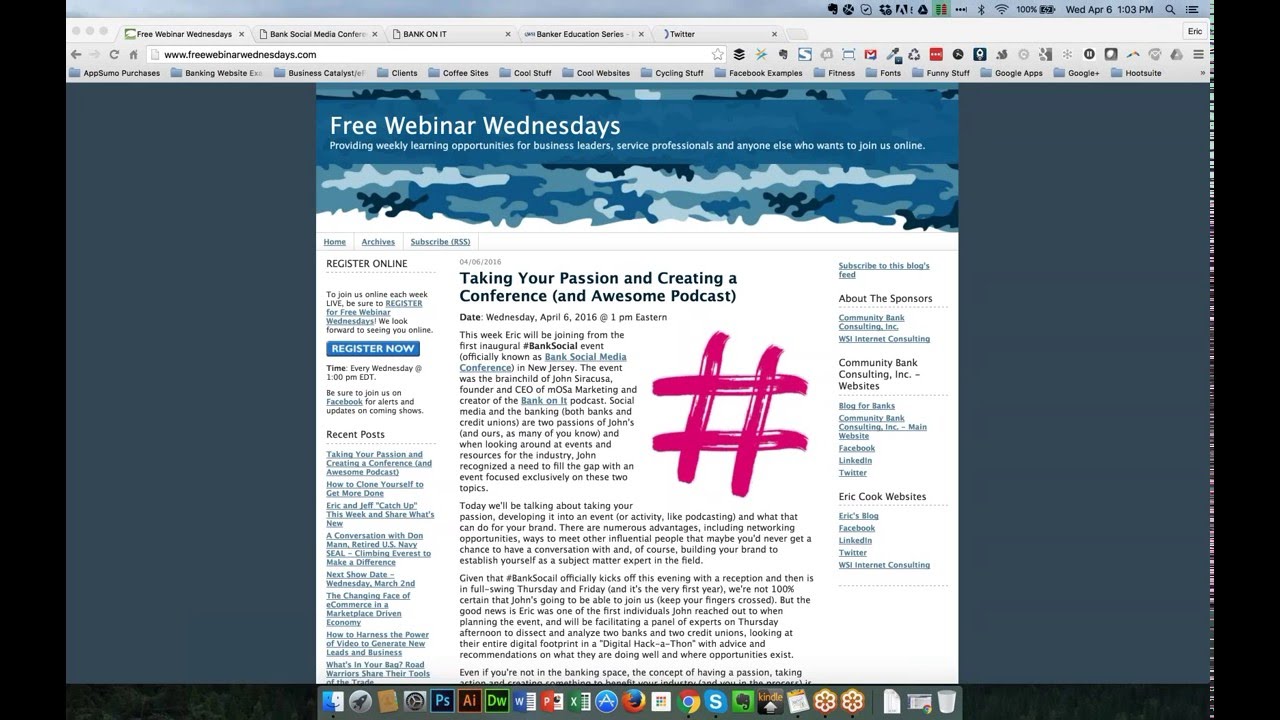
Eric Cook and Jeff Simpkins talk about launching the Bank Social Media Conference and Bank On It podcast from John Syracuse's passion for banking. The conference brings bankers and social media experts together to tackle compliance-aware marketing, SEO, and analytics. They discuss using mystery shopping and TweetReach to measure what works.
Chapters
Everybody, welcome to the Wednesday, April 6th, 2016 episode of Free Webinar Wednesdays. This is Eric Cook. I'm with WSI Digital Marketing, where we work with businesses and organizations, helping them better understand and leverage the power of the internet as a tool. You can learn more about me and WSI online at www.poweredbywsi.com. With me this week and back in the saddle after a little jaunt down to Florida for some warm weather is my good friend and Free Webinar Wednesday partner, Mr. Jeff Simpkins. Jeff, say hello to everybody out there in Free Webinar Wednesday world.
Greetings everyone, this is Jeff Simpkins. I'm with Community Bank Consulting Inc., and you can learn more about me and Community Bank Consulting online at www.communitybankconsulting.com.
Awesome. So did you enjoy your time away from the office? You were gone, we missed you. We had a really good webinar last week, but hopefully you'll get a chance to catch it on replay.
I did. It was an opportunity for me to visit with my parents. I hadn't seen them since Christmas and Wanted an opportunity to visit them in Florida before they head north.
Cool. Well, good deal. And I know you probably had much better weather than what we've been having up here in Michigan. I think we snuck out for a bike ride when it was in the 60s, and then we've seen snow pretty much every day the last few days. So it's It's been somewhat disenchanting that Mother Nature just doesn't seem to want to let go of this white stuff. But what are you going to do? C'est la vie.
Well, it's cooler in the Carolinas this week, but it's still in the 60s and 70s. Yeah.
So, well, before we jump in and get started with our discussion today, I just want to give everybody some reminders. I see some new names. I see a lot of new names in the live audience list, so this might be helpful. Just a couple of things. One is, if you are dialing in and you are using a telephone connection and you are connecting in the United States, please make a note that the phone number that's provided by default is a Canadian number. If you don't have international calling, you may end up getting some long-distance charges. So double-check on that. There's an additional numbers list, and you can go ahead and pick a US-based number. Second, all of our Free Webinar Wednesdays are recorded, so you can go back and check out past shows. And we get those up on YouTube and embedded, hopefully within the same day or 2. Sometimes it depends on how fast technology wants to work for us. But we get those up so you can check those out after the fact, share them with a friend or a coworker or both. Maybe your coworkers are your friends, and that's even a better thing. And then lastly, if you do have questions or comments during today's discussion and you are listening or watching live, Please feel free to use the chat box and let us know. We're going to keep this one a little bit kind of freeform and talk about a conference that I'm at and some of what I know with regards to the creation of the conference around one individual's passion, which just happens to be one of my passions. And I'm excited that I'm part of the very first of what I hope will be many more events like this down the road. So with any luck, John Syracuse is going to be able to join us. Even though it's probably going to be via telephone as he's traveling back and forth because the event that I speak of is going live this evening. So he's got lots of other stuff to take care of, and then we're going to be basically up to our eyeballs in all sorts of awesome social media and banking-related content for the next 2 days here in New Jersey. So, so we'll keep our fingers crossed. But if you've got comments or thoughts, please feel free to use the chat function. And And let us know. We always love the live interaction that we get from our audience for today, for our shows. So, um, so with that, I guess let's kind of hop into the discussion. Um, the, the whole concept around today's show is really taking your passion, and it's no secret, and I know we say this just about every week, Jeff. It's no secret that Jeff and I come out of the banking world, and that's very much, uh, you know, a passion of ours. Jeff coming from the data center technology service provider side of the fence and me coming from the banking, kind of the actual banker side. And fortunately, our worlds collided several years ago, which kind of brought us where we are today. But I had the pleasure of meeting a gentleman who we'll talk about until he shows up, and if he doesn't show up, then I'll just tell him that we talked about him for an hour on Wednesday afternoon. John Circusa from Mosa Marketing, and I actually noticed that it has been redirected to the Bank Social Media Conference. And so John and I ended up starting some conversations. He had heard about me through, I think it was the New Jersey Bankers Association, or was doing some searching online for banking and social media and digital, and fortunately Because I do a lot of yapping about all that stuff. Fortunately, my name came up and he reached out to me and introduced himself. And at the time, he was in the process of creating a podcast called Bank On It and wasn't exactly sure where the podcast was going to go. But he knew that his agency at the time was doing a lot of work in the banking space, didn't really want to get into web development. or, you know, managing social media stuff, but they were doing a lot around content. And so thought that there might be some synergies, maybe a little bit of overlap, but more complementary services than really competitive services. And so we struck up a nice dialogue and had some good conversation and kind of became— I kind of refer to these people as technology or social media friends because we've talked For at least the last year or two, but I've never met in person until later today. But he's a really good social media friend and soon to be a live in-person friend when I get a chance to shake his hand later this afternoon. But was one of his very first guests on the Bank On It podcast and kind of when he was feeling his way around. And I've actually had him on one of my webinars. But his passion for social media and his passion for the world of banking really kind of took him in a different direction. And unlike myself or even Jeff, he really didn't come out of the banking industry. He kind of, I believe, acquired an affinity towards the financial services, the bank and the credit union space.
Yeah.
And what he's done is kind of brought together one of the probably more impressive collections of individuals in the areas of social media and content, not just from a banking perspective, but from a social media perspective that can help bankers better understand the concept of why social media is important, why we need to be thinking about it, and The folks that he's got aren't necessarily coming from it, from a banking world where they're concerned about things that those of us that are bankers sometimes are maybe too concerned about with regards to compliance and regulation. Because that sometimes— and I know Jeff can attest to this— sometimes those things stifle us from being able to think creatively because the thought is, oh, we can't do that because compliance won't let us, or we can't do that. because we're in a regulated industry. And so one of the refreshing parts about my involvement in this process is meeting lots of speakers from outside of the banking world that really kind of need to be educated on banking because that's not their world. So they're not hindered by some of these compliance and regulatory concerns. They're just out to, you know, build a brand, create engagement, tell a story, start a conversation, all the different things that you really want to use social media for. And then he's got other folks like myself and the founder of Gremlin, the founder of Social Assurance, you know, some really high-quality banking-related software platforms here to kind of ground everybody and make sure that, yeah, we do have to worry about those things, but let's start with some really cool ideas first and kind of work our way backwards. And so Bank Social in its first year is getting ready to kick off this evening. I'm actually facilitating a panel discussion with 1, 2, 3, 4, 5, 6 folks, a cross-section of banker industry and non. We're calling it a digital bank hackathon. And we've interviewed 2 banks and 2 credit unions. And asked them questions like, what are some of the most pressing things related to your institution? We're getting comments like social media engagement, staying relevant to our customers or our members, the challenges of organic search optimization, and how to, how to get rankings from an SEO perspective. And these 4 institutions have provided us with access to their, their analytics. They've spent, you know, anywhere between 45 minutes to an hour with me on a webinar going through all the different social channels, kind of opening up their kimonos to let the panelists really see behind the scenes as to what's going on in their institutions. And so that's the session that I'm doing, and I'm pretty excited about it. My biggest challenge is Going to be taking, you know, half a dozen experts and trying to get them to answer questions and talk about 4 different unique institutions and all of their— and making sure we stay on schedule and get it done in an hour. So you guys can cross your fingers for me. You know, I don't know how easy that's going to go. That's probably one of those sessions that could go an entire half an hour. But just wanted to kind of throw up the agenda here for everybody to take a look at because when John was coming up with the idea or the concept around, you know, building a conference that embraces the 2 passions in his life, you know, what are the things that really need to kind of come around or be talked about? And so, of course, we've got a networking reception, which, you know, I'm sure there'll be some adult beverages there, and, you know, that's very important. But Andrew Davis, who actually was on this week's Bank On It podcast, John releases a new podcast every Tuesday morning. So I downloaded this actually before I hopped on the plane today and was able to listen to Andrew talk, but kind of talking about branding, Focusing on a niche, understanding what it is that you do really well and not trying to be all things to all people, be everything to a certain smaller group of people. So Andrew speaks at conferences all over the country, anything that's content related. He is not a banker. If you get a chance and get an opportunity to download the podcast, it's a really good interview and he tells a really funny story about Miss Piggy, actually. So you can tweet him out and let him know I kind of gave you a little spoiler alert on that. Joe Sullivan is another person that's going to be speaking. I've actually had him on one of my webinars before about kind of looking at your, your market and customer insights. So there's a ton of really cool stuff here that he has brought together. Um, That really kind of focuses on, you know, not just the world of banking, but how social is actually working and interacting with folks and helping, you know, businesses build better relationships, but obviously with a bent on the community banking and credit union industry. So, um, I'm going to hit the pause button for a little bit because I just did a rather large dump of information there. I'm just going to See, Jeff, if you've got any thoughts or observations or comments to make.
These are all really interesting. I wish I was there.
I told you, you could, you know, I probably should have given you more of a heads up than, hey, get to New Jersey today. I know that's not exactly fair, but Yeah, it looks pretty cool. One of the other interesting parts about this, and if you're not in the banking industry, you may not understand the rivalry that exists between banks and credit unions, but as a banker myself, I can attest that there's not a lot of love lost between a traditional bank and a credit union, probably more so On banks with regards to credit unions because of some tax advantages and some regulatory issues. And there's also the debate about profit versus nonprofit and shareholders versus non-shareholders. Now is not the time to get on that soapbox, and I don't want to turn it into that conversation. But the other thing that I thought was interesting, and I'm interested in your thoughts on this, Jeff, is the fact that he's taken his conference, or we've taken the conference, to both industries. It's not just a banking social media conference, even though it says Bank Social Media, but there are credit unions that are here, and he's got a panel discussion of bank CEOs talking about how the banks are using social media, and he has a panel of credit union CEOs. talking about how credit unions are using social media and whether that's different or not. I'm going to be really interested sitting in on both of those to see if the similarities are a lot more prominent than what maybe people think, which, you know, I suspect is probably the case. It's a financial services company. There may be subtle nuances in the message or maybe the vision or the mission of an organization. But this is one of the first events that I've actually been at Other than maybe a core processor event where the technology provider serves 2 different sides of the same industry. But from a marketing and a strategy perspective, this is going to have, you know, strategies on both sides of the fence. And I've not been at one of these before. So, Jeff, you've got some banker blood in you and you've worked with both credit unions and banks.
That's right.
Any thoughts on What maybe might happen if everybody, everybody's gonna play nice or if there's gonna be some challenges. I want to get your opinion on that.
Well, I'm kind of chuckling because I agree with you. It's, uh, I think one of the things that both sides will learn is how much they have in common. Um, the big difference is really just the underlying business structure. But even though credit unions are nonprofit entities, member-owned entities, they still have to stay in profit in order to make a business. I'm thinking, you know, I'm not for sure either because I have attended conferences that were designed just for banks and and I've attended conferences that were designed just for credit unions. In all of my years working with one of the larger bank technology companies, I can only think of one client financial institution that we had that was in fact chartered as a credit union that ran their technology, ran their software using a banking platform. Typically those platforms are designed specifically for bank or credit union. My hope is that you'll have some folks that will set the differences in their business structure aside and talk about the things they're there to learn at the conference and build some bridges and learn from each other.
Yeah, that's kind of what I'm— not that today's Bank Social or this week's Bank Social is going to fix the raging debate that goes on in Washington, D.C. and all the individual state legislatures. There's a lot more to it than that, but I think there's going to be some interesting conversations. And I agree with you, I think some appreciation for both sides of the fence because the folks that are at the conference, I don't think, are as wrapped up in some of the political and competitive issues, although as marketers, you know, if you're competing against somebody that traditionally offers, you know, more competitive rates for one reason or another, that might maybe hit the marketer a little bit more so where they hurt. But I think we see a lot more of the senior management issues.
Yeah. From a regulatory standpoint, there's just Such a small amount of differences between banks and credit unions these days. With the advent of the FFIEC, the regulatory basis is really the same for both types of institutions. So there's not a big argument over how each is regulated differently because they're very, very similar now. Yep.
Yep.
You know, I will make this comment in working with banks, and I've worked with more banks than credit unions, but in working with banks and working with credit unions, I do find that credit unions tend to be more open and innovative in the use of social media and social media function. So I will go as far as to say there are a number of community banks, and I'm not talking about Mega banks or regional banks, but there are a number of community banks that I think have a great deal to learn from their credit union counterparts.
Yep, yep, I would agree. I would agree. So just kind of walking through the list of folks that, that are here, some great videos and cool stuff. And again, I know that we're kind of geeking out in the whole banking industry, but there's no really a reason why You know, if, you know, whatever your industry is that you might be coming from, maybe you're not a banker, but, you know, pick your industry. You probably have challenges, you probably have opportunities, you probably have folks that you could bring in from the outside, maybe even some of these folks that would give you some perspective on different ways to be innovative, different ways to communicate, different ways to tell your story. And I think it helps to get outside of your industry on occasion, just because, you know, you're taking an opportunity to get outside of your box and maybe see things a little differently. And, you know, if you are in a regulated industry, whether that's the banking industry, whether that's insurance, whether it's healthcare, you always have to put that edge back on to make sure that you're going to remain compliant. You're not violating confidentiality or regulatory issues or any of that stuff. But I oftentimes see businesses stay just within their, within their comfort zone and miss opportunities to look on the outside and see, well, what, what could somebody from the outside world actually teach us? Like, for example, I'm at Mark's, I'm at Mark's profile right now. Mark's one of the individuals that's actually going to be on the panel. Not a banking guy, but he works and owns a consulting company called Stone Temple Consulting, and his primary area of focus as it relates to the panel discussion is going to be looking into the banks and the credit unions' Google Analytics accounts and analyzing traffic trends and looking at organic reach and comparing that content. He doesn't need to do that, but he's going in and reading the tea leaves and looking for opportunities, looking for trends, looking for different sorts of signals that might present either an opportunity or a challenge to the website owner. So I'm, I'm looking forward to maybe even hopefully catching him this evening and picking his brain a little bit because we did have One of the financial institutions specifically mentioned, you know, organic reach is getting very, very difficult. And for those of you that are listening, if you haven't picked up on it, Google has made another shift with the way the advertisements show up when you do a Google search. I don't know if you've noticed it or not, but used to be you would have ads on the right-hand side and you'd have a couple ads at the top and your organic listings would, you know, you'd be maybe 3rd position or maybe 2nd position depending on the number of ads. Google's done away with the right side column and in what I suspect is very much more of a kind of a universal mobile-inspired approach. And so you're seeing now, you know, several ads at the top of a page of search results, then followed by the organic. And if you're on a mobile device in particular, you may not even see any organic listings if you do a search on your iPhone for mortgage loans, pizza places, insurance providers, whatever you want, your paid advertisements are right there at the top occupying the most valuable screen real estate. So even though this is a bank social media conference, I think there's going to be some discussion, as the moderator I can make it that way, about the growing relevance of digital advertising in the world of being seen Even in Facebook, the paltry organic search results that you're getting, you know, from an org perspective, when somebody goes online and they're looking at their profile and seeing brands versus what their friends are doing, most businesses now, if they want to be relevant, are going to have to allocate budget and boost posts and, you know, make sure that they're paying to get their message and their posts and their promoted items out there.
One of the things you mentioned a couple minutes ago that I want to comment on a little more is looking outside of your own industry for new information. I know you tend to be a podcast guy. I tend to go with periodicals and publications like that. And actually, access books that are outside of the financial services industry. And I will agree with an idea that you shared, and that is you can often learn some of the most valuable new things by looking at publications and information outside of the industry that's your core industry. One example I'll use is Harvard Business Review. Each— it's published approximately monthly, and there's not a month that goes by that I don't pick up on something that is non-financial services related that I can adapt and get huge value from in the industries that I serve.
Cool. Uh, as I was talking about search, um, I thought it would be maybe a good idea to pull up an example just in case, and you Maybe you've not noticed it, maybe you have, maybe you just said, wow, the page looks a lot more white than what it used to be, but not really understanding what's going on. But I'm not on a giant screen, but I've got a pretty good-sized laptop. It's a regular 15-inch, but it's got good resolution. And I've done just a generic search for mortgage loans. Do whatever search you want, put your own industry in, but you can see the first 4 positions are advertisements and there's no more ads on the right-hand side. And then you've got a map that shows up. So before we even see anything related to organic search, and this is a really broad term, so I don't expect, you know, community bank in New Jersey to pick up and to be listed number 1, because this obviously is a very broad search for a reason. But you can see you are a page into it scrolling before you get to any of the organic listings. And of course, when you look for just mortgage loans, you're going to get quite a bit of competitive, you know, the big dogs, of course, LendingTree and US Bank and Bankrate for rates and comparisons. But I think that's one of the challenges that businesses in general are having, and it's one of the reasons why social is playing more of a role, because if I'm interested in a mortgage or a dentist or or an insurance provider or a veterinarian or a dog groomer, yeah, I might go online and Google it, but what I'm also going to do is I'm going to go to Facebook and I'm going to ask my friends. I'm going to, you know, search around. I'm going to maybe go to Twitter and look for some hashtags. Social is becoming— even though we don't think of it that way— social is very much becoming a search engine, whether it's a social engine or an actual search engine. But if you're not going to Google and looking at ads or trusting Google to rank your business organically based off of its secret algorithm that it continues to change to try to stay ahead of the spammers, putting forth a strategy, which again is why bank social I think is so important, that paints a picture, tells your story, gets your customers or your members in a credit union's case talking about you and sharing positive stories, Those are the things that are likely going to have a higher relevance on purchase and buying decisions down the road, as opposed to just relying on Google or Bing or Yahoo or whoever from a search engine perspective. So, so I think that's going to be maybe one of the— I don't want to say unintended discussions that's going to go on. Over the next couple of days, but that's certainly going to be something that I'm going to pick the brains of folks and see, you know, where search is headed as it relates to social, just to help a brand kind of figure out how they're going to be found by people that are looking for the products and services that they offer. So if I kind of shift off of The Bank Social Media Conference. And I think this kind of goes somewhat in reverse because I think came up with the whole concept of the Bank On It podcast or Bank Social Media, or maybe they were, you know, created or conceived at the same time. But I really was exposed to John and kind of his passion as part of this Bank On It podcast. And so you can see he's got over 40 episodes now. I'm not even sure if the one that I even did is still available. Let me go back and see whether— let's see. I know I use an app called Dog Catcher on— let's see, episode 2, episode 1. I use an app called Dog Catcher, and Dog Catcher doesn't go back very far, so I don't know, maybe I did mine in June with him. I'm just kind of curious. It might have been storytelling. Anyway, there we go.
5.
Kind of matches with my birthday, June 5th. Oh, 5. Should have known it. So yeah, if you can't get enough of Eric Cook and you want to listen to me ramble on even more, feel free to check out episode 5 from June of 2015. But we talk about kind of ROI or return on engagement and different ways that you can measure. But it's a pretty awesome little podcast, and he's had people on. He had NASA talking about their social media strategy. You want to talk about somebody that is, you know, different than banking, but all the different social media channels that NASA manages, the different sorts of platforms that they use. when they use a platform for one message versus another, like the Mars Rover or the Hubble Space Telescope and the power of images. And think of things like Instagram and Pinterest and telling visual stories. He had the former Chief Marketing Officer of Ford Motor Company on talking about, you know, launching social media at Ford from a, you know, a Big 3 automaker. You know, some of the craziness that went around, you know, not launching products in Super Bowl ads but launching them via social media. So that was pretty cool. So even if you're not a banker, there's some really interesting stories here that, yeah, they relate back to banking, but you can just as easily take the word banking or financial services and put whatever industry you're in in place of that and get you some really cool ideas. So it's, uh, it's, it's pretty good stuff. Who is, uh, over at Convince and Convert, he just wrote a book called Hug Your Haters, which talks about when somebody goes online and they say something bad about you, are you paying attention? Are you responding? Should you respond? How often should you respond? Um, and, uh, And so, I know that's a question. I don't know about you, Jeff, but I get that question all the time. I don't wanna be on social media because then people go into my Facebook page and they'll say bad stuff about me. And one of the—
Yeah, we've had that conversation on this program several times.
Yeah.
We've actually gotten some really good information on how to deal with that.
Yep. So we had, um, I'm gonna say Paul Gillen. Um, you'd have to go back and take a look at the show notes. Paul Gillen was one of our guests, and I know we talked about, uh, that in great detail. And so that was, uh, that was a really good show that went around that. So, um, that topic. Um, one of the, one of the stories, and I was able to get through a couple of the Jay Baer Podcast interviews as well, He tells a story. One of the companies, and the name escapes me, but one of the companies that I think he interviewed for his book said their goal is to increase the number of complaints by tenfold, because if they're not pushing the envelope and doing things differently and out there looking for feedback and getting their customers to tell them what they can do better, they felt that They would not be approving because, you know, they just wouldn't have people challenging them. So they're curious. And one of the examples that he gave is when somebody posted a comment, a negative comment to this business, they responded publicly, which we've talked about in the past. You should do just so that they get an acknowledgement, but everybody else that sees the comment knows that you're paying attention. But one of the interesting strategies that I'd not heard of before was, I don't know if it was the CEO or the director of customer experience or whoever, actually reached out to the individual directly in a private message and said, you know, I wanted to again, I had some time to think about it, you know, I really appreciate your comments. It seems like you've got an awful lot of insight on kind of our industry and we value you as a customer. And obviously you took the time to tell us what you thought we were doing wrong when you could have just As easily left. So hopefully that's an indication that you want to see us improve. Would you be open to me maybe sending you a couple of gift cards every month? And what I would ask of you is use those gift cards to, or, or, or, you know, stop by or patronize our locations and then click this link and give us a survey. She was basically creating mystery shoppers for the cost of a couple of gift cards. And I think he said she had over 250 mystery shoppers now that were out in the marketplace visiting her stores and providing feedback to, you know, what works and what doesn't. And I don't know, Jeff, if you've ever worked with a client that's done mystery shopping, but I know some banks that have and they've hired that out. It's not an inexpensive process. So for the cost of a couple of gift cards, you can get some very valuable feedback. I thought that was kind of a sneaky but yet very creative way of getting some candid feedback about your organization as to what was kind of going on.
Yeah, it seems like a good idea. And yeah, the phone fell out of my hand.
I heard some crumbling there.
The advantage of the described over hiring mystery shoppers is when I've worked with financial institutions that use mystery shopping, the staff can always tell when it's a mystery shopper, when they're at least doing phone shopping, and it tends to make them nervous and they don't always perform as well. The approach—
Right.
Well, I can see that it may be more challenging in financial services, although it could be done. I like the fact that it's a real transaction happening by a real client or member.
Yep. Yeah, absolutely. So anyway, some cool elements here. And, you know, I've talked to John a little bit about this, and we're past the halfway mark, so my gut's telling me Even though I gave him the phone number, he's probably up to his eyeballs, so I don't think he's gonna be able to join us. But he did know this wouldn't be admissible in court because it's hearsay, but we're not in court, so I can still tell it. He had mentioned the cool part about the podcast for him is not that he gets a chance to be John Syracuse on the Bank on It podcast; it's all the awesome people that he's gotten opportunities to meet. And he's told me on a number of occasions. You know, there's no way he would ever, you know, get a conversation with Scott Monty from Ford Motor Company, but he's built a podcast. He's asking for advice. He's looking for, you know, guidance that helps Scott and his brand. It helps John and his Bank On It effort. It's something that can feed and educate. And I think you'll find that, you know, there's a lot of those people that know a lot of Stuff that are willing to share, but you've got to create some sort of an avenue like this. And that's one of the things you and I have talked about with Free Webinar Wednesdays is some of the guests that, that we've had an opportunity to have on the show, like SEALs and ultra-distance marathon endurance athletes and You know, business coaches and entrepreneur app software developer creators. Um, you know, that's got some nice power to it. And, uh, it's been kind of cool because I can kind of echo what John is saying that with Free Webinar Wednesdays, it's giving us some really cool opportunities to meet some folks that maybe you guys have had an opportunity to meet or have a conversation on. So any, any thoughts on that idea, or you want to expand on that at all?
Yeah, I agree with— I did a program called Bank Talk Radio before the recession, and it was one of the more fun and rewarding things that I think I've done. And starting Community Bank Consulting. With the recession— I remember that. The industry became so focused on getting out of the recession and what they had to do on a day-to-day basis. It reached a point I decided it just wasn't— I wasn't getting the reach that I wanted. But absolutely, I agree with everything you said.
I totally forgot about BangTalk Radio until you mentioned that again.
BangTalk Radio was awesome. I had between 100 and 200 people downloading the podcast every time I did it.
Yeah, yeah. So, um, you should, you should get that fired up again.
My issue is—
In your spare time.
All of these are great ideas, but, uh, You gotta make, you gotta make an income as well. And while these things contribute to income, you also have to have time to do the things that generate the actual hard dollars coming in.
Yeah, well, you know, it's no secret, you know, it's called Free Webinar Wednesdays for a reason. You know, there's no official sponsorship for us. We don't get paid to do this. Hopefully You know, there's some clients out there that are sitting in. I can recognize some names and some folks that, you know, at some point down the road might reach out to you or might reach out to me, and that would be great too. But we're also not afraid to kind of say, you know, hey, we, we've got a client meeting we've got to bug out to, or we're at a conference. And I think we've done over the last 6 or so years pretty good of keeping our little Free Webinar Wednesdays passion going. But you're right, there is that balance. And, you know, I've not actually had that conversation with John as to, you know, his plan to monetize this. I don't know, maybe he hits the lottery secretly and I don't know it, and he's just doing this because he enjoys it and wants to talk to cool people. You know, there has to be some sort of an endgame around this where you're going to generate revenue, and hopefully it may take a little bit longer than traditional ads or in-your-face Sales, but I think if you do get some relationships out of this, it's my thought that they're going to be longer lasting. They're going to be more solid relationships because people are going to choose you because they understand and recognize and appreciate the passion that you have for what you're doing and your involvement in what's going on, not just necessarily that you're out there advertising or promoting stuff. You're kind of putting your money where your mouth is. In my opinion, so, but yeah, it's.
Just got a message that something's gone wrong with the. I'm having the same issue on my end. Can someone type a message in the question box and let me know if you're hearing me in good quality? Eric, I think you've gone totally digital.
Let's try this. Yep. Is that better?
You're back. Yes, I'm back. You became Mr. Roboto for a minute.
I accidentally must have bumped my Darth Vader voice filter, so my bad.
Well, I guess I, I show my age by referring to sticks. Mr. Roboto.
Yeah, domo arigato, Mr. Roboto. Domo domo. I remember that.
So actually went to a concert.
Did you? Excellent, excellent. So very cool. No, what I was just kind of— your segue, I don't know where I digitized and didn't get heard, but I was talking about the the, the introduction of the Banker Education Series on my part as an effort to kind of narrow my focus a little bit, similar to what John's doing on, you know, Bank Social and his podcast and what you had done with the Bank Talk Radio. And I think before I went digital, you heard me say that I was very fortunate to have you as a guest on, uh, one of my past episodes. Talking about branch transformation and kind of the concept of universal banker, which we've touched on a little bit here in in free webinar Wednesdays. But you know, this is another thing that you know I've tried to do it on a monthly basis. I almost got to twelve straight months, and then last month I just couldn't fit one in. So coming up later this month, I'm going to have a couple of bank CEOs who actually are are here. at BankSocial, and they're going to talk about kind of leading a social charge within an organization from the top down and be very much banking-focused. I think in any organization, if you're going to try to instill a culture, whether that's social communications, sales, service excellence, whatever you want to call it, it really has to come from the top down. And so we've got A couple of top-notch CEOs, Joe Castile and Tim Marshall, that are going to be my guests for that show. And they oftentimes get paired up together because they both kind of stand out in the world of bank CEOs that aren't afraid of Twitter and use it on a regular basis. So it'll be pretty cool to have them, have them on the show, which would be kind of nice. So, and the only other I guess note that I wanted to maybe mention for those of you that are interested in the world of banking and social media, if you want to— let me just— I'm trying to type with one hand now because I had to disconnect my Bluetooth headset that decided it wanted to go digital on me. Bank Social. And we'll just go ahead. You can go ahead and do a search on that. And this kind of gives you, you'll be able to follow the bank social conversation thread and see what's going on with the folks that are chatting and everybody that's going to be part of the event. So I'm going to run, I think I've shared this before, but I'm going to, I'm going to go ahead and hop over to a service called TweetReach. And if you've not heard of this before, this is one of my favorite Twitter research tools, and I use the free version, although I've purchased a couple of reports for $25 a crack to get full information. But if you've not heard of it before, TweetReach is a service that you can subscribe or sign up to using your Twitter account, and you enter a hashtag and it'll go out and it'll grab all the conversations related to that particular hashtag and give you some really interesting graphs and engagement statistics. Statistics and a recap of everything that's going on, and it's it's a pretty cool platform to be able to kind of do some research. So I know anytime I attend a conference or an event that has a hashtag associated with it, I'll go and I'll run a tweet reach report. So if I just do B A N K S O C.
C-I-A-L.
And it looks like I can't hit my keys with my fingers. So there's Bing Social. This will give you a quick little recap of kind of who's talking. And for a business that may be participating, or somebody from a business that may be participating in an event, this is a great way to do a little bit of data mining to determine if there are people that may be in your local community or within your sphere of influence or a potential customer that might be tweeting about the same event that you're at, and it can give you an opportunity to create some additional dialogue. And, uh, you can see that there's so far a total of 346 tweets and I've got, uh, 100 of them right now. So if I wanted to get the full report, I'd pay $25. I'm going to wait until the event is actually over in order to get it. But you can see, you know, the top contributors, the most retweeted, the people that are out there kind of making it big. So this is going to give you quite a bit of really cool information. I will say one of the things that I'm pretty excited about is on the way to the airport today, I, I was going through Detroit and I don't know if you know this or not, Jeff. I know you're not much of a heavy metal fan, but I am. Iron Maiden happens to have their own 747 jet that is tricked out with Eddie on the tail fin. And I saw the Iron Maiden jet— looks like Air Force One but with Iron Maiden on it— in Detroit. So I actually was able to, for the first time ever, work Iron Maiden into a tweet regarding a bank conference. And so I don't know if that's gonna be topped anytime soon. I'm just waiting for Iron Maiden to pick up on the fact that I drug them into a banking conference and have them retweet it, although I don't necessarily think that's gonna happen. But I was playing a little Iron Maiden on my Google Play Music before I got here. So yeah, kind of interesting. But this kind of gives you an idea of who's tweeting, who's retweeting, the impressions that are there. And so, you know, this social media financial marketing bank social conference— Terry, Drew, myself, John— you can see there's all sorts of folks here that are doing some tweets. And I'm going to go through when this is done and make sure, because these are all people that have similar interests in social media, in banking. These are folks that I probably am going to want to follow, add them to some lists. And my suspicion is Over time, I'll get some great content out of these folks, some good conversations, probably come away with some new friendships and, you know, kind of eating my own dog food or drinking my own champagne, as it were. So anyway, that's, that's kind of all that I got. I just, I just kind of wanted to tell the story of, I guess, in proxy on John's behalf, but the whole concept of taking something that you're passionate about and building some stuff around it that Provides opportunity for conversation, for learning, for education, for influence. And, you know, maybe some of what we talked about will inspire you to do something similar in your industry or in your organization or in your community to help kind of raise the awareness of what it is that you're doing and what you're passionate about. Because, you know, people, I think, want to do business with folks that are passionate about what they do, not It's, it's just a job. It's their life. It's kind of who they are. And, and that's very much the case with the folks that are presenting and attending this event. So kind of cool. Any closing thoughts on your part? We might even be able to wrap this up a couple minutes early and, and not consume the full 60 minutes this week.
Yeah. Well, thanks for sharing the information on your conference. Really good, thought-provoking information, and I hope you have a great rest of the week in Newark and make lots of contacts and enjoy yourself.
Absolutely. So one last little teaser for everybody, we do have— and I've got it confirmed— we're gonna have somebody from the FBI joining us within the next week or so as our guest. And talking about some security tips and different things that an FBI agent who focuses on cybersecurity and fraud and online theft and all the bad stuff that goes on behind the scenes, things that you can do as a business owner to protect yourself and make sure that you don't become a victim of fraud and all the other bad stuff that, that could happen. I just saw on the news Some woman from Michigan mailed $6,000 in cash in the post office in New York or something like that. The postmaster somehow discovered the letter and realized what was going on, and she didn't know that what she was responding to was a complete fraud, but was mailing a boatload of money through the mail and was able to get it back to her. And so it's, it's happening, and I've I saw it quite often when I was at the bank, even from some customers that you would think are very savvy people that knew better, and they fall victim to stuff like this. We'll have the FBI on. Bring your questions. We'll talk all sorts about cracking iPhones and ISIS and terrorism. Of course, I don't know if he'll answer any of those questions, but we'll have somebody from the FBI. It should be a pretty cool conversation.
Awesome.
With that little teaser out of the way, we'll go ahead and we'll draw this week's Free Webinar Wednesdays to a close and get the recording compiled. We can get the recording up on the site, and then I can be off to Bank Social 2016 and keep an eye on Twitter. And I might even try to do a Periscope or 2 and do a livestream of the event and catch some interviews and other stuff. So we'll see if we can kind of make this a fun social experience. So With that, enjoy the rest of the week, everybody, and we'll see you next week and every week here at freewebinarwednesdays.com. Until then, take care. Bye-bye.







