The Benchmark Partnership: Peter Fenton, Eric Vishria, Chetan Puttagunta, Ev Randle | Ep. 41
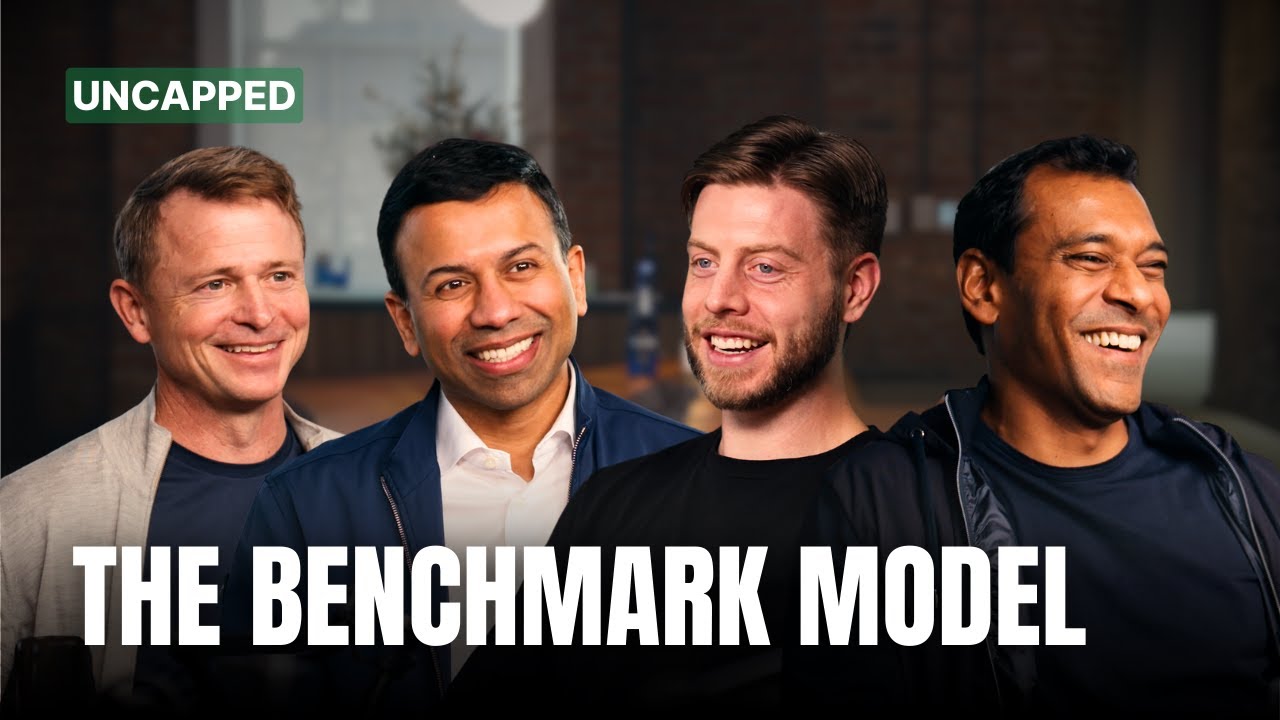
Benchmark partners Peter Fenton, Eric Vishria, Chetan Puttagunta, and Ev Randle explain why they've stayed small while other top VCs scaled. They argue that staying small lets them partner deeply with founders, maintain equal ownership, and focus on happiness over pure returns. They contrast their approach with larger firms like Andreessen Horowitz and Sequoia.
Chapters
I know that I'm a moment away from any of these people firing me, and I want them to. Um, but the minute I become predictable, it's over.
Many things, predictable is not one of them.
Benchmark team, it is an honor to be here with you all. I'm not going to make you all reply in unison to me, but I'm really excited to be doing this with you. I want to start with an observation, which is that of the sort of top VC firms, whatever you'll call that, but like, you know, I'm thinking of Founders Fund, Sequoia, Thrive, Andreessen, most have scaled in a big way for whatever set of reasons that has been sort of like the dominant strategy. Benchmark has been a stalwart in some ways to hold out with small firm, small team, smallish capital base. And I'm just curious, like, why? And I'm sure you all have sort of like different opinions on this. So just to pick somebody random, like Chetan, I'm curious, like, what is your take on this whole topic?
You know, we only do one thing, which is partner with founders early, and we really like to partner with them really early. Like, I think the favorite amongst all of us is partnering with a founder pre-launch or at idea phase, or when it's like 2 or 3 people in a room, you know, and just growing with that firm. I think just like in terms of measuring happiness for each of us, like that's where we derive the most amount of like professional satisfaction. And if you just think about what that does in terms of alignment of Benchmark with the founders and that company, it's pretty amazing if you're there from like step zero. I would argue that you can't do that as you scale, like the interests, and we see it all in our board meetings, like every round becomes its own thing and its own game and its own whatever.
And one of Benchmark's things that you, I mean, we've talked about this, that you're like, we don't, do the future round. So there's no conflict in the middle of those. That's right.
And we're fully aligned on dilution. We're fully aligned on trying to make this as the biggest outcome we can do. And I think capital constrains you in that way. Time constrains you in that way. And each time you go partner with a founder, you're doing it with extremely high conviction and you're going all in. That to me personally is an extraordinary experience. And, you know, different models, different ways of practicing the business. But for me, this is the way I love practicing the business. It's becoming rarer by the day, and then therefore it becomes more differentiated.
Peter, you've been here the longest, and so you've obviously seen Benchmark in its context through a bunch of sort of changes around you. Have you felt tempted at any points? Have you felt strengthened and sort of your clarity on what it should be like?
You know, you have your behavioral experience on a Monday, which is where we aggregate. Today is a Monday. We're here with you. Feels great. And, and there are eras in the business that I've participated in where the Mondays sort of sucked. And some of those were just cyclical. You know, you have a downturn in the economy, your partners are bringing in their, their struggles, their pains, the, the channeling the entrepreneurial landscape at that moment in time. What I was struck by is the period of time that I've spent. I, I've had time at Accel and I've had time at Benchmark when that felt more self-inflicted, not market-driven. And, and so the lived experience, the behavioral experience is the joy of the business is centered on serving entrepreneurs. And as Chetan related, you know, getting close to an entrepreneur, being a partner, deep partner to them. Social-emotional partner, strategic partner, all of that. On a Monday, if we're talking about that, it feels really good. It feels aligned and it feels purposeful. And on the Mondays, we're talking about our friction with their European effort. And I'm sure the European partners at the time, now called Balderton, were talking about problems with us. It felt draining. I joined Benchmark and they just raised over a billion-dollar fund in Benchmark IV. overhang of the misfit between how, how do we practice our business of partnering early, going shoulder to shoulder with entrepreneur and deploying that volume of capital. And so there are a number of things that happen when strategies are misaligned with purpose and values. And the main thing that happens is just less fun. And, and so I looked at this simple question of like, how many hours a day our Monday meetings go, you know, somewhere between 6 to 8 hours and how, how much of it is just joyful and aligned and how much of it is dealing with the stuff that's not sort of what brings us purpose. purpose and meaning and value in the business. And, and what I feel like we got right is we select people who care mostly about the proximity to the entrepreneur, being able to deliver a meaningfully differentiated experience for them. So they come away and they give a reference to us that says Benchmark shows up on all the recruiting calls. Benchmark is at the epicenter of our tough decisions. They're always available, they being us individually and then as a group. And Scaling, just asking the question of like more capital equals a whole bunch of activities that I think degrade. Interestingly enough, they, they, they, they eat at the essence of why we practice the business. So the outcome of maximum cash-on-cash multiple, I think, is degraded with scaling.
Yeah, definitely that.
The quality of the relationship with the entrepreneur is degraded by scaling. The, you know, I think the Ultimately, the joy, because there's some other thing that's growing, which is an incentive system that fuels more is more, you know, isn't wrong for other people to do it. I just know what their Mondays feel like. And like, we leave Monday and carry that energy and that effervescence and the sense of purpose into every day that follows from that. And when we didn't do that, we had more activities, more extracurricular activities. Man, it felt the opposite. It's like you wanted Monday to end and then you were a little less of yourself the rest of the week.
What about you, Eric?
I think this strategy is not financially maximal. It's not financially maximal for us. No one's crying for us. We're doing fine. But it's a perfectly fine financial outcome for us or financial strategy for us, but it's not financially maximizing. It's happiness maximizing. And it's happiness maximizing for the kind of person who wants to do the, the work.
Can I put a third variable there? If there's happiness, financial.
Yeah.
If you had to put a third variable of like impact, do you think that you can have the most impact this way, or do you think you could increase your impact if you worked with more companies, even if you suffered a little bit for it?
I don't know that the way we do it, it just doesn't scale, unfortunately. Like it doesn't scale.
Is that because of the board seats?
Yeah, it's the engagement. I just say it's like the engagement with the entrepreneur that I think is the, is the time limiter and the constraint.
Yeah.
And that's it. That's the time limiter.
Ev, you obviously came from like bigger firms, Founders Fund and KP. I guess you're only what, are you 2 months in now?
3 months.
3 months. So like your experience on this has to be at least notable because it must operate so differently.
I mean, I think today especially One of the beautiful parts about the asset class is that the menu is so large in terms of how do you want to spend your day to day and what do you want your life to look like as an aggregation of that day to day. So even among firms that are larger, like KP is very different from Founders Fund, which is very, very different from Sequoia, which is very different from Andreessen, which is different from Lightspeed and GC. Like everything, some firms are more similar than others, but every firm is actually quite distinct. But I do think the thing that really stands out about Benchmark, and I think to Chetan's point around being even more relatively differentiated than it was in the past, is as the prevailing trend has been towards scaling and getting to mega scale, I just, I talked to some of my friends and peers at some of these larger firms and the way that they talk about their day-to-day and their job and, you know, how they're getting fulfillment out of their job. You know, it'll be, let's say it's over the summer and they're like, yeah, I've already done 4 deals this year, so I'm having a pretty good year.
Yeah.
And I'm like, I have to plan a lot.
And I'm like, I'm like, that, that is like the Yeah, that is the North Star and KPI of like, yes, what's giving you fulfillment? I'm like, do you like the founders?
Do you like the companies?
Or is it just the fact that you've shoved capital into 4 investments in 4 companies that's giving you—
This was one actually that gets at one of the things that was a noteworthy difference for me going from running a company to now doing investing is as a company, like money's involved, but like the primary work is about a product and customers.
Yeah.
And then in venture there is at least one way to practice it where it's primarily about dollars. Yeah. Which I just don't think that's like a path to happiness.
I mean, and it can be for some people.
Yeah.
Like, this is, this is a group that's very much self-selected into, you know, maybe the Charlie Munger punch card approach where it's like, over your lifetime, you might only have 10 meaningful partnerships. So every single one of those partnerships should be unbelievably meaningful for you, for the founder that you're working with. And I think that fundamentally, comes into conflict with the idea of, you know, each of us going out and doing 8 investments a year or scaling up massively or something like that.
What are like the principles or like foundational tenets of Benchmark? If you had to describe like the 3 to 5 things that like define what Benchmark's about, like how would you name those?
We want to be the first call for an entrepreneur. We want to be their most important and most impactful partner. And I think it's like pretty easy to quantify. You can ask any of the companies we all work with, who do you call first when you hit a patch of bad news? Like, who do you share that with? We want to be that person. That can only come from being there for the founder, having full trust between you and the entrepreneur, and the entrepreneur knowing that when they speak to one of us, they're getting an authentic experience. Like, it's not— I noticed, you know, with these like, Large groups that we've all been part of and boards and stuff. Like whenever bad news gets presented in a board meeting, you can see panic in some people in the room because they have to go tell their boss with the board meeting notes afterwards, like things are off track.
And also, by the way, it's a reflection of something in the relationship if they're learning bad news live in a board meeting.
Yeah, totally. Yeah. And you know, like we're working with such uninformed companies and people that like, there's gonna be bad news. And if you like aren't expecting that, then you're doing this job all wrong. And so like things go well, things go badly, things go sideways, things go up, things go down, stuff happens. And as long as the entrepreneur knows that they can call you and you're gonna be there and there's trust there and you're that first call, I mean, that's what we aspire to in every single one of our relationships.
So there's that, that part of it, which we've talked about a bunch. And then the other part of it is the equal partnership. And I think that's a, it's a very special, like, it's a very special thing. You know, I've been here for a quarter. Peter's been here for 20 years. I think I'm on 11. You're on what, 8?
Yeah.
That equal partnership is really special, I think, and just something that also doesn't scale, frankly, but has a very kind of special dynamic. And I remember when I joined and you're just like this new person. It's my first investing job. You know, Peter and Bill and Mitch and Matt, who were the 4 that, that I joined, they're like asking me about doing things and you're like, well, I have no idea. Like, I have no idea. I have no idea how to do this job or anything else. But I think it's just, it relates to this, you know, deep belief in the equal partnership. And I think it's very empowering for a new person. I think, or I found it very empowering.
Kev told me he was disempowered.
He was disempowered right out of the gate. It was the same. I think it's just like, it's very empowering. for the new person. And it's, and it's also, it has, it also like creates, I think for the right kind of person, it creates a lot of internal drive and expectation because you're like, oh, I better not fuck this up. And, um, and so I think that's a magical piece of—
Why is it so hard for most people to do this? Because like, I think a lot of other firms, you know, want it, but effectively, you know, rounds to zero the number that can do it.
I have this belief that the biggest leap wasn't at the founding of Benchmark. The founding of Benchmark, like, the founders came together, it's like, how do we cut things up? Okay, we cut them up. Okay, it's equal. What else do we do? But then they had an amazing first fund. Benchmark 1 was like a legendary, you know, whatever, 70x return or something like that. Then, so they built all this brand value, like they gave it away, and then they gave it away. And I think that was the leap.
Nobody can do that.
And that That I think is the hard part, right? It's like, well, I, I, I built the firm, I built the brand, I should get some economics from that. I should do, or whatever it is.
Like, no residual economics is the craziest.
It's the craziest thing. It's the craziest thing.
I mean, there's no incentive really to do it unless you really care about legacy and something other than yourself. I mean, there's, the incentives are very thin to do it.
It's also just root— I think rooted in the culture of Benchmark. And you go back to Bob, I mean, Bob, Bruce, Andy, all these, the founders have played their part, but it was rooted in this idea of respect and affection is that you should have a partnership where you really respect and admire. You give all my money to any of my partners, but then you admire them. You'd say they're— there's an old saying like a virtuoso is somebody who surprises even themself. And I believe that about all my partners practicing the business. They're virtuosos in the aspects of the business that motivate us to do the work. So when Bob raised his hand and I was there, he just said, it's time, I'm out. And others had left before, you know, Andy and others, but there was never a conversation. It was actually just the opposite. We want to, we, we give him, we gave him economics in the fund. Um, they weren't giant economics, but it was just, um, yeah, a way of saying thank you. And I think the culture, you know, as soon as you get into the, the parts of everyone's identity that, that are ego-driven. They, they, they lay claim to things psychically that make sense to them. And, and it never— it would never make sense to ask for something of this firm that was going to entail taking more than you're giving. And, and I think that's a weird thing just to say, but it's a pressure that I feel as the last of the prior generations, knowing that I want to be raising my hand first before I realize I've— I'm not contributing more than I've taken out. not because, you know, it's, it's some explicit trade, but just it's, it's a cultural ethic. And the cultures we know, as you found in your company, like, they're so durable. Like, the inertial forces of a culture that get founded. It's one of the things you said, what is benchmark? And if I read one book that captures benchmark, it's this book. Now, every partner is different here, but it's the Carl Rogers On Becoming a Person. And that the premise of the book, which is very simplistic in a sense, it was like the, the Apex of Client-Centered Therapy. It's about psychotherapy. Sorry, this is not where you wanted to go in this conversation.
We love psychotherapy.
But, but the premise of the book is that to be useful in a relationship, you have to first permit yourself to understand the other person fully. And I think if Benchmark is doing its best work, an entrepreneur comes in here and says, they see me. I bet if you ask Andrew at Cerebras, you know, who understands him most fully and the founding team, The purpose and the vision of the company. It wasn't, well, he, he found this hire for me, or he gave me this advice about negotiating the contract with company X, Y, or Z. It's that, like, Benchmark understands what I want to do. And then we do something else, which I think is equally important, unconditional positive regard. And there are examples in the past of Benchmark where that's been broken. And, and I think an immune system builds around those, those failures and says, how do we not do that again? As opposed to say we're defined by that one act. And so I think what you see in the current lineup at Benchmark is a really, uh, uh, uh, an emboldened immune system. We've had some, uh, vaccinations from past experiences to basically say, like, we never want to be in a position where the relationship degrades, where there isn't that faith that we've delivered unconditional positive regard because we believe in our founders oftentimes more than they believe themselves.
Yeah.
And so, so if you, if you understand the founder fully and you have unconditional positive regard, Then you really can empathize with what they're going through. And I think that, that, that nurtures the sorts of success possible with founder entrepreneurs that we all hold out as the great examples of why we do this job.
I remember when we spoke last, you talked about the fact that bench— like the benchmark seat was kind of given to you like that from the beginning is like, I'm going to give this to the next person. And I can see why, like you're saying, like the seminal moment was actually the handoff because that creates the instigation for all the future handoffs.
Yeah.
And you feel responsibility with that. Yeah. Like, I mean, like, I think all of us feel We feel responsibility. That was one of the big things we talked to Ev about when, as Ev was joining, it's just like that responsibility. Well, just like you feel it, like not everyone feels that, like, and not every, you know, which is fine, but like, totally.
Well, also I think, you know, if you're talking about if at the, because it's equal when you walk in, it's like if a bunch is given to you right at the beginning, you're like, I got to pay this off to somebody. And the people who kind of set me up from the beginning, like I can't really pay them back anymore. So I can see why you'd be like, I got to make sure I give enough before I go, even though it's sort of your, in a weird way, You know, paying back prior generations.
But rooted in that as well, Eric says responsibility, and I think he feels it, and I respect that. I think the founders gave us permission to basically not take it too seriously.
Yeah, they did.
They said, listen, come on, like, there's a group of you, no one's going to be around in, you know, a million years.
Come on, man. It doesn't have to be so heavy.
Everything's ephemeral.
Yes.
So what you want is, is, is a tight-knit group of people That are at maximum potential manifestation, like the energy, the joy, the, and the heaviness of like, oh, we're gonna, you know, have to maintain this relic and wheel it out. And like, they'll tap tablets in the back about what the founder said. None of that bullshit, man. Like, you're like, this is like a day-to-day thing. By the way, forgive me, we're in an entrepreneurial environment where like when somebody has a legacy, we want to destroy it. We're, we're, we're in the business of creative destruction.
Yeah.
Not, not permanence and enduring and forgive me. Yeah. Like our startups bubble up from nothing and we stay true to that. And I think the firm's premise is that we should have our own form of creative destruction. There's no legacy or claim to it at Benchmark. It's like the immediacy and present moment that we deliver. Everything else is secondary.
One of the things that you just said, which I hope is okay for me to press on, is, um, and I've wanted you guys to talk about this, which is I know each of you individually, and I know you all are founder-friendly. And there's like, it's very easy for people in a competitive venture landscape to like poke at one historical example that everybody else has done. If you're just loud, you can just like, you could just poke at people.
Sure.
I would say you're not loud externally, and you sort of have a mindset of like, we're gonna let our actions speak. But I've wanted you guys to sort of like speak, because I know you're very founder-friendly, and I've talked to founders you work with and all of that. So I'm actually curious to hear, you know, your sort of thoughts. As you know, you've seen some of the stuff. Like, is it important for you to sort of just like talk about like what you just said? Like, there's like a thing and then we have like an immune reaction to it and the firm updates? Or like, yeah, how do you process all of that?
Humans are storytelling animals. Every firm has their story, and depending on the situation and what the motivations are of the counterparty, you accentuate certain parts of a firm's history You know, the ethic of the firm, and I think this is sort of borne out in even in our worst moments, is the company must come first. And so we're not more important than the company. Nobody's more important than the company. It's the initiative. It's the collective premise of an entity which is bigger than any one individual. And there are moments in the past, you know, look, and I was, and I've been around through the generations where It used to be the standard model that, you know, when are you going to get a real management team? And that sort of faded to, well, perhaps we can go the distance. And you have the Steve Jobs narrative, which is like, what crimes were committed against this notion of general management versus the founder mode reality that we all support? The part that's sort of most relevant, I think this is what happens every day here, is we view our job, I do personally, and this has been borne out in the references, is making the founders the best version of themselves. And, and like any relationship, if it's simply sycophantic and enablement and codependency, we make 'em worse. If it's, if it's harsh and it's judgmental or absent, we make them worse. So, so one of the things I think you, you, you need to figure out in references is like, what questions should you ask? And of course, if you're gonna engage with any great firm, you want to go and do references. The one that's, it's the first phone call, but I actually think it's even, you could go a level deeper and say, How does this person make you a better entrepreneur and, and how have they unlocked your potential? And what we care about more than happiness is flourishing. And our companies, and I think what's borne out in the work that we've done, is that if I work with that group, like, I'm gonna be a better version and I'm not gonna be living in fear, 'cause then you're not a better version of yourself, nor am I gonna be getting, forgive me, what happens in our job right now. I'm, I'm struck by the number of boards where I see this is a, a relationship that's sycophantic. That, that, that where people aren't afraid to, um, people are afraid, I should say, to pursue the truth because they don't wanna hurt anyone's feelings. Or worse, I think the greatest crime that occurs in many of the boards that we all serve on is that somebody says something behind the entrepreneur's back they won't say to their face. That's one of the things I, I think is a deep ethic at Benchmark is that we are transparent. Like if, if we're gonna say it to your face, we, we may not say it behind your back, but we're not gonna be in a situation where, here's what I really thought about the board meeting. And, and this idea of congruence, which is a, key term in psychotherapy is that you really want to know that you can trust your partner because they're not putting a face, a mask on because they want you to feel a certain way, but they're being real.
By the way, this also goes to your point about if you're not going to— if you don't need to put more dollars into the company, if you structurally almost can't put more dollars into the company, then you just want to tell them the truth.
You're truth-seeking.
If you're hoping to get to win the next round, you don't want to piss them off because next month you might be writing a term sheet. And I think there's a lot of— there's the references piece, there's the I want to put more money into this company thing. There's just like, I don't want to fight type of stuff. And I do think it leads to to that, which I think, um, I think there's like the, like the best version of being founder-friendly is, is not comfort all the time, obviously.
Yeah, definitely not. That's definitely not the best.
And there was, I mean, there was a recent example of this. I recently led an investment that's still unannounced, but we actually had the founders over for dinner in the dining room where we'll have lunch here in about an hour. Um, and after, you know, we, during the dinner, they showed a demo. We were going through their commercial strategy and we gave them a lot of very direct feedback. And, and a lot of it was constructive. It was like a really productive, constructive conversation. But not every founder, you know, responds super well to that. So I called the founder afterwards and I was like, well, how was that for you? You know, how would you respond to that? And in that call, he said, you as a team are going to make us better founders. And I can tell that right away. And because of that, he really wanted to work together because it wasn't just going to be you know, slaps on the back and congratulations, but it was going to be a relationship where we really pushed both the founders and the whole team to be better versions of themselves.
Does it feel like structurally different to you than KP and Founders Fund in any way?
I think maybe the most difference is with Founders Fund, because I do think Founders Fund obviously, um, really, really leans on this, the kind of like Hippocratic oath of VC, which is do no harm. And in doing so, it's like, hey, we're going to be completely hands-off is kind of the pitch. And then if you need something, call us. I think, again, that sells really easy. I actually do think that it's one of these things that in practice actually materializes sometimes as— I don't want to say like laziness, but it is just more passive. It is just like we should back founders that are going to figure it out all on their own and that they don't need help and they don't need any VC assistance. And sometimes that works out. And, you know, sometimes maybe there are founders that are like that. But I think the vast majority of the time, Almost every single founder could use feedback, a sparring partner.
Yeah.
Any of these things.
Like even Tiger Woods has a coach.
It's like 100%. And so I think like having that position is something that I think is a great soundbite and like, you know, goes really well on Twitter. But I think when it comes down to it, there's very, very few practitioners, even, you know, the Tiger Woods of the world that don't, don't benefit from something like that.
This is ultimately the highest accolade of a firm. that they seek is a manifestation of a value system. And I, everyone in this room, I've heard this and I know I'm gonna hear this on your newest investment, is that if we've really done our job, and you'll hear this in our references, they feel like a co-founder benchmark. It feels like they were a co-founder. And what does that mean? Well, it wasn't a conditional transaction. It wasn't a one-night stand of they gave us money and then we sort of could, you know, brag about the brand, but it was a, they were proximate with me. When, when, what, what a founder and a co-founder does, it's a bit like being in a partnership where you have a child, where you just say like, there's something existentially deep that's permanent in that relationship. And I, I believe most companies that have single founders end up finding proxy co-founders because they, they, you need support systems. You need a relational, you know, balance and, and as the ups and downs of being an entrepreneur. And so, If we've achieved that, you could say, well, it's not for everybody. Some firms might want more of like just, just the money, thank you, and the brand, or they want services that are delivered by people who work at the firm. Yeah, those are different facets. But the depth that can occur when you have that kind of proximate relationship and ends up, you know, taking you through troughs that would otherwise leave companies to be sold early or to have a destitute, you know, founder who's just tired and doesn't—
there's also a through line to it. Like, I felt this as a founder where like, even like a, like a longtime exec might be 4, 5, 6 years, but then you have a board member who's there through the first round, the second round of execs and the third exec team and all of that. So you're working, you know, many more hours per day with people on your team. But then when you look back over a decade, you're like, there was somebody who was with you the whole time. And it's, you know, hopefully your co-founder and your board members. So I, there's, there's something about the long arc of it too that is special.
I have moved away from talking about it as like guidance or advice or whatever. And I loved your sparring partner thing because I think that's what it is. And that's what the co-founder thing is too, because like startups are hard. They're really hard. And the most successful startups are doing things that are new, innovative, and haven't been done before. Therefore, you're figuring things out for the first time, like you're figuring things out for the first time that are like challenging, hard, and no one knows. And so like a huge part of the co-founder thing or, you know, which, which we should be careful about like using it, but like it's, it's that aspiration or that idea is, hey, we're asking each other questions that like sharpen our thinking. We are like trying to figure things out together. And I think that's a, that's a very specific way of working where I feel like a lot of times What we're doing is you're— I'm talking to somebody and I'm thinking of a very specific example from last week, but it's just like where it's like the entrepreneur knows, like she knows what she wants to do and it's like in there and you're asking questions to help them realize, realize it and for it to like come to surface or get clarity on it. And like, that's very— it's different than getting like advice, right? That isn't advice. That is— That's a sparring partner.
Yeah.
And, um, and, and a sounding board. And I think that's where you get—
It's part of what I feel like is, forgive me, this is where I gotta be the older person in the room.
The de—
the degradation of our industry, and it really has been a degradation, is I think it's shifted. The, the, the system has shifted to winning. Our goal is to win.
Right. Because there's, there's capital supply now.
And so, so you have this large sums of capital that need to be deployed. And so the system is built to, I think, create in the mind of the entrepreneur a selection criteria. The old saying, if you're doing POCs, you want to design the criteria of the POC so you win it. So what's happening is industry's programming entrepreneurs in a way to select for things that I think are off target. And they're aligned with the target of the firms and the capital bases they're deploying, but they're off target relative to the quality of the relationship the entrepreneur seeks.
So what are the big ones?
The biggest thing, though, I'm not going to pick on the off target things. The on target things are when I want a co-founder, what questions do I ask? And do they make me a better version of myself? Do they provide the kind of expansion of my horizons that make me every day feel more joy for doing this work? Do they keep me honest? Are they available? Do they put me first? And so a lot of winning as opposed to serving, winning is a moment in time. We average in our boards 10-plus years. If you go back and look at the history of my boards, 10-plus years. And so maybe 3 or 4 executive teams, as you say, might go through those years.
Yes.
Yes.
And the sense of continuity of my partner is there. And this is the case of, I mean, I, I love my relationship with Howie, not to pick one, but with Howie Liu at Airtable. And, you know, how, how he's going through a genesis right now and a creativity that I think occurred at the beginning of Airtable. And it is so fun to watch. But I, but I understand the human and I know what he's gone through. I know how to help him at parts sort of say, eh, you like, this is an area you want to be asking some questions about. And, and I think that that's different than winning. Winning was is a transaction of like, take my capital and I gotta get onto the next one. 'Cause if you win, you gotta win the next one. And so we, we say yes once or twice a year, serve for a decade long. And the differentiation of that, and because our incentives aren't the same as deploying capital. So I think that creates, in the entrepreneur's mind, they, they have to ask the right questions. What do you want in that co-founder? 'Cause you can't fire your board member.
Right. I'll take a shot at one of the things I think is like off target, which is the, like, you know, it's become like a, a thing to sell no board seats. And you're like, one of the advantages of working with our firm is we'll give you all this, you know, capital with no board seat. And I think it's, um, there's like a misunderstanding of boards as governance and control rather than boards as like signing up to work on the company, which I think is like how it should be understood in like 99.9% of cases.
Yeah.
But I think it has been very effectively and somewhat disingenuously sold to founders because it like sounds good and you just keep control of your company and there's no risk. And that means that we don't have to help. And so we can, It aligns with deploying a lot more capital.
Deploy more capital.
Yeah.
And probably says something about the experience of the average founder with the average board member. It's like, can you blame a founder for thinking that's a good pitch based on the experience that they've probably had with the average founder?
Yeah. And also you hear about a terrible situation once and it makes a big impact without nuance and it's hard.
It's, it's going on right now. You know, like the, the, these seed rounds at over $100 million with no board and it just, I, I know how it ends. It's just between now and then, the amount of entrepreneurs that will miss the opportunity to really seek out a close partner is such a, it's a shame.
It is. One of the things I wanted to ask you all about was, I'm guessing, I'll take it as a premise that we probably all agree that like a great entrepreneur is like unique or odd or strange or just beats to their own drum in some important way. You know, maybe there's examples where it's not like that. We could talk about that too. But one of my questions is, do you think to be a great investor, you have to be the same way? Do you have to be unusual as a person to be a great investor, or is that not the case? And can you just sort of be like a, a regular person who can spot unusualness?
You know, one of the things about Benchmark, as we were talking to Ev—
I'm asking selfishly because I don't think I've got the oddities that sometimes I wish I had.
You know, in our conversations with Ev, I think Peter framed it Perfectly, which is like when you know, you know very clearly, and then given our structure of equal partnership, you're essentially refounding the firm every time somebody new comes on. 'Cause the, the whole dynamic of the partnership changes, the conversations change, sort of feel changes, everything sort of changes. And so it feels like a refounding moment. There's some alignment that happens. I think it's, it goes back to the core of like, what values do you prescribe to as a person? And part of it is like, you are competitive. I think that is important. Like there is a competition aspect to this, this asset class. At the end of the day, we are investment managers and you enter a company and then there's competition to enter the company and then you invest and then the company itself faces competition at some point. Like you can run competition-free for maybe 12 months and then the big guys show up. Like, Each of us has faced immense industrial, like, competitive threats from external bodies. And you have to have some kind of competitive persevering spirit about you that can be that stabilizing force for the founders. Because you also have to have that empathy that the founders feel it 10 to 100x more than you. Because at the end of the day, You as an investor are diversified. You get to work on lots of projects. The founder is simply not diversified at all. This is the only thing that they get to work on. This like value system, hypercompetitive energy, and empathy, like that is actually not present in a lot of people.
I mean, you and I talked about this a little bit with like Max at Agora. It's an interesting example. It, you know, you did the seed. We're not here to pump Agora, but like while we're here, it's like, you know, it's like, but it was like NYC, it's a legal tech company. Like, there was already Harvey. And the question I think I asked you right before we sat down was like, why'd you meet? Like, you know, I think, like, once you meet Max, you can see it's good. But, like, I'm like, you know, to the extent that, like, that's like a case study in spotting somebody who I think is unusual in a very positive, strong way, like, what was that for you?
Well, Peter and I actually met Max in this exact room together. That was the first reading we had. And I think within 15 to 30 minutes, We both came away sort of like that unspoken language between us that we want to be in business with this person. Yes, it was legal tech, but there was some core purpose with him as he was expressing it and the founding story of like how he picked that problem. And, you know, they're sitting in Stockholm watching Harvey at the time of our seed round in March '24. I think Harvey had already raised at a billion and a half dollar valuation or $2 billion. And then by the time the product had launched in October of 2024, I think their number one competitor had already raised a $3 or $4 billion valuation. And so, but what we were backing was him, his co-founders, because when we invested, it was a team of 5 people that had a very core insight on how to attack the legal market and why LLMs were like the perfect fit for lawyers. And when he expressed it, Eric likes to say this a lot. there's a magic of founders when they explain something very complex and they explain their unique insight into it, and it becomes very obvious. Like, that's obviously how the world should work. And with your fire and your energy, that will probably be how the world works. And in Max, you saw that right away. We saw it right away. And so we needed to be in business with them. That was it. And like, the conversation immediately went to Well, great. Like, what are you doing the rest of the day? Like, we just want to spend time with you because like, clearly you're spectacular. Clearly there's something here. Yeah. And it's, it's been amazing. And like, we didn't see it, right? Like the product didn't launch until 6 months after our money went in. And then I think like, it's, you don't start to see the amazing stuff that a person can do for a while.
But if you look back at other— great investments that you've had, do you think it's always clear that the person's unique to you? Or was something in the Legora situation— did something there jump out faster? Or like, are there other situations where you don't see it for a while? Do you always see it quickly?
No, I think you see it quickly, but each person spikes differently. Like, I think—
Yeah, we all have different— coming back to your question of like, is there one way to succeed as an investor? God, no. In fact, in this firm, We joke these, these— imagine 2 circles, entrepreneurs that I respond to, entrepreneurs Eric responds to. There's this tiny little gray area in between with like 6 people in the universe.
And for 2 people who do like a lot of software infrastructure or enterprise or open source or whatever, for our Venn diagrams of entrepreneurs to be so separate is, is remarkable.
So you guys will meet a founder together and one of you will be like, this person's amazing. And the other one's like, I don't see it at all.
And flipped. I don't know about that.
Yeah.
No, no, no, no.
No, I, I, I could never work with that person.
That's, that's a different, that's a different statement than whether, whether they're good or not. Whether they're good. I would like Ben Shapiro to invest, but I don't want to work with him.
I think we often—
yes.
Good for you. Not for me.
Yes. I think, I think we do have that.
By the way, Bill Gurley and I had that where it's like there's again, almost no intersection. What's, what's, what's interesting, and this actually relates to any entrepreneur that's thinking about working with a venture firm. A friend of mine was raising money. family friend so that I, it wasn't appropriate for Benchmark. And I said, you know, he's like, how do I choose? And I said, you, the question I would be asking if I was an entrepreneur is which of these esteemed venture capitalists is most personally resonant with you and committed to you?
Yeah.
And they're going to say they're committed because they want to win. Codify it. Like, make them be explicit about the kind of commitment they're going to make and make it uncomfortably concrete. So with most of the entrepreneurs I work with, we speak every Friday. And, and so, but you, you make it real. And if you don't want to put the time in, if you don't feel that response for you with running your fund and for us individually, um, I, I knew Max Lagore, like, uh, Chetan would be 24/7. He'd fly to Stockholm on a moment's notice. And he has.
And he is today.
Yeah. It's true.
You're gonna do a good one today.
He's going today. Okay. So there you go. And, and so, so, so as you introspect on your commitments, Does it clear that threshold for you personally? Because if it doesn't and you're doing it because it's a good investment, that is a reliable path to a bad investment and a bad relationship. And, and so I think you're going to find that, that chasing what is it that you see and then, and then allowing that to get washed with experience, because sometimes you're going to get it wrong. And, and when you get it wrong, you learn, okay, don't make that mistake again because you've seen me make that mistake and vice versa.
So. So it's interesting that you guys have like these Venn diagrams that let's just say they don't touch. Just to make it simple, but they're both good. Like, I know you both make very good investments. Is that basically like a, you know, you can kind of cultivate any set of tastes as long as it includes the good stuff? Like, is that basically what you shake out to? Or is it like—
There is a lot of overlap on the people though. Like, if you look at the people in these Venn diagrams, the 4 of us have, there is overlap in that, in the quality.
In the qualities of the people. Yeah.
Something Keith and Vinod said that was interesting when I talked to them together is they're like, they're really different people, which is very apparent when you talk to them. And, um, but they said one thing that we basically always agree on is, did we walk out of the meeting with the founder and was that person special or not? Which I thought was an interesting thing because I wouldn't have expected that out of the two of them because they are quite different. So I would've thought that there would be these very different tastes in there. That doesn't mean they always wanna make the same investment.
It's very rare that one of us thinks a person is special and the other person is like, absolutely not.
Yeah. Yeah.
I mean, another question I always have here is like, Are really special people— is it like, can you miss it? Like, are they like—
Yes.
Is it a special ability to tell special people? And like, it's like, let's take Max at Agora. Like, do you think that 100 reasonably at least okay VCs who are, you know, been doing it for a while, do you not think most of them would have come out and been like, this guy is great? Is it unique to be able to see greatness early, or is it more about getting into the right room with Howie and Jack Dorsey at the right time?
That's a good question. I think most of the time people react Similarly, like people who are good at this will identify or see that specialness. Like we, and we miss it. Like everybody misses it sometimes, but do it. But I think there's a bigger thing that happens, which is I think people talk themselves out of stuff for other reasons.
Yes.
Like they'll, the competitive situation, you know, this company, or like, can the outcome for what they're working on be big enough? And like, you know, like those kinds of things. Like I have that in like, I'll take Alex at Scale. Like, you met Alex and you were like, something's going on. This guy is a winner. Like, when we saw it very, very early, like, we saw it together.
Yeah.
And, um, and, you know, and those were particularly painful, uh, because it's like, we absolutely recognized that he was amazing and a super special person. We absolutely recognized that the autonomous vehicle labeling revenue was bullshit and going to go away in, in like not that long. So the facts and the read was correct and the conclusion was incorrect. And it's like, goddamn it. And so like, you know, that's like a particularly painful one and it's a good lesson for me, which is just like—
So you thought he was special anyway? You thought he was special and passed anyway?
Yes.
Have you ever done that? And like, have you ever passed on a special person because you didn't like something else about the setup and been like, I'm still glad I did that? Or is the lesson just always back if you feel that way, no matter what else?
I mean, at this particular moment in time, I would say like, yes, I did. You know, with the hindsight benefit. It's like if you feel that way and I think you have chemistry with the person, like that's part of it, which is like, who do we respond to?
We're focusing on the positive case. The negative case, which is useful also to think about, and it's actually true, I think if you're an entrepreneur, is this word inauthentic. And I think it's easy over time, over many decades to see the masks, the fakeness. The posing. And if there was one trigger for all of us in general, I think this is true in entrepreneurship, it's true for the employees you're recruiting, is that they think you're faking it.
Yeah.
And if there's, there's the whole fake it till you make it thing, put that aside. I think that's broadly bad advice. If someone's not willing to be vulnerable with us in the meeting and expose what they don't know and be real, then we— how can we have a relationship? So there have been people come in here who've done well, who've raised money, And particularly now in the cycle, I think you get people who are playing the promotional game because there's something that's attractive in the external metrics. It could be research background, pick your favorite. And they, okay, we got to sex that up a bit and then we'll flip these people. One of the, if there was a common thread in the benchmark investments is that very low representation, there are exceptions of the promoter. And, you know, the case where you find someone who's like, really talented, but they're in the wrong market and we don't back them, but we love them. That happens. But, you know, when we get in trouble as an industry, I think, is when we start to become quite accepting of the— this is, forgive me, the distinguishing traits between founders and entrepreneurs. When you find it in a market like we're in, the number of founders increases geometrically.
Mm-hmm.
I think the number of entrepreneurs stays as a fixed constant. So what happens, we have a lot of founders, because anyone, I could be a founder, you could be a founder, you were a founder, but you're also an entrepreneur. Entrepreneurs have this guile. There's a sense of leverage. Like, Brendan Imerkour to me is an entrepreneur in any cycle, in any market. He happens to also be a founder right now. I think that's not the case for a number of people who found companies who would otherwise, if the market was shitty, they would be employees at big company X, Y, or Z.
Yeah.
So as, as, as a founder, you have to, I think, introspect. Do you have the entrepreneurial qualities? And to study entrepreneurship, um, the vast majority of entrepreneurs drop out. The phenotype of the personality is they don't want to be validated by a system they didn't create. They're not looking for, you know, fancy brand names and they're not attracted to big, you know, fancy whatever. They, they, they look for things that are substantive and—
They're the dropouts, not straight A students.
Yeah. And there are exceptions. You know, Brett got great grades.
Brett's in that Venn diagram. 6 people in the universe kind of stage.
But I think this, this market right now, because it's so attractive to be a founder, has brought in a degree of promotion and, um, the sorts of stuff that get people into trouble over the mid to long term. And, and, you know, our whole system is identifying and, and getting proximate to the entrepreneurial energies, which are, you know, kind of, as we know, these forces beyond all measure.
There was a period of time between Q4 of 2022 We call it like end of 2023. There was like a broader macro tech correction where like a whole bunch of like public tech stocks corrected. There was like a tightening of the late stage market and like, you know, interest rates were going up and like all the sort of like tourist capital had like fled the scene for a little bit of time. And capital just like got a little bit harder to raise. And at that time, what was really interesting is if you look at all the seed and A deals that we did, And where those companies are now, like it will look like our hit rate went way up. But I actually think what happened is that if you were willing to start a company at that point in time in AI, you were a true believer. Like there was some natural inspiration for what you were doing. So it's like Ladder Fireworks, Red Sierra, Harrison at LangChain. Like it's, it's companies where the entrepreneur had some fire that was like, I need to do this.
Got all those done in that era, in that one year?
I think you're right. I think a lot of people read it as what happened here is they just got to the blue ocean thing first.
Yeah.
Maybe there's a degree of that, but a lot of it is if you want to do this at a time when it looks really painful, that's just a different subset than people who are going to do it at a time when it looks incredibly attractive.
That's right.
Yes.
Yeah. 2008, 2011, when we did Series A at Uber, Instagram, Twitter, Snapchat, Snapchat, like, and it was, but then by the, like 13, 14, it became very, Yeah, and it's funny because all the, like, think pieces and essays about this stuff are always like, there was a, there was a new technology and on top of that new technology came X. You know, you get cloud, you get blah, blah, blah, you get mobile, you get blah, blah, blah, you get AI, you get blah, blah, blah. Which I think is true, but you don't really see people talking about in the moments where the psychology requires a different kind of hardness.
It's just—
100%. And I think in that moment of— That's probably a bigger explainer. Like 2022, 2023. early 2024, if you wanted to be in AI applications and AI application enablement, it actually took a, took a special kind of person that truly believed regardless of what anybody else thought. Because at that time, it was quite unpopular and weird to decide you wanted to build an AI application.
Yeah.
Because the natural assumption was that fundamentally the foundation models were so powerful, and as they reached more and more intelligence, like they would just start to gobble up the applications themselves.
Even if you look at the people who worked at the labs in the like late 20-teens.
Yeah.
And now you compare those people to the people who are working at the lab. I mean, not that obviously people are brilliant now, but like you look and you see like Ilya and Greg Brockman and all these people. It's like they were doing it when it was really not cool.
Yes.
And those are still, I think, the most brilliant people.
Yeah, that's right.
So there's something there. The last topic I want to get to is Basically how you all are thinking about AI, which I realize is sort of like something that we've probably all talked about a lot, but I do think it's like the most interesting thing going, and I don't think any of us want to talk about politics right now. Going through sort of a lot of your recent investments, it's actually clear that you guys caught the AI wave in like a pretty substantial way. A lot of them were not obvious companies, you know, even Lagora, which is sort of like a middle-of-the-fairway venture type of company. Was not an obvious thing to do from Sweden. And, you know, there was already Harvey. I think Manus was a very unusual investment as well. I think Cerebras is extremely interesting. Obviously, like Sierra was like before it was happening. And I think when it happened, it's like, wait, Brett Taylor's doing customer support? Like, I don't think you guys were loud about AI, but I think just empirically speaking, you look back and you caught a lot of it. So I guess what I'm curious about is, as you're thinking now and you're looking at companies today, what are you excited about? Like, what are, you know, to the point of you guys are having these conversations as a partnership and you're being really curious, like, what is at the top of your curiosity list in AI right now?
I think you just have to roll back to, you know, call it end of 2022 when we happened to get involved with these spectacular entrepreneurs. I think the thing that it became clear to us sitting around the table was that AI was the thing. And even if it wasn't the thing, it didn't matter. That was like where we were drawn to. Like it was the thing that had this like gravity pull for us. And so all we wanted to do was spend all of our time talking about it, thinking about it, meeting all the people working on it, all that kind of stuff. And then you have to overlay your value system on the thing that you're excited by. And the thing that we laid on top of that was what kind of relationships do we want to get into with companies in that moment in time? And we decided we wanted to be in business. With companies where that ethic of being the primary partner, board partner, lead investor, first investor, principal investor, principal believer in the mission is how we wanted to practice investing in AI at that time. And so that meant that we were looking for just really spectacular entrepreneurs with unique approaches to the market. And if you want to do that in a place where you want to be the first investor, And you want to back teams with 2 people, 3 people, 4 people, 5 people, whatever. You're often meeting people that are probably a little bit early on whatever the next curve was. And so if you remember what was happening in 2022 and early 2023, everybody wanted to start a foundational lab and everybody wanted to aggregate GPUs. And so there, there was like a big drive to aggregate capital to basically buy GPUs, which then would be utilized for training runs and stuff like that. And it wasn't that we had some hypothesis or some macro view of why we don't want to do that or do want to do that. We were looking for companies and entrepreneurs that resonated with us, that wanted to partner with us. And in that moment, we met a lot of people that were working on really aggressive ideas. That we thought were just spectacular people with spectacular approaches. And as a result, you saw this list of companies that we compiled at that time. So that was when we did Sierra, when we did Fireworks, we did LangChain, we did Merkur, we did LevelPath, we had Lagora, Manus, et cetera, et cetera. All of that came together. And when Eric did Cerebras, the Series A, like it's all of that same stuff, which is. partnering super early with founders working on something that they're deeply passionate about. And frankly, it's cliché to say it, but all of those investments at the time were a little bit non-consensus. Yeah, I think you have to be.
It's interesting because from the, from the outside in, before I joined Benchmark, I think if you look at the investments that were made in that kind of '22-'23 time period, you had like an inference cloud with Fireworks, you had a data infrastructure platform with Mercore. You had a horizontal, um, AI play with Sierra. You had a vertical AI play with Lagora. And obviously that's only 4 of, of the, the kind of 10 great investments that were done in that era. It was easy to ascribe kind of like a thematic nature.
Then you got here and were like, oh my God, these guys had no idea what they were doing.
Yeah, that is correct.
That is correct.
But, but I think you come in, you're like, oh wow, they had like a vertical, they had horizontal, they did data. It was like, they must have done a market map. And then you come in and you start asking about each of the investments and the story behind each of the investments. And like 90% of the story on every single one of the investments is the person, is the founder and the entrepreneur and the relationship that they built and why the entrepreneur was so special. And that was, that was so revealing to me coming into this organization. And this partnership was like, wow, like the founder centricity just like bled off the page in terms of the stories of all those investments. And so I think that's The way that we're approaching it today is obviously we love to talk about all of the newest and greatest things that are going on in AI every single week. But in terms of the actual investments, it's always— and I think it lends itself especially to this era where I think because the sands are shifting beneath the founders' feet so quickly in AI and things are changing so rapidly, founder centricity as an investment strategy matters more now than any time in the last decade.
I think the underlying technology substrate's changing very quickly with AI in a way. Like, I just, anything, any software that you could have built in like 2022, you could have built in 2010, plus or minus. Like, once we had the cloud, you know, we got little APIs here and there, but for the most part, for 12 years, like, it was pretty stable. If you compare that to today, you're getting more change like every quarter than, you know, we did in a decade in terms of the substrate. And so a founder's ability to navigate that, And actually like understand where their edge is and where their edge is going to come from and how quickly the moats are deteriorating because they're deteriorating really quickly and how do you build the next one? Like it's just, it's critical. And so I think it becomes even more important. And so if I look forward, I'm like, you know, we see all the same things. Like it sure feels like the infrastructure cycle is going to continue. It sure feels like, you know, 5 years from now or maybe even sooner, we're going to have really interesting things in robotics. It sure seems like agents are getting really good and the applications are going to get better. And like all these things, like, seem like really clear, but I don't know that, that, that isn't enough, I don't think, to make an investment.
It's impressive to me that, um, it would be, it would have been so tempting to answer my question with some high-minded thesis about like, and you all just said founders. Yeah.
Well, I think it's also, if you step back and you just think of these as, as, um, uh, forces, not, not like specifically AI or social or mobile. Um, there, there are windows where the disruption is so high that it, that entrepreneurs come in and they see something with such clarity that they can't not do it. And then there's this lag effect, years of like all the other people then come in afterwards. And, and in a sense that happened already with AI. It happened with the first generation. It happened with the people doing, okay, now we got to do our model company. Now we got, but, but when your brother and the team of people were at OpenAI, and that was before it was obvious, then lightning struck. My belief is that that is likely to happen again, at least 1 or 2 times in the AI cycle, where there's something so disruptive that no one can fully understand it, and then there's a completely new kind of entrepreneur that emerges. What we've been watching for the last 3 months, um, post-Opus 4.5, is the force of that disruption has awakened a whole group of entrepreneurs that were otherwise not seeing things they were seeing that now they weren't seeing them 3 months ago. I'm a big believer in what you're doing with Sunday and robotics because that's a world where we all know that in a decade we're going to have these things in our house. But the path from here to there, is that an incumbents game where the big companies are going to push down complex products, or will there be entrepreneurs? It seems likely that it will bring— so, so much of this is like, okay, where is there a disruption that— but then the lag effect of our industry is that, you know, 90% of the capital flows in afterwards, after the entrepreneurs have figured it out.
Mm-hmm.
By the time it's sort of figured out and there's the next thing, like, It's not for us. And, and that's our faith that the Silicon Valley is an adaptive landscape that will continually have these disruptions that, that make a, as soon as there's a winner, like we're kind of uninterested, we move on.
So it's a great place to end. Thank you guys. This was really fun.
Thank you. Thank you.
More from Eric
How Benchmark Capital finds EXCEPTIONAL startups in the age of AI — A convo w/ Eric Vishria