Economist Bryan Caplan on Non-conformity, Sex, Feminism and Homeschooling
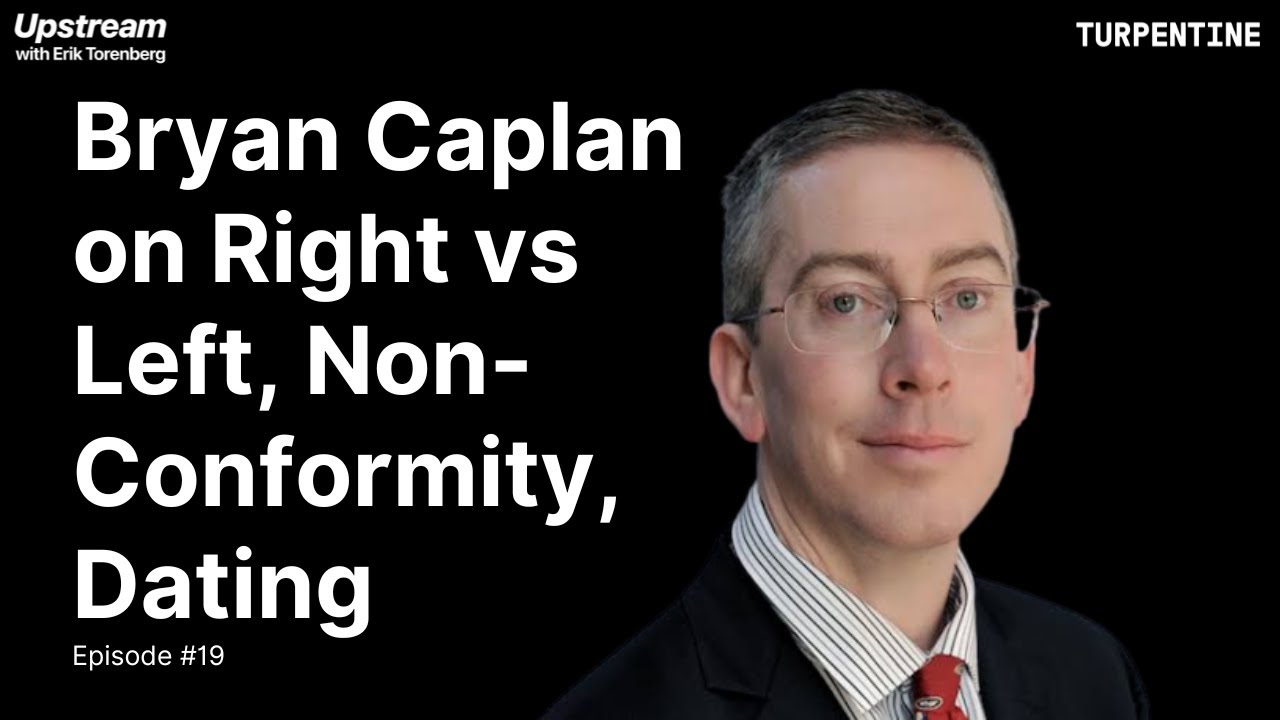
Economist Bryan Caplan argues that selfish incentives can raise fertility rates and defends homeschooling as better for parenting. He links feminism and dating apps to declining birth rates, and credits his own success to being friendly and low-variance rather than aggressive.
Chapters
What is it that unites all of the left? What is it that unites all of the right? Or what unites like 80% of them? Imagine that we go and we got a time machine, so we bring left-wingers from all over the world for the last 200 years together, and we ask them to write a consensus position paper. Do the same thing for the right wing. So, you know, in the left wing, we've got communists, we've got Jean-Jacques Rousseau, we've got Joseph Biden, we've got FDR, John F. Kennedy, we've got, you know, like all these people, just throw them all in. We, you know, we've got— the German Social Democrats, the British Labour Party, put them all in a room together and then say, okay, write something you can all agree with. And again, same thing for the right wing. So we got Donald Trump, we got Mussolini, Milton Friedman, a bunch of French monarchists, like put them all in a room and like, what are they, what can they agree on? At this point you may be saying like, I don't think they can agree on anything. I said, no, they can't.
They can't.
And my answer is what that big left-wing convention will agree on with like 80% of people signing on is a bunch of complaints about markets. And what the right-wing convention will agree on is a bunch of complaints about the left.
Right.
And my slogan for the simplistic theory just says the left is anti-market, the right is anti-left. Doesn't mean there isn't a lot else going on. I'm just trying to go and peel away all the other details and to say, what do these 2 movements have in common? If people have sex anytime they feel horny and don't take any precautions, we're going to have an enormous number of kids. I think a very big part of what's happened is just we have had rising levels of self-control. Doing what feels good in the next 5 minutes leads to really high fertility. Doing what feels good in the next 3 years leads to low fertility. I've met people that have gotten married using online dating apps that are geared towards that. And if you don't like what you're getting on Tinder, then go over to the apps that are geared to giving you what you want. Again, it's like going to a liquor store and saying, where are the books? I think you're fantastic. Like, is there any hope for us?
Bryan is a professor of economics at George Mason University, as well as the author of 4 books, including The Myth of the Rational Voter and The Case Against Education. In this conversation, we talk about Bryan's views on nonconformity, sex and relationships, how to get people to have more children, homeschooling, and why his conclusions arise 5 years ahead of the curve. Here's Bryan.
Bryan, you are a widely known public intellectual, uh, but you— there's one thing I feel you don't get enough credit for, and it's how early you are. It's how early you are in terms of you'll write a book that seems controversial at the time, and then 5 years later, it won't be controversial anymore, or it won't be as controversial. The Case Against Education, The Myth of the Rational Voter, Open Borders, all of those ideas seemed more controversial at the time, and then 5 years later, 10 years later, I feel like they've become a bit more accepted. Your most recent book is on feminism and why you shouldn't be a feminist, and it's controversial now, although not as controversial as perhaps you expected. I suspect in 5 years from now it would become even less controversial. So either you're very persuasive or you're just early. You identify something that's kind of technically correct but isn't politically correct yet, or people don't realize it, but in a few years from now they will. How do you respond to that?
Erik, you are the first person who has ever said this. I mean, look, honestly, I'll say that I'm so much in my own world that I just have trouble seeing what's going on. these trends. And to me, I'm just so focused on getting the work done as to what the normal view was before or since. I have some idea about the level, but as to what's going on with the changes, it's one where sometimes I feel like when I'm writing it, it's like, well, people kind of know I'm right in their hearts. They just aren't saying it, or it's not acceptable. I'm just like, I don't really know that, Bryan. Can you read minds? I'm like, no, I can't read minds. So yeah, I mean, like, even with Trump, you might think that this would lead a lot of people to say, oh my God, the myth of the rational voter was right. But it's not like I've gotten many people tell me anything like that. I mean, in a way, sometimes I've just tried to go and push on people and say, come on, you can't really be an enthusiastic fan of a system that in your own view puts horrible people in power half the time, can you? And the kind of people that really need to answer that question don't answer.
Yeah, they just assume that same logic applies for so many things, and they just assume that they're always going to be in power.
Right. Or in a way, I often get the feeling that they're thinking, look, all right, maybe technically you're right, but what a stupid thing to say. It's obvious it's not constructive, and stop harshing my buzz. So perhaps that's what's on their mind. One's ability to go and get people that really disagree with you and to cross-examine them like they're witnesses in a trial is basically zero. You can't do that to people. Every now and then I'll get somebody at lunch and I'll say, okay, let's settle this. Sometimes if the person has a good personality, it's fun, but very rarely at the end do I feel like, okay, now I understand what this kind of person is thinking. Instead, I'm often even more confused than when I started.
Exactly. Another book you were early on was selfish reasons to have more kids. I remember a decade ago, people were concerned about overpopulation and today people are more concerned about underpopulation relative to a decade ago. So I feel like the Overton window has shifted on that. What do you think are the best explainers as to why we're having less kids, especially more industrialized, more progressive, successful societies? And if you were in charge If you were given a big budget, $1 billion, let's say, to change this, reverse this trend, what might you do?
All right, so as to what's going on in my book, Selfish Reasons to Have More Kids, I do talk about this. My preferred story really comes down to this. It starts by saying, look, if human beings are totally impulsive, then we will have very high fertility. If people have sex anytime they feel horny, And don't take any precautions. We're going to have an enormous number of kids. So that's just step one. And then to realize, all right, so what has occurred? I think a very big part of what's happened is just we have had rising levels of self-control. Now, if you're wondering, well, how does this really fit with your thesis that people aren't having enough kids? I think a lot of what's going on is that people have what I call an intermediate time horizon. So most people, when they get really good self-control, it doesn't mean that they're actually coming up with a good plan for their entire lives. Rather, it means they're coming up with a good plan for the next few years, which is still very different from doing what feels good in the next 5 minutes. Right now, in the case of having kids, doing what feels good in the next 5 minutes leads to really high fertility. Doing what feels good in the next 3 years leads to low fertility. A lot of the thesis in my book is that Doing what feels good over a lifetime would lead to considerably higher fertility, because then you would be considering how you're going to feel when your kids are older, when they're grown, when you want grandkids. Furthermore, I mean, really the thing that I focus on most in that book, though, is I think in rich countries, the main thing that is holding back fertility is the self-imposed helicopter parenting, where people make their own lives miserable on purpose Due to a theory that they need to do these things to give their kids a decent life. And the main thesis of that book is that we've studied this in great detail, and that theory is just false. It is not true that you need to go and do helicopter parenting to give your kids a good life. In fact, the effect of that is pretty much negligible. And so if parents would go and adjust their parenting to get in line with the science, then the idea of having more kids would be a lot more appealing than it currently is. Now, in terms of the question, if I had $1 billion in order to change people, this is one where on the one hand you could say, well, why not just spend $1 billion trying to go and publicize these findings? And I would say, gee, I mean, in the giant world of trying to change people's minds, $1 billion isn't even all that much. I don't know that that would work. I would think more along the lines of this. We've got a lot of evidence that the number of kids that people have is very faddish. That's why we have baby booms. It's like, why is everyone— why are people having 4 kids in the '50s? If you look at objective circumstances, it's very hard to understand what's so special about the '50s. But if you just look at the fact that people are doing it because other people are doing it, I think that makes a lot of sense. So I think actually I would try things like going and paying bonuses to high-status people, prominent people who have a lot of kids, giving prizes for things like that. And then maybe this gives them a forum to go and talk about the research, or in a simplified version of the research. But I would think that in terms of actually changing behavior, just getting your most prominent, admired role models, high-status people to go and do this and be very upfront about it and say why they're doing it, and just to go and publicize beautiful large families, I think that would probably do more than just trying to go and get it into the school curricula. Although that is actually probably one of the underdone things too, especially at the state level, Most people want to try to influence federal policy, which is really hard. One thing that we've seen since COVID is that state governments matter a lot more than they used to. Probably they were always neglected, but now it's really obvious. The number of governors most people can name has probably doubled since COVID So that would be where you might go and try to go and change that. And I mean, you can imagine just trying to go and change sex ed and make the main theme of sex ed is no longer oh my God, never have sex. You could get pregnant, you could get a disease, but rather plan out your life wisely to make sure that you have as many kids as you want. You could go and change that. So these are all things that I would at least think of.
Yeah, it's interesting because some people would push back and say, hey, the people who are having the fewest kids, it's not the people who are hearing about abstinence, it's people who are hearing about casual sex and the joys of it and kind of delaying marriage, so careerist that they delay marriage. up until when it's too late to have enough kids.
I think those people are hearing a lot about the joys of casual sex as to how much they're actually having. There's a lot of evidence on actual sex is down, at least the numbers for places like MIT and Caltech. I think a majority of those students are graduating college while still being virgins. Again, here you can go and blame internet porn and other substitutes, but I think a lot of it is just social anxiety, which has always existed. I think it has gotten worse. I mean, as to the totality of what's going on, I'll admit that it's kind of confusing. But yeah, I do think that feminism plays a big role here. I'm going to be talking with Louise Perry, who wrote The Case Against the Sexual Revolution, where she wants to fault feminism for spreading promiscuity. And my view is, look, all right, there's a few feminists spreading promiscuity, but I think the general effect of feminism is to reduce sex by spreading fear and antipathy of men among women. And then, yeah, there's a few women who hear all this stuff and say, well, men are beasts. If you can't beat them, join them. But I think the more normal reaction when you hear that men are beasts is to say, oh, I don't want one.
We'll get into the book in a second, but to your earlier point about role models, Elon Musk has 8 kids or 9 kids. We'll see if that has a cascading effect. I'm surprised more pronatalists don't have dozens of kids via new technology or surrogates, kind of just to make a statement. I'm surprised more people don't do that. Aren't you surprised people don't have like 100 kids? I mean, the technology is there, people are wealthy enough. Who wouldn't want to do that to some degree?
I think it goes back to that conformity thing that I was saying. People don't have a pile of kids because they can. They don't even have a pile of kids because they think they would enjoy it. They have a pile of kids because other people around them are doing it. I mean, in a way, this is what we really learn about billionaires, is that they are fully capable of having hundreds of kids. It would be easy to do it. But almost none of them do, as far as we know. It's probably because they're not that weird. They're normal humans who happen to be super rich. So the old, let's see, it's the Hemingway and F. Scott Fitzgerald argument above, the rich are different. Yes, they have more money. And yeah, whichever one was saying they have more money, I'd say this is borne out by the fairly modest fertility of the super rich. I think actually the super rich do have higher fertility than the merely rich. So it's not continuously declining. There is some pattern of very rich people having 3 or 4 or 5 kids, but yeah, 100. I don't know of any really rich person in the Western world doing that. Obviously, in your classic polygamist despotisms, that's fairly common.
I think the argument with billionaires is that their opportunity cost is just higher than everyone else's in terms of how interesting their life could be relative to other people.
And thus the opportunity cost of having kids is Yeah, I mean, it's true that it's hard to have a relationship with 100 different kids. If the goal was just to have a big birthday party where there's hundreds of kids being brought there and you know they're all yours.
But I mean having 5 kids or something. We don't really see billionaires doing that much, right?
Yeah, that's one where it's not like they have to do much of the work, nor of course do their partners need to do any of the work. They got money aplenty to go and not only pay for all the childcare, to pay for surrogates and everything else. Yeah, I mean, I think just the reluctance to be weird, it's very strong. The next book in my series is actually called You Will Not Stampede Me: Essays on Nonconformity or Nonconformism, I think. Yeah, so I am a lifelong nonconformist. So this is where I bring together all my essays about the best way to not conform, recognizing there are actually some prudential reasons to conform some of the time, but you gotta figure out the The chinks in the armor, the cracks in the system.
What are the non-obvious ways in which if you can get everyone to nonconform or a lot more people to nonconform, it would be pretty game changing?
I think the big one is just ask yourself the question, what will happen to me if I don't conform? People generally don't ask this question. It's like, well, this is really weird and what is going to happen? It's like, look, sometimes there are harsh consequences to not conforming. If you decide that you're just going to drop out of high school and Learn on the internet by yourself, the world will punish you. The labor market will punish you. I've got my book, The Case Against Education, talking about that. But on the other hand, if you have unusual leisure activities, if you don't dress appropriately when you're not around coworkers, all these things, you can totally get away with doing all kinds of weird things. And what happens? I've tried it. Pretty much nothing. I mean, during COVID I broke almost every rule I could. And in the end, guess what? I found that there were a few times when I realized if I don't back down, I'm going to get crushed. But 95% of the time I just did whatever I wanted and nothing ever happened to me. By the way, I did what I thought was best, all things considered. It wasn't that I was just being a jerk to people. I did what I thought that a good person ought to do, which was different from what most other people thought. I acted on my own best judgment.
Yeah.
There's a funny video where there's a dance floor and there's no one dancing, and one person goes on the dance floor and then 2 people go to the dance floor and Before you know it, everyone's dancing.
Hey, we'll continue our interview in a moment after a word from our sponsors. Hey everybody, if you're a business owner or founder like me, you'll wanna know more about our sponsor NetSuite. NetSuite provides financial software for all your business needs. Whether you're looking for an ERP tool or accounting software, NetSuite gives you the visibility and control you need to make better decisions faster. And for the first time in NetSuite's 25 years as the number one cloud financial system, you can defer payments of a full NetSuite implementation for 6 months. That's no payment and no interest for 6 months, and you can take advantage of the special financing offered today. NetSuite is number one because they give your business everything you need in real time, all in one place to reduce manual processes, boost efficiency, build forecasts, and increase productivity across every department. More than 36,000 companies have already upgraded to NetSuite, gaining visibility and control over their financials, inventory, HR, e-commerce, and more. If you've been checking out NetSuite already, then you know this deal's unprecedented. No interest, no payments. So take advantage of the special financing offer with my promo code at netsuite.com/upstream. That's netsuite.com/upstream to get the visibility and control your business needs to weather any storm. netsuite.com/upstream.
Similarly, it's like the equivalent of like the 4-minute mile. Once some one person does it, then a lot more people believe it's possible or worth, worth doing. And in other cases, going back to feminism for a second, we're talking about the reasons why sort of people who have means are having less kids. And your definition of feminism in the book, you say it's people who think that women are treated unfairly relative to men.
Yes. In our society, at least.
In the US.
Feminism is the view that men are generally treated more fairly than women.
Right.
But again, just to specify, this isn't my definition. This is what I say is a definition, is a description of the way the word is normally used in English. And so I'm not trying to just say I'm making up a new definition. I'm God. I'm the lord of the dictionary. But on the other hand, what I am saying is that the dictionary definition of feminism, the view that men and women should be treated equally, is just a false definition. It does not accurately capture the difference in belief between those who call themselves feminists and those who don't. Because guess what? Almost everyone who says they're not a feminist believes the same thing. So it's like calling feminism the theory the sky is blue.
Yeah. My hypothesis is that among a certain subsection, we'll call it like girl boss feminism or lean-in feminism, Sheryl Sandberg feminism. of why they're perhaps having less kids is because they're prioritizing their career more and they're elevating in their career more and they're going to school more and rising up in the working world. And that has a trade-off with having kids. And there's a version of feminism that prioritizes women rising in the workplace and celebrates that. And so to the extent that there is a trade-off there, how do you respond to that trade-off and which one should society encourage feminism to celebrate more? motherhood or the Sheryl Sandberg lean-in feminism?
Good question. Meaning, of course, the official feminist position is whatever a woman wants to do with her life is great and we support everything. But yeah, that's not true. Yeah. So I think that if you actually got feminists, especially off the record, the women they admire are ones who are very successful in their careers in some way or other. And women that they don't especially admire are ones who have a whole lot of kids.
Right.
So that's just, you know, again, of course you may not want to go and give a speech saying, I disrespect women who have lots of kids and don't have much of a career. But yeah, I think that's pretty obviously worked in there. I think that is part of a general pattern of feminism, just not liking traditional feminine roles. Right. So that's also part of it. And actually probably being harsher on traditionally feminine women than almost any other part of society, actually. In terms of what should be celebrated, I think my ability to actually influence what feminism is is really low. When you go and criticize a movement, then they're not very likely to listen to you. In terms of what roles we should emphasize, my own view actually is the view that feminists will tend to say themselves, which is find your bliss, consider different options, weigh the trade-offs, try to make the most out of your life. This is what I would tell my own kids. I guess I would also tell my own kids, I really want to get at least 4 grandkids out of each of you. Can you make that happen for me? I'm not going to disown them if they disappoint me, but yes, look, I had 4 kids. I feel entitled to get 4 out of each of you. Can you make that happen for me? I don't ask for very much else, so maybe you could just go and help me out along that. And with a bit of humor, now don't lay it on thick, but same time, say— And also never say like, oh, I hope you have kids as terrible as you were. Like, no, I hope I have kids as wonderful as you are. You're wonderful, right? And I'm really hoping that you get kids just like you because so you can also have this great experience that I've been able to have through you.
Yeah. And well, quick side note for a second. You've homeschooled your kids yourself.
So it's a little more complicated. So I've been homeschooling my kids for about, some of my kids for about 10 years. I started with my twins when they were in 7th grade, so they did normal school for K through 6, and then they were really sick of it. So I homeschooled them for that. I started homeschooling them then. They're in college now. And then I started homeschooling my younger 2 kids during COVID because then it was just Zoom school or homeschool. And well, obviously it's a lot easier for me to teach my kids directly than to be an unpaid lackey of the school system telling them to watch their screen. Once our schools in our area reopened, which took a long time, then we gave the younger kids a choice. My daughter wanted to go back and my younger son didn't. So I'm homeschooling just one kid now. And all the time, yes, it's been me. I'm the one who does it. So I take the kids to my office and do it. My wife's got a less flexible job than I do and also doesn't have the motivation to do it either, I'd say.
Are you bullish on homeschool? Do you think the percentage of people going through homeschool will rise in the next decade, should rise? People getting together?
We had a local maximum during COVID I haven't seen the numbers, but I would just be astounded if it didn't have a huge increase during COVID because COVID was the one time I was telling people it is no longer true that whether or not you should homeschool depends upon your life circumstances. If the schools are closed, you should totally homeschool because it is better in every way than Zoom school. All right, so anyway, I think there was a local peak of homeschooling during COVID and then once the schools reopened, there's a lot of people, for obvious practical reasons, stopped doing it. My guess that it's still noticeably higher than in early 2020, but I don't know for sure. The numbers are sparse. Whether it will then, I mean, I think it'll keep falling a little bit till we get back into long-run equilibrium, and then will it start rising again? Yeah, I mean, I think it will for one simple reason, telework. Telework has also declined a bit, but I think it's clear that there's going to be a lot more telework than we would've expected back in early 2020. And telework makes homeschooling way easier. Even if people were actually doing their jobs while teleworking, homeschooling would be a lot easier. And guess what? A lot of people don't really do their jobs when they're teleworking.
Yeah, remote work will be a boon for sure.
Remote work.
Yeah, exactly. Putting in quotes. Going back to the dating conversation or feminism conversation, in your view of Louise Perry, what I read from your sort of review when you thought it was the best feminist book you've read, but you also had some critiques of it or some differences in terms of basically, I think you think that Louise Perry is a little bit too kind of prescriptive or kind of maybe sex negative or sex conservative.
And you're more negative. Honestly, I don't like books that aren't prescriptive. If your topic isn't important enough and relevant enough to human life that you can't then say, and now here's the way the world ought to be, I don't want to read it. But yeah, I would say the book is very negative and not just unconstructive, it's anti-constructive. I'm actually doing a podcast with her, so personally she seems super cool, but I'm going to have to figure out the really nice way to say, hey, you're being anti-constructive, Louise. Be pro-constructive.
I read that you're more free market oriented as it relates to the dating market. And I guess what I would say is we believe in free markets, of course, but it seems that the dating markets have led to this situation where 80% of women want the top 20% of men and the top 20% of men via dating apps, there's more efficient matching and thus we have this sort of— they don't have to settle down, there's a ton of casual sex and thus we have a percentage of men that are incels effectively, unhappy, and also a percentage of women who want better men but can't get them to settle down. And thus we're not having the marriages that we want and thus the kids that we want. Is that an accurate read of what the dating market has produced? And is that what the free market does? Is there a market failure there?
Right. So there's a bunch of things going on. All right, so first thing, the basic facts. Is there more or less casual sex going on now than before? And all the data I know of says that sex is way down.
But there's less marriages and less dating.
Yeah, but basically what we're really having is an epidemic of loneliness and sexlessness. Not that we're having, like, a giant bacchanalia. That's just not true. It's more of people are looking at dating apps and saying, well, there's got to be someone other than me that's going to have a great time because things aren't working out for me right now. Really what I tell her is that markets are a mechanism where people with something to offer get stuff that they want. And it is unreasonable and unconstructive to go and look at current markets and say, hey, well, women are trying to go for these super hot, super attractive guys. And then they're having casual sex with them and then they're not getting married. It's like, okay, there's some of— now we'll say there's some of that going on, but the key thing is, is that what the market does or is that what the market does when people want these things and offer these things? So a friend of my son's complains a lot about how, oh, I can't find the right girl and nobody— I can't find anyone that shares my intellectual interests. And then he's on Tinder all the time. I'm like, okay, well, Tinder is exactly the wrong place. This is where people go for casual hookups. There are other dating websites that you can go to for the thing that you say that you want. So look, if you don't know about them, I've met people that, well, that have met, that have gotten married using online dating apps that are geared towards that. And if you don't like what you're getting on Tinder, then go over to the apps that are geared to giving you what you want. I mean, again, it's like going to a liquor store and saying, where are the books? So it's like, yeah, well, it's a liquor store, so they're not going to have a lot of books there. You want books, go to the bookstore.
Yeah, but all the hot people are at the liquor store. They're not at the bookstore.
Yes. Not from what I've seen from the couples that are getting married online. There's plenty of hot people over there too. It's a different kind of hot person, although you're doing different things, right? So yeah, like if you want to go and make it— make you have a long relationship, don't go to a kegger, right? Like, what should you do? Well, there's lots of other things, but You know what I mean? There's so many related pieces of advice here. If you really want to go and find long-run compatibility, don't focus on looks.
Duh.
All right? Looks fade. This is especially true for young men, and I tell them this every time, but I think it's true for young women too, which is that people put way too much weight on physical attractiveness and way too little weight on personality. And it's pretty obvious though, if you think about it, if you were with a super hot person, 5 years later, if they are still very attractive but they have a bad personality, you will be miserable. Focus on personality a lot more, which then means you also focus on improving your personality. This is the kind of thing that I was really noting in— well, this is actually not in Louise's book. This is on her website where she was saying— Well, I'm just getting so much great positive feedback from my book because I keep getting emails from women saying, I was going to have a hookup with a guy and then I didn't. And it's like, all right, that's the best you can do? I would be happy if I got emails from women saying, instead of doing hookups, I tried to find true love and I found true love and now thank you so much. That's what you should be— that's success is not stopping hookups. It is kindling true love. That would be a success. But again, like, if you want to get that, you can just sit around and say, oh, the market is so bad and market is making everybody— look, the market's not making anybody do anything. The market is giving people what they want, what they actually are willing to offer something for. So if you want to go and find a person with a good personality, improve your personality. It can be done.
Dave Chappelle, or maybe Chris Rock, has a bit where he says that women are giving, uh, giving it up in quotes too easily, and thus their stock is too low. I guess what Louise would say, I think, is by refusing to just casually hook up, you're kind of raising the price of entry for sex, and the price is commitment. And so holding out for commitment, basically. Yeah.
So again, I would say, look, how about combining that with something good?
I agree. I agree. I agree.
So look, if you just say, I'm going to give the same level of negative emotional negativity that women usually give to guys that want to hook up with them, Plus I also won't hook up. Well, yeah, that's not going to work. How about you go and substitute being real, having a very low threshold for sleeping with a guy, with having a really great personality? How about that? Well, why should I have to do that? Yeah, well, that's what markets are about. It's about going and saying, here's something that I want and here's what I'm willing to offer for it. Right now there's some notion of, well, that's just so bogus and ridiculous. It's like, well, there's two— you're not the only person in the world. You say, I want to get something much better for me, but I don't want to offer something much better for someone on the other side. It's like, yeah, well, that's going to be hard. And furthermore, why is that even something that you should be all self-righteous about? It's like, here's my plan. I'm going to give other people less of what they want, and I'm not going to go and offer them anything more, but I want more for myself. All right, maybe you can get it, but yeah, probably you're just going to go and have people with other problems because someone who has a lot to offer is going to feel like that's not very fair to them.
Yeah.
One other problem in the dating market, or that's preventing the market from clearing, is that women are doing much better than men, or the median woman. 60% of college students are women.
Yeah, like, single childless young women are outperforming single childless young men. That's the best way of describing it.
Yeah, I agree. Not at the top level.
College graduates, men are like, male college graduates still do the hard majors that pay a lot more.
Right.
That's true.
But women tend to not date down. And so if most of society is college graduates, you know, most women are college graduates are not going to date a non-college graduate. And thus there's not enough like men at their level. And so I see you've kind of forced potential solutions for the, for how we would get more marriages and matches. One is that women— and all of them seem implausible to some degree. One is women change their standards, lower their standards. Seems unlikely. 2 is the median man overtakes women again, in college admissions as an example. Also seems unlikely. 3 is polygamy or polyamory. That also seems unlikely. Polyamory would work because women want the top men and top men are more usually happy to have multiple women, but that would present more other problems. And then fourth is we continue to not really match, but we find, or not match as much as we should, but we find other ways of having children like artificial wombs and other technologies, fertility technologies that enable more childbirth. Any reaction to that? Or do you see another potential solution for how to increase more marriages?
I mean, I think the most realistic one out of those 4 is women lowering their standards. Not a lot, just a bit.
Yeah.
Right. And so for men to improve, there's a bit of that.
And lower standards on a very specific axis, which is like economic performance. Right.
Meaning, honestly, I think that specifically on whether or not the man has the same educational qualifications as them. So for my book, The Case Against Education, I was looking a lot at patterns of marriage. And it really does seem like the key caste system in America is BA or no BA. So basically, if you don't have a BA, your odds of marrying someone with a BA are really low. And if you do have a BA, your odds of marrying someone who does have a BA are quite high. BA versus advanced degree seems fairly flexible. High school grad versus high school dropout is flexible. But that BA versus no BA seems to be the big line. I mean, obviously you could just have more men do the easy BAs, but I don't think that's so likely to happen either. I think it's just women with BAs just saying, all right, well, I can go and marginally dial that down and say he doesn't have a BA, but he's got a good job, so that's good enough. So I think that is the most likely margin of adjustment.
My good friend Logan Ury has a book called How to Not Die Alone. Some of her advice is, Things like don't marry the prom king or fuck the spark. I.e., it's not about the first date, it's about the 100th date. I say this to ask Brian, is there a dating book in your future?
I mean, I have dispensed advice to people when asked, definitely. My own experience is so incredibly narrow. I met my wife when I was 19. I never dated anyone else. We got married at 23. I don't think that I've got the ethos for writing a dating book. I mean, I think it's just hard for me. Again, you might say, well, look, That's exactly what success is. All right, possibly. I could go and do— I could just cover the research, but I think of it as more something that I'm happy to blog on. I do have advice that I think is pretty good. And especially I think that I've got advice that is good for people who are not doing that well. I have a piece called I Want to Hold Your Hand where I just say, hey, ask to hold hands on the first date. Do it. And then my friend Richard Didenne just says, oh, that's terrible. No, no, no. What you got to do is you just take the hand.
You don't ask.
A guy with the confidence to do that doesn't need any help from me. I'm here to go and help out the guys who are just like, gee, what do I do? Oh my God. Oh my God. And I'm like, ask, ask, request to hold hands. I think that's a great— I say it's good in many ways. It means that either you get out of the friend zone right away or you find out if you're in the friend zone forever. It's a way of finding out whether you even want to get out of the friend zone with someone. If you hold hands, you're like, I don't know, didn't do anything for me. All right, well, then that's probably not a good match. So it's the kind of advice that I would give to someone who actually needs a lot of help, which honestly, I would say most guys do need a lot of help. I've been planning on writing a piece called something like Mansplaining Men, where I just say, look, women have a horrible selection bias in the men that they talk to. The men that they actually talk to are confident, and extroverted and are asked what they want. And that is like 2% of men, but they get around and create a false impression of what men are like. And the large majority of men are much more like guys who wait months to get their courage up to ask for a date. And when they do, they give the classic teen romance movie thing of, oh gee, Emily, I was wondering if you weren't doing anything. I mean, if you know, I mean, you know, you don't understand if you don't. Like that thing. Like, that's what most guys are like. But women don't hear from those guys very much because those guys shut up. There's a great Onion headline called NASA Scientist Plans to Approach Woman by 2030. That is what most guys are like.
You're broadly familiar with kind of the pickup artist community or movement?
Yeah, I mean, like, you know, I never, never having been part of it, but I have talked to a number of them and definitely read their stuff. Sure.
I think the cynicism or the critique there is, hey, they kind of objectify women, or it seems like some element of it focuses on casual sex or kind of competing for casual sex. The positive claim is that it teaches nerds how to— or the charitable steelman of it would be it aims to teach nerds how to be confident in ways that kind of shortcut it a little bit so that they can train to be more confident alpha, even though they're really nice guys.
Yeah. As to what's really going on, I don't know. I think the main thing that happens is that lonely nerds read pickup artists and just sort of say, oh, if only I could be like that. It's almost like watching an action movie, or I could be Schwarzenegger, I could be Andrew Tate. But it doesn't mean that it's not really doing anything to motivate them. I would say that most advice of telling people to do something radically different from what they're doing is just kind of hopeless. The advice that works is baby step advice of, look, here's where you are. Do something a little bit different, but do it. Don't just talk about it. Don't just fantasize. Do it. That's why I say that that piece of I want to hold your hand is really good advice. It's like you're on something that is ambiguously a date. Just open up your mouth and say, could I please hold your hand? And then you'll find out. That immediately resolves the question, are you on a date at all? Is there any hope for you? I mean, I think if there's a guy with a girl and she won't even hold his hand, then I think that just means you are friend-zoned for life and you've learned something. Right. So if that's what you want, great. But if you don't want to be friend-zoned for life, then talk to somebody else.
Definitely don't do it at the office though. That'll get you in trouble.
Yeah, quite likely. Again, there is a point where you would— if someone says, look, I'm just so in love with her, But we work together. That's where I would just say, all right, well, what probability of getting fired over this are you willing to take? If it's true love, you should be willing to take a 10% chance of getting fired. I mean, I also have the view that it's the kind of thing where, again, I have no firsthand experience. This is just me imagining being a writer in a scene and how it would turn out if you were to just go and get the girl of your dreams that you work with on her own and no other witnesses and just say, look, I've got to level with I think you're fantastic. Is there any hope for us? I think that direct statement said like that, the odds that you'll get fired over that, I mean, it's the kind of thing, even very good-looking women, how many times in their life do they hear those words?
Not many.
I don't think it's that many, right? If you say that, I say this with utmost respect for you, I think you're fantastic. I think about you all the time. Is there any hope?
Is there any hope? That's a fun phrase.
I'm not saying this is the best thing to do, but if I knew a guy who worked with the girl of his dreams and he just didn't know what to do and was so worried about sexual harassment law, I would just say, you're serious about this? This is really how— you felt this way for a month straight? Yes, I can't sleep. All right, it's time to go and take a chance. So that's— that would be my advice.
The, um, do you know the cartoon or meme where a, um, there's— it's like side by side, an attractive guy and an unattractive guy at the office, and the unattractive guy like asks her out and she's like, oh, sexual harassment. And the attractive guy's like, ask her out, she's like, oh yeah, sure. Um, it is— and it's so— it is funny just how much like hatred there is for just nerds. Like, it's interesting, like the people who are getting, you know, MeToo'd were all— they weren't like athletes or music— they weren't like musicians. It was like, you know, nerds, right? Yeah, I remember Scott Aronson had this like painfully long— or Scott Alexander— long blog post about shy male nerds. And so it is fascinating, like what is it about the nerd like stereotype that— or the archetype that is just so off-putting?
Yeah, there's something in Louise Perry's book where she talks about how, you know, every woman has had the experience of being hit on by a guy that they just find repulsive and what a horrible, disgusting feeling they feel in the pit of their stomach.
Right.
And you're reading that and like, as a guy, it's like, yeah, I kind of suspected that this was going on, but now I know. All right. This, you know, and like, you know, like on the one hand, this is a case where like you can totally sympathize with someone who's being hit on by someone they find very unattractive. But at the same time, it's say, all right, It isn't— can you be a little more constructive about this and realize there's also a whole lot of people who are just unattractive to a large number of people and they're just trying to go and make their way in the world? And can you at least turn them down in a way that doesn't crush them and make them want to kill themselves? Right. Scott Aronson, a good friend of mine, he very sincerely talks about the years when he was contemplating suicide or chemical castration. Because women didn't like him and he didn't know what to do about it. And he said, like, he internalized feminist norms. I must never harass a woman. And then given how much they dislike me, then how, like, shouldn't I just presume they all hate me? And then I never asked any and then I die alone. And what do I do about that? This is like one of the main things that when I read, actually, like almost any time someone talks about their personal experience, there's hardly anyone that I don't listen to and say, yeah, I can totally identify with what's going on for you. I think, like, when I read feminists talking about how men have treated me badly, my reaction is, okay, I totally understand that you didn't like that, right? But you're not the only person in the world. Things are tough for everybody. Almost. Just a few people don't have things tough. But if you're born the Prince of Saudi Arabia, maybe not. But although even he's got to worry about getting hacked to death. So yeah, like, everybody's got problems. And the constructive thing is, on the one hand, to say, oh, I hear these are my problems, and what can I do in order to make them better? But at the same time, don't feel immense antipathy for almost everyone else on Earth, and don't refuse to go and consider what their life is like too. This is not only common human decency, I think it actually helps you just to get along better with everyone, just to see where people are coming from, to say, well, what would it feel like for me to be in this person's shoes? And Is there some really low-cost way that I can go and just make this person's life less bad when I interact with that person?
You're a big believer, I think, in kind of don't embrace victim ideology, i.e., take as much agency as you can.
Yeah. And it's not because I don't ever feel like a victim. It's just like when I feel like this is a completely unconstructive feeling which will get me nowhere and make me feel bad, what can I do about it?
That's inspiring to nerds. That is something that nerds should should listen and take heed. Related, you've been a fan of this sort of mental health philosopher, for lack of better words. Is it Thomas Szasz?
How do I pronounce it? Thomas Szasz. Yes. He's Hungarian. S-Z-A-S-Z. But I have it from the man's own mouth. It's just pronounced Szasz.
Szasz. What is his great innovation? Because he has kind of radically different thoughts from sort of the therapeutic era of today, right?
When you unpack What Thomas Sowell is most famous for is the slogan, the myth of mental illness, by which he very clearly says, I don't mean that people don't have a whole lot of problems. It just is not literally true that they are medical conditions that are just imposed on you from the outside. Rather, it comes down to different personalities and different choices, often bad personalities and bad choices, but still, It is unconstructive to think about it as a medical problem. A lot of his best work is actually these books of aphorisms that he wrote. One of my very favorite ones of his aphorisms is this. All right, look, suppose you're watching TV and the shows are really poorly written. You don't call up a TV repairman. And similarly, when someone says, I'm an alcoholic, or, I'm depressed, you don't go to a doctor. It's the wrong person. Like, you've got to go and change the script. It is not a physical problem with the television that makes the shows boring or poorly written or insipid. It is functioning perfectly well. It's just not doing what it is that you want it to do. So most of his work is about thinking about— I'd say the therapeutic part is about trying to go and take agency, not make excuses, And make your life as good as you can, given the hand that you're dealt with. Part of what he's doing is just saying, look, first of all, don't go and— probably the part that he's most famous for is being against involuntary mental hospitalization. And that was one thing where a lot of people least credit him with great success, right? Saying, look, just because a person has very different preferences from you and you would never do what they're doing doesn't mean that they belong in a prison to help them. But he's also much less popular for doing— for being consistent in saying it also doesn't mean that they are entitled to your support or that you have to go and treat them like victims either. Right. They're like, you know, they are not people that need to be helped against their will, but they're also not people that you are obliged to go and support against your will. You know, like one thing I often think about is the way to go and treat a severely alcoholic Relative. All right, now this is one where one thing you could do is just lock them up against their will so they can't drink. All right, another thing that you could do is say the person's sick, it's not his fault, it's my obligation to go and let him sleep on my couch for the rest of his life, drinking away my money, not working. This is one where if you give someone a vignette where the person that is supporting the alcoholic just gets tired of it and says, look, either you have to go and change your life or I'm kicking you out of my house, Most people will not condemn that person. And yet, if someone says, look, taxpayers shouldn't have to go and support people who have these kinds of problems, they should go and fix their own lives, that's where you do get the condemnation. It's like, well, I mean, I'm dying to be condemned for my unwillingness to support complete strangers who live irresponsible lifestyles, but you're willing to go and understand how someone who is the relative of someone with an irresponsible lifestyle does eventually decide to pull the plug. So I would say these are cases where the relationship between 2 people, at minimum, it seems reasonable to say that I'm not going to automatically take the side of the person who was irresponsible. This is, again, of course, part of the Sossian view, is to go and take conditions that we're supposed to call sicknesses and say, no, it's irresponsible behaviour. It doesn't mean the person is sick.
I found it just fascinating how even in my short lifetime, just the role of therapy has become so pronounced, almost such that it has kind of religious sort of undertones in terms of, like, everyone's got trauma, they've got to work through the trauma. It's almost like the work is never done, and there are clear kind of Christian replacements one to one.
Well, yeah. And also, it is the responsibility of all of us to go and care for the most difficult people, right? And not to judge them, right? Radical forgiveness. So, yeah, like, doesn't matter if your relative is a lifelong alcoholic. That's not their fault. They're sick. They have a disease.
Right.
There is a South Park episode where there's an alcoholic talking to a cancer patient who's like, oh, man, you got cancer. Well, guess what? I caught alcoholism. We're the same. They're not the same.
Yeah. I had Richard on the podcast as well, and he was talking about— we were talking about the El Salvador approach to crime. And he's for it. He thinks it's effective and most humane for the people who wouldn't be victimised of crime. Do you agree? Do you think it's most effective and thus most humane?
I think that it's clearly much more effective than anything else any high-crime country has done. I will say I'm not as gung-ho about it as Richard. What I'll say is I totally understand people support it. For me to support it, I'd want to learn more, like what fraction of people who have tattoos all over their bodies are actually not criminals? Right. And it's something I suspect the answer is really low, but I'm a little worried that maybe it's not. And before I go and throw someone in life for indefinite detention, these are questions that I think ought to be answered to my satisfaction. So there is that. Again, the basic approach, yes, is like anyone that just looks like a criminal, we're going to put in jail indefinitely. And then, yeah, they got their murder rate down an enormous amount. Seems pretty clear that a lot of the people that they've locked up were in fact violent criminals. The question in my mind is how many innocent people are getting caught up in this net? I would say I don't have any actual philosophical notion of procedural rights. For me, it just comes down to procedures are justified if they have a high probability of accuracy. So if the heuristic of we lock you up if you have tattoos all over your body, and that has 99% accuracy, if that's actually higher than a fair trial, so-called, then I don't think there's any good reason to say that the fair trial is a better system than the, if you've got tattoos all over your body, we're going to lock you up. Right. And then I will also say I am concerned by the precedent. Well, if you can lock some people up without trial, what are the odds that you go and start locking up totally innocent people? Historically, it is normal that when you can lock people up without trial, you do lock up a lot of innocent people. I don't know what's going to happen in El Salvador. I've been thinking, well, if we can make bets on this, what are the odds that they wind up getting the population of people where They're in no way plausibly violent criminals, and we're going and putting them in jail for life without trial. What are the odds of that happening? I mean, I think it is a real worry. The main thing that I get out of El Salvador is not a policy recommendation, but an intellectual validation of something I've been saying for years, which is that the whole idea of state capacity is just totally confused. And yes, while it is true that there is such a thing as state capacity, The much bigger issue is state priorities. Normally countries that people look at and say, oh, there's nothing they can do given their crummy state capacity, it's like, no, there's tonnes they could do. They just don't want to. They choose not to because they have other priorities. So I've been having arguments with my dear friend Tyler Cowen for decades where I say, look, they should just do this. Oh, you're so naive, Bryan. They can't do that. Why not? Seems like it's totally doable. Well, that's just because you've never been in a position of authority, Bryan. If you'd had, like me, you'd realize how just totally intractable these problems are. And it's just you and your delusional view, because you don't have any practical experience, leads you to imagine that there are other ways that would be highly effective, but there just aren't.
Right.
And then you look, and then you look at El Salvador a few years ago, it's like, well, there's just nothing they can do. And then they go and do something really different and they basically get, they get their crime rate down, their murder rate down to almost nothing. It's like, I knew it. I knew there were things that could be done. I don't even have to agree with them just to disagree with the claim that nothing can be done, which I will just say is one of the most asinine, pigheaded views. Like, things can always be done. Like, don't tell me things can't be done. I know they can be done. Like, they may— like, maybe there's a lot of stupid things they'll do instead. A lot often with me and Tyler comes down to Oh, this university president, his hands are tied. I'm like, his hands are not tied. He's not going to get fired if he changed his policy. And I'll always tell him, look, I agree that if he thought like I did, he wouldn't have gotten hired in the first place, but that's no excuse for him to not do what I want now that he's on top.
On the theory versus practice sort of perspective, and we're talking about Tyler, Tyler's moved to state capacity libertarian. Which I actually don't know what the difference between that and nationalist populism is besides better branding. It's kind of like just conservatism to some degree.
To be fair to him, it's not the same as nationalist populism. Rather, it's the idea of we need to get— what poor countries need is to have a strong, well-functioning government, and then they'll be able to go and have better, higher quality policies. But basically, first we go and get their governments working, get them collecting taxes, Get corruption down, that kind of thing. And then we can talk about this other stuff, maybe.
And so why are you not a state capacity libertarian? I guess I'm curious how focused you are on pragmatics in the sense of libertarians never have more than 1% or 2% or whatever. Do you expect that number to go up? Do you just hope it does? Or what's the pragmatic play to get more of your views in the world? Or are you not focused on that?
Well, let's see. It's one of the things I think about. It's true, I am an academic, so my main thing is not actually Getting from here to there, although I do want to engage that, and I'm always really happy to talk to people who do care about that. Hopefully we can teach each other both ways. What I would say is that there is first changing public opinion. It does matter, and there's some effect at the margin. So there's that. In terms of what's the biggest bang for your buck, I think there, honestly, the biggest bang for your buck is going and just getting involved, like being involved in policy and trying to find rising stars who are open-minded, rising stars of politics who are skillful demagogues, who aren't the least militantly committed to terrible policy views, and then to go and whisper in their ears and get them to do what you want. My view is probably the most effective intellectual in the country right now is Chris Rufo. Right. He's a think tank guy. He's not a politician. But what has he done? He goes and he writes policy position papers, he writes model legislation, and then through a combination of skillful manipulation of public opinion and actually talking to policymakers and influential people, he is managing to actually get major policy changes. He single-handedly got the world talking about CRT. A human being did that. One guy. Chris Rufo did it right. This case, I am enthusiastic because I think that on all the things that he cares about, he's either right or at least I think it's it's not a crazy view, right? And like I've noted, I haven't seen him do anything against immigration, which I say like good, Chris. Good, good. Yes, lately, I'm not 100% sold on we want to go and call. having kids go and take hormonal treatments for gender dysphoria child abuse. But it's the kind of thing where I can understand where a reasonable person would think that, obviously, if there were parents that were going and getting elective amputations for their kids, we would call that child abuse unless there was some medical reason. And then there's this grey area, right? And Chris is very convinced on that. And when Chris is really excited about that, my reaction is, Right. Like, I can totally see it. And like, I don't— like, this is not something I'm going to— I would ever condemn him for. Right. And then when he's going and trying to improve public schools and go and get the pernicious influence of woke despotism under control, like, this is stuff from like, yeah, go Chris. I like you. Like, you are stopping the full takeover of left-wing ideologues on public universities. Which, again, my first choice is just for public universities to lose all their funding and go down in flames. But at least if they're going to exist, I don't think that they should be left-wing cathedrals where they just promulgate their ridiculous religion as if it's fact.
And you don't see any progress there, right? Like, that is just one-way train.
Like, Chris Rufo, man. Chris Rufo is changing the world. Look, there are— so Florida actually went and passed a bunch of anti-woke stuff for the public universities, and I think it's all Chris. Of course, Chris couldn't have done it on his own, but he is the one that got the ball rolling. And again, if you go and follow his Twitter feed, he is just an amazing guy. Even if you disagree with everything he's doing, it's like he goes and says, I'm going to try to do something, and then a week later it's happening. And it's not stuff that was going to happen anyway. It's stuff where he just moves stuff. There's a word that I've heard some people use, like, oh, he's very agentic. It's like, yeah, Chris Rufo is the most agentic person I am aware of. I'm just sort of stunned when I'm like, wait a second, he's doing it. And then it's like the next day he's doing something else and moving forward, moving forward. So, I mean, I am planning on going over his record in a lot more detail and just doing a piece on everything that he's done and my assessment of it. Overall, I'm very pro. I'm not going to say I agree with him on everything, but also I think that you have to be pretty crazy to say I can only go and praise a person if I agree with them on everything.
Right.
And he's done it on a tiny budget, too. On immigration. So you're open borders advocate. You have been for a very long time, both on economic and moral grounds. I'm not sure how many caveats you have to that. One thing I'm curious about is if we think about different kinds of organizations, whether it's companies or nonprofits or open source, any sort of organization, we don't always think— we think more people is better to the extent that they're kind of net productive, like that they make the collective better, they make the output better. And so I'm curious why you aren't open borders to the degree that they're net productive citizens that make the outcomes better. How would you react to that? Right.
It comes down to this. There's a very big difference between you are not productive in an organization and you are not productive in society, period. This is a long argument again that I had with Tyler where he was looking at people that are being fired from jobs and seeing, see, they have negative productivity. I'm like, all right, first of all, it only shows their productivity is less than their wage. But anyway, suppose they did have negative productivity at that job. It does not show they have negative productivity in life. It just means they need to find something else. So my view is that while it makes sense for an organization to say we don't want to hire a person because they have negative productivity here or because they aren't worth what we would pay them here, It does not mean that they have negative productivity in society. And I say, if you actually look at the real world, the share of human beings who actually have negative productivity everywhere is really low. We're talking about violent criminals, people like that, severely disabled. But the vast majority of the population, there is something useful they can do where they can be productive members of society. But just washing dishes in a restaurant, well, the dishes have to get washed. So someone says, we don't want an Afghan goat herder who's just going to come and wash dishes in Afghan restaurants. Well, I go to that restaurant, the dishes, I would like them to be clean. He does a useful service. What do you have against this guy? I understand why you don't want to hire him to go and run your company. Doesn't mean there's no place for him. So that is my view, just as an economist, is that people are very quick to go and declare that a person is a garbage person rather than just not suitable for certain particular jobs while having a valuable role to play. A lot of it is really just sort of this mentality of the US is like the NBA and we only want to have the 10 best people in the world here. It's not like the NBA. It's a lot more like the whole stadium where they play, where you have a lot of people that are just regular people who go and serve the hot dogs.
Right.
And then we're not going to go and have the most amazing people in the world working the kitchen. That's just a giant waste for everybody concerned.
Well, maybe it's more we want to have the best 500 million or best 1 billion But there's 5 billion people who want to be here or something, or there's more people who want to be here.
Right. Again, just looking around the world, I've been to a lot of different countries to find people that are just so bad that they couldn't be a useful janitor or dishwasher. There's just very few people like that. There are some.
What data would you need to see to sort of change your mind slightly on the idea that they're more net negative minus cost? Because it's a big cost to bring them in too, of course.
Normally they pay the cost. Right. If there were a government program to go and pay for all their full travel expenses and relocation and then to go and give them free housing for 10 years, there'd be a big cost. But that's not the normal way immigration works. Normally, immigrants are really happy to go, and if they can just get it at market price, that's fantastic for them. In terms of the evidence that you need to show me, this is one where if you were like, here's one. If you were to show that people are committing a lot more violent crime that goes unrecorded, That would be something. So that kind of thing. I mean, again, honestly, the kind of thing that would really impress me is if it was hard for immigrants to get jobs in the US, especially immigrants from low-skilled countries. I just don't see any sign of that. I see that companies are totally happy to go and hire low-skilled immigrants. And I mean, in particular, and then when people say, oh, but there's the cost of diversity, it's so terrible. Yeah, but so terrible, then why is it businesses seem to be totally happy to go and hire janitors from whatever country? Typical businesses in areas with cosmopolitan populations are cosmopolitan. They are not egalitarian. You'll go and see immigrants from some countries are doing the high-skilled jobs, immigrants from other countries are doing low-skilled jobs. But again, I don't think you can plausibly say this is just caused by discrimination law, especially not when businesses are hiring illegal immigrants where it is they are breaking the law just to hire them. And you know they won't sue you because they can't afford to. They're illegal. Businesses love hiring illegal immigrants, which is precisely why anyone who's against immigration wants to crush the hiring illegal immigrants, because they know it is not true that they are not productive.
20 years ago, the right was the party that was the pro-immigration, pro-trade, and pro-war in the case of Iraq.
And I don't think the right was pro-immigration 20 years ago. But what I'll say is there's— I'd say there were a few pro-immigration right-wing intellectuals, very different from the right itself being—
Well, yeah, Bernie, I think, famously said open borders is a cause Yeah.
Koch brothers.
Yes.
Koch brothers are and remain the only ones alive. But also very pro-immigration. But again, they are not the right.
Right.
But would you say that it shifted on all 3 of those?
Yeah. So I think the right got a lot worse on immigration. I think they were both absolutely and relatively anti-20 years ago. There have been a few articulate pro-right-wing or pro-immigration right-wing people such as Ronald Reagan, who gave his great City on a Hill speech. Yeah, I think that's been the unusual position for a long time. So right-wing intellectuals, basically right-wing economist intellectuals, I think, have been pro-immigration. But that's just a minority of a minority of a minority.
Got it. Makes sense. I'm corrected.
Free trade used to be more of a mainstream conservative view. Even then, it was more of the right-wing economists that were pushing it and then other politicians sort of going along with it. But I think there was always plenty of right-wing protectionism. And then let's see, what was the last one? The last one?
Pro-war. Now the right is against Ukraine. Yes.
Well, this is one where you should be reading more Richard Hanania, because what he shows is actually definitely the Republican rank and file is very pro-Ukraine war. And out of actual votes in Congress, it seems like they're very pro. Basically, they're looking for some way to go and split the difference. and tell right-wing Twitter people that I'm actually against this war without losing the rest of their support. And so they'll sort of make noises like, oh, there should be congressional approval for this. It's just not right. Or even things like, how can we be paying for this Ukraine war when we haven't properly handled the relocation of our workers who've been put out of business by the Chinese paper competition? But nevertheless, I think his view is right, which is that They are not actually anti and are very likely to continue the policy or intensify it. So I think that's the actually reasonable view. And again, it was Biden that went and got out of Afghanistan, not Trump. Biden would say he was just following through on Trump's plan. As for what Trump would have done in that situation, again, so erratic, Lord only knows.
The question behind the question is, are the left and the right a series of ideas, or are they more so a tribe of people? i.e., the right is the white working class and some billionaires, and the left is college-educated people and minorities. Obviously, great simplification, but—
Right. Great question. So this is straight out of my latest book, which is called Voters as Bad Scientists: Essays on Political Rationality. My answer is that at any given point in time, this tribal story is right. And yet there are some long-running commonalities for left versus right. not just for the US, but for the world. For as long as we've had these labels, basically the terms left and right, they start during the French Revolution based upon seating in the French Parliament. And I have what I call my simplistic theory of left and right, which tries to boil down what is it that unites all of the left, what is it that unites all of the right, or really what— I sort of tone it down— what unites like 80% of them. Right. The thought experiment that I like is this. Imagine that we go and we got a time machine, so we bring left-wingers from All over the world for the last 200 years together, and we ask them to write a consensus position paper that must be approved by 80% of all the attendees. Do the same thing for the right wing. So, you know, in the left wing, we've got communists, we've got Jean-Jacques Rousseau, we've got Joseph Biden, we've got FDR, we've got, you know, like, John F. Kennedy, we've got, you know, like, all these people, just throw them all in. We've got the German Social Democrats, the British Labour Party, put them all in a room together. And then say, okay, write something you can all agree with. And again, same thing for the right wing. So we got Donald Trump, we got Mussolini, Milton Friedman, we've got a bunch of French monarchists, right? Put them all in a room and like, what are they, what can they agree on? And like, at this point you may be saying like, I don't think they can agree on anything. I said, no, they can't. They can't. And my answer is what that big left-wing convention will agree on with 80% of people signing on is a bunch of complaints about markets. And what the right-wing convention will agree on is a bunch of complaints about the left.
Right.
And my slogan for the simplistic theory just says the left is anti-market, the right is anti-left. Doesn't mean there isn't a lot else going on. I'm just trying to go and peel away all the other details and just say, what do these 2 movements have in common? A lot of people, especially left-wing people, say, no, maybe the left is anti-market, the right is pro-market. I'm like, You obviously don't really know right-wingers very well. There are free market right-wingers, but there's also plenty of right-wing people who are really angry about markets in 100 different ways. Mussolini, like, he was the head of the Italian Socialist Party before he founded the Fascist Party. He had tons of complaints about markets. He was a big government guy. What was it that made him right-wing then? There are right-wing people say, oh, then he's leftist. Like, no. 'Cause Mussolini hated the left. Like, he rounded them up and put them in camps, and that was not just something— that was not just talk. He really seemed to hate them, and they— and of course they did— they weren't too fond of him back. But like, that was his big thing. I will crush these guys, all of these revolutionaries going and messing up Italy and talking bad about our country. I'm gonna go and put them into a prison camp. And he basically followed through on that. So that's why he— I say that he is actually in this right-wing camp, even though, of course, he would have a lot of other disagreements with tons of other people. You know, just like there's tons of disagreements between Joseph Stalin and Joe Biden. Obviously, they're both named Joe, but they're totally different guys. And Stalin murdered millions of people. I don't see any sign Joe Biden wants to round up and murder millions of people. But if you made them go and talk and come to a common list of things they complain about, They'd be bellyaching about markets together.
Yeah, that's a good place to wrap. Maybe as a last question, because we mentioned Richard Hanania, you guys agree on a lot, you differ on some, you certainly have different temperaments. Richard is a friend of mine and he's been on the show. My characterization of him is he's somewhat audience captured, but in a reverse way where as soon as he gets too close to the right, he starts to He sees the worst versions of it, he starts to dislike them. And similarly, the parts of the left too. And so he's constantly antagonizing both as they get closer and then further away from him. I'm curious what your assessment of Richard is and also just more broadly, where substantively do you disagree or have different opinions?
Yeah, so I've hung out with Richard several times in real life. I would say in person, we're not so different. Humble brag, I really am Mr. Tolerance. I'm friends with all kinds of people, all kinds of personalities. Just you be you, man. I'm not here to go and judge. I'm just a very accepting person. And COVID made me even more accepting than I ever was during COVID It's like, you'll talk to me in person?
A friend.
All right, we're brothers. But Richard and I, we are in person. I'd say we think very much alike, talk very much alike. Actually, I will even say in person, we could be very close relatives. It's not so easy to see from our photographs, But face to face, I'm looking, I'm sort of staring at him and saying, you could be my brother. This is eerie. It's weird. But anyway, in terms of writing, yes. So he does go out of his way to antagonize people, and I go out of my way to try to win people over. He's getting a lot more influence, and more power to him. The main thing I would say is I don't think I could do what he does well. Honestly, a lot of the reason why I never yell at people in writing, It's not because people don't make me angry ever. It's just because I think I would be bad at it. I feel like if I were to release the beast, I would just go crazy and make a fool of myself. So I just like, I'm just going to stay on the straight and narrow. I know how to be scrupulously polite to people. I don't know how to go and walk the edge of acting like I don't care while actually trying to expressing that I hate somebody's guts. Like, I'm just not good at that. Anyway, so Richard's star is rising and I hope it keeps going up because he's really almost the only person in the world where when he writes a new essay, I immediately want to read it.
Related, he had one on how to get over anxiety and avoid the mental health framing. It's kind of advice to nerds on how to be more agentic and take more ownership. And then he also had this other one which explains kind of his behavior a little bit, the pickup artist theory of politics, basically. And he's basically applying that as a public intellectual, whereas you're being nice and reasonable and you've had tremendous success as well. He is applying the kind of pickup artistry of he's negging his audience, he's using humor.
Yeah, I mean, humor I like. There's humor at someone's expense, and then there's the humor where you are able to go and see the funny side of things. I've actually done stand-up comedy. My style, it's not really biting. If it's just me, one other person, then my humor is definitely harsher than what I would do in front of an audience.
Do you have any substantive disagreements? Certainly your tone has been different.
Yeah. So I think Richard is doing really great. I mean, I just see the retweets that he gets, just the way that he's able to make things go viral. He's someone who has a much better sense than I do of what people want to talk about at a given instant. So he's really good on that point. Oh, yeah, actually, this is what I wanted to say. This strategy that I follow of just trying to be really friendly to people, I will say it works great for me. So I hope Richard's career becomes much more successful overall than mine. I'm not sure that on balance it will be. I'm totally rooting for him, but What I'll say is the career that I have is one where if you told me in grad school that I could have it, I just would've said you were lying. There's no way things could be that good. I mean, I really get to have friends all over the world. I can go to almost any major area in the West and there's people, and I say, hey, anyone want to meet up? There's people there. I get speaking offers all over the world. I have an enormous number of friends. I think if I were a jerkier person, this would've been quite a bit worse for me. Of course, I'll never know because I don't get to live my life twice.
I think the jerkier version, to put it that way, is higher variance where there's maybe higher upside in certain ways, but higher downside.
Yeah. The way that I like to put it is that being nice to people has low variance and high mean, and then all the alternatives have higher variance, but they also have a lower mean. So whether it's intimidation or deception, Look, sometimes they work, but you're playing with fire, right? Especially in the long run. You treat people this way, often people just hate you forever.
Totally.
That's a great place to wrap it. And we tied it full circle with the dating advice earlier. My guest today has been Bryan Caplan. We mentioned a number of your books, which are must-reads. I'll put them in the show notes. The most recent one is Voters as Mad Scientists. Bryan, thank you so much for coming on the show.
Thank you very much. And by the way, you can get them all on Amazon. The new paperbacks are just $12 each. $9.99 is ebooks. I have not raised the price despite very high inflation. Also, buy today. Awesome.
Buy today. I certainly did, and I enjoyed it very much. Thank you, Bryan.
More from Erik





Palantir CEO Alex Karp & Rep. Ritchie Torres on Innovation & The West | Hill and Valley Forum 2024


