Emad Mostaque and Sam Lessin Debate Whether AI is a Good Investment for VC
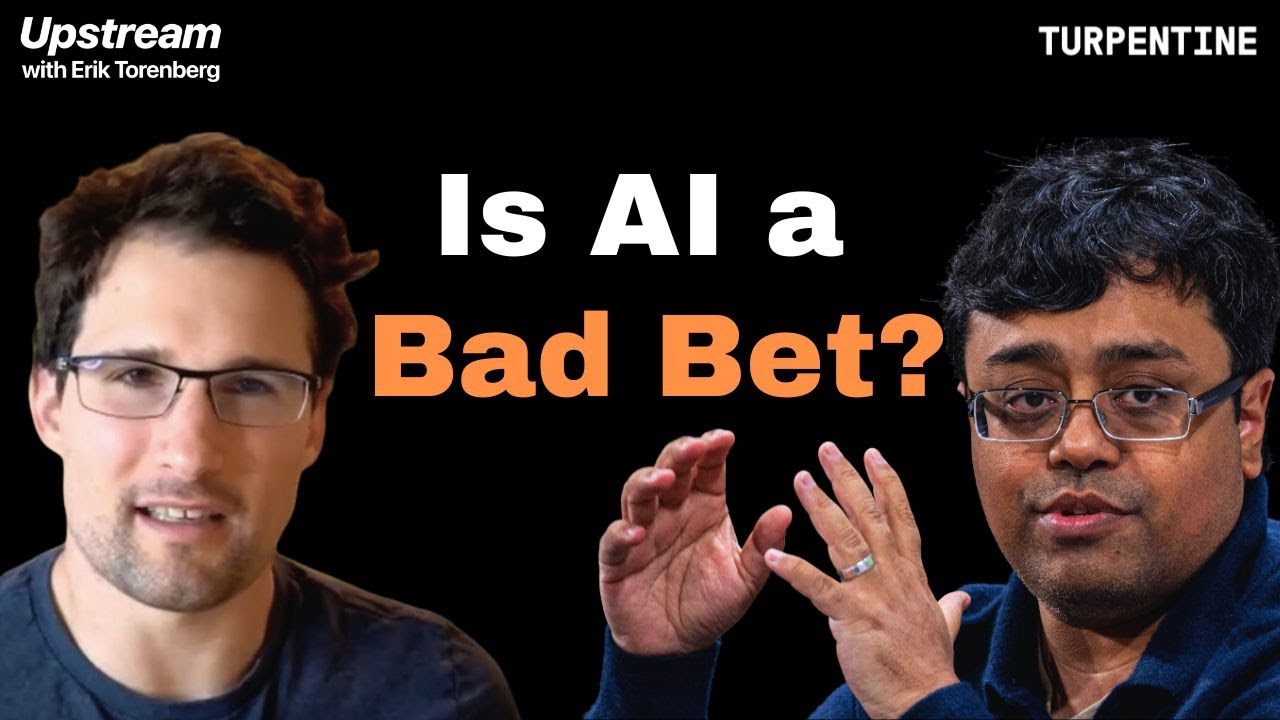
Emad Mostaque and Sam Lessin debate whether AI is a venture opportunity or hype. Mostaque sees massive upside in new entrants; Lessin argues incumbents with distribution will capture most returns. They disagree on where money flows: existing platforms or niche markets like education and healthcare.
Chapters
As an investor, I think the case about why a bunch of this technology is going to make Meta and Amazon and Google and a bunch of big players an assload of money are clear. I think the idea that it is a wedge or an angle that's going to allow a bunch of companies from zero to come out of nowhere and then become wildly profitable or compete with those types of big players, I think is much more sus, as they would say. And it's because, I mean, to really take advantage of this stuff, you need a ton of distribution, you need a ton of data. And I really see a lot of what I've seen is opportunities to extend innovation that already exists versus kind of completely reshuffle the deck.
What if you had an AI tutor for every child? What does that look like? What if you had 100 AI tutors for every child?
For the first time, every single person can have hundreds of characters that like and support them all the time. Basically, you log into social media or whatever, and you're like, hey, I'm Sam. And it's like, cool, what type of people— instead of who do you want to follow, it's like, who do you want to follow you?
For example, there aren't enough therapists in the world, you know, and it is a regulated industry. But at the same time, there is a gap for therapists, just like you have the meditation apps kind of step in. And they created Calm and they created kind of these other things that were huge.
Today, I'm excited to air a conversation between 2 influential thinkers in tech, Emad Mostaque and Sam Lessin. This discussion was ignited after Sam released an essay a few months ago on Twitter calling AI a terrible bet for VCs and dubbing generative AI fool's gold. Emad responded and suggested a podcast, which I, along with AI Scout and Cognitive Revolution co-host Nathan Labenz, moderated. Emad is the founder and CEO of Stability AI, and Sam is an early-stage investor with Slow Ventures. In this conversation, they interrogate whether AI is a disruptive or sustaining innovation, define the contours of intelligence, discuss impending regulations, and survey the industries most immediately affected by AI, like SaaS, education, entertainment, social media, and even porn. It's a lively and fast-paced debate I think you'll enjoy. Sam and Emad engage each other directly for most of it. You'll hear some of our questions towards the end.
I think that large language models and a lot of the AI stuff, that we're seeing kind of start to get consumerized right now and become real. It's super cool. Like, there's no question about that. And like, there are absolutely going to be great product experiences improved by it, right? And opportunities to create more efficiency, create like better interfaces. Like, I am not negative on how some of this stuff will find its way into consumer product experiences and make things better in places. I mean, you know, my wife's company, the publication, the information, like we've already deployed a bunch of AI stuff that makes search for the information go from absolutely terrible to like pretty good. And like, there's a bunch more stuff coming that will get better. It's like, I'm not, I'm not against that. I do think the things that I keep in mind, one, as an investor, is I think the case about why a bunch of this technology is going to make Meta, And Amazon and Google and a bunch of big players, an assload of money are clear, right? I think the idea that it is a wedge or an angle that's going to allow a bunch of companies from zero to come out of nowhere and then become wildly profitable or compete with those types of big players, I think is much more sus, as they would say. And it's because, I mean, to really take advantage of this stuff, you need a ton of distribution, you need a ton of data. And I really see a lot of what I've seen is opportunities to extend innovation, right, that already exists versus kind of completely reshuffle the deck.
Right.
And so that's like my big thing. Like, I am very bullish on crypto long term. Crypto is undeniably, whatever you think of it, a deck reshuffler, right? AI and what we're seeing is not a deck reshuffler from my perspective. It's an extender. So, you know, people come pitch me like, we're going to be the Adobe of AI. I'm like, Adobe is going to be the Adobe. Right? Like from a deployment. So I think it's a very tough one to see. Will there be exceptions?
Of course, there'll be exceptions.
There are always exceptions, right? But I think as a theme thing, I think it's hard. I'd also say as an investor, a seed investor, which is, you know, how I earn my daily bread, right? I'd say that, you know, the opportunities to deploy a few million dollars, turn over a card and have an experience where like, oh my God, like there's something here. Now let's have a Series A investor put a ton more money in and see it scale up, I think are few and far between. And because everyone's so excited, everything's way mispriced, right? And so for me as an investor, I think it's an extremely hard market to get excited about. What else can I say? I mean, like, look, I do think that the elephant in the room, which I'm sure we can discuss or not, right, is, you know, for the companies that have gone out so far, that, you know, talk about ChatGPT, I think there's huge regulatory problems which are becoming clearer. And, you know, it's not about like the machine is going to eat us all. I think that's a load of crap, right? And I've been on the record for quite some time being very, very negative and cynical about kind of a lot of those narratives. I mean, at the end of the day, token guessing, guess the next token is not a fundamentally dangerous piece of technology. I do think that the copyright issues are deeply real and complicated. And there's a bunch of other challenges that these guys are going to face that, you know, again, because the world has a general viewpoint of like, Fool me once, shame on you. Fool me twice, shame on me. Is the era of, from social media to Uber to whatever, I think people are going to be way more quick reactive to what's going on from a regulatory environment here, I hope, than historically. But I don't know, that's a ton of ground and I don't know, where do you want to go?
Yeah, no, it is a ton of ground. I think there's this question of, is this a disruptive or sustaining innovation? And there's a question of what this is. You know, you had the classical big data and then you extrapolated to sell you ads. And that was good old internet. And it created these kind of behemoths in Meta and Google in particular. But then you had the application of computer vision and these other things largely to the incumbents. So value was captured there.
I would say in mobile, and mobile's a great example of like, just double down, right?
Yeah. And that's why kind of Facebook's first shift to mobile was good. Next shift to Meta, I don't know, maybe they'll rename themselves Spatial or something. But this becomes very interesting because these models are something a bit different. So with Stable Diffusion, we took 100,000 gigs of images and the output was a 2-gig file. And it was 4 of the top 10 apps on the App Store in December. We're having that as the entire backend. You put words in and images pop out and it makes pretty pictures of your face, right? But then they all dropped off and they disappeared because there were more features than apps. They were cool features, but they weren't product experiences.
That is exactly what happened when the App Store launched, right? You had like fart apps as number 1 for $5.99. There's a brief moment where it's cool and you're experimenting with it and you have these kind of poop poops, right? But they're not real.
Yeah, I think like poop poops. Yeah, you're right. Exactly. Literally. But it's not real because you have to have the user experience and build products like normal. But where I feel right now is that we're at the primitive stage and very boring interactions. One-to-one interaction is very boring. I think it is again, very surface level without any memory and it's ephemeral and fleeting. My thing is that probably iPhone 2G, iPhone 3G bit, we're just getting copy paste because what's happened is you've got technology that's gone from research and is now starting to go into engineering. What are the design patterns for this? How is it implemented? Was it good for— I think a key question of this is like, you know, people say hallucinations. I was like, what does that mean? Well, I mean, it doesn't get every single fact completely right. ChatGPT is probably like 100 gigabytes down from like 10 trillion words. The fact it can get anything right is an absolute technical marvel that no one's really sure exactly how that happens. It's like Pied Piper from Silicon Valley. That Wiseman's Fool would be even more intense if you can compress all that knowledge. Because what these really are, they're reasoning machines. They're not fact machines because we've got 2 parts to our brain.
Are they reasoning machines? Aren't they guess-the-next-token machines? Like, that's the, I think, I think that's a really fundamental thing. Like, I, I think the, the, my model and the easiest way for most consumers to think about this, I think it's basically accurate, right? Is like, there's no actual intelligence to these systems, right? All they're doing is saying, okay, based on all the words I've seen in the graph of language that I've been able to observe, here's the most likely next token. And that's really cool, to be clear. That's like super useful. But calling that intelligence is a real stretch in my mind.
Well, I think it depends on your definition of intelligence. Like, are you applying the free energy principles of Carl Friston, where everything's just intelligence from energy kind of dropping to its lowest state, or a different definition of intelligence? I think what I look at it is like this. One-to-one is guessing the next token for language models. For image models, they're diffusion-based and now generate all sorts of other architectures. But it's about output and what can it do. So one-on-one, it's a bit dumb. It doesn't have memory. You have the meta paper by Cicero whereby they had 8 language models interacting with each other and it outperformed humans in the game of diplomacy. You know, you just like all that good old AlphaGo type stuff which used reinforcement learning. Is that intelligence? Probably still not, but it can augment intelligence. That's something that we've been focusing on a lot because you can use it for actual intelligence augmenting things. You can use it for reasoning things. Give it a PDF and say, What on earth is this PDF talking about? You can do that right now. And that's a useful thing that reduces frustration. I used to invest in video games. I used to look at time to fun, flow, and frustration. I look at things like, you know, this podcast we're doing. In a year, it'll be automatically transcribed and edited and added to our knowledge base through next token prediction. Does that require AGI?
No. Yeah. Although interestingly, let's talk about this podcast. I think it's a really interesting case. You know, in the early days of Clubhouse, when Clubhouse was ripping. I used to like go after Paul all the time. And I wrote about this being like, you're so stupid for not recording this stuff. Oh, I was like, look, here's the reality. These conversations on Clubhouse are drivel, right? Like 99% of them is crap. And I don't want to listen to it. However, if you've created a magical pump that says the internet is full of SEO shit and Wikipedia, we have a magic pump of people wanting to talk to each other live. Here's the thing. People want to talk. No one wants to listen. But if you transcribe and record it all and you can create an index out of it, and then all of a sudden you have this meta, this next generation search engine, but that's fucking interesting, right? Here's the problem. What Paul said at the time, which I think turns out to be totally wrong given where AI has come, he's like, yes, Sam, but like there's no way to index it and blah. I'm like, there will be, like there's clearly going to be, right? We're just, and it turns out I'd like to, you know, because I like saying I told you so, like I told you so. There definitely is a way to do that now, right? And like, that would have been super sweet. And I think what a great— here's the problem though, is with a lot of these visions of like, oh, well, we'll just like take all the recorded podcasts, right? And then kind of put a front end on top of them and like compress them down and be done. Is there's no economic model to that. And maybe we can get into business models for a second. That's going to make sense for anyone to publicly share anything, right? Like the way, the reason that like, people put things on the web was because they were getting paid for it in one form or another, because the whole ecosystem of Google, right, created was a trade. It was okay, like you get to index this shit, but you're going to send me traffic and I can monetize it. And like, you know, the publishers got snowed by that for a while, right? And like almost lost, almost went away, like, you know, until they figured out paywalls, right? We're doing this now because it's kind of fun and bullshit and we'll learn, right? But we're also kind of doing it, at least I'll do it because like, Eh, I'll post it. Maybe someone will follow me out of it. It's a fun hour to spend with interesting people, right? But there's an economics to it in some form, social or financial capital. This model, I actually think that the interesting thing about AI, if you take that view, which I do think is interesting, is like, it's already going to crush the information economy of the web, right? I think that if you roll it forward, like this conversation will not be in the public domain, right? Going forward, because there'll be no, there'll be no social economics to it. It'll just be a compression on top of it. And if anything, AI, again, if you take the model of, oh, it'll take a bunch of podcasts and compress them down into tweets, right, will end up kind of collapsing on itself if you need people, which you do, right, to ultimately be the source of truth and information about the world.
I'm sympathetic to that point of view. I'm not sure I entirely agree, um, because, you know, sometimes it's fun to shoot the shit. And Tony, you do have the health podcast thing. They've got their ads and things like that, but I think the attention economy is a very interesting element to this, particularly because these models are based on attention. So the differential with these models versus previous is that you have the Attention Is All You Need paper where it's like, from an information theory perspective, information is valuable inasmuch as it changes state. So you can take this whole podcast and compress it down to a few tweets, and that's all you need to see. But sometimes people want to see the full kind of thing.
No one really wants to see the whole thing.
Oh no, they do. They do. Sometimes it's quite fun to kind of do it because I mean, let's take the Christensen thing of a job to be done, right? You have a functional component, a social component, and an emotional component. You know, why does everyone want to go to a concert? You know, why do people want to have collector's items things? Products have different aspects and different elements to it. People still read full books. They don't kind of read the summaries of books. They don't read the simulacrums of them.
I mean, like, look, to me, there's, there's, there's 2 different, again, this gets into Some old Facebook stuff. But like, I think we can talk about— let's take financial economy out of it and just talk about like informational and social economies. There's the entertainment economy, right? For sure, AI is going to crush in the entertainment economy, right? Like, there's no question about that, right? Like, you start with porn and go on through. And the reality is, is that, you know, we went from, you know, People magazine to your friends, and your friends are more interesting than People magazine. And guess what's more interesting than your friends is professional friends who are like hotter and funnier. And guess who's more interesting than hot, funny professional friends? It's going to end up being— actually, I said there's a more TikTok, which it turns out algorithmically find the best person from the universe, you'll find some niche that's better. What's better than that? Synthetic, right? Where you'll get to the point where you say, hey, like, there will be like a hotter, funnier, more interesting, more personalized AI thing, which is derived— like, I totally buy that, right? And I think that's why actually, some— it's been funny to watch some pretty interesting influencers who are smart be like, oh my God, this is the end of the world for us, right? I agree with that. Information is a very, very different beast, right? Than entertainment though, right? Because the value is not like engagement. That is actually the— in the broad sense, the attention is everything, where it's totally wrong, right? Which is like, that is for sure true if you're trying to optimize for entertainment. It is not true if you actually need to know what's going on in the world, or you're dealing with the real world. And that interface between the real world and the digital world, where the systems have no knowledge of what actually is truth, is the point where I think probably that argument falls down the most.
Well, I mean, maybe this is why if you say that hallucinations are core and it's a creativity machine, media is where it's most impactful, where the truth isn't the element there, right?
What's happened a little bit to date is a few of the AI companies wanted to talk about themselves as information machines. And they realize they can't, right? And so they'll be like, we're not, instead we're creative, don't trust us for facts, is like fine. And I agree, they'll be useful entertainment machines. But I do, I think that goes into the whole like, what are we actually talking about here? What are the actual value is? And like how scoped it is, which is not, again, it's not zero. It's just not like everything.
Most of our societies are based on stories, you know, like all of My view on finance, pretty much all of finance is securitization and leverage, telling stories, and then how good you tell them. Like, and we can see the power of stories as they move around. So Silicon Valley Bank was a story that was true and led to an $18 billion outflow like that. All of us are kind of familiar with that, probably listening to this podcast.
I think it's pretty cynical to say it's all just stories. I mean, that's like a, I think there are, there's reality in the world. Like the economy is not based just on storytelling.
No, I mean, the dollar is a story. The economy is based on the dollar. And so you have the Fed confidence, you have confidence in the stock markets. It's kind of layers of these things. And then you have this technology.
You need trust. That's for sure true. And trust, I mean, ultimately goes all the way down to like, is there a military behind it, which is somewhat of a story. And that I agree with. But I think that's like a pretty abstract view, right? Like companies earn cash flows, they're real or not real. They release products, they do work that's real or not real. It's not just storytelling.
What is the multiple? Maybe it's because I'm a former hedge fund manager, so I always looked at what was the incremental story for a stock that adjusted the multiples and other things.
Sure. I agree that if you look at the world of multiples, you say, why do you get multiple expansion or compression? Right. And that's based on people's feelings about the world and future cash flows. Right. And in theory, that, that is a lot of storytelling. I don't think that's actually the vast majority of the economy. Right? That's the stock market. So I think that separating out what is the stock market from what's the economy is pretty important.
Looking to give your startup a competitive edge? Meet Mercury. Mercury is banking for ambitious companies, a modern partner that can provide you with the tools and resources you need to turn your startup into the best version of itself. Say goodbye to the friction that comes with traditional banking. Mercury moves at the speed of startups. From creating an account to wiring money, a few clicks is all it takes. Mercury isn't just a place to hold and send money. It's software built to help you scale with safety and stability when you need to, whether you're a team of 2 or a team of 1,000. And Mercury goes beyond banking to remove the roadblocks to success, providing you with the connections, network, and guidance necessary to make your ambitions real. As a startup and Mercury customer myself, I've loved how easy it has been to scale my company's finances with Mercury. Visit mercury.com to join more than 100,000 startups on Mercury. The powerful and intuitive way for ambitious companies to bank. That's mercury.com. Mercury is a financial technology company, not a bank. Banking services provided by Choice Financial Group and Evolve Bank and Trust, members FDIC. If you're a startup founder or executive running a growing business, you know that as you scale, your systems break down and the cracks start to show. If this resonates with you, there are 3 numbers you need to know: 36,000, 25, and 1. 36,000. That's the number of businesses which have upgraded to NetSuite by Oracle. NetSuite is the number one cloud financial system. Streamline accounting, financial management, inventory, HR, and more. 25. NetSuite turns 25 this year. That's 25 years of helping businesses do more with less, close their books in days, not weeks, and drive down costs. One, because your business is one of a kind, so you get a customized solution for all your KPIs in one efficient system with one source of truth. Manage risk, get reliable forecasts, and improve margins. Everything you need all in one place. Right now, download NetSuite's popular KPI checklist designed to give you consistently excellent performance absolutely free at netsuite.com/upstream. netsuite.com/upstream to get your own KPI checklist. netsuite.com/upstream.
And I think this is the important thing. We separate it out and we see where does this technology affect? So when does it go to the incumbents versus startups? Are these things kind of fundable, right? And so we have one area of media, we can discuss that very concretely. I think it will have a massive impact on media. At Stability, we have leading media team, right? And so we have agreement there, but we can dig into that. The other area is a lot of these things are language models right now, they're chatbots. And it's like, it's nice, but Bing is not the top search engine. It's not even top 20 on the App Store. Right? Because it's still a terrible experience, relatively speaking. Yeah. So even though some people are like, well, I use it for all the things, you don't really. You know, ChatGPT writes really fast and it's useful for things like doing your homework, but do you really use it that much? So where I'm finding it interesting is really looking at where companies are trying to go beyond the basic search patterns and have the classical kind of feedback loops with engaging content. And see how that grows. So I think Midjourney is a good example of that, whereby David Delivery built a community, took it to like 14 million people, and is making money hand over fist because he built, even though Discord is freaking weird, a good experience on an existing infrastructure, Facebook app style. But how many of those have you seen looking across the entire AI space? Most of the stuff right now is terrible.
But again, I think the question is who gets the value, right? And I think, let's talk about the entertainment because we actually agree on the entertainment Like, in a world of closed loop, it's all about what's the most engaging thing and attention is everything, right? Yes. Like, these systems are like quite— assuming that you don't end up getting into hell, which I do think is a really big problem around human creativity and copyright and a bunch of other points of legal leverage on these things. I agree that you can make really compelling cases and it's going to hurt a lot of the human entertainment industry. Right. That, that I agree with. But the question is, who's going to win it? Is it going to be the Hollywood studios? Is it going to be, you know, is it going to be the existing publishers who just start adding incrementally more of this stuff in, et cetera? Or is it going to be new startups or new people? You know, look, there's always exceptions to the rule, but I think almost the entire pie is going to be the people who have the distribution, they have the IP, they have all the pieces they need to just plug this shit in.
Well, but I mean, maybe we can look at it in terms of the consumption of content went to zero with streaming. And kind of all these things that led to some winners coming because you had Netflix, you had Spotify, et cetera. The creation of content basically goes to zero with this technology as well. We may see, I believe, in a few years, full feature films using this.
Yeah, but I guess who's going to own and distribute those, right? And like, the reality is I think it'll be the Hollywood studios because they have the distribution, right?
Like, if you believe that's kind of the distribution mechanism, but there's a whole ecosystem that can build around that. Things like DNEG, things like industrial lighting magic, do you need that when you have rendering at scale?
To be clear, I think the thing I think you could totally see changing or evolving is going to be the factory inputs, right? So like, meaning like, yes, are there capital investments that people have made that will become less relevant because of AI? Absolutely. There's no question. Will you almost certainly still have human writer rooms for the foreseeable future? For sure, right? Like, is what I would mean. So there's going to be hybrids. I just, I think saying that, and, but my basic point is that IP matters, distribution matters. Like, there are things that matter. I agree with you that the factory plumbing in some of these places gets a lot less valuable if you have better AI tooling in certain places. I just don't think it matters.
Well, I think it's a bit of a disruptive innovation for that side of things, increasing the pace of output. So Pixar can do 6 movies a year rather So the question around the industry. So a few weeks ago, I was at Cannes and I gave a talk. So I used to be a video game investor and player. And I was like, the video game industry over the last 10 years has gone from $70 billion to $170 billion. The average score has gone from 69% to 74%. Movies are $40 billion to $50 billion. The score is 6.4 on IMDb. Are you going to be able to make better movies and have a bigger market there? In which case, there's more room for people to make money? Or is it going to be a case of it cannibalizes itself. There's some key questions around kind of media, right? And media consumption.
In the end of the day, the media consumption thing though, again, depending on like how you want to factor and look at it, it really just comes back to there's 24 human hours in a day, right? Like, and the reality is, is like where time spent, it shifts, right? As it comes to this stuff, like for sure, time spent dramatically into social, right? Off of other things, right? When that thing Will social get more compelling, right, with AI? Absolutely. Right. And so will more attention shift into Instagram because of it? Absolutely. Do I believe there's going to be another platform that comes out of nowhere and swipes Instagram because the cost of production goes down? Nah, right? Like, do I believe that like some new studio is going to come out and take out Pixar? Nah, Pixar will just make a few more films, right? And like, that's cool. Like, I'm not, I'm not against that happening. I think that's completely fine. And like, people will make money on that in some places. The, the, the, the level, the cost of production and therefore the war of content gets more intense for sure. You'll get to a point where like, if you don't use this stuff, you're going to get fucked. But like, just because the competition level rises doesn't necessarily change, change the scorecard very much about how these things go.
So, but then this question of, do you use legacy systems or do you use new systems such as Runway ML, such as WonderDynamics and some of these other ones that are engineered differently? I think there's a lot of kind of legacy stuff where you used to Photoshop and you continue to use Photoshop, and now they're introducing features like infill. But is there room for a ground-up kind of interface? And we see that sometimes kind of occurring.
And my assertion is broadly no, but there will be exceptions. And the broadly no is going to be, it's just, it's not to your point about innovate, about is it sustaining or is it disruptive? It's like Photoshop will get it 95% right. They already have everyone's payment on file. They already have the infrastructure. This is not like the internet. People like, in the internet, there was a bunch of companies that were fundamentally unprepared for this, right? I do not think that most of the incumbents are fundamentally unprepared for this.
Yeah. And, you know, there's a question of, do you create brand new markets? So I was an early investor in Huya, the Chinese kind of Twitch, and there was 2 hours a day on average per user. Now on Character AI, I think it's still number 2 on the App Store. We're seeing 2 hours a day on average of usage. Which is some insane kind of engagement metrics. It's quite nice, you know, you have a chat with it. But there's a question of, can that become then a product and a network? I think that we may be looking at some of the wrong areas here because what you have is you have the consumer experience, the media experience, and enterprise experience. I think one of the things that's most interesting for me in terms of where money could potentially be made is actually the regulated experience. So at Stability, we make open models, open source. But actually what we do is open auditable models for enterprise, private data, governments, et cetera. So we've got a whole bunch of stuff that doesn't have any web crawls, et cetera, employed via Bedrock and others. But I think that's valuable data. So one of the things we do is kind of education. And that's where I look at some of these areas and they've been the main contributors to US inflation and CPI, education and healthcare. And I'm like, you can do something different there. And maybe that's where a significant amount of value will be.
I mean, I think it's sad from a Silicon Valley story if the answer is like, well, the money's all going to be made on regulation. I don't disagree with you for what it's worth.
Disrupting regulated industries, which is different.
I do believe that someone's gonna make a lot of money on AI regulatory compliance, right? There's no question.
AI insurance. There we go.
Easy one. 100%. Like, you know, like there's a bunch of things that are like really sad things. That you have to do. And like, you know, people will make money on it. There's no question that people will find niche markets. They're super boring and not the type of thing I want to be involved in. But like, yes, like some enterprise investors will have, will make bank on like, you know, the, whatever Europe comes up with certifying your models are compliant in GDPR 8.0 to like deal with fucking data request removals. Like that will happen as kind of this stuff happens. I'm like pretty uninspired by that, right? Like, I think that's like pretty sad that that's, if that's, if the net income of like new opportunities in AI is just going to be like opportunities to like interface with government and rein it in, it'll be sad.
Yeah, but like I said, regulated industries. So the example that I have there is education and healthcare. So like one of the things we're working with a range of charities and multinationals on is deploying tablets into entire countries in Africa with AI that teaches and learns. You give every kid a tablet, the Young Ladies Illustrated Primer, what does that do to an entire nation? The only thing that's been provably to work in education is the Bloom effect, the 2 sigma effect. Right now, our sister charity, Imagine Worldwide, has been deploying the Global XPRIZE for Learning, adaptive learning, and we're teaching 76% of kids literacy and numeracy in 13 months and 1 hour a day with older kids teaching younger kids. I look at this technology and I'm like, there are certain areas where there's a gap, that nothing could fill before. What if you had an AI tutor for every child? What does that look like? What if you had 100 AI tutors for every child?
I get it. And like, I do think that we can always go back to the industries that tech has been trying to disrupt for a million years and like for lots of structural reasons has not and say, ah, but now with this new tech, we'll disrupt it. You know, I'm— I look forward to the, um, to the years of debate in the— and we'll talk about the US— between the teachers unions and people trying to deploy tablets for AI. We can say, oh no, no, we're going to do it in Africa, skip the regulator, like the teachers. But I'm just saying, it's like, yes, there's always hope that the next wave of technology will somehow unstick a bunch of problems technologists hate because of the regulatory or the structural issues with them. But I, I have no confidence that this one is meaningfully different.
But I mean, this is the question, structural issues, right? Regulation is one thing. Um, you look at kind of Bijuu's, some of the other Indian kind of education companies. You look at the Chinese ones across emerging markets. Maybe it'll be the case here. I mean, this is what I believe, that much of the productivity enhancements, aside from maybe coding and things like that, which we can get onto, and the biggest leaps will happen in the Global South because they leapt to mobile and there was a whole mobile economy and massive companies created from that. What if they make a leap to intelligence augmentation with this technology, because right now they can't service that. Now they could potentially service it given the decreased cost of creativity, of engagement and other things from education to healthcare to other things.
I think if your argument is that there's a bunch of countries outside of the US that have lagged in a bunch of infrastructure effectively, or ability to like execute certain things in education, et cetera, that will be able to, à la the cell phone, have like a leap Frog moment and move forward to that. Yeah, I don't object to that. I think that's basically true. Again, it goes back to the thing where I'm excited about kind of— the US, I think, lives in the future, relatively speaking, to most other people and countries. And I think the thing most people are excited about is how AI changes the top of the top. I agree with that. So I think if your argument is it doesn't change the top of the top, but it does catch up a bunch of the third world, I do think that there are places that'll be true.
Well, so let's look at the top of the top then. So, um, I think Microsoft put out that 50% of all code is AI-generated on GitHub now from Copilot, etc., and there's 40% improvement in efficiency. I mean, my top coders really enjoy it because they train their own models, because we have code models too, and they are showing more and better code. What do you think about it with respect to that industry? Because that's obviously a large industry which is technology disrupted.
The only thing that I actually think is fucking awesome for ChatGPT effectively is, I'll call it Stack Overflow 2.0. It's fucking great for that. Right. And like, if you think about it, why is it great for that? Like, why? Right. Like, I think it is the perfect problem for the existing technology we have. You have a shitload of open source code that these models can look at, right? Plus you scrape all of Stack Overflow. which sayonara Stack Overflow, right? And that goes back to the whole copyright issue as well as the issue of like where some of the inputs come from, but most of the copyright issue. Plus the nice part about computer code, right, is that it's test-driven in a lot of cases. It either passes the fucking test or it doesn't pass the test, right? So you have like the perfect, the perfect dataset of digital-only self-contained reality, right? Which I totally agree, like ChatGPT is great at. And frankly, like I'm the type of person who like, I code, but I would never consider myself an engineer. It makes coding for me so much more fun because all this shit I don't want to deal with, like what the fuck is this random error? What package do I have to install to manage this? It's all great at. Now it does lie and it does make up wrong answers and it's not perfect, but I fully agree that the Copilot-esque thing is very powerful and like a really great specific use case. And I do agree that like talking about business models or, you know, happens is like, like Stack Overflow is the poster child. Stack Overflow is the Yelp of this generation, right? You know how Yelp had this like huge lawsuit with Google that's gone on forever because Google basically just stole all their results, right? Like Stack Overflow is going to be that of this because they are screwed, right? Um, and like it is a great example of a place where the tech is better because it was basically lifted.
Yeah. And you know, it becomes very interesting as well because now what you have is regulatory arbitrage, I'm imagining, like the good old double Irish with the Dutch sandwich on taxation. whereby Israel and Japan have said you can scrape anything for any reason, which is kind of crazy, commercial or otherwise. So maybe you scrape in one area, you trade in another, and you serve it up in a different country. So I think this technology is kind of inevitable. But then what is the implication of that? Like, my take is that as we move through the next kind of 5 years or something like that, the nature of coding will change. Like, I started coding, what, 22 years ago? We had like assembler and Subversion and stuff like that. And kids these days have it so easy with GitHub, you know, and all these libraries. What does it look like in a few years when you've got these technologies that you can describe something and it starts building apps? You know, what does the whole ecosystem look like again when the creation of these things—
It'll just make them much less valuable, right? Like, it is what it basically comes down to. And what ends up remaining valuable is distribution and data, right? Because like right now you can be a great engineer or solve a problem, whatever, and there's like value in that. You can create a product actually worth something. If everyone can make products, this is just theoretically, that are like cost nothing, right? Or really easily, then like there's just no leverage in that anymore. And again, this goes back to who wins, who wins, the people with distribution data, right? That's the answer. Like, it won't exist. Now, to your point about regulatory arbitrage and data, I think this is really, I think, the sad part about a lot of this AI stuff. Everything is going private, right? Like, that's what the net of this is going to be is like any, anything that has historically been an open dataset, or people are able to say like, okay, well, like, I'll share this, but in return, I get trapped or notoriety, and that's like a fair economic trade over, right? And so what's going to end up happening is walls are going to go up everywhere, everything's going to go private. And that's going to be the interesting question about where you end up from all this stuff from an economics perspective the next few years. For what it's worth, this has happened many times before, right? Like, this is not the first time in human history this happens. You know, people, you know, if you look at the news industry, you know, people are always like, oh, like the news industry used to be so great. And then whatever, it's like bullshit. It's like the number of times that the history of news, basically, you had growth in distribution, right? Things get super spammy. The elites retreat to private newsletters, like, and it cycles. It's happened like 6 or 7 times. And like, I think this is just going to be a hard pivot in some ways. Like, I think the biggest thing is that I'm very confident of is that AI will be the death of the public web and will be the death of a lot of open information, specifically because of what you said, right? Which is that it just will not— that it's going to be too valuable and too important.
The reality is, AI doesn't need any more information because of few-shot learning.
But it does, it does, it doesn't for entertainment. And that's why I think entertainment is screwed. I think it absolutely, the oracle problem in crypto, where how do you keep a system, a digital system in sync with reality and being meaningful is exactly the same problem that AI has, which is it can go in any direction it wants as long as the data is self-contained. The second it's not, and it's trying to be synced to reality or a real world, It does need more data. It does need to be continuously updated or it'll drift in whatever direction, you know, it can't garner attention.
But then, you know, you have public broadcasting data, you have some of these other things as well, whereby the oracle problem becomes a lot easier to do when you can do retrieval augmented models and other things like that. I mean, there are sources of verifiable data for these things. Maybe it comes down to the use case.
My basic point is that they're going to be increasingly cut off. Right. If there's no economic model for supporting them and they're all getting abstracted and scraped by models.
I would disagree with this. So, you know, like I made it deliberately open so that we could highlight how bad scrapers are. I think they're unsafe as well. And we're the only company to offer opt-out, but we work with multiple governments on national datasets and national models using broadcaster data and other things like that that are continuously updated as national infrastructure. Because I think these models are a form of infrastructure. They're a weird type of primitive. They're like a mega codec type thing. Where stuff goes in, stuff comes out, but people do want to have relevance and updates. So I think you will have an open version that is updated continuously, but then maybe again, that's where value is. Which parts of information go private and are served up through models and who is providing them? Is this financial data? Is it this? Is it that? And what is the quality of these fine-tuned models? Because what you've just described as well is a bit of an Armageddon for consumer apps in a way, right? It goes down to zero. So then what becomes useful is that then that Apple takes a massive leap forward because they've got this identity infrastructure and they have all the data there and they can do apps quicker than anything else.
Yeah, except for the fact that Apple's entire shtick about encryption and privacy is going to make it literally impossible for them to play in this. I actually think Apple's role in the future of this stuff is going to be one of the most interesting big tech questions because they have positioned themselves so hardcore against all the things you would need to get leverage, right, from AI. Then it's going to be very interesting to see how they navigate it. Google, fine. Meta, fine. You know, but like, you know, I am very, I mean, despite the fact I am very skeptical of what Apple's AI approach is going to be, or I will say on the flip side, they're incredible at government relations and PR. So if they figure, have to figure out a way to like totally recant on all their encryption and their approaches to this type of stuff and have a new model where they somehow are the privacy heroes. But also doing AI, I'm very curious how that's going to work.
They can keep in production and they can keep a customized model. Because again, you don't need to take everyone's data to train it. You have a generalized model. I think—
Local model, mini models on your local device with like a general model behind it.
Exactly.
I think in practice, it's— we'll see how it plays out. I'm skeptical.
Well, I mean, it works with an embedding layer potentially, but it is kind of very interesting because Again, the technology doesn't matter. It's the use that matters. What use can you get out of it? So yesterday they had the thing whereby they said, oh, it learns automatically with a little ML model in there. It learned through a small embedding layer, you know, but they don't talk about the technology that much because Apple always just talks about what the use actually is. So I think the question is, you know, what is disruptive? What can engage more? What could attract more? And so I think that you've got apps coming down there, which is why the bar generally rises. I think we see this with technology as it goes, the bar generally rises. And so attention becomes even more difficult where it does come down to distribution and things like that. But I mean, what's your take on the nature of virality in this type of age? Because these things are good at optimizing for virality potentially, right? Like, again, you can build better content, you can build better engagement once you get the funnels down. And that is the start of many of these apps.
Yeah, I just think virality is a war, right? In a lot of ways. So like, look, I think, you know, in the end of the day, it's like, will newsfeeds get more compelling for people? Absolutely. Right. Like, will ads get more compelling for people individually? Absolutely. Right. Like, like there's no question that these things are true and the existing players will get the vast majority of the pie of that type of stuff. You know, I do think you'll tend towards more and more niche interests. Right? So like, let's talk about like porn for a second. Like porn is always fascinating as like a leading edge thing on this type of stuff. It's like, you, you can go on Reddit and find the weirdest fucking porn in the world of all these subcommunities that like have filtered into these like weird things that they're interested in, right? AI will make this 10 times weirder, right? And like, or if 100 times weirder, right? And like, people are just going to keep filtering. Now, why does this like weird filtering happen, right? Like, I mean, there's a bunch of reasons and different things. I think part of it that Moving away from porn for a second, the broader ecosystem is people are desperate for a sense of purpose and place, right? And like, the reality is the internet makes you feel very small because there's millions of people just like you. And that encourages people to seek out right-sized communities that are smaller and smaller. With AI, right, I think the interesting thing will be when it comes to attention and things like that is, look, for the first time, every single person can have hundreds of characters that like and support them all the time, right? Like the math of it all, right? You know, used to be, okay, like you're trying to find a community that's the right size that knows you, that you have a place in, you're valued in, right? But like, it's hard to— you're not necessarily the hero, right? So you go find out a smaller niche or a different niche where you're more of the hero, or like you create a spin of it and try to lead that, right? I think a future where like basically you log into social media or whatever, And you're like, hey, I'm Sam. And it's like, cool, what type of people— instead of who do you want to follow, it's like, who do you want to follow you, right? And like, you end up with like hundreds of AI characters. Or frankly, I think what's more likely is it's a mix of humans and AIs, and you're not really sure which is which, but they're caught— they're the ones commenting on your post being like, you're fucking great, or like, here's a cool question, or whatever. Like, I think that's the world we're gonna end up on, is like more and more segmented niches, right? Where the ultimate end would be the Her model, where it's like you just have one AI girlfriend. I'm not sure we'll go there.
I think that's really hard pull off.
And I think like, that's a tough thing. But if you told me that, like, in the future, you know, on Twitter, good example, you know, everyone has 100,000 followers, right? You're not exactly sure who's a person and who's a robot, right? And they all fucking love you. And it makes it super compelling and you feel great. Like, that's a very plausible future.
Oh, man, birth rates are gonna do that. Have you seen that chart of young male virginity under 30 in the US for the Washington Post? It went from 8% in 2008 to 27%. In 2018.
That—
do you see what happened with Replika on Valentine's Day this year? So Replika was originally an app that was designed to be your mental health buddy, right? Until they did realize you could charge $300 a year for erotic roleplay. Until the 13th of February 2023, when they get a message from Apple saying shut this off. So on Valentine's Day, they shut that off. And then 68,000 people joined the Reddit the day after and said, why'd you lobotomize my girlfriend? You know, like, uh, it was quite a massacre.
That's where we're going. And like, look, there's a whole history. I mean, again, like, we'll go back to porn for a second. Like, the whole— it's always fascinating. It's like such an interesting base human thing. But it's like, look, it's like the whole dynamic of like, you know, you know, how Tinder has affected sexual inequality, right, is like fascinating. Like, there's all these really interesting studies on this. Like, technology has a deep impact on this type of stuff, right? But if people ultimately want care about validation, titillation, whatever it's going to be. There's no question that place— one place you, you and I will agree is that AI does dramatically shift the power on these things. It will end up with weirder sub-communities in these settings. Here's my question to you, though. We talked about power dynamics. I still think— and this I might be wrong about, I will admit, because it's a little bit of a niche, weird industry— but my bet is that Pornhub is still the winner. I actually, I assume they're the biggest porn company, like, I, or whatever Reddit is, it's like the place porn is doesn't shift, the platforms don't shift. It's just going to be like weirder and weirder stuff and more and more AI generated.
I don't know. I mean, to be honest, Pornhub isn't that big. So MindGeek is the company behind it. They were just bought by Ethical Capital Partners. Because, you know, life is weird. Reddit could be a big winner of this.
But I think You know, but they're already like, Reddit is already just full of porn, right? So it's like, I just assume more full of porn.
I'm sure they're gonna be very smart about this, you know, and engaging porn. But really what you're saying is go long AI waifus, you know, like this kind of loneliness that they fill in. That could be a good investment theme because again, you have the whole Hololive stuff that then emerges to these engaging people.
I think it's gonna happen, but I don't think it's a good investment theme. And like, let me just go back to like, just because it's gonna happen doesn't make it a good thing to invest in. And like, to me, it's really unclear where the leverage is in that, right? Like, it's like, you're, you'd have to believe that somehow you're going to have dramatically more compelling characters than like the next company also providing them, right? Or you'd have to believe that like, I just don't think there's any lock-in, I think, and I don't think there's any like other, and so it's really unclear. Just because it's going to happen doesn't make it an investment.
Well, I think there is kind of If you kind of look at hook dynamics, there is kind of that trigger reward kind of dopamine rush and lots of stuff that you invest into each character. So there's probably gonna be a lot of first mover advantage here. On the other side, you have the licenses, you have the IPs that can be brought to this, like not on the porn side, but there's a whole gamut from porn to your mental health buddy, right? I mean, I think ultimately if you are basically saying, is there a solution to loneliness and solution to making you feel good? There's a whole gamut of different things that can happen here where you've got IP, where you've got these other things. And again, the example I think that comes from that is the Hololive influencers. They're going up like that.
Not to push you with it. I mean, it sounds like you're agreeing with me, which is like the leverage is in IP, right? Or the leverage is in distribution, right? For this type of stuff, because the pure tech stuff to it, it's like, yes, there'll be gajillions of, you know, virtual girlfriendy, whatever things, but it's not, those are not platforms you can invest in. And they're like, They're not clearly valuable, even if there's a lot.
I think bringing it all together is something that will take time. So I think there will be a lot of first mover advantage. So like with stability, again, data distribution are key, right? So my thing is take the best of open, which we stimulate and we fund lots of, build a stable series of models of every modality, and bring data and distribution to it. So open data, licensed data, national data, and then we take it through cloud system integrators on-prem, and I take a share of all that revenue. So I agree, that's kind of core to a good business. But what I'm saying is I don't believe in this particular area going from porn at one end to mental health buddies in the other end. There are established distribution networks. I think there'll be a lot of opportunity there for first mover advantage.
In the history of investing, first mover advantage has generally turned out to be a pretty bad investment.
Okay, maybe not first mover advantage. Let's say first proper entity advantage that takes advantage of classical good company dynamics. There aren't good companies here yet.
Yeah, maybe. Again, I think it's a little hard to know exactly. There's a huge spectrum here, so it's hard to like exactly react. But I would say like, look, I think we're agreeing that like entertainment is going to get more entertaining, right? And cheaper to produce. Right. I think we're agreeing that IP is very valuable and maybe gets more valuable. Like, so maybe the answer is you buy Disney stock because like they have a bunch, like, because Elsa is going to be a way cooler character when she, like, that's kind of obvious, kind of obvious. Right. And like, I think we can all agree on that. I think what is not clear to me is outside of the IP plays, outside of the existing distribution plays, like what IP, what AI really unlocks as a new disruptive vector for this type of stuff? Because I don't— I do think that there are some pure AI type things you can do. Again, we'll talk about the AI girlfriend thing. It's just unclear what the payoff is there, right? Because I don't think there's any moats.
Well, I think if you look kind of, you can scale a certain type of human endeavor, shall we say. For an example, there aren't enough therapists in the world, you know, and it is a regulated industry, but at the same time, there is a gap therapists, just like you had the meditation apps kind of step in and they created Calm and they created kind of these other things that were huge. Now this is more engaging. So I think one of the areas to look at is where can you not find enough people that can fill in some of these things and then build good experiences around that? If you're looking at companies that can come to the fore because there isn't an existing solution. This is why, like I said, for me, I look at the global south, I'm like, there's lots of gaps. I look at kind of here, And there's again gaps. Where are the gaps that you want to go? Because you can basically create a market and you can fulfill a key customer need. And so again, I look at mental health in particular, and that goes again from the porn AI wifey all the way through to proper mental health, um, kind of therapists. There's a huge gap in that particular market and there's a huge chasm of loneliness and a lot of products that could be built that are genuinely useful and that can go quite fast enabled by this technology where they were not enabled before.
I think this has been fascinating. I have kind of a handful of concrete prediction questions that I kind of want to get you guys on record with if you're up for it, and see if you have similar concrete predictions or different. And then we can obviously check back in on in the future. How does the market for inference shape up? And for a jumping off point, how do you think it might look different from the current cloud infrastructure market?
I think inference will be the vast majority, but I think it's like GPUs to ASICs for Bitcoin mining. Because these are big research artifacts that apply torch to them, but the output is a little tiny file of binaries, and that's not a complicated thing to run inference on. So you see Inferentia2 on Amazon Cloud, you see kind of the TPUv5s and others. I think there'll be more and more customized solutions as you move from that research to engineering bit. And then the cost competition, goes massive in a few years' time. Over the next few years, I think there'll be a shortage because everyone will try to use this technology. There won't be enough. And then eventually it'll move towards the edge because I think there's just orders of magnitude optimization that we can do from here.
Yeah. I mean, this is a little bit beyond my direct wheelhouse, but I think in the end of the day, what I'd say is like, I highly suspect because the distribution isn't different, right? And the patterns aren't different in any of this stuff that what you're going to see is everything from chipsets All the way through to cloud providers, things look basically the same as they do today. Everyone's just making more money.
Yeah. And the inference is also interesting because in the cloud, you just move to wherever the cheapest inference is for these models. And so it's quite a mobile thing. So you've got NVIDIA coming hard for that reason.
Question 2, what happens to the price of primary care medicine in the United States over the next 10 years?
Up.
Unfortunately, given the issues, I think he's correct. It should go down, but the regulatory capture is far too strong unless something major happens.
Question 3. You guys both have kind of said there's a ton of junk out there. It seems like broadly we're not expecting that many major incumbents to be disrupted. What would you guess would be the most likely incumbents to be disrupted if you had to pick some?
Stack Overflow?
I think they're bought by Google for $1.6 billion by process, right?
Whoever owns Stack Overflow.
I mean, I think process are probably fine. You know, you've seen disruption in Chegg and other things. We didn't really get into this, but I do think that some SaaS companies with low switching costs will be at risk from some of these higher context window companies where you can put 10,000 words of instructions in because some of them are relatively basic. In that way.
I actually, for what it's worth, I think we once again mostly agree. The only thing I think is at risk are things like Zapier, right? Or some of these like kind of like, and they're, they're, it's kind of a 50/50 because they also get way more powerful. But there, I think there's a bunch of SaaS tools that probably end up looking more like features where they used to look maybe like companies because of AI. But real incumbents, like public big multi-billion dollar companies, I mean, I don't think any of them are really at risk of disruption. I think they're all just going to get stronger. I think a bunch of startups or Series A companies are going to get swiped out or all of a sudden not going to be able to grow, right? Because I think the big guys will just get better faster.
Will the big tech companies that are currently open sourcing, for example, Meta, Salesforce, will they continue to do so? Or will they stop?
Well, I think Meta has moved to non-commercial open source for all their open source. I think Salesforce is kind of continuing to do full open source. I think it's just very difficult because the regulatory environment will become tougher and tougher, and it's not core to their business to open source.
I think that it would be 100% driven by business models, right? So like Meta, if you think about it, is incredibly well positioned should generally the level of AI continue to grow in the world, right? If you think about it, it's like the way they're going to monetize that is having dramatically better ads, right? And like dramatically better content in a bunch of ways. And so I think they have a heavy incentive, if you think about it, to like keep open sourcing it. They want the talent. They want, you know, the reason companies also open source is like, there's like a real internal external interplay, In terms of how you build an ecosystem that attracts great talent and things like that. So I think it'll still keep happening, but I think the list of people who are supporting open source stuff will shrink, if that makes sense, as people get super competitive about this stuff and the battle lines are drawn.
If you had a billion-dollar company of any kind, could you come up with a story? Could you identify a type of company that should not, where it wouldn't make sense, or let's even frame it more decisively, where it would be defensible to not be investing, say, at least $1 million in figuring generative AI out today? In other words, is there anywhere where this is not relevant?
I mean, I'm sure there is, but nowhere I can think of offhand.
I think it's relevant just about everywhere, just because you always get a level of productivity increase. But as Sam said, for a lot of industries, this is sustaining innovation. It's just the next stage as opposed to massively world-changing, shall we say.
What happens to the marriage rate and the birth rate in, say, the United States as AI companions of all sorts become available?
It clearly goes down everywhere.
I mean, look at South Korea. They're at 0.8 now on their fertility rate thanks to video games and a few other factors.
There are negative and positive ways to spin this, actually. I personally, I have the negative take on this, like, I think it's bad for the future and a bunch of other things. But here's the reality. It's just a simple economics thing, which is like, if the world is more entertaining, then like, that makes doing unentertaining, hard, long things like having kids and raising them like less appealing. Right? It's like Tinder, Tinder is going to hurt the birth rate. Like AI is going to hurt again. It's a sustaining innovation, which is technology generally is going to hurt the birth rate. Yeah.
And then you see places like Japan where you've got declining birth rates really embracing this because they want the productivity increase, which is the other flip side of this. So you'd be more productive, less people.
Yeah. I mean, that's the irony that you talk about a lot. If you, in the, the Diamond Age you referenced earlier, like the really long-term sci-fi story is pretty simple, which is like highest, highest, highest level, like technology will drive there to be fewer people. And then because there are fewer people, we need more technology. Right. And like, it becomes a symbiotic thing. That's the really sad part. I mean, like, it's all sorts of people thinking about like, oh shit, like the entire human population is going to fall off a cliff. Right. It's because we're like entertaining ourselves to death.
Do you think any AI leader, you know, OpenAI right now, or somebody who takes, you know, the leading position from them in terms of having the best model can sustain Super high gross margins for a few years into the future?
Based purely on the AI?
No.
It needs to be distribution and data.
I think the proprietary side, it's just unless it's super data unique, you're going to zero. I think that you have Google and OpenAI as uneconomic actors and that's incredibly difficult.
So just to unpack that, you mean that basically they won't allow They don't intend to make a ton of money on this and they won't allow anyone else to either because they're going to provide it at cost.
They don't care about— yeah, they provide it under cost to get the data. Again, they have different business models. Google cost shifts all the time, right? This is why I went to the other side for open models to private data and standardizing that.
No one's making money on open models alone.
Well, I mean, there is a way. There is a way. So basically what I do with my business model is standardizing it. And then providing all the services around it as a blueprint for my partners to take forward.
Yeah, I mean, there's a consulting nexus version of this that you can probably pull off. Again, consulting models, I think, are obviously something you're pursuing, but very difficult.
I build the models, I give it to my consulting partners, and they take it forward. That's my business.
My theory of stability has been a partial theory. It's obviously a lot of facets to the organization, but I kind of view Stability as the provider for the nonaligned countries, if you will. Those that are like, we definitely don't want to buy from corporate America, we want to own our own, we want control. Those folks seem like they have nowhere close to the resources domestically to build their own systems, but they do have kind of a point of Pride and also just practicality, right? Like, if you're an African government and you want to get your own legal system into a language model, who's going to do that for you? That feels like a real sweet spot for Stability. How much of the future do you think is kind of serving that kind of third set of countries?
No, I mean, look, we're creating subsidiaries in dozens of countries, bringing in all the top family offices for data and distribution and national models, national datasets based on broadcaster data, We take a subset of that, make that open, and we've got the rest of that for our commercial side. So I think the Global South is the focus for us, plus some of these big multinational companies, building dedicated teams for them, because we're the only company in the world that can build you a model of any single modality or type. Is that sustaining? Who knows? But it's a decent business. And so my thing was build a decent business, doing decent stuff, doing something different to other people. I'm sure there'll be more competitors, but again, let's see how it goes.
Upstream with Erik Thornberg is a show from Turpentine, the podcast network behind Moment of Zen and Cognitive Revolution. If you like the episode, please leave a review in the Apple Store. Turpentine is a network of podcasts, newsletters, and more covering tech, business, and culture, all from the perspective of industry insiders and experts. We're the network behind the show you're listening to right now. At Turpentine, we're building the first media outlet for tech people by tech people. We have a slate of hit shows across a range of topics and industries, from AI with Cognitive Revolution to Econ 102 with Noah Smith. Our other shows drive the conversation in tech with the most interesting thinkers, founders, and investors like Moment of Zen and my show Upstream. We're looking for industry-leading hosts and shows along with sponsors. If you think that might be you or your company, email me at erik@turpentine.co. That's erik@turpentine.co.
More from Erik





Palantir CEO Alex Karp & Rep. Ritchie Torres on Innovation & The West | Hill and Valley Forum 2024


