How to Have A Philosophical Marriage w/ Agnes Callard and Arnold Brooks
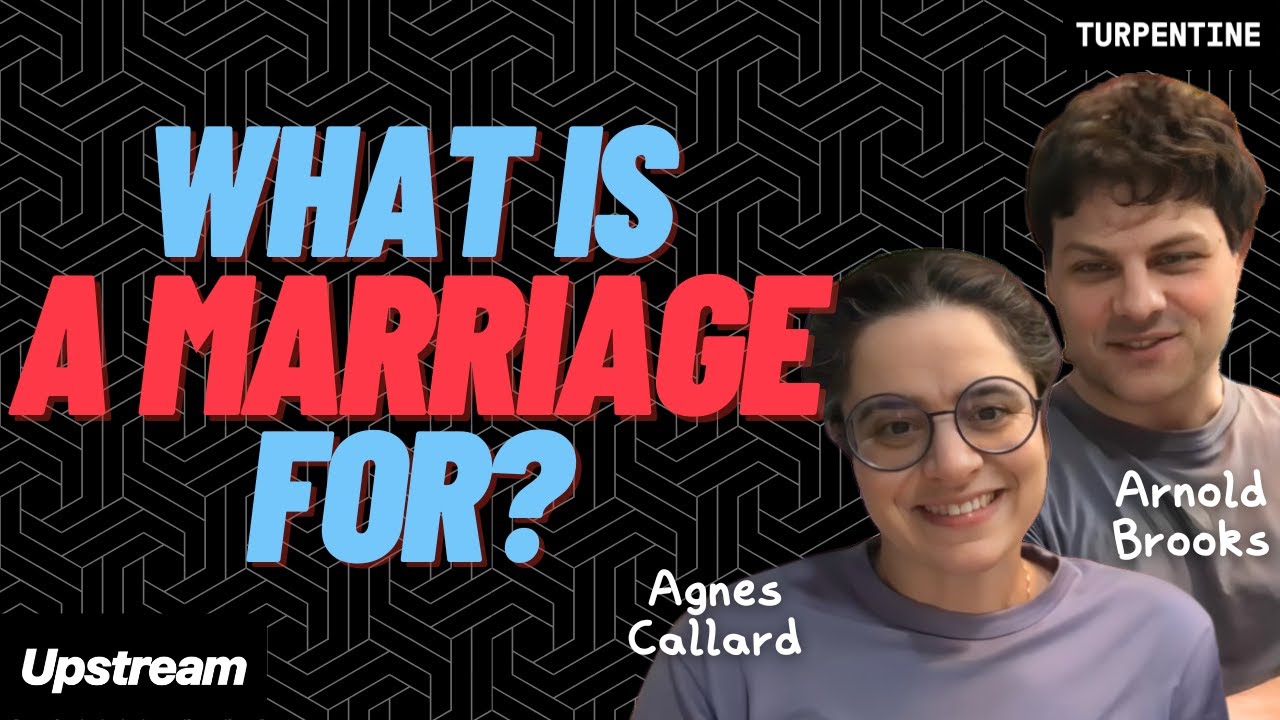
In this Turpentine Upstream interview, philosophy professors Agnes Callard and Arnold Brooks discuss the unconventional origins of their marriage, how philosophy shapes their partnership, and their evolving ideas about love, marriage, divorce, and parenting. They recount meeting when Arnold was a PhD student and Agnes was teaching Aristotle, the rapid divorce from Agnes's former husband, and their 14‑year marriage with a son, Izzy. The conversation explores how each partner’s philosophical interests (Aristotle interpretation, aspiration, eudaimonism) informed their attraction, the role of abstract reasoning in daily disagreements, and the tension between idealized notions of marriage and its lived reality. They debate whether marriage should be a pragmatic, goal‑oriented project or an indefinite, aspirational practice, compare their views on reciprocity versus bearing witness, and reflect on how their past relationships influence current trust. The interview also touches on parenting philosophy, emphasizing abstract questioning to foster curiosity, the likelihood of their children becoming philosophers, and the idea that marriage prepares one for divorce. They discuss the impact of a public profile about their relationship, clarifying misconceptions about authorship and its effect on public perception. Advice for listeners includes overthinking relationships together, emphasizing shared conceptual frameworks and open, principle‑driven dialogue. Sponsor ad reads are interspersed but are peripheral to the core discussion.
Chapters
Hey, Upstream listeners. Today, we're releasing an episode from Turpentine's show, Modern Relationships, where I discuss dating, marriage, and more with great couples. In this episode, I sit down with Agnes Callard and Arnold Brooks, who are both philosophy professors at the University of Chicago. We discuss the origins of their unusual marriage, what they look for in a marriage, the role of philosophy in marriage, and more. Please enjoy the episode.
Agnes Arnold, welcome. Thanks so much for coming on.
Thanks for having us. Thank you.
So the, the conceit of the show is we have really interesting couples on and we ask them to share their thinking about how they thought about finding a partner to the extent that they even thought about it, or, and what maybe other people can learn from how they went about it and more so on, on how to make partnership and relationship great and lasting. And so maybe we'll start with that sort of first question. I'm curious how you guys conceived for yourselves to the extent that you had a conception of, oh, here's what I'm looking for in a long-term partnership. I'm curious how that evolved over time and how it led to you guys or how it manifests in terms of you guys finding each other.
Yeah. Well, I mean, I suppose it's a matter of public record to some extent how we got together, but we, we should probably say something about that anyway, but We met in my first year as a PhD student. Agnes had been recently just graduated from her PhD and had been hired at Chicago, and she was teaching her first year a course on the Nicomachean Ethics. I was one of the students in the course, and over the quarter we started talking more and more, and towards the end of that course we realized that we were not That, that is that this had gone in a romantic direction. And Agnes was then married to Ben and had been for 7 years.
Yeah, that's right.
And she decided that she wanted to pursue our relationship and talked to Ben about it. And I talked to Ben about it and they got a divorce about 2 weeks later. And then we got together and then we married about a year later. And then had our son about a year after that. And we've now been married for, I think coming on 14 years.
I was gonna say less. Okay. Yeah. Good. Wait, well, oh, Izzy's 12, so I think 13.
Maybe 13.
Maybe that makes sense. Yeah. Izzy, our son, just turned 12 yesterday.
Right.
But that's not an answer to the how do you choose him question.
Right. So I'm saying all that because we, you know, we didn't start speaking to each other with a relationship. As a plan, right? And I, I take it, Agnes, you had considered the relationship question to be more or less settled when we met. And for me, it, it certainly wasn't settled, but I was in a state of some despair at the time. That is, I'd gotten out of several sort of quite brief relationships in which I had failed to connect emotionally with the people I was with. And it occurred to me that You know, I was dealing with a kind of systematic problem to which Agnes was the solution.
And so the problem was you were not finding the right thing specific, or the problem was you, or what was the specific problem?
I think the problem was that I, I wasn't finding somebody who in the very particular way that I wanted was a fellow philosopher. One of these people that I was dating was also a philosopher and she was great and I, there was certainly No problem with her. And she's, you know, an intelligent and accomplished person. But Agnes was the first person I met who was a philosopher in the sense that I understood that term for myself, where that means something for her that it means for me. And I'd never met anybody like that before. And as it seems like I didn't wanna let go of the person who was like that.
So.
I would give a slightly different account, not about your side, just about my, my side. Arnold is really, really good at interpreting Aristotle. I think that's what drew me to him. It was like he kind of could be Aristotle. He could kind of channel Aristotle. I'd never met anyone who could do that before. It's probably the most impressive power that I've ever seen demonstrated in anyone that I've ever met in my life. So I was just very impressed by that. And that matters a lot to me. And like, I, I, I was interviewed once by like a German journalist and she's like, so you, you really, you know, were attracted to someone because they could interpret Aristotle? And I was like, well, what, what does, what are the other things people attract? Like someone's smile or their sense of humor or that they're good looking? Like those are better than like being able to kind of telegraph the thoughts of like arguably the most successful intellectual who's ever lived. Like, I think that's pretty good. So, and I think that's how I initially conceived of it is kind of like Arnold could explain Aristotle and understand Aristotle and understand other people in relation to Aristotle. And then I learned that his powers are slightly broader, which is that he's just generally good at interpreting people, not just Aristotle, including me. So like pretty often I'll sort of say something and Arnold will be like, no, that's not what you think. This is what you think. Or he'll be like, here's, Here's your view about this, or here's how your views line up. Like, he's just a really good interpreter. I think all of those things are consistent with saying that Arnold is a philosopher. It's just, it, and he is, but it's sort of more specific than that.
But I have a question for you then. Yeah. Because that's very flattering what you're saying.
I was worried you were going to find it insulting.
Yeah, I, well, but that's, that's the but.
Yeah.
Yeah. But, but I do feel a little instrumentalized and I sort of wonder, like, I'm on the record accepting money for that kind of work.
Yeah.
Why marry me? That is what the— because, you know, I, I will do this for money.
Yeah. I mean, that's fair enough.
Or, or if you just wanna hang out and interpret, I mean, so why the—
Just wanting more of it, probably. Like for money, it's gonna be some restricted hours of the day or whatever. Just seems like the best way to get it. I mean, you could philosophize with someone for money too. I could say the same thing to you.
That's true. That's true. But I, I guess what I meant was, I didn't want to extract a bunch of—
You could be funny for money. You could be charming for money.
I didn't wanna extract a bunch of philosophy thoughts from you. Exactly. The issue was more like I saw you and I as having a kind of basic affinity on the question, what is philosophy supposed to mean for somebody's life? Which is to say, not merely an academic person.
I think that's right. But like, if I ask myself, like, could we have changed our minds about that?
Mm-hmm.
Like, I, I think the answer is yes. And like, like which bit do I hold fixed? I might hold fixed something about communication.
So is your marriage part of the something that helps you with your life goals of being a better philosopher? I'm sort of speaking crudely, but how would you sort of edit that characterization?
Yeah, I mean, they're almost too connected to say helps with, so maybe here I'm backtracking on my instrumentalization, but look. The question was what drew me to you or attracted me to you.
Mm-hmm.
Right? And I think I gave an accurate answer about that. And then I think that it's a mistake to think that what your relationship is, is like what drew you to the person. There should be some relationship between those things, but otherwise it's kind of a bait and switch. But, but I, I don't think our relationship is the same thing as what drew us to each other in the first whatever months, which were, which was really talking about Aristotle. That's literally all we did. So I had to be attracted to you on the basis of talking about Aristotle, cuz we didn't talk about our goals. goals for life or what we wanted or being philosophical. We just talked about Aristotle.
Yeah. But the question was something like a more general question about what, you know, what are you looking for in somebody? That is, and it's hard to believe that what you were looking for was a good Aristotle interpreter.
Oh yeah, fair. I wasn't looking for anything. So I was answering the question like, on what basis was I attracted to you?
Yeah.
Yeah. I wasn't looking for anything. So.
But if you had, let's say you had been looking for something like, what was your, I know you, you were married at the point, but maybe before you were married or something like, did you guys have a conception at any point of like, Hey, I want to have a wife or a husband, and this is what I'm looking for in that kind of per— this is how I think about, like, when other people ask me what I should look for in a partner, here's kind of how I answered it for myself, at least.
I think I was less reflective than most people are about that. Or maybe I, I have just a poor memory. That's also quite possible. So maybe I was and I'm just not remembering it, but I think I cared about, like, I'm trying to remember some of the things that I said. Like at my wedding to Ben. I, I remember a few of those things that were like a kind of rationale and like one of them was courage. I think I care about courage. I care about having kids. So I definitely wanted someone who wanted kids and I cared about sort of not being squashed. Like a lot of that kind of gets taken care of by the question of who would, who's even interested in me in the first place? Like.
Yeah.
Yeah.
Yeah. So I think that this last thing is probably getting more to Erik's question. That is, if we had to take a look at your attempts at love as a whole and try to understand what it was that you're aiming for and what are you working toward, both in looking for relationships, kind of developing the ones that you're in. I think the squash thing is a good start. That is that You are a pretty unusual person and he, you're unusual in a way that rubs some people the wrong way. You're looking for, I, I conjecture you're looking for somebody to live with where you're living with them doesn't, isn't even a friendly constraint on who you are and what you can be, but it's sort of like an open invitation to be.
Yeah.
the unusual person that you are. Right.
So a little while ago, I had this dinner with a friend where she was describing like her problems with men. And it sort of emerged that every man she had ever been with was sort of like a kind of like alpha male, high achieving, competitive, high money earning type. And I was like, oh, I've never been attracted to such a person. And she just couldn't believe it. And I was like, no, never once. There's never been such a person. Not only not that I've not dated, but not been attracted to. But that's like, I didn't need to think about it. It was just like, I could tell that, that, that was not going to be in equilibrium.
That's interesting. Related to this, I wanna segue to marriage or why marry in the first place. You know, you mentioned Arnold earlier about the public record that you, you know, alluding to this. New Yorker magazine article about, or just kind of profile on Agnes, and it got at your respective relationships. And it closes with a quote that Agnes has, or that's in an email. Marriage has an amazing PR team. For 2 decades, it is continuously telling me, this is good. This is how it's supposed to be. This should count as enough. Lots of people don't get this much. You should accept this and move on to other concerns. And I feel increasingly emboldened to say, no thanks. I'd rather keep working and searching and striving. I'm, I'm, I'm curious how you, how you think about marriage.
Well, that's your quote.
I mean, any of you're the interpreter.
So this comes down to a pretty, so for both of us, our marriage, I think, represents not something that we do sort of in addition to the philosophical life that we have together, but is a manifestation of it. That is that we see it as something that's continuous with the intellectual work. that we do as philosophers. And so one of the things that that means, you know, because that sounds a little fluffy, but one of the things that it means is that when we have a philosophical disagreement, it's also a marital disagreement. And one of our deep philosophical disagreements is about whether or not it's important that we, in the ethical parts of our lives, be able to achieve some kind of end and remain stably there, and that the goal is to You know, get to a good place and be there versus whether or not the goal or, you know, for us mortal beings is to sort of pursue in a kind of indefinite way something that's, you know, beyond our nature or something like that. So, you know, you might take in terms of scientific knowledge, for example, you might take this to be the contrast between people who are relatively pragmatic and say, look, we have a bunch of knowledge of physics already. And we can build on that, but what we're looking for is the kind of thing we already have. And versus somebody who thinks, no, that, that as it were, true science is something that's far off and maybe we'll never get there and maybe we'll never be certain about it, but we can sort of incrementally pursue it. Agnes is more of the indefinite incremental pursuit side of things, including with marriage. And that's, I think what that quote was capturing was that the true marriage in a sense is something far off. It's something very high, something very difficult to achieve, something maybe beyond a mortal lifetime, but it's something that we should orient ourselves towards by pursuing, even with the understanding that we'll be pursuing it indefinitely. Whereas I tend to think of marriage as something that we achieve and build on, and that, that is, think of it in a somewhat more pragmatic sense that what we have now is, as it were, a true marriage and It can change and it can be modified and it can, we can discover new things about it. But what we want is a lot like what we have going into the future. And so we argue about this and a lot of our arguments sort of actually come down to this question. And it's a Plato versus Aristotle question at the end of the day. So I think that that's what's behind that quote, which is not a quote I agree with.
That's so one of the amazing things about Arnold is he can interpret people he doesn't agree with. Many people can interpret people they agree with, but The key is being able to really charitably and to really don't agree with.
You, you found that good enough?
No. So, so it's good and it is, and it's something I think, so I'm not sure it's what the quote means though. That is, I think that there's at least, so you remember this line that we said to Rachel? I've only read the profile of me once, so I actually like can't remember whether this is in it or not, but something I said to her is marriage is a preparation for divorce.
I said that.
You said, well, he stole it from you. I steal a lot of stuff Lauren says. If I like it, it just goes in my head. Okay. Well, anyway, you said it, but like, you don't believe it. That is, it doesn't fit with the view you just gave, right?
No, I guess not exactly. That is, I was channeling you, so I'm like, yeah, very good. Thanks.
Fine, fine. You said the words doesn't matter. It's my view. There you go. Okay. So I think that there's something you're trying to achieve in a marriage. It's not just that you're striving for some ideal marriage. It's that you're striving for an ideal state that isn't marriage. And, and then you'll be done with the marriage and you'll just move on. Now, that's gonna be like a lot of lifetimes in the future. So it's not, there's no immediate danger that I'm gonna acquire the totality of human knowledge and then let's not need Arnold anymore. But yeah, I think, I think of marriage as something that kind of in principle somehow gets transcendent because it's a project. Yeah.
We'll continue our interview in a moment after a word from our sponsors. Even if you think it's a bit overhyped, AI is suddenly everywhere, from self-driving cars to molecular medicine to business efficiency. If it's not in your industry yet, it's coming fast. But AI needs a lot of speed and computing power. So how do you compete without costs spiraling out of control? Time to upgrade to the next generation of the cloud, Oracle Cloud Infrastructure, or OCI. OCI is a blazing fast and secure platform for your infrastructure, database, application development, plus all your AI and machine learning workloads. OCI costs 50% less for compute and 80% less for networking. So you're saving a pile of money. Thousands of businesses have already upgraded to OCI, including Vodafone, Thomson Reuters, and Suno AI. Right now, Oracle is offering to cut your current cloud bill in half if you move to OCI. For new US customers with minimum financial commitment. Offer ends March 31st. See if your company qualifies for this special offer at oracle.com/turpentine. That's oracle.com/turpentine. Every time I hop on the 101 freeway in SF, I look up at the various tech billboards and think, damn, Turpentine should definitely be up there. And I bet I'm not alone. In a world of endless scrolling and ad blockers, sometimes the most powerful way to reach people is in the real world. That's where AdQuick comes in— the easiest way to book out-of-home ads like billboards, vehicle wraps, and airport displays, the same way you would order an Uber. Started by Instacart alums, AdQuick was born from their own personal struggles to book and measure ad success. AdQuick's audience targeting, campaign management, and analytics bring the precision and efficiency of digital to the real world. Ready to get your brand the attention it deserves? Visit adquick.com today to start reaching your customers in the real world. Again, that's adquick.com.
The piece also has a moment where you and your ex-husband, also at the University of Chicago, are talking to students or in front of students, and you're asking the question, is divorce a failure?
Oh yeah.
Yeah.
The Night Owls that we did.
And it's more, and I think you have a quote, something along the lines of, if it's a failure, it's not a failure we should run away from, or we should, and, you know, embrace it if it happens. Or how do you think about sort of the role of divorce or sort of, yeah, how should we think about these things?
One way I think about it, and I think Arnold probably gets to this, but we're about, we're about to find out, is that There's another sense in which marriage is a preparation for divorce, which is that when you get divorced from someone, you learn what your marriage was really made of because now you have to navigate something that's harder to navigate than anything in your marriage. And so like divorce itself, I don't think is some necessarily something to cry over, but the way the divorce gets navigated typically is that is people getting divorced are cruel and unjust to each other. And they tend to excuse that as being acceptable under those circumstances. It's really not. And that's really kind of a social disaster that there's a circumstance under which people think it's okay to be cruel and unjust to each other. In that sense, divorce is a disaster given that it's that. But I think, I guess maybe like if I could be a social reformer, I would be a social reformer of the kind that would spread the message. Even when you're getting divorced, you have to be kind and just to the person you're getting divorced from. Like, even if you think they're the cause of the divorce, doesn't really matter. 'Cause, 'cause there's a general rule that you have to be that way to everyone. But, but there's a kind of, you know, a specific temptation to behave badly in, in that circumstance. So that's my main thought about divorce is that the moral rules do not get suspended during divorce.
Implicit in that is, you know, some people have this view of like, you know, divorce is a, there's something wrong about divorce, that marriage implies this sort of lifelong bind to somebody. And do you have sort of a different view of marriage or the role that marriage has in society?
I guess I think people typically get divorced because sort of something has gone wrong in their relationship. And that thing, whatever it is, is bad. So I don't wanna deny that. But, you know, there's like a question of like, what's our, what's the relevant comparison?
Right?
So it's like, if the thought is, are you licensed to draw the conclusion it would've been better if they'd never gotten married? I think the answer to that is no, you're not licensed to draw that conclusion. You're not licensed to the, draw the conclusion that the marriage was a mistake.
Yeah.
Like in life, you often undertake things and then something bad happens. That's actually like pretty common. And then you have to regroup and, you know, kind of start over. This can happen in a career. It can happen with like, you know, you go to grad school and you don't finish and you change course and there's something bad happened there. There's a genuine bad, whatever the specific thing was. But I guess it's not like the fact that you didn't complete the marriage or something that I think is The bad thing, the bad thing is whatever it was that led you to decide that you couldn't be with this person anymore. It's more concrete. Marriage isn't like a project that you're supposed to, like, you're supposed to finish up to, you know, like, okay. The most romantic thing that Arnold has ever said to me, he knows exactly what this is because I've told him this most romantic thing is that he said one point to me, the reason that I like you is that you're not just, or that I love you is That you're not just trying to get along until we die. And I think the model of marriage where it's like, just, just try to get along until you die, it's like a very dark model.
Yeah. In the piece, it mentions that Arnold believes that your first book, Agnes, or sorry, your book about aspiration was inspired by the relationship, or it was about you trying to make sense of the relationship. Share more about that. Maybe Arnold.
Yeah, I mean, her book grew out of work that she did on her dissertation about weakness of will and quite a lot of thinking on quite a lot of topics. And so I guess I don't mean that the book was sort of like structured around that topic, but a lot of the thinking, it seemed to me, that went into the book was really drawn from Agnes's experience making sense of our relationship and in, in general. the question of how a relationship is to be understood. I mean, a central part of Agnes's claim in that book is the idea that you can't rationally see your way to the end of certain kinds of important projects, projects that are vital to human life. And in particular, it's those projects in which you come to value something that you didn't value before. And of course, if you valued it at the start of the process, then you wouldn't need to go through the process, but if you Don't, then you can't see why the process is important or worthwhile. And relationships are really a prime case of that. That is, a relationship is a very central case where what the relationship is going to be about ultimately is not going to be a peaceful home life or children or, you know, a stable partnership or anything like that. Not because those things aren't important to a marriage, but because The marriage will be made up of much more concrete, much more individual and specific dynamics, right? That is, it's the way that you talk to each other every day, the specific way in which one person's messiness interacts with another person's cleanliness. Like, it, it's so specific that the kinds of general ambitions you can have going into a relationship can tell you almost nothing about what your experience of it is going to be and what ultimately you're going to value about this person once you learn enough about them to really see them for who they are. And so in a relationship, you're diving into something and you're saying, let me learn to value something or someone without having any real grip to begin with on what you're going to come to value. And you have to be somehow open to the possibility that you're going to value things that you just had no real relationship with before.
before.
And so the book was really, is where that, but in a sort of more general light. But I think a lot of the logic of it came from us sort of navigating the beginning of our relationship.
I think that's right. It was also influenced by stuff you taught me about Aristotle, like how there's no such thing as the beginning of the fastest of change. Yeah. The time asymmetry with change.
Yeah. Yeah. Yeah.
But that's probably less interesting to, it's not about relationships. It's about like the physical structure of change.
Well, in point of fact, it is about our relationship. That is, that's the Aristotle thing. I'm not really sure you could have known that when we got together.
Like, not right when we got together, but there's no such thing as beginning a process of change. That was like, we talked about that within like the first month. Remember the tattoo that I got you? It was a temporary tattoo, but I, I had it made for him on this line. There's no such thing as beginning a process of change.
Yeah.
That, that, that—
I have yet to go into the full tattoo with that line.
Change has an endpoint, but it doesn't have a beginning. So you never know when it's gotten started or not.
You mentioned, or the piece mentions that in the beginning of the relationship, there was an early fight and it quotes you, Agnes, saying, maybe I'm doing the same thing again. The veil was lifted with Ben and now it's being lifted again. And I guess it's implying like, are you sort of realizing, oh, you know, I challenged one person, but I might have similar or different challenges with a, with another person. But later on in this paragraph, it quotes you basically say for what your point Was your work is trying to do is sorting out what one human can be to another human. It seems to her that Arnold had come to her with a question. Is it possible to eliminate the loneliness that is intrinsic to any relationship, to be together in a way that makes full use of another person's mind?
I think that we did this event on May December, the movie. Okay. We did an event together and, and we had this discussion about it that I kind of wish we'd recorded. It was really good. And that we sort of came to the conclusion that the movie is about how all relationships, but maybe especially one that, ones that begin somewhat traumatically like ours, are haunted by their beginnings. That is, there's something about the way the relationship starts that like sets the terms for the relationship. And I think that, and that's something you have to escape. So like the relationship has to escape its beginning. And I think that in our case, it was that like our beginning was such that I, in order in some sense to like justify totally uprooting my life and getting divorced from someone that I really had a good relationship with, right? It wasn't like he was bad in some way. He was great. In order to justify that, I had to kind of configure this relationship as some kind of perfect ideal. Like, you know, that this is just, it's perfect. I mean, it's the platonic ideal of a relationship already. That's what I was being offered. And it was sort of inevitable that I would become disappointed that it wasn't that. And, but that was like me succumbing to the trauma of the being in the thrall of the way the relationship started. And I think it's right that it took me, like the thing I said to Rachel, you know, is something I said like a decade after. And like on reflection, like actually it's less that we were offered this perfect thing than that there was something We have to figure out. But yeah, so both of those strands are present at the beginning. Yeah.
I mean, it, in particular relationships that begin in such a way that they end some previous relationship.
Yeah.
There's this, and people get caught. I mean, I've seen many people who get caught in this. You get caught in this thing where in order for the relationship to be justified, to be acceptable, it has to justify the end of the previous relationship. Which means that it has to be special in some way. If the previous relationship was a very bad one, that might be no problem, right? That, that's not much to overcome. But if the previous relationship wasn't in some sort of obvious way problematic, the new relationship has to get idealized. And that's something that people end up really struggling with because of course relationships are relationships. They're real things. There are no ideal ones. And so it's Once you start encountering the reality of this other person and the kinds of conflicts you get into them with them, unlike relationships that, as it were, start fresh for both people, these ones that involve the end of another relationship, these difficulties suddenly present a kind of existential threat. Like, is this justified? Did this justify the end of my previous relationship? And it's like the way that relationships begin can carry a kind of curse through the rest of it. And that's something to, you know, that one has to overcome.
And I think this probably explains why when people, let's say they're, they're getting together or maybe getting together and then they're talking about their previous partners, there's a kind of inclination or temptation to talk about them in very negative ways. And I think partly it's like that helps create a low bar of idealization, right? So there are maybe multiple reasons why you might think about your previous partner in negative ways, but I think would be one of them.
And one thing that the piece also shows, and it's quite remarkable, is that you and your ex-husband, you know, most people when they break up, they usually separate to some degree. There's, you know, broad question people always say, can exes be friends? Most people are skeptical that's possible or desirable or constructive for new relationships. And yet you guys seem to have achieved something there that most people not only can't do, but are almost shocked by. That might've been the most surprising thing in the piece for people. I'm curious what you can share about what other people can learn from your example or what sort of what you find remarkable about it.
So when we first got divorced, I did move out. Like we, we weren't living, we now we all live together, but we didn't at the time when we got divorced. So That did take a while. That was like a year and a half later or so. But I think we were always friends. Ben and I were always friends. We never stopped being friends. And so part of it is like we have 2 kids together and he's basically a parent to Izzy now as well. So like there was no world in which we were not gonna interact. So the question is, are we gonna interact as friends or are we gonna interact in some distant way? So that's like, it's highly desirable. If you're gonna interact with the person and you're gonna have to navigate the difficult, you know, questions that arise with child raising, that you have a good relation with that person. So like, you know, it's relevant that we had that kind of incentive. And I think the other thing that's relevant is that a big part of my relationship with Ben is and has always been philosophy in a very different way from how it is with Arnold. Namely, Ben's like standing. response to almost anything I say is like, that's crazy. And like, why are you contradicting yourself? Like, I tend to speak in ways that Ben hears as like just a flat out contradiction, right? So I'm like—
He's very friendly about it.
He's very friendly. He's a wonderful interlocutor. Yeah, he's very constructive. But right, I mean, there's no one I'd rather be grilled by than Ben. But the point is, it's like, it's exactly that he can't channel how I'm thinking about it that forces me to articulate it. So there's just never been a time where I don't spend multiple hours in a week talking on the phone to Ben about philosophy. Even though we live in the same house, we still talk mostly on the phone about philosophy. Because if we're in the same space, often like our kids will be butting in. So I think that's like, we had a different basis for our relationship. So we had like the kid thing and the philosophy thing. I think that helped. And I guess I think navigating the divorce thing, like How you navigate the actual, like, mechanics of the divorce is probably pretty significant. You know, Ben, like, there are definitely things I could have done that would've made Ben feel betrayed, like cheating on him or lying to him. I think we probably could have recovered if I'd done those things, but I didn't do those things. Like, I was pretty open with him at every point, and so I don't think that he felt wrong. And I think that's relevant. Often there's one party who feels wronged. I think that, as you know, he said to me quite early on, he's like, I don't feel that I am somehow owed you loving me. He's like, that's not what a thing someone can owe another person such that you have betrayed them because you don't. So that may be Ben's distinctive point of view, but so like, he didn't think that he had been denied something that he was owed by me, and thus he didn't think he had grounds for anger. So those are all, I think, relevant.
We'll continue our interview in a moment after a word from our sponsors. In an age of AI and big data, your personal information has become one of the most valuable commodities. Data brokers are the silent players in this new economy, building detailed profiles of your digital life and selling them to the highest bidder. With data breaches happening frequently, these profiles aren't just fueling spam, They're enabling identity theft and putting your financial security at risk. But what if there's a way you could opt out of that system entirely? Incogni is a service that ensures your personal data remains private and secure. They handle everything from sending removal requests to managing any pushback from data brokers. What I trust most about Incogni is how it provides ongoing protection. Once you're set up, it continuously monitors and ensures your information stays off the market. Want to extend that peace of mind to your loved ones? Incogni's Family and Friends plan lets you protect up to 4 additional people under one subscription. Take control of your digital privacy today. Use code UPSTREAM at the link below and get 60% off an annual plan. Again, that's incogni.com/upstream. Hey everyone, Erik here. In this environment, founders need to become profitable faster and do more with smaller teams. Especially when it comes to engineering. That's why Sean Lanahan started Squad, a specialized global talent firm for top engineers that will seamlessly integrate with your org. Squad offers rigorously vetted top 1% talent that will actually work hard for you every day. Their engineers work in your time zone, follow your processes, and use your tools. Squad has frontend engineers excelling in TypeScript, React, and Next.js ready to onboard to your team today. For backend, Squad engineers are experts at Node.js, Python, Java, and a range of other languages and frameworks. While it may cost more than the freelancer on Upwork billing you for 40 hours but working only 2, Squad offers premium quality at a fraction of the typical cost without the headache of assessing for skills and culture fit. Squad takes care of sourcing, legal compliance, and local HR for global talent. Increase your velocity without amping up burn. Visit chewsquad.com and mention Turpentine to skip the waitlist.
Back out or going to an earlier question, like let's say someone you're very close to, maybe one of your children when they become of age to be having a serious relationship or someone you're close to says, hey, you know, Agnes, there are, you know, a bunch of people I could like, a bunch of people who could like me. What's kind of the point of a relationship? Like, how do I think about who to be in a sort of romantic partnership? with or romantic relationship given it's kind of hard to, is it just sort of like what my gut wants to do? Is it sort of, you know, some people seem more stable than others. Some people seem more fun. Some people help me become more of the self that I want. And that, that's kind of what I took to be your answer when you said not be squashed. Like the positive version is like, you know, helps me sort of aspiring towards more of who I want to be.
I mean, when I said not be squashed, I really did mean just the negative version. Like as a starting point. So like, I just, I do a lot of weird things. You could see my office. Dressing weird, you know, just kind of getting obsessed with things that I then wanna talk about nonstop. So just to not be stopped from those things is like, that's big. That's a lot to get already in terms of what I was looking for. But what advice would I give? Okay, we're gonna set aside my primary motivation, which is that I want grandkids. So be like, marry someone who wants kids. 'Cause I have 3 boys, right? So this is like, you know, I'm shocked by people like my age who have kids who don't talk to their kids about having kids. For me, it's like a constant hum in the background of their lives. Like, oh, what are you gonna name your kid? What will you do with your kid with video games? How much video games are you gonna let them play? Like, when you have kids, are you gonna cook at home? Are you taking restaurants? Just like the presupposition, make sure that presupposition is baked in there. You're going to have kids. So just to be straight with like what, you know, my motivations are.
Your motivations for what?
For talking about what, who they should choose as a partner. They should choose someone who wants kids. I'm not saying that's the only criterion, but that's like—
Okay. Assuming that's equal, that's baked in across all.
I guess I find that hard in the abstract. Like my initial impulse is to say things where I'm like, no, that would be right for me, but maybe not for them. I'd be like, choose someone interesting because you have to talk to them a lot. That's like mainly what a relationship is, is talking. So if you don't find them fun to talk to. It's not gonna work. But then I'm like, well, not every, like, I care about people being interesting. I care about my kids being interesting. It's the thing I've noticed, like a lot of people don't parent for interestingness. That is, they, you know, of course you're gonna love your kids no matter what, but like secretly you have goals for them. And my goal is that they'd be interesting to me. And so, so like, that's a big thing for me in interlocutors. Even though I've, you know, optimized my own kids for interestingness, that's not the same thing as saying that they're optimizing for that in their lives. And so I guess I probably would need to have the conversation in a more concrete way and thinking more about like who that kid is at that point in their lives. What's your thought? Maybe you have a general answer.
I do have a general answer.
Okay, good.
Is it like, don't listen to her?
No, no. I mean, I want grandkids too, but I think that if I had to try to generalize about what I wanted from you and what I think Is a reasonable thing to shoot for, that there are all sorts of goods that we provide for each other in relationships that are reciprocal, right? So mutual support, being an interesting interlocutor, stuff like this. And those are important and no one can live without those goods. But I think ultimately what, if I were to give the kids advice on this, what I would say that they should be looking for is somebody for whom The main thing that draws them into and keeps them in the relationship not have that structure. So this is my situation with you, I think, which is—
Not have which structure? Oh, you're gonna explain it. Okay.
Not have the structure of a reciprocated good, right? I support you, you support me, that sort of thing. Because maybe you'll stop supporting me at some point, right? And that'll be a problem and we'll get into fights. But if that's the reason we're together, then that can really threaten things and It's also, you know, I think, as it were, not a good enough reason. The main reason I think I am married to you and continue to be is because I just like seeing the way that you live. And I like sort of being there for it. It, it's to bear witness. That's the main thing. And you don't need to do anything for me. In order to make that possible.
Oh yeah. I'd give you something to witness, don't I?
Yeah. Yeah. But you're gonna do that anyway. You've got this whole little internal motor, as you know, everybody knows.
But see, that may be you, you may be giving advice to yourself. That's what I'm saying. Like, that's a very distinctively you thing.
No, no.
Everybody should just do this. It's advice for everybody. It so happens that I do things the right way, but—
But think about Maccabee.
Yeah.
And how like deeply, this is our middle son. How, like, just like deeply interactive and social a person he's much more than either of us.
He's gonna make a great husband one day.
Yeah.
But I do think that it is important. It'll be important even for him that ultimately the thing that makes the relationship what it is, is something where the reciprocation goes in the other direction. That is, he should be with somebody where the basis of his love for them is just that He loves the way that they live.
Hmm.
Yeah, I do think that the, there's a danger in the other way where like the deep structure of the relationship is just revenge. It's like waiting for revenge. It's like, oh, you're not picking up your part of the bargain, then I'm out. Right. So it's like, I'll support you if you support me. And there's this constant attunement to like, but are you supporting me? Because otherwise I don't want to give you more than you're giving me. So I see that. I see the worry about the overly reciprocal marriage.
Yeah, that's really interesting. Something you mentioned earlier is sort of that some, you know, the relationships have to recover from how they start to some degree. And in your situation, as in many situations, you know, you didn't start from scratch. There were other people involved. And so sometimes when a relationship like that starts in that way, there's always a question of, hey, if someone left someone else to be with me, how do I know that they won't leave me to be with someone else in the future? Or that, you know, or that some person in your dynamic. How do you think about that idea?
I think Arnold is a very, very non-insecure person, like at some very far end of that trait. So that thought seems like very alien to him. I think he would probably think something like, well, look, if you decided that this was some better life for you, you would convince me of that, and then I would be okay, or something like that. I, I mean, you tell me, but I don't, I just don't experience you as like Having this fear.
Yeah, I mean, that's your decision. And I guess something I have good grounds for thinking is that if you did meet somebody and want to be married to them, then what you would do is you would immediately be honest with me about that and you would thereafter treat me well and you wouldn't try to close your life off to me and we would still be friends and we would still Have something. And it's, you know, as you put it, it's not like the marriage would then have failed, right? It would just be that you're doing something else and, you know, I, we'd both be fine.
It's like, yeah, I think that that might sound crazy to people in the sense of they might be like, but I want, I want more insurance against that. But there's another part that's maybe not visible. Like recently we were Somewhere and I was having a problem with a friend who I was finding really annoying. And I just like sort of struggled with dealing with this friend in a social situation where my experience of it was like the friend was annoying everyone in the group. And it was like really bothering me. And I talked about Arnold afterwards and Arnold's like, no, this is a you problem. Like you're just, it's fine. And you're projecting a bunch of stuff onto this person. And as like, as soon as he explained it, I was like, oh, you're right. And so the point is like, say I said to him something like, oh, I met this other person and I think I should be with them. Like most likely he'd be like, no, I don't think that's gonna work for you and it won't be good and you won't be happy. And I'll be like, oh, you're right. So it's like 99 cases out of 100, it would be that. And he would just convince me. And then in the one case out of 100 where it genuinely was better for me, then yeah, he would want what's better for me. But yeah, so.
99. Look, I, bigger or smaller, I don't really know. It's like, you know, I think if you came to me and you were serious about marrying somebody else, then yeah, I mean, we would talk about it and I'd—
But, but it probably, I probably wouldn't get to the point, like when I went to bed, I wasn't already gonna marry you, right? Yeah. So it wouldn't start with marriage.
Yeah.
But yeah, I guess I think there's a way in which we sort of take each other seriously such that we can expect that we will take each other seriously in the future. And that means that we'll just navigate whatever happens then. And we're pretty confident we'll make the best decision.
Yeah.
You have this also in the piece. You have this nice idea that, you know, for many people, marriages start sort of, you know, amazing with a rush and then sort of lose their luster over time, but that yours is like a ladder up or is the opposite in the sense that it, yeah, it's just gotten way, way better as things have gone on.
I mean, I think sometimes it gets worse. Like we go through some periods of some mild alienation and like recently we were on a trip and we were discussing that exact thing and It's like we can go through a period where we feel like we're not talking or connecting well, but then it will sort of wear on us and then there'll be like this impulse to fix it. So, 'cause it's like, it's not as though our marriage is the center of our attention all the time. It's probably at center of our attention a surprising amount. I mean, we, we spend a lot of time together.
Yeah.
So we tend to work here together in my office most days. So, you know, we do spend a lot of time together, but a lot of it is just like us individually working or we're talking about, you know, some sociology book that I'm reading today. It's like, we're not talking about our relationship, but we do talk about our relationship a fair amount too. And so, yeah, it'll sort of like fade in and out of the center or move in and out of the center of our attention.
Let me read it. A common refrain in their fights was whether Arnold, who became an assistant professor in 2021, should aspire to more. Agnes felt that he could write an extraordinary book about Aristotle, but he was content to read the texts and share his interpretations with his students. Arnold fundamentally sees life as like, you're supposed to find a place of contentment, she said. And his way of doing things often shows up to me as, he's not working hard enough. And my way of doing things often shows up to him as, she's incapable of being happy. The source of my question is, what is the aim of work? It has to be something that's not work. Aspiration can't be infinite, as much as you would love it to be. 'Cause at some point you have to get to the value that you were supposed to be aspiring towards. And once you're there, that's who you are.
Right. So that's the thing you mentioned earlier. That's the, Arnold's an Aristotelian, I'm a Platonist, where I'm like the infinite striving person and he's like the, there better be a goal person. The most salient feature of ancient ethics, so of every ethical theory, like You know, in the West, let's say before Christianity. So we're talking Socrates, Plato, Aristotle, the Stoics, the Skeptics, Epicureans, all of them. They all agree about something that we don't necessarily agree about anymore. It's called, the name for this thing is called eudaimonism. They're all eudaimonistic. What does that mean? Eudaimonia is just the word for happiness. It's the, the human good. This is the way I put it. The human good has to come home to the human being whose good it is. What I mean by that is that like my good can't be like achieving something that's like outside of me that I'll never like be aware of or conscious of or know. And thus like altruism doesn't make sense as a life project. 'Cause it's like if my goal is altruism and I'm gonna help Arnold and then Arnold's goal is altruism, he's gonna help you. It's basically like a pyramid scheme where we're each pushing off the meaning onto another person. Someone's gotta actually experience the good and it's gotta be you. And so I think Arnold is channeling that like ancient thought of Whatever happiness is, it's gotta be something I can like have during my life.
Yeah. I mean, I guess then there's this question, how do we make sense of what you're doing?
Yeah, that's your job. You're the interpreter, right?
But that quote refers to a sort of way, a more pragmatic discussion. And I think one that, um, in which a bunch of pretty concrete details about academia get worked out. That is, I think you found a great thing with the sort of public work that you do. But I think we're both a little alienated from academic research and my interests are arcane, to say the least. That is, they're not of public interest. So I get what I get out of philosophy through teaching mostly. You know, I'm not a, I'm not a great writer. And part of my understanding that is seeing a great writer in action very nearby. But there's this question in our lives, I guess, very generally to sort of move away from those things, which is just to what extent is striving supposed to be a kind of like indefinite lifelong thing? And to what extent is it supposed to terminate within a human life in some, you know, desired condition? To what extent are we supposed to see the aim of our efforts intellectually and socially as having a kind of endpoint that, that we could reach as opposed to having a kind of like ideal endpoint that we merely approximate. And that again is this sort of like ongoing debate between us. Is it, it's sort of a metaphysics point even.
Yeah.
Is that the biggest debate or conflict you guys have in your marriage? Or I'm curious if there's anything bigger or?
Not by intensity, but it's the most consistent. That is, many of our debates come down to that point and we end up discussing that question a lot as a result. But no, I mean, Agatha just mentioned the sandwich problem, which is that she doesn't like making sandwiches. I also don't like this, and sometimes it's necessary to make sandwiches, and this is a source of conflict, probably more intense conflict than some other conflicts That we get into, but I make like 100% of the sandwiches just because— That's just not true.
When's the last time you made a sandwich? I, last time I made a sandwich was the night before last night.
That was dinner.
Those were open-faced. That doesn't count.
Why doesn't open-faced count? I asked if you wanted open or closed face.
You could have closed face. But you're just making a dish. You're just— bread is involved.
You don't like sandwiches cuz they, what they represent. Metaphorically or something, or—
Neither of us has any idea why we, we do that.
I'm curious if, you know, gearing towards the end here, is there something we haven't yet discussed that you think we should discuss or that listeners would benefit from hearing or that you guys find remarkably interesting? You know, the piece does allude to, you know, Agnes, maybe you might wanna write a book about sort of philosophical marriage or some of these unconventional, you know, family arrangements. And I'm curious if you think there's anything That you'd wanna cover there prominently or that we haven't yet discussed?
I'm just putting together a proposal for my next book, which is going to be, one of the chapters is gonna be about marriage. It's not gonna be a whole book about marriage, but it's gonna be a book about unruliness, which is sort of like weirdness, but not quite. And I, and I do think that part of why I want There to be a chapter about marriage is that I think marriage is like, maybe, maybe what it is today more than anything else is kind of like the perfect venue for something. That is, it's like this institution that it just won't die. You know, we kind of keep, we keep modifying and attacking it and detaching it from a lot of other things that it's traditionally been attached to, and yet we keep still having it. So it's kind of capacious and open in an interesting way. But that also means that it's really hard to give guidance because you can make very many different things of it. And so what I want to talk about is like, what is something really cool you could do with it? Which is not necessarily the only thing you might want to do with it, but yeah, that's what I want to do in that chapter. But I don't know, what do you think?
Can I channel you a little bit? That is, if I were to give some sort of like, you know, because I know the dangers of this, but sort of platitudinous advice about marriage, it's overthink it. Let's be aware that you can't think about it by yourself. That is, see it as something where it isn't merely an activity of passion. It's not merely pragmatic. It's something that you should intellectualize and think about a lot and think about with your partner. And that is, think about it in the abstract. Think about it as like, what are marriages for? What do we want out of this? What is the— What is a relationship like? What can 2 people mean to each other? Read books about that and talk about it. And just the more, you know, people talk about being open and honest in a marriage, and of course that's sort of important, just as important to acknowledge that no one will be entirely, but that it's really important to talk a lot about relationships in general. It's really important to develop a kind of like Conceptual rapport with the person you're in a relationship with about what relationships are and what they mean to them and so on. Like having years upon years upon years of stuff to draw on when I talk to Agnes about a fight we're having where it's not stuff about some previous problem that we've had, it's abstract stuff about like what 2 people should mean to each other. That is an enormous help to me because it It allows me to get a much better sense of what she's worried about, what she's thinking about when she has a problem, because I've spent time trying to, you know, occupy her point of view in general on what a relationship should be. So, I mean, I think people should overthink their marriages, but they should do that together. I think overthinking can be a problem if you try to do it by yourself, but as long as you're doing it together, it's just a, it's just a win.
Yeah. I, you know, a funny thing, cuz I've been sort of promoting my book Open Socrates, in which I argue that like Argue for basically overthinking. And I get a lot of people ask me this question. They're like, either about themselves or someone they know, like sent themselves into a depressive spiral by doing like too much philosophizing. And I'm like, well, describe that. Describe how that happened. And every time it is, I sat alone by myself in a room reading a bunch of books and like pondering to myself and like writing in a journal. And I tell them, you know, the story I've never gotten is the person who comes to me and says, I had all these philosophy conversations with my friends and we argued about a lot of stuff and it set me into a depressive spiral. So the thinking isn't the problem, it's the being alone and thinking that's the problem because you're very bad at that actually. So you're kind of getting compounding returns on your insanity basically. And so yeah, like you will drive yourself crazy doing that. And I think the same thing is true about relationships, like trying to think about your relationship, even just like talking to my best friends. Like when I've had a problem with Arnold, listen, I'll talk to my best friend, but like, I really need to talk to Arnold, not to her about it. And it's really important that you not construct too much of it by yourself in your head without the participation of the other person.
Do you worry about the burden of sharing sort of insecure thoughts or sort of putting too much on the part? You know, it's like you can imagine someone who sort of shared every criticism that comes to mind or, you know, constantly bringing up fears and it sort of, it sort of reifies it by making it a thing that you guys are discussing, that you guys are philosophers, so you know how to maybe separate.
Yeah, I think this is why I said that the thing that's important in overthinking or overtalking a relationship, the thing that's important is really is the abstract stuff. So that, yeah, I think bringing up every criticism or fear that, that could be a little A little, you know, difficult, but bring up everything you think a relationship ought to be in the abstract. And, you know, that's going to interact with the things that you're worried about and the things that you're afraid of. But the nice thing about talking about relationships in the abstract is that you can't avoid the demand that you make sense of what you're saying and that what you're saying cohere and can be explained and can be given a justification. And that the other person is, you know, responsible for hearing that and critiquing it and objecting and, or adopting the view if they find that it works. And that, that's just what thinking together is, right? If I'm feeling insecure or stressed or upset about something, I think it's important for me to bring that up at some point. But in a sense, that can't be the, the meat of thought because it's not something that I can explain or justify.
Or really share, like in the sense of if you're just reporting your own mental states, that's not a conversation. And so I think openness, yeah. So like insofar as like people sort of tout openness, it's really the sharing, the kind of not keeping anything in, which that's my tendency. So I'm not, I'm not saying it's a bad thing, but that's not what we're talking about here. I think it's something like having a sense of like what your shared principles are. Like when that thing I mentioned where Arnav was like, this is a you problem and like you just need to like treat this person well and you need to like ignore the reactions that you're having to this. The reason he was able to say that is cuz he was able to draw on principles that I have. He's like, look, this person may be annoying those people, but you don't actually know that he's annoying them. And it's like their job to like deal with that if he is annoying them. And like he was able to sort of remind me of my own standards such that I could just well imagine that if our relationship had been different. Someone telling me, oh, you know, you need to be accommodating, would like raise in me suspicions. The only reason he's saying that to me is that he's worried that he'll be in the position of this other person at some point. And so he's really protecting his own interests by giving me this advice or something like that, right? Like a lot of times when people criticize you, you think, well, you're doing that from your place, like from the point of view of securing your own interests. And the reason why I know Arnold isn't doing that is just because he's able to cite the principles, my own principles, and be like, that's why you have to do it. Well, I, because it's because he knows what they are.
I think the beautiful thing about argument is that maybe I am doing that.
Right. It wouldn't matter. Yeah. No, that's true.
You don't need to worry about my motivations because if the argument goes through, then you have to accept the conclusion.
Right, exactly. But what I'm saying is if you hadn't given me an argument, I would just jump to that, right? So I guess it's like maybe a way to think about it is that A relationship sort of starts out as something like a dream or an ideal, but eventually it becomes a shared structure of ideas that you can then reference when you have to make a decision.
Is there another example that comes to mind of sort of an abstract, you know, idea of what a relationship should be that one of you has shared with another that has been helpful for you in understanding, you know, each other in a deeper way? At some, at some point.
I mean, this thing that you brought up earlier about not just getting along until you die, like, you know, I didn't know that Agnes was going to react to that line the way that she did, which was very strongly, but that wasn't really a claim about her concrete behavior so much as a claim about what she thinks a relationship ought to be. Something that she's, you know, believes in and strives towards and so on. Though, you know, I mean, certainly. Like everybody, there are days where we're just getting along and we're just sort of trying to make it through the day and all of that. But it's in the background. I know that Agnes is, you know, wants this to be something perfected and perfectible, something that we could sort of like work on. And I could come to that thought because we'd spend a lot of time talking about relationships and to some extent, this is like early on, she was reading the Symposium and Which is about love. And we talked a lot about the Symposium and we have different readings of it. And we've talked a lot about Aristotle's theory of friendship in Nicomachean Ethics. We've talked a lot about just the theory of relationships. And I'm familiar with her position. I sort of understand it and I can hold her to that position. But when, you know, often when you're in an argument with somebody and you hold them to something. It feels like an attack because they didn't invite it. They didn't invite that thing being brought up. You know, maybe they don't wanna have that commitment on the table when they're having this conversation, but it's, you know, these kinds of general principles are sort of the guiding principles in a relationship. You do want those on the table. And Agnes in particular, I think, is good at recognizing that. And seeing that when I hold her to some principle like that, That's something that she really welcomes.
I thought of another example that it's not quite relationship. It's like recently I said something to our 16-year-old about, I think it was like a video game, like don't play any more video games today or whatever. And Arnold like pulled me aside and he's like, you know, like he's too old for us to say stuff like that to him. Like he's kind of a compliant kid, so I can just kind of say that to him and he'll say, okay. Um, and Arnold was sort of saying like, look, What you have to do is explain to him why it's bad, and then if he decides that you're right, then he decides not to do it. But like, right? And do you remember this?
Mm-hmm.
Yeah. It was, was it the video game thing or was it going to the play?
It was both. It was that if he didn't wanna come to the—
Oh, that's another thing. We were, we were supposed to go to the play.
He said not to play video games while we're—
Okay. Yeah, yeah. So we were supposed to go to a play and he just like didn't wanna go. And I was like, fine, you don't have to come to the play, but you cannot play video games instead. Right? That was the thing Arnold said to me. You can't say that to him. You can tell him, you can explain to him the rationale, and then he can decide not, right? Happy ending. We went to the play and then they forgot our tickets. Like, oh, they were supposed to be held for us, but they weren't. But then finally on Friday we went and he loved the play. So I was happy ending eventually. But it was like what Arnold was doing was reminding me, look, you have a standard for being a parent, which is that at a certain age you really have to recognize that. Your child is making their own decisions based on reasons. And so you can give them reasons, but you can't tell them what to do. And that is a standard I held myself to. And I was just like, I was annoyed that he didn't wanna go to the play. And so I was like, well then you can't play video games. And he was like, totally gonna take that, you know? But I was like, no. So that's another example.
Well, it's interesting cuz I was actually gonna ask in closing of going back to your point of, you know, you said your goal is to make your kids more interesting. You know, we also talk about parenting sometimes in this podcast. How do you do that? Is that one of the big, your big philosophies in terms of help, you know, have them make their own decisions? Or if we do wanna make our children interesting, how can we go about doing that?
Ask them questions. So like there's a conceit about kids, which is that they're always asking questions and they're so curious and they always ask why. Like, and that's not true. I don't know, maybe there's like a short age where they do that, but what they're really good at is answering questions. And they'll, they'll kind of come up with an answer no matter what you ask them. And they love it. They love being in a position where their answer matters.
So, and actually I think it's kind of the same principle as with the overthinking relationships thing. That is, kids don't really like to be asked about how their day went or like how things are going at school or any of that stuff. They're not interested in concrete questions, but ask them an abstract question, right? Like ask them what they think about some politics thing or what they think about, you know, how do the orbits work? Or, you know, why do people need water to live? They like theorizing. They like coming up with explanations. They like puzzling over general moral principles. Interesting people are the people who've spent time talking about those things, not thinking about them, but talking about them. That is, children need to build up year after year after year of speech in which they have taken positions, seen their own responsibilities in relation to those positions. And develop them in response to questions, change their minds. The most interesting things about our kids are when they talk about things like, and they, you know, when they say stuff like, oh yeah, okay, so I used to be this way. I used to, you know, believe this. Our youngest Izzy is really interested in coming up with theories of cosmogony and God and stuff. He takes after his old man in a way. And, you know, he notices that he's changed his mind about something and that really excites him, that he's felt the shape of an idea and he's like seen its contours and he's like found a seam in it, you know, where it's not just sort of blurry nonsense to him. He really has to spend time thinking it through. And the only way to get them to do that is to ask them questions because they can't do it on their own. They're terrible at thinking on their own, worse than adults, of course, who are also bad at it. So yeah, just constantly ask them abstract questions where they need to build up little theories of the world and just when they say things that are wrong, don't, you know, just explain the right answer. Just keep asking them questions and let them develop that interest in building ideas.
Yeah. Socrates is helpful for parenting too.
Yeah.
Is your kid or are your kid, other kids, Agnes, likely to be philosophers? Or are they very different?
Yeah, I think not.
Very unlikely.
I mean, their temperaments, I mean, their willingness to engage in philosophy is very far above the median, but they might come to it at some point, but I mean, our oldest majored in philosophy in college. It's not like, it's not like so far from their worlds. And our, the other 2 are like outraged that there's no philosophy taught at their high school and things like that. So it's like they've, they very much philosophy. Plays a central place in our lives, but I don't think that's where any of it is gonna end up.
When A was young, he noted that it was funny that when boys are little, they like trucks, and when girls are little, they like dolls. But when everybody grows up, they just like philosophy. Because he's growing up, I mean, he's growing up around 3 philosophers and he's growing up in a sort of like, you know, Hyde Park is not college town exactly, but it's Yeah. Sort of an academic life. And so they're all sort of interested in, you know, finding their own way with things and, and finding work that doesn't look like our work. But yeah, I think they're all pretty invested in philosophy in one way or the other. I mean, so Abe majored in it and I imagine Maccabee will not escape unscathed.
And maybe in closing, were you okay with how the, and you said you only read it once, Agnes, so maybe you were with how How, so the public record was perceived, most people's relationships are not of, of public record and it being public so that then people have a perception of it and then that sort of did that. Do you wanna correct the record as it were, or are we fine with how the record is? Not that there's any need to correct it from my end, certainly, but just wanna give you guys that opportunity here on this massive show.
I'm just kidding.
Thank you.
I think that there. You know, there was a lot of drama to the point where the record is like a big cloud of confusion. There's nothing false in the piece, so there's nothing to correct in it. There are lots of false inferences that were drawn by people, but I can't even remember them. I think that it's funny because I've been asked, like, you know, because I've been doing book promotion, people ask me like, so what's the impact of this proposal on your life, of this proposal, of this profile on your life? And I was like, you know, the most salient one to me at the moment is that I'm getting asked what its impact is at every interview because it's like, this was like several years ago. And not just that it was several years ago, but it was about something that happened like way before, right? So from my point, this is like ancient history in my life. But then from the world's point of view, it's like something that just happened. But no, I mean, I think there's like pluses and minuses of it, basically. It's like there's a lot of people who hate me as a result of the profile, but then there's a lot of people who know about me who wouldn't know about me otherwise. And I don't know, probably about evens out. Or maybe even a net positive. I don't know. What's your, what's your view?
Yeah, I thought the profile was great. We sat down for many hours to talk to Rachel and she wrote up what she did and she found a real, real thread. I thought that it came out very well and that it was very sort of honest. I mean, we both tried to make it clear that, like, like not to let it be a laudatory story, that it be something that sort of shows off the sort of concrete messiness of things. So yeah, I mean, there's no correcting records anyway. That's not a real thing. And I don't particularly want to do that here. But I think that from the perspective of this idea that the sort of fertile soil in which philosophy and therefore human happiness can grow is kind of talk that we do together. about things and the more abstract it is, the more fertile that soil is, right? So the more you can get people talking about what relationships are and ought to be, the better. And if the profile did that, then that's just, that's all we wanted. And it did do that. I think, I think it did that very well. I think, I think Rachel made that happen in a really excellent way. Yeah.
Yeah, maybe then that's the one thing I would sort of correct is a very weird thing that happened in relation to the profile is that I was repeatedly asked one time, like actually on the BBC, on the radio, I was asked, but also in many other contexts, why did you write it?
Asked me. Yeah, that's weird.
And I was like, well, I didn't write it. It was about me. Like I'm the person it was about. The author is this other woman, Rachel B. And this person, this BBC interviewer was like, okay, okay. But I mean, like, why did you choose? For it to be about what it was about. And I was like, well, I didn't. I just answered the questions that the interviewer asked me. And they're like, okay, but like, you, you know, you like decided. And I'm like, no, I really, I didn't. Like, really, I'm the subject and somebody else, right? And what was Rachel doing in that process? Rachel was channeling you, the interviewer, the reader, whatever, and thinking, because that's what a journalist does, right? Thinking, what is it that people want to know about this world? Right. And she was asking me those questions on your behalf, you the reader. And I think a lot of readers somehow have the idea that what happened with this profile is that I, like, I'm an exhibitionist and I wrote this thing about myself because I need to, like, declare certain things to the world. I'm not not an exhibitionist in certain ways. So it's like, it's not the problem here isn't that that's somehow wrong. I'm, I'm pretty open. Let's put it that way. I was fine answering these questions. I would've been fine if the profile had nothing to do with This topic as well. But the reason why that's a problem, I think, is that there's an important potential, there's an important moment of recognition that's being evaded there, which is this is what you wanted to read. This is what you wanted to know. The reason it's there is because you have like a deep, profound, obsessive curiosity about this that isn't getting sated in your ordinary interactions, in your marriage, in your relationships. There's something you're unhappy about, and that's why you're drawn to this profile. And so it's telling you in a way more about you than about me.
I like that. I like that. I mean, maybe we should wrap on that notion. I'm really grateful for you both for coming on this, on this podcast, and I hope you do more recorded conversations and interviews together. I've been the beneficiary of it in private, but, and yeah, hopefully more people will be benefiting from this and other future conversations you guys do.
Thanks for having us. And it was great to see you.
Upstream with Erik Torenberg is a show from Turpentine, the podcast network behind Moment of Zen and Cognitive Revolution. If you like the episode, please leave a review in the Apple Store. Hey everyone, Erik here. At Turpentine, we're building the first media outlet for tech people by tech people. We're the network behind the show you're listening to right now. We have a slate of hit shows across a range of topics and industries, from our AI and investing cluster of podcasts to shows that drive the conversation in tech with the most interesting thinkers, founders, investors, and influencers like Econ 102 with Noah Smith. We're launching new shows every week, and we're looking for industry-leading sponsors. If you think that might be you and your company, email me at erik@turpentine.co. That's erik@turpentine.co. Turpentine.co and let's partner together.
More from Erik





Palantir CEO Alex Karp & Rep. Ritchie Torres on Innovation & The West | Hill and Valley Forum 2024


