Sense-Making, a Top 1% Information Diet, and Generation Warfare with Michael Guimarin
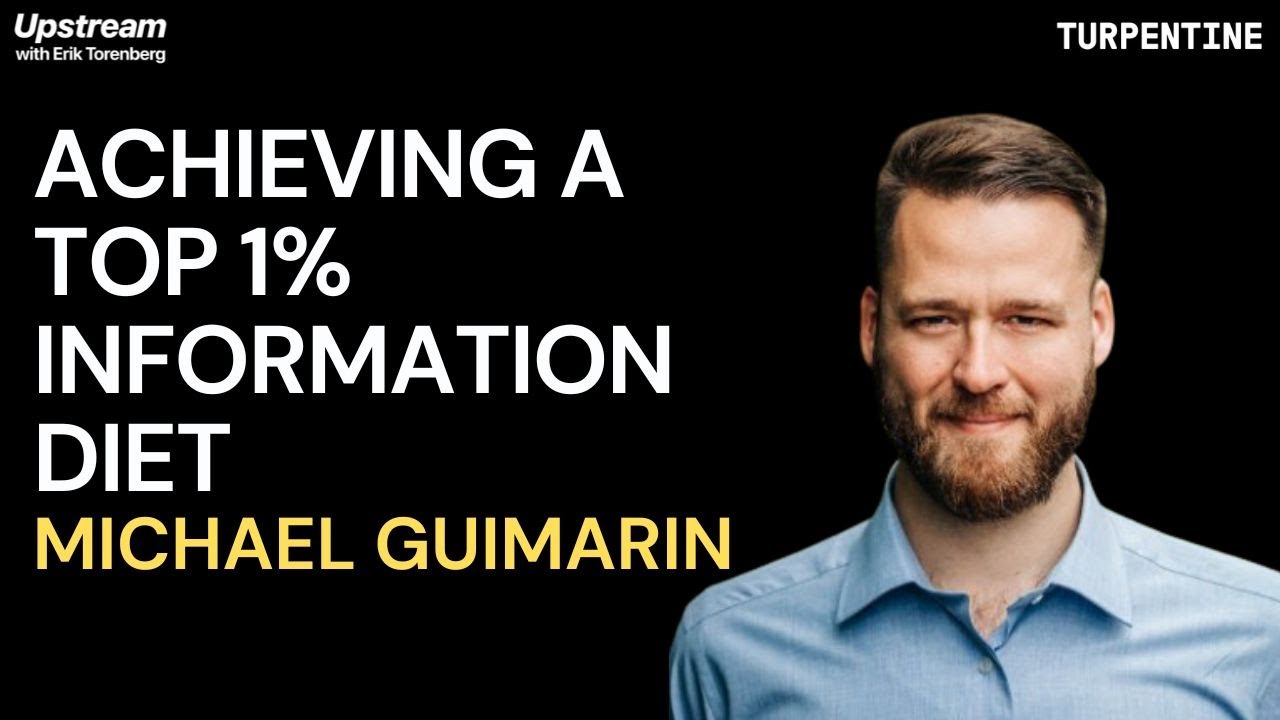
Michael Guimarin argues the real conflict isn't left vs. right but institutions vs. disaggregated networks, and that consensus is a myth. He introduces "information diets" as a way to curate inputs for better decisions, and explains how generational sense-making has shifted from Boomer consensus to Millennial resonance.
Chapters
I don't think consensus actually ever existed. I think it was BS. And I think that the internet has revealed that consensus-based power structures were really just ever hard power structures with the guise of consensus. And we can see that today by the way the institutions are reacting to the fact that they no longer have a monopoly on information. The position that I'll put forward is not a reformation position. Like, we're not going to reform the institutions. We need to exit them and we need to rebuild new institutions, which we'll talk about as possibly networks based around this idea of resonance. Human brains are not able to make orthogonal extrapolations. We're really good at doing linear extrapolations. We're less good at understanding what an S-curve is. In the late '90s, there was a technology to digitize music. You could suddenly rip that CD into a digital file, an MP3. All of the profit dollars that used to flow into music labels and producers and distributors, they started to flow into the iPod. How are you supposed to predict that digitizing music was going to lead to Uber? The big fight of the 21st century is not between the left and the right, capitalism and socialism, but between institutions and networks. And, and really it's institutionalists and netizens. So it's people who believe in institutions and people who believe in disaggregated networks.
Today's guest on Upstream is Michael Gomarin. He's worked in Silicon Valley his entire career in information technology and web systems, and now leads workshops to help people separate signal from noise in their information diets. In our discussion ahead, we cover the erosion of trust in institutions, how new ideas take hold over generations, and consensus versus resonance.
Michael, thanks so much for joining.
Thank you, Erik.
So, Michael, on your Twitter bio, it says that you help people have better information diets. Why don't you, by way of background, describe a little bit of the work that you do and how you've come to do it?
So this is not my day job. This is a side project. A number of years ago, some folks came to me and they said, you always seem to know sort of generally where things are going and have pretty good outcomes. Can I get a list of your sources? And I was like, that's not really how it works. And then that's kicked off this whole conversation on what does it mean to have good outcomes? Well, it means that you make good decisions, right? There's all this research about decision-making, and certainly I had done that. And at the end of the day, you realize that so much of good decision-making is actually just the inputs, the information that you put in. So if you think about like a somebody who's very successful in business, like a billionaire or whatever. Yes, they work really hard, but they're probably not like working harder than millions of other people in the world. And so then what's the difference in outcomes there? Well, it's the information, the access to opportunity that that person has, and then of course their willingness to take, take advantage of it. And so this whole idea of, okay, how can we structure our information diet so that we can have much better outcomes and we don't need to worry about have better decision-making. And that's sort of what this all got kicked off on.
That resonates a lot with me because I remember listening to a podcast episode with this guy, Michael Maier, on Invest Like the Best. And he talked about this idea or this belief that he didn't feel that he had a special algorithm for interpreting information. And so he needed to just get better access to information. And I felt like that on the recruiting side at companies. Or even investing. I don't feel like I have this special algorithm for evaluating people. It's just that I need to either see people that other people aren't seeing them or see people earlier in their development so I can build relationships or just be kind of the chosen partner. So, that philosophically resonates a lot with me. Why don't we go deeper into what is the problem with information diets, people's information diets today? And what are some of the tips and tricks or frameworks that you have For people to get more productive ones?
Yeah, this is a very complicated question. So I'm going to give sort of a very general overview of the problem. And then because you know your audience better than me, if you could ask more specific questions, I'll try to answer them. The way that I think about this space, which is generally called sensemaking, so understanding reality, I'm a millennial.
Okay.
And there's people in different generations who've come at this space. And so if you're here, you're listening to this, you're like, I really want to learn more about this. My recommendation is if you want sort of the boomer generation perspective, there's a gentleman called John Raab. He actually invented RSA. If you're a nerd, that's kind of amazing. That's the boomer guy. The Gen X guy, there's actually 2 of them. Jordan Hall, who invented video compression, and this guy Daniel Schmachtenberger. And then my approach to sensemaking, comes from more of a millennial perspective. So it's important when you hear how people are talking about this that you keep that in mind, because the structure of the information environment when we grew up determines how we interact with information. So, for example, because I was born in the '80s and I was born in Silicon Valley, I had access to a computer and the internet very early. So the primitives in my brain about how to understand the world of information are different from someone who was born, say, in 1955. And this is really important when thinking about the problem. So let's just jump right into it. The problem at a very high level is that the economics of information distribution have changed fundamentally. Prior to the internet, there was a cost to distributing information. And the simplest example would be, suppose that you wanted to tell everyone in the US something, how would you do that? Well, you would buy some printing presses, you would distribute them across the United States, you would print up whatever information it was that you wanted to tell them. And then you would get, for lack of a better term, paperboys and other distributors to distribute all of that, all of those pamphlets. if you will. And that had a cost. And because it had a cost, it limited the amount of information that you could send to somebody. And because as a person consuming information, you actually had to buy at some level that information. And certainly we organized local libraries to solve sort of the, I don't have enough money to buy all of the information that I could want problem. But at some level, you had to spend money, whether it was travel time or actual dollars to get that information. The internet changed that problem fundamentally, right? If the cost of information distribution went to zero, and so you now have access to all information. And if you are a little bit older, you'll remember that Google started off as a company that was saying, okay, for all of human history, there's been a gatekeeper for information, right? Whether it was the church, or whether it was the university, or whether it was the cost of books themselves. What we're going to do is we're going to organize the world's information and democratize access to that information, right? And if you're a sort of a cypherpunk in the '90s, people would talk about carrying around all of humanity on a Zip disk. Wikipedia was just starting a few years later. And so this idea that you could That you could hold or have every book ever written on a hard drive was this incredible thing, and we would democratize information. And what ended up happening was it was too much information, and it was so much information that it overwhelmed our ability to understand what was going on. And so then we were like, I don't know what to do. And sort of everyone collectively threw their hands up, and we find ourselves in a very interesting place. today. And the bulk of this side project for me in information theory and info diets is sort of like, how do you navigate the environment of infinite abundance when for all of human history prior to about 2 generations ago, it's been scarcity? And that's been a really interesting ride.
Fascinating overview. Thank you. How would you differentiate your approach from the Jordan Hall or Daniel Schmachtenberger approaches? Could put them in a slightly different category.
Yeah. So fundamentally, it comes down to the way that we feel like changing the world has to do with what we consider pristine. So if you were born before the internet, right, so BG, before Google, then you have this vision in your mind, like when you think about what pristine is of an institution.
Right?
And, you know, you could take something like the EPA, the Environmental Protection Agency. Okay, so there are issues related to the interaction between citizens, corporations, and the government with regards to the environment. So what we're going to do is we're going to form an institution, we're going to give it the mandate to understand and protect the environment, and then it's going to issue regulations, etc., to govern the access and use of the environment. And whether you're a citizen, a corporation, or a government, you at some level cede some of your authority to that institution. And then that institution itself operates via, you know, a standard institutional mechanism, right? So it collects information. There is a hierarchy in the institution on how that information is decided upon and analyzed, and then it's distributed to everyone in the entire ecosystem. It's kind of like Hey, the EPA says that we're not going to have more than this many parts per million in sewage water runoff in this area, right? And there's really no argumentation on that. And so in sensemaking, the fundamental organizing principle for institutions is consensus. And the way that you might come across consensus is when you vote. So voting is a, is a market-based consensus mechanism, right? Right? We come to consensus on who the leader is by voting for that person. And so even within the institution, they'll have committees and they'll vote on issues around inclusion or exclusion, and different stakeholders will have a vote. So you hear a lot about voting, voting, voting, voting, voting. This is about consensus. So anybody who's born before Google is really, really heavily like, okay, we're going to take our institutions, we're going to reform them if there's any kind of corruption or problem, and we're going to reestablish this pristine consensus. And I am an after-Google person, a millennial, and I don't believe that it's possible anymore for us to have consensus. I don't think consensus actually ever existed. I think it was BS. And I think that the internet has revealed that consensus-based power structures were really just ever hard power structures with the guise of consensus. And we can see that today by the way the institutions are reacting to the fact that they no longer have a monopoly on information. And so as a millennial, the position that I'll put forward is not a reformation position. Like, we're not going to reform the institutions. We need to exit them and we need to rebuild new institutions, which we'll talk about as possibly networks based around this idea of resonance. So it's the difference between I'm on a battleship with 1,000 soldiers and the captain decides which way the ship goes. That's consensus. Right? He takes in a bunch of information and makes decisions based on a common goal versus a school of fish with a million fish. So let's say it's the same amount of mass, and the fish don't communicate all amongst themselves to one fish that makes the decision. It just sort of emerges through resonance. Every fish has an understanding of both the global priority and its local context, and then it— and then they sort of make decisions on that. And so I believe that we're going to end up looking a lot more like a flock of birds or a school of fish. than a battleship.
And Jordan Hall and Schmachtenberger are still holding out for some form of possibility.
I don't know where Jordan and Schmachtenberger are because I've had conversations with them sort of through the internet, like not one-on-one, if you will. But for a while, Jordan was talking about Plan B, just sort of like this idea of reformation. And honestly, and John Robb talks about this too. John Robb is excellent if you want a context in fourth-generation warfare. His 2007 book Brave New War is amazing. They're like, okay, we're going to reestablish— we need new consensus, we need to like clean up all the, all this environment, environmental stuff, not, not EPA stuff, but environment like information and sociological environment. Um, and then we're going to, you know, be able to reestablish this, uh, kind of, um, institutional authority and legitimacy, uh, you know, that the US was, was founded on. And most of the, most of the countries that are uh, post-Westphalian nation-state, they all operate on this, um, this idea, right? And sort of what has happened, uh, over the intervening few years is that there's slowly become a realization that we're in, we're in a, we're in the midst of a major transition. A major, major, major transition, right? Like really big. Like people will talk about it in the history books. And the only analogy that we have is when the printing press was invented. And so, like, to give a very, very high-level framework about this, I forget who it was in the English system, but they talked about how there's sort of 3 branches of society. There's the king, which is the first estate. There's the aristocracy, which is the second estate. And then there's the common folk, which is the third estate. And what the printing press did was it allowed the aristocracy, the second estate, to overthrow the First Estate, which was the king and the church. And between the 1430s, when the Gutenberg Bibles were printed, and then 1520, when Martin Luther kicked off the Reformation, and the Treaty of Westphalia in the 1740s, there was a couple hundred years of constant war in Europe for basically reorganizing societies away from this sort of First Estate organizational system to more of like a second estate republic. And so you got these sort of parliaments and executive branches in the United States of America is sort of like the ultimate version of this with our 3 parts of government, et cetera, et cetera. And so the contention is that the internet is doing the exact same thing to the second estate that the Gutenberg press did to the first estate. And what do I mean by that? Well, You have to sort of look at the function of how the second estate was able to overthrow the first. What they did was they created what's called the fourth estate, which would be like journalists, right? And journalists, they would publish these papers and there was all this like information distribution and people could read. And so it was very easy for these ideas to spread. And with the internet, and this is what's crazy about it, Mark Zuckerberg was the one who suggested this, which I think is great. He basically said the internet has created a fifth estate. Where every person now is a journalist. And so we're in the process of the third estate overthrowing the second. And the second estate is not interested in being overthrown at all, which is why there was like a UN guy who just gave a speech literally in the last 24 hours saying, we governments of the world need to come together to fix the integrity of our information systems and They must be decided upon by, you know, austere religious scholars at the height of— I mean, it's just like you're like watching it and you're like, oh my God, this is crazy.
Hey, we'll continue our interview in a moment after a word from our sponsors. Looking to give your startup a competitive edge? Meet Mercury. Mercury is banking for ambitious companies, a modern partner that can provide you with the tools and resources you need to turn your startup into the best version of itself. Say goodbye to the friction that comes with traditional banking. Mercury moves at the speed of startups. From creating an account to wiring money, a few clicks is all it takes. Mercury isn't just a place to hold and send money. It's software built to help you scale with safety and stability when you need to, whether you're a team of 2 or a team of 1,000. And Mercury goes beyond banking to remove the roadblocks to success, providing you with the connections, network, and guidance necessary to make your ambitions real. As a startup and Mercury customer myself, I've loved how easy it has been to scale my company's finances with Mercury. Visit mercury.com to join more than 100,000 startups on Mercury, the powerful and intuitive way for ambitious companies to bank. That's mercury.com. Mercury is a financial technology company, not a bank. Banking services provided by Choice Financial Group and Evolve Bank and Trust, members FDIC.
Compliance doesn't have to be complicated. In fact, with Vanta, it can be super simple. Trusted by over 5,000 fast-growing companies like Chili Piper, Patch, Gusto, and Juniper, Vanta automates the pricey, time-consuming process of prepping for SOC 2, ISO 27001, HIPAA, and more. With Vanta, you can save up to 400 hours and 85% of cost. Vanta scales with your business, helping you successfully enter new markets, land bigger deals, and earn customer loyalty. And bonus: Upstream listeners get $1,000 off Vanta. Just go to vanta.com/upstream. That's vanta.com/upstream.
So is that where you see as the fundamental conflict or fundamental divide?
Yeah, yeah, basically between institutions and networks, right? And, and the way that really comes down to is, uh, individuals in the common, in the common folk, um, and then people in the aristocracy. And there will of course be some kind of, um, defection within the aristocracy, but we haven't seen it yet. That's why there's a— basically, it's a global elite, right? It's a global mono elite. It's not really like left versus right or country versus country anymore. It's really sort of like people with institutional power versus everybody else.
Is Elon an example of defection?
I don't know. It's really quite early. Elon is a very interesting individual because he grew up on the internet in the '90s. So he has these this very libertarian cypherpunk, you know, like power to the people sort of thing. And at the same time, he's been a general for 20 years in the great game. And so he, I think, has a perspective now that is very difficult for him to communicate just because it's kind of like Jeff Bezos also has this perspective. And you could say Bill Gates and Steve Jobs got to it earlier. So, these are all tech guys because that's where I'm from, technology. But of course, there's people in hedge funds, there's people in government, there's all kinds of people that all get this general perspective where basically when you achieve a certain level of status in our society by the function of the fact that you're wealthy, right? And so, it used to be you were an accredited investor was sort of the gate. You got access to much better information. And in a financial perspective, you call this deal flow. So all of a sudden, your deal flow got really good. One of the big contentions of people who were formerly poor who then became accredited investors is that just that movement across that line from being able to invest in public markets to private markets is worth 30% to 90%. So if you're an accredited investor, just the fact that you can invest in private companies before they go public, you can make significantly higher returns. Obviously, you can lose your money as well, but more easily. But actually, maybe not. And so that's why people are like, oh, we should reform that now. Right.
Makes sense. You're saying we're in the middle, we're undergoing this revolution. Paint a picture of how the world will be different on the other side of it, or just share what can we expect?
Yeah, it's pretty difficult. There's a bunch of cognitive singularities I have around trying to make predictions about the future. And that's mostly a function of human brains are not able to make orthogonal extrapolations. We're really good at doing linear extrapolations. We're less good at understanding what an S-curve is and really bad at doing orthogonal implications. And sort of what do I mean by this? Let me give you an example. In the late '90s, there was a technology to digitize music. So you went from a sort of analog CD, and it really was analog if you looked at the bits, if you will, basically like the phonograph miniaturized and used with a digital laser. You could suddenly rip that CD into a digital file, an MP3. And so then you got centralized MP3 distribution with Napster, and that was very chaotic because the limiting factor, if you will, in the music industry was on distribution. So if you were, you would say like, okay, I have $50 a month for music. And so you would go and buy 2 or 3 CDs from Tower Records or whatever it was. And then as soon as that music was centralized and digitally distributable, so it was free, now all of a sudden there was sort of like this 6-month period when Napster came out where it was like everybody stopped everything and just downloaded all the music that they'd ever want, right? Like university networks, corporate networks, everything was just music, music, music, music, music. And then the music industry basically like lost it. They went absolutely crazy. And, you know, this sort of culminated with this entity RIAA suing Grandma because her son, her grandson, you know, torrented 11 songs for like $1 million. This is like a crazy story, right? There's like 3 Metallica songs. And I'm sort of glossing over the fact that we made this transition fairly quickly due to copyright. From centralized to decentralized distribution. But that's not really important to the story. What's important to the story is all of the profit dollars that used to flow into music labels and producers and distributors like Tower Records, they started to flow into the iPod, right? Because you had all of this unlimited music and now you're like, well, shit, now I need a place to store it. And Apple was like, hey, yo, we have this hard drive that you can walk around with And they took all of those profit dollars and then they created the iPhone, right? And then so like, and then you think about like, how are you supposed to predict that digital digitizing music, you know, Sean Parker with Napster was going to lead to Uber? Totally crazy, right? Very. And that was only 10 years, 12 years, almost impossible to make those kind of predictions, right? So when I think about the future world, I think there's going to be a much bigger emphasis on the third estate. So if you look at all of human history, it's sort of like the poor, the commoners, they just sort of did whatever they were told and had pretty not great lives. And it's been getting better very significantly over the last couple of hundred years in the West, at least. I think it's going to get even better in terms of the experience that we'll have. Right. You may not be able to fly anywhere in the world very cheaply due to some this and that that governments will do, but you'll be able to have very good, high-quality VR experiences. Likely, if there isn't too much this and that with food, you'll be able to have very high-quality food. So, as a commoner, you're going to be seeing a lot more, a lot better. We're going to have a lot better position in the world, and certainly, it's going to be a lot more what you might think of as democratic right now. It will never be democratic. It was never democratic. Democracy doesn't work. It's the worst form of government. It never worked. Even the Athenians, only 4% of people voted. That's a whole other issue. It'll take us 2 or 3 generations to figure that out. But just to sort of give you a preview, if the institution is all about separating authority and responsibility, so you get this situation where you have— I like to, instead of calling on people specifically, I'll say like, you don't go to a dentist that doesn't have any teeth. Okay. Or like a fat doctor. It's like if you go to a fat doctor, you're like, I don't know if the advice is really good. It's like it could be good, but the experience of the doctor being like obese, you're like, I don't know if this is really good stuff, right? So authority and responsibility are unlinked by the institution. For network authority, authority and responsibility is linked. So anytime that you join a network, You're like, okay, who is authentic? Okay, and the measure of their authenticity is the degree to which they have the results that they that they claim that they have. And of course, there's like how do we verify results? Get that. Totally understand. There'll be technology for figuring that out. But in this future world, there will be a much closer link between authority and responsibility, and the institution won't be able to break it. Right today. Let's use a political one, but not in the way that maybe people think. So the IRS, if you're upset about the way that the government spends money or collects money, you really have no recourse whatsoever, right? You can leave the US or you can just sit down, right? Like, there's not— you don't get to really do anything there. And so there's an extreme asymmetry that's going on. In the future, the networks will allow for much closer symmetry in terms of power. And so you'll be able to, you know, talk to your local priest and say, hey, I really don't like the way, you know, we're spending our location's money. Let's fix that.
You know, I've always wondered why there isn't as much scrutiny on either local or federal, you know, budgets and, you know, allocations in the same way that there is kind of detailed analysis on public companies?
Yeah, well, I think it's by design. So there's a couple of things here that I think are sort of challenging. The first one is that there is an economic incentive for the market to push technology for the regulation of companies in terms of if a company is required to disclose, like, let's say, a 10-K or a 10-Q, whatever, whatever the numbers are, you can go to the EDGAR system on the SEC and sort of download them for free. You can learn about companies and they have to say, this is how much money we have and this is our business line. There's a market incentive to create technologies to distribute that information very quickly because people want to make money by investing in different stocks. Whereas with the government, there is no incentive for me to go outside and say like, hey, there's a pothole. Who is responsible for reporting the pothole? Who's bidding on this pothole? How do I start a company that bids on this pothole? And how much money did we spend to actually fix that pothole? Right? Like, in theory, what I described is the easiest thing in the world. It's like 3 database calls in theory, but in practice, why would the government do that? Right? And like, when you, when you sort of open your eyes, like, my favorite one that anyone can do is if you live in like kind of like a middle class or higher neighborhood, go outside. And you'll see like street signs, then they'll be like the standard no parking signs, but then they'll be like, uh, sort of like random to your location signs like the Olive Zone or Wine Trail or whatever, right? Who makes those signs? Where do they make them? Who's the government? How much money do those signs cost? You know, it's really good. I've looked it up. It's an amazing business.
Would you say your work is in the vein of, uh, of Sovereign Individual and Balaji in terms of the idea that there are time periods where technology favors centralization and decentralization, and we're entering a time period where whether it's encryption or other technologies, for some reason they favor decentralization? Or do you think it's more nuanced than that? Or where do you differ from some of these folks?
It's funny, Balaji and I got into it the other day. So The Sovereign Individual, 1997, was a really interesting book. And it was all about the logic of violence shifting from functionally the second estate to the third estate and what that looks like and how digitally defined currencies, which we call crypto assets today, by having self-custody, right? So let's say for a moment that Satoshi Nakamoto is a real person and they're currently in jail. It would be a problem for Bitcoin if access to those coins was permanently lost, right? Right now it's kind of a limbo because they're in jail. And this is a hypothetical, by the way. Satoshi is definitely not Paul Le Roux. So it would be a real problem if those coins were lost to the network, especially because the government, from a logic of violence perspective, is used to, you know, knocking on Goldman Sachs' door and being like, hey, this person's stealing money, give me all their money, right? So there isn't actual wealth destruction. But with cryptography on the internet, not crypto, but cryptography, which is sort of the original definition, it's now possible for me to store my wealth digitally with the password in my head that you cannot compel to get out of me, right? Because asking somebody for their password and then torturing them is not the way that torture works. So you actually cannot get assets out. And so there's a really big problem with crypto assets, which is the government doesn't have the ability to steal people's money. And that really shifts the logic of violence pretty significantly because now they're not really able to compel wealth or income taxes or all this kind of thing. And so when this sovereign individual came out, there were 2 authors, right? And so you have to ask yourself, what happens to those authors? Because they were looking into the future. On this, uh, you sort of institutional to network switch, um, one of them died and the other one went insane. And I think that straddling consensus and resonance in terms of a sensemaking perspective, I do believe it drives people insane. Um, it's something I've had to deal with as well because you're sort of like trying to understand the world through a resonant lens, uh, because that is very clearly where we are going. But most people are still operating from a consensus-based mindset. And so it's almost impossible to square those 2 concepts. And so when you look at different speakers in the environment, they all have to sort of take a backseat. So most of the people that are very sovereign individual focused, and I'm not going to name names, but you can think of who they are, they're actually withdrawn. So first of all, they're post-money. And second of all, they are not right in the thick of it because I think it actually makes you go crazy. I think it makes you go crazy.
Crazy because you can't straddle that line? You have to pick one or the other? Yeah.
I have not encountered somebody who's able to act from a resonant point of view. They can invest from a resonant point of view and they can opine from on high from a resonant point of view, but they're not really able to act from a resonant point of view in an environment that's still institutionally defined, right? They end up giving speeches to like the Oxford Union back and forth, and then they can't resolve some fundamental thing for 20 years. And these are very, very smart people, don't get me wrong, and they're very important for us to understand and look at. But I found it's very, very difficult to take what they're saying and put it into reality. Like, I've been a part of a number of organizations on the ground, so to speak, which you could say is sort of the evolution of Balaji's network state cloud communities idea. And, uh, because I wanted participatory information, and we can talk about that if we have time, which we do, about why that's important to go and get. But like, nobody really knows, and you have to actually go into the, you know, between the two armies and sort of fight it out, but you don't want to get shot.
Right?
Like, so it's, it's, um, it's very challenged.
Hey, we'll continue our interview in a moment after a word from our sponsors. If you're a startup founder or executive running a growing business, you know that as you scale, your systems break down and the cracks start to show. If this resonates with you, there are 3 numbers you need to know: 36,000, 25, and 1. 36,000— that's the number of businesses which have upgraded to NetSuite by Oracle. NetSuite is the number 1 cloud financial system. Streamline accounting, financial management, inventory, HR, and more. 25. NetSuite turns 25 this year. That's 25 years of helping businesses do more with less, close their books in days, not weeks, and drive down costs. One, because your business is one of a kind, so you get a customized solution for all your KPIs in one efficient system with one source of truth. Manage risk, get reliable forecasts, and improve margins. Everything you need, all in one place. Right now, download NetSuite's popular KPI checklist. Designed to give you consistently excellent performance, absolutely free. And netsuite.com/upstream, netsuite.com/upstream to get your own KPI checklist. netsuite.com/upstream.
I'm, I'm curious if you could share more about like examples of not even names of people who've made the shift, but more like what are the implications for when someone makes the, the full shift from consensus to resident? Like how do they approach the world differently or, or engage the world differently? that is seemingly different than they were in a consensus model or worldview?
Well, I think a lot of people get stuck in, in between gears when they shift because you can see how the institutions are corrupt, right? Like, all human structures are corrupt and they get corruption over time. And sort of the way that we deal with that corruption is either through reformation or exit. And exit is actually a form of reformation because What ends up happening is you create a new institution. The problem is, is that consensus itself is broken, and so you can't create a new institution. So both reformation and exit in the traditional sense are broken. And so these people, uh, we all get stuck in this like, well, what are we supposed to do, right? And there's literally tens of millions of people who are like, okay, this is what we're gonna do. We're gonna like remove all the pharma people from the CDC and the FDA. And then they're going to go back and continue to do what they're going to do. And we're kind of like, no, those organizations will actually— the shelling point has actually moved. And so the corruption will just come right back, and there's really no way to pull it out. And so what do you suppose? And you're like, oh, well, we'll create a new FDA, right? Or a new FBI. It's like, no, that's not going to happen. Like, it's going to do the exact same thing. And I think one of the things that may frustrate people about me specifically when I talk about this is that I'm talking about decades to centuries on the timeline. This is not like we're going to resolve these issues in the next 5 years. Like, if you're alive today, these issues will not resolve in your lifetime. And if you don't believe me, go read the Bible, specifically Numbers 14, okay? God banishes the Israelites. Doesn't even matter if you believe this story. People have been reading it thousands of years. God banishes the Israelites to wander in the desert for 40 years for a journey, Cairo to Jerusalem, that takes 5 days. Okay, why do we have a story about these people being banished for 40 years? The reason why is 40 years is 2 generations. Okay, and if you are born into slavery Anybody who's born into slavery is unable to escape slavery in their mind. They will recreate the conditions of their slavery, uh, if, if, if, if allowed to do so. And there is discussion about this throughout for the last 1,000 years. You can find commentaries from all over the world on this issue of it takes 2, 3 generations for concepts and ideas to go through. In science, they have sort of like an observation that science moves with the death of each new person. Okay. It's just, this is not gonna— this is not something that's gonna resolve. So then the question is like, what are we supposed to do while we're waiting for everyone to die functionally?
Right.
And then you have all these people that are trying to become immortal, which would be a disaster. And so you don't really— you're like, oh, what am I supposed to do? Right. Like, in the meantime, I have this resonant perspective and I understand where we're going to get to, but we still have to act in a world where there's going to be generations of people who are like, no, no, we need to— you can't abandon the FDA. We need them. Right. And that's a stand-in for every institution that exists. And they go, okay, okay, you want to abandon the FDA? What are you going to replace it with? And there's no good answer to that. Right. And people are like, well, we need to create decentralized communities that allow stakeholders based on token voting. I mean, go like Go like watch the Ethereum conversations and the level of technical discourse on them is so high that less than 0.2% of the population is able to understand it at any level, not even like at a technical level, at any level at all. And you're like, okay, this, this, you know, new structure is going to govern everybody? I don't think so.
So that's why it's chaos. So I'm tempted to ask, like, so what is going to happen? What is the answer? And, and I guess you just say, I don't know, I'm just presenting the different—
The answer is that we want to try and live according to the principles that humans have always tried to live for and to teach those principles to our children while trying to make small incremental changes in the right direction, understanding that this is not— I mean, like, there's a guy, Jan Hus. Are you familiar with him?
Uh, no, I'm not.
Okay, so you know how Martin Luther wrote his, like, problems with the Catholic Church and it kicked off the So there was a guy, Jan Hus, who wrote the same thing 100 years earlier, and nobody read it and nothing happened. And the reason why nothing happened is because the Gutenberg press hadn't created enough literacy in the population, so they weren't ready, right? The message was there, but the people receiving the message weren't ready for it. So we have tons of people today, right? Like there's the— what was it? Gibson. Okay. The future is all around us. It's just not evenly distributed. All right, it's already here. It's the same thing with this, right? So we have a sense of what these things are going to look like, but the populace is not ready, right? They're not ready to give up on some of these institutions. And so we're going to be oppressed heavily by them. As you can see with the whole carbon, whatever, everyone gets 2 tons per year and it costs 500 kilograms of carbon to fly from New York to I was going to ask where you differ from Balaji and you perhaps dropped a clue where in your sort of critique of the longevity movement.
Balaji is fundamentally a transhumanist or optimalist as you might like to say and believes the only way out is through.
I agree with that 100%. Balaji and I are like the 2 people who, and by the way, there's a huge asymmetry there, right? He's post-money in Singapore. I'm on the ground in Silicon Valley. There's a huge difference between us and I really respect what Balaji is doing and I wish that I could be a Balaji, but we're the 2 people that argue that are right next to each other on the distribution, not opposite ends of the distribution.
And so, why do you think it's a disaster if longevity thing works given that that's his central goal, right?
Yeah. Well, so I don't believe that people fundamentally change their mind. There's tons of evidence for that. they don't change their mind, right? So if you get them to do something like kneel, then they're gonna— they're like, I'm the kind of person who's a good person, therefore anything that I do is a good thing to do. And so if you want to manipulate people, you make them do things that force them to not go back, right? And it's a— there's sort of like a— there's really this weird, uh, fractal power law. It's called— I, I look at it like, um, 90% of people are consumers, 9% of people are contributors, and 1% of people are creators. And then if you zoom in on any area, you see 90% consumers, 9% contributors, and 1% creators. And if you think about this from like an adopting new ideas perspective, 90% of people are going to take whatever programming they get before they turn 15, and they're going to run with that for the rest of their lives. And absent they have like a child or an act of God or whatever, they're not going to update any of those priors. So we see people spontaneously Uh, redpilling on all these topics, but they tend to be contributors. So they tend to be men who are like, what the heck is going on? Like, I'm getting screwed. Like, I need to figure out what's happening, right? So they tend to be contributors or creators, which again is only 10% of people. And if you've ever sold courses on the internet, you know that all these people buy courses and then never finish them or take any action. It's like crazy that only like 1% of people read the course or do anything about it. And so you're like, well, why didn't they buy it in the first place? Because they're a consumer. So what are they consuming exactly? They're consuming the belief that they can change, but they don't actually change. It's like people ask you for advice. They're like, hey Michael, can you tell me, you know, I'm doing this thing and it's not working. Can you tell me some advice on what I should do better? What they want you to tell 'em is that the thing that they're doing is gonna work and they don't need to change. That's what they want you to tell 'em. They don't want you to actually tell them how to solve whatever their problem is. 90% of people. That's why we say it's not going to change. It's like, and so this idea that we're going to create immortal people, like, oh my God, that's terrible. Because just because you're rich doesn't mean that you're part of that 1% of people that change their minds.
You've explored the course space. Was it around the information diet?
Oh yeah, yeah. So what happened was I put out a position— I've always done position papers, but I've kept them really to the chest. Because everyone's like, oh, you're just freaking crazy, right? And then my chiropractor, he finally figured it out. He's like, he's like, no, you're just like 8 years ahead of the market. I was like, yes, correct. And I don't understand why or what it is. And so I say like really crazy things, um, and then they come true. And it's really difficult, right? You feel like Cassandra because you're always talking about this stuff. And so during the coronavirus pandemic, at the beginning, I sort of did a tongue-in-cheek, you know, this is what it's going to look like for the next 6 weeks, and then published it. I like 100% hit it, except for I said Jeffrey Epstein was going to come back from the dead, was sort of like my last sign-off. It's like, the virus will totally disappear, no one will understand why, and Jeffrey Epstein will come back, right? And we— I called like, this is when the US is going to shut down the schools, this is when the market will, you know, bottom out, like just the whole thing, right? And there were a bunch of people who somehow got that on Wall Street and they made like a lot of money. And so some of the people that had received that, and maybe like 1,000 people saw it, not more than that, right? And it's kind of embarrassing to release now because I had some assumptions in there that were catastrophically— I mean, they ended up being right, but for the wrong reasons, which is like the worst place to be from a finance. So like people who are not finance people, basically, You want to focus on your process, and a good process will lead to a good outcome. Just because you have a good outcome does not mean that you like. So I don't. I had a good outcome with the document, but it was like the wrong process. But I learned, so I updated it. Anyway, a bunch of people asked me, like, "Can you teach us how to do this? How to create these minority reports?" And so I had to create a course to do that, and it was a lot of fun. But it was making me crazy because. I was having to help people straddle, right? Like pull people across that institutional to network divide, right? So the big fight of the 21st century is not between the left and the right, capitalism and socialism, but between institutions and networks. And really it's institutionalists and netizens. So it's people who believe in institutions and people who believe in disaggregated networks.
It feels like your idea is hitting more of a mainstream. So, in your course, you teach basically what you've been talking about for the last 45 minutes or so.
Yeah.
And then, what to do about it, right? And I try to trigger people so they don't take the course. So, there were a lot of people like, oh, yeah, I want to do this. And I'm like, I'm going to say crazy stuff that's true that you're not going to like and then you're not going to want to take the course. And so then, they didn't. And I would say things like, this course is going to be really hard. for you, not for me. And because I did not want to teach people the course because it's like a horrible way to see the world, right? Because you can't really do anything except explain like, no, that's not going to work. But then like people get really upset, right? And it's very difficult when, especially during coronavirus, when they would not listen to any kind of rationale. And it was kind of like a civil Right? I could talk about how this information diet, information environment is a total war. And in many ways it is. And it's a total war because you don't know the difference between a civilian and a combatant on any topic. And you just mentioned Trump. I lived in San Francisco. People would like melt down and reboot like their brain. You could have any conversation and be like, blah, blah, blah, isn't it great? We're gonna go to the bakery. And, um, you know, it just, it just Trump, man. What can you say, right? Like, kafifi, right? And then they would just stop right there, and you couldn't— they couldn't do anything. And it's the same— QAnon was the same thing on the right. So this wasn't like a left-right specific phenomenon where this was happening, um, but it's very difficult to explain to people, like, okay, this is why this is happening. This is what entrainment is. You have to be careful about the media you consume because, you know, all these people at Facebook and Google and all these companies are paid millions of dollars to figure out how to get you addicted. on these dopamine loops. And then, you have this entire counter movement of dopamine fasting. So, you have all these founders who are like, okay, we're not going to give our kids the iPads and we're going to dopamine fast ourselves and not use any of the technology that's enriching us beyond belief. And then, you have the sort of the spiritual disconnection of that. So, you're trying to explain to people how amazing the world is and we should connect everything together and then you get Klaus Schwab clowns that come up and they're like, okay, what we're gonna do is we're gonna oppress everyone. And then they use the language of progressivism to oppress people. And so you get— so you basically, then you look at— just look at pictures of Jack Dorsey. So, you know, like, um, like presidents, they go in and they like look young, and then they go out and they look like they've aged 1,000 years. Jack Dorsey looks like he went in as like a normal guy, like in the early 2000s, and now he looks like he's like a hermit. you know, at a Buddhist temple on the mountain. And he like, and I just, because it's a spiritual journey, right?
Yeah.
It's just like, you can't, you know, unsee this. And then I'll give sort of one last nugget for people to chew on. We've been afraid significantly for artificial intelligence for a long time, right? And the way that I measure that is you look at our media, right? Our movies, our television shows, people are afraid of Terminators, okay? And they believe that Rosie from The Jetsons is the form that artificial intelligence will take, right? And they don't understand it's like a washing machine, okay? That was fundamentally the thing that happened because we, again, we don't have the ability to make predictions about the future. And if you look at the science fiction from the last 20 years, it's all very focused on, and some of the good ones are, of course, Of course, Ex Machina. There's the show Devs on Amazon, which is a sleeper that people should watch, and then Altered Carbon and stuff. If you look at the science fiction, everybody predicted that AGI would come out of some DARPA program. That's what Skynet is. Or it would be like Google search that you put into a brain, right? Like some combination of Google search and Facebook, which is what the Ex Machina AI comes from. And everybody sort of missed that Twitter is an artificial general intelligence, and they missed that as an AGI, it woke up in 2014, 2015. And then there was a bunch of people that realized that it was, and then they moved really quickly to sort of censor it and clamp it down. And I find that whole— and I'm not saying that you should believe because I said it that it's an AGI, but you should just think about— like what an AGI is and whether or not it is. And I think this also gets to sort of the fractal nature of our reality, which is that sometimes people at a level above you are making moves that seem very contraindicated. And then sort of as you come into awareness of what actually the game is, then you sort of become more understanding of what's happening. And this itself is a problem in the metagame because you'll have a situation where— and Donald Trump was very good at this— where he would have a conversation with one person by tweeting it. So everyone in the world was in the room, but they were unable to do anything about the information that they had, which is a very disempowering feeling, and it basically drives people insane. And that is something that we're seeing in our information environment as well. You're seeing influence operations For a very small number of people that are happening on the internet that are affecting tens of millions, and they don't really understand what is happening or why. And so it's very chaotic.
Zooming out, one question I wonder in terms of the institutional conversation is whether we concede too easily reform. Elon and Twitter is still very early, but Twitter seems like a very different organization under Elon than before. Now, it's too early to say if that's like a success case or anything that could be modeled out.
From an outcomes perspective, the algorithm has gotten worse.
Got it. But from a speech perspective or kind of intellectual diversity perspective, would you say it's gotten better?
Yeah, I mean, I think people are able to say things, but information is not able to travel as quickly. So I'll give an example. Donald Trump appears to have made a deal with the Russians to leave Syria, um, and in exchange for that deal to leave— actually, it's the opposite. He made a deal to like get Soleimani, right? And the Russians asked him to leave Syria. So the US sort of exited Syria, uh, during his administration. And as part of that, the, uh, Russians asked that their assets in the Iranian government who gave up Soleimani be allowed to like defect to the West. Okay. And then the Iranians shot down the plane that those 2 guys were on, which was like, you know, they shot down an airliner and that whole story doesn't make any sense. Twitter was able to surface the identity of those 2 people within 48 hours of that event happening. And when the coronavirus situation happened, we were able to come to an understanding that it was a bioweapon engineered by the United States. States and others throughout the world by like the end of January 2020, right? Like there was no— there's literally nothing that has happened since that's new. But there was so much, you know, haystack and not enough needles that it was very difficult to get it out there. But the stories were there. And so if you knew how to like surf the internet, you could get to those stories very quickly. Twitter has degraded significantly since 2020 in terms of, and this is because, you know, a bunch of influence operators have understood that. I mean, like, it's absurd that like some guy in Silicon Valley could be like, yep, those are the 2 guys that gave up Solomani and they were defecting and then they shot down the plane. And all these people are like, no, no, no, that's not what happened. It was a mistake. You know, 15 planes took off first and then they accidentally shot down the one with the 2 Inspectors on it. I mean, but that didn't actually, you know, like, it's just, it's not a thing, right? And that whole story about how the Pentagon blew up the family in Afghanistan and then said, no, no, those were terrorists and there was a different whatever, and then they like showed pictures and it just didn't work. Or the balloon story. So this might go out in a few months, but there was a balloon from the Chinese that flew over U.S. airspace and everybody looked really bad because they didn't shoot it down immediately. And so then the government was like, oh, but there were a lot of balloons that went over the— during the Trump administration. administration, and all the Trump administration, you know, defense officials were like, well, we were never, you know, briefed on them. Where were they, right? It's just like these blatant institutional lies, like, don't— they just don't work. And fundamentally, the reason why institutions don't work is because consensus leverages the violence of excommunication. Okay, so when you describe reality, reality is really messy. There's a lot of contradictory facts. In reality, in order to create consensus, you have to censor contradictory information that is true. When you read a newspaper article about a sports game, there is a censoring of the things that happened in that game so that it can fit in the article. And the whole point of the Gell-Mann amnesia effect is that you recognize for things that you understand that the journalist or whoever has done the generalizing of the story sometimes confuses cause and effect because they've generalized it so much. They've taken out so much nuance that they've done that. And so we believed that consensus was everybody was voting, uh, but really what it was is sort of like people would just agree with whoever had the most power. But it wasn't clear that that was the case until we got the internet, because we had to see all the minority reports, all of the things that are true and contradictory that can no longer be censored. I mean, for God's sakes, the American Medical Association recommends rice to diabetics.
Okay?
The American Medical Association and the Diabetic Association, they recommended white rice on their website for people with type 2 diabetes. You can't say, oh, it's like, that is like, that is so messed up. That is so messed up. Like, we, we gotta help these people. We gotta give them good, accurate information. The lipid hypothesis has been disproved for like 50 years and we're still talking about it. The VA forces my dad to take statins. They don't work. There's no evidence that they work. Like, it's just crazy. It's actually nuts, like, to live in an environment where like, yeah, these things are not true. And then people are like, oh well, we can reform them. It's like, no, we can't reform them because in order to reform the institutions, we have to give them back a monopoly on information. And the internet exists. So the only way that we get back to the situation that we had before is to eliminate the internet. And I don't believe that it's possible to eliminate the internet at this point, but I do believe people will try for sure.
Just to close the loop, even if, let's say, people that you felt were aligned, people like yourself, people like Balaji, other competent people who see reality clearly and know how to act, even if they were running some of our institution-making, you know, sense-making institutions, It's the structure of the institution itself that can't work?
I want to believe that I would be this great Cincinnatus leader and it's like, okay, Michael, we're going to make you dictator of California. Go fix all the problems. You want to believe that you can do that, but I just don't believe that that's true. I think humanity is so messy. Just think about it back to the school of fish analogy. You have 2 million fish. They're swimming next to the whatever, the coral reef, and there's a shark that's coming to eat them. If we make decisions via consensus, you'd have to distribute votes to all those people. You'd have to collect all the votes. They'd have to go back to the one fish that's a kilometer away from where the shark is, and then it would have to determine what needs to happen for all the fish that are around the shark. They would have to, like, you know, make the hole so the shark can't eat anybody. All right. And that process just is too long. The Fed is too— it's fundamentally broken because it's a stepped process instead of a continuous process. Like, if we were to rebuild our institutions with computer principles, right? So, so right now everything is built on top of literacy and numeracy. And if we add computeracy, where there's some fundamental differences, right? So the difference between sort of the linear relationship of inputs and outputs, which is what— how you would describe sort of a traditional government system and an exponential relationship, which is what you get with software. Best example is there are 100 people in line at the DMV. We have 10 tellers. Okay, I want to cut the line in half. I now add 10 more tellers, so I have 20 tellers. Okay, and there's some overhead for management, so you need 11, 11 more people instead of 10 more people. A software person comes in and writes everything that those 10 people in the DMV do, deploys the software, and now there's no line. Because everybody is able to use it at the same time. And so how do you compare those 2 systems? How do you develop a government from first principles using computeracy, right? Like principles of software development, right? So for example, uh, the, the length of time for search for any piece of information in a, in a, in a linear sort of paper-defined world is relevant to how much effort you expend. Okay, so if you want to learn something really specific, eventually you have to go to the Library of Congress. Whereas on the internet, I can just type it in and it doesn't matter whether I'm asking about water or about the most specific thing on the internet, I'll get the answer in the exact same amount of time. It's fun, this idea of like, and databases and this idea of like the cost of re-digitizing something goes down very quickly. So anything that becomes digitally determined as a process becomes worth almost instantly. And so like the entire idea of software development moves from, we have a list of requirements to, we're actually a coverage area that's a vector moving through space. These concepts are very fundamentally at odds with the way that institutions function today, right? And there have been suggestions that we're going to reform the Fed, we're going to make the algorithm that they use to set interest rates understandable and knowable. But is that really going to work in an adversarial environment? This is not like we're going to get a bunch of really smart technocrats together. And as much as I want it to be, right, that's not going to be the thing that happens because they're not going to come up with a system that is able to be dynamic enough. I mean, look at Gen 1 hedge funds, like quantitative hedge funds, right? I went to school at Princeton. We had the Bentheim Center for Finance. So they took people in applied physics who were taking models and fluid dynamics and all of this stuff, very fancy PhDs, and they're like, hey, the market looks like these fluid dynamic models, let's apply the same algorithms to it. Those people are like, great. And so they make a little bit of money, and then all of a sudden everything blew up. And why did it blow up? It's because the fluid dynamic model, so water flowing through a pipe, does not encounter an adversarial system, whereas the market is an adversarial system. Anybody can watch the moves that you're making and try to predict the moves that you're going to make. And if you're not able to update your priors— and these were really smart people, PhDs in physics— they were not able to update their priors about the effectiveness of their models in an adversarial environment. They got blown out of the water. So I don't believe reformation is possible.
Sorry. That's helpful to put a bow on that. Gearing towards closing here, I'm curious what you would advise someone like me if I went through your course or your coaching. And let's just say me as a hypothetical, I think I'm already in the top 1% of information diet. I'm not super tribal, I'm relatively sober and detached. I have access to people and information and resources. And I guess my goals are to see reality more clearly, advance in my career, have richer relationships in personal life. And I'm interested in dedicating time and resources to kind of going from the top 1% to the top 0.001%. And I imagine you talk to folks in that archetype as well.
That's like my bread and butter, right? And I always talk about this. It's like the difference between being 90th percentile at something and 99th percentile is the difference between flying economy and flying private. And everybody wants to be 99th percentile. But the problem is what got you here won't get you Right? So what I explain to people is that they take my course and they're like, we thought you were going to teach us how to read the New York Times. That was not what your course taught at all. What I end up teaching people is how to read themselves. In a world of abundance, the superpower is being able to cut things out, is being able to create slack. In a world where people are entrained by the media that they watch, Right? CNN, negative story, negative story, negative story, positive story, commercial break, over and over and over and over again, forever and ever. In that world, being able to have emotional mastery is the thing, right? And so like, I literally have a module— 1/12 of my course is about how to manage emotional triggering, right? I ask guys, because it's all guys, they have to go in their life and they have to go deal with their issues with their dad and their mom. And we talk about archetypically what is it that mothers do, archetypically what is it fathers do, and how are these patterns of behavior that you've learned as a kid— how are we going to remove them so that when the great opportunity walks through your door— everybody gets gazillion opportunities. We are not wanting for opportunity. This is not my grandmother's grandmother's information environment. We're not worried that the guy coming through town is going to be the only thing to talk about for the next 2 weeks. Okay, we get hundreds of opportunities in our domains all the time. The question is, which opportunities do we focus on, and how do we have the focus and the energy to actually hit those opportunities? Well, all of that is internal work. So that's, that's, that's if you want to take the next level, Eric, that's what you're gonna have to do. You have to do the internal work. I'm gonna tell you dumb things, you know, things that'll be like weird, like, you know, when was the last time that you went to church or talked to your faith advisor or whatever. Are you, are you developing yourself spiritually? Why would you develop yourself spiritually? Why would you read Musashi's The Book of Five Rings, right? Like, what— let's, let's talk about some of that, uh, some of those things that are in your mind as being a human being that you maybe have never encountered before. Why is it that some people, when they get cut off in traffic, respond Differently than others. When you get emotionally triggered, you're going to go through a de-escalation loop, right? Like, your body goes into flight-or-flight response. It has to do something in order to get out of that response. Some people go lift weights, other people go for a walk, other people beat their wives and children. They have alcohol, they do drugs, they do all these dissociation things. Those are all de-escalation loops. They're not addicted to drugs. They're addicted to the feeling of not having to deal with their problems, right? So if you want to have really top-tier outcomes and you didn't inherit a billion dollars and you didn't marry a billion dollars, like, you have to go and deal with all that stuff. And I find that most people don't want to deal with that stuff because, like I said earlier, they just want you to tell them, just keep doing what you're doing, you're going to break through. And if you are willing to deal with that stuff, you should follow me on Twitter. You should read whatever Erik's doing next because it's very rare that you get people who are like, all right, we see all of these problems and we're going to run right into them.
It's fascinating. I could break it down at a high level of there are the inputs themselves in terms of the information that you ingest. There's how you interpret that information. And then maybe there's also even the selection process of how you think about where you're drawn to. What type of information that you are attracted to and maybe there's some influence on all 3 of those. I'm curious on the inputs themselves. What's an example of you work with someone like me, goes through the course or spends time with you and what changes? Is it less news, more group chats with really smart people or what are some examples of—
The problem is it depends on what your goals are. So, the first place that we start when I do coaching is we talk about What is it that you're trying to achieve? What is your mission in life? And we have a really deep conversation about that because if you don't know where you want to go, it's very difficult to get there, right? And so like after that, it's kind of the analogy with food is when you go to a buffet and you have no goal and you end up getting a little bit of everything, okay? And that's kind of how people tell you to consume information today. They're like, I'll get a little bit over here, a little bit over there, a little bit over there. Except that if you're a marathon runner and you go to a buffet, you eat certain things. If you're a powerlifter, you eat certain things. If you're a football player, you eat a set of certain things. You have to treat the information environment like that, right? So you need to decide, am I a powerlifter? Am I a football player? Do I just want to be able to play with my grandkids when I'm 80 years old? Right? Like, these are different levels of fitness and are going to require a different level of exercise and diet. And it's the same thing with the information environment. Like, people look at curators on the internet who seem to always be ahead of things, and they're like, man, I want to be like that guy. And it's like, really? Do you really want to be like that guy? I don't think so. What I think you want is you want the ability to quiet your mind and then focus on those things that are really important to you. I get a lot of QAnon people who are very wealthy. Hey, they come to me, they find me, they're like, hey, you've helped a lot of people get out of these Conspiracy rat holes, and the first thing I tell them is like: Why do you care? You live in Wisconsin. Why do you care about the Pennsylvania political system? It affects your life not at all. Just cut that stuff out. Okay, like I get it. It's exciting. It's dopamine hit. We all like to watch the Kardashian clips from now from time to time, but like that's like eating a diet of only donuts. You don't have to be a rocket scientist to realize that if you only eat donuts, you're going to get.
My goal is more along the lines of, Tyler Cowen calls it the information trillionaire. But you look at someone like Balaji or Tyler Cowen or Marc Andreessen and you're like, wow, these are really well-read, well-learned people. And then I'll ask, Tyler's more straightforward. I'll ask him how he becomes him and he says, oh, you just write and read all day for 40 years or whatever.
Literally like Warren Buffett's the same way, right? Nobody knows his secret power is reading all the financial statements and that he actually went to Standard& Poor's and got the financial statements in person before everybody. I mean, that's like crazy. And then a lot of these things, like, uh, you could say this, you know, venture investing— so not to talk specifically about Balaji or Andreessen because I respect them enormously, but venture investing is in a lot of ways one of the only places in investing where past performance is an indication of future success. And why is that? It's Because if you're the head of Andreessen Horowitz, your deal flow is better because you're the head of Andreessen Horowitz. It's kind of like Harvard students win because Harvard students win. So you're like, well, how do I win? It's like, well, you go to Harvard.
Yeah, it's a bit reflexive in that sense. But even putting aside the venture wins, both of them and Thiel also just understand a lot about their technology or Philosophy or history or economics. It's an interesting question of if one wants to be that smart in 10 years, that's a specific goal, you're willing to do whatever it takes, what is the equivalent of Scales? What does the training look like for that? And by goal, I don't mean venture success, I mean just knowledge acquisition.
Yeah, the training is the same, I think, for all of them, which is that people read a lot and then what they do is they create a feedback loop where they make predictions and then see how those predictions are. I have like hundreds of these journals, okay, where I just like write down all of this stuff all the time, what I'm reading. Like, that's the way that I do it, right, to try and get feedback on. Because the thing I think one of the, one of the problems is our tolerance for making mistakes needs to go down, right? Or sorry, we need to Sorry, we need to tolerate making more mistakes. So like in the 1950s version of the world, maybe you want it to be 95, 98% accurate before you took action. The number today, if I was to give it a number, would be like 70%, which means that you're going to be making 10 times more mistakes than you would've made 50 years ago. So you need to be making 10 times more decisions, period. So if you can put yourself into a position Where you're making a lot of decisions and those decisions have impact on the outcomes that you're looking to get, then you're going to learn a lot faster, which is a fancy way of saying just do stuff.
Arnold Kling had a blog post recently where he said books aren't super information dense. Let's say, for example, you have the ability to talk to every author who's written the books. Do you read the books or do you talk to the author who wrote the book who's like a neural net of what's important about the book and also can talk about what he didn't in and how his thinking has evolved. I'm curious how you think about reading books versus reading the people who wrote the books or who know.
It's a fractal thing. It depends on where you are. So, books are not helpful until you have an understanding of what the rules are. So, there's sort of 3 levels: novice, intermediate, expert. Novices need to understand the heuristics. There's 5 to 7 of them that define 80% of the outcomes in the environment. Intermediates are asking when and how the rules of the novice are violated, right? So that's why they always say, like, you say that someone will make a generalization, there'll be some like random guy who shows up and is like, actually, this is not true here, right? That's intermediate thinking. And you need to do that because that's where all innovation happens, because you'll discover arbitrages. And then experts will go back and talk about why are the rules of the novice the way that they are, right? So you can make a rule like Men are taller than women. When is it violated? Okay, we could talk about that. But then, like, why is it— is sort of a completely different, uh, conversation to the fact that men and women— men are taller than women. So if you're designing things, just knowing the rule is sufficient. But if you're studying human biology and the history of our species and how men and women interact, then understanding why men are taller than women is actually really important. So you need to understand what it is that you're doing and then ask yourself, Is it good enough that I just know the rules in this space, or do I also need to know when the rules are violated, or do I also need to know why the rules are there and understand that to go up each level costs 10 to 100x the amount of investment? So if you start thinking about things in terms of, am I a novice on this topic or not? Okay, this person's an expert, they're communicating to me. At some point as a man, you also understand that you need a mentor. It's all throughout history. It's apprenticeships. Women too, right? There's no human experience where you get to be top level where you don't have a mentor. And at the same time, you'll have people like Wayne Gretzky or Michael Jordan, to use sports figures, who are terrible coaches.
This is a fascinating conversation. We're nearing its end, so I want to be mindful of your time.
Michael, thanks so much for coming on and giving an overview of some of the Yeah, and I want to say to people out there listening who may have been triggered by some of the things I said, guarantee you a huge percentage of it was wrong, and that's okay. We try to adopt fallibilism, which is this idea that we want to try and be less wrong over time. And the only way we do, we do that is by having conversations like I had with Erik, by getting out there, by getting people yelling and screaming at me on the internet that I'm full of shit. So I really appreciate you, Erik, for giving me this opportunity to interact with your audience. Everybody who's listening or watching this, feel free to reach out to me and say, hey, I agree with this, but mostly everything else you said was BS. We're totally going to be able to reform institutions. I'd love that like nothing else because I want to be less wrong over time.
That's a great note to end on. Definitely check out Michael on Twitter. We'll link to it in the show notes. And Michael, thank you for coming on.
Thanks, Erik.
Upstream with Erik Torenberg is a show from Turpentine, the podcast network behind Moment of Zen and Cognitive Revolution. If you liked the episode, please leave a review in the Apple Store. Turpentine is a network of podcasts, newsletters, and more covering tech, business, and culture, all from the perspective of industry insiders and experts. We're the network behind the show you're listening to right now. At Turpentine, we're building the first media outlet for tech people by tech people. We have a slate of hit shows across a range of topics and industries, from AI with Cognitive Revolution to Econ 102 with Noah Smith. Our other shows drive the conversation in tech with the most interesting thinkers, founders, and investors like Moment of Zen and my show Upstream. We're looking for industry-leading hosts and shows along with sponsors. If you think that might be you or your company, email me at erik@turpentine.co. That's erik@turpentine.co.
More from Erik





Palantir CEO Alex Karp & Rep. Ritchie Torres on Innovation & The West | Hill and Valley Forum 2024


