The dominant paradigm of the 21st Century, Explained with Jon Askonas
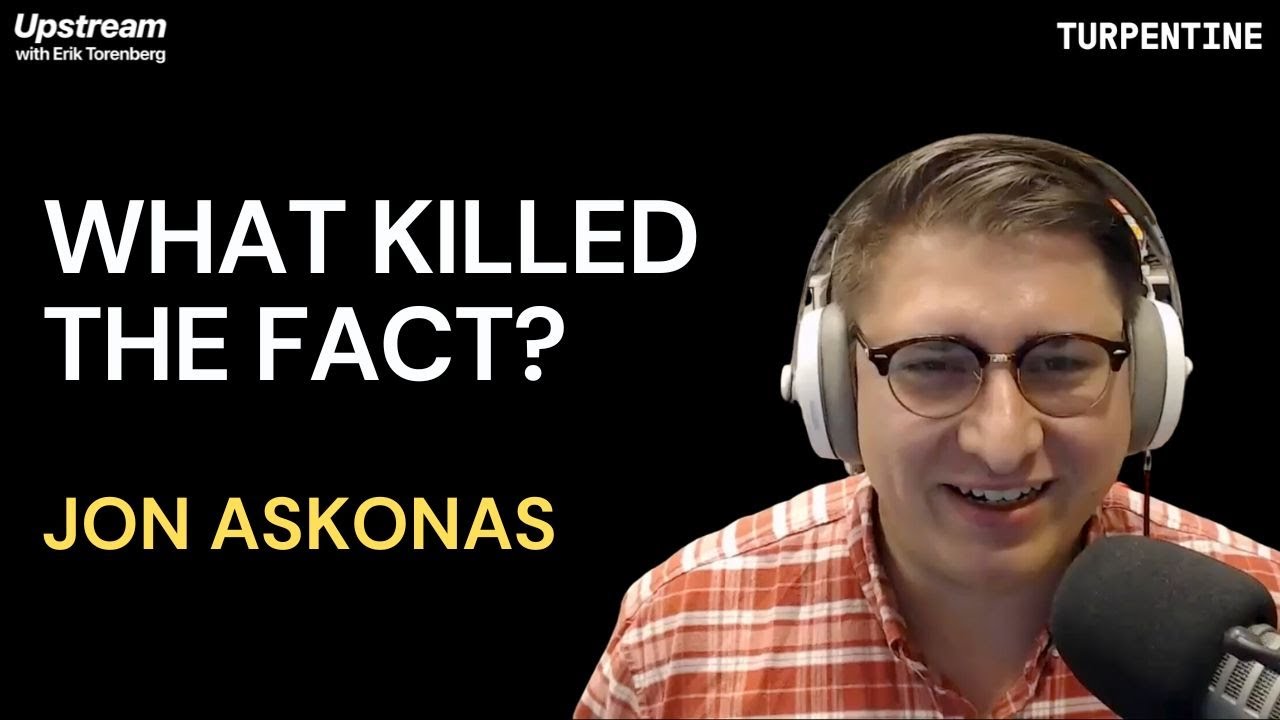
This content was created by Erik Torenberg. This content was uploaded by Erik Torenberg. This is a YouTube interview titled "The dominant paradigm of the 21st Century, Explained with Jon Askonas" (published 2023-09-15). It is an episode of Erik Torenberg's Upstream in which Erik Torenberg (host) interviews John Askonas (assistant professor of politics and writer). The conversation covers the end of consensus reality and how search, abundant facts, and the internet/social media changed truth and public discourse; the geopolitical implications of planet-scale networks (US/China cores); second-order cultural and political effects of AI (including religion/idolatry, identity, and automation); and why conservatism has failed to preserve social order due to inattention to technological change. The excerpt includes discussion of media ecology, military/economic determinants of power, and practical societal impacts of emerging technologies.
Chapters
What killed the fact was not social media, it was having really good searchability and massive databases that enable me to invert my relationship to the fact where no longer am I sort of accepting scarce facts as they are. Instead, I'm searching through and aggregating and sifting the facts that fit the arguments I want to make, the stories that I want to tell. We've been talking about the internet as it changes, if it's like a 10 or 15 or 20-year change. It's a, at least a 500-year level change. This is at least the most important technology since the printing press. And arguably it's a 2,000-year change. I think it is true that we are displacing the alphabet and the written word as sort of the foundational symbolic form of communication in our society. A world in which you have low-latency, high-quality video everywhere, auto— being auto-translated, is a world of a single memetic architecture a single space of public discussion. And spaces of public discussion tend not towards diversity, but towards groupthink, right? And then if you marry that to an architecture where you can actually kick people out of the public square, then that's a recipe for kind of a totalitarian thought control. I mean, this sounds like tinfoil hat stuff, but it's just, it's written in the technology.
Today on Upstream, I sit down with John Askonas to untangle the complex interplay of technology, culture, politics, and AI. John is an assistant professor of politics at Catholic University, a senior fellow at the Foundation for American Innovation, and a writer for publications like The New Atlantis and Compact. In our wide-ranging conversation ahead, we look at the impact of disruptive technology in important areas like the media, religion, and politics. predict the winners and losers of the AI level change, and understand what killed the fact and reality altogether. Let's dive in.
Jon, welcome to Upstream.
Thanks for having me on.
So when I think about the Jon Askonas view of the world or some of your biggest contributions, just to set the table for our conversation, I think about your pieces on the end of consensus reality, your pieces on sort of what happened to conservatism and how conservatives Lost, your thoughts on what's happening with AI. We talked about how in our episode with Marc Andreessen, how he quoted you saying that in medieval times, people might have had an easier time adjusting to AI than now. And we'll get into that. Is there anything you would edit or add to what you think your contribution to the discourse is, or the John Askinas, you know, view of the world?
No, I think that that's a fair summary. And I think, you know, if you want to draw a thread through all of those, as well as through my more academic work on military technology, it's that we tend to overfocus on and overestimate the immediate physical, scientific, technical effects of new technology and vastly underweight and underestimate the long-term political, social, and cultural effects.
The Sovereign Individual, of course, a book that we've covered in our chat with Balaji and others, was a book a few decades ago that also talked about how the logic of violence is dictated by the by the sort of logic of technology and thus the logic of society. Where do you agree or diverge from some of the claims made in that book?
That's a fascinating question. If I'm not mistaken, it came out in the mid-'90s, 1997. And I think it's at a period where even the most perspicacious people can see the end of the era of broadcast, the era of television, the era of mass media, but can't see beyond it. Right. This is the thing people miss out about The Matrix, is The Matrix is not a movie about the internet. The internet barely existed as in its contemporary form in 1999. It's a movie about the world created by mass media, the world of a kind of constrictive, singular consensus reality. And so the authors of The Sovereign Individual can see that this era is coming to an end, but they can't really see beyond it. I mean, I think that my primary sort of disagreements with them would be missing out on the way— what Marshall McLuhan calls the global village, the way that this sort of the era of mass media in some ways, and it actually is accelerated in the internet, creates new kinds of tribalisms and new affordances for really strong, sticky tribal communities, which is like the main structure of the internet as a social space today. They miss out on the ongoing role of violence, and they vastly overestimate the ability of individuals to escape violence. I think they underestimate, and people like Balaji still underestimate, the way that the physical infrastructures which produce the internet require the state. I mean, the internet is a planetary, literally a planet-scale technology today, right? Starlink exists in low Earth orbit. There's only a handful of— there's actually—
3.
2 states, China and the United States, that can produce planet-scale technologies. And so I don't think political violence is going anywhere. At the same time, I do think Balaji and others are right to focus on the— the nation-state is really— it's a product of the printing press, and it will die with the printing press. And so what we are going to see is something quite different from the nation-state. But it's not going to be this sort of an anarcho-capitalist utopia.
Is it going to be a much more centralized world, a much more decentralized world? Are these going to be sort of this massive empire state, you know, sort of the China sort of dystopian all-seeing being? Or is it going to be thousands of, you know, city-states, you know, Singapores or some hybrid, you know, bifurcation, just like the internet usually does, where the hits get bigger, you know, and the the long tail gets bigger as well.
I have a theory on this, and it's something you— I haven't really written about this yet, but I started thinking this way before the Russian invasion of Ukraine, and I think the Russian invasion of Ukraine has confirmed this. Theorists like Charles Tilly, and certainly implied in Max Weber, Karl Marx, if you want a more specific, like the work of Daniel Duende, who's an international relations theorist, suggests that the scale and structure required to operate military technology is sort of the determinative factor in the political structure of states. And if you look at the world today, you have a world where planet-scale networks of communications, telecommunications, finance, really advanced technologies, especially chip-based technologies, and now AI, are required to operate sort of at the bleeding edge of military operations. And in addition, access to those 4 or 5 core planet-scale technologies is highly gateable, right? You can, as we are seeing, you can control who can access the global financial network, who can access the global telecommunications network, especially super low-latency low-Earth orbit satellites. You can control who has access to The latest chips, the highest quality GPUs. You know, I think what we're seeing is— Henry Farrell and Abraham Newman have a book on weaponized interdependence. They have a new book coming out on a similar subject, I don't recall the name, that lays out, I think, a sympathetic version of this argument. So I think global power is going to be about who has access to those networks. The countries at the core of those networks, China and the United States, they're not really They're not empires in the traditional sense. You call them superstates, you can call them sort of the core of this imperial complex. They will modulate who has access to these networks. And then there are some states that will on the margins of these networks and maybe can play defense but can't play offense. So you see this in Russia, right? Russia can play defense against the penetration of these networks. It can't play offense. And if it wants to, it has to gain access to the only other planetary network, which is China. So I think that's going to be the kind of dominant paradigm of 21st century geopolitics. Now, that still leaves a lot of space for the individual, and I think the kind of sovereign individual technologies give you a lot of space as an individual to hide, as it were. But I think anything more ambitious than that, at the very least, requires being able to ensure access to one of these networks. So to the extent that you have a city-state, You'd have to have a city-state that either had some kind of modus vivendi with one or both of those networks or had affirmative access to one of those networks.
That's really interesting. And so when we're evaluating how America's power vis-à-vis China, et cetera, is going to sort of develop, Zeihan thinks about things like demographics and geography, And energy. And Balaji thinks about things like talent/IQ and culture. You know, he thinks about it much more like a company. And who's advancing technologically. And so I'm curious if, like, which one you resonate more with, or what are the sort of inputs that are most determinant of your answer to sort of how are things going to develop in terms of geopolitically, in terms of who's going to have the highest leverage? And what determines a country's dominance?
That's a really interesting question. By the way, the book is called Underground Empire, and it's out September 12th. So, you know, highly recommend. It looks like it's going to be fantastic. And I can recommend their other work as well. Underground Empire. So, I mean, the obvious answer, right, is both. So I think what I would say is focus on the military and economic determinants of power. And those interact and intersect with questions of talent, questions of demography, but they are also independent of them. And I think the problem with Zion and Balaji's work is that they don't really understand the military dimension, and they don't understand the economic dimension at a macro scale, right? I mean, certainly Balaji. I mean, I think that— it's a longer conversation, but, you know, his macroeconomic theories are, shall we say, outside of the mainstream. And, you know, I think the betting record Suggests that maybe he needs to like take Macroeconomics 101 or something. And also, and part of the reason his theories are so bad is because he doesn't understand the military component, right? Like ultimately what backs up the US dollar is the US military, and the US military as an organization is far more resilient, far more dominant than people realize. I think it's easy to focus on our obvious weaknesses as a country, I think it's a lot more difficult to focus on some of our less obvious strengths, like our skill in logistics. Somebody on Twitter, so I can't claim original credit, said the most terrifying fact about the US military is that we can put a Taco Bell anywhere in the world in 24 hours, which is absolutely true, right? There was an amazing Chinese TikTok video. It showed videos of US Marines pigging out on Thanksgiving dinner and steak or whatever in Afghanistan, and then it showed starving hardened Chinese soldiers. And the upshot from everyone I know who works in military logistics is like, this is not saying what you think this is saying, right? This is saying your logistics are shit. And, you know, we, we can get steaks and ammunition and intelligence and everything down, you know, push it all the way forward within 24 hours. So I think we have more hidden strengths than people realize.
I didn't know the combination Taco Bell and Pizza Hut song was a geopolitical Sort of.
Absolutely. Absolutely. I'd like to see China or Russia put a combination Pizza Hut Taco Bell. I'll give them— I'll give them a full week. I don't think they— I don't think they can pull together the supply chain for it.
Yeah. The band Das Racist is smiling listening to this, I'm sure. I want to get into your thoughts on AI, but first, maybe let's set it up because one of your core ways of understanding the world is this sort of end of reality concept. So why don't you tee us up? by outlining your thesis there and why that matters.
Yeah, so I have an ongoing series, it's really a serialized book in The New Atlantis, which is a journal of sort of science, culture, and politics, entitled A Reality: A Postmortem. And it's an attempt to give a kind of comprehensive media ecology take on what has happened to our sense of consensus reality. Because it seems, as someone who sort of lived through this transition, particularly since 2016, particularly since 2020, The most dramatic thing looking all around in society is the way that our shared sense of what is going on in the world, our shared intuitions about what's important, about what's true or what's factual, have just completely broken down. And I set out to kind of make sense of why that was. And the underlying shift is the end of the era of broadcast technologies, of One-to-many technologies, whether it's a printing press or a radio tower or a TV station of broadcasting, one person broadcasting to everyone. And the rise of the internet as a form of many-to-many communications where there's no central node necessarily. I mean, there's platforms, and even then platforms to some extent are a kind of halfway house from the world of broadcast to the world of the internet. And this has a lot of implications. So in the first essay I look at called Reality Is Just a Game Now, I look at alternate reality games as a kind of metaphor or root metaphor for the way that we all encounter the internet, the way that we all have a sense of kind of what's going to score points with our friends, with other people on the internet, what's going to go viral, not just viral everywhere, but viral within our particular communities. And the way that that shifting incentive, that shifting kind of overlay of a point system in our brains can't help but rewire the things that we think are true and our way of encountering the world. Then I look at the incentives of the news media business and the radical changes from a mass advertising-based news system to a subscriber-based news system. It's called How Jon Stewart Made Tucker Carlson. And then I have an essay on sort of shifting epistemology and what happens to the fact as facts become super abundant and basically the value goes to zero. It's called What Was the Fact? And then I also, in the latest edition, Latest essay, there's a kind of hidden engine of fragmentation, which is the massive, massive, several orders of magnitude increase in government secrecy over the last 50 years, as a kind of hidden force that's driving kind of conspiracy theory and this sort of our collective insanity. So far, the series has focused more on the end of consensus reality, and then the series now is sort of turning to the future, which is what does a world look like where we all have access to and live within Let's unpack some of the main points there.
One of the main points I take from your earlier pieces in the theory, in the saga, is basically this idea that we used to have this sort of tops-down sort of media ecosystem where we would just watch one of the main cable channels and the same news would get filtered to all of us or read the same newspaper. Martin Gurri has also talked about this as well in his work, sort of the rise of social media, that news and content, instead of going from tops down, became peer to peer. And that peer to peer sort of media ecosystem became uncontrollable or, you know, it couldn't be— we stopped getting the same thing. And so we created these bubbles as a result of just this much more fragmented ecosystem that couldn't be tops down controlled by the government in the same way. Would you add anything to that characterization? Hey, we'll continue our interview in a moment after a word from our sponsors.
Looking to give your startup a competitive edge? Meet Mercury. Mercury is banking for ambitious companies, a modern partner that can provide you with the tools and resources you need to turn your startup into the best version of itself. Say goodbye to the friction that comes with traditional banking. Mercury moves at the speed of startups. From creating an account to wiring money, a few clicks is all it takes. Mercury isn't just a place to hold and send money. It's software built to help you scale with safety and stability when you need to. Whether you're a team of 2 or a team of 1,000. And Mercury goes beyond banking to remove the roadblocks to success, providing you with the connections, network, and guidance necessary to make your ambitions real. As a startup and Mercury customer myself, I've loved how easy it has been to scale my company's finances with Mercury. Visit mercury.com to join more than 100,000 startups on Mercury, the powerful and intuitive way for ambitious companies to bank. That's mercury.com. Mercury is a financial technology company, not a bank. Banking services provided by Choice Financial Group and Evolve Bank and Trust, members FDIC. If you're a startup founder or executive running a growing business, you know that as you scale, your systems break down and the cracks start to show. If this resonates with you, there are 3 numbers you need to know: 36,000, 25, and 1. 36,000— that's the number of businesses which have upgraded to NetSuite by Oracle. NetSuite is the number one cloud financial system. Streamline accounting, financial management, inventory, HR, and more. 25. NetSuite turns 25 this year. That's 25 years of helping businesses do more with less, close their books in days, not weeks, and drive down costs. One, because your business is one of a kind, so you get a customized solution for all your KPIs in one efficient system with one source of truth. Manage risk, get reliable forecasts, and improve margins. Everything you need, all in one place. Right now, download NetSuite's popular KPI checklist designed to give you consistently excellent performance Absolutely free at netsuite.com/upstream. netsuite.com/upstream to get your own KPI checklist. netsuite.com/upstream.
Martin Gurri and Andre Meir, and sometimes collaborator of Gurri, are really foundational, especially for my thinking about media. I think one thing is I'm, I've sort of become convinced that social media is a bit of a red herring. Like if you look at everything that's attributed to social media, it's actually just the internet. And it's actually things that were beginning to happen before the internet on forums of different kinds. I think the important thing with social media is not anything particular about platforms and algorithms and feeds, although that's— those affordances are important. It's that it was the killer app. Right before social media, there were, you know, there's that famous Gibson quote, the future's already here, it's just not evenly distributed. Before social media, all the affordances of internet reality were already there, were already being lived in by people who were already online. Like I was, like you might've been, like many of our friends were, but it wasn't for normies. And normies still lived in the world of broadcast media. What made social media important was that it took, timing it with the smartphone revolution, it took, everyone had to get online, right? First with starting high school and college with MySpace and then with Facebook, everybody started living through the affordances of the internet in a way they hadn't been before. But you know, you could do away with all social media platforms tomorrow, and unless people went left the internet, I don't think that it would radically change things. So I think I think this is there's a kind of utopianism that says, oh, if we just fix the problems of Facebook and Twitter, then it all go back to the way it was. I think that's completely false. That's one thing. The other thing I would say, which is not disagreement, is is I think it's important to think about the underlying incentives that people have and the kinds of business models that. make sense or don't make sense in this new world. When you talk about peer-to-peer, you tend to— you think about it in the sense of like P2P networking or like BitTorrent, these kind of technologies. But it's actually a network structure, and in a network structure, there are very, very few networks that are actually where all of the nodes are connected with edges, right? Really what you have in a network structure are— is you have varying degrees of centralization. What matters in a network structure, unless it's a hub-and-spoke network, is that you have different kinds of structures with different degrees of interrelatedness and different degrees of centrality, and it becomes heterogeneous in a way that a kind of top-down hierarchy is not. So that's, you know, what's important about the internet is not so much that it's perfectly peer-to-peer, it's that organization is decentralized and you get centrality within discrete subnetworks, right? So this is the right— I mean, this is what an influencer is, right? Influencer is a replacement of a celebrity. The celebrity is the kind of person who's a leader in the age of mass media and different kinds of mass media. The influencer is the kind of person who is a kind of strange attractor within the world of the network.
Explain your first point larger for the people in the back who think, hey, once we solve the problems of Facebook and Twitter, we will have gone back to the way things were and to a world of sanity. Why is that misunderstood?
It's because the incentives that people have to produce content that's pleasing to others in their network has little to do with the affordances of any particular social media. In fact, to some extent, it's a centralizing technology. Like YouTube and TikTok are far more centralized than the world of internet forums that existed before and the world of kind of Discords and Slack channels and DMs that's emerging now. And you, you know, you can add on a Web3 layer and then take it even further, right? So that's the change, is a world where you're rewarded for pleasing everybody by producing content that's most attractive to the largest audiences that I can then sell advertising towards, to producing content that is most attractive to a small subnetwork of highly loyal people who will pay directly or indirectly for that content and pay monetarily and pay in sort of status and other kinds of things. So that's the change. In addition, a lot of the things that cemented consensus reality together are also subject to these forces. I mean, look at what killed the fact. What killed the fact was not social media. It was being— having really good searchability and massive databases that enable me to invert my relationship to the fact, where no longer am I sort of accepting scarce facts as they are. Instead, I'm searching through and aggregating and sifting the facts that fit the arguments I want to make, the stories that I want to tell. So it's a switch from an era of scarcity to an era of abundance and then superabundance. So some of these other changes are much deeper. This is pretty core to my project. We've been talking about the internet as a change as if it's like a 10 or 15 or 20-year change. I mean, my argument is it's a at least a 500-year level change. This is at least the most important technology since the printing press, and arguably it's a 2,000-year change. It's as important. It's actually replacing— I don't like the argument that we're like going back to orality, but I think it is true that we are displacing like the alphabet and the written word as sort of the foundational symbolic form of communication in our society.
When you hear people like Jonathan Haidt You know, make their arguments around, hey, social media is when, when things really started to change for mental health and, and kind of the deterioration of our public square. What do you think they misunderstand, or where are you sympathetic?
Well, so I think there's 2 things there that are going on. So the first is the argument that this combination of social media and the smartphone, uh, is really bad for people's mental health, and especially for teenagers, and especially teenage girls. I think this is completely uncontroversial and it makes sense, right? It's a changing mode of self-identification. And you and I were teenagers once, a long time ago, right? And it's already a place where your identity is really insecure when you're highly conscious of what other people think of you. And then you layer on the artificiality of the visual internet of Instagram and now AI-enabled Instagram with The social content of the kind of Mean Girls network. And it's just a complete disaster, right? And so I think that to some extent that is— now, I don't think that's replaceable by social media. I think you would get versions of it, especially the kind of network problem without social media, but it seems like something we can do about. And really the smartphone is the problem. And I do think we can actually, you know, just by taking smartphones away from teenagers, we can actually solve a lot of this. And there are other technologies like smartwatches that can give parents a lot of things that they want. They don't really need the smartphone necessarily. So that's one thing. But he also, you know, he had this article, and I think it was in April, about the Tower of Babel and the sort of rise of fragmentation. And I don't disagree with him that we are experiencing a moment of tremendous fragmentation. I guess I disagree with him about what that means. And, you know, I'm actually working on a response piece to this. For Commonweal magazine. You know, in the Bible, the fall of the Tower of Babel and the confusion of languages is a good thing. It's a blessing, actually. The world of the global village is a dystopia. It's a totalitarian dictatorship where all thought and all mimesis is all interconnected, and there can't be any real diversity of human life. Right. And so the fragmentation of, uh, you know, at the very moment where, where we reach this sort of dream of the universal language with the internet, which had been the dream for 400 years in the West, the fact that we're experiencing a kind of fragmentation is actually, I think, a very good thing and not a bad thing.
Say more about why, why it's a good thing, because that would be, some people, that'd be a surprising idea.
I, I think it is a surprising idea. It's certainly not the mainstream idea. It's easy to mourn this period of unity and consensus. We could all agree on what the world is. But when you have a technology, like, look, look what's happening. I'm not a big proponent of like talking concerned about wokeness, but as an empirical sociological phenomenon, it's fascinating that you have memes about wokeness, about racism, about anti-racism, about gay rights, about all sorts of things that have exploded anywhere that has access to the internet and the English language. Like literally anywhere where people speak English and they have the internet, their culture has been totally dominated by essentially American ideas about how these things work, right? It's a net loss of intellectual creative diversity around the world. That's before low-latency internet everywhere and therefore video everywhere. That's before automatic translation. Like a world in which you have automatic translation driven by AI, where you have low-latency, high-quality video everywhere being auto-translated, is a world of a single memetic architecture, a single space of public discussion. And spaces of public discussion tend not towards diversity, but towards groupthink and towards at least the creation of a kind of core of what's acceptable thought. Right. And then if you marry that to an architecture where you can actually kick people out of the public square because it's all on a small set of global platforms, then that's a recipe for kind of a totalitarian thought control system. I mean, this sounds like tinfoil hat stuff, but it's just straightforwardly— it's written in the technology. And so I think it's important that not only do we have technological decentralization at the platform level, but that we also have this reality fragmentation. which is driving people to leave, just as the fall of the Tower of Babel did. It's driving people to leave these sort of spaces of groupthink and actually identify new ways of experiencing the world, identifying new values, and actually living by those values. And so I think this kind of fragmentation is the only way as a species that we survive and thrive and adapt once we have this global technology.
This is basically your piece on filter bubbles?
I mean, this is something I haven't fully written yet. I mean, I think it's kind of where the reality series is going.
Maybe it's a good time to bring up AI because you have some interesting thoughts around where that's leading us and really around sort of the second-order effects and how this changes culture, society, et cetera. So why don't you unpack some of your arguments there, your thesis there?
Well, I mean, I'll let you probe the things you think are interesting, but I guess the My underlying take is, I mean, in addition, it will have— AI will have significant, huge economic effects, military effects, et cetera, but it will also have really substantial cultural and political effects. And I think that, again, we're really tending to focus on the kind of immediate doomsday threats, some of the kind of immediate safety problems that the technology presents at a technical level, and we're really underestimating—
How much?
how it's going to shape our culture, how it's going to shape our politics, how it's going to shape our civilization, how it will shape our ideas about the self, our ideas about what makes us human. I think as a technology, it confronts us immediately with the question of, well, what does make us human?
Say more about what does make us human. Right now we're having this sort of EAAC versus EA war, and part of the things that EAs are concerned about is Hey, are humans, is this the end for humans? And I know that this is much longer term than the stuff you were just talking about, but it kind of brings up, you know, what is human necessarily?
Yeah, well, I think, you know, one of the interesting things to me about the EA community is that the threat from AI emanates from its intelligence, and it reveals that, this is not a shock to anybody who's familiar with this community, with the, right, that comes out of the rationalist community, is that it's a community that worships reason. Human reason, human intelligence, unbiased human reason is sort of the highest good. And so when you have a technology which is good at imitating or even enacting rationality, then suddenly this is a threat. And you see this in arguments which EAs make that a sufficiently intelligent system is sort of prima facie dangerous, because the more intelligent you are, the more powerful you are. You have people who, you know, experienced in politics and say like, where did you get that idea? The most intelligent people are never in charge, are never the most important people in our political, economic, and cultural systems. Yeah, and so I think if you don't begin from the premise that the most important, the most human thing about us is how brainy we are, then it's not necessarily the same kind of threat to our— your sense of identity as a human. You know, I said before in other places that This idea that humans are at the top of sort of the IQ totem pole, that we are the most intelligent, rational beings on the planet, and that therefore we're being somehow displaced from the top of the food pyramid by AI potentially, is a very modern idea. No human being before, call it 1750 or 1650, would've ever thought this, right? We, as a species, we lived in a world where at the best we were kind of towards the top, maybe in the middle. We lived in a world of gods and jinn and river nymphs and demons and angels, all of which were presumed to be far more crafty than humans. Like, it's not an accident that Descartes, who begins this sort of way of isolating the human intelligence, the cogito ergo sum— the cogito ergo sum is in response to a thought experiment about a demon that has craftily— might have deceived him about what he was experiencing, right? That wasn't— that's not like a coincidence, right? That image of the supernatural, spiritual, intelligent being that was more intelligent than you were was sort of a given in most— in every human society, basically, before the 17th century.
And this is why the medieval mindset is perhaps better suited to deal with AI than sort of the current one.
Yeah, absolutely. Like everything that AI does, everything that our computer technology do, they have a model of. It's just what we would just call it magic, right? It's like, uh, you know, you talk into this, this obsidian mirror and, uh, it translates from one language to another. It's like, okay, cool. You have very powerful, you know, demon powers. Like it's, it's, you know, par for the course. It's, it's like that line from, uh, from Monty Python and the Holy Grail, you know, we already have one. Like John Dee, he, he already has his obsidian mirror. We don't need your, That's pretty funny.
What happens as a result of it? We create a religion out of AI? Does AI enchant the world again?
Big time. No, I think we absolutely already are. We already have created a religion out of AI, right? There already are cultists of said religion, and we'll have more, right? You know, every new technology, every powerful new technology has immediately tempted humans to idolatry. And I think this is the most powerful technology ever created for this, right? Here you have something that appears to speak with its own voice, its own super intelligent voice, its own, in this case, potentially even backed up by highly personalized data, right? We're going to be very tempted to see in it the voice of an oracle or the voice of God. Even the light bulb did this, right? Like when you, as soon as you had like electric lights, the séance, the modern séance was invented as a way of communicating with the dead that depended on the sort of spooky affordances of modern lights. And now, as soon as we, after 50 years, when we kind of get, when it became boring, then that phenomenon just disappeared, right? So in 100 years, maybe, when AI has become boring, then we won't have maybe the same relationship to it. But I think for the next 50 or 100 years, I think this is a huge danger.
You know, the one big difference here is that it's in much more of our control than the past gods. I mean, so much so that there's a big group of people working on it who are actively trying to slow it down or shut it down.
I don't know if I agree that it's more of our control. I don't think for the average person it will feel more in our control. And I think that we are going to recreate in some ways the kind of enchanted universe that the medieval mind experienced, where rather than every tree having its own little fairy, it'll be every toaster has its AI. Right? And, you know, some of them will be kind of dumb and readily understood and not very powerful. And some of them that we encounter will seem very powerful to us, and for the average person, more powerful and more intelligent than they are. I mean, this is already to some extent true of even ChatGPT. You know, wait till we get GPT-5 or 6. So I think it's important that we begin to prepare ourselves for this. I mean, that we think about as a culture, how do we adapt to a world where Many people, for better or for worse, will experience these technologies as out of their control and in some cases more intelligent than they are.
What are the other second or third order effects that we haven't yet covered that you find particularly interesting or questions that you're waiting to get answered?
Oh man, that's a can of worms, right? I mean, one of the real questions is what happens when we take this stuff out into the real world? I think one of the real questions over both over existential risk as well as over the effect of automation on jobs depends on not just learning large language models or transformer models, but also continuing advances in other kinds of deep learning architectures. How good will they be at picking up what Michael Polanyi called tacit knowledge? Humans don't make sense of the world the way that an AI does, right? When you're going to catch a baseball, you're not calculating its parabolic trajectory. No, it's almost an instinctual move movement based on the way your body is morphologically designed to kind of move through the world. And so I think the question of how good will these breakthroughs be at producing robotic systems that can act in the world is an important question. Obviously, self-driving cars are actually much more advanced than I think many people realize, though maybe if you're in San Francisco, you've seen them driving around. And I will also say, like, the answer to that question does not necessarily dictate how much automation we'll have. Like, one way we produce automation, we've done this since the first industrial revolution, is by making the world more legible to technology. But in some ways, when we do that, it makes it less livable for humans. So I think that's, yeah, that's one of the interesting questions is like, how will these technologies make the world legible to themselves? And how will we change our world in order to produce legibility for AI systems? In order to kind of, you know, to create efficiencies or whatever.
Some people are optimistic that by figuring out AI, we will figure out the human brain as well, um, and finally understand consciousness and all these things that we've been spinning our wheels on for centuries. Are you optimistic or how do you think about that?
I mean, I'm not, this is, you know, getting to be really beyond my expertise, but I'm, I am pessimistic. For 2 reasons. One, again, it's true that a neural network shares something of an architecture with the human brain, but humans aren't just brains. Again, this is another element of, show me who your picture of the human is and it'll dictate your view of AI. Humans are also bodies. Humans are also mortality. Humans are also families and have familial relations. It wasn't until 20 or 10 years ago that we even understood the relationship between gut bacteria and neurology? Do you think we've mapped out all the other ways in which our embodied experiences shape our consciousness? I don't think so. So I think there's this hyper-materialist, hyper-neurological view of consciousness, which really doesn't actually have very much empirical support. So that's one problem. The other one is even our brains are not just neural networks.
Right.
bizarre structures of hormones and various different kinds of topological shifts, like the lobes that form our minds, shape our minds. And we aren't building AIs that look like that. So sometimes you have people who are worried about, for example, power maximization, and they seem to assume that it's from a neural network architecture. It's like, well, we also have this limbic system. which is really important and shapes desire and shapes power acquisition. We're not going to build a limbic— we could maybe theoretically build a limbic system for an AI, but we wouldn't need to. And so I think for all these reasons, I think people are way too optimistic based on oversimplification that we'll sort of figure out ourselves from the AI.
That's well said.
I want to segue into one of your other big pieces, which was on conservatism and how conservatives have not had power or lost power. And there've been a lot of different theories as to why. And you bring up a bit of a new one or underappreciated one in the discourse. So why don't you outline the argument that you were making there?
Yeah, sure. And to be clear, the argument is not about whether conservatives have power. It's about why they haven't had any effect. Like whether or not they have had power, it seems to have done very little to actually conserve the kind of society, the kind of life, the kind of politics that the conservative movement set out to do. And so why is that? And the argument I make is that it was inattention to the problem of technology, inattention to the way that technology— new technologies disrupt society and in particular disrupt the passing down of tradition. That has rendered the conservative movement completely ineffectual. So the conservative movement, for a number of reasons, was focused on kind of ideology, whether it was sort of the ideologies of the French Enlightenment and progress, or especially in modern American conservatism, sort of communism and progressivism. And to some extent, you know, there were a lot of victories fighting those ideologies as ideologies. Like, there aren't that many actual communists, and actual communism is not really that important anymore. But they completely failed to preserve the larger project of actually preserving the kind of political order that they had set out to. And the reason was is that it wasn't disrupted by ideology, it was disrupted by technology. Like, you know, if you go back to the 1950s, you'll have conservatives railing against sort of Soviet experimentation and social engineering of the family. And we ended up getting the same kinds of things that they pilloried Not from communism, but from like the two-income trap and the pill. So, and new technologies don't have an ideology necessarily. They certainly don't announce themselves as an argument. They just change the structure of incentives that people face in the world, and then that changes everything around them. But the piece is less about why conservatism failed, though that begins with that. It's about where do we go from here? And the answer is we actually need to take technology seriously. And think not only about technologies to counteract, but also technologies to build, and actually looking at building technology as a solution to restoring a certain kind of order. That piece launched a lot of conversations sort of in the right-of-center world.
What do you think were the strongest sort of disagreements that you were sympathetic to, or what do you make of the conversation that emerged as a result of it?
There were a number of folks who wanted to kind of shoehorn a lot of what I had talked to as like a form of conservation. As opposed to restoration or rediscovery or reinvention. And I wasn't really sympathetic to that because most of those arguments had to do with a kind of abstraction, of abstracting out the idea of the family or the market or the church or civil society or philosophy or whatever away from the actual practices of like, show me the concrete institutions traditions and practices that are handing this on from one generation to another. And I have to say there's been a massive generational divide. So pretty much everyone I've talked to under the age of 40 or 45 has completely agreed with the piece. And the strongest disagreements have come from people who were older than that. Make of that what you will.
What do you make of it?
What do I make of it? I think it's because people in general, and conservatives in particular, are really uncomfortable Identifying sharp discontinuities. The idea that something that worked for a really long time could just hit a brick wall and actually just stop. And yet I think if you look at any number of indicators of passing things on, you see that the kind of last generation, the baby boomer generation with the older Gen X, received a kind of social world and order that they were not able to pass on. And not necessarily for any particular personal fault. Because of the— again, that's the era in which you have real globalization, real automation, real emergence of information technology, these massive epochal disruptions in how things are handed on and in the structure of society. The percentage of Americans who make their own clothes, even in 1950 or 1970, that was much higher than it was today. Now granted, from from a pattern or from— it wasn't like from— people aren't sewing stuff from scratch. But you look at all of these sort of, even these foundational technologies of reproducing our material world, how we make food, how we make the stuff around us, how we make education, how we make clothes, how we make houses. Many of those technologies, except maybe the last one, have again— well, even the last one, the way we make houses today with a lot of prefab, a lot of drywall, It's completely different for how we made houses 40 years ago and more. So I think that, so in the lifetimes of, you know, a 45-year-old, a 50-year-old was literally born in a different world. I mean, at a material level compared to someone born today. And I think someone born in the last 30 years has really experienced the lack of handing on that I argue is evidence of a failure of tradition. One question is, How small, for lack of a better word, can a tradition get and still pass— be passed on, right? So there's this like, it's not a linear decline, right? You have, it's, it's much more like in genetics where you have population sizes and then you hit a threshold of population genetic diversity where if you go below that threshold, you know, you'll get weird mutations and then inbreeding and then just the species dies, right? So for instance, historically, A lot of classical learning, a lot of classical texts from the Greek and Roman period were preserved in a really small number of monasteries in Ireland and in the Byzantine Empire that then were rediscovered in the Renaissance and then reemerged and had a massive effect on Western civilization going forward, right? I think it's a good thing to consider concretely. So on one hand, you could take this vast fabric of the kind of Greco-Roman tradition of rhetoric and philosophy and reduce it to a really small number of hundreds, maybe thousands of monks scattered all over the Western world, and then that's enough to kind of bring it back in a way. But at the same time, looking at it, again, thinking about it kind of as a genetic thing, It also, it certainly did not go through that experience sort of unchanged. Massive amounts of learning were lost. We have like, we think we have maybe, I don't know, half, maybe less than half of Aristotle's texts. We don't have any of his dialogues. We only have his, the sort of lectures that his students wrote down. So there was a lot that was still lost. And when it came back, it came back through, you know, through the Arab world. It came back through at a different point in time. So very different than if that tradition had never gone away in the first place. So I think, but that's the conversation I want to have. I want to have a very concrete conversation about what we preserve of human culture and what technologies help us do that or don't help us do that.
Do you think that when Breitbart says, or that school of thinkers say, hey, politics is downstream from culture, given what you said about, hey, conservatives focus too much on ideology, You know, they say actually they didn't. They focused too much on winning elections and not enough on, on moving the culture. Right. I think this is the Kochs' great sort of regret, is that the culture passed them by and, and all these sort of kids and younger people didn't get excited about sort of conservative ideas and got excited about kind of new leftist ideas. Do you think that's missing the forest for the trees, or what do you think about that?
It's a good question. And I think certainly would agree that conservatives often ignored the culture. I think about the kind of person who makes that argument, right? I've seen— everyone I've seen make that argument was wearing tweed when they made that argument to me. You know, what about economics? What about politics? Like, I don't think people embrace— let me put it this way. I don't think people in my generation have embraced leftism because of culture, because it's cool. I think they actually lived through the Great Recession. They've lived through, you know, college tuition increasing 300% of inflation, marginally increasing real wage increases, massive increases in cost of housing, right? That's why they're so sympathetic to this. You saw this in the '70s and '80s. You could look at the culture and say, oh, conservatives didn't have the culture in the '70s, which was true. But then, like, there was crime, and then there was the Reagan— like, there was a change in the actual circumstances of people's lives. And that changed their politics. And in any case, the biggest change in the economy, in how culture is produced, is change in technology, right? So, I mean, and to some extent the successes conservatives are having in the culture are coming from changes in technology, right? The changes— conservatives have been at the forefront of taking up some of the affordances of alternative realities and these sort of new media because of being denied the mainstream media. That's a technological shift. You know, the rise of remote work, which has made it a little bit easier to be at least a white-collar parent with kids, is making it easier to have a family and therefore is making more conservatives. So these changes are all downstream of technology.
Yeah, and this goes full circle to something you said at the beginning of your conversation, which is you think the concern about wokeness is a bit overstated. And I'm curious why, given sort of the hold that sort of this equity-based progressivism has had on K through 12, on higher ed, on sort of what we saw in 2020? Why do you think that's overstated?
Well, I mean, it goes back to that question of where does it come from? Is it actually driving changes in people's behavior or is it downstream of changes in technology as well as maybe changes in sort of legal system and the incentives that people face in the legal system, the kinds of arguments that will get them things. And if it's actually the latter, then— I'm around a lot of conservatives who are very worked up about wokeness. And then you ask, so what do you want to do about it? And sometimes they have good responses that amount to sort of forms of decentralization. Sometimes they just want to have the fight. And then you look at, I mean, it seems like on both sides, the reason wokeness has been so important is because it was a great thing to fight about in the kind of world of the kind of like wokeness scores lots of points in our brains on both sides, whether you're advocating for a kind of woke position, you put it in the language of progress or anti-racism or whatever, or, you know, on the opposing side. And what's made it so successful is you get these sort of dueling spirals of You have incentives to surface the most insane things on the other side. So again, I think wokeness is— wokeness both as an actual phenomenon and as an epiphenomenon is driven by technology. So I think a great example of this is like Libs of TikTok. Like, nothing against the account, hilarious account, but both the incentives of the people who are on TikTok saying insane things and the incentives of the Libs of TikTok account who can get, you know, gets a lot of clout for surfacing And finding— it's a search engine for the most insane things on the internet, both in both directions. The internet acts as a search engine for the most insane things. And that to me is more interesting than what those things are in and of themselves.
Yeah, where it comes from is really interesting. I'm definitely sympathetic to the, you know, Richard Hanania view around sort of how the law in very subtle ways sort of enabled it or accelerated it significantly, I guess, once people realized sort of the the extent to which the law could be used there. But then also it feels like it really did capture a lot of hearts and minds in ways that others sort of other ideas didn't or couldn't. And then there's a question for, you know, how sustainable is that heart and mind capture? Is it just a fad or just a phase, or is it actually something kind of deep-rooted? Because the questions for the right to me are not Or the interesting ones anyway, are not, hey, are we going to go back to a time where women have more traditional gender roles and we go back to the 1950s? Or is the right going forward in a way where we are able to accelerate, you know, AI or things like nuclear or even just accept inequalities? Is the right going to be able to justify the use of technology, whether it's nuclear, whether it's AI, under some sense of inequality because disparities will rise. And the only way to get disparities to slow down is probably to, you know, heavily regulate, heavily control these, these, these technologies. That to me seems like one of the main questions on the right going forward. I'm curious if you agree with that or how you'd react to it.
Well, again, I think that question of the shape of inequality is going to be downstream of technology. And one of the, one of the reasons why this sort of the left's project of pursuing equality has failed for the last 50 years is because they're sort of pushing on the wrong end. They're trying to push on the end of culture and policy when actually a lot of the disparities are driven by really deep questions in sort of family formation, family structure, education, and then the structure of the economy. Yeah, I thought it was really interesting. There was a hit piece, I think it was Vanity Fair, a week ago, on sort of the 4 Horsemen of the Apocalypse of Peter Thiel, Marc Andreessen, Elon Musk, and— do you remember the last? Oh, Mark Zuckerberg, of course. How could I forget? And one interesting point it made was that that posed a threat to their supposed transhumanism, and they're actually all very different thinkers, the supposed transhumanism towards and indifference towards social difference, but then potentially biological difference with, you know, with biological modification, was a threat to liberal democracy. And this is obviously true, but it doesn't— the remarkable thing is it doesn't come from these 4 random guys. It's a deep-seated— like, the technologies that are available massively change the kinds of the returns on investment to different kinds of people. One of the huge questions around AI is, who will it reward? My money is that AI will really increase the welfare and the productivity of kind of the bottom 40% of talent and skills pool, and then massively reward the top 10%, and that it's the kind of like 50 to 90% that'll be— it's sort of the midwit meme, actually, if you want to be honest about it. But that's a really huge political question. And I think one way— one place where technologists have really missed the boat and why Silicon Valley needs to wake up to the need to work with Washington, and I gotta put a plug in, I'm a senior fellow at the Foundation for American Innovation. We're trying to defend America's future, but we need to work with technologists to do that. Technological questions, because they are redistributive, necessarily redistributive, are immediately political questions. And you're asking to be regulated to death. if you do not go into it fully aware that the technological and economic prosperity that you unlock has nonetheless political implications.
Gearing towards closing here, is there anything we have not covered yet that you think is important or top of mind as we reflect on the conversation we just had?
There's always more to talk about, Erik, isn't there? No, I thought it's been a good conversation.
John, well, thanks for coming on the podcast. I think this is a great tour of some of your ideas. I'd highly recommend listeners check out your series on the New Atlantis, as well as some of your pieces on UnHerd and Compact. We'll put it in the show notes. And just, you know, follow John on Twitter. And any other plugs or things we should point the audience to?
I'm hosting a conference with Leidos on generative AI and national security, October 3rd in Washington. If you follow me on Twitter, I'll give you some more details there.
And give us a quick preview. What are the discussions you hope to be facilitating there?
We want to look at both the kind of the national security civil society implications of generative AI, misinformation, disinformation, intelligence operations, as well as some of the military implications. And people might not think of this, but the large language models have some potentially really interesting applications for autonomy in defence and the ability to kind of load a sophisticated visual classification system onto any kind of autonomous system potentially, as well as other sort of things within the military operational side of things. So we've got a great roster of speakers from academia, from think tanks, from the real world. We'll be excited for that. And the keynote's going to be Michael Kratsios, who was the CTO of the United States and Undersecretary of Defense, and now is at Scale AI, which is probably the most important AI company your readers might not have heard of or thought about.
Well, maybe just this last closing thing that wraps up everything. This goes to your piece of what happens when we can't determine what a fact is. What happens in that world? How do we make sense of it? Is it just chaos everywhere? Is it this great fragmentation?
So it's a great question. And the upshot of that is not that we can't determine any facts. It's actually we have too many facts and that we can't rely— you saw this during COVID right? You could not convince anyone just by piling up facts on your side, 'cause they'll say, well, fine, I've got my own pile of facts, and how do I adjudicate between them? So this is where I think who you follow, who you choose to trust, will be really important. I think a lot of transparency over the assumptions you're making and humility about the assumptions you're making is really important. And also the recognition that, like, I think it helps to have a sense of what is and what is not a scientific question. And a lot of the problems that we face in our society is a result of what's called scientism, Right, of wanting to adjudicate questions that are political questions, philosophical questions, theological questions, cultural or aesthetic questions through the lens of like of science. So this is a little aside. There was yesterday there was an injunction in Texas about an age verification law around porn basically aimed at pornography requiring age verification for pornography, and the the basically the porn companies are trying to make it so that parents are— the only parents responsible for whether their kids get access to porn, which is dumb and terrible. The reasoning, the laudatory reasoning given in defense of their position in their press release after this injunction, which is just a preliminary injunction, was Texas's policy is based on politics and ideology, not on science and technology. And the idea that, A, the only kinds of laws you can pass are laws that experts, scientific experts have validated. And that the only way of adjudicating one of these questions is whether, is like doing a study. It's just the most like Reddit-brained way of approaching the world. And we just have to completely reject it. Only the atomic wedgie is the proper answer to this approach to things.
So you're saying, John, that you don't believe science?
No, I don't believe in, I haven't put my faith and trust in, you know, my lord Anthony Fauci or whatever, right? That's just not, that's not even the scientific approach. That's the thing. against me, right? Is that like, it's the most midwit thing that I have all the scientists on my side, therefore I'm doing the science right. Well, like literally the model of the Royal Society is nullius in verba, you know, take no one's word for it. Like, this is the, this is the principle. This is like the, the model of science emerges from the recognition that like trusting authority is a highly inconsistent way of figuring out what's true. So, and again, I'm not, I'm not disparaging the notion of expertise, the notion of authority. It has its place, absolutely. But it's something— it's a very bizarre situation. Whatever claims there are to authority, they're not scientific claims. They're another— they're institutional claim, a political claim. Maybe it's a heuristic claim, but it's not a scientific claim.
It is so fascinating to see Sam Harris, who— someone who I think, I think is really smart, and I felt for a long time— be so less concerned with sort of the mistakes that our experts have made and more concerned that we are overthrowing the idea of expertise entirely, such that he's willing to defend— rather have bad experts, basically. It just shows how, among other things, just how tribal some of these, these things are. And it's really hard to be sober on it.
Well, I think there's an amount of tribalism. I also think people are scared. I think people recognize You know, it's the sort of feeling of like, I mean, I don't know, I like the painter René Magritte, and he has these paintings, sort of men in suits and hats standing in midair, right? It's that feeling of recognition that you're not standing on anything. A lot of this is just about reestablishing gatekeepers out of fear over the world that we're entering. The problem with that approach ultimately is that it's going to do a lot of harm. It's actually just simply not gonna work, because of the fundamental change in the media ecology. And so much more important, I think, is to figure out where we go from here. So for instance— and frankly, you know, I think very quietly in parts of the scientific community, in parts of the public health community, these conversations are happening. I was at an event last year, and I got to ask a question about public messaging over COVID, especially over masking. And basically the guy was a very senior epidemiologist at an Ivy League university said, look, look, we— our whole approach to public messaging was wrong and actually unscientific. What he didn't say was it was based on the era of television, right? It was completely, you know, not fit for purpose in the internet. We're developing— we're trying to develop new ways of doing public messaging that allow us to preserve our credibility, that focus on pushing down messaging to local communities and local doctors people actually trust instead of this sort of monolithic man from Washington approach. So I think we're in a period of adjustment. One white pill might maybe is that I think we are starting to adjust. I think we are starting to figure out what it means to live on the internet and after consensus reality.
That's a good note to end on. Thanks so much for coming on the podcast.
Thanks for having me, Erik.
Upstream with Eric Thornberg is a show from Turpentine, the podcast network behind Moment of Zen and Cognitive Revolution.
If you like the episode, please leave a review in the Apple Store.
Turpentine is a network of podcasts, newsletters, and more covering tech, business, and culture, all from the perspective of industry insiders and experts. We're the network behind the show you're listening to right now. At Turpentine, we're building the first media outlet for tech people by tech people. We have a slate of hit shows across a range of topics and industries, from AI with Cognitive Revolution to Econ 102 with Noah Smith. Our other shows drive the conversation in tech with the most interesting thinkers, founders, and investors, like Moment of Zen and my show Upstream. We're looking for industry-leading hosts and shows along with sponsors. If you think that might be you or your company, email me at erik@turpentine.co. That's erik@turpentine.co.
More from Erik





Palantir CEO Alex Karp & Rep. Ritchie Torres on Innovation & The West | Hill and Valley Forum 2024


