Emine Mehemet | When Doctors Say, "We Don't Know Podcast | Episode 306
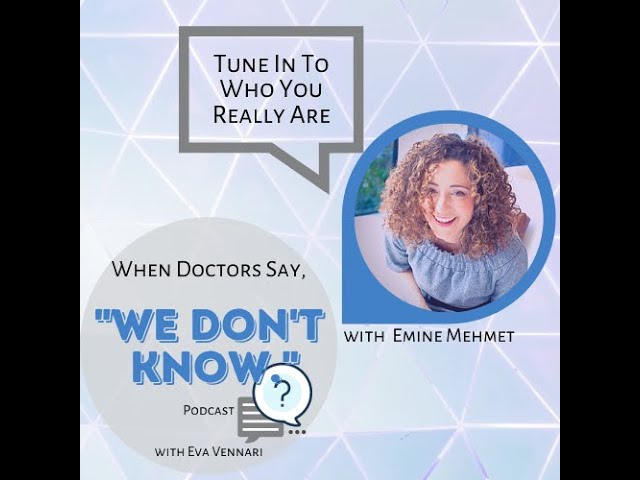
Emanet Mohamed spent three years with a chronic condition doctors couldn't diagnose. When she asked her body what it needed, it answered: love me. She left a 25-year design career to become an energy intuitive and sacred feminine leadership mentor, helping women in her Facebook community "The Women's Room" reconnect with themselves.
Chapters
Welcome to the show. My name is Eva Vennari, founder of the Elevate Institute, and I'll be your host for today's podcast. When Doctors Say We Don't Know is an inclusive conversation. So many are craving to share their stories and experiences, and today's guest is no exception. Today's honored guest is Emanet Mohamed. She is an energy intuitive and sacred feminine leadership mentor. And she's from Sydney, Australia. So it's wonderful to have you, Emanate. Thanks for being here.
Thanks, Eva. It's a great pleasure for me to be here with you today.
I loved our first conversation, and I remember realizing how very, um, beautifully sensitive you are to your, um, just the intuition and the world around you. And so I really enjoyed that, and I'm wondering how much that played a part in your journey. So we'll uncover that. I want to hear more. So tell me Tell us what inspired you to say, I want to be a part of this conversation of When Doctors Say We Don't Know.
For the last 3 years, I've been struggling with a chronic condition which has been kind of diagnosed, but not really. I think the diagnosis is really only for one particular, um, part of it, and there are so many more things going on with me. That doctors can't explain and don't really know how to deal with, to be honest.
Hmm. So what was it that you were bringing to them to fix, if you will?
Well, I started getting a lot of pain and going to the bathroom frequently. And I was quite healthy before. I exercise frequently, 3 to 4 times a week. I ate well. You know, I was always on the go. I was active. And I never got really got sick apart from, you know, the occasional— I actually probably hadn't had the flu for at least 10 years, 9 years. So I was quite healthy and didn't really go to the, you know, go to the doctor at all unless I really had to. So, um, For me to have something like that and then reaching out to doctors to help me with it, because I believed, because I was healthy, because I didn't go to the doctor often, that they would be able to help me and that whatever they gave me would actually work immediately. That was, that was my belief. That was my— that was where I was coming from. And what I discovered was really doctors themselves don't know. And I went to 4 doctors, and one doctor told me, you know, maybe I'm making it up. Oh, which made me very angry, I have to say. And I remember as I was walking out, he, um, he took my hand in his hand and he patted my hand and he said, don't worry, we'll, we'll work it out. And that made me worse, you know, angrier.
That sounds very condescending. Yes.
Very much so.
Yeah.
But what I understood was that, that's his— that was his go-to way of dealing with patients who were emotional or who felt like, um, who felt helpless perhaps. So needless to say, I didn't go back to him.
Fired.
Yeah. And I ended up going to my old doctor. I had moved out of the area I had lived in. And, you know, it was quite a trip to get to her, but I decided to go to her. And she, the first thing she said to me is, hmm, I think that what you've got is a red herring. I think there's something else going on. And, um, she sent me to a specialist and, um, I had a little procedure done and, and they— the specialist told me, um, you know, about 5 weeks later, my appointment after my procedure was 5 weeks later. And in my very naive mind, I thought, oh well, I must be— mustn't— there mustn't really be anything wrong with me. And, um, She said to me, oh, you've got interstitial, and I hope I've pronounced that correctly, cystitis.
Oh.
And I went, oh, okay, great.
Something.
So yeah, so how do we, how do we cure this? What's the cure? And she said to me, there's no cure. All we can do is manage the symptoms.
Wow.
And yeah, that left me in a state of shock, I have to say. And, uh, she said, um, we can put you on some mild antidepressants now, and that, that had certain, um, side effects. And I just went, well, that doesn't really sound like somewhere I'd want to live. And as I walked out of her office I realized I had 2 choices, and the choices were I could either, um, fall into, uh, victimhood and just allow this, whatever it was, to take over me and just let it be my life, or remember who I am. Remember what I can do and go another way.
Where do you suppose that little, that little insight came from, that remember who I am part?
Because I remembered that I was exactly as I described to you before— fit, healthy, always on the go, strong, independent woman. You know, this wasn't me. This was not me. This is not who I am. And I'm not going to allow this to take over me and my life. That was the determination I had. And I walked, I caught the train to the specialist. So I walked, as I walked to the train station, I kept repeating to myself, and I was swearing at it. You are not going to get the better of me. This is who I am. And you, you are not going to exist in my life. And I was in that mode the whole way to this, on the train back home. And I was sitting on the train and asking my body, what do you need from me? What is it that you want? What do I, what do you, what do you want from me? What, What can I give you? And what came back, being an intuitive and understanding that everything has energy, and if we listen, we can have the answers, find the answers. What came back was, I want you to love me. Oh. And it's, and it's not necessarily loving my body, but loving myself, who Well, what would give it—
okay, so just to really put a point on that, what was going on that your whole body cried out and said, love me, that there was a disparity between loving and not?
Yeah, well, the thing about us as women, as human beings, is that that we are brought up in a society that has certain— that puts certain expectations on us from our families, from our community, from our friends, from, you know, our schools, from our work about the way that we should be and the things that we should do. And what I've discovered is that every time you compromise yourself like that, so that's a compromise, and every time you sacrifice yourself, so you are sacrificing yourself. you lose part of who you are. You lose part of who you are, and you become out of alignment with your true path and your true self. And that is painful. That is painful to the body. That is painful to the, to the spirit, to the soul. You know, your soul cries for you when you are not fully in acceptance and in loving of yourself, of who you are completely, and allowing that who you are to be shown to the world without fear. So that's what I discovered.
Well, that's a great point to get to, but what caused— what was going on in your life that You like, were you doing a work that actually didn't feed you emotionally or give you purpose? Where was, where was the disconnect in your life that was the evidence?
Yeah, so I think it's a whole lifetime of things. So it's not just one area, it's like a buildup. And this is the thing, it's a buildup. It doesn't just, you know, happen overnight. So it's a buildup of constantly trying to please, you know, your parents, constantly trying to achieve, get, you know, get good grades at school, constantly trying to be the person that I believe that others expected me to be. And when I, when I was working in the corporate world, that is that element of— there is that element of keeping yourself quiet, like holding yourself back and not fully being who you are because of the whole culture of the corporate environment. Which is, you know, we're in a patriarchy at the moment, and that is slowly, slowly dissolving and breaking down, and we're moving into matriarchal system, which is more about, about bringing people together and nourishing people and, and building community and allowing people freedom to be who they are and not trying to control them. So for me, I always found it difficult, uh, working in the corporate world. I did love what I did, my job. I did love my work or what I did, but not necessarily where I did it, if that makes sense. So, um, so yeah, that was one aspect. But just generally in life, continually, um, being not yourself. And, and I had all these abilities that I knew that I had, all these, um, you know, if you want to call them psychic abilities or whatever, you know, I grew up with them. Um, They were just— I didn't really think too much about them. I didn't really tell people about them. And, um, then there was one point in my life where I was virtually given permission to be that person, and that really changed everything for me. I was in a relationship and, um, the guy I was with really was on that spiritual path. So that enabled me to start to accept more of that part of myself. So this is about self-acceptance. You know, when you hide who you are, you, you make yourself sick, and nothing really is fulfilling or works for you.
It's, it's an entrained response to exposure from, like you said, the culture, parents, especially siblings and friends, family, anybody who does not find themselves sensitive enough to be bothered by the incoherence. You were— you're sensitive enough, you had the psychic abilities. So denying your true self resulted in the physical. That makes— to me, that makes sense.
Yeah, absolutely, absolutely. And even now, I mean, I'm still going through the journey. And more recently, you know, a few months ago, I was going through a massive, uh, what I would call an upleveling. So more, um, awareness or growth of my abilities, and I was resisting it so much.
Oh.
I developed severe anxiety, which I've never had before. I could not sleep. I thought if I slept that I wouldn't wake up. And so I was— for 2 nights, I just was fighting sleep. So, you know, that just goes to show you, when you resist yourself, you create discourse within you.
So it sounds like there was a bit of getting used to the, the tide, if you will, right? Yeah, a new way of being. Yeah.
Yeah.
What was the, what was the, the psychic development and the spiritual development that started to blossom within you? Because there's many different spiritual gifts that we could Embody? Hmm.
Yeah. So, uh, I've got a number of, um, gifts or abilities. Um, so I can read people's energies. I can pretty much tell from a person what's going on for them just by— I feel their vibration, if you like. So I can, I do that. Uh, I can see forward into the future. I can, I can see past, past lives. I channel as well. That, that's something that probably started happening about a year and a half ago, 2 years ago, something like that. So, you know, they're, they're quite, quite varied. There's quite a lot going on, but all of it is who I am and makes me me. And And I'm really— I really have now embraced all of that because when I embrace it, I have such calmness within me and I have such quiet strength as well and clarity. And for me, that is the most important thing, to have those things. And so therefore, I have no choice but to be true to who I am.
Well, I'm silent because yes, that makes absolute sense to me. It's a journey that I too embarked and came to the same conclusion. Like, once you have your path before you, then anything else will fail.
Absolutely. Yeah. And you suffer as well if you try. You do. You do suffer in some form, mentally, emotionally, physically, whatever. You do suffer.
So then what happened to your symptoms as you became more in alignment with you, your true self?
Gosh, well, um, you know, then, then there's that whole— for me, it was a lot of work on myself, releasing, letting go of a lot of— so it was really, uh, me working on myself and releasing, letting go of a whole lot of patterns, beliefs, programmings, behaviors, thoughts, emotions that had built up not only from my own self, but from past lives, my ancestors as well. So things aren't necessarily yours. They're genetically handed down to you and you carry them with you. And so untangling myself from all of this has been quite, quite a journey and is ongoing. I mean, I don't think I'll ever, or anyone will, you're ever free or, um, you don't ever come to the end of the journey really. It's a continual process. You know, this is what we're here for. We're here to discover ourselves and to shine, to shine our light and to let everyone, everyone know who we are. So, um, you know, I've been working through all of that. And I am, I'm a lot stronger. And I know who I am. And I don't, and I actually work now with my own instincts about what's going on in my body. So I'll tell, I'm seeing a naturopath at the moment. I'll tell him what I need.
Rather than him saying you. Yeah.
I also, of course, you know, value his opinion. And, and, you know, he tells me as well, but, you know, it's a two-way street. I feel like you have to, um, have, have real control of what's going on for you, real, take a real active, responsible role and not just accept as I did in the beginning with doctors. And I took all these antibiotics that made me worse. So I'm now having to reverse those. those effects, those side effects from antibiotics. But, um, yeah, I think you need to take responsibility and an active role in your healing.
So I'm wondering if you had the relationship where the— he was a spiritual person that encouraged you, but as far as the rolling back and going into the past lives and discovering the things that you've inherited through history of your family, Um, has this been a solo journey, or are you working with a spiritual master of sorts, you know, or maybe a set of people to help you? Like, what kinds of people have come into your journey?
Yes, so many people, so many wonderful people. Um, so, uh, I was seeing, um, uh, she wasn't a psychic, she was a— I think she called herself an energy healer in the beginning. And the thing with that which was interesting was that I was telling her, and then we'd compare, and then she'd tell me first what she sensed, and then I told her, I'll tell her what happens, and we, and we kind of compared notes. So I was very active because I was very aware and very spiritually, I guess, um, perhaps more, uh, aware than her clients. That's what was, that was what was happening. And in the end, I kind of, I suppose I outgrew her because I, I was doing more than she was in a sense. So from there I started seeing a spiritual kinesiologist, a beautiful woman that I still— we still work together actually now. And it was with her that I first started channeling, which was really interesting for me. And since then I've also worked with another beautiful spiritual healer as well, more recently. So when I need to, I do reach out for support, most definitely. I think everyone should. This is not a journey that you take by yourself. And if you think that it is, you know, you're not, you're not doing yourself a service. Reach out, ask for help, look at, try different things, see what works for you. And go with your gut. Like, I, I only, only work with people that, um, that feel right for me. They feel right, you know. If it doesn't feel right, I won't do it anymore. I mean, in the beginning, I've seen like 4 naturopaths, and so the first couple, you know, I didn't like at all. I didn't like their methods. Um, I wasn't getting anywhere, you know. So go— I learned early on to, to let go if it wasn't working and go with my gut and what was right for me.
I think that's, that's something that's really important. And at the same time that you were developing the spiritual gifts, I'm hearing the confirmation and an increase in confidence of where you were in these, I guess, meditative states, you know, when you're channeling and whatnot, and you're sharing the experiences post-event and saying, oh, that's— I experienced that too. What else did you see? And then you— oh yeah, I experienced that too. That really creates a nice strong spiritual muscle, so to speak, right?
Yeah, yeah, absolutely. I like that.
Yeah. And this is the journey as I describe it, as people ask, because the spiritual gifts you and I share many of the same. So when I hear these, I'm like, oh, I resonate with that. That is part of my history too. And I'm thinking about how the people around me— it is not a solo journey. You need others to help you connect the dots and build the spiritual muscle. Or at least that's, that's what has propelled me forward in being able to be of service to others. So I'm curious to know, did you change your careers?
Oh my God, did I ever. Did I ever. And it just of happened, you know. I didn't actually set out to change it. So my background is interior design. I've had a very long career in interior design, 25 years. And more recently, I was working as a consultant creating environments that support health and well-being. And what I discovered— and I often had events for the industry as well on, you know, creating environments that support health and well-being. And what I discovered as I dove deeper into that area is what was really going on for human beings. And I— my— the way I started to speak changed. The words I started to use changed when I was, you know, in my Facebook community or When I spoke at events or whatever it was, I started to really focus more on the person rather than how the building can help the person, right? And started to dive deeper than what the built environment was covering in terms of supporting people's health. And these words were just spilling out of me, you know. I didn't know where these thoughts or feelings or, or information was coming from. It was just spilling out of me. And, and as I looked into it, I discovered that what I was actually saying was true because I could— I saw it here or there or online or wherever, wherever it was. And I was like, oh my God, how do I know that? These are not things I have studied. How do I know that? And then, um, I remember I, I decided to change my Facebook group because I discovered that my audience were women.
Hmm.
And I had a session, I, I, um, had a live session where you could ask me anything about your well-being. And I had these women come and, you know, they had, had all these questions and I realized That if I was going to serve these women to the fullest capacity that will really help them and support them, then I had to use what I know are my abilities.
Hmm.
If I don't dive deep into that and give them the information that is specific to them that will support them, Then who am I but just some other consultant, really, right? Because I can go online and find out, you know, you can look up stuff, right?
Yeah, there's a lot of information. Yeah.
Yeah, like, I'm, I'm, I'm, I'm feeling anxious, what, what do I do about that? You know, you can look up stuff, right? But to tell them why they're feeling anxious and what's going on for them and what they need to release or whatever is so much more valuable than just You know, go and do some meditation or something like that. You know, I'm just, you know, picking things out of the air, but you know what I'm, what I'm saying.
I do, yeah.
So that was my turning point. That was the point where there was no going back. I'd revealed myself and that was it. I had to keep going.
Ta-da! Here I am. Yes, here I am, world. So, well, I mean, on, on that point, I'm, I'm hearing a lot of Um, very— a chance for a very personalized journey here, not the standard, um, generic. Like you said, it's not like everybody else. And so I, I think that's amazing. Do you— so do you work with, um, with people in programs as groups, or is it one-on-one? I heard, I heard you say a Facebook group.
Yeah, so, um, I have, I have group programs. I'm also at the moment offering one-on-one programs as well with me for something more private and If people are interested. And yeah, I've got a Facebook group, it's called The Women's Room, and I share a lot of information in there, a lot of live videos. And yeah, I'm loving, I'm loving it. I'm loving being able to support these women who enter my, my realm.
The Women's Room. That sounds like the ladies' room. The Women's Room.
Yeah, the Women's Room. Yeah.
Okay, good. I'm gonna put that link in the show notes so everybody can see the Facebook group, and if you wanted to jump on, you can take a look at the group. Anything else you'd like to share with the listeners for today?
Anything else? No, no, just— I think what's really important is to keep going, to not give up, and to know, to know that no matter what things look like right now for you, that you're going to be okay. If you, if you can tune into who you really are, you can see that what's really— what's going on right now does not fit with who you are. And therefore it won't, it won't stay, it won't last.
Evidence proves that those of us who are sensitive and have a mission and we just haven't found it yet, the universe is going to nudge us one way and another until we finally find our way. So I'm glad you've done that. Yeah, that's the journey. So, and, and you've answered the question right there, the final one, which was You know, what do you feel is the most important thing when searching for answers? And I agree with you, tuning into who you really are is the magic behind it all. Yeah.
Absolutely.
Absolutely. So we have run— come to the end of our time, but I wanted to say thank you so much for joining us and having this beautiful conversation.
Thank you, Eva. It's been my great pleasure. I've enjoyed being with you today.
Very good. Thank you. And I'm hoping that those of you listening in with M&A and myself today on Doctors When doctors say we don't know, have heard some glistening moments of hope so that we can turn your message or experience of pain into a triumph as well. And if you are driving or simply cannot click on the links to the show notes, remember you will always be able to hop on to my website, theelevateinstitute.com. Follow the podcast links to find today's show. And there's Always more to talk about. Tune in next week for a new episode of When Doctors Say We Don't Know. This is Eva Vennari reminding you to question everything.









