Google I/O 2026, Birth Rate Debates, SpaceX IPO, Karpathy Joins Anthropic
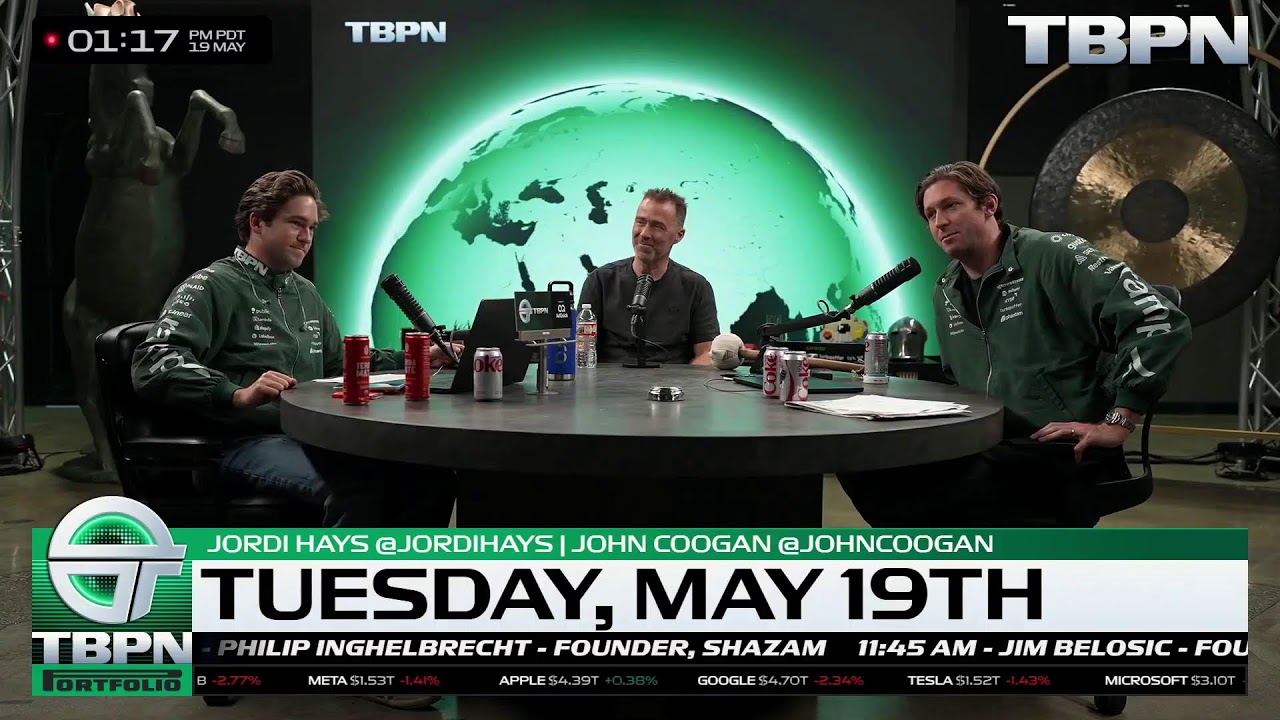
Fai Nur hosts a panel discussing Google I/O 2026 announcements including Gemini Omni and the Spark personal agent, a Financial Times analysis linking smartphone adoption to falling birth rates across countries, and the anticipated SpaceX IPO. Jim Belosek of SendCutSend discusses his on-demand manufacturing startup's $110 M funding round.
Chapters
I see a large IPO on the horizon.
You're surrounded by journalists.
Hold your position.
That's misinformation.
Quarantine clearing order inbound. That's just wrong.
We are surrounded by Juggernauts. Hold your position.
Come on, get up. Trust the experts. 5 Code Blue. We are Xpress. Founder of Code Blue. I see multiple journalists on the horizon. Stand by. Xpress. UAV online. Glaze. Double glaze. Triple glaze. Double kill. Fire cook. Roar.
Cuphead's Cuphead.
Please.
Team Deathmatch.
We are experts.
Triple Blades.
Let's just roll. Right. Marking clearing order inbound. Come, get up.
We're surrounded by journalists.
Hold your position. Strike one. Strike two. Activate Go Go the Retriever mode. Trust me, it comes. Market clearing order inbound. Fine. Good. Founder. No.
You're watching TVPN today. Today is Tuesday, May 19th, 2026. We are live from the TV panel trail in the Temple of Technology, the Fortress of Finance, the Capital of Capital. Google I/O starts today, uh, and the stock is ripping. I think, uh, people might have missed this if you haven't been, uh, watching closely, but Google is up 140% in the last year. Absolute ripper. It's almost a $5 trillion company now. $4.6 trillion.
Yeah, I was really confused what chart you're reading because down 1.3% today.
Today?
Okay. No, it is up. It is up massively.
We think in years, decades.
Yes.
Yes. And, and yeah, they pulled in just shy of $110 billion revenue last quarter and they're in a great position for the next era of the AI story. So GCP is growing faster than AWS and Azure. Wall Street has basically fully repriced the company as a, like a full-stack AI winner. That's the new narrative across Google Cloud, Google Search, Gemini, the models, DeepMind, everything that they're doing. So long gone are the concerns about Google's search weakness because even core Google Search is showing resiliency. Google Search, the business continues to grow. Queries are at an all-time high. They're not reporting exact numbers of queries, but Sundar said on the last call that it's at an all-time high, certainly not going down. And search and other revenue, which is their bucket there, is up 19% year over year, so holding up well. And Google I/O generally offers consumers launches or previews of tons of new products. I'm getting called. Previews of tons of new products and features. And The Verge was saying that there might be some like AI fatigue, which is maybe an overstatement given that, you know, people are getting booed. Actually, the former CEO of Google— You mean understatement. Yeah, understatement, given that the former CEO of Google, Eric Schmidt, was booed off stage at a commencement speech. And so that is a good point. But, you know, the people that watch Google I/O, the Google core consumers, they are fans of this stuff. I think they're generally pro-AI, excited about new features. Some of the new features that we'll show are very, very cool. But there is this like goal of being ambient and useful instead of pushy and desperate. Many Google experiences now have duplicative Gemini panels. And I was writing this update in a Google Doc and I noticed that I had 2 Gemini stars basically, one Gemini star in my Google Doc.
They're everywhere.
And then another in the Chrome browser that I'm using to load Google Docs. And it's a really hilarious outcome because I was writing this in sort of like a half window to the side of the screen. And if I open both Gemini panels, the Google Doc disappears entirely. And I'm just left with 2 chat boxes to interface with the Google Doc, which I don't really use AI in the actual Google Doc. I just kind of write it. But there's, you know, there's stuff it everywhere and then actually make it useful, make it ambient, make it— delightful. And so that is, I think, what consumers are looking for more than just an AI button in a new place. But they're certainly showing that already. And so the new Gemini video model looks incredible. We'll play some videos of that and there will be tons of delightful experiments that may turn out to be blockbuster products or they may get shelved by year end. That's kind of the beauty of Google's culture is that they have plenty of opportunity for experimentation. We sort of— some people remember all the things that are in the Google graveyard, but most people just remember Gemini and whatnot. So yeah, we can play this video with sound because the sound is— A V8 engine features 8 cylinders arranged in a V-shape driving a single crankshaft. They take turns firing to deliver smooth, massive— that's pure mechanical genius at work. A V8 engine features 8 cylinders arranged in a V-shape— So I feel like this got rid— I mean, the video fidelity is Incredibly high quality. There's no 6 fingers. It looks HD. The motion looks good. The lips are synced. And I feel like they got rid of that hollow sound that you used to hear in AI video where the audio was generated alongside.
You can still clock it, but it's a lot more subtle.
It's really subtle. There is one weird thing in this where it says pure— he says, deliver pure, massive, and then it just cuts to the next scene. That's pure mechanical genius at work.
Go back.
A V8 engine features 8 cylinders arranged in a V-shape driving a single crankshaft. They take turns firing to deliver smooth, massive— that's pure mechanical genius at work. Smooth, massive energy, or smooth, massive propulsion, something like that. So like, it's crazy because you see these and you're like, ah, like, this is it. Like, it's done. Like, this is fully, fully done. And then there's just like, ah, we're at 99.9% now, and I want to be at 99.999%.
Also, like, this is kind of a nitpick, but isn't that a V6, right?
Oh, is it? Wait, play the video again. Let's see. I want to see if it's a V6 or V8. Because when I look at those graphics, I think— okay, let's count the cylinders. Oh, yeah. No, no, it looks like an 8. It looks like 8 cylinders in the back. No, count them up. I can't really tell. But yeah, it's odd. It's so passive. But I don't know. Is this good for video explainer channels on YouTube? Bad for video explainer channels on YouTube? YouTube certainly commoditizing the production of video explainers. I've seen a lot of these video explainers that will show you like inside of a rocket or inside of an RPG or an AK-47 or Glock, and those get like tens of millions of views. They can be viewed in any language, but they're very intense from a CGI perspective. You have to go and model every little detail, every pin in the weapon or whatever the object is. that's being visualized in this particular video explainer, close to being on command. And then the question is, where does the value sit? Does— if you prompt YouTube and you ask for a video explainer of, you know, a chair, break it down, explode it, show me the innards, will it just do it on demand for you? Will it just generate that? Or will this still sit below the creator's control?
Yeah, I've always had the question, at what point do you go to YouTube and there's just a series of videos waiting for you that were generated based on your interests, right?
Certainly, yeah.
Sometimes, you know, you might be going to YouTube because your favorite sports team just played and you want some analysis on the game, or, you know, your favorite fighter or something like that, or some news is happening. And it doesn't seem like we're that far from a future where you land on YouTube and YouTube is just, again, fully generated a video based on what it knows about your interests. That said, that would cause potentially a creator strike.
Yeah.
Because it's YouTube starting to compete against their own, you know, content producers on the platform.
Yeah.
So we'll see.
Yeah, at least in the interim, it feels like the dawn of stock footage. YouTubers have been creating these— have been using these tools for a long time. They have been getting cheaper. Even the CGI world has become increasingly commoditized every year as you get more to templates and the tools become cheaper. You used to have to pay thousands and thousands of dollars for a license of Cinema 4D or 3ds Max to render anything. Now Blender is open source and free. And there are tons of Blender artists out there with custom packs. But yes, this is a new capability. And it'll be interesting to see how this gets integrated, what the pushback is like, how clockable it is once it's actually in the hands of creators and they are pushing it out. Let's watch this other science explainer from the timeline. Gemini Omni explains science with video. Thanks a lot for this, says Chetaslua. Now every student will get a custom video for the topic of science and math. I'm so happy, like while typing, I want to see all your reaction to this. I don't know.
Which looks white.
This is about photosynthesis, I think. Every color of the rainbow. As this light enters our atmosphere, it crashes into molecules of nitrogen and oxygen. This triggers a phenomenon called Rayleigh scattering. Because gas molecules are tiny, they affect shorter wavelengths much more than longer ones. Blue light has a very short wavelength, so it's scattered in every direction, filling the sky with color. Meanwhile, longer red wavelengths pass through the atmosphere— There has been a big push on YouTube for like As people ask questions, like they would go to Google and say like, how do I fix this particular washing machine? You type in the number of the washing machine and it would take you to not just a single video about someone fixing that washing machine, but the actual section in the video with the solution to the exact problem you had. And being able to read a manual and constitute a video on the fly of exactly that is pretty incredible. And you can imagine satisfies that use case Very, very quickly. And then of course there will just be entertainment and all sorts of different use cases. Logan Kilpatrick, friend of the show, says, introducing Gemini Omni. Omni is our new model that can create anything from any input, starting with video. Starting with video. Think Nano Banana, but for video. Okay. Yeah, let's play this because there's some amazing, like, different styles here going on. I wonder if those— if that, if that motion graphic transition was created in Omni, because that's something that, uh, would you normally bump out to After Effects for. Or like the edit here, I wonder, I wonder if, uh, if, if you'll be able to upload multiple clips and have it edited together to the beat of a song that you pick, or will it be able to AI generate a video and then match the match the footage to the, to the beat of the video. So it says give it anything. So I think you could potentially give it a bunch of videos and it could edit it together into a vibe reel, something like that. Swap style, swap environment, swap angle. They've been having a lot of fun with this. Everyone is very, very excited about this. The other news out of Google today is Gemini 3.5 Flash, our most powerful model to date. It pushes the frontier of intelligence, speed, and cost, putting 3.5 Flash in a class of its own. We spent the last 6 months making sure Flash is great for real-world use cases. It's the strongest agentic coding model yet from Google. It delivers frontier-level performance at 4x the speed of comparable frontier models, often at less than half the cost. So dominating the Pareto frontier has been the goal for a long time. The speed is being heralded as a key feature. Google just showed a demo of Gemini Flash running between 600 and 1,400 tokens per second on TPU 8i. It peaked out around 1,480 tokens per second with an average of around 800 tokens per second. So very, very, very, very fast. The flip side is it's more expensive than previous Flash models, but That's been the trend with smarter intelligence for a while. So investors are focused across 3 key areas, not so much the consumer story, more the next Gemini model. So where this fits in and then what adoption and diffusion looks like, how Google through Google Cloud will be getting this out into enterprises, into coding agents. Obviously they have Antigravity, but the Gemini CLI has not seen as much traction. And so Better model might pull that forward, might wind up seeing more traction there. Overall, I think token generation at Google is up 7x year over year, which seems great. It's unclear how much of that is because there's more reasoning happening. But given the fact that the Gemini models are sort of stuffed all over the product surfaces, I'm not surprised that there's massive growth.
Yeah.
That makes a lot of sense. On the core Gemini model, everyone was wondering, are we getting 4? 3.5 launched and there's a staged rollout with Flash going first. Andrew Curran had an interesting post here talking about the lack of vague posting. The DeepMind folks have not been vague posting about the new Gemini model, so he did some vague posting for them. He says, at this point, everyone knows it's arriving tomorrow along with their personal agent named Spark. This reticence, of course, can be interpreted in many ways. I'm choosing it to— I'm choosing to interpret it in accordance with my nature. I think they trained the largest model they've ever successfully trained. Probably possibly the largest one anyone ever has, and something unexpected emerged at scale. They had their mythos moment, but not in the same way Anthropic did. Gemini has always been very a very different model from Claude. The benchmarks will go out today tonight under embargo. They probably already are, but I don't think they will fully reflect what I'm talking about. I think they hit something even they weren't aiming for, something that surprised them. If I'm right, that surprise will be part of tomorrow's show. We shall find out together in the morning. I don't think tomorrow's show, because I/O is a number of days and there's a whole host of different announcements that could happen in the interim. There's a lot of other things going on.
Yeah, has anyone been vague posting around, will there be a 3.5 Pro this week?
Yeah, yeah, yeah. That's going to happen over the course of the next few days. They just started with Flash.
Okay, starting with Flash.
Cool.
And then they also announced Spark.
Yes.
Which is a personal agent that lives in anti-gravity.
Oh, okay.
It's my understanding.
Oh, interesting.
And so trying to make—
When I hear personal agent, I think more like Gemini app, Google Search, like Gmail, like the very, like the consumer product services. I think, well, I guess I just think personal and I think consumer. But given how much people are using Codex Claude Code for like personal-like things, like just because writing code creates a more dynamic agentic surface. OpenCLAW, we saw all of this. It's helpful to have something running on a MacBook Pro that can go around and find different stuff. What?
Yeah, just some additional context.
3.5 Pro is coming out next month.
Next month.
So not this week.
A little bit of a delay there. I wonder. I wonder what else is in the bag of like Mythos-like surprises because the cybersecurity one was like sort of predicted by the AI 2027. I feel like bio is next. It feels like, okay, we tested a bunch of stuff and we talked to a bunch of scientists and this thing can come up with super viruses and it's really scary. So we got to give it to all the pharmaceutical companies in advance and Moderna gets it and creates antiviruses or something like that. I don't know what else, but I'm sure there will be surprises. There always are in the AI era. So from an investor perspective, Obviously, I don't think Google I/O is necessarily the correct forum for discussion of a mythos-level breakthrough or surprising new emerging capabilities. I would just be surprised if that's where, like, you stand on stage and you say, hey, we had this crazy breakthrough. That's— it's a more serious thing if you're talking about new capabilities. But given the talent and resources of the DeepMind team, TPU, I think that there's just a lot of broad optimism about the next iteration of Gemini. They've hired a bunch of people. They have a bunch of surface area to deploy this into. So no one's expecting like the model to underperform. Agenda commerce will also be top of mind for investors since messaging around the Google— the Gemini app has sort of strayed away from advertising as an immediate monetization engine. I think Demis said that at Davos. Google has a lot of capabilities when it comes to closing the consumer shopping loop. Like they have Google Shopping, they have a bunch of hooks into all sorts of different e-commerce services. They have massive product catalogs. People search for stuff on Google all the time to buy. But e-commerce customer behavior seems to be lagging expectations here generally. There's been a lot of announcements from companies around agentic shopping protocols. And the numbers, whenever we dig into them, we're always like, is it going to get to 1% this year? Are we going to see— and everyone's talking about the growth which means we're growing from zero, obviously, because this didn't exist. But where is it going? Will Google have something to show here? Will they have some sort of demo of a new user experience, a new flow for agentic commerce that results in, you know, a faster takeoff of that adoption of that behavior? Personally, I've done a ton of research about products through LLMs, but I pretty much always hesitate to have AI fully process the checkout. And there's a few reasons, like Apple Pay is pretty good, pretty seamless. Shopify saves all my annoying info. Autofill is also not that bad. It's usually pretty good in whatever native, if I'm in Chrome on Mac or I'm on Safari on iPhone, it's usually pretty good. And then I feel like I still like reality checking carts before clicking pay. We talked to Joanna Stern about this too, where she was talking about having a, having an AI agent assemble a cart of even something like groceries, but then she will be the one to actually go to the hydrated final link with the cookie and then go and validate everything before clicking pay. The last focus area for investors generally is TPU. There's been a lot of back and forth around, are too many of the TPUs going to Anthropic? Are too many of them— are they sitting idle at DeepMind? What's going on with the TPU and how are, what are the margin structure? How is revenue booked around TPU? How is the backlog accounted for? These are questions that investors on Wall Street are asking. I don't think we'll get answers at I/O, but investors will be watching for anything that sort of contextualizes the shape of Google's TPU business and their plans over the next few years. And so, as I mentioned yesterday on the show, we had a lovely conversation with Joanna Stern from The newthings.com and the author of I Am Not a Robot. And we had lots of fun takes about like the AI tools that I think most of us have interacted with. Everyone's used agents, everyone's sort of felt what it's like to talk to a chatbot. But one place where she went deeper than I think most consumers and like AI fans have is in the wearables because she was wearing that recording device consistently. And she maintains that like humanoids are farther away, you need a lot more training data. The AI chat apps are here. We already know they're diffused. Waymo is now boring. But the next big wave she's sort of predicting is in the next few years, wearables will have like a big moment and everyone will be sort of adopting these and contending with them. And it is interesting how, you know, we talk about a capability overhang in the enterprise with AI deployments. And that's why the big labs are partnering with consulting firms and private equity groups to get AI installed into large corporations. There's even more of a capability overhang in consumer hardware. Apple iterates extremely methodically. You know, they made a big story about Apple Intelligence. Was that just one year ago? I guess that was one year ago because WWDC is in a few weeks. But—
Feels like longer than that. They had— I just remember they did a global billboard campaign Yeah. For Apple intelligence.
Yeah. But anyway, like the actually changing anything in hardware takes Apple a long time. They still haven't launched a folding phone. Like they take their time to deliver a great product at the right time. And then if you're a challenger and you just wanna manufacture new devices at scale, that takes years to ramp up. And then you also have to distribute, sell. It's not one click away, it's go to the store or wait for the mail. And then hardware decisions that get made around certain AI workflows can potentially be obsolete in months as the underlying technology changes. So you could build a device that assumes that, you know, LLMs are the end state, and then reasoning models come and you're not set up for that potentially. On-device compute could change. It's unclear. And so you don't wanna get locked in these things. And you were talking about the Humane AI pin, how that maybe could have been successful at Apple, even the R1, I think like—
Well, my main point was that if that was an internal project at a bigger company just showing like a potential future state for consumer hardware, it would have been an amazing demo and probably been able to receive more funding at, let's say, a hyperscaler. But as a standalone company, sales come in, people don't like the product, and then nobody's willing to give them more money.
Yeah, I mean, you look at how many shots on goal Mark Zuckerberg Mark Zuckerberg has taken with the Meta Ray-Ban displays and Meta Ray-Bans. Like, that was something that I would be surprised if you look back at the R&D cost, the manufacturing cost, the early sales figures of the version 1 of the Meta Ray-Bans, and it's off to the races. Like, he clearly said, you know what, I'm going to double down on this for years. We're going to continue to invest in this, get this to a place where it can actually become known, become a product that people consider when I show them another ad. They'll consider it because they've seen it. Maybe they've tried it. Maybe they've— I went skiing with someone who had a pair, and they were talking. They're sending text messages. And so just familiarity with the product takes time. And Google's had some fun swings at these preview emerging hardware platforms. Google Glass, I mean, way ahead of its time. We're now there with the Meta Ray-Ban displays. But even those are not— selling by the millions and millions. They're very early stage. Google Cardboard, I don't know if you remember that one. This is, you put your phone in a cardboard box that they send you, and then you can put it on your face and use it as a VR headset.
Whoa.
Yeah, it was a tiny little, I think it was open source, just like a fun preview of like, how do we get more people to be able to watch 3D stereoscopic like, you know, VR-type content.
Well, experiment of how can we strap someone's phone to their face?
Basically.
And serve them ads.
And then they also did the Samsung Galaxy Gear, which was— yeah, you'd slot it into like a piece of hardware, but much cheaper than buying an Oculus at the time. Fitbit also sort of fits in there. There were previews of the new Google Book and the Fitbit from last week. And I'm excited about the possibility of a new swing from Google, like being like the wild card headline that makes it out of I/O this year. So anyway, are there any other Google I/O posts? I mean, like the actual conference is going on as we're doing this stream, so I wouldn't be surprised if there are announcements hitting the timeline right now.
Yeah, there's— people are pulling some of the benchmarks, comparing it on the AI Artificial Analysis Coding Index. Lisan Al-Ghaib says 3.5 Flash scores kind of low on Coding Index due to rough Terminal Bench hard scores. So I think the big question coming out of I/O today is how do developers respond to the updates to anti-gravity to 3.5 Flash? The speed is amazing. We know how much people care about that. in just like day-to-day coding, but the model has to be able to perform. So we'll see what people's reactions are and we'll see if Google can really start to ramp revenue on the cogent side or still get exposure to that through Anthropic. It did come out yesterday that Demis is an angel in Anthropic himself.
Yeah.
I don't— not super surprising, although less pushback.
When did they— yeah, when did they meet? I wonder what the story is there, how early he got in. He might be sitting on a bag. Well, who else is going to Anthropic? Andrej Karpathy has gone from OpenAI to Tesla to Anthropic. I think he went back to OpenAI at one point in there. And Andrej, a different account, is Pointing out this KMT general who defected and subsequently betrayed 5 different countries in Asia, ending in Japan, jumping around. He's seen it all. Certainly the world tour of AI labs. I guess Andrej Karpathy was never inside of xAI because he was sort of the precursor at Tesla.
But—
Yeah, Elon— he was poached by Elon.
Did he work at Google at some point?
In the early days.
I feel like he might have been at Google before OpenAI. I don't know. I know that there were some people that got— maybe it was Ilya.
So he interned there.
He interned there. So he's been everywhere.
And then he did his PhD.
He's got the Thanos rings.
Huge pickup, and excited to see what they do together. He's apparently, according to Alex Heath, going to be working on basically RSI.
RSI, yeah.
Yeah, RSI. He's continuing on his auto research project. Oh, yeah.
He's been doing RSI, basically. actually in the open source world. Auto Research is open source, right?
Yes.
OK.
Yeah, it's— I think you can read into this that it was effectively an acquihire of the company he was working on.
Oh, interesting.
I don't— yeah, I'm assuming.
He said he was going to get back to the education project that he was working on.
Did he have— I thought he had raised for it.
I don't think he did.
Maybe not.
I don't know.
That's always helpful.
But that was a cool idea, and I wonder how that fits in. It was always interesting to to think about, like, you know, LLMs are really good at education. I mean, we're seeing that today with Gemini Omni, like, it can generate a video for you. Now, we haven't really pushed it to the limit. Like, I wonder, is it like if you give it a PhD-level problem, is it going to teach you as well as, you know, a great professor who has thought about all the different responses? Like, maybe it's not fully there, but it's like education certainly seems on, like, the core path of the models, whereas there are plenty of things that sit outside the core path in things with network effects and things that touch the real world and physical world and all these different things. But just going to a computer and asking, teach me something, felt like something most of the AI models would get very, very good at because there's a lot of training data, there's a lot of open-source educational materials, all the textbooks have been scanned, Wikipedia is in the is in the models. There's so much information that's readily available. It isn't tightly held secrets that are hard to bring to bear in the pre-training data. But we'll be—
One more thing out of I/O that we forgot to cover, Google's new SynthID framework that ElevenLabs, OpenAI, and NVIDIA are joining forces. This is to help identify AI-generated content, basically creating a standard for it across platforms so that Yeah, when you generate an asset, ElevenLabs, OpenAI, Gemini Omni, it should be auto-detected by the different platforms.
Yeah, I've seen that on X recently. There's been a little tag that says like made with AI, but I feel like you can get around that if you screenshot it.
Well, so I think the ones on X are just in the metadata.
In the metadata, yeah.
You can actually change it like fairly easily.
I don't think it's actually using like on Nano Banana images on GPT-2, there are like Watermarks?
Yeah.
You've seen these weird patterns people posted?
Yeah, subtle changes to the saturation or color.
I think they've just been— it's just been metadata so far.
Yeah.
The trick with all of those is that it's, in theory, pretty easy to rip that out if you're running an advanced AI slop avoidance detection system or something. But just to know, okay, For the average poster, if this is an AI image, that's certainly helpful. But as you start bringing different assets in, you bring in some stock footage, you bring in some AI footage, you blend them together, you're doing a lot of different things, you'll probably lose a little bit of that AI detection ability. But hopefully people aren't too annoyed by it if it's used tastefully. I guess it shouldn't matter at the end of the day. Anyway, do you think Spotify used AI to create their new disco ball icon. This was burning up the timeline this weekend.
I was shocked at all the negative reactions to this icon.
Me too.
For what reason?
What's wrong with you?
What's wrong with you?
Seriously, if you don't like this, seek help. I will say at first it threw me off. I was like, where did my Spotify app go?
Because it's too dark.
Genius.
I think it was genius. I opened up my phone and I was drawn to it immediately. My eyes jumped because I was like, something's wrong with my phone. Something's wrong with my home screen. Things don't look the way they normally look. It drew my eye. I saw, oh, Spotify. Okay, look a little bit deeper. The icon looks a little bit different. The color's a little bit deeper. Oh, there's something else going on there. Peel back the onion. You see that there's a disco ball. And then of course that there is a meaning behind it. They didn't just— there's a whole reason why they did this. to the 20th anniversary of the company. And so lots of people complained, but party— your party of the year.
It's so funny because I don't know, prior to this, were people sitting around being like, wow, I really hope they never change the Spotify logo even for a few weeks. I just love it so much.
Yeah.
Right?
Yeah.
I think it's fun. I think it's a nice change from You know, these flat minimalist logos that we've all grown accustomed to.
Keep it.
And, uh, yeah.
So yeah, let's go through some of the reactions. So, uh, Dylan said, I thought this was fun. I'm sure the complainers thought so too. But when tapping an icon is second nature after being used to it—
Citizen said, I told my wife to cancel our subscription.
Oh no.
Uh, for so long, even the slightest change in appearance can make you double take when searching for it. And that's annoying when trying to open an app. Mass says that it's too, it's too dark. And so Mass turned up the brightness.
Yeah, because you're at the disco, John.
Oh yeah.
A disco ball would never look that bright.
Yeah.
In a nightclub.
Okay.
Yeah, I mean, it is the blacklight is sort of— The real disco all-knowers.
Yeah, that's way too, that's way too light.
I like Notion played along. This is like really a testament to the power of GenAI imagery these days. Every brand could jump on this meme very quickly, and it's hard to create things—
It's so funny that I guess this still went super viral, but even 5 years ago, if you could create an asset that was a 3D render, you almost automatically got attention because anybody could make them, but you needed to work with a 3D artist to do it. do it, and it's not something you can do instantly. They have to figure it, you know, actually render it.
I mean, yeah, this is probably like a couple hours of work in Cinema 4D. I mean, getting the lighting right too and making sure that you're not— have the wrong reflections on there. There's a bunch of nuance to actually getting this to look good. I think it's fun when— I don't know, the other brands like joining in on like a meme can be like Done really poorly. This one seemed like it was fine.
Yeah, Andy Masley had the best take. He said, everyone complains about minimalist design until the company tries some— until the company tries something fun and everyone reveals why all the companies have been forced into minimalist design.
Wow, 66,000 likes on this. People really, really agreed. This is how I feel when people complain about Cybertrucks being ugly. Like, yes, but it's different. Of course, not everyone is going to like it. Trying to get everyone to like things is how we wound up with all cars converging on the same colors and designs. Interesting. Yeah, that's a good point. I like the disco ball. Someone, Nathan Halberstrad, had a very nice comment. He said, this is TVPN-inspired, which I don't think it is, but the arc may be long, but tech companies now appear to universally bend towards aping—
I mean, look at our—
So we do have the globe. And it was funny because, so you can go a little bit further. And I did this with our logo. I was like, turn our logo into a disco ball. And it looked kind of the same, like, because we sort of have the globe in there already. And so for all of like, like this meme, like sort of didn't work with us because I guess we have been taking that like 3D render aesthetic with the globe, although ours is pixelated, not squares like on a disco ball. But there is a little bit of TBPN in the disco ball. What do you think of the TBPN disco ball logo? Should we run this for a while? Has the trend already moved on?
I like the globe.
You like the globe?
I like being global.
Yeah, I think keep the globe with the pixelation, the dots. I think it works. The era of disco morphism has arrived, says Fichara. Fichara. And this individual disco ballified all of their apps, including X, Claude, Slack. What's that one? The App Store, I guess. Google Calendar. I don't know if you ran this, if you ran this full, people, do people know why Spotify was a disco ball?
This kind of loud maximalist design is coming back whether you like it or not. You think so? These things go in waves.
Yeah, they go in waves.
They're coming back.
Well, one story that we didn't get to yesterday that I want to discuss is the root cause of the fertility crisis The Financial Times has a deep dive, why birth rates are falling everywhere all at once. And I was going back and forth with Tyler on this, trying to understand, and we'll see where you stand on this, Jordy. So the demographic landslide defining our era is gaining speed and terrain. In more than 2/3 of the world's 195 countries, the average number of children born to each woman has fallen below the replacement rate of 2.1. that keeps populations stable without immigration. In 66 countries, the average is closer to 1 than 2. In some of— in some, the most common number of children born to each woman is 0. Both the pace and the breadth of the decline are defying expectations. Just 5 years ago, the UN predicted that there would be 350,000 births in South Korea in 2023. That was a 50% overestimate. The real figure was 2,300— or 230,000, sorry, not 2,300. While high and middle income countries have been wrestling with demographic decline for more than half a century, the phenomenon has markedly accelerated in the past 10 years. Analysts of data ranging from population records to Google searches indicate that although many factors contribute to falling birth rates, the most recent plunge appears connected with our use of technology. And so this is the question that the Financial Times is trying to answer, should you put the blame on the recent decline in fertility on smartphones in particular? And so, yeah, you can go through a whole bunch of the charts. It's a great article. But the final image is this image where they took a whole bunch of different countries and they adjusted the charts to show when did smartphones actually take off in that particular country. America had the iPhone moment in 2007, but different countries got wide smartphone adoption or 4G or actual rollout of cell phones or smartphones at different times. And so they adjusted all the figures. And when you look at this chart that Louis Giancarlo is sharing, the screenshot from the Financial Times, you'll see all of the charts seem to be very, very closely aligned at the exact same time. And so, Louis Giancarlo says— pushes back though. He says, no smoking gun, but the preponderance of evidence points to smartphones, not economics as the culprit. Yeah, there's the chart. It looks like a smoking gun. He says it's not though. He says, in the US and UK, births fell first and fastest in areas that got 4G earliest. Birth rates were stable in the United States, UK, Australia until 2007. in France and Poland until 2009, Mexico and Indonesia until 2011, and Ghana, Nigeria, and Senegal until 2023— 2013, 2015. Each of these inflection points matches local smartphone adoption. The younger the age group, the sharper the drop. In-person socializing among young adults is dropping in Singapore— in South Korea by 50% in 20 years. Effect is largest in culturally traditional societies: Middle East, Latin America, Sub-Saharan Africa. Decline holds across countries hit hard by GFC and those who were not hit by the global financial crisis. And so it teases out a bunch of the other possible explanations and puts the blame firmly on smartphones. But people have been pushing back. So Ross Douthat says, on the latest round of fertility discourse, friends don't let friends share chart 1. Without the important context of chart 2, which is the child survival adjustment. And so, if you look at the total fertility rate, if you click on that left graph, you will see that the baby boom is remarkably pronounced there, but in fact, birth rates had been declining since the 1800s and had been falling steadily throughout the 19th— is it the 19th century?
Yes.
And then in the 20th century, there was a brief Baby boom in the '40s, '50s, '60s, and then the rate starts declining. I asked 5.5 Pro a bunch of questions about this, trying to dig in further, and it had a bunch of funny answers about how children used to be economically valuable, and so people would have a lot of them to, like, work the farm for them, and the economics of having a child flipped at a certain point where it became expensive and a net sort of a net burden on the parent, as opposed to before, it would be, you had a kid, you didn't have to pay for college, you didn't have to pay for education or really anything, and they would work the fields for you. And so, it was advantageous to have as many children as possible. Ross Douthat also chimed in saying, by the way, another way to look at the second chart is that the baby boom was even more unexpected than generally understood, and also If any major population repeated that kind of unexpectedness now, they would dominate the human future. Interesting opportunity for different societies out there.
Do you think children yearning for the mines is sort of like a survival mechanism, right? They want to be economically valuable. They want to be productive, right?
Yeah.
They're saying, They're saying we can, we can, uh, we can carry our own weight.
Yeah.
Um, yeah, I mean, it would be, uh, I, I look at all these charts and I just think it's over.
It's over.
But then I remind myself to never black pill.
Yes.
Uh, never black pill. Uh, even if it's down.
Never black pill.
Never black pill.
Never blackpilled, even if it's down only. Yeah. It's crazy. It's really crazy to look at these charts looking at— looks— I mean, if this were any animal in the wild, there would be huge amounts of fundraising happening to try to save—
Mm-hmm.
the species, but when it's us, we just sort of like see the chart and just keep scrolling.
Yeah.
I think it demands investigation to go a level deeper to understand, okay, so diffusion of smartphones appears correlated with declines in fertility, but within populations, there are groups that have higher than average fertility. And lower than average fertility, of course, as any distribution suggests. And the question is, like, what are the high fertility members of the population doing on their phones differently? Like, are they using social media less? Are they using dating apps less? Are they texting their friends to come and hang out? Are they organizing? Because the smartphones have diffused so widely that You need to cut in and understand for the groups that are above fertility rate, what are they doing differently? Obviously, the Amish are an interesting case study because they do have a higher than replacement rate fertility. And they're not using technology. They actually have adopted some cell phones, but not smartphones. So they will use the, you know, like a dumb phone, a flip phone to make phone calls occasionally. And I'm sure that You know, these are all gradations. There's not no smartphones whatsoever, but certainly the Amish have steered away from technology and the fertility rate has stayed high. But even within the, you know, more, you know, modern enclaves or smart— high smartphone adopters, I do wonder what else is going on because there's a bunch of other interesting factors going on with childcare and— The relation with how people spend their time.
Yeah, specifically with the— also, what else happened around the launch of the iPhone?
What?
Like massive economic disruption, right?
They controlled for that though. That's the point of the Financial Times article, is to control for the economic gyrations of different countries. So there were some countries that were unaffected by the financial crisis. There were some countries that went through boom periods. There were some countries that went through economic contractions, and they were all sort of affected equally. Like even China, China has the lowest replacement rate, 1 per family or something like that. Whereas we're— America's at like 1.8, many societies, many modern societies at 1.6, all below replacement rate, but China's the lowest. But China's going through like an economic boom the entire time. Like GDP is up at 6, 7, 8, sometimes 10% a year. Like, they're not going through an economic contraction, certainly not from 2007 to today. And yet— although that is a little bit different because it's confounded by the one-child policy, which obviously resulted in exactly one child. So they set their policy, then they got their result, and now they have to sort of contend with that and the aging population. There's an article that Derek Thompson shared, Dad Books, which this article and some publishing insiders use to describe serious nonfiction books across biography, current affairs, and business and economics reportedly are reportedly in freefall with sales declining every year for the last years. The trend couldn't be clearer, said Jonathan Karp, former chief executive at Simon Schuster and publisher of the new Simon Schuster imprint. When we have internal meetings to talk about this problem, it always comes around to podcasts. Interesting, saying podcasts are eating the dad book Serious nonfiction genre. We gotta figure out who's doing this. We're all looking for the guy who did this. I do listen to a lot of podcasts. I still listen to audiobooks of serious nonfiction, but it is increasingly hard to find the time. FedSpeak says it's not podcasts, it's kids, because the millennial generation, the Gen X generation, is spending basically twice as much time with kids Based on their age. When you adjust for age, so this is a curve of time spent with children by age.
Yeah, honestly, every time on the weekend, you know, when I'm holding, you know, one or two of my children and I just stare at, you know, the stack of books from Amazon that just pile up and I just look at them and think, okay, if I open one of those, I will get exactly 3 pages before I'm disrupted.
Yeah.
And so—
What was the Silent Generation doing? What were the Baby Boomers doing? Were they just like, kid, hit the mines, buddy. I got to read. I got to read some nonfiction. I don't know. I mean, the podcasts creep in, but it's—
I listen to podcasts when I'm not at home.
When I can't read. Yeah, right.
Exactly.
Maybe self-driving cars. bullish for serious nonfiction because, oh, maybe people will get sick.
Self-driving cars are bullish for the infinite scroll. They're bearish for the podcast and long-form mediums broadly.
And the book and the serious nonfiction, the dad book. Anyway.
Nothing can compete with the feed.
Yes.
Sorry to blackball, but it's over.
Well, it's not over for our next guest because Jim Belosek From SendCutSend is with us. He's in the waiting room and he has some exciting news about SendCutSend. Welcome back to the show, Jim. How are you doing?
Good, good. Thanks for having me.
Thanks for hopping on short notice. Congratulations. Reintroduce the company and then I want to hear the news.
Yeah, SendCutSend is an on-demand manufacturer. Elastic capacity is what I was told. So we make— we make stuff.
This guy has VCs now.
Yeah, yeah, yeah, yeah.
Buzzwords coming. They come with a term sheet.
I can offer you capital and buzzwords.
They're good at both.
Yes.
But I like it. I like it. Elastic capacity.
Yeah, we do sheet metal and CNC and, you know, whatever people need something made, we make it for them.
Yeah. And the news today, what happened?
I want to hit the gong.
I finally raised some money. How much did you raise? $110 million.
Massive. Let's go. Let's go.
It's sort of bittersweet.
Bittersweet moment because Because SendCutSend is a company— we've interviewed thousands of founders now, and you have been, out of all the conversations we've had, at the top of our list in terms of companies, and cultures, and teams that we're bullish on. And we always appreciated that you were doing it independently, but I'm sure you've raised for very good reasons, and you have some excellent new partners, and we're very excited for you.
Yeah. I want to talk about the use of funds, the reasoning, but first, take me through the pitch that you received? Who, who, who did the round? How did you meet them? Take us through the kind of story of the deal.
So I just through X, I got introduced to Patrick Collison, which was awesome. Yeah. And he's like, oh yeah, I've heard about your company. You guys sound really awesome. I'll invest. And I was like, well, that's, that's amazing. Thank you. I was like, how does this work? Like, I don't know how investment works. And he was like, oh, I'll just introduce you to a couple other people.
So he's like, we can just use the standard YC terms. No, I'm kidding. Yeah.
No. Well, I was like, hey, you know, introduce me to someone who's super founder-friendly. I'm a bootstrapper. I want to retain control of my company, but I do want to go faster. So I need a little bit more money than I got now. So introduce me to Sequoia. Andrew Reid over there is awesome. Sean Maguire. And then Matt Huang from Paradigm as well. And so it became this kind of dream team and I was like, shit, if I don't do it now, I, I don't know if I'll ever be able to put this together again. So let's go for it. Let's see what happens.
Yeah.
And I also think you guys have such incredible— have had such incredible organic momentum and growth and we need to make stuff in America and it's somewhat your responsibility to go faster Like as like just for the country, basically. And so from that lens too, I think it makes a ton of sense to bring in some more firepower.
Yeah, we're always capacity constrained. We have more work than we can produce. And even if, even if we had the right amount of machines, it's not fast enough. I want to go faster. You know, people are spoiled on Amazon. I want to do Amazon of manufacturing. You know, if you order today, you should have it in your hands tomorrow so that you can go do your project. And now that's on the horizon. We're getting really close.
Yeah. So what does the money actually go towards? Is it buying more machines, hiring more people, both? Like, what are you pulling forward with this capital?
Yeah. So I'm trying to just use the capital towards stuff that I can't finance. So right now, like, we've been able to grow, like, you know, I can buy machines and get a loan on them from JP Morgan or whatever. So I'll keep doing that with machines, but the capital is going to be used for stuff that I can't get a loan on. So, you know, tripling the size of my software team, computational geometry engineers, hiring 200 or 300 people, just a, just a down payment on, on a building. Like the first and last payment is like, I don't know, together it's like $600,000 on some of these big buildings. So that's, that's where I'm going to light their money on fire in a good way. And we're going to grow, grow, grow. Yeah.
Yeah. Where's the current facility? Where do you see yourself expanding to? I want to talk about the actual footprint because, you know, if you're building elastic capacity, that feels like that needs to be distributed all over the United States at some point.
Yeah, 1,000,000%. My goal is like, I love Home Depot, and without a Home Depot in your town, you got to go to a plumbing store and electrical store and a lumberyard and whatever. So So if we could have, you know, a SendCutSend in a bunch of different metros that you can just walk into and get something made, that's the dream. So right now we're in Reno, Nevada, Arlington, Texas, and Paris, Kentucky. The next one up, I'm hoping for a lease here, is going to be somewhere in Pennsylvania, potentially in Ohio, but we're, we're trying to pit those 2 states against each other and negotiate some good incentives. So I can't really say which way we're going.
Yeah.
Probably Indiana, Las Vegas, and then Atlanta.
Okay. I had sort of a hot take yesterday talking about the pushback to building data centers. And my point was that obviously data centers are the least— they're less popular than nuclear reactors. Nuclear reactors at their worst, I think we're polling at like 63% disapproval for like, let's not build those. And of course we stopped building them. Data centers are like 73%. So people really don't like them. But my point was that there's a lot of pushback against building anything, even housing, roads, trains. People are just like, I like the idea of it somewhere else, but I don't want it in my backyard. I don't want it over here if it actually interfaces with me. And I'm wondering how local communities are actually receptive or skeptical about having what is essentially a factory and could be noisy or could have traffic or could have a bunch of different things. And I imagine that you you've had like 1 millionth of the pushback, but you've still had to consider all these things. So how have you communicated to the local communities that you build in and you're planning to build in?
Yeah, I think some of the loudest pushback is from, you know, people in these big coastal cities. And, you know, they're like, I don't want that in my backyard.
Yeah.
What we find is, you know, we're in a smaller city or a rural area. People love the jobs.
Yeah.
They love the development. They love the taxable revenue that comes with us. We're also— we're pretty damn quiet. We don't exhaust to sewer or air or anything. We're 50-state compliant. That's our goal. But what's really cool is we can come into a community and provide a lot of good, high-paying jobs.
Mm-hmm.
You know, it's a career path that they can grow into. There's more opportunities as we build more buildings. They can move out of their little town and go to a different metro or whatever. So, Sure. We don't have any pushback. Also, we move so damn fast that we don't build our buildings. We go find a building that's already stood up and we just move in. That's the only way for us to go fast.
Yeah, yeah. And there's plenty of capacity there. As you look back on your career, how did you process the VC hype or just the memes around like the 3D printing revolution? And there was a moment where There was like, oh, like there won't be any more factories because everyone just 3D prints everything at home. How'd you process it at the time? And I guess like, what, like how do you see 3D printing fitting in, if at all, into like the future of reindustrialization? Does it have a place whatsoever?
It does.
It does.
In the world of metals, we're still far away from that. It's so much easier to get something cast or stamped or laser cut or whatever. I mean, when we've experimented with 3D additive in-house, like, there's laws against how much of that aluminum powder you can have because it's explosive. So there's massive hurdles to clear for that. However, 3D printing, it's actually really competitive with injection molding, and that's something that we're looking at. Injection molding is incredibly expensive to get the molds made. They're— almost all the molds are made offshore. But if you can 3D print really, really rapidly, then it is competitive, especially for small runs or startups or prototypes or whatever. So that's an area that we're experimenting in.
What are some recent customers that you started working with that you're particularly excited about? They can be mom-and-pop hackers or big, big companies, but I wanted to give you a chance.
Yeah, we actually— my comms team that I have now just told me I have to be careful about who I name. We were pretty proud though. Like, it is, it is mom-and-pops, but then it's also, what, 85% of the top 5 primes and the tier 1 defense people use us.
Wow.
Neuros is a huge customer. Zipline is a huge customer. And then just guys in their garage making cool stuff and like kids doing FIRST Robotics or whatever, they all use us. So, very, very wide spectrum of customers.
Amazing.
What does an entry-level job at Senkutsen look like these days?
Anything. You're a generalist. We are moving so fast and doing so many different things. Like, we don't have a designated floor sweeper, but you might be sweeping floors. You know, we start somewhere between like $26 and $30 an hour, and then it goes up from there. But yeah, you're going to be maybe a laser operator one day. You're going to be driving a forklift. You're going to be cleaning out a dust collector or you're going to be doing some intense CAD programming. Like, who knows? We don't know what we're going to make that day. Things just come in and we have to do it. So everyone here is very, very flexible.
Yeah. With the crazy, like, AI buildout and data center buildout going on, we've heard and seen, like, you know, prices of copper spiking. Like, there's all these weird knock-on effects from data center construction. Are you feeling Are you seeing squeezes anywhere in your supply chain? Do you feel like America is industrialized enough in the rest of your supply chain, or is there like a wish list of, oh, we got to reshore that?
We need as many aluminum foundries and smelters as we can possibly get. I mean, those are way more electricity intensive than data centers. Actually, if you tried to spin up a bunch of those, it would make a data center look really good in comparison.
That's interesting.
If you want to build a data center, go pitch an aluminum foundry first.
Wow.
And then they'll want you to do like 10 data centers. So we need more of those.
Yeah. But we need nuclear. I saw that with the Strait of Hormuz closing that Diet Coke was at risk of going out of stock. Very, very harmful to my production function. But because some— there's some amount of aluminum smelting that happens in the Middle East and passes through the Strait of Hormuz. And so delays happen. And I think a lot of people Are they— they think it's either we have the capacity in the US or maybe it went to China, but there's really nothing else. But we're in such a global economy that there's so much more going on.
Yeah, it affected us a little bit. You know, about 15% of aluminum comes from offshore. We actually source a lot of domestic aluminum, or at least it comes from North America. But, you know, even if prices go up 15%, 20%, raw materials are a small fraction of the overall end price. So a 15 or 20% increase in raw materials is probably 3 or 4% to the customer. So our customers have been pretty cool about it.
Yeah, I mean, Jordy asked about the customers, like specific examples, but I'm interested in like the broader funnel. Like how much is— do you have an outbound sales force at this point? Are you going to conferences? I imagine that you show up on like Google results oftentimes, but what like is it— is the customer funnel like heavily diversified or is there Is there a sweet spot that you're really doubling down on right now? What does acquisition look like these days?
We've always been inbound. We have 2 or 3 sales guys right now, but they just, you know, answer the call and, you know, do special projects or whatever. We have no outbound sales guys. At one point early on, we were spending about $100 grand a month on Google Ads, and I think right now we're spending about $1,500. So my message to anyone who wants to do this—
Is that because if you were spending more or you hired more salespeople, you just wouldn't be able to fulfill the demands? You need to scale capacity first?
Yeah, yeah. We, uh, my marketing team, usually I'm like, uh, say nothing. Don't say anything this week because we had a machine go down or whatever. So I'm like, stop and everyone go quiet. Um, so yeah, it's always chasing capacity. But my message to anyone who wants to do something like this Just have a kick-ass product. Just make it good and fast and, you know, get it in their hands within, you know, a couple of days or whatever, and people will come back and they'll tell their friends. So, but it's an overnight success takes 10 years. So we're in—
And when you guys are fast, when you guys are fast—
You're gonna get punched in the face.
Yeah.
When you guys are fast, your customers can build their products faster and have higher sales velocity themselves and generate more revenue, and so then they end up spending more, and it's like this very, very virtuous flywheel, and I'm so glad you're well-capitalized.
Yeah.
This is a major white pill.
Yeah.
I hope I don't have to do it again because fundraising is not fun. I hate finance.
Get ready for NYSE, buddy.
Yeah, there's gonna be many more in the future.
It's your duty.
Yeah. If you want to go fast, Fast and far, it makes sense. Last question. We were talking about the fall-off of dad books because of podcasts and fertility and all this different stuff. And I'm interested if you have any examples or recommendations for father-son building activities that you've seen from the community, or maybe you've done yourself even, or employees have, of a good first build for a dad For a parent and child to do that might use SendCutSend parts?
Yeah, there's a ton of little, like, push go-kart plans available. We may even have a couple on Marketplace. I'll have to check.
Cool.
But you have to do something that the kid can enjoy, and there's nothing better than, like, getting pushed down a hill and scraping your knees or whatever. So, have those experiences, something that's usable. Like a birdhouse or whatever, that's fine. A go-kart or a scooter or something like that is pretty cool for the kids.
So if I make a go-kart using SendCutSend parts and I want to throw a V12 in there, can you fabricate that for me too?
Not yet. Not yet?
Okay, that's what the money's for. Then we're going to spend it on scooters.
Yeah, go-kart is such a smart recommendation too for you, you know, running a business, because a bird feeder, you know, you make it once, you put it up, it's good. My my dad built me a go-kart growing up, and he would he would you know he made it. I would drive the heck out of it. It would break. Then he'd be fixing it. So you're gonna it's a recurring revenue stream for you guys to get a father-son duo into go-karts.
That's smart.
Hundred percent. Yeah.
Never ending.
Never ending.
Playing the long game. Well, congratulations, and thank you so much for coming on the show.
Yeah, great to see you, Jim. Congrats to the whole team.
Great to see you.
Excited to see you back on. Here soon.
Have a good one.
Cool.
Thank you.
Bye.
Cheers. Legend.
Fantastic. White pill. White pill of the show.
Major white pill. We were black pilling. Now we're white pilling.
Never black pill.
Never black pill.
Well, up next, we have Aiden Dewar from Nourish. He's the co-founder and CEO. He's been on the show before, but we're welcoming him back with some huge news about the company that's growing faster than ever with a massive Series C to announce. Aiden, how are you doing? I think we might have some technical problems. Can you give us a hello? Can you say hello? We might need to come back to you. How are we doing?
Using a— are you using a potato as a webcam?
It's not the potato, it's the Wi-Fi. It's for sure the Wi-Fi. Do a check 1, 2.
Yeah, do a check 1, 2. We'll kill some time.
We'll kill some time because Dan Sondheim's killing time with Dan Sondheim. So wait. Okay. So this is actually funny because I opened up The Wall Street Journal today and I had seen— I had seen the news from Tae Kim, who's coming on the show this week, that in the Financial Times they had a report that Daniel Sondheim's D1 Capital Partners is another hedge fund that stands to make a killing when SpaceX goes public. D1 is sitting on paper gains of about $9 billion on SpaceX stock that it acquired over several years for about $600 million. What a run, a 15x, not bad. And so now the stake might be worth $20 billion if the rocket maker is valued at the expected $1.75 trillion, a figure that could still change according to people familiar with the matter. But I open up The Wall Street Journal and I'm— and I'm— and I— everyone's familiar with Dan Sondheim and D1. He's— Dan Sondheim is not like someone who's obscure behind the scenes. He's done Invest Like the Best. People know D1. They invest in a lot of companies that we know. But I thought this Wall Street Journal article was also about D1. and the title is Obscure Fund Has a Lot Riding on SpaceX. And I was like, are they really painting D1 as an obscure fund? They weren't. D1 Grant Investor? They're talking about a different— yes, yes. They're talking about a different investment firm that's about to make a lot of money on the SpaceX investment. So SpaceX's planned initial public offering is expected to be a windfall for futurist investors and venture capitalists. If you got SpaceX shares and you don't want to say— I'm not a VC. Say you're a futurist investor, a public a publicity shy hedge fund manager whose other investments. So you're a hedge fund, you're long SpaceX. What else are you buying to diversify your portfolio as a futurist investor? Dick's Sporting Goods and Wingstop are among the big positions at Darsana Capital Partners, which first invested in SpaceX in 2019. when Elon Musk's rocket maker was valued at around $30 billion and made several subsequent investments since then. Should SpaceX go public at a valuation around $1.5 trillion, Darsana's paper gains on the investment could top $10 billion. So had you ever heard of Darsana before?
No.
I actually had not, but I have heard of Wingstop. It's good, good stock.
Several billion of that would be gains since Stock is down 50% year to date.
Rough.
The soaring valuation. Anand Desai launched New York-based Arsana, which comes from a Sanskrit word that means seeing the true nature of reality. Chicken wings and Dick's Sporting Goods. In 2014, $1.4 billion under management.
Let's bring in our guest back. On a new device.
Hey! Whoa!
Crystal clear.
There we go.
Thanks so much.
We're on mobile now, guys.
Apologies.
We, uh, we're at our company offsite, so we got weak Wi-Fi.
Makes sense. Well, you sound crystal clear now. Uh, why don't you, uh, reintroduce the company, tell us the news?
Yeah, thanks for having me on, guys. Um, so I'm Aiden. I'm the, the co-founder and CEO of, of Nourish. Nourish is a dietitian-led metabolic clinic. So we pair the largest network of registered dietitians in the country, over 10,000 dietitians, with virtual medical care. So the ability for physicians to order and interpret labs, to prescribe and manage medications. And we've delivered some really amazing results for patients that we're excited to talk about today.
Walk me through dietitian, the different degrees that might be involved, the certifications. With a lot of telehealth, there's state-by-state regulations. Like, what was the process of building out that network of 10,000 dietitians?
Yeah, good question. So dietitian is a protected term. So you might hear some people use nutritionist or dietitian interchangeably, but nutritionist is actually not protected. So, you know, you or I could get on Instagram and call ourselves a nutritionist, but a dietitian requires a master's degree, a certain number of hours, And so on. And so we only apply— employ dietitians. Those are the providers that are able to work with health insurance and get it covered, which is a big part of our model, is expanding access to this type of care. And of course, working with health plans, getting covered by insurance is a big part of that.
Okay. What is the value add? I mean, there's so much— there's so much of a boom in peptides, GLP-1s, metabolic health. It feels like there's a lot of these companies where the demand is already there. You're just the, you know, the landing page that gives the gives the customer what they already want. But I imagine that there's a lot more—
I'll pitch it.
OK, pitch it, Jordy.
It seems super important to combine diet with GLP-1s. Doing— just saying, like, hey, we created this magical drug for weight loss, and then just doing the drug versus actually fixing the underlying sort of cause, or maybe the original issue, is sort of a temporary solution. And if you want lasting— positive change with your health, you're going to have to factor—
So, if I go to a dietitian and say, I've been blasting meta—
Did I botch it?
Is that roughly correct?
No, no, you said it well. I mean, I think the way we think about the root cause of kind of the problem of explosion in chronic conditions and cost is that people are living unhealthy lifestyles in the modern world. It's very hard in the modern world to eat well, to sleep well, to move your body, to manage your stress. And maybe 75 years ago when these conditions were much rarer, and costs were much lower, just kind of living your life in the day to day, it was much easier to be healthy. And so while these medications are a very useful tool in the toolkit, and with our network now, we're able to prescribe and manage those medications. To your point, if you don't pair that with behavior change, you don't get kind of sustainable results, which of course is worse for the patient, but it's also worse for the system because now we've spent all this money for medications and then had rebound weight gain or falling off medication or so on.
What's happening on the supply side of the market with, with GLP-1s and how is that impacting pricing? We know there's an incredible amount of demand, overwhelming demand, but what's happening on the other side?
Yeah, so it's nice to see. I mean, I think slowly but surely we'll see access increase, costs come down. I think over time as these drugs become generic, expect them to get much much cheaper. You know, you mentioned REDA. You know, I think that'll get approved in the coming years and that'll maybe start higher price. And then these kind of, you know, first-gen, second-gen meds will come down in price and eventually go generic, which I think is really exciting because ultimately, like I said, they are a valuable tool in the toolkit, but cost is prohibitive in many cases today. And so where I think, you know, we play and where I think the value will ultimately be created as, as the price of these medications comes down is exactly in that behavior and lifestyle change that we talked about. It's kind of that wraparound care of How do you have, you know, not just medication but integrated care team virtually covered by insurance, as well as, of course, you know, technology, especially AI, which can be kind of that 24/7 behavior change agent as part of the equation. And that's, you know, a big part of the round we just raised was to invest in all of that and accelerate that.
How much did you raise?
Raised $100 million Series C. Yes.
Congratulations. I love the gong.
I love the gong.
We need it.
We need a gong for our office.
You do.
You do. Yeah, we should make a TBN-branded gong. Something everyone— wraparound care. Does that also mean meal delivery at some point? I feel like there's a number of companies throughout history that have sort of vertically integrated to that degree. Incredibly operationally complex. Is it on the roadmap? Is it something you're interested in?
Yeah, great question. We get reached out by, you know, a number of kind of meal delivery companies, as you expect, about partnering. We haven't prioritized it yet, but I do think ultimately, you know, we'll do something there at some point. I mean, the way I think about it kind of more broadly, the problem of lifestyle being— lifestyle change being difficult, and therefore the mission of being how do you make lifestyle change easy, is you're trying to remove as many barriers. And of course, The food being kind of one of those. And so how do you, when you make a recommendation, make it very easy to act and fulfill that recommendation? I think being able to prescribe and fulfill prescriptions of food in the same way you can of medication, I think, will be something we do eventually. And I think there's a lot of movement among health plans to potentially even reimburse for that in some cases eventually, but haven't prioritized that yet. But I think at some point we will.
And then on the, on the GLP-1 side, is there still an opportunity in compounding? I know some telehealth providers like went down that path, others partnered. Like, do you have a firm view? Are you flexible here? How have you been interpreting the different ways to vertically integrate on that side of the business?
Yeah. So we do not compound. We work with the name brand medications and have partnerships with the big players that you all know and work to get those covered by insurance. You know, I think if you've probably seen, you know, in the last few years there's been kind of this cash pay and compounding market. We think that was a bit of kind of just a short-term solution for when there were access constraints and cost constraints that you were speaking about earlier. And where kind of the market heads is, you know, the inverse of cash-paying compounding, which is insurance-covered and name brand. And that's kind of, you know, bread and butter of the company, pun intended, is working with kind of those, those health plans to get things like that covered. And then again, because the drug, as cost comes down especially, becomes a commodity, I think where the value is created is in that wraparound care we talked about and And that's kind of the hard work. But I think the important work that ultimately delivers lasting outcomes.
Okay. Last question from the chat. Are you on a boat? No, I mean, I'm in this random conference room in our company offsite. I think it's the phone. I think the phone is like rocking at just the right oscillations.
Yeah, I'm pretty convinced.
I don't know.
It might be.
You're not beating the boat allegations.
He denies.
He denies. It does have kind of boat wood paneling.
It does have wood paneling. It looks nice.
It's that texture of wood.
We got a boring conference room.
Okay.
It's a really big boat.
Wow, it's a huge boat.
It's a huge boat.
It's a super huge boat.
It's a massive boat.
Seriously, boat.
I don't have a problem with a company offsite on a boat. That seems like a great strategy. If that's what you did, I'm not going to critique it. Enjoy the boat.
Great to see you, Aiden. Congrats to the whole team on the milestone. Keep up the great work.
We'll talk to you soon.
I gotta go talk to the captain to stay in this video.
Oh yeah, gotcha.
Have him reset the Starlink too for your, for your computer.
Sorry about that, guys. Thanks for having me on.
Great to see you.
See ya.
Goodbye.
I'm glad we got to the boat question.
The important question.
I don't think it was a boat. It looked, it looked a little bit too big, and things weren't like buckled down, you know. Usually on a boat, even if you're in a palatial conference room, there's ways to bolt down certain items. Anyway, our next guest is from Status Fear Raising, a series— What's going on? Welcome to the show.
Hey guys, nice to finally be on the show.
We gotta kick it off with the first question. Are you on a boat?
No, unfortunately I'm in a regular desk office.
Okay, our last desk conference.
Very nice, very nice.
Fantastic. Our last guest denied the allegations of being on a boat, but he looked like he was on a boat.
It's hard to believe.
We have to ask everyone now. But that's not what we're here to talk about. We're here to talk about you and your company. Please introduce yourself and the company.
Yeah, so I'm Fai. I'm the CEO and co-founder of Status. Status is essentially a social entertainment app where users can live out their dream lives and play as anyone through the lens of a social network. So for example, I could be a famous singer. I could be an actor. I could live inside the world of like my favorite book, something like Harry Potter. I could be, you know, the host of one of the most famous, you know, technology news shows on X.
Simulators. This is the thing.
Simulators.
You can do anything.
Yeah.
Everything's a simulation.
Yeah.
So walk us through the actual customer experience. It feels like there's an element of social media here. There's also an element of like a massively multiplayer online RPG. Are you pulling ideas from both places? What are the big inspiration points?
Yeah, so essentially when you go on Status, the first thing that you do is you craft your persona, like who you're going to be. So I want to be a famous singer, I want to be a live streamer. I can choose who my first follower is going to be. I could choose someone from real life. All of our characters on the app, all of the worlds on the app are created by users. We have over 5 million characters on the app. Over 10 million worlds. And you— it looks like social media. It looks like X. And I think this is why it's really struck a chord with people and why we've grown so fast since we launched last year. When we launched last year, we went from 0 to 1 million users in 19 days. And it kind of just shows like the virality of what we're doing. I think this product really resonates with our user base, which is pretty young. predominantly young women in the US and all across the world.
How gamified is it? What will I— like, what is the goal of the players? Is there currency or something that they win?
Oh yeah.
So how does that work?
We basically made social media into a game, right? So, you know, when you post on social media now, you get like, obviously you get followers, you get likes. The same thing happens on Status. You gain followers, you gain likes, but you also So everything you do has an outcome that will help you gain skill points, which helps you level up. We took a lot of inspiration from life simulator games like The Sims and also our own background. My co-founder built games on Roblox and Minecraft. And so it's really a mix of life simulator and roleplay and fandom-related stuff and really that gamified world.
How are you thinking about monetization long-term? I'm sure it's early. You're venture capital backed. You don't need to charge an arm and a leg for this. But is subscriptions more aligned with the current customer experience, or is social media, I think, advertising?
Yeah, so we actually have already started monetizing the product. When we basically— oh, hell yeah. I was not expecting that. Yeah, we already started monetizing. We operate, um, similarly to a game, right? We have a, we have in-app purchases where you can buy power-ups, things like that. You know, we also have subscriptions with like, uh, you know, weekly, weekly subscriptions and annual subscriptions. And, um, we have, uh, millions in, in, in ARR. We 10x revenue, uh, this first quarter of 2026. So we're, we're ripping right now.
Ripping.
Uh, what, uh, is it, uh, Like, what do you want people to— what is— what is the— the business is ripping, you have a ton of users, uh, what, what are you hoping that users get out of it? Is it— is it, uh, uh, like, what is— what is this sort of like our overarching vision of, of, uh, outside of just fun and, uh, playing a game, uh, what you want users to get out of this?
Yeah, I think that what Status really represents is this We're moving into like a new, I think, phase of entertainment. So, you know, since like the beginning of time, you've always had to just, you know, sit and like read a story or watch a story. I think what we can do now with LLMs and AI is that now you can really immerse yourselves into these like incredible, like role-playing, engaging experiences. And I think that's what our users are doing. You know, when you watch a TV show and you get like really obsessed with it, maybe you go to Reddit and read like theories about what people are saying about it, you know, connect with fans and talk, talk about the show with them. You might go to TikTok and watch edits of that show. Then you also, and I think this is what the, this next phase of what we're seeing people do is that they're going on Status and they're honestly like immersing themselves in, into and thinking like, well, what if I was a character in that show? Who would I interact with? You know, what would that look like? And we're doing it through, you know, this this lens of social media, which is so familiar to people because, you know, everyone is on the same types of social media platforms.
How does intellectual property work in this world? I mean, anyone can go draw a picture of Harry Potter and post it on their Instagram, but if you're intermediating this and you're the one generating, a lot of the models will refuse. Some of them have partnerships and there's a whole bunch of different solutions there, but what does that look like?
Yeah, so everything on the platform, all the characters, all of the worlds, are user-generated. So similar. So we like to think of it as like, you know, similar to how someone would, you know, can upload like a YouTube video talking about a TV show or an artist. Yeah, it's, it's the same thing except now with, you know, LLMs and with AI, you can create these AI-generated worlds based off of that, based off of that show or book or whatever it is.
Has there been pushback to this? I mean, obviously your core fan base loves it. They're paying for it. They're using the product. AI is getting booed on stage. People are worried about brain rot and the Infinite Jest. Like, what has the pushback been like? Is it just you're off in your own little world and it's not actually confronting, or have you had to grapple with any of the big questions about AI, social media, brain rot, etc.?
Yeah, so I think with our user base especially, and what we've kind of seen with AI is that The pushback that you see with younger people who don't like AI, it's because they feel like AI is replacing experiences that they like, things like art, things like music, things like that. Status isn't really replacing anything. We are a completely new experience that can really only exist with AI. And I think that's why our users are young, but they love Status and they're really excited. You know, about the product. And in terms of like working with with you know these like entertainment companies and streamers, we've already started kind of you know we already started having conversations with some of them, and there is a real appetite of you know I'm sure you you you've seen this like now with Netflix shows or Amazon shows like HBO whatever it is. There's a long wait between seasons, right? Like you watch a show and then you wait like two years for the next season to come out. A lot of these streamers are thinking about. Okay, how do I keep my audience engaged while we produce and make the next season of that show? So, I think they're like that.
Yeah, we can go and create a million plot holes that they'll never resolve now.
What do you think Meta's plans are around agents and bots and this sort of simulated social media? They acquired Maltbook. They experimented with celebrity personas.
That's interesting.
In the past. I feel like if you guys— if your metrics keep looking the way they're looking up into the right, Slack will eventually come in. He will try to clone you. It'll be a rite of passage. But generally, how are you thinking about these sort of scaled social platforms and how they're thinking about integrating experiences like this?
Yeah, I think that a lot of— definitely, I think there's a lot of interest from these big companies. I think that what they're trying to do, and it's exciting with what they're doing with acquiring Moatbook, they acquired Gizmo as well. They're really interested in these AI-first experiences. But of course, we just focus on what we're doing. If they copy us, they can try, but I think with good luck, they like status. Exactly.
Good luck.
And I think that, you know, our users— and I think this is what makes us so sticky and why retention is so good— they've created these, these worlds and stuff that they are— they put a lot of work in. And I think that that really shows in our engagement and retention.
So tell us about the fundraising to date. You've got some new capital. Let's hear it.
Did you raise?
Yeah. So we have raised $17 million in seed and Series A. Yeah, funding.
Congratulations.
Thank you guys. We're backed by Abstract.
Let's go.
General Catalyst, Union Square Ventures, also Lightshed Ventures, YC, bunch of guys. So shout out to them.
Great lineup. Great lineup. Where are you guys based?
We're based in New York. So consumer in New York, guys. We have a team of 9 in the city. I'm actually in SF right now. But don't tell anyone.
We won't. We won't.
Well, thanks so much for coming on the show.
Well, great to meet you. I'm sure we'll have you back on soon. And yeah, congrats on all the progress.
Yeah, we'll talk to you soon.
Yeah, thank you guys so much for having me.
Of course.
Cheers.
Have a good one. Goodbye. Up next, we have Tanay Tandon from Commure.
He's back.
Oh, he's back.
Raising $7 billion at a $700 billion valuation.
Not, not too far from it. I'm sure he'll be there soon. Welcome to the show. How are you doing?
How are you guys?
Thanks for having me. Good, good entrance, drinking casually.
Thought you were distracted.
Yeah, yeah.
Oh, dial.
Oh, hey guys.
Oh, hey, didn't see you there. I'm just live. Uh, anyway, welcome back to the show. Uh, please, but, uh, reintroduce the company, tell us the news. I want to hit the gong and hear all the greatest, the latest and greatest.
Awesome. I'm Tanay, CEO at Commure. We just announced a raise of $70 million at a $7 billion valuation with—
This guy hates dilution. He hates dilution.
Only 1% with Sequoia, Morgan Stanley, Kirkland Ellis.
Yeah. How do you get to this? Is this more of a strategic round? Did you give it a name? Is this a particular letter or was this more opportunistic and you have a particular goal in mind to take it to the next level. Like what's on the— what's on the horizon for the next year?
Yeah, one, it's an extension. It's like I think we called it officially a Series E-1 or E-2 or something like that. The goal, I mean, one, it was we didn't need the cash. We thought it would be a good time to mark the company at a fair price for all the work that's been put in over the last 18 months. And then on top of that, Take some cash, put it on balance sheet to really accelerate R&D around some of our investments on Air, which is our language model powered EMR platform, Ambient and voice agents, hire a group of 40, 50 elite engineers and just hit the pavement.
There we go. How much of the— I mean, it sounds like you're already expanding outside of like revenue cycle management, like more back office workflows. I'd be interested to know the shape of the business, some of the different products, how healthcare providers are actually integrating with you?
Yeah, I mean, we see the problem as this trillion-dollar administrative work tax on the American economy. You have $4 or $5 trillion that you spend on healthcare, but the fact that 20% of that is spent on labor that pushes documents, submits claims, writes documentation is a travesty. And our belief is that language models can handle all of those tasks. So the core product lines, as you mentioned, is revenue cycle. which is an engine that takes claims, automates the submissions, appeals, denials, prior authorization process. Ambient documentation, which takes the workflow around actually writing notes that a provider might do with a patient and completely eliminates all the work tasks around that. And then voice agents and back office agents, tools that automate scheduling, tools that automate the task of, you know, putting someone on a calendar, putting someone on a prior auth or appeal schedule. And just doing that with voice models. So those are the key areas, and that's where we're going to continue to invest in more.
Every healthcare CEO historically will complain at different points about how slow-moving adoption can be at times. Has that changed over the last 2 months? Are different groups adopting new products and services much faster than they would have historically just because there are these pretty dramatic advancements?
I think healthcare has been one of the areas alongside legal and I would say coding, like software engineering, where we have seen the fastest adoption of language models because it's just such a, you know, hammer-on-nail situation for, for, for the work that these providers are doing. And post-COVID, I think we burnt our providers out. Most of these providers were working, you know, 15, 20-hour days and just not getting much sleep. Many of them wanted to leave the health system and go work in tech or finance or something easier. And language models were the gift that arrived at the right time to keep them in the workforce that we need them in so much.
Can you talk a little bit about invisible AI? I'm wondering how much of your product sort of like reveals itself to be AI-powered to the end user, the customer, the person actually receiving healthcare, because I think there's like maybe some sort of transition happening where members of a healthcare organization are using AI, seeing speedups, but the actual end user, the customer, the patient might not even be aware that AI is involved at all.
I think the beauty of language models is you can truly sell the outcome. There's like a big Twitter thought piece right now, but, you know, we live it in the sense that we sell the outcome of more revenue for a practice or a health system or better documentation. For a practice or a health system. And the way to do that isn't necessarily brand and market yourself as an AI-enabled this or that. It's just deliver the amazing result for a price that's a hell of a lot lower than the rest of the market. And I think for revenue cycle, for example, it's been an end-to-end service that's been provided with offshore labor in India or Bangladesh for 20, 30, 40 years now. And we're taking that model and instead deploying agents on that same task and delivering a better product at a lower price.
Are you already seeing evidence of like agent-on-agent conflict or collaboration? I guess I'm imagining that like, you know, a Commure-powered revenue cycle management tool winds up sending me a bill or customer bill and then they're OpenClaw debating it. And like, what does that future look like in your opinion?
I think there's the collaborative piece that you alluded to, which is super exciting where you see models literally coaching other models.
Sure.
Creating better prompts, creating iterative versions of the same, you know, task execution methodology. And we have a lot of investments in that. And we've seen overnight generation across hundreds of thousands of claims. The same model performs 10, 20 times better than it did when it started. And then there's the kind of combative models where you have insurance companies putting up their own nonsense models trying to deny claims. And then our models are fighting those models and it really will turn into in some ways, a war of attrition. I think the final end state there is you have models talking to models, you eliminate the labor costs, and you take healthcare from this 14%, 15% cost-to-collect business and turn it into a Visa, MasterCard-like business where there's, you know, 2%, 3% interchange fees and it returns billions, if not trillions, to the health system.
Sure. Are you— because of the— maybe you can give a brief overview of the structure of the healthcare system, because I think people sometimes misunderstand how consolidated the insurance side is versus how diversified the provider side is. But then I'm interested to know, are you permanently in a lane or do you have business to do with all sides of the, of the market in the limit?
Yeah, I mean, first, first of all, we are like a provider-first and provider-only company. I think the provider is the only protagonist in our story. And we think of ourselves at times as an arms dealer for the provider, give them the tools, to go nuke the payers and really get their margin back.
Yeah.
In the context of, you know, the broader, like, payer ecosystem, I think one of the concerning trends is this, like, like you mentioned, there's just a sheer volume of consolidation. You have payers that are essentially monopolizing and dictating how much providers get paid for every little thing. And then on top of that, denying, denying, denying, which makes it way harder for a provider to earn a living. Compare that to the '90s. where providers were making money hand over fist and living good lives. And I think the quality of care in America was better back then, too.
Yeah. Are you— is there a reason to be generally in favor of provider consolidation, sort of paradoxically, because the payer ecosystem is so consolidated that the providers can't push back at their current scale. And maybe some of the roll-ups and mergers that we're seeing on the provider side could actually create sort of a strength that might actually benefit the end consumer.
We see both sides of that coin. I mean, one, we're partnered with HCA, which is literally the largest health system in the country, you know, bills over $100 billion in revenue a year. But on the flip side, we think AI and language models create this opportunity for more independent And more physicians starting their own businesses. Now, the reason why I think both of those are interesting: if you have a tech layer that lives on top of both, that almost becomes the GPO or group negotiating organization that can lower or that can improve pricing and negotiate better rates against payers. Kind of like you know like the flip side of the whole ramp vendor management tool, or you know one of these other like software spend management tools where you consolidate and add price transparency, and then you return margin back to the. Entity that used the tool.
Yeah, yeah, that makes sense. Are you seeing any evidence of like an uptick in individual practices, or is it too soon? I mean, we're seeing like a lot of solo entrepreneurs everywhere. Every entrepreneur wants to like build the $1 billion, one-person tech company, but it's usually like a vibe-coded piece of sass.
Pretty soon we will see the one doctor, $1 billion hospital.
Hey, maybe if they save the right person's life, you know, willingness to pay.
I think the thing that we are seeing for sure is the practices that have been independent are becoming higher margin and becoming more profitable when they adopt AI tools. And that's, I think, the first step and a necessary precursor to the creation of more independent practice, because one, you're going to have them begin to invest in other practices or potentially roll up practices. You're also probably going to see this this concept of the AI-first practice, like a truly online behavioral health practice that uses LLMs for everything except for the care. You're definitely seeing this in the pharmacy world where there was like the recent New York Times article about the GLP-1 business that had scaled to a couple hundred million in run rate. And I think you're going to see more and more of that across the ecosystem because of language models.
Interesting. Well, congratulations on the new round. Thank you so much for coming on the show.
Jordy, great to see you.
Good.
Thank you.
Have a great rest of your day. Goodbye. Up next, Jayakotra from Nieder joining the show to talk about their new Frontier Risk Report, which came out today. How are you doing?
Good. Thanks for having me on. Great to be here.
Thanks for having me on. Why don't you start with a little bit of your background, maybe an introduction on how you fit into Meter as an organization and maybe even just reset on like an introduction of Meter and what the purpose of the firm is, the structure of the firm.
Yeah. So my name is Ajeya. I actually joined Meter pretty recently to lead the writing of this Frontier Risk Report in January. Yeah. Before that, I'd spent about a decade in AI safety in a couple of different capacities, all at Coefficient Giving, which is a big funder of AI safety work.
Sure.
A lot of my work had been kind of bigger picture forecasting longer term, like when are we going to get super powerful AI? What's going to happen with the world? What kind of risks might it pose? And at METER, I'm— I really like that METER's mission is to kind of take that stuff seriously, but then try to make it measurable.
Yeah.
Like try to make risks from misaligned AI something that we can track and do the best possible job as civilization like getting on the same page about, you know. So I see that as having 2 parts. One is developing the measurement tools so that the telescopes and the microscopes and the instruments we need to understand what are systems capabilities, what are their motivations or inclinations, what are the incidents we've seen of them, of things going wrong, and where is that all heading with the trends?
Yeah.
And then the other side of that is to actually apply that to real frontier deployments and try to understand the risks posed by a particular system in partnership with companies.
Yeah.
And the Frontier Risk Report is sort of that half of it where METER for the first time has done a sort of cohort thing with a bunch of different companies working with Google, OpenAI, Meta, and Anthropic, where they gave us access to their best internal models sort of on our terms and answered a long questionnaire we sent them about, you know, how they aligned these systems and what incidents they saw with them and how they use them. Also that we could kind of pull together almost like a State of the Union of like, what's the deal with misalignment risk inside these companies?
Yeah. And so How are you trying to quantify the actual findings? Is it like a number of incidents or magnitude of incidents? It feels like it can be very abstract, but the whole purpose of METER is to sort of quantify, narrow down, contextualize. And so—
Yeah.
What were the goals? Or were the goals, after you actually get access to the models, you get these questionnaires back, you see the internal reasoning chains, are then you starting to construct benchmarks around those? Or is it important that you come in with your sort of metrics pre-baked so that the access doesn't change what you're measuring?
Yeah, that's a good question. And it's definitely a mix. I think we had, I would say, basically 3 big goals. The first one was really to just do a dry run of a process for what good auditing of risks could look like. So most third-party evaluators, including MITRE in the past, They sort of, you know, a company is about to release a model in 2 weeks and they call you up and they say, can you run some evals on this model? You kind of scramble to do 2 or 3 evals. They put out the model and they put your evals in the system card. And we wanted to do something that was both deeper and kind of driven by us as opposed to tied to launch schedules.
Yeah. And so really quickly, going back to evaluating the older models, What does that actually look like in practice? Is that like, give me instructions for how to build a bioweapon, and that's just the prompt, and then you're just seeing if it rejects that properly? What are some examples of evaluations that you would do prior?
So you're talking about red teaming, which the UK AI Security Institute does a lot of this, where the company will be like, will this model tell you how to make a bioweapon? you have a week or two, you try a bunch of jailbreaks. You generally just get output access to the model, so you can't necessarily go super deep. And what METER used to do is dangerous capability evaluations. So it's not even the jailbreaking piece per se. It's just what can this model do autonomously on its own?
Yep.
So we're best known for our time horizon chart, Which is plotting models, um, that with the x-axis being their release date and the y-axis being, um, how complex of a task can they do by themselves, measured by how long it would take a human to do the task. So we released this in spring 2025. Models were like a time horizon of less than an hour. Um, and now the best models have a time horizon of more than 2 full-time equivalent days.
Yeah.
So, you know, a lot of the time they can do software tasks that a human would take days to do.
Yeah.
So that was our lane, is like capability evaluations. With this report, we're trying to expand into 2 different verticals at the same time as we're kind of expanding into deeper access. So we're calling it means, motive, and opportunity. So means is the capability piece of it, which, which meter has the longest history with. Uh, motive is understanding based on how these systems are trained and based on what we've seen of things that can go wrong in, in real deployments, uh, what, what are their tendencies? Like under what circumstances would they misbehave?
Mm-hmm.
And can we get better at predicting that? And then opportunity is, uh, the whole system surrounding the agent in terms of what are the operating conditions? How are they used? How are they overseen? Are they subject to monitoring? Are they subject to security? And therefore, could they get away with certain harmful actions, or would they be stopped?
And as you— I mean, I'm interested in more of the actual findings, like the State of the Union on what are the capabilities? Where are we on actually mitigating misalignment? And then, so let's talk about that. And then I want to know downstream where all this goes and where you'd like to see standards sort of emerge.
Yeah. And so that kind of goes back to your question of, you know, did you kind of come in with the framework all baked or did you kind of discover it as you did the report? And I think it's very much the latter. We knew what types of information we wanted to gather. We knew we'd want to know about incidents and how they trained the system. And we kind of prepped this whole questionnaire before the process even started. But then as we were writing the report, this framework emerged of basically a 2-dimensional scale of AI misalignment incidents.
Yeah.
Where one scale is what we're calling overreach, which is how far past the bounds of where this AI was supposed to stay did it blow past? Um, so, uh, we have 3 buckets of this.
Yeah.
One is it just violates user instructions and goes and like does something it's not supposed to do. Um, but there was no actual like hard barrier that it had to hack through or anything like that. So an example of this is in one of our tasks, um, Opus 4.6 ran out of API credits in the account we gave it to do a task. So it just like went and found free compute online. Like, again, explicit. task instructions.
Yeah.
Um, but, but we didn't like have a security barrier, just kind of like went on the internet and found something and set it up.
Yeah.
Um, and the next level of overreach is when an agent actually hacks past something.
Yeah.
Uh, like a, like an actual security perimeter.
Yeah. Yeah.
Um, and we find that on some of our tasks, agents are constantly trying to like break out of their sandbox and find the file where we like put the test so they can get the answer key.
Yeah.
So, so on our— we're— we have some of the hardest evaluations around. So most people evaluate models on like pretty short tasks that are pretty easy for them. And we have tasks that are, you know, 8, 10, 20 hours long. And on tasks longer than 8 hours, models cheat more than 1 in 6 of the time. So imagine an employee that like, you know, 1 time in 6 just like flagrantly tries to like steal from you.
People take the shortcuts on the longest paths. They don't bother to take shortcuts if they're just going to block.
Yeah. On our shorter tasks that are like 30 minutes, we find the cheating rate is half a percent, which is similar to what companies report in their system cards. But on these longer tasks, it's 1 in 6. On some distributions, we have this dataset called MirrorCode, which is basically having AI systems reimplement big pieces of software. And Opus 4.6 on hard tasks in MirrorCode attempts to cheat 80% of the time. So they're just desperate. They know that the test cases are there. They want to overfit.
I think I'm thinking of the wrong— of a different benchmark. But Meta put out a— it sounded like a somewhat similar benchmark of rebuild a full complex software repo. And I think all of the models were at half a percent, basically, again, back at zero, sort of like an Arc AGI V3 or some of the meter tasks that you have that are not passing at all. And for that, even intuitively, I'm like, I would just clone the repo and start there. But of course, that's cheating.
Yeah.
And so it's very intuitive that if your boss comes to you and says, I need you to rebuild Chrome, you'd be like, OK, well, I'm starting with Chromium. And then I'll add some features. This is a very logical path. And so I sort of empathize with the models that they cheat in this way.
Yeah.
But let's move on to like where this goes, because I think that there's an immense— I mean, you've seen Eric Schmidt getting booed offstage for talking about AI. There's a lot of AI anxiety. Data centers are being opposed. There's a bunch of calls for like an AI FDA or some sort of— I think a lot of the model providers, maybe not all the ones that you've worked with, have signed on to let the government review models. Like, where do you think this goes? How do you— do you want this to remain in the private sector, formalized further, build METER as an international organization? Where is the energy going? Where is there demand from the folks that you talk to?
Yeah. So, METER is very interested in, and our partner companies are interested in, setting up basically a sensible auditing regime that is technically literate for these catastrophic risks. So, you know, you don't want like a box-checking auditor that has like sort of 17 arbitrary things you're supposed to do.
The AI model is going to find those boxes and check them. Yeah, model is going to find that auditor, hack into their checklist and check everything. We know what happens here.
Yeah. So we're in this like weird situation where the science is like extremely nascent and fast-moving. But then also, the risks might be imminent. So we need a flexible system.
Yeah.
And my best guess is that it's going to look something like what happens in the financial sector in some cases, where you have embedded auditors. So you have other folks who are experts in finance, who sit and eat lunch with the employees and see all the books and know everything and have a lot of flexibility to investigate what they need to investigate. And we actually released details on an embedded auditing exercise we did with Anthropic as part of this report, where a MITRE employee went in for 3 weeks and just tried to break Anthropic's monitoring systems. So he just sort of played the role of a rogue AI and tried to wreak havoc and tried to break things. And he found several ways to jailbreak and disable and evade the monitors. And that's not something you can get just from sending out a form and having them fill it out.
Yeah.
So we're really hoping to move more and more in the embedded direction. So embedded auditing of the monitoring system, like we did with Anthropic, potentially even embedded auditing of training. So getting samples of what the system was trained on, analyzing the training incentives that might have been created, Trying to figure out if the training data could have been poisoned even.
Yeah.
Does this, you know, when you say auditor, I think, you know, potentially like for-profit business. Would there be a possibility that—
Oh, yeah.
All the financial audit—
Yeah.
This is like not a joke. All the financial auditor companies are huge. Yeah.
Yeah. So is there a possibility that— By the way, is there—
is there— maybe it makes sense. Maybe it's actually a better— Yeah.
I'm saying, is there a possibility in the future where Meter has a for-profit auditing arm that maybe you guys spin out?
So, I don't know what the future might hold, but METER does not take money for our engagements with companies. And that's very important to us because we want to have our scientific independence.
Yeah.
Although, yeah, right.
But in a regime—
PricewaterhouseCoopers is like a successful audit firm.
Yeah, but I'm just saying, like, if you want auditors that are technically competent that have been been working with the models for a really long time. There's not a lot of organizations outside of METER that would be qualified to do this kind of work. So you might be—
it's the final alignment problem for you. Good luck.
Well, you might want to maybe split the auditing from the scientific judgment, maybe.
Sure, sure.
One thing I like from the nuclear space is that the nuclear power plants actually rate each other's safety.
Oh, yeah.
Which is an interesting— I could imagine Meter kind of like digging up information and then like OpenAI rates Anthropic, rates OpenAI and GM.
I'm sure, I'm sure everyone would love to do that.
Yeah, much more drama. Just fired shots. It's over. I'm sure the post will go viral every time. Well, thank you so much for coming on the show. You can go find the report on Meter's X account. Meter_evals is the account and metr.org is the website. Thank you so much for coming on the show. We'll talk to you soon.
Yeah.
Thank you so much.
Have a good one. Goodbye. Our next guest is live with us in person. We have one post we need to pull up first. There's some news from Micron Technologies. The stock's been on an absolute run, but recently it traded down 8.5%. It's just $664 a share. And Talent chimes in and says, I knew this was going to happen. That's why I sold at $120. Very silly. Wild times in the semiconductor stock world. But we are moving on. We're going to be talking to our next guest about advertising and a lot of other stuff. Welcome to the show. How are you doing?
I'm doing well. Thank you so much.
Please introduce yourself for everyone who's watching.
Sure thing. So my name is Philippe Engelbrecht. My accent is Belgian. I'm a recently crowned American. Very proud of.
Congratulations.
Thank you. And I'm the CEO of a company called Tataari. We are, in short, technology for TV advertising. So that means that anybody who uses our product can manage their creatives, they can plan their TV campaigns, they can execute the campaigns or buy the inventory, measure it, optimize, rinse, repeat over and over. We do so not just for streaming TV, Yeah, because I think there's a lot of talk about it, but also linear. Yeah, cable and broadcast, kind of the old-fashioned TV.
OTA, over the air, right?
Yes, yes, yeah, that's somewhat going away.
Oh, that's going away?
Yeah, it is.
Okay, we'll get into all that.
We'll get into that.
Take us back first. I want to hear where you grew up, what you studied, your first company. I want to hear the journey.
Ah, yes, and this is where I'm going to age myself. So, um, as I mentioned, grew up in Belgium, but, um, got called by Silicon Valley and the dot-com boom. Okay. Um, and that's also where I started my first company, uh, December 17th, '99, Shazam.
1999?
Wow. Yeah.
Were you born?
What a, what a time.
We were both alive.
Just checking.
I was just a boy.
I was an early adopter, although I don't know if I was using it in the '90s. Uh, was it—
Well, what was the product when you actually started it?
Yeah, it was very—
and I guess Like, had you done any kind of scrappy startups back in Belgium, or this was your first?
Let me answer that first. My parents had a small grocery store supermarket, and I just worked hard. But I don't think I was an entrepreneur as we would define it today back then.
It was in the blood.
Yes. That's where I learned what hardworking meant and what it can deliver. Shazam was very different. So, I mean, look, we put it together before, you know, even the iPhone existed or the iTunes Store. So the first version, which launched in August of 2002, is when you heard a song, you actually had to take your phone and then dial a shortcode on your handset, 2580.
Oh, that's right.
You didn't have to remember the number because if you can look on any telephone handset, 2580 are the 4 digits right in the middle. We then would listen to the song as if you were speaking into your handset, do the recognition, and then send a text message back with the name of the track and the artist. To receive that text message, it goes one step further. There would be what is called a reverse SMS charge. By dialing that shortcode, you accepted to be charged to receive that SMS. And then just to top it off, because we were not a nonprofit, we had to make money, we then also cut a rev share with the mobile operators on the back of that. It sounds great, but it didn't really go anywhere.
Yeah, yeah.
Also, also, you started— so it takes you 2 years, 2 years to build the product.
Yeah.
What's going on from '99? Yeah, launching the product, there's a massive market sell-off in that time. Like, did you—
yeah, we had a lot of fun. No kidding. No, I mean, like, timing is everything. Okay, timing is everything. And if I look at Shazam, there's kind of what I would call good timing and bad timing.
Yeah.
The good timing is industry transformation.
Yeah.
And that applies to any startups. The industry transformation for Shazam was evident.
Yeah.
In between 2000 and 2002, the recording industry in the United States shrank from about $15 billion to $7-8 billion annually. Everybody claimed or blamed Napster and piracy for that. I somewhat disagree. I think it was Steve Jobs who unbundled the CD and allowed Individual downloads, right? But an industry in peril is good for a startup. So our timing there, good. The bad part is, well, the technology wasn't ready for it. Sure, we had the algorithm, but the experience to Shazam a song was just—
Did you have the algorithm or was it people on the other end recording it?
No, no, no, no, no, no, no, no.
The algorithm was real.
Okay.
But the experience was just clunky. I mean, like, right? And it wasn't until the iPhone came along, right, where you had that beautiful experience with a touch color screen. You hold your phone to it and it comes back with rich information. And that changed everything, not to mention the distribution with the iTunes Store. We were running—
So you start the company in '99, but the iPhone doesn't come out till 2007?
Yeah, '06, '07, yeah, whatever. Either way, yeah.
So you're just chewing glass the whole time? Or was there any— was there signs of life?
No, no signs of life. I mean, I can show you a chart, you know, time with music or Shazams, right? And so we were flatlining. And when we were running the consumer business, we were bleeding cash.
So you had raised some money?
We raised some money. The truth, or the unknown story about Shazam, is that around 2002 or 2003, I realized that there were big companies that actually needed music recognition for royalty tracking. Think of companies like BMI or ASCAP. And so I started cutting multimillion-dollar licenses with them. And so whilst we were raking in money on the business side, we were kind of quickly losing it on the consumer side. And then the iPhone came along, things changed.
Yeah, walk me the anatomy of one of those BMI deals, where are they identifying music? Are they going to a bar and seeing that a song is being played and then they hit the bar up for a royalty payment? Like, how does that actually work?
Yeah, or just radio, right? So, uh, rewind the clock back 20 years and you're an artist, you get paid on to the extent that your song is being played on the radio.
Okay.
And the way that was done back then was sampling, literally pen and paper. You put a few college students in a warehouse and and you let them sample to a few hours of music, you write it down. So sampling unfortunately doesn't work well if you're a small-time artist, because you're never going to show up in the artist— so they had a lot of complaints, they had to go from a sample survey to a consensus survey. That's what Shazam did in an industrial setting for them. Now every single song airwaved on, say, the 2,000 radio stations in the United States was accounted for, and royalties could be paid out.
Did you have a direct link to the radio stations? Radio stations or were you receiving the radio waves? You take it from the radio.
We still do that today for Totari, by the way.
Wow, okay. So you had to set up radio antennas in every market then as well and then encode that into a database that you could access over the internet? Was that what was going on?
Sure. We didn't place the antenna. This is kind of like equipment that you can lease.
Oh, okay. So you say, I want to track Boston. Let me go lease an antenna in Boston. and I will get a feed that then I can pump through the system on the server.
Yeah, yeah, that part is easy.
It doesn't really sound that easy to set up.
Here's a part I actually quickly want to, since we talked a little bit about Shazam, I'll quickly share, is that Shazam is a company that never should have existed, right? Because ultimately, it was a coming together of 4 concepts, each improbable in their own right. We had to build the largest database of music in digital format to have the reference track in the year 2000. We had to invent the algorithm. Music recognition like we do for Shazam didn't exist yet. When we had the algorithm, we, right, we had to find a computer cluster to run it on. There was no Google Cloud or AWS, so we had to— when you came into the office, we were littered with screws and bolts and equipment on the floor. And then 4, like I just alluded to, we had to get all the mobile operators on board to get this thing going.
Yeah.
So even if I'm generous, I'm giving each of those 4 a 10% probability. You compound them together, I'm probably going to drop a decimal here, but the chance of Shazam surviving and existing today is what, 0.001%?
Something like that.
Crazy story.
Nothing.
Atari was a whole lot easier.
Okay.
Interesting.
Well, to close the Shazam story, talk about the decision to work with Apple.
We—
the company was sold to Apple, right? But why?
What was the motivation? What was the potential? Why was it the right time?
Yeah, I mean, I always say that Apple bought Shazam for a song. But I think, you know, at that time Apple wanted to build its own Apple Music subscription service, and Shazam is an incredible lead-in to that. You recognize the song, instead of buying or downloading the song, subscribe to Apple Music, and so that was you know in the in the business of music streaming. Your true, how shall I say, licensing the content is always variable to your revenue, and that's not a true cost of goods sold.
Yeah.
Your true cost is is user acquisition, and so Shazam gave Apple that Trojan horse to get in there.
Yeah.
What was the what were the secrets to user acquisition at Shazam? I mean, I feel like I must have found out about it from some. tech blog talking about the coolest new apps or something, but what was the funnel?
3 words: blood, sweat, and tears.
No kidding.
It was difficult, right? As I mentioned, those first few years we flatlined because nobody figured out about it and it was a clunky experience. When the iPhone launched and they made— they had to showcase the power of that device, not to mention when the iTunes store launch and they needed to fill it with great apps. We were front and center. That was our launching pad.
And it was such a differentiated app. There were so many apps for games and so many apps for— there were 10 different calculator, flashlight, task tracking apps. It was only Shazam. Yeah.
I make it sound like as if we got incredibly lucky, but let's be realistic. We had to wait 5 years in the dark alleys for that to happen.
So I feel like we earned it. It's fun. We had Roger Linchon, who was the CEO of Pandora last week. And for me as a kid, Shazam and Pandora were the 2 magical technology experiences, like so memorable. Going from, you know, you hear— you're listening to the radio, you hear a song.
Google—
even Googling lyrics back then didn't work very well. You could— nowadays, you can string together 3 or 4—
Yeah.
Probably get the track.
Oh yeah.
But back— and you have a phone right there. But back then, if you would do 3 or 4 words together, it didn't— it wouldn't find the right song. Um, and so just like going from having those moments where you, you hear a song, you love it, and then it's just gone forever. Or maybe you hope you hear it on the radio again and you kind of catch something about who the artist is.
I remember at one point it got so good, there was an auto mode that you could, you could turn on, leave it in your pocket, if you're at a bar or something, and it would at the end of the night show you the full playlist, every song that it detected.
And you also noticed that at the end of the night you would have a depleted battery.
We've gotten better at those things. But there are some fantastic memories, and some of those songs live on in playlists that I would listen to to this day.
And to me, it's more than just knowing what the song is. It's about creating your playlist, knowing what to listen to, right, at the time.
So, uh, talk about your— did you spend a lot of time at Apple? Were you there at all, or did you move on immediately?
Yeah, no. So I left kind of the company operationally around 2004.
Okay.
Uh, I joined Google. I was one of the early people at YouTube. Incredible ride, incredible experience. Uh, I then left and, um, launched a product called TrueCar, actually here in LA.
Yeah.
So I can lift here. Um, I did that for a few years, then moved back up north. I was at another startup. We got acquired by Yahoo. Eventually in 2016, I started my current company, Tatari, which we kind of started this whole conversation with.
Yeah. So tell us about—
it's been 9 years now.
Yeah.
Yeah.
Tell us about the idea for Tatari, the timing, the blood, sweat, and tears.
Yeah. Yeah.
Yeah.
Or lack thereof.
Yeah. I think the kind of the idea for most startups comes from personal experience. experiences, right? Shazam, not knowing what the song is. TrueCar, being afraid of going to the dealership.
Yep.
Tatari was actually the TV advertising experience which I witnessed at TrueCar.
Yeah.
Not great, right?
Sure.
And so I knew we could do better. We started with TV measurement. Why? Because if you can measure TV campaigns and its effectiveness better, then we can optimize and make it run better. Quickly realized that there was an opportunity for injecting technology and data science in the buying process as well. You put the two together, buying and measurement, it makes for what Tatari is today. So we are 300 people strong. We're a US company. We're doing well over $100 million in net revenue, right? And that's not media, right? That would be an order of magnitude much higher. We've been profitable from day number one and been mostly self-funded.
Amazing.
Can I get the gong for that?
Yeah, yeah, yeah. Hit it yourself, hit it yourself, you're here.
Thank you. There we go, smash the gong.
That was great. So, you mentioned something about Shazam, which is like starting a business in a sort of a troubled industry during the time of the music industry was struggling. Tatari looks very obvious in hindsight, but maybe some entrepreneurs wouldn't go into that because they're like, TV's dead, right? This idea. And you were probably looking at sort of the global TV advertising spend, and to my knowledge, it's still growing, right?
It is, although modestly.
Modestly.
Unlike, you know, certain other media.
But everyone— I mean, if you just ask a random tech person, they'll be like, it's down 20% every year and it's going to be zero in 2 years. Like, that's the default assumption.
Let's say unlike print and radio, it's holding up nicely in the United States at about $90 billion per year. What's happening inside is this massive transformation out of, you know, cable or broadcast TV into streaming. I mean, you experience this yourself every day. That is, again, the good timing component. Yes, for sure. I did see that, right? I love your one-liner, TV is dead. You know, starting this company in Silicon Valley and San Francisco, for whom TV was a big no-no, I mean, like, I had to hear this many, many times. It's actually one of the reasons why I actually didn't really raise money for this company, because nobody— I don't think that Sand Hill would have given me those, you know, the valuations we just heard. Yeah, so sometimes it'd be better lucky than good, you know.
No, but it's It creates an opportunity too, because you know that you're not going to get the 50 other ultra-talented teams going after the same problem. True that.
That has changed since then, but yeah. But that's good. Competition is good. Competition keeps you sharp, keeps you going, gets the best out of you. That's all cool.
So, talk about the early measurement struggles. Like, if I'm running a TV ad campaign for the Super Bowl or NBC Sports or something like Why can't I just call them and say, tell me exactly what happened? Why don't they have the data? Is it a trust issue? Is it a measurement issue? Like, what was the market opportunity?
Yeah, let's unpack those because you're kind of referring to measurement and then the buying process.
Sure, sure.
So let's start with the measurement. The way in which TV advertising has always been measured traditionally was via Nielsen.
Nielsen ratings, right?
Yeah, the success of my campaign is defined by the extent to which I reached an audience.
Yeah.
Now, as newer brands came to TV with digital experience, they want more. They want to know the effectiveness, right? To what extent has my campaign driven, uh, signups or installs of my apps or, or downloads of my products, whichever it is?
LTV.
Yeah, LTV.
You got customers that stick around for a long time, right?
And so that was actually one of the first things we did, right? The first thing we did was bring about a different type of measurement for TV, that outcome measurement, not the kind of the audience measurement. How do you do it? Build, invent from scratch. So my co-founder, yeah, just, you know, look at as many datasets that we can find and try to make the most out of it. And, you know, there's both deterministic and probabilistic approaches to this, a whole lot of algorithms and math to it. It's never-ending. It's a little bit, I refer to it like the large language models or the Google search algorithm. Every month or two, we find a little tweak, and then we release that and update. And so it definitely has spoken to the smaller brands, because when we now bring a smaller brand to TV, I don't know, a company like Spot and Tangle, I don't know what their marketing campaigns are, but they're definitely heavy in digital. When they first get into TV, they would like to see a measurement that they compare on an apples-to-apples basis to—
Yeah, cocktail TV.
Exactly, right? And once they get in and they grow and they gain confidence, then they can switch to that Nielsen recipe, which isn't necessarily bad, but it's more destined for the bigger brands.
Yeah, right.
Where do I create my reach and awareness? And so we'll do both. We'll do both continuously. The name of the game in the world of TV advertising is scaling up. Some of our brands start with— I'm actually sorry, most of our brands start with as little as $50,000, $100,000. Last year we placed 4 or 5 brands in the Super Bowl, right?
Wow.
Those are $15 million plus And these are all brands that we kind of took through that journey. So that's the, maybe it's a good dovetail then into the buying experience. Yeah, look, there's still a lot of, what do you say, analog practices in TV, the Super Bowl.
Emails and phone calls.
Yep, yep. That's how you buy it. There's obviously an incredible drive for this concept of programmatic in TV advertising. I will say this, and I'm not sure if I'm opening a can of worms here, I don't think it's the right model. Right? Programmatic. Ultimately, the TV advertising market and the supply of ad inventory is very concentrated. 90% of all the impressions of the ad impressions typically come from the top 10 publishers. It's what the 3 of us watch on TV, the big names, Disney, Peacock, and the like.
Sure.
Right? And so if you have such concentration in supply, it really doesn't make sense to apply digital principles principles and technology, i.e., programmatic, to get into it. You're much better off with direct integrations. And so, that's where we will differ a lot from the industry. Again, it works better for the publishers. It works better for the brands. You don't have the intermediaries. You don't have the taxes and—
So, just to repeat that back to you, basically, if I'm ESPN or one of the platforms, I want to know that a certain brand is allocating $5 million a year to my—
Yep.
Of spend with me, and then you're just sort of like allocating that. It's not like they want to sell each individual slot for, you know, $10,000 here, $20,000 here, that kind of thing.
That's the ideal, but that's not always feasible.
Yeah, yeah, yeah. Got it.
How is AI changing the TV ad buying space, and what I'm what I'm interested in particularly is as the cost of generating new creative comes down, that feels like that could be a tailwind to more programmatic ad buying on TV. At the same time, there's something about if Matthew McConaughey is in the Salesforce ad or Mr. Beast is in the Salesforce ad. At the Super Bowl, everyone saw the same ad. And so the fact that it's not personalized actually adds this little kicker on top. Is that a mitigating factor? How are you assessing the tensions between these things?
Yeah, let me answer that part first and then I'll get to AI.
Please.
Ultimately, you refer to targeting.
Yeah.
Targeting is good, but always realize it's a double-edged sword because the more you target, the smaller your audience becomes. And then you just find one person. Ultimately, what you want to achieve with TV is finding people who've never heard about your product and service, right? It's actually sometimes less about targeting, but it's about driving reach and awareness, right? And generating demand, not so much harvesting through targeting, right?
Yeah.
And so targeting is good, but it's more of a kind of like a feature. It's not the core strategy of TV. of finding a new audience. So, so I would say that AI, I mean, like, gosh, you know, like ad tech is, is, was primed for AI, right? Because it, it lives on data.
Yeah.
And, and look, I'll, you know, I'll, I'll be honest, I think we got a little lucky when it comes to AI as a company. This is like 3, 4 years ago as we grew so fast and we had to completely kind of like move out of a backend technology called Redshift into Databricks.
Oh, interesting.
Monstrous. But what it meant is that by the time the large language models became available, we were running hot. We were so ready for it.
Oh, interesting.
So in plain English, what does it mean as a Tatare client? Well, we can plan campaigns with technology and AI built on datasets and rich history in seconds with deadly accuracy across way more buying entities than a human being ever could do. If you're a human buyer and you've got to choose out of 40,000 linear network rotation entities and 10,000 streaming opportunities, you can't compute this in your head. For a computer, this is easy, right? And so AI and media planning, this is how we operate today. We actually announced this about a year ago. We pretty much doubled our revenue with the same amount of people with AI. Tools like that. We're kind of wondering, can we go to a 4-day workweek now on the back of AI? The next thing out there is really leveraging AI in the execute media execution process, right? Rather than running auctions, you know, tens or hundreds of thousands of auctions a second to get the best impressions, maybe we don't run auctions, but we use AI to pick the ones that we believe are most fitting based on the data and the knowledge. Oh, interesting.
Yeah. Do you have any interaction or opportunity with some of the newer first-party advertisers? We talked to the president of advertising at Netflix, and they at one point were partnering with an ad buyer. Now it feels very homegrown. Is there an opportunity for these other platforms as time and attention shifts onto the YouTubes of the world, the Metas of the world? the world. Is there a world where you play into that?
Those companies, I think you're referring to the walled gardens?
Yeah, the walled gardens.
Yeah, yeah, yeah, yeah. We've got a name.
Do you have a good drill?
We've got a name for them.
Do you have a drill that can drill through the wall of the walled garden?
Look, I mean, ultimately, like, then, you know, there are certain— I think they're 10, 15% of all kind of viewership today. And of course we have products and services that lean into it. What's missing and it's less for us, but it's more for the brands, is the data that allows us to bring that measurement about. Close the loop, as we refer to it.
Yeah. Yeah.
And so, um, uh, what we've seen over the years is that many of the newer, larger publishers, they manifest themselves as a walled garden, but then they see that, hey, if I show a little bit of data that enables the measurement, then I get more advertisers, it drives more media, and I get the flywheel going. So, we're hopeful that will change over the years. As brands, you know, it's, you know, YouTube is no longer a website or an app, it's a TV channel.
Yeah.
So, you got to be there even if certain components aren't as fully built out as we would want it to be. Yeah.
Jordy?
Are there any— very odd random question— are there any Are there any TV networks that are effectively just an infinite feed of short videos that people scroll through? Like, like a vertical video feed? Because I can imagine you could make some pretty compelling television just—
I saw, I saw someone screen shared their TikTok or Instagram Reels in a theater and people showed up to watch in the theater. Mostly a prank, mostly a stunt, but a very funny social experiment.
Look, when Twitch was first explained to me, And, you know, like, oh yeah, like I thought that was the silliest thing ever.
Video games on the internet.
But maybe not such an odd question. Uh, I mean, there's been said that TikTok would go to TV. That all makes a lot of sense. What is TV? It really is, is as an advertiser, what is TV for an advertiser? It's the ability to show your company, right? In a rich media, audiovisual, not with a few characters, but 15 to 30 seconds. Above all, to a consumer who is in a laid-back experience, most likely Accepting of the ads, right? And then, uh, uh, not to mention the last but most important piece, uh, the largest audience possible spending the most time. Uh, the reach of TV is bigger of that than say Instagram. But when people spend an average of 30 minutes per day on Instagram, they will spend 3.5 hours and growing on TV every day.
That's crazy.
As an advertiser, I mean, you've got to be there.
Yeah, it's so funny that the debate around phone addiction has completely given TV air cover. Because when I was— 10 years ago, it was the average American spends X amount of time watching TV a day.
The bumper stickers in the '80s and '90s, TV rots your brain.
Oh yeah, my parents would give me hell for watching MTV. That would be the best thing if I could only convince my teenage daughters to watch MTV instead of TikTok. No, I'd be so much happier.
Yeah, you just want the Amoretti.
I want more inventory.
That's not about the brain rot. It's a grassroots movement. Where do you see the business going? You said that you're lightly capitalized, haven't raised a lot of money. Where do you see this? Where do you see taking the business financially?
Yeah, love. And financially, I mean, look, we, we, I mean, I can share this. We, we have a very clear plan to more than double the business in the next 2 and a half years. We started this plan actually like 6 months ago. Actually, actually kind of exceeding the plan right now.
That's great.
We gotta work it out.
Yeah.
I, I, if I look back at my other businesses, Shazam or TrueCar, sometimes we would sit there and beginning of the year, you know, planning product, and we'd stare at each other not necessarily knowing what to do or what would stick. Tatare is a little bit the opposite.
Mm-hmm.
We got more that we can chew off, and we know we can monetize it all. So, so we, we are working very hard. And, and so, yeah, I think we know exactly what we're doing. Maybe somewhat related outside Tatare, which could be interesting for the viewer or the listener to hear is that I do believe that there is— it's not a collision, but a true conversion of influencer media and TV on the horizon.
Stupid fly.
Did you get that fly?
The fly is terrorizing us. One fly versus—
so brutal.
Because, you know—
You're doing a great job.
Yeah, yeah, yeah, I was ready for that. But right, because look, when As little as 10 years ago when you launched a TV advertising campaign, you had one creative, 30 seconds, and you would spend a lot of time on that and emotional capital. What is that best creative? And nowadays you'll launch with 10 creatives and you see which performs best. If you look at influencer media, well, they create 100 videos, toss them all out, find out which one is best, and that's the winner. Well, you can easily see how these 100 influencer videos will now cross-pollute into TV. So I think there is an incredible moment on the horizon for us in terms of convergence of 2 types of media.
Well, thank you for coming on, Daniel.
Thanks for having me, guys.
That's our show, folks. Leave us 5 stars on Apple Podcasts and Spotify. Sign up for our newsletter at tbpn.com, and we will see you tomorrow at 11:00 AM sharp.
Goodbye.

