Headaches, Dizziness, and Poor Sleep...Are they Connected and Are There Solutions? The Local Voice
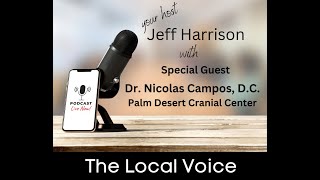
A Local Voice YouTube interview (Mar 31, 2023) where host Jeff Harrison interviews Dr. Nick Campos about chiropractic care — especially craniosacral (cranial sacral) chiropractic — and its role in treating headaches, dizziness, TMJ, sleep problems, balance issues and sports-related injuries. Dr. Campos describes his background, recent move to Palm Desert to continue the practice of the late Dr. Curtis Budding, and practical advice on maintenance, prevention and functional wellness.
Questions this video answers
23 years.
He moved to Palm Desert 'last fall' and has been practicing there since February (following a January death of the prior doctor).
January (year implied by context).
323-359-1032.
DrNickCampos.com (also referenced as drnickcampos.com / DrNickcampos).
Chapters
Foreign.
Hey, welcome to another episode of the Local Voice. I'm Jeff Harrison, your happy, friendly host. And today I have a. I have a very unique guest today. When I say unique, I don't mean, like, you know, he has three arms or four legs. I'm not talking about that. He has a unique place and a story in my life because as a young man, I was in a bicycle accident. I was 13 years old, went over the handlebars of a bicycle, went through a windshield of a car, out, and then crashed into.
The curb. And of course, at 13, yes, I have some gray hair. So it was a while back this particular profession wasn't looked upon as a go to. And over the years, as I continued to get older, I was about 20 years old at the time, and I got to the point where I could barely breathe and my back had always hurt and whatnot. And so I went to this profession as a chiropractor, and this person actually changed my life. I could breathe again. I could stand up tall again. It got to the point where I really could only sleep on the floor on a really hard surface. And, you know, it works if I. If I, you know, I live in a cave or something, but it doesn't work on a normal basis. So I'm really excited to bring aboard a guest today. His name is Dr. Nick Campos, and he has a location here in the Palm Desert area called the. Let me just get this correct. It is the Palm Desert Cranial Chiropractic. Please give us a very strong welcome for our local voice. Welcome for Dr. Nick Campos. Dr. Nick, welcome. How are you today?
Hi, Jeff. Thank you for having me. I'm great.
Hey, I'm happy to be here. I'm happy that you're here, as I hear. I don't know if I told. If I don't think I'd ever mentioned that story about my relationship with a chiropractor. So I've had a love relationship, not a love hate, but a love relationship with chiropractors over my lifetime once I found out how important they are and really helping me be my best. And before we get started, though, take a second and tell us a little bit about you and kind of your journey and just so we get to know a little bit about you.
First off, that's an amazing story. I did not know that, and I'm so glad you shared that with. With your audience. I have a similar story which I'll probably get into, but I'm a doctor of chiropractic. I've been practicing for 23 years. I still maintain a practice in Los Angeles. But last fall I moved out to Palm Desert. I started working with a doctor who is. Was well known and loved in the Coachella Valley. His name was Dr. Curtis Budding, and.
He was not only renowned in the area, but he's somewhat of a legend in my, my profession, my industry. And, and the reason being because he did a special type of chiropractic called cranial sacral chiropractic. And I also do this same type of work. And so last fall I came out to the desert and started working with him, mostly because he was planning on retiring and we were getting things together for me to come out and fill that void. Because, I mean, he'd been in the desert for, for the last 20 years serving the Coachella Valley, and.
Thousands of people have come to him to receive this, this very unique, deep healing type of chiropractic care. As it turns out, sadly, he. He passed away very suddenly in January. And so I really did come in to. To fill this void that was left in his. In his absence. So I've been in Palm Desert, practicing in Palm Desert since February, and things are going great. I love the Coachella Valley and I'm here to help people with their chiropractic needs and their craniosacral needs as well.
You know, Dr. Nick, that is. That's amazing. I think it's amazing because while I'm very sad to hear about the circumstances with your. I would say, you know, somebody you knew very well and a strong name in your profession pass away so suddenly and. But you. Things happen for a reason. That connection that you made to come out, to carry on that whole process. If you could take a second and tell us a little bit about. Not a second, but tell us how what you do is different than what we think of normal chiropractic care. Because I've never heard it called cranial. You called it cranial what?
Cranial sacral chiropractic.
Yeah, cranial sacral chiropractic. I've never heard it talked about in that form. How is that different? I'm curious.
Well, let me start by saying that I do traditional chiropractic care. That is a part of my repertoire. But cranial chiropractic works on the deeper levels of the spine and the nervous system by working with the cranial sutures, which are the attachment points of the cranial or skull bones. And so by realigning or readjusting these sutures, we affect the nervous system at a Much deeper level. And so we can really help people with issues such as headaches and dizziness. A lot of TMJ issues. Tmj, Pain, clicking.
Wearing down of teeth. We've worked very closely with dentists in the area.
Any sort of balance issues, and I like to say any type of symptom that seems unusual that isn't really being helped by traditional chiropractic or any other traditional musculoskeletal care. The cranial sacral is extremely powerful and gentle healing technique. And that's why so many people were coming in to see Dr. Budding, because the cranial is. It's an extremely powerful technique. So it's very gentle, very light, no rapid or forceful movements, no cracking.
And extremely relaxing. I think that's what many people experience is walking away from a treatment, just feeling relaxed and symptoms improving over time.
You know, as you describe it, I mean, that's about, you know, 92% of everyone I know. You know, a balance issue, headaches, tmj, that type of thing. And typically, we wouldn't think, well, I need to go see my chiropractor. Right? We think, hey, I need to go see a, you know, ear, nose and throat specialist or whatever. Yeah, this. This whole thing about cranial sacral and. And the attachments of our brain, I'd like to get a little bit more into that. Understand that, because we think of the nervous system, you know, going to our brain, down our spine, and that's where we need the alignment, is our spine. But it sounds like when you're doing that type of adjustments, if that's the right terminology, correct me if I'm wrong, is it's really not in our spine. Is that correct? Yeah.
Well, okay, so there can be spinal misalignments, but the way that the cranial sacral works is we're working on the meninges, which is the.
Connective tissue covering or sheath around the brain and the spinal cord. This sheath or covering has attachments in the cranium as well as in the sacrum, along the spine as well. But those are the two primary areas. So as we affect the cranial sutures, we're affecting that. That sheath that. That surrounds the nervous system. And when there are fixations that occur within this sheath, it can prevent the free flow of cerebral spinal fluid that happens when. From the cranium down to the sacrum. And so we're rebalancing that system to allow the nervous system to operate the way that it's supposed to. The difference between what we're Doing. And the. The traditional medical care, which is sometimes necessary. But there are cases where traditional medical care doesn't help or clear up whatever neurological issue is happening. And that's because there are misalignments and some imbalance happening in the nervous system and in the cranial vault and sacral sutures as well.
You know, I'm just a kid from West Texas, so I'm going to try to break this down real simple, make sure I understand this correctly. So imagine the water line coming from your house. That's. That's the. The city line. Right. That's where they're going to turn the water off and on.
That's a sucral. Right, right. Okay. And then. And then you have the line coming in the house. Let me call that the spine. And then we have the connections in the brain. Right. So let's call that the faucets. So if. If those two connections on the end are not right and your spine is okay, you can still have all these issues that we may, in typical allopathic medicine, may overlook. Is that correct?
That's exactly right. It's a wonderful analogy. That's exactly correct. So we're essentially opening up that flow. Open. Working on the faucets at the end to open that flow through this, through the system.
Well, kind of talk to us a little bit about what kind of results do you get? Because I remember hearing, when we were talking off camera, you know, you also had some time in sports medicine. Does that play into that? I mean, let's face it, I was. I was watching and playing in a pickleball tournament yesterday, and there are a lot of people who make me look young that are out there, and they're like the weekend warriors and they're playing. You know, the grandkids would be like, oh, you don't do that, Grandma and grandpa. No, they do. They're out there diving for balls and things like that. Is this something that. That the generation here in the Coachella Valley, which is made up of a few more of us that have gray hair than normal, that we can benefit from?
Absolutely. So I am a trained sports chiropractor, and I spent much of my career working on sports injuries. And you now, I've been trained to work on athletes, but I always say that everybody is an athlete in the game of life. Whether we're talking about people working on their homes or housewives, the movements that we're doing with our bodies take on certain stresses that just need to be alleviated. So I also work on things like shoulder issues and knee issues. And you know, the idea is to get people back into living the lives that they love. So whether that's working on their businesses, spending time with their families, running around with the grandkids, or being back on the court or the golf course, I do work on people's sports injuries to get them back up and running and playing. And of course the cranial sacral only enhances that because without a free flowing optimal nervous system, you're the rest of your body. The muscles, the joints aren't going to operate at their highest ability, at their optimal wellness.
You know, Dr. Nick, I'm married, so there's often times where my wife might say I'm a little off balance or maybe I'm not playing with a full deck. And we'll give her credit because she's a very, very smart woman because she married me. But at the same time, how do we know that it's something.
That has more to do with the cranial sacral versus allopathic medicine? What kind of signs show up, I know you talked about it a little bit earlier, but what kind of signs might show up that we say, hey, I need to call Dr. Nick?
I think that chiropractic is the perfect gatekeeping healthcare profession out there because.
We do look at the body in many of the same ways as the medical practitioners. So you know, we, we are looking to see if there are underlying organic issues. If we need to refer somebody out to an orthopedist or to a neurologist.
We'Re gatekeepers. And so really the, the, the chiropractic doctor is able to make a determination of whether your case is a case that can be helped by conservative care, which is what we do. And conservative just means no drugs, no surgery, no injections. It's long lasting, it's natural, it's effective. But if you do need a referral out to a neurologist or an orthopedist, a good chiropractor is going to be able to do that. So really it comes down to the assessment and the evaluation.
Well, I love the idea, that analogy of a gatekeeper because, you know, we think about, when we talk about business in general, we say, hey, there should be certain people in your life, like you should have an attorney, you should have an accountant, that kind of thing. And when we talk about optimum health, I mean, I always like to refer to optimum health. I don't want to just be average, I want to be optimal. And not just for my age, but at the very best that I Can be. And so when we talk about you as the gatekeeper, are there other components that we should be looking at that you have in your experience, in your years and your profession said, hey, these are some people you should have in there. Is it like a nutritionist? Is it somebody we work out at the gym? Those kind of things?
Actually, both of those things are great. So I've actually written a book called the Six Keys to Optimal Health. And the premise of the book is that there are six major areas of health and wellness for your physical body, and they are diet, nutrition, physical fitness and movement, sleep and recuperation body work, which includes chiropractic, massage, acupuncture, mental health, and then minimizing toxins. And toxins are going to be anything that you're putting your body that's not food, so alcohol, recreational drugs, some medications, pharmaceutical drugs and so forth. So anybody, any professional that can help you in those areas, a nutritionist for the diet trainers or, you know, Pilates instructors or yoga instructors for the physical. And if you're having sleep difficulties, chiropractic can certainly help. Cranial chiropractic can certainly help with that. But again, you know, you can be referred off to another practitioner if that's what's necessary. So all of those areas can use or utilize a practitioner that would be wonderful for your overall wellness.
When it comes to. Tell me the name of the book again. It's. It's six.
It's called the Six Keys to Optimal Health. I just want to put that on my website. Or you can get it on Amazon.
We just.
Just want to add that real quick so that if anybody's asking about Six Keys to Optimal Health and you say you can get that on Amazon. Absolutely. Or your website. Website. And the website is across the bottom. It is. It is. Nick. Excuse me. I did have it up there. Dr. Dr. Nick dot com. Let me just pop that up there real quick. That way we can show that. There we go. And a phone number on there as well. Now, so, so this, this whole process, I look at your phone number. 323-359-1032. It makes sense now because it sounds like this sudden change here to come to the desert full time. It wasn't really designed for that. It was going to be a little bit of more of a baton handoff and there was going to be this Runway, but it sounded like it was, hey, you got to bend over and pick up the baton. Is that right?
Right.
Yeah, yeah. Plus it sounds like, you know, hey, we live in an age of of cell phones, of, you know, why would you ever change your cell phone number? Right. Everybody knows your cell phone number, so that's true.
So, yeah, you can reach me directly at that line. That is direct line to my services.
Great. Dr. Nick, tell us a little bit about something that maybe the average person walking in that doesn't know about what you offer, whether it's from traditional chiropractic care to sports chiropractic care to the cranial sacral. Tell us a little bit about that and some of the, as we say, the frequently asked questions you might get that people ask that maybe we can help shed some light on today.
You know, I'm often asked what my ideal patient or client is. And for me, that would be the person who understands the value in maintaining and optimizing their health by utilizing chiropractic, by utilizing nutrition and fitness and so forth. And so they come to me to prevent any illness or, like I said, to optimize the health that they have. However, the reality is that most people seek me out because they're in some sort of pain. The, the role of the chiropractor, my role is to determine what's the source of the pain.
Is it something that can be treated conservatively? Do we need to offer other supports like orthotic support for the feet or maybe an elastic belt support for the pelvis and sacrum, in some cases a low back pain? And that's really where, you know, the doctor comes in. It's, it's the one area where we know we're not going to be replaced by AI because it's, it's a complex activity. It's a complex function for us to make these determinations based on the type of pain, the symptoms and so forth. So really, I think that the, the, the unique element is that I, I really am able to take a strong look at what's happening and have a good sense of what every individual needs, whether it is traditional chiropractic or it is a sports injury situation, or it's cranial sacral chiropractic. So that's really the, the essence of.
It, you know, as, as it seems to be evolving. And over the years, I've had the great opportunity to speak to many doctors on our show and have them as clients and friends. And one of the things I've noticed is this term functional wellness medicine is really starting to come in. And as I hear you speaking.
You are an integral part of functional wellness. Because let's face it, if I'm not able to do What I want to do, your work can get me back there. That's getting me back functional.
That's right.
But one of the things that, you know, that I try to do, as an example my wife and I try to do is, is as you're talking is let's stay at optimal levels. You know, do the exercise, make good choices of food. Talk to us about what type of. If I came to you and we were in good shape, okay, and with the exception of the gray hair and bad eyesight, what, what would you tell us to do would be a regular maintenance to keep us at optimum level from a, let's face it, from a structural standpoint.
Let me start by saying that what you've just touched into about function is, is really.
Everything that's, that's the foundation. Everything comes from function, how you're operating. So pain is really just a warning signal. Most people come to see me or other chiropractors or other practitioners when they're in pain, but once you're in pain, the function of your body is already being compromised. So it's really about getting you back to functional operation.
I would say that the things that you can do that are probably at the very top level would be get regular chiropractic care to make sure your joints and your spine and your nervous system is operating at its highest potential.
Then physically. Obviously, exercising is a basic. But I really love yoga. I think stretching is a major, major.
Value to any individual. I don't, I don't know what my life would be like if I didn't stretch regularly over. You know, it's been two and a half decades for me now.
And you could start at any time. You know, I know some people get discouraged by that idea because they say, I'm very stiff. I haven't stretched my whole life, but it's massive. So, I mean, I would start now because you'd be surprised at how far you'll get in a six month or a year period. And then, you know, trying to eat the best, most healthy way that you can. Whole natural foods, drink lots of water. If you can supplement, that's also a great idea. But those would be the primary things. Get the regular chiropractic care, make sure that you're stretching and exercising, and eat to the highest level that you can.
You know, that's. That seems so easy. You know, it's one of those things to say. It's. It sounds so simple, but it's not easy. You know, sometimes it's easier to change the oil in our car every three months or 3,000 miles than it is for us to get chiropractic care on a regular basis. You know, I don't change the oil on my car only after black or white smokes rolling out of the back, right. I say, oh, that little tag says that. I wish we had a little tag that would remind us, hey, you need to get in to see Dr. Nick because, you know, it's just good. It's just good, regular maintenance. Do you like playing at this level or do you have to drop down to this level to, to say, oh, I better go see, you know, whoever it is in this case. Dr. Nick Campos.
Why is that so difficult for us? Is it just something we've always been taught is we just, we just kind of go through life and until we're broken, if you will, or, or disrupted, we just kind of keep on going?
You know, that's an outstanding point. And because most people want to spend their time doing the stuff that they love that, that they find value in. So for some people, it's, you know, their work and the service they provide to the world. For other people, it's being with their families or, their, you know, their, their, their relationships, their friends perhaps.
You have to see how the way you physically function affects every element of your life. And so when the body breaks down, you're going to have a harder time working, you're going to have a harder time having peaceful, pleasant relationships. It's very hard to focus on life outside of pain. Anybody who's ever been in pain knows the truth of the statement I just made. When you're in pain, that's what's on your mind for a lot of people constantly. So the more that you can relate it to what you love.
The more powerful it is. The more of a inspirational factor it can be for people. I have programs in my practice that make it easy for people to do a wellness based program with me. And your listeners can call me. I'm happy to talk to them at any time to explain these programs. And they can get set up on a wellness program where you get your reminders and, you know, we get you coming in regularly. That's. And of course, it's. Sometimes we need the reminder in my office.
We provide that.
You know, that's good news. And just an FYI here for those who are listening to the program and they're not seeing it, it's Dr. Nick Campos today of Palm Desert cranial chiropractic. He's at Dr. Nick N I C K Campos C A M p o s.com he can be reached at 3233-1032. That's 323359. 1032. There's nothing more value. In fact, it reminds me of that saying that says the man with good health has a thousand wishes, but that person with poor health has but one. And if you find your wishes diminishing and you just get up and just think, gosh, I wish I could have better health. I wish my feet weren't hurting. I wish my back wasn't sore. I wish I was. Then it's time to reach out to Dr. Nick and reach out to him not tomorrow, but today. Call him at 323-359-1032 and get on the swallowness program. I love what you said. I apologize for not knowing that. That's exactly why you're here today, to help us get on a program that keeps us at our very, very best, playing at the highest level in our life that we possibly can. Because, let's face it, you know, as I said when we first started, you know, there are people here in the desert that are older and you know, the joy of getting down and playing with your grandkids or your kids. Grand kids. Kids. I guess that would be your grandkids, your children's children's kids. That's the great. Grandkids is still the number one thing, you know. And if you can't get down and do that.
That robs a joy from your life. And so I really encourage you to do that. Hey, before I let you go today, Dr. Nick, I have a little fun part. We call it the lightning round. And I just like to ask a few questions. It kind of gives us an insight of. Of really behind the scenes of who Dr. Nick might be. So if you. If you'll play along, I just have four or five questions. Is that all right?
Of course.
Fantastic. So our lightning round. It's usually just one word or a sentence. You let us know, are you a morning person or a night owl?
I'm a morning person by default, but I think on my natural rhythm. I'm a night owl.
How do you function with that? How does that work?
I have to go by the default.
Oh, gotcha. Do you prefer Italian or Mexican food?
Definitely Mexican. It's my favorite.
I love it. There you go. Do you have a. Do you have a favorite of Mexican food?
I love enchiladas.
Oh, there you go. I love it. Cardio or resistance training?
I like both. At different times.
My unsatisfying answer.
Yeah, Dr. Nick is going to be a politician one day. Great answer. All right, so this is my last one. Netflix or Hulu?
I actually don't watch TV. Can I say YouTube?
Sure, absolutely. YouTube University. I love it. YouTube and Twitter. Great. Well, speaking of that, Dr. Nicholas, thank you for being here today. I really appreciate. You've been a fantastic guest. You've really shed some light on this whole idea of what you do. Before we let you go, take us through your reach. You know, how do we get in touch with you? What's the best way? And really your ideal client, that you could help us, and then we'll. We'll say goodbye.
Jeff, thank you so much for having me. So you can reach me at 323-35910 32. My website is Dr. Nickcampos.com I have lots of articles there, services that I provide.
The number I gave you, though, is the direct link to me. I will call you back and I will give you the time to speak about whatever your concerns or questions are. You can email me as well. DrCampos2002 Yahoo.com Dr. Campos2002 Yahoo.com I just. I'm here to serve the Coachella Valley with chiropractic care and craniosacral, and I'm. I'm here to help people with their aches, pains, any weird symptoms like inability to sleep, headaches, dizziness, anything that you have tried everything else and you're not getting results, please come see me, come talk to me, call me. I'm here to answer any of your questions. And Jeff, thank you again for having me.
You bet. That's Dr. Nick Campos of Palm Desert Cranial Center. And, you know, I just. I have to say one thing. Full disclosure. Dr. Nick is part of my. My networking group called BNI, and already he is helping so many of the members who, quite frankly, have been a pain in my neck. Now they're no longer. He's taking care. No, I'm just kidding. He's. But. But the referral, or, excuse me, the. The feedback they're giving, the testimonials of how quickly their life is changing. We're not promising miracles, but sometimes a little. A little adjustment here or there can make a big, big difference. So I want to thank you for that and really reach out to Dr. Nicholas Campos and get some if you're in great shape. Fantastic. I'm not saying it's going to add 25 yards to your drive, but it might. It might. It might be the one thing holding you back. It might get you to bend over and see the line of your putt a little bit better and you stop pulling or pushing it offline. So give Dr. Nicholas Campos of Palm Desert Cranial Chiropractic a call at 323-359-1032. Dr. Nick, thank you again for your time. I really appreciate it and you've been fantastic. And I want to thank you for joining us for another episode of the Local Voice. I'm Jeff Harrison, your humble host and where we actually help you as a local business owner find and get more ideas on how you can attract your ideal customer. So if you have questions about that, you can get hold of us at Swing Point Media. Thank you so much and have a fantastic day, everyone. Bye. Bye.









