How To Create and Use Opt-In Forms on Your Websites for Small Businesses
A workshop-style YouTube presentation (speakers: Andrew, Alan, Jeff) that reframes email opt‑ins as "party starters" and surveys practical opt‑in offers small businesses can use (ebooks, workbooks, e‑courses, checklists, audio/video, physical products, rolodexes, downloads, members‑only content, consultations). The session includes implementation advice (landing pages, Mailchimp autoresponders, segmentation) and a live hot‑seat applying the ideas to a speaker/consultant (Alan).
Chapters
All opt ins. Party starters. Party starters. Party starters. Party starters.
Say that in English.
There you go. You can read it online. Party starters. So what I call a party starters. I don't like the word opt in. I think opt in is too boring and too generic. So here's why I like to call this party starters. Imagine you're going to a party and you come along and there's someone who brings out hors d' oeuvres or someone who brings out chips and dips, that sort of stuff. That's what I call a party starter. It's getting people enticed and getting ready for the party. This is what an opt in to me is also like. It's the ability to get people warmed up to your website. So they come along, they're checking out what you're doing. Let's get them involved a little bit in the party. Let's get them eating the chips and dips, get them having a drink. This is what an opt in for me is. It's like get in there and see what I've got to offer. Come and check out what my party is going to be all about. Does that make sense? So I like to call it a party starter. So I'm going to go through today a number of different party starting ideas that you could use on your website. So if you've ever thought about or if you're starting to think about what could I possibly give that's valuable for my readers, then I'm going to try and jog your ideas with some of these today. Is that okay?
Yes, Ellen, My thought is that for value you might give something that you empathize with your reader that's in their industry or business and you find it out from an association and you send a quote about profit margins or advertising or something.
Great. I'm going to go through some of these today so see how that fits into what you just said. And you get some ideas from this as well. All right. Are you ready to begin? Ready. Sounds so excited. Coffee in here please. Alright, so let's check the first one out now, the age old one that's been around forever is an ebook. How many people have got an E book on their computer that they've never read? I've got lots of them. Ebooks were great. They were interesting initially, but now they seem to be a bit passe people. Ebooks are everywhere. They're not as valuable as what they used to be. Some industries, they're still very good. Depends on what industry you're in. If you're in an industry that hasn't really had many ebooks presented to it, then you may get some good. You may get some good opt ins or party starters from ebooks. But essentially an E book can be anything from two pages to. I've seen ebooks that are a thousand pages. Now, for a free ebook, I would suggest that it'd be pretty short. People want to consume stuff relatively quickly. Okay, so have a think about how much information you're giving as an opt in. Can you guys see that? Okay. Yeah. Okay. So this was just an ebook. We did find our customers. It was essentially a Word document that we turned into a PDF. We've got a nice cover over the top, so it looks like it's something that's more substantial than just a three page or ten page document. Okay. So it can be pretty straightforward. So that's an ebook. Digital workbooks. Digital workbooks.
What did ebooks give way to? What's the update of that?
I'm going to go through all seven or eight things here that you could use. So ebooks still work, as I said, Alan, in some industries. And it's up to you what you want to do. And one of the things that you want to check is test and measure, test and measure what's working. Put an ebook out there and if no one's opting in, your opt in rates drop down. Maybe you change it to something different that I'm about to show you here. Okay, Robert is confused. Are you thinking good things or bad things? Thinking what am I doing here? Okay, so a free digital workbook can be a great thing to have as an opt in or a party starter. Now a workbook can be something where you may be presenting an idea. Let's say, Ellen, you're presenting about public speaking, okay. And you have a couple of ideas that people should follow in order to make a good presentation. So you might say, I'm going to release a workbook. So you may give them some instruction on the page and then some questions and answers that they need to fill in specifically to their presentation. So you've got the ability to let them download this. And this would be similar. Now this is a physical book. I'm scribbling copy of a physical book. But it could be the same sort as an ebook. But a workbook gives it a different feel than just an ebook. If I said to you, what would you rather have, a workbook or an ebook? Most people who would say workbook, who would say they prefer a workbook, who would say they prefer an Ebook, it just going to depend on your market.
And is one of the advantages that we can add new chapters?
Absolutely, yeah. You can create these. These are all digital. Remember all this stuff that I'm giving you is digital, which means that it's changeable at the drop of a hat. If you find that the workbook has got a mistake, bang, you can change it and upload the new one like that. You don't have to go through printers, you don't have to go through a whole range of waiting to get it fixed. There can be stuff that can be done. And creating these ebooks are very simple. It's basically a Word document that you turn into a PDF. Okay. So it's not a hard thing to do. So a workbook is another option you can use. Next one is a free E course or a workshop itself. Now this is one of the very first E courses I did about six years ago when I was just starting out on doing some of this opt in stuff. And essentially, I mean, it's pretty crappy graphics, but you know, it looks like it's a solid amount of content that I've got for this E course. All I did for this E course was a series of 21 emails, 21 different emails about different topics. So it wasn't a downloadable option. But when they signed up for my E course, all they got was an autoresponder. We've spoken about autoresponders that just delivered an email every couple of days. So when Alan signs up for my E course, he would get the first day on day one. And there might be, let's say it's how to get online a couple of days later. Automatically. I wasn't sitting there, oh wow, Alan's gonna get an email today. It was all done automatically so that it was sent out for day two. And the next day two might have been how to get on social media. Day three might have been the pitfalls of YouTube. So you, you got that automatically delivered whenever, whenever you signed up. Now this could be good. I would never do 21 days again because it's just waiting too long. 21 days is way too long. But you can do a quick, you can do a three day E course for people on your topic. What would be a topic that you could do an E course on?
Travel. Okay, so travel tips. So it could be how to pack, how to pack for the perfect travel voyage or whatever it may be. So it could be tips like that that are giving them a little course on what to do every, every day. You can Do a three day. You can do anything you like, Ellen. It doesn't really matter how long it is, but once again you want to make sure that your market is happy with that link. Your market may only put up with 3 days, whereas Les might put up with a 10 day course. Does that make sense? That's an E course or a workshop. You can call them either or sometimes it can be a workshop that's delivered. And in a workshop, the only difference is you may be getting them to do some stuff inside that email. You may get them to do some exercises in that email. In my E course I didn't get them to do any exercises per se, I just gave them some information. Does that make sense? Yep. All right, so let's have a look. Cheat sheets and checklists are a great one here. So cheat sheets. In the case of travel, it could be a checklist. Checklist for. Oh, there you go, there is one there. Look happy. Right up your alley. There you go. There's a camping checklist. Now you could say, hey, opt in for my camping check. If you're a camper, opt in for my camping checklist. Make sure you've got all these items on here because people want lists, they like lists to check off. It could be a five star hotel checklist. Make sure your hotel has all these things to enjoy the perfect holiday. So whatever your industry, whatever your market is looking for with cheat sheets, Alan, it could be the case of does your presentation.
Have these items in it? And make sure there's a cheat sheet to see what some of those presentation terminology means. Or in Larry's case, there may be regular expressions for mobile industry. What is a mobile website? How does a mobile website work? So it could be like an FAQ or a cheat sheet for people to keep up to date. I know that when I start I still have a cheat sheet pinned to my wall about how to code video. There's a program I use, but I don't use it very often. I use it maybe once a month. And what I do is I have to put certain check boxes, there's certain things that I have to check and mark to make a video the way I want it to, to turn out. I can't remember what it is. So I use this cheat sheet that they sent me and stuck it on my wall. So every time I need to do it, all I do is just look at my cheat sheet to help me get through that.
You cheat on the cheat?
Cheat on the cheat sheet? Yes. I was thinking, how difficult would it be to Set an opt in where you have a menu of items to select from. So you can offer several things. Offer a workshop. You could, you could have that. I would do it in a case of where you've got different opt in itself rather than one opt in for a selection because somebody may want to. Now here's the thing, just a little technical thing, is that a lot of email responders, when you opt in for one list, it won't let you opt in again for the same list because we'll say, hey, you're already subscribed to this list so we don't want to send you in case you accidentally subscribe twice. I don't want to send you two emails so they'll only send you one. So let's say in your case you've got.
Opt in here for an evaluation checklist and then down the bottom you may have a opt in here for the 10 things that an appraiser doesn't want you to know. Now I may want both of those. Now the good thing about having two opt ins is that you can start to segment your audience. For people that like checklists, I might start sending them emails about this because maybe they're not interested in appraisals, but if I'm in both, then I may be interested in appraisals and the checklist that you've got as well. Does that make sense? So you can have more than one opt in on a website? You can have as many as you like. Good question. Any questions about cheap sheets and checklists? Yes. Do you have an opinion on whether the check boxes actually visually offer more information? It depends. It depends on. I mean, sometimes there's just a little line, like an underscore where they can just check it. Sometimes it's just a list, sometimes they don't need to. Like camping, they may print it out because they don't go camping that often. So they may print it out so they can check, check, check to see if they've got it all. It may be that it's just a list of things for people to do and they just need to go through it visually. Like I've seen checklists for social media posting. Now that's an every week occurrence. Every week you need to do these items. So you wouldn't check, they don't want you to. You wouldn't want to print it off every week, you just want to have it on your wall so you know what's going on. So in that case I wouldn't bother check boxes, I would just have the list of things there.
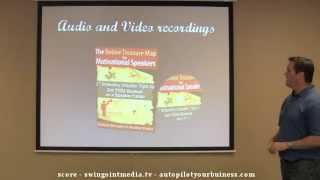
It just depends on how your market are looking to use that. Okay, any other questions about checklists and cheat sheets? All right, audio and video recordings. Now here's one that's really working well. If you've got a video that is important to your industry, then we're finding the opt in rates for videos and audios are much higher than say for instance, ebooks. Now, a video doesn't have to be a long video. It doesn't have to be an hour long. It could be just a five minute video. It may be in Larry's case, it may be the benefits of mobile marketing and how your site could look if you used Larry's services. So the video may be only a five minute video, but it could be super quick. But it's very valuable for people. We're finding the longer the videos, the less likely people are going to opt in. Especially if you tell them how long it's going to be, they'll opt in, but then they won't watch it. If they click on it and it says one hour and three minutes playing time, people go back to it. But you can check with yourself right now. If you've ever looked at a YouTube video and you looked at it and seen how long it's going to be and you said, you know what, I don't care about the content. The time tells me that I'm not going to watch this. So have a think about this. The idea of an opt in is to get people started at your party. It's like, how do we get them involved? Once they know what you can offer, then they can, then they can start to look at more information. In this case here, this was a, this is our book. We wrote a book here called the Online Treasure Map available on Kindle and Amazon. And what we did was as a side note, so on Amazon, when you sell a book on Amazon, on Kindle, you don't get to find out who buys your book. Amazon don't tell you, they just give you the sale. They give you the money in that too. So what we did was we recorded our book as an audio file. Now there's a trick on Amazon, have you ever seen on Amazon where you can actually read the first 10% of a book? It says read, look inside this book. So what we did was inside the first 10% of this book. We made sure that we had a call to action that said, hey, get the free audio download of this book. Now there were some tight arts out there that said not going to pay 99 cents for this book, or a dollar or $3, whatever it was on Kindle. But we'll take the free download, which is what we wanted them to do. At the end of the day, we wanted to get them on our list. So people said, oh, we'll click on this link. They went to the link and here's the free audiobook. It's pretty much exactly the same as what the book was, but then they signed up for our free audio of the book. So we're able to collect their name, their name, our name, their name and address on our opt in page instead of them selling the book, which we found was more valuable for us for their email address than was the 99 cents that we sold the books for on Kindle. So that was what we did with this. So this is just, I mean, there's no CD involved as an audio. It's just as simple to say, hey, this is an audio, rather than actually you're not getting a delivered DVD or a cd. It's just an audio play. As soon as they click on their email address, we send them the link and they can listen to the audiobook from there. So audio and video have been working really well. You know, it's not too hard, but it has been proven to be a really good.
Party starter for us.
Let's see what's next. Physical products. Now, this one can be a little tricky because it's going to cost you money. Even if the physical products are free or it doesn't cost you any money for physical products, it's still going to cost you money to send out. The trick with this is to know your figures very well. So if you know that, let's say, for instance, I was a fitness trainer training for fitness, and I was able to go and buy a pedometer because I knew that clients wanted a pedometer to see how far they were running or how. And let's say that I could buy that pedometer for maybe $3 in China, but they probably would sell for 20 or $30 over here in the US if I could buy a $3 pedometer and know that my shipping and handling was going to cost me $5, how much is that going to cost me altogether to ship that? $8. Right. So if I knew that the lifetime value of a customer or an opt in person was, you know, 150 to me every time somebody opted in, then it would make sense for me to say, you know what, I'm going to give away a pedometer. It's valued at $30.
I'll even pay shipping and handling knowing that that opt in down the track when I market to them properly could be worth two or $300 to me later. Who would spend $8 to get $300? Yeah, so think about, think about what physical item you could use as long as it's going to be worth and as long as you know how much your lifetime value of a customer is. I don't want to get too technical about that, but just saying that it's a good option. People really like physical things. Just understand the great thing about physical things is you also get their physical email address, their physical mailing address too because they have to give you that address in order for you to send it, which is super powerful down the track for offline marketing as well. Any questions about physical.
Okay, here's another cool one. Personal Rolodex. Now personal Rolodex can be really good if you're a coach or a consultant or you've got contacts that people want to know. So if I was a coach, let's say I was a coach of Internet marketing and I said, you know what to opt in here or get the party started here. If you give me your email address, I'll give you my list of people that I use for my social media graphics, my web design, my printing design and blah blah blah. It could be valuable for people who are looking for that sort of information because it's going to eradicate you looking for those sort of people if they know that I'm going to give them my personal Rolodex. It could be valuable for some people. So you can think about who do I use? Can I use people's names and contact number? Make sure you check with them first to see if they can take on any extra workload. But it could be something that you could use as an opt in. Does that make sense?
So you share sources?
Basically, yeah. It could even be on that note, Alan, it could even be just tools that you share as well. It may not be people, but it may be. It's my personal Rolodex of website tools that I use for my business and you should too. Here it is.
All right, this one's fun. Downloads and printables. Now this is going to depend on your industry. Now in your case, you may want you could do some fun downloads of your images that you've got if you wanted to give them away. Maybe just like a PDF sort of thing. But it could be shiny, glossy sort of images that people may want to download and use on their walls.
In this case it is an animal Alphabet from a opt in from a kids club. But it was effective, it was nice and shiny. They got it, created a high graphic end designer created it so that they could print this out and stick it on the kids walls. It was valuable, something valuable for that particular audience. How could you use something like this for your people? It could be in the form of the cheat sheet as a. Well, you could mix a cheat sheet in conjunction with a nice fun downloadable sort of thing as well.
You do it on a link.
Yeah. So this would be on a link. So you'd have this on a. You'd have this on your website and then you just direct people to a page that they download here. Yep, it could be. It could even be something that's really cool like an infographic too. If the infographics worth printing out, it could be something like that as well. Any questions about that one?
Alright, I think. Whoops. Couple more left. Members only content. Now if you have a membership site, you've got people who are paying you a premium for your content. It may be worth saying to people that are new to your site, hey listen, I've got some great content. People are paying X amount of dollars for this, but I'm going to give it to you for free. This is my best piece of work. People want to know if they can get in exclusively without paying. It's a deal. So they may want to be able to get in and get some free content that you're delivering that other people are paying for and they get for free. So it can be a very valuable way to get people opt in as well.
Consultations. If you're a consultant or giving your time away as a service at any point, it may be that it's a free consult. Now it doesn't have to be a full consult, it could be just a shorter period. I had a lady who was a lawyer, she was at an expo for startup businesses and that sort of stuff and her target market were entrepreneurs and small businesses. And what she was doing at the expo was giving away free 15 minute consults for her lawyer for her legal practice and she was getting a lot of people signed up and basically it was more of a hey, get in, come and chat to me. I'm not going to charge you for my consult if you've got some legal issues. I specialise in divorce law and that sort of stuff. If you've got some issues, come and talk to me. So she knew that she was setting herself up for a bit of a busy time. But she knew that of every five people that she had at consult, she could close three people and become a new customer. So it was worth her time anytime. And you can set the time frame. If you want it to be an hour, you can be an hour too. Just be aware you're going to have to spend your time doing that consult down the track, but it could be a great way to opt in for it as well.
All right, I'm going to wrap up here. Here's an action step for you. I want you to take this away and then we're going to go jump and do some hot seats. I think in a minute, come up with three things that you can use as a party starter. If money or time with no object. So you can take this home and think about this and think about how else could I use this sort of stuff.
Before we go into the hot seat, does anyone want to just give me a couple of ideas on what they've thought about in the last 20 minutes, about what they could use on their website as an opt in list of how to prepare for when the pager comes to get the best result? Great, good. How long would that list be, do you think?
All on one page? Yeah. Nice, easy, downloadable chart. Yeah, Perfect. Great. Good one, Alan.
I call it an audit for excellence. And they then answer questions or stay statements and they come out with a score. Everybody loves to score themselves and I make it almost easy enough for them to get maybe a 70% if they really think they can get 80 and maybe even 90.
Yeah, right.
So that's a checklist.
Would they have to add the screw up themselves?
Yep.
Okay. Because you could even do this.
It has to be on the link.
So you can even do this. I'm just going to think out loud for you right now, but you could do it. So there's probably programmed, you know, once they've signed up, they go to a page which is just a program page where they enter their details and adds them up. It adds it up for them already as they punch in, it's all online. They don't need to go to a link. I just do it straight away. And then the result pops up and says, hey, you're a, you're a 70.
You give ranges.
Yeah.
You know, choose another profession.
Yeah, exactly. Yeah. Don't bother speaking, don't even talk on the phone. So you could have it. So it's giving some sort of call to action at the same time, you know, if they get a low score you need to call me straight away right here. Don't speak to anyone else.
Yeah. So you can run it so that it's programmed that way. So that gives them some interaction as well. On the flip side of that, I've also seen this done is that they, they go to your website and they enter the scores without even opting in. So it's like, oh cool, I'm going to enter my score, see how good I am. And then when they hit find out my score, it takes them to an opt in pop up that says, hey, I'll give you your score but you need to give me your email address. So you've already got people enticed into it already. Now I really want to know what my score was because it's a really cool thing you're doing. How do I do it that, oh wow, my email address. So they give you email address and you just send them the score.
Is it dangerous?
There can be dangers in it. But I mean I was a really.
Helpful site and I started doing it and suddenly they wanted all this stuff from me.
Yeah, I felt really ripped off. It depends on what you're asking for. A lot of mortgage brokers and that sort of stuff will do it. A lot of companies that are looking for a lot of information from you can make it really, really elongated and really ask for too much information. It depends on what you're doing. In Alan's case, if he's just looking for an email address, then it's probably harmless.
The risk, Andrew, is that you cannot cheat an honest man or woman.
Right.
So you put that aside as long as you stay on the integrity side.
Exactly right. If you're not going to find that email address out to a whole bunch of other people and they're going to say, well, I'm never going to that side again, People say, hey, I got value from it. I got a good score, I got a score. He delivered what I asked for and he's not spamming me anymore either, or he's not spamming me, which is great. Then it's a good thing in some of these mortgage cases they'll send out email after email about stuff.
This was simple site building stuff.
We will help you with these very simple, we'll answer these simple questions for you. So I spent three minutes filling an hour, did it, then suddenly they went in my email address and I thought, wow, so that really bitter tasting on it.
Yeah, once again it's going to depend on your audience as well. They've probably had good results from it. They won't get everybody like yourself. But that's a part of getting the information.
All right. Crushing.
No, I was just going to say, like, how about a report or say an ebook on nutrition basics for me or a report about supposedly healthy food.
That'S not really healthy. Yeah, you could do a quick. Like the 10 healthy foods that you think are healthy but they're not. Yeah. And give them a list of just 7 or 10. These are funny number because funny numbers seem to work better than nice even numbers. Don't know why. You know, think of seven and using the top server. But yeah, you can do that. If that's what. If that's. If that's what you're targeting for the audience, you can do that for sure. All right, Any questions? No, no, no, no anymore. All right. Is Jeff still here? Is he around? Jeff, wake up. Jeff. Thanks. So what we're going to do, we're going to switch over to do a hot seat. Who wants to do a hot seat today? Anybody want to do a hot seat today? Ella, what's your hot se. Perfect. All right, you know what we'll do? Let's get you a chair. Come over here. We'll sit up the front instead of coming back in.
Jeff, are you coming back in? Come back in, Jeff. Now. Alan, have you got a website already?
Pardon?
Do you have a website already? You don't have.
No. Okay, that's why I need you.
Great. Take a seat and we'll talk about this.
Me back in? Jeff, you want to call in?
You can handle it.
Here's his phone.
You can handle it. Andrew.
Oh, you there? All right, let's have a look. So, Ellen, tell us about what your business is and then where you can. Where you'd like to go with what you're doing.
First of all, I'm a professional consultant on finance, and secondly, and more importantly, in fees, I'm a professional, professional speaker. Have been all over the world speaking on finance to associations, corporate executive meetings, etc.
Hold that thought. Hold that for.
I want to add Jeff in here too, because he's got some brilliant ideas about stuff. If he stops talking to Robert.
Well, let me finish it. One of the most successful things that we've done is to have councils of homogenous owners of different businesses like 15 to 50 million in sales. And we meet three times a year and they pay 2,000 a year for just the content of education that I put together, always with an outside speaker on the first day. And they choose when to meet or where to meet. And they then pay their own expenses, travel and subsistence and home hotel. And we then always have a nice cocktail party before the first night and the second night. And this causes a homogeneity that comes about with these people. And the value I'm finding is that that group, and There are only 15 in the group, they become their board of directors when they're a small company. And so they bring their family and their wives to Colorado Springs, to Broadmoor or wherever.
San Diego, etc. And that becomes their board of directors. And we get to the point where we finally share and here's why I come in with some diagnostics or overview. They bring their balance sheet and their operating statement from the current year and that gives more of an opt in. I mean, it goes to the point, what else do you want to know about me, Alan? And so I have free reign. I have to be very careful with that power I get from that. It's not power, just information. So I do that. Then I speak to associations, annual meetings and workshops, and that gets me business. So I then can raise my fees, you know, clear up to $100 a year and charge that way. So that's what I do.
So you don't organize the actual meetups of the groups though, do you?
Yes, you organize that as well, because that's a pattern. I mean, Susie does that. So you know, it's calling the hotel, getting a room, getting the arrangement. And I never buy whiskey from the Broadmoor. I always take my own in with the big boxes.
That was the advice I was going to give about that, actually.
We always have then a nice, a nice meeting or a nice room, a suite where, where Susie and I stay. And then it has a nice living room kind of environment. And they come then at 3 o' clock in the afternoon on the 1st or 4 or 5 whenever they get in. And we have heavy hors d' oeuvres at the hotel supplies and I bring the whiskey, as I found about 10 years ago. They just barbecue you on that whiskey. 25 shots and a fifth. Get out of here. They charge you like this, $700 a sip.
We don't want to disparage the broad. Let's focus on why are you here? What are we looking for? To help you.
Oh, here. I need a website. I don't know why, but I need a website. I guess to be contemporary, I don't know. Everybody has a website. I don't need a website.
If you don't need one, then why do you want to have one?
I'm missing 20% of. Of the people I could reach with a very.
Good database just to add some more people so I can primarily raise my fees.
How are you attracting people to your business now?
Word of mouth. These people I speak to all are members of some association and they go to their own meetings. And I then get the right to go speak to all these people at that meeting and then they say, hmm. And in a room I could have.
150 opportunities to speak in 25 association execs. And all I want is one each year from each of them and they have me back a second year because it's an institute kind of thing. And chapter two is next year and the association gets behind it and so forth. The part I see coming up is writing the staged blogs or data that I'm then going to automatically send out on autopilot. That's ominous. But I'm learning Dragon naturally speaking and I do have the ability to speak. So I can generate a lot of words and edit it down to something you've seen. So that's why I'm here. Plus I like to get coffee and donuts and YouTube.
If you're speaking to a group of people and let's say that.
Les is sitting there listening to you speak and he's like, well, I'm not ready to buy into it right now. I want to know a little bit more. I want to do some research because he's just hearing you for the first time. How can people find out more about it? Or is it just then and he's.
In a fresh audience.
Yeah. Yep. Okay.
If he's in a fresh audience of other people like you, then the best thing that can happen is that then part of the. Either the hierarchy of that association or the king five pins of that industry that are known by everyone come up and give me some authentication by just visiting and they can listen at sort of the periphery. Step under the tent. He then has to listen to this and he then says if George is using Ellen, then maybe I could use Alan or a problem I'm having now.
But if he's. If he's. If he's sitting there listening to you and he likes what he hears but he's. He's still not convinced. Okay, one more step. And maybe he doesn't know too many other people in the room.
All right.
He's like, you know what? How do I find out more? I want to go and see if this guy.
I got you. I have to then do an opt in.
Purchase. Yeah. Yeah. Okay.
First of All I hear you say testimonial, drop my business. I'm word of mouth. You don't need, you do not need a website, but you do need a landing page. And I would put a landing page on there. You know, you know, Andrew can whip one up for you probably before you leave for breakfast tomorrow morning.
Landing pages, it's called landing page.
Think about, it's a one, he's gonna pull one up, but it's a one page website. It's basically what if there's a landing page. So what would happen is there are so many of those that he can use. But ideally it sounds like to me how you convince your customers and quite frankly all of us convince our customers. Put something on there about you put a short snippet of you presenting a very valuable piece of content.
Video.
Yes, a little valuable piece of content. Then what I would do is I would make sure to add some testimonials on there from other people associations and they say if you'd like more information, opt in.
I've got all of this raw data.
There you go.
I have a thousand testimonial letters I have.
I wouldn't use them all on the same page.
Well, some of them are as far back as months.
This is just another example testimonial down the bottom. This is a one of our customers that she does a lot of financial stuff, stuff for women. So here's her little video. You can watch what she talks about. There's a opt in for it right there. And then if you want any more confirmation, she's got one testimonial that you can have as many as you like there probably not a thousand, but you can have a couple there. So that's an example of just a page that she's collecting and running her business from. People go to this first and from there then she can market to these people later.
Do you only have two seconds to get them on the landing page to go on?
The idea about a landing page, you can see here all the navigation up the top here. There is none. You don't want people to suddenly think, oh, I want to go check out. The idea of a landing page is to do one thing and one thing only, and that's opt in to get the party started. You don't want to go, oh, I'm going to see. If this was on their website, they might have the about us and the contact and their blog. You don't want people to go to that yet. You don't want them to go to that. They can go to that later. But the idea is, hey, get them in, get them on the list, and then they can go and explore as much as they like, because you've got them.
Treat them nice.
Treat them nice. Get them into it.
Okay, just one more step. Okay, now, so you've gotten them on that page. Now the next thing is, geez, now where do they go? Well, connect that odd bin to something free, like mailchimp.
Like the chimp.
Like mailchimp.
What?
It's called Mail Chimp.
It's a C H I M. P. Yes.
Mailchimp. Yes. And you can put up to 2,000 names in there for no charge. And you can have autoresponders on there, meaning, hey, if you. If they respond back to you or they. They sign up, it just automatically responds.
Hey, thanks, you're gonna go above my PayPal.
No, no, I'm not. I'm not. I'm like saying, think of a Mailchimp or an AutoResp is nothing more than your phone answering machine at home. It's answering when you're not there. Okay? And you programmed it to say a certain message. I guarantee you, unless you have a different message on your phone if you're going on vacation versus if you're home, hey, I've just stepped away. I'm busy right now. I'm on vacation. And then when you come home, all your stuff's gone. You don't want to put that message on. But my point is, that's all that is. Because if you get them to sign up and then you have no place for them to go, you might as well not even do this, because now you just send them down a deep, dark hole that you nor they can get out of. Okay? So what you want to do is. Hold on for just a second. What you want to do is make sure you connect that to something. It doesn't have to be crazy, okay? Doesn't have to be crazy. You do not have to send out 10 pieces of email to the people every week.
And the nice part is, I don't have to unlearn any of this.
No, you just take what you can do. Is this. Keep it simple, alan, go to mailchimp mailchimp.com mailchimp M A I L chimp.com.
Would someone write a note down?
We'll give it to you.
Okay?
Mailchimp.com Go in there, take your 10 pieces of content, okay? Put them in there, and then schedule one when you want them to be done. Put in 12 pieces once a month, once a Month, you're staying top of mind? Yes. If you got, would you, would you opt out if I only sent you something once a month versus if I sent you something four times a week?
No.
Very rarely will somebody kick you off their email list because you don't contact them often enough? Yes.
Right.
So that's it. We're talking 12 pieces of content. That's it. Okay. So have Andrew create your landing page. It has a video on there about what you do, a little piece that's valuable. So as an example, if Les checks in, he lets you say hey, I like his message. Then there's an opt in. Then there's a testimony about somebody like Les. Okay. They say, you know, I like that. Let me give my name. He sounds like it's something I can learn from. Puts it on there. As soon as he clicks yes or submit, he gets an email back that says hey, thanks for opting in. I really appreciate that. Thanks for checking me out and you'll be hearing from me soon. Boom, 12, excuse me, 30 days later, bang. Or you might send something right away and then every 30 days here is.
The first of several I'll send you.
Absolutely said hey, I'm sorry but don't get excited. I'm not going to over email. You do that once a month. You'll hear information.
In fact one things I do with some clients is when they are representing association. How often do you want me to contact you? And I always do a two less or one less than they say so that I never overstay my welcome. That's worked so well.
So that would be a process. Now there's a lot of other things that Andrew and I can tell you and Amy can tell you to do, but it would feel overwhelming. Just get a landing page made. You can get them made for what, a couple hundred bucks? Yeah, couple hundred bucks. A really nice professional color and everything. Yeah, look at this sign page has everything they want to share you on the Internet. You know, it's all there. Okay, he'll make that for you. Set up the, set up the, the mailchimp thing. Like I said, it's free. You've already got the content, write the articles, make 12 articles, that's it. Yes sir.
You got to remember too, I mean you go to do these events and you got 150 people there and you want to capture 20% of them. You give them your business card, they get somewhere, they lose the business card, they'll never be able to find you. That's why you know, you need this and then the other side of it is that you have to decide how much more business you really want, right? This is simple and easy. Like they say it is autopilot business. So, you know, my feeling too is if somebody has pertinent information and I want it, I don't care how often they email me. A lot of times I put it into my junk mail and then I go back into it to see kind of what's there. But if the information is informative, then it's people want to read it. It's the stuff that people don't want to read, which is where they opt out.
Before I get off of this for a second and then I'll turn it back over to Andrew, Every piece of content, content that you share better have a call to action on it. It's almost like if I Tell me your name again, Linda. Let's say I just show up at your house, I show up at your house and you answer the door and say, hey, how you doing? I'm doing good. I just stand there. Isn't that a little creepy? You're just looking at him going, I'm thinking, is she going to invite me in?
Right?
Well, that's your personality.
I usually get invited in because I'm carrying whiskey. No, I'm just kidding. So anyway, so I go in and I sit down on her couch and I'm just hanging out. And she's like, jeff, what are you here for? I just want you to look at me. How do I look? No, I'm there for a reason. If you're putting something out there and you're not giving them something to do afterwards, hey, if you like this article, share it with a friend. Use this link and share with a friend. That's a call to action. That's nothing threatening, right? I might not come here and say, hey, do you mind if I borrow a cup of sugar? See, I knocked on the door, I gave you an article, I knocked on the door. Why am I there? How many times you go to visit somebody and say, hey, the reason I'm here, Or you get in the car and go somewhere, you just go get in your car and just drive around the cold. No, you have a purpose. So if you're sending that article out your content once a month, make sure there's some call to action. If you'd like an frame. Some of them, I say, hey, if you want to dive deeper into this topic, click here. And then you have a mansion. Take it over again and I'm sorry, I want to answer Your question?
Go ahead.
Yeah, my question is really simple. He hasn't got a website. I've got a website. It's great. A lot of people I know really like the content of the website. I think it's wonderful. The trouble is I've got. My Mac is like 0408 and I, I've got no idea of how to actually publicize the website.
He's your Mac.
That's the whole point. Yeah, so I mean, so I've got this.
It doesn't matter about your Mac or the tools you're using for your website. It's irrelevant because websites live on the web. It matters what tools we use to access your website. If your website was from 04, then it may be an old looking website that may not doing what it's doing. So the Mac is irrelevant. It doesn't matter what sort of Mac you've got.
But I don't even know how to make a list.
You should now.
Go and check out mailchimp.com mailchimp what mailchimp does. The other thing Jeff didn't say was that they also give you. Once you create a list, they also give you some code to create this box, this box and the button. They give you some code and you paste it on your website. So you go to the back of your website where you put a blog and you just paste that code right there. It will give it to you automatically so that people can read your blog or your site and then they can enter. Now if this gets too technical for you, you can go to fiverr.com this is Fiverr. Fiverr F I V E R R.
R R F I V E R.
R.
Do it for you for five bucks. Okay, so I've got some mailchimp code I want to put on my website. Someone do it for me. And for $5, if you want to spend your time learning and trying to work it out and fiddling with it, go for it. You can afford $5 for someone to do it within a day or so.
About four weeks ago, your recommendation was to put Pinterest, Facebook and Twitter onto my site. I did that. I got onto my HD guy and.
He did all of that.
Now I'm thinking, okay, so I've got the Twitter account. What do I do with all this stuff? Now I've got it.
Okay, so now you get after those platforms. This is another whole entire hour long session.
Chapter two.
You want to get out there now and tell people you exist and where you're telling us to go. What's the call to action. Instead, you know, I'm here for a cup of sugar. You're out on Pinterest. Here's what I want you to do. Come to my website. They come to this website and there's an opt in. Ah, now you're opting in. So now what you're doing is you're driving traffic from those social sites, telling people to come and see my work, check out my pictures, my paintings. They come back to your site and right there is an opt in. Hey, get my download of this or whatever it is that we spoke about today. Whatever you decided to do. So now you're driving traffic from those sites back to your site. You're collecting this name, this opt in as parties data.
I get it, but how do you get them to drive it back? It's like, like crazy. Tell me what to do and you come and drive the car.
Okay. Who has not seen one of those sign spinners on the street? Who's not seen it?
One sign.
Sign spinner. They're spinning those signs.
Wash your car.
Anyway, so, so here's the deal.
Wait, wait, what was that?
Your, your opt in page?
This, this landing page is like a sign spinner in the web traffic. If you put something out there that's unattractive, nobody's going to stop. Now how many of you stop at the one on Washington and Country Club because of subway sandwiches? Yeah, you may not be interested. You're just traffic. We want targeted traffic. But every once in a while it must be working because it. They make what, 30 bucks an hour? Yeah, they pay $30 an hour. People spend signs of.
30 bucks an hour. So the deal is it must be working. Andrew said that in the beginning. Hey, what's the investment? What's the return on my investment? So they must be sending up people to make sense there same thing. In a brick and mortar world. This landing page is basically your traffic gather. It's gathering attention. Okay.
As you get people to get on your landing page, how do you get them to learn?
I'm telling you, you have to create something that's interesting for less. Start writing content. I'll give you a perfect example. Then we got to wrap it up. Okay, you're in health. Yes. Okay, how about every once a week you write something? Or let's say what if every day. What city do you live in in the Coachella Valley?
Indio.
What if every day you wrote a two or three hundred word article about something happening in Indio and then you put something down there about exactly what.
You do.
Now Google likes that. Because now, anything new and relevant about Indio, what's going to pop up your article and what's at the end of that article? Your advert, you know, your advertisement. And for more information, click here. That's how you get the traffic to come to your landing page. You start putting things out there. For a blog, that's a totally different subject. But if you're not writing a blog, boy, you are missing the boat. Missing the boat. You gotta write because people don't know about you. It's almost like having unlisted phone number and say, God, nobody calls me. No kidding.
No kidding.
You've got to publish your. You've got to publish your phone number and then what you do, Right.
So should your blog be on your website or be different?
Yes, definitely be on your website. Like, what do you do, sir?
Start and run businesses for small investors.
You start what?
I start and run businesses for investors. Cool.
How many people knew that? No one in here. But if you had an article and say before you leave, here's what I do, right? That's what you're doing. Traffic. Here's the cool thing. Traffic is bigger and better than it's ever been in our entire lives because more and more people are on the Internet looking for answers. If you're not providing an answer, somebody else will. So whenever you write an article, you know, make sure it's something that's giving teaching.
Okay.
I'm just going to share. Jeff shared this a few weeks ago. So I went out and started a blog. And Jeff sat down and he said, you know, you don't have to write original stuff all the time. I went, you know, search the Internet for relevant articles, download it, modify it. You know, a little bit of plagiarism is.
Okay, I didn't say plagiarin, folks.
But you only steal from the smart.
Okay.
I don't plagiarize. Right. I read it and rewrite. There's nothing I find fits me exactly anyway. But I don't have to get everything from scratch. It's not that hard.
It's not.
Right.
I have a question because I think.
We'Re confused that you're saying that his blogging can be attached to his landing.
Page and it doesn't have to be a.
To the website?
No. So this will be generally a standalone. If he doesn't want to create a website, this won't have blogging capabilities. This will just be a landing page. It'll be one page that's designed to do one thing. If he's out speaking at events and all he wants to do is get people to come to that page from his speaking events. Then that's what's going to happen. He's going to send people to this page and they'll upload in. There's some information they're locked in. If he wants to take it, if he wants to take it the next step and start blogging on a regular basis, then he's going to need more of a fully fledged website. This can still sit on the website itself, but the blog will have to be part of the website.
But the 10 to 12 pieces a.
Month you said that he could like attach to the landing pages that will come to the autoresponders to the emails, the information that he writes, he may want to write some extra information. They'll come through as email. So once you sign up for Alan's list tomorrow, you get the first piece of information. Next week you get another piece of information. The week after you get number three and so on and so on. They're not blogs, they're just, they're just pieces of pieces.
She just said 12 a week. That's not right.
This might be a silly question, but can I have my opt in when I fill, when I, when I fill all the email address, can you go directly to mailchimp so I don't have to re enter it in? Yeah, that's right. This is all connected. This is all connected. You don't touch it. This is automated.
This is how automated it is. Let me tell you how automated it is. You have a page here, okay? Now you're sitting here right now and somebody out there has just found your website, this page. And here's what happens. They go and enter their email address and hit enter. Now you're still sitting here, you're still eating, copying, drinking coffee and eating donuts. You never get that right.
Is it hot?
Is it hot? Hot donuts, Hot donuts and corn. Coffee. So head to their email address and if you submit, okay, now you're still sitting here. What happens is that name goes into your list automatically. If you haven't done anything, you're still sitting here. And then that list will send the first email out. Bang. They get it while they're sitting there. Hey, this is Les. Thanks for signing up. Here's what's going to happen now. Here's my first piece of content. You haven't done anything yet and then you don't even know. I mean you can go and look, but you don't even know. That someone's there, but they've only got information about you. They're checking you out. You don't even know this now. Three days later, you still don't know that you've signed up. But another email comes to them and says, hey, this is Blez again. I've just got this extra piece of information. Thanks for signing up the other day. Here's this. Now, how much work have you done?
Nothing.
Nothing. That's all automated. Everything's automated. And you don't have to do anything because mailchimp is a fully automated system that does this for you. Now the only time you go to do something, let's say next Monday, you want to send out something to your list and you think because let's say there's been a big event, a big movement in the appraisal industry and you think all of your people should know about it. You may want to write an email and say, I'm going to send that to everybody. So you write the email and go bang. It sends it out to everybody from inside mailchimp. You don't have to do anything else. But that's how automated this is. This is why it's so cool. Because all Alan does is gets up in front of people and says, okay, thanks for listening to my presentation. If you want to know more, go and see alanhurst.com and all it does is that takes them to a landing page. People sign up and then he's doing exactly what you've just done by them filling out information and delivering information without him doing anything else. It's ongoing movement of his brand without doing anything. Makes sense. All right.
Okay, so let's wrap it up. First of all, Alan, thanks for coming up and also the great feedback. Did you like what?
Thanks, Alan. Yeah, thank you. Alan.
Did you like what Andrew had to say about opting in? Did everybody opt in before you leave?
Was it helpful?
Because we're not opening the door until you do. So there's a page. So we do this every. Every Tuesday, 7:30. You can also watch it online at 7:30. And now I was just checking out there. It sounds really good, Andrew. Sounds fabulous. The cool thing about it is now it's interactive so you can also send questions. If you're home or you're away and you can't make it. But you want to get some information, that's great. If you want to dive deeper. Okay. Into a specific topic, let us know. We're talking about creating a one day deep dive kind of program and it'll be I think we're talking about a Friday in July.
Friday or Saturday?
Friday or Saturday? July. And we'll take one topic and basically we'll have one location and we're going to dive real deep into one thing. Our background is video and video marketing. Andrew's background is much different than that. It's a little broader. He can go very deep in all of these topics, but we won't do all of this. The topics. So, example, Lynn, if you're coming and you want to know about blogging, you walk in and Andrew's on my blogging. It's only blogging. It talks from the very first thing of saying, hey, this is the letter A and he'll take you right to Z. And when you walk out of there, you'll know how to do it. It's an all day thing. Okay? So if you're interested in doing that, let us know. Just opt in. Just, just write on Andrew's shirt on the way out. I'm interested. Okay. So again, thank you all for coming. We appreciate it. Please take an extra donut. There's a donut out there. Donut and coffee. And we really appreciate it. Thank you so much.









