Your Optimum Health with Dr. Edmund Chein Episode 1
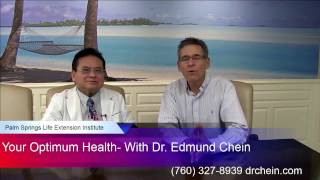
A recorded interview (Your Optimum Health with Dr. Edmund Chein, Episode 1) in which Dr. Chein describes his rehabilitation-medicine background and his specialty in hormone optimization. He frames aging as a disease that can be slowed or partially reversed by restoring hormones (thyroid, pituitary, adrenal, sex hormones) to a 20-year-old level, cites a published 1999 study treating ~2,000 patients with such a program and reporting improvements in biological-function measures and age-related conditions, and emphasizes testing (lab-driven diagnosis) and telemedicine to extend access. Practical takeaways: check hormone labs first, then address nutrition and exercise; contact via office phone for lab orders and telemedicine visits.
Questions this video answers
760-327-8939
1999; about 2,000 subjects
Hormone levels adjusted to a 20-year-old level
Thyroid, pituitary, adrenal, and sex hormones
Telemedicine is authorized by statutes in California (enables treating out-of-state patients via telemedicine, with some exceptions).
Chapters
Welcome to another event.
This is called you'd optimum life with Dr. Chen. Dr. Chen, welcome. Tell us a little bit about yourself. Just briefly, tell us a little about yourself. I have a question today to ask you that I think our guests are going to want to know. But before we get started, tell us a little bit about yourself.
Basically, I was trained in rehabilitation medicine with a subspecialty in hormones and subsequently I just decided to going to deal with hormones once I found out that hormones is the main factor, that how we got get old, how we age and we can slow down, reverse biological age, prolong life expectancy, prolong lifespan, increase health span just by optimizing hormones and nutrition. So now that becomes my specialty.
Many, many years ago when you, I should say many, many years ago. But when you were at USC medical School, you kind of asked that question differently when it came to aging. How did you structure that that made you go down this path that said, hey, I'm not just going to treat medic issues, I'm going to see if I can discover a way to really solve them.
Right.
Basically I found out that I felt anyway at that point that, that aging is a disease because ultimately it leads to death.
All conditions that lead to death, it's called disease. So why don't we call aging a disease? And so then if we call aging a disease, then we've got to slow it and we got to modify it so that we not only lengthen the lifespan, but also increase or maintain physical function and mental function. So that became my main goal.
Now you did something that was to prove your point. I don't want to get too deep into this because there's a lot of information here. But one of the things that we all need, like the very first time I met you and you were telling me about your specialty and actually how you could trigger cells inside our body to reverse their aging. And I had to be honest, I was a little suspicious. But the more you talked about it, because it was all done on a scientific level, I became more and more believer. Tell us what you had to do to prove your point when you did this with, with another doctor out of.
The Medical College of Wisconsin.
So tell us a little bit about that.
Okay. Basically we did the 2000 subject, 2000 human beings study raising their hormones.
Thyroid, pituitary, adrenal sex hormones to a 20 year old level. And basically at that time, the rumor has it that majority of the doctor's position was that it'll have side effects, it'll cause cancer, it'll do all kinds of things. So we want to prove that. Does it or doesn't it not reverse biological age? So we measure the biological age of our patients, all 3,000 of them, by function at that time. Telomere test hasn't come out yet. So we only have one way of measuring biologic function and biology by function. And so we measure them and then we put them on two years of our hormone program, pushing the levels, adjusting them to a 20 year old level, and then measure their biological age again. And all of them have success in reversing their biological age, got younger, but not only that, in the process they got rid of many, many, many age related diseases such as cholesterol, hypertension, you know, arteriosclerosis, things that we didn't have when we were 20 that we ended up having is called age related diseases.
Now why did, I'm just curious, why did you choose 20 and why didn't you say, hey, you know, 30? Why do you use 20?
Because 20 is the optimum age. We, we are biologically optimum. And that's why the, the armed services draft people in the, in the 20s. I mean you're 30, you apply for marine, they won't take you. So there's a reason they don't take you because you're biologically not optimum, physically not optimum. So that's why we picked up, we picked the 20 year old level as a target, as a goal and see if we have get people sicker or get people healthier. And it turns out if we bring their hormones up to a 20 level, they all get healthier, stronger, younger.
And as you say, those typical diseases that are related to aging, like maybe my focus, my concentration, my hearing. You said like arteriosclerosis, arthritis, cholesterol, all those things either reduced or were eliminated.
Yes.
Wow, that's amazing. So that brings us really to today's question. How would you define optimum health? Since that's the name of the show. Let's start off there. How do you define optimum health?
I define optimum health as a person who has the mental and physical function.
And the health status of a 20 year old. That's my definition.
Okay, so now let's take that another step further. I think that's a great thing saying, hey, I want to wake up every day and feel like a 20 year old. Some of us, we have to think back, how did I feel when I was 20?
How do they go about doing that?
They go about doing it by first doing something that a lot of Doctors don't do that, is to check your hormone levels. You got to check your pituitary hormones. You have adrenal hormones, your sex hormones, all of them decline with age. You have to check where you are. And in my book, living to 120 and beyond, I've done a study on all the gurus in the history that are on diet, all kinds of diet. Okay. And then all the gurus in the history, exercise buffs, all kinds of exercises, and none of them live beyond 94.
And actually most of them don't have the quality when they reach 60, 70, you know, and. But the ones that do exercise are better. They do better. They have. But they suddenly drop off at the end. They don't have the longevity to go with it. And that's because they didn't pay attention to hormones. They pay attention to nutrition because of nutrition guru. They pay attention to exercise. They have exercise guru like Jack Lanaine. Okay, Jack Leslie ate well, exercised well all his lifetime, suddenly died at age 94 and over a flu, a flu that you and I get over easy.
But he actually died from it because his immune system.
That he didn't take care of.
Which are controlled by the hormones.
Exactly. So he neglected hormones, which is a huge area.
In my specialty. I consider hormones, number one, to maintain fitness and functionality. Next two is nutrition. In fact, the third is exercise. Oh, really? Yes. Okay.
So if you have to do it in order, it's first of all, get.
Your hormones and then nutrition.
Nutrition and then fitness.
Yes.
Interesting.
Okay.
Well, you know, it's funny that you mentioned some of these people that you talk about in your book, because right now the average lifespan of a man is what, about 78 years old.
Exactly. By CDC.
Now, I understand it actually for the first time in I think a decade or two decades, it actually went down. It didn't extend, not by a lot, but it went down for the first time ever. And I don't know if that's because. And this is just speculation. I don't know if that's because of the amount of obesity and the type of foods we eat and the fact that they're not. They're not doing it as a whole. Probably people are not doing any of their hormones except letting them decline.
Right.
So thinking about these people in your book, I think about somebody like Jim Fix, the runner, long distance runner. Now, here was somebody that looked like he was in premium health, but I think he died at what age?
54.
And then you have Dr. Kritikin.
Yes.
I mean, here's a guy who says, hey, if you eat this way, you're going to live.
And he himself, then 68, he didn't.
Even make it to the athletes.
No, he didn't.
So if he'd have done nothing, he probably better off and probably could have lived to the. He died.
And his principle is still being followed today. Scary. Yeah. So basically, it's missing. A big part is missing. If people look at his lifespan, something is missing. What's missing? Hormones.
So is there a way that, let's say the average listener or viewer can say, hey.
I wonder if because of some outward signs that maybe my hormones are low. And then they would have them contact the office and say, hey, can I get that baseline test? Can I see where I'm at? I mean, are there any outward signs that you might notice that a person might notice that their hormone level, any.
Complaints that they have in terms of energy, stamina, not being able to do something even after rigorous training like going to the gym and want to lift weights or trip, that's certain distance and just can't get it done, or things like cholesterol coming in, hypertension coming in, obesity coming in. All these things.
Should suggest to a person, hey, go check your hormones. And if they call my office, give us the name. We'll give them a prescription to do it anywhere they are. With the lab coat in excess lab, which is a. Which has branches throughout the country. So we help people without charging one penny, help people find out what their hormone levels are.
Well, something that I found that was very, very impressive. It wasn't one of those things. Like when I came in this year, you didn't say, well, Jeff, how are you feeling? You didn't seem to care. I don't say care, but that was not the most important thing. You want to look at, hey, my results from my test. Because it was only based on those test results that now any action was taken.
Yes, that's correct. Because that's the cause. Okay, for me to care about you. Let's say you come in, you say, I've decreased energy, decrease endurance, decreased stamina. What's the cost? Billion reasons can be the cause. So actually, it would be.
Inappropriate for me to say, oh, I think it's this. Oh, I think it's that, including hormones. I can't even say that that hormones is the cause or what's the cause. But until once I do the test, then I have data, I have scientific data to say, no, your weakness or loss of endurance and stamina is not from hormones, but rather from your leaky gut, from an infection somewhere hidden that we don't know. I can say that because look at your crp.
Going up, your homocysteine going up. I can point to the test and tell you the reason why you're not feeling good. And it may not even be hormone.
So just because your specialty is hormones, when you go run that test, if you find that that is not the specific reason, it doesn't mean you're going to say, hey, you have to go down to the doctor. You're going to continue to move them in the right direction to help them health.
Yes, yes, I do that.
Well, tell us how the people watching again, how would they get in touch with your office? Because if you're watching, you know, on the world wide web, which of course I know that dates me, but how would someone get a hold of you? Because we're in Palm Springs, California.
Right.
And so tell us how to get.
All they have to. Just email me edmondchanayahu.com or call the office 760-327-8939 and then say, I want to check my hormones. Give me a prescription. Give me a lab order. I am in Tennessee. I am in Florida. You know, I'm in Alaska. I'm in Hawaii.
So now that brings up another question. Let's say, for instance, this person is in Alaska and they, they do the test.
Yes.
They're in Alaska.
Yes.
How do they see you?
Okay, Well, I even tell them we have telemedicine. Okay. Telemedicine is authorized by statutes in California. So it's legal for him to see him or her in Alaska without even coming to California physically. Except certain conditions have to be met. You know, like a little examining my local doctor. And then the disease or illness is not one that requires physical contact. Example ophthalmology, you know, I cannot practice ophthalmology through telemedicine. How are you going to look at the eye or gynecology? How are you going to look at the female parts? You know, impossible or cardiology? I can't. I can't listen through the computer. But laboratory, what our practice is and hormones is just all numbers. It's all numbers. And so it's totally adequate enough to do through telemedicine. So I can check the person's appointments and nutrition through blood tests, and then set up a telemedicine, make him a patient, make her or him a patient, and then treat.
So for those of you watching, and I've seen this before, like I'm watching, yeah, but that person is way out of my area. Dr. Chen, and we're in his office. You don't see this in his. In where he does is telling us there's a big TV screen behind the camera. Of course, you see this beautiful view back. That's those people that are in Alaska and maybe it's snowing in Boston. They see this beautiful beach scene. I think, isn't this in your backyard?
They see that. So you're not.
You're not restricted from getting optimum health just because you're not in the area?
Absolutely.
Yeah.
Because it is technology make us so. The world so small.
Because you also do this around the world, do you not?
Yes, yes. But telemedicine is really helping a lot of people.
So with this, what our goal is to share with you as the viewers, to build on that. Hey, what is optimum health? Because you heard Dr. Chen say a lot of times you might say, hey, we know there's two components, eating right and exercise. We've heard that forever.
Right.
Eat right and exercise. But if you're missing that component, which really should be at the top of the stack, and that's saying, hey, let's get your hormone levels right. And then you probably. And tell me you're the doctor is, does that make the food that we eat? Are we able to utilize it and synthesize it?
Absolutely.
And our exercise is beneficial.
Absolutely. Hormones control the gastrointestinal tract in terms of absorption of nutrients and what to do with nutrients.
I'm going to challenge you all to go to Dr. Chen's website. It's doctorchen.com or totalshormonegenetherapy.com and you can look at some examples of patients when they first started and then after a period of time, and you can see how their muscle structure has changed as far as tightening the skin and their tonality is different things that they might experience as they get their hormones right. I mean, we see the fine lines go away in the skin, what some color back in their hair.
If they. Yeah, if they go back to the study that we did.
1999, published, 2,000 people, that was published with Dr. Terry, you can see a lot of different changes, improvements in all kinds of conditions in that scientific report and the percentage that were successful and the percentages that are not successful, you know, and not. We just, we won't go into why not successful today. But basically it's environmental poisons and, and toxins. But those that are successful, you can know the percentage.
Well, that actually brings up, hey, when you come back next time we are going to talk about how does environmental conditions put optimal health in jeopardy.
Absolutely.
And even if you live in, let's say, not the most optimal background, you're not in a perfect place. What can you do to make sure, even if you're in a high pollutant area or maybe the water's not perfect, that you can do things to still maintain or regain optimum health?
Yes.
Well, Dr. Chen, thank you so much for joining us.
Thank you.
And thanks for joining us out there. This is called you'd optimal Health with Dr. Edmund Chen. He's with Palm Springs Life Extension Institute in Palm Springs, California. And again, one more time before we leave, the phone number that they can.
Reach out and get a call, 760-327-8939.
Fantastic. We'll see you again next week.









