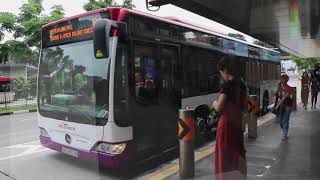
Researchers at ETH Zurich use supercomputer simulations to model how heat from buses and buildings affects street-level temperatures in Singapore. They build 3D models of urban canyons, run CFD simulations for hours or days, and test cooling strategies with VR tools to improve outdoor comfort in hot cities.
Chapters
I am Dr. Hassan Badreddin, postdoctoral researcher at the Future Cities Laboratory at ETH Zurich in Singapore. I am a member of the Cooler KALMA Singapore Impact project. One of the aims of this project is to study the effect of solar radiation and anthropogenic heat on autothermal comfort. By anthropogenic heat, we mean the heat released to the environment due to human activities. One example we are studying is the heat released from the bus radiator. In contrast to real physical experiments that could be challenging and difficult to achieve, we try to replicate reality on our computers by using computational fluid dynamics. This numerical tool solves the set of equations that govern the dynamics of wind and temperature. By doing this, it will allow us to better understand the system under design under consideration. Improve its design.
To simulate the heat release on the bus and its effect on the surrounding, we first build on our computer a representation of the bus and the surrounding buildings. Once this is done, we set up the case by specifying all the required physical properties and boundary conditions. We then run the case on supercomputers and depending on the size of the case and the physical models that we are using, it could take from hours to days for the simulation to finish.
Here we are simulating the heat injected from the bus and a turbulent wind that is entering our domain from the west to the east side. The vortex created inside the street canyon is clearly detected by our simulation.
By zooming in on the bus, we visualize a temperature contour of 33 degrees colored by velocity magnitude resulted from the heat released from the bus radiator that is activated for the first 30 seconds. Once the heat source is removed, the time required for the heat to dissipate could be determined.
Numerical simulations, once they are tested and validated, give the expert the freedom to test different mitigating strategies and to study the effect of different anthropogenic heat sources on auto thermal comfort. Once this is done, we could also use virtual reality such that the designers and architects can have better visualization tool and hence improve their design such that we could have a better outdoor thermal comfort.