FCL Podcast | Episode 05 | Preserving Biodiversity in the City
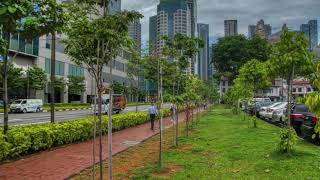
Podcast episode (May 10, 2021) in which host Andrew Stokels interviews Justine Saunders, project coordinator for the Natural Capital Singapore Project. They discuss the global biodiversity crisis and focus on locally actionable responses in cities, especially Singapore: project goals (assessing urban ecosystems, valuing ecosystem services), governance actors (URA, HDB), design approaches (Biophilic Town framework, Kampung Admiralty), community actions (community gardens, urban farming), and specific conservation sites (Mandai mangrove and mudflat) with regional importance for migratory birds.
Questions this video answers
Beginning of 2018
National Research Foundation (from the Prime Minister's Office)
About 231 different species across a survey of 135 housing corridors
May 10, 2021
Chapters
Hello, everyone. Welcome to Future Cities Lab podcast here in Singapore. I'm your host, Andrew Stokels.
Hello, everyone. I'm here today with Justine Saunders. Justine is the project coordinator for the Natural Capital Singapore Project, which has been at SEC center here in Singapore for about a year and is working to measure the impact and the value of Singapore's ecosystems for the larger city. Hello, Justine. Welcome and thanks for being part of Future Cities Lab podcast.
Thank you, Andrew.
So today we're going to be talking about the topic of biodiversity and what we can do about it at the local level.
Many people saw this report that came out that was featured in many media outlets around the world, looking at the issue of species loss and saying that the world is facing unprecedented loss of over a million of species due to many different factors from climate change, but also habitat loss and degradation of coastal Earth habitats as well, land habitats. But today we're going to be talking a little bit more about what this means for the local level and what can cities, policymakers and residents do to try to mitigate these threats that we face, and what are the importance of doing this actually for the larger ecosystem, but also for human health and other things that we enjoy or we take for granted in cities. So, Justine, this article that was in the New York Times as well as other media sources claimed that 1 million species were at risk of extinction. Can you talk more about what this means and talk more about the challenges of this? How do you mitigate this or deal with this?
Yeah, well, approximately 1 million species. And, you know, over the past centuries, we've made massive improvements in our standards of living in terms of child mortality, our longevity, we're living longer, we're healthier in general, but that's come at a cost. And development has happened at a large scale. And as you mentioned, it's included things like habitat change, pollution. But although these impacts have happened at a large scale, the focus that we're going to look at, talk about today is how we can address those losses of biodiversity at a small local scale. Because there's a difference between the loss of biodiversity happening at local scale and, say, climate change, which is a global issue and it needs global solutions. But the loss of biodiversity that we're experiencing can be solved, I think, at a local scale.
Right. So carbon in the atmosphere goes right into the atmosphere. It's global. Global immediately. But species loss, you can actually deal with some things within a local area.
And have an impact. Yes, and have an impact. And I think one of the other things that the report highlighted as well Is that perhaps the reason behind this destruction that we're experiencing is, or this threat that we're at is because we haven't really appropriately valued the benefits that we get from nature. And a lot of it, perhaps in the past, we've taken for granted. So the ability for nature to provide us with a healthy climate, to mitigate water flows and to provide us with psychological well being as well. So we haven't really quantified that very well, but there's been some massive changes in the last decades in how we do that. Great.
Could you talk a little bit about some of those changes that you're working on as part of the Natural Capital Singapore Project? What are these concepts that are helping people value and understand the value of ecosystems?
Yeah, so the.
National Capital Singapore Project was commissioned beginning of 2018 and it's funded by the National Research foundation, which comes out of the Prime Minister's office. So it was seen as a strategic issue to focus on. And it's strategic for a whole number of different reasons. Natural Capital Services comes under a whole range of different international conventions that Singapore signed up to, such as the Convention of Biological Diversity. So there was a lot of top down impetus for Singapore to be looking at this, but also there was a lot of focus within government to see that this was a way to address some issues and to create a city that's healthy for its people. So, yeah, this project was funded and the first stage of it is to assess the status of our ecosystems in Singapore. And it's really unique because we're dealing with a city. So how we define those ecosystems as a start is very unique. And then a really big focus of the project is to look at the value of those ecosystems, the importance of those ecosystems to people. So we've invested a lot in social surveys.
So Singapore is a small, contained city state, obviously has a lot of constraints on it in terms of development. So something like this is presumably very important for trying to value these limited amount of spaces that are left, green spaces, open spaces in the city.
Yeah. One of the things that was focused on in the Intergovernmental report, the EDBEST report, was that firstly, we need to strengthen our environmental laws and we need to connect better across all the different scales of governance. So within Singapore, we still need to protect what we have, but when we develop, we can be a lot clever about how we integrate nature into that development and optimize some of the benefits for the people who live in those areas, particularly psychological, well being, recreational health. And.
So, Justine, you're Talking about psychological benefits from nature and how Singapore is working to integrate nature into new developments. Could you talk more about this? And are there successful cases so far in Singapore that are actually bringing nature into the city?
Sure. So governance happens at a whole range of different scales. So first of all, in Singapore, we have the Urban Redevelopment Authority, so their response, responsible for the planning of the whole space of Singapore in general. And so as part of their recent draft master plan, they've incorporated the concept of exit and services into that planning approach. And there's a really strong focus on every area that they're developing that nature is integrated into that. So that's a really positive step forward. And then we come down to the smaller scale of the Housing and Development Board. And so they're responsible for small local areas for people to live in. And in terms of now we're coming down to more of a design level. And in terms of designing those areas, they have developed what they call the Biophilic Town framework. And biophilia, it was a. I guess it reflects our need to be around nature or our love for nature, as opposed to biophobia. Biophilia. Yeah. So that's driving what is happening on the ground for local people.
So are there successful buildings or neighborhoods that have really tried to integrate this nature into people's daily lives?
Yeah, I guess a really good example that came out last year, that was launched last year was Kampung Admoti, which is the housing area for the elderly. One of the initial focuses was to put all the services that the elderly need in one area so they don't have to travel too far to go to hospital, see their dentist, and also community services. But really strongly they integrated this nature into the surroundings. So they really brought in historical, cultural elements of nature that would mean something to the people. So, like trees that they could harvest fruit from, or vegetation that might have been reflective of their childhoods. So there's a lot of thought put into the place and how they designed it. It's very nice.
So these are all benefits to people in their daily lives. We started the podcast by talking about this loss of species diversity. So I'm actually kind of interested in how you make the connection between species diversity or animal habitats in Singapore, and also valuing that in terms of the benefits that those species diversity or different types of species have for people on a daily life. Is it something that is an indirect benefit, or are there actually tangible benefits of people being exposed to nature? And.
There'S a whole range of benefits that flow from nature. So you Have I guess the Millennium Ecosystem Assessment that came out in 2005, that was our first attempt at a framework of ecosystem services. And one of them is our productive services. So things like fisheries, for example. So we recently did a recreational fishing survey on the weekend, a few weekends back. And really surprised at the number of people engaged in recreational fishing. And it gives them not just the value of the fish that they're catching, they can take home or cook right there on a barbecue with their family and friends. But there's also all the fishermen spoke really strongly about the cultural values that they get from fishing. So every one of these benefits we get from nature, there's many different aspects to it. There's maybe a productive value, there's maybe a regulatory value from the fish as well and how they regulate food webs. And then we also get this cultural value, really strong cultural value. And that's why that's been a strong focus for our project, is trying to understand that, because it's hard to quantify, hard to value, and often that means people put it in a too hard basket. But I think it's probably one of the most important values that we have that we get from nature.
So you mentioned fishing is one activity that people are engaged in. You know, it's interesting, a lot of people that haven't been to Singapore have the idea that Singapore is a totally modern, completely urbanized city, but there's actually a lot of green space integrated in Singapore. And as you mentioned, this has a huge impact on people's lives in terms of how people interact with nature on a daily basis and getting to be involved in activities that bring them into contact with different activities that they wouldn't normally be engaged in. So are there other examples of how that kind of bringing nature into people's daily lives is happening, particularly in terms of planning or design of communities and neighborhoods?
Yeah. Okay, so we can talk a little bit about community gardening. So that's a really strong focus here in Singapore. I think it lets back to a lot of cultural traditions as well where people want to provide their own food. But there's also the psychological well being of just tending your garden and watching something grow. So there's a really strong revival in terms of what's called urban farming in Singapore. And this has multiple benefits to some? Well, because Singapore is looking to improve its food security. So having food grown at a lot of local small scales helps to solve that issue as well as providing psychological well being for people. And I guess this is a really good example about.
Action happening at the local level, because even with community gardens you can get high diversity of species. You have all these HDB areas with all their corridors and you have people putting all their plants along in their corridors and on their balconies and, and it's actually quite a wealth of greenery which can support a lot of insect populations and birds as well. So the pollinators. So even those small scale gardening activities can have a benefit for biodiversity. So there's benefits both ways.
And you did a survey that actually found there's a lot of species in these corridors?
Yeah, we found about 231 different species across a survey of 135 of these housing corridors.
So this is something that came about somewhat organically. People tend to plant gardens or plants outside of their flats and then that attracts species. Or was this also government policy to encourage this?
Well, this is a nice example of a bit of both. So it's like I said, a part of a culture. So people want to garden but then it's fortunate that they have the support from the Housing Development Board to have these spaces from for people. There's a little bit of ad hoc growing along these corridors, but then there's more focus recently to create these designated community gardening areas where people can get together. And then it becomes a bit more of a community event then too. And it brings people together and you get people sharing their different produce, sharing recipes. There's some really great local NGOs, little organizations that share all this information on Facebook. They're great to follow. And yeah, it's a real undertone. I think it's a really good example of how action at the local level in Singapore can really help to support government strategies. And so a nice example of this top down governance approach and a bottom.
Up local action and the scale of Singapore means that it's somewhat easy for government to set policies that actually affect neighborhoods. And then there's not a lot of different layers of government that have to policies have to go through to have an effect.
That's right. I mean there's I guess a handful of key players when it comes to biodiversity in Singapore. So it's easy for them as well, potentially to communicate amongst each other and create a strategy across all those layers.
So Justine, Singapore is an interesting place in which this research is happening because as a land constrained country, it really has to make these trade offs in planning decisions in terms of incorporating the value of nature, the value of ecosystems, but also the need for development. Singapore is actually smaller than the size of Greater London and so it has to have all of these functions of a country within the boundaries of the city state. So with that being said, how do you go about convincing policymakers or incorporating the value of nature into these decisions in a way that nature can actually be balanced or actually can find a kind of middle ground between development and preservation?
Yeah, you're right. It's difficult in Singapore because the value being a constrained island, the value of the land in Singapore is enormous. So if you're ever going to look at some sort of trade off analysis between the value of developing land and the value of conserving nature, nature's unfortunately always going to lose. So we try and steer away from any sort of trade off analysis and really just look for win win opportunities. So you're looking for a win for development, a win for something society, and then a win for nature as well. And one way that we can do this is to use multiple indicators, not just economic indicators, but use other indicators of the changes in values that might happen as a result of policies. And some of these examples of indicators I think is a good example from Bhutan where they're measuring gross national Happiness instead of just focusing on gdp. So we're using a lot more of these different indicators now to get a more holistic view of the impact of developments. But basically, ultimately a country has to make almost like a moral decision on what they want to protect. If you can't protect nature in some sort of trade off analysis, then it comes down to a moral decision. So again, the IPBES report focused strongly on increasing or improving environmental laws. And we've had some improvements recently in Singapore with.
A few nature parks were designated the Mandai Mangrove and Mudflat. And also we have the Nature park network which is providing more habitats for wildlife. And these might seem insignificant in a very small island, but even Singapore itself plays an important role regionally. So with this Mandai Mangrove mud flat, it's linked intrinsically to the East Asian Australasian Flyway, which forms a really important migratory route for birds. And we get a regular influx of birds stopping off at these mangrove and intertidal habitats in every year. So even though we might feel we're a small country, we can still provide play a role regionally and internationally.
So these are birds actually migrating from Australia, ultimately all the way up through Asia. Okay, so this is an example in a way of how biodiversity issue at a global scale actually depends on these local locations and spots. And so Singapore is actually critical in a way to these larger questions.
Yeah, we must forget that we're a small island in a big pond, but we still have a strong role to play.
Great. Well, thank you very much, Justine, for coming in. It was a fascinating discussion and look forward to talking more about your work.
Thanks, Andrew.
More from FCL










Day 1 - Policy Innovation for Urban Transitions | Future Cities Symposium & Exhibition 2025
