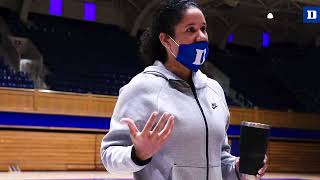
Kara Lawson explains the difference between working hard and competing in sports. Using a running-drill hypothetical (individual vs group), she argues coaches can prescribe hard work through constraints, but cannot force competitiveness — competing is an internal choice. She urges athletes to ask after every session, 'Did I compete today?'.
Chapters
So I'm gonna give you two hypothetical situations, okay? The first is.
Jen. If I put you on that line, you don't have to do it, okay? Okay.
And I. And I give her a time and I give her an amount that she has to run about what you're about to do, right? And I say, okay, you gotta run this many times in this. In this many minutes or this May 2nd.
But now, if I put Jen on that same line and I put three people next to her and I have all four of them do the same thing.
Do you run differently when that happens? It's an individual question. You don't have to answer it out loud. Do you run differently? You're doing it by yourself. You're doing it with other people. One thing I think that players and coaches and just people around sports mistake all the time is they mistake hard work and competitiveness.
They think they're the same thing. Hard work and competitiveness. Hard work is. I give you a task, right? I give you constraints on set task. I say, you have to do this in this amount of time with this much weight, with this much load, whatever it is. I give you these constraints, and I force you to do it. And it's hard, right? It's hard. So I can force you to work hard just by what I ask you to do, right? And I'm not saying that in a mean way. I'm just saying that in general, like, you can force. You can force someone to work hard, right? You can't force someone to compete.
You can't. There's nothing I can do to make you compete.
And that's such an important distinction in sports.
A lot of players, at the end of a practice, at the end of a game, they'll talk to their parents, they'll talk to their teammates. Hey, V, did you work hard today? And you're like, yeah, Coach, I worked hard today.
That's good. But did you compete?
So at the end of every session that we have, that's the question you're asking yourself.
Did I compete today? Because that's different than working hard. It's different.
Working hard is something that a lot of people do, right? Millions of people, every day, billions of people do every day around the world. Billions of people work hard in whatever job they do. But not everybody's wired to compete. So I've talked to some of you, and you say, coach, you know, what do you need from me? What do you want from me? Like, what's important to you?
I want you to compete every day. Every day. Compete every listening session, every Wednesday, weight session, every basketball session. Doesn't mean you're going to be perfect. Doesn't mean you're going to. You're not going to fail sometimes. But getting yourself that mindset, when you walk out here every day when we're about to start, you click in, yo, I'm ready to compete. All right? So start thinking about that before you start. And then when you're done, be honest with yourself. That I can heat today. The answer is gonna be might be no sometimes. Make sure it's not too dangerous. Okay. All right. Have a good work.