#547 Perfect Operations-Centered Maintenance | Frank Hess interviewed by Niels Brabandt
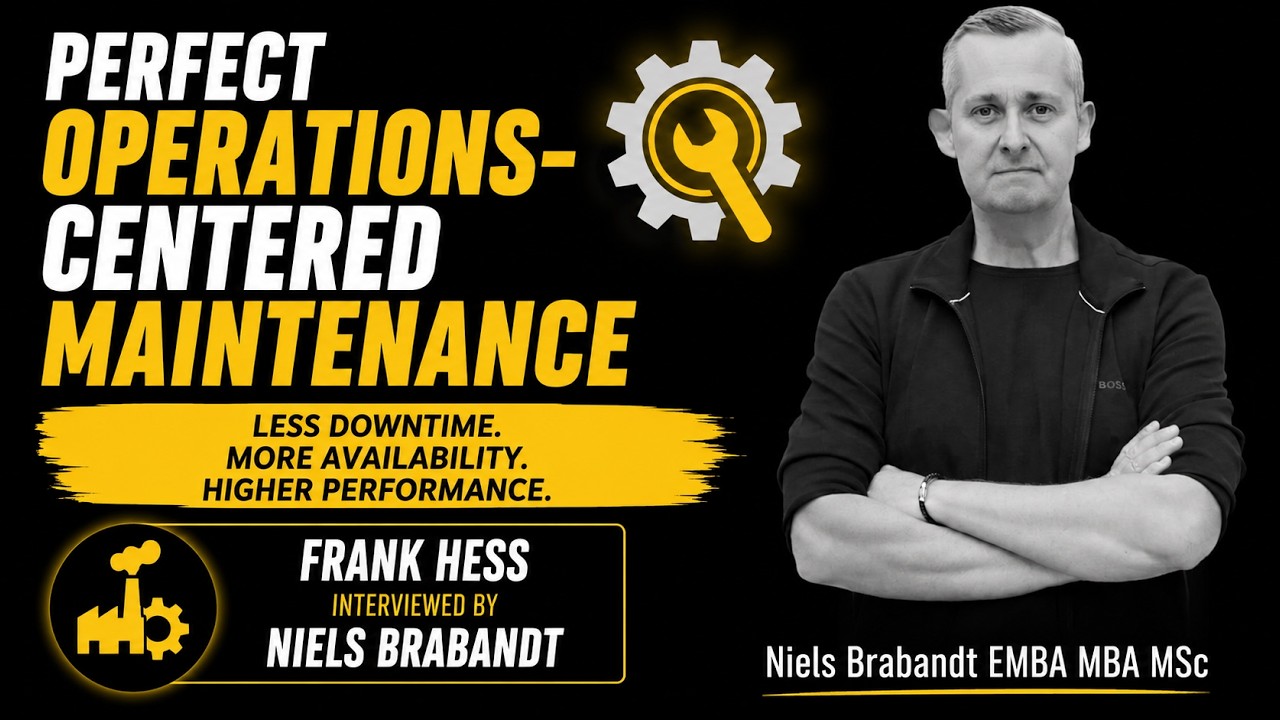
Frank Hess wrote a 300-page business novel about operations-centered maintenance, a shift from "I maintain equipment" to "I support production." Set at a fictional South Texas site, it follows protagonist Palina Sawyer through the urgency of corrective maintenance, designed to make the field accessible beyond technical manuals.
Chapters
Maybe at the moment it's not running too well in your maintenance team or in the organization or with everything around that. And maybe you now think, yeah, that sounds a bit like— because there's always a bit of firefighting, bit of stressful work. However, the question is, how do you solve it? And we have an expert with lots of experience here today. Hello and welcome, Frank Hess.
Hello, Nils. Nice for having me. Thank you very much.
Thank you very much for taking the time. And I get straight into the questions. This is the book you've written, The Decision: A Business Novel About the Origins of Operations-Centered maintenance. So am I right, this is not a book where you just share best practices? This is a story around maintenance and how to do maintenance. Is that correct?
Yeah, absolutely. You are surprisingly completely correct. It's a business novel, which means it's an entertaining non-fictional story about industrial maintenance. And I gave it a little bit of touch of a nonfiction book because the title, The Decision, sounds not like an entertaining novel, right? Or like a fantasy novel. It sounds a little bit dry, and the title exactly is chosen for that, to say, okay, this is also a novel about business. The working title, to reveal that a little bit at the beginning, was Eagle Ridge Firefighters for the entire— And for those of you, they will read, um, of you will read the book, You will understand why the title, the working title was Eagle Ridge Firefighters, because the book plays in a location in the south of Texas, and the site name is Eagle Ridge. And these people on that site, they are always in trouble. And in maintenance, you mean mostly you call it firefighting, right? When you have corrective maintenance, something breaks, everything is urgent. So it's not about the firefightings when Anything is in flame and house is burning, it's firefighting from the urgency perspective. And this is all about this business novel.
Excellent. So of course I have to ask one question now. So first, of course, I think, because I know that there are other business novels out there, but I think there is no business novel out there regarding operations-centered management, or am I wrong? At least I don't know any.
No, no, that's totally right. And this, maybe you will find a few articles about operation-centered maintenance. That's kind of a model actually I have step by step developed over the last 25, 30 years. It plays not an important role, but it's a guideline in the novel where people start their improvement journey based on operation-centered maintenance, which means they refocus their focus from, I am a maintenance person, I'm responsible to maintain my equipment, into the direction to say, I'm working for productions, for operations, and my business goal is mainly to make sure that I have the right availability. So this mindset switch, this focus back to that why, the question of why, why are we doing that, what are we doing, and how are we doing that, this is all about operation-centered maintenance. So I'm using that in this book to guide the story a little bit, but it's Um, and not a non-fictional story, so you will not find that much detail. So you can read that even as someone who has no clue about what it means.
Okay, so it's not one of these dry books where you tell me this is the process, this is the scientific research, this is the 1, 2, 3, 4, 5. So it's not one of these dry books, it's, it's something I can basically read through and learn something from it on the way.
No, no, it's a small non-fictional book. It has 300 pages, but each page will make fun, and it's a turn-pager, I would say. When you start to read it, and it's not 300 pages of a fictional book, um, where you— of a non-fictional book, yes, where you have a lot of tables and references, scientific way, and it's hard to get through, right? And you just look up sometimes, but you never read it in a whole, right?
Yeah, so it's a real page-turner here. So of course, one question I have to ask, what was your main motivation to write this book right now at this point in time?
Um, there are several motivations behind. So one I always had the wish to write a book, but, you know, like many people nowadays, we all have not that much time. And once you start, I mean, you can write an article because that takes you maybe 2, 3 hours. You can give an interview, preparations, all of that. But writing a book, that requires sometimes a little bit more time.
Mm-hmm.
And the most important thing, time without any interruption, right, to get in the flow. That was for me the case. So, and I had experience, so that's not possible. I was always very, very busy as a person during my business life. And now since last year summer, I'm retired. And the first idea popped up and said, okay, now I have the time to write a book. And the story was not there. I was always a little bit thinking about, so is it more interesting for me to write a business model? Is it more interesting to write a fictional or non-fictional story? I talked to some people and every— most of the people say to me, oh, don't, Frank, don't write a fictional, non-fictional story.
So that makes another, another non-fiction book on this one, probably the thousands books out there on that topic, and you're the 1,001st book.
Yeah, yeah, yeah. And then this is titled Operation Centered Maintenance. It's maybe not a page-turner, and it just sits on Amazon and nobody will buy it. But a fictional story will be the first one first, and it's more entertaining, and it reaches a larger audience. That's what I believed at the final, because it's accessible for any person, even my mother, just by the way.
I'll share that with you.
She read the book and she was—
I have a very important question here. When now someone says, look, I'm just seeing Frank here, massive career in maintenance, 30 years and more of experience, and maybe someone sits there and thinks, I'm just starting my career, I'm a team lead, I have 7 years of experience, I don't even know if this book is for me. Would you say this book is really for everyone in that interest area?
Um, I would not say the book is for everyone, but everyone can read it if you just grab the book by just in the moment you see it or you get a link to that and you think, oh, that's cool, that's interesting for me. It's accessible for you, you can read it. And even as a young person, I got some feedback from— I know one person who is also an author and he was recommending this book to his daughter and she was reading it and say, okay, yeah, that's interesting. Now I understand what that means in business, industrial asset management. I like it, and I could imagine to do that. So because even for her, this book was in some way interesting and a page-turner, and she was going through the book and, and reading it. Yeah, I think so, especially for, for young people. I think it's interesting, right? It's positive. And most of the people, the characters in the book, are some young— the main character, Palina Sawyer, is a, is a woman, which is also—
you—
this, this business is dominated by men. Yeah, like me, even older men. And my main character is a young woman and she's doing the change management. It's also fantastic and it's a positive character. Yeah. And she's doing very well in the book. Yeah, brilliant.
I think these are the perfect final words. You see, The Decision, a business novel about the origin of operations-centered maintenance. Not a dry topic. It's definitely a page-turner. And you see, it's a read for absolutely anyone who is interested in any kind of work there because we all know We all have machines everywhere, and maintenance is a huge industry where many of us don't know much about. So even for you, it might be highly relevant. When you work in the field, it definitely is. So at the end of this podcast and the end of this videocast, there's only one thing left for me to say. Frank, thank you very much for your time.
My pleasure, Nils. Thank you for that great time, and enjoy your stop in London. Bye-bye.