
Linear Pricing Page & Billing UX Teardown — What SaaS Founders Can Learn
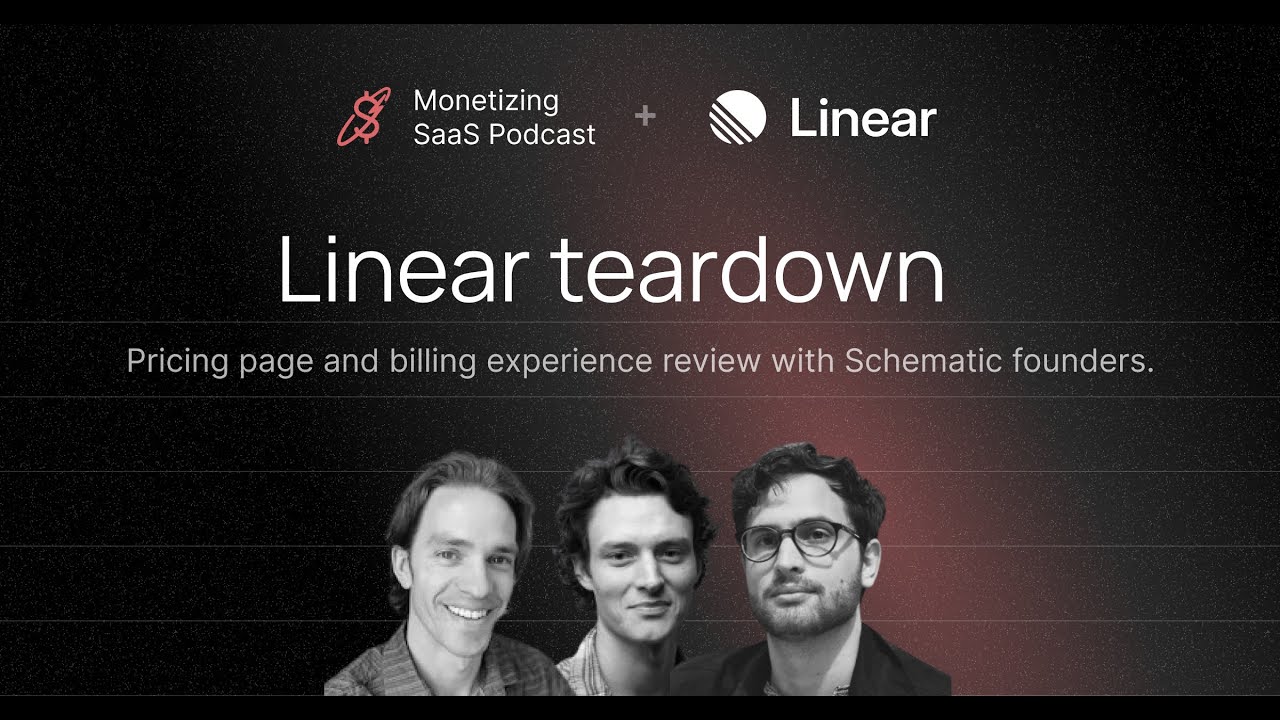
Ben and Gio from Schematic break down Linear's pricing page and billing experience with host Fynn Glover. They praise its clean design and two-click upgrades, but question whether seat-based pricing makes sense as the market shifts to usage-based models. Linear scores 4.5-4.8 on pricing and a near-perfect 5 on billing.
Chapters
Hey everybody, welcome back to another edition of Monetizing SaaS. This is the podcast where we break down how great software companies approach monetization, how they think about packaging, pricing, monetization as a practice. My name is Fynn Glover, as always joined by my co-founders at Schematic, Ben and Gio. Today we're going to dive into Linear, which is one of the most product-respected startups in the world, in my opinion. I'm sure many others. Linear is known for beautiful UI, fast performance, and incredible developer experience. The question we're going to be asking today is, how do they think through their pricing page? What is the anatomy of their pricing page? Where is it really strong? Where does it have opportunity to improve? And from there, we're going to move into what is it like to purchase Linear? What is the billing experience in the application like? How do they handle things like upgrades and downgrades, trials? So I think it's going to be a great episode. Um, without further ado, Gio, do you want to share your screen and move us into Linear?
Let's do it.
Okay. Let's, let's start off a little bit high level with Ben. We'll kind of pick on you first, but I kind of think about Linear as it's, yeah, I'm a Superhuman user. So to me, Linear reminds me a little bit of the superhuman, the superhuman of issue tracking. But I'm curious how you think about it, having used the product for quite some time at this point. What's the real value?
Yeah, I think when you think about Linear and how they kind of entered the scene, you have to think about Jira, basically. It's like every issue tracker is just what you have to think about, like, how does it relate to Jira? To me, I think Linear has always just been like all about favoring kind of convention over configuration, like giving you a tool that just works, is pleasant to use, rather than something you have to work on a lot to get it to work for you. Things like that. And then as they've matured as a business, like, they're kind of— challenge, I think, is just to add on more and more capabilities without losing that product coherence, right? Which is generally like what happens to more configuration-oriented products like Jira. So I think beyond that, you know, they really nailed just kind of like the early days of just kind of like showing, not telling, the fact that it was a really high-quality product, you know, and built a lot of goodwill with startups and developers really early on that they've continued to kind of, um, sustain for years now.
Gio, what about you?
I think of it similarly. It's coming from product and design. Linear does a lot of excellent things. I think it's by far the best experience for the product person too, in terms of definition, ticket management, project management, burndowns, all of that. I think what I really like about them is they're just really opinionated. Instead of being hyper-configurable to the point where it's really hard to even know what to do and how to get started, they've decided to go more of an opinionated route. You know, their CEO talks a lot about how they like to build according to what they think is correct, not necessarily doing a whole lot of user research, but instead just leaning on their own experience with their own product and their own careers. And you can see that confidence around their point of view and everything they do. And now it's like, it's consistently the, the point of reference for product designers and marketing designers. On the UI side, like they just do everything extremely thoughtfully and simply. And then on the marketing design side, like everybody just tries to copy them now. So it says something about how They're the leaders in both dimensions.
Would either of you disagree with me positing that their target market is predominantly product and engineering-led startups, probably primarily early to mid-stage teams, early stage to kind of growth stage teams? Does that feel correct or do you feel like they've, they've, they're beyond that at this point? They're really attacking the enterprise.
I think they're trying to move beyond it. I think a lot of their recent expansion has been on larger accounts from what I hear. I think you do see it in their product, right? Like they're listing Samuel and things like this here that I don't think would have featured my friend's page a couple of years ago, right? But certainly their brand is very attached to experiment.
Yeah, I agree with that. I think probably their brand and their go-to-market is still downmarket oriented overall. But they are certainly starting to try to capture bigger contracts, ship features for them, and their product's gotten a lot, a lot bigger to the point where it's maybe starting to suffer from some of the overconfiguration that like Jira kind of is derided for. But I'll say that Linear is way more disciplined about maintaining simplicity there is, you know, having seen new engineers onboard into our company and use Linear, there can be sometimes a small learning curve, but I overall feel like it's— they're actually handling that going upmarket complexity pretty well.
So it sounds like the real, you know, kind of this company has won a lot of trust and built a great brand with a lot of early-stage companies, a lot of early-stage product engineers. The big opportunity before them, I imagine, is expanding the product as they're already doing, becoming a real platform, evolving beyond we're just an issue tracker and into, you know, a real platform that could satisfy enterprise use cases. Let's, let's see if we can kind of learn how that shift is happening from them, starting through the context of their pricing page. So Gio, maybe just like ground us a little bit in the pricing model here for customers. So we have a fair amount of intimacy here, but seems like it's a flat per seat pricing. There's a free tier. What do you see? Kind of walk us through what's going on here from a pricing strategy perspective.
Yeah, I think what we talk about always is you need to make sure your pricing page is not overwhelming. That's the first thing. If it looks too complicated, that's like the first failure of a pricing page. And I think that there doing that and they're not falling into that trap here. Things feel pretty simple. There's 4 plans. One is emphasized as what we sort of expect you to do. There's the ability to get started on all 3, a contact sales CTA, which is good. There's, there's detail within each of these line items here that go to specific either docs pages or feature pages. And I can tell without scrolling, like, this isn't going to be some extremely complicated decision for me. You know, we talk a lot about seat-based pricing and whether that's kind of something that the world is moving away from. And I think that generally is true that it's no longer like the most trending pricing model, but for a product like theirs, it probably still is the right metric for them. It's kind of hard to imagine another metric, frankly. Um, and maybe Ben can speak to like why we upgraded, for example.
I, I do. I would love to press on that for a second. I mean, Ben, what's your point of view on the longevity of a seat-based model for this type of product? Is, is this really the right price metric, or do you think that they have, um, pressure and/or opportunity to consider a more usage-based value metric?
Yeah, I would say I mostly agree with Geo on this, like, I think, you know, Linear is of a vintage of software product where seat-based billing was pretty much the norm. And I would say as an industry, we're maybe in a transition now where seat-based billing is less the norm. And a lot of that has to do with AI. A lot of it has to do with changes in hiring, right? Like from a sales perspective, like seat-based billing is great when everyone is hiring more every year. It's not so great when people are hiring less every year. So there's a lot of different factors that have, I guess, pushed the industry away from seat-based billing and into more usage-based models. But in Linear's case, again, I do think I agree with Jia that it makes sense here maybe the way to monetize is more essentially like the add-on type monetization, like get people to move between plans based off of needed capabilities, you know, versus like a usage base. Because it's just like kind of hard to imagine, like, what are they going to price per ticket that you have or something like this, or per project or something? It's kind of just hard to envision. So I mean, the seat-based billing is nice, especially since like the product still, even after all their expansion, is mostly used by engineers and product managers and designers. So you don't necessarily need to give a seat to everyone in your organization. They are moving into more success-based seats, but adding $14 on top of your fully loaded costs for like an engineer or product manager is kind of like, issue, right? So for them, like, the seat-based billing I think is really easy for them to charge for, even if, even if it costs twice as much as like a competitor. It's just kind of like easy to blend in. The reason we upgraded, I think, was because of our back— I think their free tier, everyone's an admin, and once you have a team of any size, like, that's not viable. If I remember correctly, that was the reason. Yeah, actually, it's a viable basic. We may have even gone to the third tier by now because I do think we use some of the customer success-oriented features now, like associating tickets with specific customers. That's a big one. But yeah, seat-based does make sense for them to me, but it's, yeah, it's something that just in terms of company growth, it's hard to have Tailwinds on right now.
Do you know what we're paying Linear?
I can find out.
I was just guessing, maybe like $500.
We're on the basic monthly, $10 per user per month, which is this.
So a month?
Yeah. So once you remove this, yeah.
So to your point on add-ons, like for them to scale their business with a company like Schematic, we need to hire many more developers and product managers. Or they start to consider an add-on type option if there isn't like a really intuitive usage-based metric.
Yeah. Or they could have some agent that does triage for you and charge you for it. I mean, there is a lot of data in there. And my experience with these types of products is I have a low willingness to switch between them. Such like a set of the paper trail of like what decisions got made and when and why. Engineering, you're constantly mitigating that type of stuff. So having a tool that has like a well-structured dataset, you're planning execution over time. I mean, it is quite valuable. I could see that monetizing in some more modern ways based off of that. But yeah, I think like just adding more capabilities that force people on tiers is probably the more practical approach.
Cool. Well, I want to keep going into the pricing pitch. One thing I'm just kind of thinking about, I always try to back of the napkin, these types of companies when we do these teardowns, but I'm guessing if Linear has like 130 employees that the company's doing, you know, roughly $30 million in ARR. And I'm guessing, you know, a lot of the customers that they're serving are like, like us where they might be paying, you know, $1,200 a year roughly. So it seems like right now this company is probably supporting 10,000, 20,000 customers potentially, unless there's sort of 20% of the base that has very scaled teams and, and kind of much larger contracts. And I would imagine that's starting to happen. But, um, Gio, tell us kind of what's your next observation about the pricing page here.
I think that there is good detail as you keep going. Feels like there's this— and this is like, I feel, just good design, which is progressive complexity, where You don't need to see all this unless it's meaningful to you. So if you're between free and basic, you can, you can see why you want to upgrade right away. If you're between basic and business, it's a little further down, et cetera. Um, pretty basic setup here, but just super clear. Like I know where I need to go based on a couple scrolls and figuring out what my use cases are and simple. They've got very, again, simple sort of social proof here. They don't have FAQs, which we like to see FAQs, but because their pricing is relatively simple, I'm not even sure what FAQs they'd have.
Yeah.
I think that's kind of what I meant by show, not tell is like, You know, it's an issue tracking product, right? Like people know what it does. It's how they do it. That's the differentiator, like the feel of the product, how nice it is to use. And you really can't, like you can say until you're blue in the face, like this is a nice product to use, but no one knows that until they use it. So people don't need to know that much about what the features are in writing, I don't think.
What happens if you click on one of these features?
These are all go-to detail views.
Yeah. And that's a good example, actually. I don't know what Linear Insights is. So they have a few where you would have to drill in and figure out what it is. I mean, I could, yeah, assume it's analytics.
Yeah. And this just goes to a full-on product marketing page.
And I was going to say, this deep dive does, I mean, to me, it's, it's excellent product marketing around the feature. It's really cool. It's beautiful.
Yeah, they just set the standard for all this stuff.
Like, they do set the standard.
Now that I see this, it's like, I want this. And it's not like, uh, wildly different than what you see out there. Maybe to Ben's point, like, their issue tracking, they didn't invent a category, but they just do everything better. And even in this little marketing element, like, I've not seen this exact approach to highlighting UI and details, and it's, it's really good, really thoughtful, simple, and good.
Well, when we say better, maybe we should sort of qualify what that means for people. I think what it means is, you know, often it's like a list of features and sort of at worst there's no explanation of the feature. Often And maybe increasingly I'm seeing people kind of link to descriptions of features in their docs pages. I'm rarely seeing this level of depth around, around a feature. You kind of sometimes also see the little pop-ups where it's like a 100-character description, but I've not seen this level of depth for a feature with this level of design consideration and beauty and product marketing. I think that that is a standard that I've not that they are setting that I haven't seen from many companies, if any, that I can recall.
Yeah, they have like the little pop-ups for small things and then they just send you to the feature pages. These, these all exist here too.
Yeah. Um, one thing that's also notable just from an, you know, an anatomy perspective is they haven't felt the need to restate value proposition at the top of the pricing page. And maybe to Ben's point, they are a ticketing tool. Everybody knows what they are. Like it's, it's an unnecessary thing to do. They've got, Gio, if you scroll up just a little bit, they've got, I mean, clearly 4 tiers and those tiers are relevant to different segments, probably kind of early stage companies, hobbyists, all the way to enterprise. There is sort of something notable going on in the business tier, which is get started or contact sales. So, you know, what I would surmise is the company is kind of moving from probably pure product-led selling and to some degree of enterprise selling on top. They do a good job with social proof, I think, if you scroll down. I mean, obviously, like, you know, renowned logos and then deeper dives into kind of the difference between the tiers. No FAQ, already been called out, but those are kind of some of the core anatomical observations that I have.
Yeah.
And maybe my last comment on all of this is I remember upgrading because of this feature. Customer requests, and now it's included everywhere. So that's just part of our own point of view is that the best companies are always shifting their pricing, their packaging. It's maybe not a big public release each time, but they've decided, I think recently, to make this feature available to everyone. And I, that comes to mind for me because I remember we either moved from a legacy plan or something, but we, we made a packaging change as customers in order to have this feature.
Now I remember that too. Yeah, I think it's a great call out. I mean, effectively they're releasing features into higher tiers. They're probably watching sort of the market's reaction to those features, and if they start to think this is going to be a feature that's going to provide a lot of value for all of our customers, they're graduating those features across all the plans and making them available. And that's great for the startup or the hobbyist who gets to benefit from that innovation. It's great for their business presumably too, because they are probably like making more money by constantly being committed to iterate on the way they're monetizing and evolve their pricing and packaging.
Yeah. Yeah.
Yeah.
Yeah.
Why don't we drop into what it's like to buy this product? Can we, can we get started?
Yeah. I mean, it. It sends you into the, into the pro. You know, I think the way this would work if we weren't a customer is we would just sign up, be on the free plan, and you would see these limits throughout the product. I remember we hit limits around issue size, file, you know, I think sneakily, sneakily, like this is quite a low limit on the file upload size. Z, you know, when I'm reporting bugs, I often throw in a video or an image and you get to 10 megabytes in like right away, like 3 tickets. So that's, that's probably where people hit a limit early. Um, and then this is their just plans page and we can show you ours. I think we're gonna have to blur out some of the details here, but yeah, so you can see what plan you're on, you can see how many users you have and how that ends up coming into like an upcoming invoice number. And then it shows you what you get in the next plan up. If you hit upgrade plan, this is just a one-click upgrade. There's not some kind of full checkout flow. Because we have everything on file. So they've done everything custom here where, you know, you're not going through Stripe checkout, which I think maybe is how it used to work. Now it's more customized, but pretty simple overall, right? You have two places. You have a billing page where you see invoices, billing details, current plan, and then you see another pricing table, which is just what you see on the marketing site with maybe a few differences, but that's it.
Yeah. I think it's a really nice experience. It's elegant. It's in the application. It's intuitive to the user. I hadn't known about the file upload size, and I think it is an interesting example of companies using limits to drive expansion. And I think we're seeing that more and more these days.
Yeah.
I can't really demo it here, but they also had a very good UX for getting people off of their legacy plan. So we were on a legacy plan for a while and That would— that showed up basically in between Basic and between Free and Basic. There was like an additional column that showed up for the legacy plan that we were on. And then it showed us like why we need to move to the current one. It wasn't actually going to cost us anymore, but that is like as thoughtful as I've seen legacy plan management before, where it actually has a native sort of first-class place in the product. And then it also shows you why you should move to the next plan, even if the next plan is the same cost. You know, I've seen that done in way worse ways than that. So kudos to them on good legacy management. Can't really show you here.
Well, one thing that's interesting is it's saying here that we are on the $10 a month basic plan. The public pricing page's basic plan is $8 a month. So it seems what's happening here is It's just the— the same amount. Okay.
And we're actually able to commit to a bigger contract here.
I see. Never mind. What would happen if we wanted to use like the Insights product? Would we be able to try that product without upgrading or do we need to upgrade for access?
Insights looks like it's, it's, uh, it would require us to move to this business plan. Kind of. Yeah. Each— we could do a trial for 30 days or we could just go ahead and upgrade. But yeah, that one is gated.
If we, if we choose to start a trial, I'm curious to know what happens around access to the Insights product.
I think we get the access, full access to learning tools. You want to try?
Let's try it.
Okay. Trial started. This allows you to go ahead and upgrade. I'm kind of curious what happens at the end of the trial. I would assume it just, it just bumps us back. That would be like the nice thing. It doesn't like immediately charge us for the one above it. And I don't, I wouldn't even know where to access Insights. I can look around here, maybe on something.
There's Insights under Favorites.
That's one of our projects called, we have, we're building our own Insights. Let me see where it even is.
Looks like maybe it's got more integrated through different parts of the product.
Yeah, it's— I'm trying to figure out where. I would sort of expect it to be on the projects view. You go here. Yeah, there's this. Is it this? There we go.
So that's the Project Insights.
Again, a very linear thing is that nothing is like— everything is subtle. They don't like put anything in your face. This is cool. So here we go. Whatever. Kind of just additional, additional reporting. Maybe we can choose a project that has a little more. This one, I wouldn't immediately know why we want this. It's interesting, I guess.
I was going to ask, would this feature be enough to move you guys from Basic to the Business?
Me, definitely not.
Yeah, I don't think we're at like a level of ticket volume and stuff, maybe. I mean, I really like what they're doing here though, which is they're saying like, here's what you can actually answer with Insights. Are you getting better at fixing bugs? What are you spending your resources on? You know, one thing we don't do a lot of ticket scoring and costing because it's just an extra step that we've gotten away with not doing. Um, and so that's probably a dimension here that's needed to get the most out of this.
Yeah, I don't think more data here helps us. We probably can't answer these questions as well as we need to without the data. But if you got a big team of developers and the data is really structured around estimates and stuff, maybe. I mean, I'm generally skeptical of the like top-down metrics-driven way of thinking about any of this. I think for the most part it doesn't work, and I'm not sure why I would expect Linear to solve that shoe length problem. I don't know, I probably more likely just gives you more data to waste your time thinking about.
It is interesting to see this like per developer stuff.
Ben, I feel like you should host a podcast just roasting software and particularly like the BI data industry.
Right. Yeah. I don't know how much to go into my anti-data stances here, but.
So while we're trialing, so we're trialing the business tier for 30. Yeah. So just, I'm going to go back for a second. We've now signed up for a 30-day trial of the business tier. It sounds like you guys, at least for our needs today, the Insights feature wouldn't be a feature that kind of naturally drives us into a higher tier. What about the triaging feature? I think it's called Triage Responsibility. Is that something that would kind of motivate either one of you to move from Basic to Business? And if not, when does Triage Responsibility really start to be something that you value in the kind of procurement and pricing kind of decision-making matrix for this type of product.
That's this. Let me just make sure I know what you mean.
Triage responsibility.
Schedule triage responsibility for you. Um, that also seems like overkill for us. Um, we have the concept of like we're stream owners, and if But if a bug, if a bug that gets reported is like in your work stream, you're gonna look at it first. I would have to see like what does triage responsibility do that is better than that.
Yeah, I do think that triage in general, kind of like ticket administration, is an area that is important. And so I could see features relating to that. Being valued because they can potentially save a lot of time, both in terms of like, yeah, potentially managing your busy work more efficiently, like your toil, or like increasing the quality of tickets once they get to like a workable state, which is, it's a big time saver for whoever has to work on that. But I don't actually know what triage responsibility really does. So it's again, it's kind of something I'll need to use for a week or something. Linear asks, I could see being a converter, but probably not for us. Like, that seems like a feature that could be really valuable for a company that has more non-developer staff, right?
Yeah.
Because like, this is a big issue, I feel like, at a lot of companies where there's like lots of ways work might need to get into the R&D organization and that gets messy pretty fast as you grow a company.
Yeah, I agree. That's a place where I have built a lot of little internal tools in Glue.
I was just going to say, I've built this at like every company I've worked at. So like having it out of the box, if it works well, and since it's linear, you probably assume it works well. I think you would pay for that. A lot of people would pay for that.
Yeah. Just as an aside, this little hover effect is like, I've not seen this before. It looks like a fish scale or something, the little rainbow effect. Yeah. They're just so good at layering in detail and thoughtfulness. Yeah.
You know, one thing, well, maybe a couple more questions before we kind of rate the billing experience and the pricing page here. But, you know, I'm not a Linear user. You guys are, but, you know, as I kind of prepared for this, one thing that I thought about a little bit was the extent to which Linear is really sort of a craftsman's tool, whereas maybe Jira is, is really more of this like enterprise machine. Maybe that's sort of not a great comparison. I'm curious how you guys would react to that. And then as a second part to that question, like, did you all consider Jira as opposed to Linear prior to purchasing Linear?
Not for schematic. No, I don't think we put a ton of thought to it. Again, like, you and I were both coming from a linear company. We knew it was going to work, so it was kind of an easy decision, I think. I can be kind of a Jira apologist at times, but I do think the benefits of Jira come more from like if you really want to customize your automations and workflow and like have different teams where things work differently for different teams. It just isn't very salient for a company that's just starting out.
Yeah, I, I agree with all that. I never even considered Jira. It's been a long time since I've used it. I know that Atlassian has a bunch of other products, so if you need all those products and you're like buying into an ecosystem, that's probably how they get big contracts, is like they just tell them, you know, you also need Confluence or whatever. I will say though that Linear just added Confluence-like rich text editing and stuff into their project objects. So I've been really happy with that. So I don't know, Jira is for bigger companies that maybe, you know, want more than just issue tracking. I did want to call out one small thing, which I like, which is we're on this trial of business. And it's actually saying that you need to like double opt-in, so to speak. Like it won't just bump us to that plan and charge us at the end of the trial, which is often how trials work. Instead, you have to decide to upgrade during the trial, which I think is cool.
Yeah, it's very user-centric. What happens if we want to move off the trial and just back into our normal plan right now?
That does not look possible. We are locked into this 30-day trial.
Okay.
The upgrade now button does kind of imply that we to make a positive choice to stay on that plan rather than being automatically upgraded to it.
Yeah, let's, let's grade Linear. So we're grading against two vectors. How would we grade their pricing page? And then how would we grade their purchasing experience, the extent to which pricing and billing are extensions of their product? So Gio, I'll start with you. Grade both of them on a scale of 1 to 5. And If you go below a 5, give us a little bit of what you think they have opportunity to improve against.
I'm going to go on their, generally on their pricing, I'll go like 4 to 4.5. I, the reason I'm not giving a full 5 is I think they have some opportunity to try to use things like add-ons to allow me to like stay on the basic plan, for example, but then buy as an add-on Tasks or something like that, or like Intercom integration. There's good reason for not doing that. I mean, the simplicity of how it works now is really good, but probably if they did some unbundling, they could expand their contracts a bit. And this is purely— this is not from a user's point of view, this is from a linear point of view. I think they probably are leaving some money on the table because of how simple they are, given how many features they have. Like, they could probably do something a little more granular and customizable and get a little more business from it. But from a user point of view, it's a 5 out of 5. It's simple. They give a lot out for free. I know what plan to choose. The trialing is excellent. I just bet that internally that they might benefit from a little more configurability, flexibility, not too much because that's not the LinearWay, but a little bit.
Okay. That's great. 4.5, 4, 4.5. How about the billing experience and application?
I kind of was probably bucketing them together. It's same thing. It's really, as a user, it's great. No complaints. Simple, clear. I can trial things. The trial is like pretty transparent and doesn't lock me into doing anything. 5 out of 5. Yeah. I mean, maybe what I would say is in these kind of smaller plans where you have usage-based limits, including like we're on the basic plan ourselves, like it's not showing me where I am against that. Like we have, I think, 3 teams. Is it Ben? 2 or 3 teams in here?
But we have 3, I'm pretty sure. Yeah, we have 3, right?
And so it's not showing me like you have 3 of 5 teams. And that's just another place to be transparent and also to incentivize and upgrade. So I'll knock them point too, for that. Like, I, I don't think that that's like stopping anyone, but it would be ideal to show, especially when you're on the free tier. I want to see like how close I am to my limit on the plans page and stuff. Um, because those limits are what's going to get people to upgrade.
Yeah.
One thing that I, that this is reminding me of that I didn't ask, let me just ask it now. What happens if you guys want to add 3 developers? Can you go do that here? How does that work?
Yes.
That's a good question.
You have it here and when you go to invite, I think they do the thing where the invites and billing are integrated, which is what it should do.
Yeah. So it's like, that's it. This is what you're seeing. Maybe that's actually another room for improvement is like, probably this should tell me how my subscription is going to be impacted. But, you know, the reason why that might not be the case is that those could be two different personas.
Okay, good. Ben, let's shift to you. What would you give them for their pricing page?
I think pretty much a 4.8 or so. I want to leave some room for a future competitor. I think they're where they pretty much are doing everything they need to do for me. Like I said, I don't need more content. I need like a low barrier to entry to try and clarity and it's doing all that for me.
I think the billing experience or the in-application pricing experience.
Yeah, I think Gio made a point I didn't think about, about like the usage reporting aside from I'd say, yeah, pretty much a 5 for me. And like the thing that they're doing that makes it so much nicer, a lot of the applications is it just is going to bring you into that application smoothly. The interactions you have with them are transparent. It's the same kind of caliber of experience as any other feature in there. So yeah, they're doing it as well as I think pretty much it can be done.
Yeah, I think that's the theme here is like their approach to the billing experience and the pricing experience is as considered as like the core product itself and every feature. And that's what makes it really, really good. So I, uh, and that's what every company should do. And that's what we hope this type of podcast can maybe inspire and all the software companies and future software companies out there is. Pricing and billing or extensions of product. And they play a really, really important role in your relationship with customers. They play a really important role in the extension of brand for that matter. I'm going to throw a 5 on the pricing page, largely because Ben, who is such a target customer, found it to be so adequate. If I were nitpicking, I'd probably say like, I always think there's room to restate value prop, especially like a belief statement. I always think that FAQs are really useful. I think especially as they move upmarket, I think that those are opportunities for them, less maybe the user, the user of today. And then on the billing experience, yeah, I think I'm pretty much like a 4.5. I think where they have opportunity to improve is around some of the kind of like what happens if I add a new user? Does that change my invoice? And a lot of the sales tools I use, that's one of my most annoying things is like I need to add a new user. And I immediately get dinged. And maybe the user's only going to be in there for a month or maybe a day. And I always sort of slightly resent not having that transparency whenever I see it. And otherwise, I thought it was really excellent. I really liked the ability to turn on a trial without having to talk to anybody, the ability to immediately have access to the feature that I wanted to test. I thought that was You know, excellent. So maybe I should give them a 4.8, not a 4.5. That's Linear. Anything else you guys would say to the world about Linear, having now thought about them deeply for the last 45 minutes?
Only that even though they have simple plans, they have made significant investments in making sure their purchasing experience is not just the simplest thing you can do with Stripe Checkout. And you may not even see it if you don't look closely, but like Upgrades are 2 clicks. Adding a team member impacts your subscription. There's not like a decision you need to make. You can trial a plan. You can shift to an annual contract and do that all within like 2 clicks. Everything is not more than 2 clicks. And they've just gone to great lengths to reduce friction while still being extremely simple. So simple still requires work. And also the last point is they're clearly moving their packaging all the time. Like from the last time we looked at pricing table, they've shifted features around. They're using packaging as a growth lever. They're deciding to make it part of their product and not just an afterthought.
That's a perfect synopsis and summary. Um, always a pleasure. Thanks, guys.
Yeah. Thanks.
More from Fynn

Schematic at Operators Guild Demo Day 2026: How to bill for AI credits without a surprise bill







Should you move to usage-based pricing because AI is compressing your margins?

Why raising prices every year backfires (a pricing leader on the Mastercard quota model)

