
Monetizing SaaS: Episode 14 with Daniel Chalef, Founder/CEO of Zep
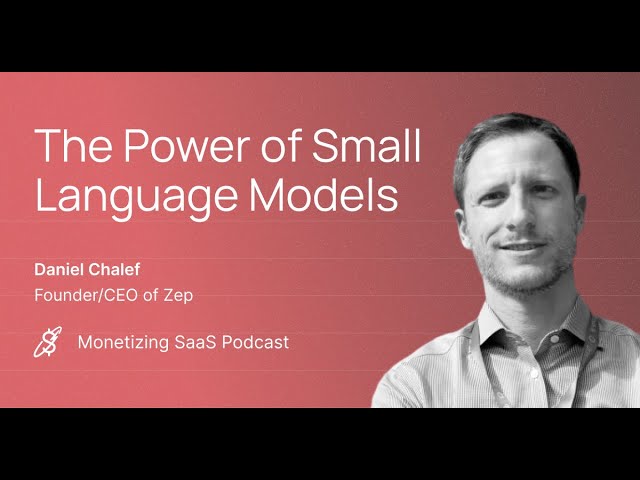
Daniel Chalef, CEO of Zep, built a state layer for large language models so conversational agents can remember users and apply policies. His startup started open-source, grew through community adoption, and now combines product-led growth with enterprise sales. He chose Stripe for billing because it's simpler and more flexible than platforms like Zuora.
Chapters
Daniel, it is so fun to be here with you. It's been so good getting to know you over these last few months. You've had a really interesting and a really textured career as both an entrepreneur and as an operator. I think that you've founded 3 companies. I know you've served in leadership roles across, you know, growth, marketing, data science, corporate development. Um, you're now building Zep, which is YC-backed. Can you take us back and tell us your story, your career journey, but, but go as far back as you want? Like, how did all of this happen?
Yeah, well, thank you for having me. So just a little correction there. I founded two companies, well, I guess three. One failed to launch. So didn't manage to raise enough money for that particular venture. It was a bit of a passion project. Yeah, so I'm an engineer and I started, you know, started life coding back on like ZX81, which might date me a little bit, Sinclair. And I've always been passionate about building stuff, whether it was when I was a kid building things with Lego and Meccano and things like that, or building coding stuff. And, but when I went to, excuse me, when I went to college, I studied business degree with a major in information systems, which is kind of like computer science mixed with business stuff. And all the while I was at college, I was actually really bored. And so I worked for South Africa's first internet service provider, Internet Africa, which was actually founded by Chris Pinkham, who went on to become CTO of Twitter. And prior to that, he was high up at AWS. And he actually came up with the idea for AWS, he and two other guys. And so back then, I cut my teeth in things like network operations and coding professionally while I was in college, paid for myself, paid for my way through college. And, you know, recognized after college that I really wanted to be software engineer. And so that's how things started off. That said, I ended up at this small development company and quickly became CTO. And I said, well, if I'm CTO, I would like some stock in the company. And then if I've got some stock in the company, I'd like to be a director of the company. And we ended up building something called KnowledgeTree. Which was an open source content management application. I put it up on SourceForge.net. There were millions of downloads back in the late 2000s. We had users ranging from large federal agencies through to European companies. So we raised some capital. I moved to the US. We spun it out, called KnowledgeTree, the company. And it was moderately successful. Wasn't a venture capital success. It is now owned by what is now Seesmic Software, which is a big sales and marketing technology vendor. But that was a really formative and interesting experience for me. Post Knowledge Tree, I didn't know what I wanted to do when I grew up. So I tried my hand at a number of different things, everything from leading marketing organizations to leading going back to my technical roots and leading a big, you know, a really focused product-focused data science organization, very, very product-focused, which I absolutely loved because I like building things. I realized that I did not like, once I'd kind of come up with the idea of this product at a company called SparkPost that I was at, and we built it, and it kind of was more in like maintenance mode, I got very bored. And so our CEO at the time, Rich, basically said to me, hey, well, you know, we just raised $200 million to buy some companies. Do you want to lead corporate development? And that's how I've ended up with a very varied and textured career by being essentially being incredibly curious and easily bored, which I think is fundamental to being an entrepreneur, actually. I agree.
So curiosity, high curiosity, easy to bore. Those are the two ingredients. Yeah.
Yeah.
What, so take us to Zepp. You've founded Zepp over the last couple of years, right? More recently than that?
Yeah, so we're actually just under a year of Zepp being a company. We launched the open source product a little bit earlier. I built Zepp because I was trying to solve a problem that I had. LLMs are stateless, and I was building an application with LLMs, and I was building it for CFOs and HR leaders, and was essentially going to take all those boring old process and policy documents that HR and finance organizations write and no one ever reads because they basically go into Google Drive or into a wiki. And basically go there to die, and turn those into living and breathing agents that actually executed those processes, nagged people to get things done, answered questions, said, no, you can't do, you can't take that sort of leave over this period because that's not our policy, et cetera. But I needed to manage state and remember things about users. Otherwise, the experience is going to be very much like when you're in a call center, call a call center, and you're getting passed from one agent to the next and you're having to re-explain your problem constantly, really frustrating to users. And so I looked around and there really wasn't infrastructure purpose-built for long-term memory for LLM applications. And I wanted something a little more sophisticated than trying to throw the entire chat history into the prompt and hoping that the LLM could make sense of it and didn't hallucinate, didn't misremember something, or didn't miss something. And so I developed an approach that utilized the extraction of artifacts like summaries and facts, so observations from the conversation, and made those available to developers progressively as the conversation continued or as a dialogue ensued. And I open-sourced it, put it onto GitHub. 2,000 stars later, plus stars later, 500,000 container installs, et cetera. Ended up raising some capital. We've now built a commercial version of the product. It does a lot more than just like core memory and helping developers remember dialogue. It's a system of record for dialogue, but our fact capabilities now do things like deconflict facts, understand the temporal dimension of facts. Because if I told you that I was in Mexico, if I told you 3 months ago that I was in Mexico and going there for a week, am I still in Mexico? No. So there's a temporal dimension to facts and facts change state. And so managing all of that complexity for developers coupled with, if we have a system of record for dialogue, we want to make more sense of it. So offering developers tools for dialogue classification to understand things like intent, is this a sales or support conversation, or emotional valence, is the user unhappy or sad or angry with us, as well as market segmentation. Is this a high-spending user, low-spending user, et cetera? And so really allowing developers to build sophisticated and more deterministic applications with LLMs. And I think that's really key as LLM applications start to penetrate the enterprise. Developers are looking for enterprise-ready tooling. That supports deterministic, sophisticated, and highly personalized engagement with their users.
When you first began working on Zepp, did you think about it as this has the potential to be a venture business that I'll raise money as, or was it more of a side project?
It was an itch that needed to be scratched, and I figured other developers might find it useful. I did think that maybe there was a business here, But I'm a firm believer that not every tool is a product and not every product can be a company. And so I really needed to see how it developed and how the LLM stack was developing. It was so nascent at the time. And it's been great seeing people like, well, companies like OpenAI coming up with very similar concepts, extracting observations and facts. From dialogue. I don't think they're doing it in as sophisticated a way as we're doing it, primarily because they don't need to. They're really focused on a broad problem. They have different key drivers, but it's been gratifying to see the demand and the need for it and other companies building similar functionality.
When did you realize there could be a business here.
When I started thinking about the bigger picture vision for the company and the opportunity to build or become the state layer for LLM applications and all of the interesting things that come from being the state layer. Enterprises have very specific needs around data retention, integration into data lakes, integration to line of business applications. Et cetera. And so when you start to really unpack what the state layer means for an enterprise, it becomes a very compelling proposition.
I was going to ask you about the vision for the business, but is that a good way to think about it? The vision of the business is to be the state layer? Yes. Yeah, very cool. Thank you for the background. You know, this is maybe— we've already kind of discussed this a little bit, but I'm interested in kind of how you think about, or let me kind of rephrase it, I'm interested in the trends or the major inflections that occupy most of your thinking that really gets you energized, that really draw your attention.
Yeah. Um, so I'm most excited about the power of small language models. Um, a lot of time is spent on talking about the capabilities of large language models. Our use cases are quite interesting in that our customers expect low-latency capabilities from us. Why? They want to delight their users. They don't want the users waiting for 5 or 6 seconds between each chat turn. Imagine trying to build a sales bot. And there's so much data about if your page, e-commerce application page loads too slowly, you lose deals. Now imagine that we're talking about hundreds of milliseconds or seconds there. Imagine waiting 5 to 10 seconds for an agent to get back to you. And so low, small language models have the ability to both be highly, to be highly powerful when we're thinking about doing specific tasks coupled with being very fast. And so those two things allow us to build things that are close to magical. And that is super exciting. And just in the last three or four months, we've just seen so much development in the space around small language models, whether it is, you know, Llama 3 HP or new models from Microsoft, the V3 models, et cetera, that are just so compelling.
Very interesting. Um, I want to talk a little bit about how you monetize. Um, it's an open source product, but you've recently built a commercial product. How does monetization work for the business?
Yeah, we're early stage, so we still work in this, working this, uh, working this out. And, um, the way we're thinking about it is there are two go-to-market motions here. Um, there's a PLG, product-led growth, uh, motion, uh, partly driven by open source and partly driven by our free plan. Um, and we want to totally support that. We see a lot of, um, sales coming in through that. Um, and I will say that right now we're not doing any outbound sales. Everything is inbound. Um, and That PLG motion seems to be working relatively well. Uh, it's really difficult to build a business though on a few hundred dollars to a few thousand dollars a month. Um, so the way we're thinking about this is, um, as we start to engage more actively with large enterprises, there's going to be enterprise sales motion there as well. We're already starting to sign much larger deals. Where, um, uh, we're having to engage and shape the deals, the deal, well, the, the deal contours for a particular customer based on their volume. It's been also quite amazing, um, seeing early-stage startups doing incredible things and growing so quickly that what we previously envisaged would be an enterprise customer is actually a 5-person early-stage startup, B2C, and they already got, you know, 7.5 to 10 million MAUs. And that's just so gratifying to see as well. It just, it really speaks to the excitement in the market around AI-based applications or LLM-based applications.
Very cool. What about pricing?
Yeah, that's a discovery exercise for us. And we very much, you know, as mentioned, you know, we, in terms of our go-to-market and structuring of pricing and plans, being in discovery mode means that we do need flexibility around how we structure our plans and pricing, which is kind of why we started working with you guys at Schematic. And, um, I think that there's always a tension around, um, trying to find a price that demonstrates or illustrates that, that is indicative of the value that you're delivering versus comparables in the market, which is very challenging when it's a nascent market. And how we see customers responding to pricing. So when we throw something out and yeah, it's, I think when we're talking about going from a PLG sales motion to enterprise, there's sometimes an, there's an anchoring that happens. Which can be deleterious in terms of your pricing, where it's challenging to go from, we have a $95 a month plan to $75,000 a year in ACV. And because of that anchoring. And so I think it's an evolution. I'm not afraid to grandfather old plans and old customers. And, you know, I've seen it enough times that your customer today doesn't necessarily mean that they're going to be your customer tomorrow. Your tomorrow's customer might be somebody very different.
This question just came to mind, but are you doing sort of like structured exercises with early customers around willingness to pay, or is it less structured than that?
It's less structured. Candidly, it's sometimes going into a conversation and, um, looking at who we sold to previously, trying to understand who the customer is, their volumes, and saying, well, we think this is a fair price. And it's much easier to come to an agreement around structuring of a deal than to increase prices post hoc.
You know, one thing that you said that stood out is you're starting with a product-led motion. Before that, there was this open source motion. You're moving towards an enterprise sales motion. We've talked about this before. There's complexity from an infrastructure perspective that you have to be able to support. But then there are things like, you know, if you end up with usage-based pricing, as you release product number 2, product number 3, all of this becomes complex. And I know you've seen this in prior companies. But I'm curious if you could talk for a little bit about your experience with just building infrastructure to support the way a modern software business needs to monetize. What have you learned about how to build that infrastructure and the complexities that product and engineering leaders especially need to be aware of and cognizant of?
Yeah, yeah. You know, we thought we'd found the solution in tools and platforms like Zuora. You know, back in the day, those weren't as flexible and capable and sometimes were overly complex. I think as an early stage startup, we're really trying to keep things simple with our infrastructure, but flexible. And so we're using Stripe. Stripe has come a long way and looking for tools that work with Stripe. Or complement Stripe. So straight out of the bat, there was no way that we were going to build our own entitlement authorization and authorization capabilities. So from an entitlement perspective, you know, I went actively went looking in the market for technologies that would work with Stripe or complement Stripe that would manage what I envisaged being an evolving pricing structure and entitled approach to plans and entitlement, and really wanted to find a platform that was not overly complex, that would grow with us and support the type of discovery and grandfathering that we would need to put in place. As an early-stage startup, I also don't want to be building anything that isn't core. And our core capability is, you know, our core product. We're not differentiated by building plan infrastructure, plan and entitlement infrastructure. So I guess just summing that up, I've just waxed on there a little bit, but summing it up, keep things simple. Buy versus build. And plan for, especially early stage, plan for flexibility, ability to be flexible.
One thing that, maybe this is true, maybe this isn't, but one thing that I feel like I've, you know, that comes across from you is the fact that you have your second time founder, you've operated at scale. And so I feel like you've seen the way that monetization can become extremely brittle.
Yeah.
And really constrain a business. And I wonder how true that is, or kind of how aware early stage CTOs and CEOs are around this infrastructural challenge that they will face if their businesses are successful.
I can only speak for myself. I'm not sure. I guess I've had conversations with folks within my YC batch around some pricing. I think a lot of them are already using something like Stripe, and Stripe is actually now built in quite a bit of flexibility in terms of being able to grandfather subscriptions, et cetera. I don't know. I can't speak for other founders necessarily.
I'm really interested in the experience that you would say has most influenced your business career, had the most impact or been the most formative.
Huh. Yeah. I would say it was actually the failure of my first startup, KnowledgeTree.
Why did it fail, do you think?
Oh, I was naive. I was naive. Um, I didn't look after my mental health. Um, and, um, I didn't know how to hire great people.
Um, did the product have product market fit?
I, it did reach initially. Uh, we pivoted and didn't have enough runway to pivot. We'd also raised Series B capital. And just, you know, didn't have, we didn't have company stage investor fit. Um, and I don't think at the time I was a strong enough leader and entrepreneur to navigate that well. I mean, for most entrepreneurs, it's challenging if, if you find that the market changes around you and you don't have that fit anymore and you plateau. So we plateaued in revenue. And so that was a formative experience, lots and lots of introspection. I think one of the other challenges one faces when you're an entrepreneur is that you start to strongly identify with your startup as being a core part of your being.
It's your identity.
Yeah, it's your identity. And just keeping some separation there and perspective. Is so important. Um, I've been able to lean on those experiences, both the positive and the negative, in so many different domains, whether it was, um, being able to take on product marketing roles or take on, um, a corporate development role you name it. Being a founder at a venture-backed startup gives you such an incredible grounding in the breadth of a business. And so it really lent itself to supporting my curiosity and ongoing ever-present boredom.
That's the title of this podcast right there.
Yeah, my ever-present boredom. Yeah. So that's been the most transformative experience of my career.
Traumatizing and transformative, I imagine. Yeah.
Well, you know, with a little bit of perspective, you know, one heals.
Well, maybe just to dig in one more time there, do you think it was, I pivot, I saw the opportunity to pivot, I pivoted too late, there was a runway problem, or I had run out of gas, I'd run out of energy, I'd run out of energy to motivate a team around a pivot and to motivate the investor community around a pivot?
These, you know, I think that one answer is reductive. A single aspect is reductive. There are so many things. I'd run out of steam. My investors had run out of steam. Lack of capital to actually execute. On a pivot, even though we had early customers for that pivot. If we were seed stage, it would have been absolutely amazing, but we weren't seed stage and our core business wasn't growing. And so, um, you know, you, you end up with a vicious cycle of things happening.
It's a concoction.
It's a concoction. Yeah. Everything's a system, right? Yes.
Where can people learn more about you and learn more about ZEPP?
So our website, www.getzepp.com. And learning about me, I guess I have a LinkedIn profile. I'm not one for self-promotion, so I don't have a website.
Are you on Twitter or X?
Oh yeah, yeah, I'm on Twitter. Yeah, so x.com/danielchaleff. And there's a Zep AI as well, Zep_AI as well.
Great. Thank you so much for doing this. It's so fun to be here with you.
Yeah, thanks, Fynn. It was a lot of fun.
More from Fynn

Schematic at Operators Guild Demo Day 2026: How to bill for AI credits without a surprise bill







Should you move to usage-based pricing because AI is compressing your margins?

Why raising prices every year backfires (a pricing leader on the Mastercard quota model)

