
Monetizing SaaS: Episode 17 with Thomas Sellers, Monetization Leader at UIPath
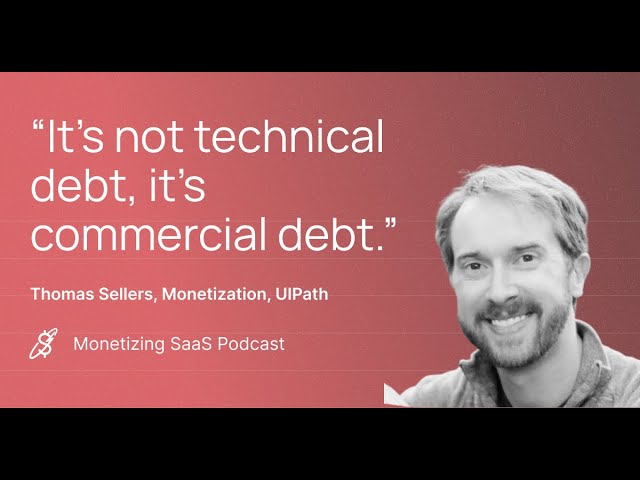
In this interview, host Fynn Glover (Speaker A) talks with Thomas Sellers, Director of Strategic Pricing at UiPath, about his unconventional career path from software engineering to product management, consulting, and pricing leadership at Cisco, Citrix, and UiPath. Thomas explains how pricing and monetization are often overlooked yet critical levers for B2B SaaS companies. He dives deep into the challenges of monetizing generative AI features, discussing the trade‑offs between user‑based and consumption‑based models, the difficulty of estimating value, and the importance of COGS considerations. He outlines a triangulation approach to value estimation (time‑savings, business impact, and customer willingness‑to‑pay surveys). The conversation contrasts pricing at large enterprises—where multiple stakeholders, complex product portfolios, and commercial debt (entitlements, metering, licensing) create heavy coordination overhead—with early‑stage firms where speed and a few focused sessions are more practical. Thomas shares stories about building a pricing council after UiPath’s IPO, dealing with commercial debt from in‑house entitlement engines, and the need for a unified source of truth for usage data. He offers actionable advice for founders, suggesting they use generative AI (e.g., ChatGPT) for first‑pass pricing analysis and then seek expert validation. Finally, he reflects on a formative failure at Cisco (the CIUS tablet project) that taught him the value of competitive positioning and learning from failure. He closes by inviting listeners to connect with him on LinkedIn.
Chapters
Thomas, it's so good to be here with you. I've gotten to know you over the last year and it's been great to get to know you. You've had such an interesting career and I think one of the reasons I'm so excited to talk to you is you've, you started in software development, you eventually moved into product management, then you started consulting companies on monetization, which means that you'd sort of lived and breathed the technical complexities of monetization as you started to consult. And eventually you joined UiPath as a leader in their pricing team. You're currently there as the director of strategic pricing. So can you tell us about your journey? How did, how did you get to now?
Well, it's, it's a, it's a fun question. I always love this one because I found that a lot of monetization professionals don't— there's no school for monetization. I mean, I actually had one MBA course on pricing, um, and I actually, it opened my eyes to it. I thought it was fascinating, but ultimately, um, like a lot of folks, I, you know, graduated with an engineering degree, got into the software space. I found it really interesting, but I also found things certain things frustrating about, you know, just why were we doing very, you know, why were we developing certain features? So I was interested in product management. I obviously went to get my MBA and it was like I said there that I found this, you know, this pricing course that was interesting. And it turned out that fast forward post-graduation, you know, Cisco actually maintains an offering portfolio. They have, obviously you buy things à la carte, you can also buy a large enterprise agreement. And so I actually transitioned to product management into— I mean, I thought I was going to be a technical product manager, but this opportunity popped up. Well, it's a commercial offering manager, sounds about the same thing. Um, and so I really learned how like the business actually worked from the, you know, the actual sales process, how do large companies purchase, um, what are the things that they find value in, and not just the technology but like the commercial levers as well. And you actually understand how deals get done. Um, so that was kind of like the interesting career hop that then led to You know, the opportunity at Citrix popped up and I actually worked very closely with a sister team at Cisco that we had a pricing organization that was just responsible for like, what's the dollar figure? And then we were responsible for the offer structure. And so I actually worked really closely with the pricing team. And so I thought it was fascinating. And then when the opportunity popped up to start a group at Citrix, you know, this was like the first, you know, group that was actually responsible for pricing as a whole across the company. I was like the number 2 person there and it was I couldn't pass it up even though I had no idea what I was going to be doing. And so that opportunity I actually, you know, thought was amazing because one of the lucky things that actually happened there was we were able to convince our leaders in marketing that we needed a budget to bring in some actual consultants that knew what they were doing. And so it was amazing to actually have some external groups come in that have actually done this multiple times. And so learning from them, you know, I'd say expedited my ramp up in the process. Seeing what worked in practice, what didn't work, hearing the lessons, you know, the battle stories from them. You know, unfortunately it's like a blessing and a curse in pricing. You get to see what amazing impact you can have, but you got to deal with some of the downsides and the dark sides as well because it is a struggle to get things done some days. There's organizational alignment things that just need to happen. And it takes time some days and sometimes the organization isn't patient for that too. So anyway, long story short, the opportunity at UiPath that popped up too, because I, you know, and I realized in looking at my career at the time, it was, I had played in the collaboration, like the, you know, let's say communication space and the virtual, you know, apps and desktop spaces. And both of those industries were slowly declining in terms of, let's say in terms of total overall value, they were, growing double digits, but the majority of the growth in both Cisco and Citrix was coming from acquisition of market share of other competitors. And so transition to UiPath was in the automation space a couple years ago. We're obviously, we're also in the AI space today. So we're talking more explosive growth. We're talking multiple peripheral markets that we play in. So the business environment's a ton different. So it's been a wild journey. We even went through an IPO after I joined as well. So it's, you know, there's everything, everything all under the sun, it seems like, you know, the past couple years for me. So with that, I mean, I found that like, you know, someone always looks at like, how do you get into the space? How do you develop this, you know, the expertise? But I feel like, you know, ultimately there's always like the little spark that interests you. And if you really enjoy and you find the need in an organization to really— that no one's thinking about pricing, no one's thinking what was the business case of developing this feature or doing this, you know, launching this new motion, or you're actually seeing that, you know, even sales feedback is becoming challenging to how to articulate value value of your solution, it seems like there might be good space to play in. And it might seem that you could kind of— anybody could get in there, try to add value, try and organize the collective thoughts of the organization, put it down cohesively in a plan, sales play, etc. And before you know it, you've played in the pricing space.
It is one of those fields where it's like you come into it and there isn't sort of like a playbook to get into it. And I think it's so interesting too, like, I mean, you went to a great MBA program and there's one class on pricing, and pricing is half the revenue equation, right? Like, there's the number of customers you have and there's the price that you charge.
Well, isn't that the funny thing, right? It's like, really, the, the price you, you charge versus the cost and then your, your margin— these are very important things. And it's amazing how many companies don't have a handle on that very simple equation.
Yeah. And, and for the sort of entrepreneurial person in a, in a large enterprise or even in a startup, it's like, wow, this could be a real lever. If we really thought about it and we're really intentional about it.
And it's amazing because, I mean, ultimately that equation is very important in terms of, you know, really your revenue generation, but then also in terms of how much you want to, how much fuel do you want to burn on the business? Because ultimately a lot of, a lot of cases, a, um, a business case will be built around, you know, the unit economics of the thing that you want to sell. But so, I mean, ultimately in the future you need to understand what does that look like if you're trying to build the case for investment while you're trying to look at What is, what are the, the unit economics look in the out years? How much revenue do you think you can land? How much, you know, how much you can think you can sell? And then there you have your potential, you know, revenue stream in the future. So it's, it's kind of important to even like the, you know, founders in the entrepreneurial spaces today in terms of, you know, getting that VC dollar.
So take us into UiPath now. So you're director of strategic pricing. Where are you spending your time these days?
So I, I primarily focus on net new product pricing. So for me, it is generative AI is the name of the game. And so the way that I think about that today is, you know, again, we actually, we play in the automation space. We've had specialized models for doing document processing, like extracting data from, you know, structured documents, et cetera. And so the advent of the LLMs have actually just really made the adoption, the potential use cases across many different services of our platform, across other vendors' platforms. It's just really brought them to the forefront in terms of potential adoption. And so it's really an amazing space to be in because a lot of companies are trying to figure out, well, how do we monetize these features? Because there is substantial costs involved in a lot of these. So ultimately, it's an interesting trade-off that a lot of companies are trying to figure out. What value do these new generative features have for my specific customers? Ultimately, is that a lasting value or is it transient? Like, if it's going to go away in 2 years because it's commoditized, well, You know, that needs to factor into your plans. And then ultimately figuring out how you want to monetize. Do you want to monetize via something simpler, makes it easier to sell, like a user-based approach? Or do you monetize via consumption-based approach because it's more aligned to cost and you might not have the money to burn on taking a risk? And so ultimately, I think that's like the interesting space that I'm kind of playing in right now is doing that holistically and simply across our platform. Because again, we play in one major market and 5 peripheral high growth or 4 peripheral high growth markets. So, you know, organizing kind of herding the cat, so to speak, is a fun, a fun element of the journey as well.
You know, one thing you said that's so interesting is like, and I've been thinking about this recently, obviously AI and generative AI are top of mind for nearly everyone building any type of B2B SaaS. But this is a new era., I think, of COGS. And it is, um, I think the question that I'm sort of interested in getting at is, um, maybe kind of look, what are the second-order effects of AI as something that you're offering as a B2B SaaS company? And is one of the most second— most important second-order effects this fundamentally reorients the way a software business has to think about COGS, given traditionally it's been, you know, 75 to 85%.
Well, it's fun because again, the time elements, I think, important too, because we also know— again, so kind of let me say, taking a, a step first back at the what, what value is their customer getting out of the features and is it lasting? Um, if you can develop something that uses generative AI, low cost, it's not that expensive, but there's money associated with it. But if it generates something that has high value that you can charge for, you know, you're in an excellent space. Or let's say the features allow you to sell additional elements of your, your platform, your, your offerings, then that actually also potentially might have lasting effects to increase the space and speed of adoption. But then to your point, it's, it's kind of an interesting challenge around the amount of, let's say, modeling that you actually want to take on and what that timeframe is, because in the short term, there are a lot of pay-as-you-go ways to consume LLMs. And honestly, at the end of the day, if you're selling a per-seat model, you're charging a couple of dollars. For the most part, usage is something you might be able to estimate and account for in what you want to charge on a per-seat basis depending on your offering. If you're charging solely based on the actual use of the LLM and you're having to bake that into your price, that's something that's just going to be a challenge to maintain going forward. And so I think that that's got the interesting I would say mindset that I kind of try to adopt here is taking those multiple steps back and trying to figure out, do you actually have a handle on usage and the value? And to be 100% honest, many customers, like everybody, we're all trying to figure out what does generative AI's impact have on my day-to-day job? Customers are trying to figure this out. They're just trying to learn at this point. And so ultimately, when a lot of companies are thinking about, I've just developed this new cool Copilot, or I've just developed this new cool feature, I mean, the usage, we're kind of estimating things. You know, at the end of the day, I've even working with small companies are in the same boat too. And so trying to figure out what you think that future usage profile might look like. I mean, it could change in 3 months. So when you're building a business plan, it's like looking, trying to, you know, be 1 year, 2 years out, just know that there's a lot of variance that could go along with that plan. And so you're having to build in hooks in terms of how you want to launch your monetization. So what might allow you to launch something initially, capture value, and might allow you to pivot., you know, in 3 to 6 months if you learn something new and you need to change. So that's like the building in optionality is kind of the other element of this is we're all just learning and trying to figure out the impacts and you'll probably need to change.
To that point, I'm trying to figure out the impact and really understand the value. How do you figure out the value of, let's say, a generative AI feature today, especially at scale, like at UiPath scale? Like, how do you actually do that?
So there are I would say triangulation tends to be the best approach because again, at the end of the day, there's not an exact science for it. You can estimate the value of a use of a feature. Like, so what's the time savings, for instance? You could estimate then, you know, based on a, if it was a knowledge worker or a developer, estimate the time or the amount that they would get paid. You could then calculate how much usage that they might actually incur over the course of a year. You could do the dollar estimate of how much time savings your feature has actually generated for that customer. That being said, that sounds a little bit more like it's a softer value prop to me. I mean, because every— all features save time to some, you know, to some effect. But I think what's interesting is really what does that— telling the story around what sort of higher-level business value is generated. So if what you're selling is speed, So not just time savings, but speed. You're enabling your develop— let's say your developers to publish code Y% faster. You're able to help your— using a sales-assisted copilot, help close deals and pipeline Y% faster. That's something that's got a lot more tangible benefit that I think scales better. And it's a better value proposition than just saying, oh, well, we can save you some time. And here's approximately how much time a business user might save on an annual basis. It's like, sure, you can do that. But, you know, looking at the overall business impact is, I think, something that a lot of companies are trying to figure out. And then lastly, but not leastly, you could always do the classic, like a Van Westendorp or a customer survey type thing. And, you know, it's one element that factors into the triangulation approach. But I think it's still an important element to understand what does the customer think? Like how much value is in the pain point that you're solving with your feature? What would they be willing to pay for it? And then does that then obviously align across industries, company sizes, and that segmentation and all that? So that's at least a high-level approach of how we kind of think about things.
Yeah, it's a great, very clear triangulation. So at UiPath, and maybe because you help, I know you help smaller companies too, but I'm curious, like what are the biggest challenges that you run into trying to help really large mature organizations get a handle on monetization, consistently evolve monetization as a disciplined practice? And how do those challenges differ when you're helping early-stage companies? Yeah.
Um, so the challenge that I find at larger companies tends to be the amount of just the scale of the business. Um, the scale of the business defines multiple different stakeholders. Um, pricing tends to roll up into one of your key C functions. And guess what? They also— it also needs to answer to the other ones. And so, I mean, ultimately you've got 3 or more bosses. You've got teams spreading the organization. Your plans, guess what? They're never going to be perfect. You're going to piss somebody off. You're going to try your best to understand where the business is. You're going to try your best to understand what the business needs to do. And you try the best to make the right trade-offs. But ultimately, you know, because you're trying to get multiple perspectives looking at a problem, there's going to be trade-offs made.
It is so true. I mean, pricing is one of those disciplines where it's like there are multiple customers of pricing internally in every company. And it gets harder the bigger you get.
And I'd say that the one thing that I do like about being in pricing, about being in a pricing role at a company for a long period of time is building up the organization, basically the political capital to say, listen, you know, I've, you know, working with the various stakeholders for a long time and basically being able to say, listen, you know, we have these situations. This is the reason why we have to make this trade-off. And then have like that, that working relationship still being in great shape after even a tough call. Because I honestly think that I've seen companies churn through pricing leaders, you know, after— and I think it's a factor of just the day and age too. A lot of people will move on after a while, 2 years. And it's amazing the type of knowledge that gets lost in those sorts of transitions. And I think that, you know, making sure that some elements of those things actually persist is something that I find gratifying about the role because you know where the— I hate to say it— you know where the skeletons are buried. You know what needs to be done. You know what's been tried before. You knew the environment of the situation previously. You know now what's changed if you're reevaluating doing something very similar. And you can basically say, yeah, we tried this, we learned this. This is a little bit different. We could try this pivot. And see how things go. And then guess what, guys? You know, even if things shit, you know, hits the fan, we're also going to be around here to basically, you know, pull our weight and fix it. If, you know, things do go sideways. And so I think that's something that a lot of people, I think, are kind of forget in terms of, you know, when you, when you lose that expertise in the long run.
I think it's such a good point. What about the earlier stage companies?
And the early stage, you know, what's kind of funny is the alignment and stuff that happens at a large enterprise, you don't really have that challenge nearly at all in small. It's typically a single stakeholder that has so many more things on their mind than pricing. And so ultimately, like, in what's— it's really difficult in those two scenarios because I feel like in large companies you can spend a ton of time on pricing analysis, all the detail, all the details, all the, the, the, the PowerPoint, the pros, cons, all that kind of good stuff. But ultimately, at the end of the day, making the call at the small company space, honestly, just spending a little bit of time documenting what was the business strategy, making sure that you kind of say what were the few things that you looked at and what was the call. And really just, you know, I wouldn't even say dedicating tons of time to this, but just get a few key people together, dedicate a couple hours. Nope. I hate to say it. No, I mean, no, no, I'm not saying pricing is not rocket science. You can spend, you know, years on this stuff, but ultimately for founders, you have so many things to worry about that spend a couple hours, do a dedicated session on pricing, figure out a reasonable call, test it, see how it goes.
And then do that periodically.
Yeah.
It sounds like the challenge. It sounds like the challenge at early stage is getting people to invest. At some increment and focusing on it.
Write it down. So when you come back in 3 months, you can, you can take an honest look at what you thought was going to happen, what actually happened, and it gives you a starting point to iterate on. Yeah, I think that's something that we like to tell ourselves, the narratives of here's the reasons why things won, here's the things, things did well, and here's the reasons why things didn't. Writing something down and putting your bets on paper makes you be honest with yourself and it makes you learn better. And faster. And that's ultimately what we're all trying to do.
Really good. I want to zoom out for a second and then I want to come back and ask some, some more detailed stories and detailed questions and ask you stories that can really be like, um, you know, useful to operators. But zooming out for a second, you've already talked about generative AI, but, you know, thinking about building SaaS companies, thinking about what you see at early stage, thinking about what you see in the enterprise, are there any other big changes or inflections that get you really energized, attract a lot of your curiosity and energy?
So what's interesting to me, and just looking at the macroeconomic situation, money's becoming harder to come by. And so you've seen this pulling back from product-led motions. And so from a monetization person's perspective, that's, that's a little sad because I thought it was such an amazing potential. And so to obviously just see the money kind of be a little bit tighter and see some of those efforts dry up is a challenge. However, what I think is really interesting is I think that there will be an— the pendulum will swing back in the other direction. It's a matter of when. And ultimately for me, it's interesting to see what sort of monetization structures that you need to start thinking about now and developing the capabilities for now that will be available to you to basically leverage when money becomes a little bit easier to come by and you're ready to basically spin up a PLG motion, keep the lights on for a long time, get a bunch of free customers. And so if you build that, those capabilities now, offer them, let's say, before— let's say offer them before the market is right for them, then you're already out there. And I'll, I'll use Symantec as a, as an, uh, as an example. Imagine if you had more unlimited funds right now and you could actually stand up a pricing and the entitlements engine now. So all the founders that are getting started now, bootstrapping now, would use for, let's say, a year or two. And once you're already hooked into the business, then you're there to grow with them. And so I think that that would be kind of a, maybe a hypothetical example, but an example of what sort of capabilities in a product-led motion does do a, let's say, even a large company need to start thinking about because a large company is going to have challenges and friction with their sales-led motion. And so they're going to need to rectify compensation issues and how they want to incorporate that in their forecast. And that's stuff that's going to take some time to think about and iterate on. And so a smaller company is going to be a little bit easier to play the game and maybe time it right with the market. But a larger company's got, you know, lead time of work that needs to be done. And so that to me is kind of what I think is very exciting about the market transitions because it's just, it's, I think it's only a matter of time until that motion comes back and it comes back in like a 2.0 type form.
Really, really cool. Um, okay. So going into And maybe we should just back up because you and I talk about monetization all day, every day to the people that we talk to. But monetization encompasses a lot. And so what is monetization? What do you mean when you say monetization for an organization and more specifically for a B2B SaaS organization?
Well, I mean, at a whole, I'd say like there is a business model that a company has in mind. So they're going to sell, they've got a an offering that they're going to sell that solves some customer pain point. And then they've got some aspects or some goals for their business. Monetization, I think, helps tie all that together in terms of, okay, what is the thing that you're selling? What is the go-to-market motions that you're reaching out to your customers? What is the profitability of the thing that you're looking at? And then how does that then— it will need to factor in, it will incorporate many elements. Of your product portfolio, what plans there are, what sales motions you want to pursue, and ultimately like what your financial outlook looks like. But ultimately monetization is, you know, it's in that little center of the diagram in terms of it's shining a light on the black box of really what's going to be the guts of this business and where's the money coming in, where's the money going out. And if you don't have that, then it's like a— I hate to use a South Park reference, but it's like, you know, the Underpants Gnomes were basically, you know, step one, collect underpants. Step 2 is question mark. Step 3 is profit. Uh, well, what, what was in that middle thing? If you could figure that out, then, then you've got a, you know, you got a business plan.
Okay, it's really good.
So sorry, sorry for terrible reference, but no, I love it.
Why is monetization complex for B2B SaaS companies? And maybe take UiPath. And is it because you're supporting multiple sales motions? Is it because you're supporting multiple products? Is it because you are, um, you know, dealing with different types of price metrics.
I mean, to me, in terms of what I've actually seen, both Cisco, yeah, Citrix, and at UiPath— I don't mean this in a bad way, but, um, pricing is not, you know, it's not the forefront of all of these business leaders' minds. I mean, it's, it's important, but let's be fair, a lot of these, these are all tech companies that I've worked at. I've Product, I mean, sell the product, customer, the customer value prop, that's going to be something that's really at the forefront of people's minds. And that's where R&D dollars go to. That's where the resource spend goes to. And then you're obviously looking at your sales organization because these are heavily sales-led, you know, or heavily sales-led products. And so, you know, there's always a hefty stream of spend going to your sales organization. And so pricing tends to be a highly leveraged group of people. But it's something that, and again, I'll also take a step back and say, a pricing group doesn't need to be massive. It shouldn't be overfunded where a bunch of people sitting around waiting and not having anything to do. So I believe that they should be highly leveraged, but the challenge of that is, is there's always going to be initiatives that don't make a prioritization cutoff or that ultimately like just, you know, they'll die on the vine. Somebody, hey, I got this great idea. Well, Ultimately, we've got these 20 other great ideas. We got to figure out which few, which these few are really got the biggest bang for the buck, and then spending the time to develop the business cases around those to make sure that we actually do in fact understand what the right business impact is. And so it's interesting because even in all these, you know, these 3 companies, because again, large, large number of people, you know, thousands plus people that are extremely intelligent looking at business problems and aware of different things and different experiences, and they're saying, hey, I've got this idea, this potential thing is happening, this customer's got, you know, a challenge, this competitor's coming in with some, you know, some tweak. You as a pricing team need to hear a lot of that feedback, incorporate that into a plan. And your plan basically also is what you have to do day to day to just deliver on your job. And what are the needles that you need to move, move on for, like, to evolve your pricing capability as a function overall. And so that ends up being the big challenge because you're always making priority calls where somebody just isn't going to be— a number of people aren't going to be getting their projects done, and you're actually still going to need to deliver and keep the lights on and evolve. Because you know what, there's going to be that next business situation that comes up that you're going to need to have the next-gen set of capabilities that you need to be in front of and have a plan for.
Is it fair to say that, um, if I were to play that back, is it fair to say that part of what makes modernization so complex, at least in enterprise, is how you prioritize effectively like material changes to the customer experience?
Well, yes, that is correct. It's also, it's, and it's not just as simple as that because how, if I was making a priority call myself, I'm, it's pretty easy for me to be aligned with myself. If I have to align the numbers of stakeholders that need to be aligned, well, it takes a little bit longer to do that. Everyone has different opinions. And that's good because you have my person, if it was just me making a priority call, I'd be more likely to make mistakes. I don't have the same experiences, let's say 5, 10 other leaders. However, that does require a certain amount of stakeholder alignment and certain trade-offs and again, hard decisions. And so that to me is like the hardest part of the enterprise space because you're having to, I hate, you know, I'll also say this, you have to pick who is in your inner circle, who is in your committee. That really gets to be involved in making decisions and what are their roles in that? Everybody's got opinions, but these people's opinions matter because they own bits of the process and responsible for delivering bits of it. And so I think that is going to be like the hardest part because there's an inner circle and then there's folks that are impacted by the decision and you also need to keep them in the loop too. Organizational alignment becomes, I think, the name of the game. If you can do that well and do it consistently over time, then you basically increase a large company's ability to execute and execute quickly. And I think that becomes a superpower of an organization at scale.
Well, you, so you've been at UiPath for some time, which has given you the opportunity to build up this trust and build up these practices around things. Can you tell us a recent story around, you know, as much as you can share around like, we had divergent opinions, we had kind of different incentives in the room, but we found a way to talk about it. And can you just like walk us through how that conversation happened?
Sure. And at a really high level, so what happened, so early on when we were actually going public, we actually, the pricing organization reported up into our chief strategy officer. And as part of our official, as a public company, our documented pricing process that we needed to adhere to for SOX compliance had him as the final sign-off party. So if you think about it, that meant that you need to make sure that, you know, you inform all your stakeholders, but ultimately you need, you know who you need to get buy-in on. So there's at least clear roles and responsibilities there. What obviously ended up happening over time, you know, people change roles. He was an older fellow. He retired actually. He was a really fun guy to work with. But in any event, what happened with the pricing organization, we moved into the product organization because ultimately we were a tech company developing a— so we were acquiring net new products in different peripheral markets. We were building them. So it made sense from an organizational perspective to have monetization aligned to product. And so what that then did is when that strategy officer actually had his organization, he basically took his people in his organization and divided them across the business, which I thought was actually a really incredible way of kind of realigning things after his departure, because ultimately you had people that were really tight-knit and knew how to work with each other and knew people's skill sets, and they were deposited across the business from product to finance to, you know, partner organization, etc. And so that allowed us to kind of maintain kind of a cohesive, uh, set of eyes and ears as we were developing net new things in our, you know, in the kind of post-IPO world and some of the challenging situations that we were looking at. And so ultimately, when we, you know, we're sitting down and saying, okay, well, how does our pricing— how's our pricing council look, you know, now that our— the person who was making decisions is now no longer there? There was no And so we had to reevaluate some of the challenges that we were actually looking at and determine what should our pricing council be made up of. And so some of the things we were looking at was like ultimately we were trying to increase our customer, our customers' selling prices because we were facing the same situation that many customers or many of our vendors and customers were looking at in terms of increasing costs. We were also looking at the challenges around really the product-led motions and the realities of business there. And so we were saying, okay, well, we need to make sure that when we're looking at this environment going forward, we need to make sure that we have a key stakeholder from sales as part of that. So we made sure that our chief revenue officer was there. We need to make sure that our, obviously our product leader was there because that's who we reported into. And then from a margin standpoint, we were a high-growth company, needed to make sure that our profitability was staying as is. So our chief financial officer was the third member of that party. We did have a few other members of the C-level that were not part of the pricing council. They were key informed stakeholders, but ultimately that was an example of like, we had to make some tough calls of, okay, who's in the room, who's out of the room? Because every pricing leader would know that every single time you have a C-level leader looking at a proposal, they're going to have their long list of questions that they want to ask and you have to go off and then do the due diligence. And so we need to make sure that we said, okay, here are the folks that we really need to make sure that we have the answers right for, and we can then go off and do that focused work. So that we're not spending endless cycles on, you know, analysis paralysis, but focusing on the stakeholders that matter in the new, new world and making sure that we're navigating the ship accordingly.
Great story. You know, um, something that you said caught my ear and I want to try to explore it. So recently I had someone say to me, um, we haven't done a pricing analysis in 2 years, um, we haven't changed pricing in 2 years. And then they said but even if we did a pricing study, even if we brought in an analyst or a consultant or tried to spin up our own team, we couldn't action those changes in the product, even if we had, you know, a great analysis. And what you said earlier that caught my ear is, you know, you've got to involve so many stakeholders. You often have to involve engineering. Why is it so hard for companies to— why is there such a high bar for making changes? And why does engineering have to be involved in pricing and packaging and monetization generally?
What's tough is what happened, in my opinion, I call this, it's the equivalent of technical debt on the commercial side, it's commercial debt. What's happened is someone made a decision many moons ago that has now, no one was aware of, and it has built up over time. And so what that means is basically you have made a decision to instead of outsource your entitlements engine, build it in-house. You're now spending R&D dollars, likely you're probably not spending enough R&D dollars, making sure that your licensing matches what your commercials are because small companies tend to change pricing frequently. And so what you'll then have is customers that you actually don't know what they're entitled to. And then that impacts customer sentiment because they don't see the end product experience that they're expecting. Your sales teams don't know what the customer's purchased and what they need to be selling to them in the future. And so Ultimately, this is now a surprise mountain of commercial debt that has popped up and everyone said, oh, you know, like, and I'm sure you get to deal with this day to day where it's like, oh man, in order to transition to something that actually does this and does this well, man, it's going to be, you know, it's a reasonable amount of money, but I don't have the money planned for that. So now I have to either find it in somebody, somebody else's budget or start better planning for it. And honestly, everyone, what I see is sometimes business leaders just bury their head in the sand. Like, I don't want to deal with that. The revenue leakage isn't that bad, or paper licensing is fine for now. But ultimately, as soon as you start to go consumption, then you realize, junk. I got to have a central system, a source of record for not only entitlements, but also actual usage. And guess what? Customers are going to want to see that information too, because you've sold them that. And If you want to sell things simply, you have to have that in a unified manner and not just sold, you know, in chunks of entitlement, chunks of usage entitlements that you can kind of, you can do if you're a large enterprise and selling a consumption offer. But in any event, what I've kind of found is that realizing that mountain of commercial debt that's popped up is just a tough pill to swallow. And so that's where I was saying, if you're a small company very early on, just being aware that ultimately, like, what might this future look like for you? What are the levers that you might want to pull in your monetization experience? And then at least making a cognizant trade-off to say, yeah, we're not going to outsource this today. I don't have the money for it, whatever. We're going to do something good enough in-house. Let's talk. And then you write that down. And then you look at that in the next year or the next 2 years or whatever and evaluate, have we grown enough where this is starting to make a difference? Because are we hearing enough pain points? Because if you're number one, at least aware of it, number two, you can at least start designing from an engineering perspective to accommodate a solutions rip and replace a lot easier than if you basically buried your head in the sand day one and then got surprised for 3, 4 years later when nothing is even prepared for a transition.
Can you tell a recent story about how this problem, this entitlements problem, impacts you either at UiPath when you're at the enterprise or with a smaller company that you've got.
Yeah, I mean, and even something that I've seen at Citrix as well as even UiPath is ultimately at the end of the day, customers do want to use or pay based on what they use and are expecting to be able to see their usage. Simple enough, it sounds obvious, but again, pricing isn't rocket science. But then ultimately in order to do that, To do all that, you need to have a source of truth of what is, what is customer bought, what is the customer actually used. Because what you tend to find is a lot of companies want to offer a singular credit and you consume from that credit. That makes sense, right? Not rocket science. But then in order to do that, then you need to have maintain a central mapping of all your different entitlements and how that then converts to your consumable usage from all of your different products that consume it. And so a challenge of that, that's simple enough for an engineering team to build, but you have to, when you have a large enterprise like UiPath, you need to cohesively do that across many different engineering teams and you're making a trade-off in terms of do you spend that product and engineering effort on building licensing and technical enforcement and metering and a licensing dashboard, or do you invest in generative AI and doing the next cool feature or the next thing that a customer, you know, large customer says they would like to do. That's a hard trade-off some days.
And just to kind of be really clear, what you're saying is the implication here is my engineering team either goes and works on the potentially high-value generative AI feature, or they have to make this really unfortunate binary trade-off where I got to go build an entitlements engine, or I've got to go like deal with debt in the existing entitlements engine because it was hard-coded or whatever.
Precisely. Yeah. And ultimately, like what's interesting, and even from a public company's perspective, you can sell bundles of consumption. It's basically an SaaS an automated bundle of consumption and a sales team can scope that and sell it. But then the challenge is that you cannot sell that, you cannot use that single consumable for other things. You can't add things easily to that single consumable. So interesting, it's a challenge, but that basically means in order if you want to have a unified consumable and add things to it, add new consumption meters to it over time, you need to be able to show the existing usage and show how you add that new entitlement. So how that actually, how much that value of the previous thing is now attributed to the net new things that you're adding.
Okay. That's a super interesting use case. So like you're at scale, you've got a bundle, but you actually can't like expand the revenue of the customer because you can't track usage clearly enough. The source of truth isn't good enough.
And then there's like, so there's some work you have to do to build stuff on the backend. Yeah. So it's, it's like I said, it's fascinating because what I love about monetization is you play in all the spaces or very many of the spaces. And so you see the product challenges. You see the finance challenges, you see really everything in between. And so it's, it's really fun because ultimately you're trying to make those right trade-offs to say, you know, again, I was part of the decision, um, you know, and this was a couple, probably about 2 or so years ago where we were identifying this need, identifying this impact that was preventing our customers from using, uh, honestly, a consumable for other things. And they were like, yeah, this is what I want to do. And we're identifying the technical gaps in being able to offer that commercially. And so we're like, well, we need to develop the product requirements to go to build a central metering system. And so, you know, ultimately it takes some time to go off and do that, but then eventually over time it's allowed us to, you know, once we actually launch that, then roll those new capabilities into our commercial offerings. And so it's really challenging, but at the same time it's gratifying to see this pain point that existed for, you know, 2 years or so. Then, you know, you see the hard work that needs to get done. And a consultant, they get to just say, oh yeah, you should solve that. But then to actually be boots on the ground and deal with the pain over time. And you know, it's gratifying to see you have a solution in market. You hear customers say, hey, listen, this thing that you had on the truck to sell, ah, it sucked a long time ago. And you say, oh yeah, but we fixed that problem. And then you hear that time down and it's like, it's cool to be able to say, yep, we were involved in actually solving that customer pain point. So that's where the engineer in me still gets excited about solving problems.
It is an amazing space with so much breadth. Thank you so much for this time. I could talk to you about this for probably another couple hours. I want to maybe kind of a couple closing questions. Just one is, imagine you're talking to a bunch of founders at companies ranging from, you know, really early stage to growth stage, you know, we're talking Series C to Series C or D. Is there, is there a best practice that these companies could start to employ to just incrementally get better at monetization?
I'm going to put myself out of a job. Use ChatGPT. Um, I, I, I joke. Um, but at the same time, I actually do that in my professional, like in my pro bono kind of work on the side too, is that Ultimately, like it's actually a joke, but it's actually not bad. I mean, if you actually can describe, here's the business that I'm in, here is the, you know, what, let's say roughly what I'd like to sell. Here is the elements that I would like to, that I think are important to my customers. And then say, please evaluate this as a pricing and packaging consultant. You know, what might be the best practices that I should think about? And generative AI will give you, I'm going to say an 80% good enough answer. And the reason why I would— I'll stop there and say it's 80%, it's not great, but it's going to help you avoid the major pitfalls that likely might impact the founder's ability to initially scale. And ultimately, at some point, someone will need to come in and really kind of course correct and get the right, you know, extra 20% in there. But day one for a founder, I hate to say it, I wouldn't worry about that. What I like to at least explicitly help founders with is do that on a more— play with ChatGPT on a more regular basis whenever they are kept up at night and then tap somebody like me on the side that will— that don't mind having a 30-minute conversation around like, hey, you know, here are the things that I'm worried about. I'm worried about this thing or I see this market transition or whatever. What should I do? And then that person can help them in the right— in that moment, get— help them dial in the feedback from ChatGPT and Sanity, check it out for, you know, just to avoid there's no weird hallucinations. And then that gets them most of the way there.
It's great advice and I think super actionable. What is— one question I always like to ask at the end is what's been the professional experience or life experience that has had the most influence or the most formative impact on your career?
Honestly, I'd say the probably the one that had the most formative experience in my career as a whole. That's a tough one, but I'm gonna go with a— it was a project that I was involved with at Cisco when I was in my software engineering days. And I actually, um, was friends with some of the product managers who worked on this thing, and we had a good rapport. And so I always like chat with them, and this was like when I was thinking about getting my MBA as a whole. And so Cisco was working on a tablet, basically a phone that for better or for worse competed directly with like an iPad or it was like a big iPhone. And there were many, many things that we did. The reason why you haven't heard of it is because we did not do well. We missed The biggest issue, we put our heads in the sand about who our biggest competitor was. Everyone was thinking, ah, Apple's in the consumer space. They're not looking at the business. Apple didn't care. Apple would sell that. They would sell their products to anyone that would buy them. And we, the Cisco CIUS, as the product was called, CIUS, great name. But ultimately the same, the product was not competitive. So number one, we missed who our competitive positioning was. We didn't really deliver what we said we could deliver because the technology, we partnered with Intel, we partnered with a smaller software shop that was customizing Android. And ultimately, like, it took us a few years to get it decent. And so market timing, just, we just missed that one too. The technology didn't deliver. And so it was, I mean, I was involved start from concept. I remember these guys evaluating different hardware in their offices. And it was super cool to say, see what the ideas were. And I was involved in like the initial rollout, trying to figure, you know, find all the bugs in my software engineering days, helping prioritize based on customer feedback, all the things that we missed, bugs that were out there, you know, feature additions. And then I was also still around when we got to kill it. And so it was personally satisfying to me because And I also hate to use this comparison, but it is kind of like just putting a bull in the product. I mean, it's— everyone gets excited about the start, the fun, the new launch. But ultimately, being around start to finish and seeing all the failures along the way and then saying, you know what, we got to call it, let's cut our losses, was, I think, a formative experience for me because I think if memory serves, I used that in my MBA school application. Um, and there's still just a— you learn so many more lessons from failure than you do success.
It's a wonderful story. Where can people find you, reach out to you?
I'd say, um, definitely hit me up on LinkedIn. Um, I'm always happy to have a conversation around monetization, just to provide, you know, a, um, a sounding board to bounce ideas off of, especially for founders, because I know it's a, it's a lonely space out there when you're grappling with all these different things that you don't know about. And so monetization is just one of those things that, um, it's always making people nervous. And so I know sometimes it helps people sleep at night to just have, you know, somebody of short conversation to just, you know, sound ideas off of. So happy to help any way I can.
Thomas, this has been so much fun. Thank you so much again.
No, not a problem at all, Fynn Glover. Chat with you later.
More from Fynn

Schematic at Operators Guild Demo Day 2026: How to bill for AI credits without a surprise bill







Should you move to usage-based pricing because AI is compressing your margins?

Why raising prices every year backfires (a pricing leader on the Mastercard quota model)

