
Monetizing SaaS: Episode 2 with Bill Wilson, Founder/CEO of Pace Pricing
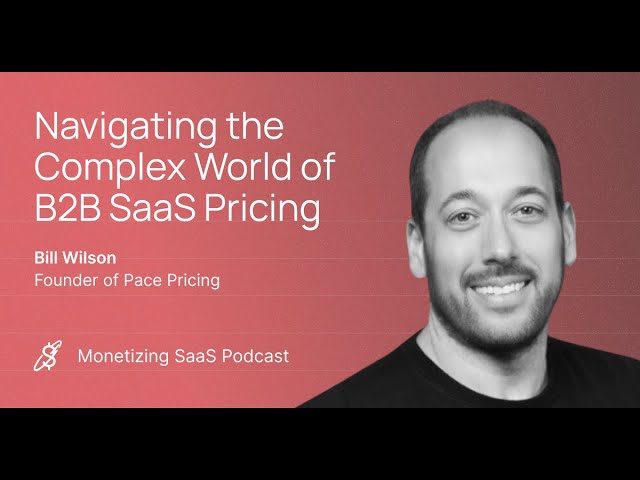
Bill Wilson, CEO of Pace Pricing, explains how SaaS companies should shift to hybrid usage-plus-subscription models and maintain net revenue retention above 100%. Early mistakes include giving away product and skipping usage data collection. Pricing requires cross-functional ownership and quarterly reviews, not just picking a number.
Chapters
Bill, really great to be here with you. Thank you so much for joining me. You've had this really interesting and textured career. Can you tell me about it? Tell me about the steps in the journey and how'd you get to now you're building Pace Pricing?
Yeah, for sure. Uh, first, thanks for having me. Um, I'm super excited to chat with you today. Uh, yeah, so man, how do I do this without being really long-winded? Uh, I started off as an engineer, so software developer is where I come from, and now I do pricing, which is Kind of weird. But the journey went like this. I spent a long time writing software for, you know, kind of big software companies back in the day, like Quest and those types of companies. And then I finally got tired of the enterprise sort of software world. And I wanted to build something on my own. So I did what most people do. And I started a consultancy and I was selling, you know, bum-in-a-seat kind of software development services. But I realized that people wanted to work with me a lot as I started doing that. And so I started building a little bit of a team. And then I used to do a ton of mobile app development back when it wasn't cool, when it was, what do you say, RIM, like Research In Motion stuff, BlackBerry, MidP stuff, really old things, dating myself here. But when iPhone started coming out, I really wanted to start building apps for it. So I started an agency called Mindsee, which built mobile apps for companies all over the world. And as part of that process, we developed a bit of a sales technique that we used, which gave some, gave our customers a bit of optionality when we were first doing our first sort of productized service offer. And so we built a little tool because we're software people. We built a tool to help us do that. And it kind of took from the typical B2B SaaS era or even SaaS, just the good, better, best, and had some add-ons and a few other things. They could fill in their information, push a button, and we'd get started on the project. And so we were selling to a lot of B2B SaaS companies at the time. And as a result, they would ask us, they would always say like, hey, where did you get this tool?
Right?
Because we'd pitch them and they're like, this is amazing. Our sales team could really use this. And with enough prodding from my own head of sales and a number of friends of mine that are in B2B SaaS, they said, just go build a product. And so we built Salesrite, which was that interactive quoting tool. And that was 2018, 2020. You know, we were at it for a couple of years, but man, it was all pricing stuff. Like, it's about doing those quotes for B2B SaaS. It just forced us to get into all of the different types, all of the usage elements, all of the perceived stuff, like all of those types of things. And I found myself on conversations with sales leaders when I'm trying to sell my product, like, you know, cold outreach, doing the things. And they would go, so our pricing looks like this. Does that make sense? And I realized that there's a lot of, like, there was just a lot of need there. There was a lot of demand for people to, like, I think they wanted validation mostly. They just want to understand if they're doing it right. They're a little nervous of it, a little scared of it. Nobody really owned it. It was one of those things. So, um, we were acquired in 2020 by FastSpring. And, um, after that, I spent all of my time just diving as deep as I could into the pricing space. So I've been coaching, uh, for the last few years now. I've coached with some other pricing firms. I've I coached at SaaS Academy. I'm the resident price coach at SaaS Academy. And I run Pace Pricing, which is a B2B SaaS pricing monetization agency. You know, so we spend all of our time tearing down existing B2B SaaS pricing models and rebuilding them to try and, you know, solve the current challenge of that company, whether it's retention or growth or both or, you know, churn or, you know, hitting a growth ceiling, any of those things is sort of Yeah, so that's, that's the journey.
So good. And like I said, textured. I mean, I think what's interesting is, right, there's engineering, there's being a founder, there's diving deep on pricing. Patrick, you said several things. You said usage-based, you said product-led, you said direct sales, you said quoting. Like you've been sort of at sort of like this, your career has been at the intersection of a lot of changes in enterprise software and B2B software. I'm curious to know how you would talk about what you think has changed in software broadly. What are the big inflections that operators have to be thinking about?
It's interesting because I mean, I think all this stuff is known sometimes, you know, so I, you know, I don't know what I don't know or I, you know, that kind of stuff. So when I think about this, I'm sort of thinking ahead and I'm going like AI, that's the thing. Like people aren't, you know, how do we price AI, all that kind of stuff. But really I think the biggest thing is that there's still tons of companies just selling per seat, right? They still haven't adopted any kind of usage model. And for a long time, I think people were sort of pitching like, you know, it's you're either you know, subscription, lead, blah, blah, blah, or your usage. And I'm just like, that didn't make any sense to me as a pragmatist, as a software developer. I'm just like, well, why not both? Right. And so I think that's really been the thing is like people have realized that, you know, usage isn't the way and, you know, just straight up subscription isn't the way. What we need is both. Right. So the, to me, the biggest thing that people are now focusing on since pandemic, just because of the economic conditions is profit. Right. And I think that's really, really important. And the fastest way to do that, I think, is from your existing customers. And to do that, you need net revenue retention over 100%. And so the best way to do that is to have, make sure that you have both inter, like package expansion, like as people move from left to right in a traditional kind of good, better, best Goldilocks kind of scenario. But they also need to have intra package expansion where they're going up and down inside the package. So you need to have a usage element and you need to have a subscription element. In my opinion. And I think those are the things that have kind of changed. I think that, you know, I think Kyle Poirier would call it like the hybrid pricing model, you know, that kind of thing. And that's really what it is. But for me, for a long time, I just, I didn't understand how that was unique, right? I just assumed that that was, and I'm not like, how do I say it? I'm not saying, oh, I had some Oracle crystal ball. It just made sense to me that if there's usage elements, you should charge for the usage elements. And if there's not, you shouldn't. And people always get, they always go, oh, I, but I want my pricing to be simple. And there's a really good pricing guy, Ulrich Schmidt, and he said, and I believe this as well, is that it doesn't need to be simple, it just needs to be understood. And so depending on the, you know, people you're selling to, your market, all those types of things, if they understand it and it's in their language and they can grasp it, it makes sense. Case in point, Amazon Web Services. Have you tried to look at the pricing for Amazon Web Services?
Yeah, I have. Right?
So if you're an engineer or you're running that kind of thing, it makes sense. It is necessarily complex. Necessarily complex. Yet if I want to go buy Netflix, it's necessarily simple. There's two packages. That's it. So I think that's the difference is that as long as your market understands your pricing, it doesn't necessarily always have to be simple. Simple is not the holy grail. So I don't know if that answers your question at all about what's changed, but I think the biggest thing that's changed has been a focus on profitability and, you know, also, and I think net revenue retention is probably the biggest focus that I've seen.
Driven to some extent by hybrid billing.
Yeah, absolutely.
100%.
That's one of the only ways you can get there. You can't get, because churn is built into the system.
Yeah.
Right. So unless you have 0% churn, you will never have 100% GRR. You will never have 100% gross revenue retention. So if you don't have 100% gross revenue retention, what can you do? You need to have net revenue retention, which basically means you need to make more money from your existing customers. How do you do that? You sell them more things.
Yeah. So how, tell me how you're building Pace. Like tell me what is the offering to companies and to founders who, and who are you trying to work with? Tell us about Pace.
Yeah. So, you know, it started off, I'm a coach, you know, I love coaching people. I love teaching people how to fish, so to speak. And so I started off wanting to basically install good pricing practice into B2B SaaS companies. And I still want to do that. I think it's really, really important. But what I realized was, is the demand is really for, can you just do it for me, right? Can you help us untangle this mess and get to something that makes sense? And once I realized that, we sort of shifted focus, and now we spend, uh, all of our time aimed at, you know, B2B SaaS companies, anywhere from a few million bucks all the way up to a couple hundred million bucks. Like, it's, it's sort of And the reason I say it's such a wide range is because they all kind of have the same problems. I haven't seen much difference as I— it's just the stakes are higher. You know, when you get into the bigger companies, the stakes are higher and there's more people involved. So there's more stuff to manage. But yeah, so the way we're building it is we're productizing as much as we possibly can. We've built out a system that we think can apply to every single B2B SaaS company that we work with. It starts with data. We go very, very deep on data. And if you don't have data, we help you get data. That's one of the things that not a lot of companies are doing. We're just like, you don't have usage data. Here's what you need. Here's Mixpanel. Here's Amplitude. Whatever you can do, like these are the things we should, we need. Let's get it. And then we dig in, we do tons of market research, customer research, data analysis, that kind of stuff, which is kind of typical, you know, for pricing engagement. We go really, really deep on the customer side, mapping out jobs to be done, you know, all that kind of stuff. Then we move into like architecture and we're packaging and then into calibration where we're setting price levels and dealing with competition. But then the real big thing at the end is we validate. And we validate and validate and validate until we nail it. And that's done in market to get as close as possible as we can to understanding that this is going to be accepted, A, by the market that's out there that you don't have yet, and your existing market, your existing customers. Because pricing is about confidence. And you can go off and you can design new packaging and you can do all those types of things. But if you don't know it's going to work, it hasn't, you know, you may have upped your confidence, but that's kind of the ultimate confidence, right? And so when you think about validation, there's a couple of things to think about. It's like, one, does it feel good to us? Like, does the company understand it? Is sales bought in? Is product bought in? Is the CEO bought in? Like, is everybody sort of, yep, this is, this makes sense to us? The second is, do your existing customers think it makes sense?
Right?
Talk to them, you know, run it by them a few times. And then the ultimate is selling it, like putting it in market. And so we try and simulate the in-market part. We do as much as we can, all the other things up front, and then we go to market and we try and simulate, simulate that, you know, that those purchase, those purchase simulations are really important to us. So that, that's kind of how we, uh, it's kind of how we do it.
Makes a ton of sense. You've worked with a lot of companies, you've thought about pricing and packaging probably more deeply than most people in SaaS. What are the most common mistakes you see? And maybe if you could kind of think about that question through the lens of the early stage company as well as the growth stage company.
Sure. Early stage is giving it away. There's a few things actually early stage that I see. One, giving it away. People need to open their wallet in order for there to be any kind of Like investment demands ROI, period, right? So if I'm going to put money in, then I demand something out. So therefore I'm probably going to put more effort into it. So if you're giving away something for free at the early stage to get customers, it's probably not the right move because they're not customers. They're just people. You know, they might use your product, they might turn into customers, what have you. So do it. And so like that's early stage. I see that. The other thing I see at early stage is overcomplication. Right. You know, they'll go the other way and they'll just set up Good, Better, Best and they'll have like artificial limits and all kinds of things in place and just really, really complicated. I think you need to understand the ROI you deliver to a company and build a good solid plan that you sell and sell it for what you think it's worth or what you think you can get for it. And don't apologize for that. And then iterate and then understand how people use it and then figure out where the, you know, based on usage data, all those kinds of things. The other thing I see people do a lot is not collect any data. Right. So, um, I'll get on calls with early stage founders and I'll ask them about, um, you know, just simple, like, hey, this feature that you just rolled out, how often is it getting used? What's the uptake? What's, you know, what's the attach rate? And they're just like, oh, I don't know. Yeah. You know, And maybe it's not that flippant, but they're just like, oh, we don't, we don't collect that yet. Or we don't have that yet. And it's always the yet. And I'm just like, look, set out as you mean to go forward. Having a baseline, whether however early it is, is super important. We just need to understand the evolution of the stuff. So make sure you're logging and, you know, collecting usage information, at least at a high level on those features. It doesn't have to be, you know, super granular, but collect the usage data. And so those are the big things. And in terms of, I think you also asked me about some of the biggest mistakes, right? And I think one of the big mistakes across the whole board, you know, whether you're early or not, is just not changing your prices. Like people hold onto it. There's nothing. I figured this out. I think it's that as founders, we don't get scared of much. Right? It's all about change.
Right?
We're always iterating. We're always doing things. We're always trying to embrace change. However, one thing we don't want to do is mess with the relationship with our customer. And there's nothing quite like changing prices to feel like you're going to mess with the relationship with your customer. And so people will just hold on to it in fear of, and I say fear because it's truly a fear of losing customers, right? Competition coming in to swoop them, market pushback, can't be able to sell, your sales team pushing back, all of those reasons. And so therefore the status quo, the status quo, the status quo. And pretty soon you've been at it for 2, 3, 4, 5 years and you haven't changed your prices, which is effectively a price decrease if you think about it. Like even when inflation was tiny, like it was still, that's still a price decrease. You're 5 years in and you're selling for $40. It's not $40 anymore.
Right?
So I think that's one of the big, the Probably the biggest mistake I see is people not changing it. And then, you know, selfishly, I think the other big mistake is when they're in that situation is not getting help. Right? Like, and I don't mean, I don't, it doesn't really matter where that comes from, but like, go and seek help, get the right people together. Like I always say, build a pricing team, like get the people involved in the company that need to be there, product, marketing, CS. Executive leadership, build a cross-functional team and, you know, start thinking about pricing. I always say that, you know, monetization is product and product is monetization. You can't think about one without the other. And so it needs to be baked in at step one. Like when you're looking at a new feature, especially if you're a going concern and you're at that really tender spot of like $10, $15 million and you're going to invest a whole couple of squads worth of work into a big feature. Please know how you're going to capture that value. Like, oh, we're just going to add it into our middle plan. Fine, if you think that's the right place for it, but what did you do to get to that decision? And I think that's the big thing that companies don't do. So those are the mistakes I think companies are making when it comes to monetization in general.
That's really good. A little bit of a similar question, but maybe I'm just curious if there's a difference, but What are the common misconceptions that companies have around pricing and packaging? Are they the same as the mistakes, or do you see misconceptions that kind of end up being like pretty significant and can drive mistakes?
Yeah, I think one of the biggest misconceptions, yeah, I think one of the biggest misconceptions is that it's about what you charge, right? The price, like people call it pricing when it's really monetization, right? But they call it pricing because they think they need to change their prices. But In actuality, it's usually deeper than that. It's usually around product changes, model changes, like how you charge is more important than what you charge every day of the week, right? Yes, the economics have to work, but if how you charge does not make sense for your customer and how they grow, you're just going to go flat eventually. So I think that's one of the biggest misconceptions is that it's a pricing thing. And then the second one, like, you know, what we charge. And then the second one is like, oh, we just need to, like, we just need to change our packages around. And I think that's the other big misconception is that it's almost never about we need to change our packages around. If you're already optimizing and you've already gone through processes to really get solid pricing hygiene in the company, then yeah, you might be tweaking, you know, various features across things to drive people from package to package. Like a big one that I do a lot when I'm with my coaching clients is like around entitlements. Like how do we get people moving from left to right in the packages? And maybe there's a too rich of an entitlement in a package and they just sit around for too long and they need to move up. But they don't. So like those are kinds of things you can change, but by and large, it's never really just about like, oh, we just need to do a packaging design exercise. It's all part of it, but it's very rarely those things. So yeah, that's, I think that's one of the big misconceptions is that it's just people just, it's, it's so, it's nebulous for a lot of people. They don't understand it. It's enigmatic, you know, like they, So therefore they kind of steer away from it. They assume somebody else has it. They assume somebody else is responsible for it. And I think that's one of the big misconceptions is just around, yeah.
Yeah, it's really interesting. Just to play it back, I kind of hear you saying like people kind of often, the misconception they have is this is what we should charge or how we should pack it or kind of what the price should be, what the packages should look like. What they're not thinking about is how should we actually monetize, which if they were asking that question, they'd be really trying to understand what is the most intuitive value to the customer and does that align with the ROI they get from the product?
100%.
Yeah.
I work with a lot of customers where I see what will end up the common complaint will be, you know, we have this group of users that use it this way. They're like, I think of a payments processor, like they're low volume, but high value. Like they'd send a lot of big invoices, but there are very few of them. And then we have others that are really small invoices, but they send thousands of them. How do we, you know, so they're clearly getting, you know, who's getting more value? And how do we, and so those types of problems are about how you charge. It's about alignment and there's things you can do to try and, you know, backstop for those things so that people are paying for the value they receive and they're okay with it. And I think that's the other big piece is that, I mean, how many times have you gone to buy something and just doesn't feel right? Like it doesn't feel fair, you know, like why are you charging me for this when I just wanna do this? You know? Yeah. So yeah, that's one of the big things.
You know, I think you're the only person who is running a pricing and packaging agency, as you described it, that I know that was also a software developer before this job. Thanks. Pricing and packaging impacts developers a lot. And it impacts developers, especially as companies scale. And I'm curious if you could speak to What do engineers and what engineering leaders not understand about pricing and packaging and the systems that govern pricing and packaging in an organization that they really need to understand?
Yeah, that's a good question. I think there's a lot to be said for subscription management platforms and trying to adopt one early. I see a lot of engineers start with the typical, you know, if it's not invented here kind of thing., you know, so they'll just use Stripe Raw and they'll just go ahead and start doing those types of things. But once you start getting into, you know, sales-led stuff and you've got maybe custom deals happening and different things, how do you start, how do you account for all that side inside the product? Like how do you make sure that it's all right and how do you make sure it's accounted for correctly when someone like me comes along and we have to do like a big analysis? Like we did one earlier this year. And they are using a subscription management platform, but they still had this problem. They had 1,400 custom accounts, custom subscriptions, you know, just because it wasn't flexible or they didn't understand how to use it. So I think from a product development perspective and an engineering perspective, they need to be, we need to make some kind of contract, you know, like a development contract between the subscription system itself and how the product works. And so that you can rip and replace if you need to, but also so that you can control things like entitlements and, you know, which features are on or off and all that kind of stuff. So I see that's a big mistake and people, and I think it's due to complexity, honestly. When you're scrappy and you're first starting out, you're just like, yeah, we'll get to it. But then you've got debt, then you got tech debt and you haven't done it and it's going to be a pain in the butt. We started off when I built Salesrite, we started off probably overbuilt, to be honest, because I'm an engineer. But we started off with Chargify, which is now Maxio. And, you know, we built it into the product. Like you can just upgrade seats. So from day one, you could just go in and add seats and pay for it. And you'd get your whatever deal we gave you at the time, it would show up. And like, we just did all the work to make that happen. We didn't do the thing where we, I think we had LaunchDarkly in place at one point. We also used a lot of like Google, I don't want to say maybe it was Google Tag Manager, but whatever, like one of those configuration things that would push things down around entitlements. So we had a number of things configured, but still we could we could never get away from ChargeFi if we wanted to. So I think that's some of the big mistakes is like build the product with all that stuff in mind and then have something else, you know, connecting to it to actually orchestrate how those things are put together. So that's, that's one of the things I think people are making mistakes on. Yeah.
Yeah. It's like pricing and packaging is not a first-class citizen in the product yet.
Yeah. And it needs to be. It really does. You know, engineering is not necessarily involved in the actual pricing discussion itself or the packaging discussion. Sometimes they are, sometimes they're not. I find like they're not the ones at the table necessarily, but they have a huge role.
Yeah, because they're always brought into whatever implementation or iteration or change. Yeah.
You know, the big question I ask is, is this possible? Like, we'll recommend product changes and we're like, you know, can you do this? And they're like, oh, well, we can get it in probably a year. I'm like, okay, so we can't. Like, how are we going to roll this new? Because the last thing you want to do is build a new model and then not roll it out.
I had somebody say to me recently that the problem that you just described, the fact that engineering always has to be involved in some type of implementation or support cycle for an iteration is just a massive weight on go-to-market creativity. And I'm curious how you kind of respond to that.
Well, I mean, the response is yes. I mean, that is exactly what happens. I've worked with tons of companies where they say we can't do that because engineering can't get the cycles to change it. I can't change our pricing page. With that because it's all tied to the whatever. We can't do it in-app because we need to get engineering's time to make an update. So yeah, I mean—
And so to your earlier point there, it's like, we're going to price and package based on like our complexity rather than what is in the best interest of the customer, sort of becomes the result.
Yeah, I'm dealing with it right now actually. You know, I got a large customer and they just can't move fast enough and they've got a number of legacy things they're dealing with. They've been in business for many decades and there's just so many competing priorities. And so they're rolling it out as best they can, but it's starting to feel, it can start to feel a little shaky when, but once the teams are engaged, it's fine. Once they get engaged and they know it, and most teams are happy for it, to be honest. If you can say, hey, we need to make monetization more important inside the product, most engineering teams I I have talked to are kind of happy about it because it's probably been one of these things that they're just like, ugh, it's a house of cards over there. I don't want to deal with it. But once there's like an actual initiative by the company to make it better and monetization becomes more important, it's so funny how monetization isn't the most, sometimes the most important thing to a company. They think about it at the end or they think about it during product development. I did the same thing. I built Salesrite. I had no idea what I was going to charge for it. And I didn't even know if what I was building was worth, you know, like I just did all, I made all the classic mistakes.
So, and there is, there's a difference between like the first time founder who's not seen that before and the second time founder who's done it, made the mistakes and then it's like, I never want to make those mistakes again. Like this has to be considered from day one. Yeah.
I think we have a mutual friend who always says you can always tell who's been in the crap, you know, when you start talking about pricing, you can always tell who's been through it before.
Yeah. Yeah. Yeah, I mean, it's so interesting, like you're kind of in companies and like any mention of adjusting pricing and packaging can make people squirm, especially in engineering. Um, uh, you know, I think you've used this word before, but like pricing and packaging and or monetization practices, uh, you know, companies have an opportunity to build practices that can be really methodical and intentional. Um, I'm curious, like if just off the cuff, like what are the things that people can go do to start to build the muscle memory around becoming more intentional with pricing, impact, and monetization as a practice or as a discipline?
I mean, probably the simplest thing you could do is get a cross-functional team together and set a quarterly meeting and just sit down and talk about features that rolled out, what the uptake was, how are they doing, you know, that kind of stuff, which is probably on people's minds. But when you have the cross-functional piece, you get everybody in the room. Honestly, I find one of the big things that we do as an organization sometimes is when we get brought in like that, it's the first time that group of people is sitting around a table talking about this subject together.
And like the core way the business grows and it's like the first time we've actually talked about this.
Yeah. Like as a group and with a focus of like we need to change it. What's working, what's not like that kind of thing. Cause it's happening, you know, one-to-one or inside marketing and product and inside product and sales and inside C-level down. Like there's all those conversations happening, CFO, Revenue Ops, like, you know, they're all talking about it, but getting everybody around the table and agreeing that this is a priority and we need to do it is something that we often got brought in. So I hate to say we get brought in to be argument settlers, but that happens too, right? Um, so yeah, so the simplest things you could do is pull together the right people, start having conversations about it. The second thing you can do is collect data, get as much data around usage as you can. If you're not collecting usage data today, please do it. Um, think about the journey of your customer and how they actually go through. Best way to do that, I think, is to map out the core job to be done and just, you know, map out a job map and then start logging the things that they have to do to actually execute. So after data, I would say it's if you, you know, start looking at things, signals as to when you should raise your prices. And I think the best signals you know, if you're sales-led or trial-led, doesn't really matter. It's about conversions. If conversions are good, you know, decent percentage, you know, lots of trials are coming in or your sales team's calendar's booked, your NPS is high and your churn is low, probably could stand to raise your prices.
Those are good signals. Those are good.
Those are really good signals. So, and so those are the ones I sort of lean on in sort of initial stuff. And I guess the other thing would be just make it part of your initial product your PRDs, like any kind of business case or PRD that's created is like, how are we going to monetize?
Very good. Where can people learn more about you? Where can people find more about PACE Pricing?
Sure. pacepricing.com, probably the easiest way to find us. I'm also on LinkedIn. I am WDR Wilson almost everywhere. So you can just search for me that way or you can just search for Bill Wilson. But I will say it's a very common name. So you'll find lots of us. But yeah, that's probably the easiest. I'm on Twitter, @WDRWilson, LinkedIn, and pacepricing.com is probably the easiest way.
This has been so good. Thank you so much for joining us.
Hey, thank you. It's been great.
More from Fynn

Schematic at Operators Guild Demo Day 2026: How to bill for AI credits without a surprise bill







Should you move to usage-based pricing because AI is compressing your margins?

Why raising prices every year backfires (a pricing leader on the Mastercard quota model)

