
Monetizing SaaS: Episode 26 with Marcos Rivera, founder/CEO of Pricing I/O
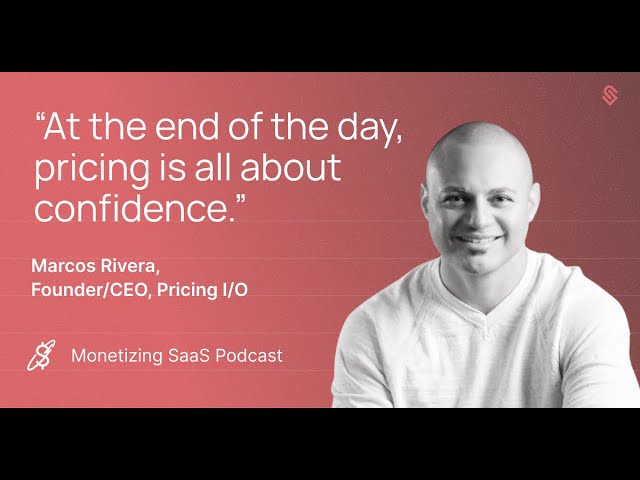
Marcos Rivera, CEO of Pricing.io, helps B2B SaaS companies rethink how they charge. His framework starts with growth strategy and customer segment before touching pricing mechanics. He found that 46% of companies changed packaging last year versus only 12% that changed pricing.
Chapters
Marcos, thank you so much for being on the podcast. You have had such a rich and textured career. You've been a financial analyst, you've been a product leader, you've worked in private equity. You're now the founder and CEO of Pricing.io, where you help growth stage B2B SaaS companies with pricing and packaging and monetization. I'd love to hear in your own words, your career journey. How did we get to now?
Yeah, it wasn't on purpose, Fynn, right? I mean, thanks for having me on. I appreciate it. The idea behind this was. I, I really enjoyed understanding how the business mechanics work. I just find it really intriguing. And then that started melding with my love of just human behavior, psychology, just really cool stuff on how people think and often how flawed it really is, right? And then, so as I get moving up in my career, I was a product guy, product management, love building stuff, love seeing it grow. But a big part of that is, well, how do you price what you build, right? And that was a, a a really hard, complex problem for a lot of folks to tackle. So decided to tackle it because the more I started pulling on that thread and digging, the more I realized like, oh, this is kind of cool. And it brings in my love of psychology and numbers and business. And I just started leaning more into that. And once others started seeing that I was getting good at it, they asked me to price their products. These are other product managers and stuff, right? So I kept doing more of that. And of course, the more you do it, the better you get. And then all of a sudden, I'm now leading pricing for a huge private equity firm, one of the tops in the world, doing it at crazy scale at Vista, right? And then after that, starting on my own. So it just started, you know, with taking a step and then taking another step forward and kind of stumbling into it. But love it. I love what I do, man. It's a lot of fun.
You have an amazing, amazing company and amazing work. And it's fascinating to me, obviously. It's a big step to jump from Vista to starting your own business? What kind of led you to do it?
It looked crazy on paper. Honestly, when you look at it, you're like, all right, you're at this really big, and I would say, you know, one of the most preeminent investors in technology. We had 62 companies at the time, and, you know, we had Marketo and all these like big companies and big names, and Vista was doing quite well. And here I am in the middle of, how do you monetize all these companies? Which was a very powerful lever in our value creation. So, Why would I leave such a great role? I had great visibility, good impact. And it really came down to wanting to control my time. And here's the thing, right? I mean, listen, there's nothing wrong with traveling and getting out there and doing what you got to do. But when you're making elite status by April in the year, right? And I was freaking living in Terminal 2 in San Diego. I wasn't living at home, right? So, you know, I had young ones on the way. I just, I didn't want to be gone from them. I made the sacrifice and said, all right, what's the one thing I can do that can control my time or maximize my ability to control my time? And I said, well, just go to business on your own, like for yourself. And that's where I stepped away from Vista. It's all on good terms, all good stuff, but I just didn't want to live that lifestyle for much longer. It's kind of wears on you after a while. And so that's where, that's where the whole idea for starting Pricing.io came from.
It's awesome. Well, tell us about the business. What type of companies do you work with? How do you help them? What do engagements look like?
Yeah, I mean, we are, I'm really proud to say that we're 20 folks strong. So I didn't think we'd be at 20 people at this quickly, but the idea here is we are passionate about helping SaaS companies figure out how to monetize their stuff, okay? And so when you look at all of the pricing problems you could solve, you could do it for, you know, candy bars and soda and all sorts of consumer things. I love doing it in the B2B SaaS space because it's such a complex problem with the value that keeps changing, markets that keep changing. Look at what's happening with AI. Look what happened in 2020, right, with COVID right? A lot of shifting things around. And I just love being at the center of that because how you monetize that system needs to kind of stay up with the changes in the business. And so when companies come to us, they're usually B2B SaaS company that is outgrowing their old model, okay? They're trying to capture more TAM. They're gaining complexity by introducing more modules, or maybe they bought something and now they're bringing it in. And oftentimes they have a pretty ambitious growth path ahead of them. They're usually investor-backed by some VC or PE. And they're like, how do we get there? Because this model that we have is not going to help us get there. And that's usually when they come to us. And I'd say ARR-wise, maybe between $5 million and $500 million. I know that's a big range, but there are a lot of companies making very big leaps and bounds in terms of their growth in that bucket. So that's who we love to help. And it's really exciting because they're used to change. And so when they're ready to change the model, it has a pretty big impact.
What are customers commonly saying to you? Like they're coming to you and they're saying, We don't know what pricing and packaging should look like as we evolve. Like, what are the common problem statements that you're having to filter through and help guide companies around?
You know, if I had to pick on a few that are most common that come, I would say the first one is, we think we're leaving money on the table. And when they say that to me, I dig a little deeper. I'm like, why do you feel that way? And it often comes in the sense of, in the sales, looking at sales and how they're winning deals, no one's pushing back on our price point. And that's usually signal number 1. Signal number 2, they say, "Hey, nobody ever leaves. Nobody ever churns. All our sales reps always hit quota, right? And we haven't changed pricing in over 3 years." When I hear stuff like that, I'm like, "Hmm, I think you're probably right. You are leaving money on the table." The second thing that I notice as well is this idea of too much friction in our process. And so, the other side of this is we're getting too complicated. And so many different avenues where these customers can go, it's lengthening our sales cycle time. It's making it harder to close and win these deals. And when we do close and win them, it's actually not easy for us to expand them up. Okay. And so they're kind of left with this sort of flat, you know, expansion that LTV starts to come down, but the CAC starts to come up and that starts to erode their economics. And they're like, we need help. We want to sort of get out of this, this problem. And that's the other big thing I hear.
I'm curious to get your sense on like the state of pricing and packaging in B2B SaaS. And maybe to add more kind of color to that, it seems like many companies conceptually appreciate that pricing and packaging is this real lever, but it also feels like many companies struggle to build real practices internally around pricing and packaging until maybe they get quite large. Does this feel true or false to you at this point?
You know, pricing is hard, right? It's not something that I would take lightly because it touches, it touches like all the different functions of the business, right? And it sends different signals out into the marketplace and customers and competitors are listening to these signals, right? So you can't just willy-nilly throw a bunch of stuff out there and see what sticks. Some companies do, but I find that to be a little reckless and hard to recover from, right? I think when it comes down to it, the investment it takes to really do pricing on purpose. A lot of companies are not sure what that even looks like. Okay. And that's where I think in helping them through, like in our model, we actually show them like, this is what it takes to actually run pricing and fix it and renew it and do all these things. And it's, it's not like this number, right? This mythical number of the magic price that's going to solve all your problems. It's actually a system. Right? It all has to work together. The structure of the packaging, what you're offering, that journey the customer goes through, the numbers, where you discount, what you give away for free or not, all those pieces kind of work together. And I don't think folks realize like how intricate your pricing and packaging can be. And so they just oversimplify it with, hey, let's just raise pricing 5% or hey, let's just make this bundle out of nowhere, right? And then that And then they don't get the results that they look for. And then that grows in frustration. So I think that's where a big piece of it is not understanding what it takes. And there's another problem lurking even behind that, which is they don't even have the data to even know what to do with it, right? So a lot of companies, believe it or not, even data companies, right? I'm not going to call anybody out by name, right? But some companies out there, I'm really shocked at how poorly they track what customers are doing in their software. I'm just going to be real about it, right? These, you need to understand how customers are getting the value. And if you don't track what they're doing in there, it gets really hard to kind of differentiate and see who's getting a lot of value, who's getting less, so that way you can recalibrate and understand where to monetize. But I'm finding that, you know, even simple things on activity in their software or even information on their win-loss, still like really lacking these days, just makes pricing 10 times harder.
I'm imagining like a BI company who doesn't have its own BI around pricing and packaging. That's what comes to mind.
It's like the dentist with the bad teeth or like the barber with the bad haircut, right? You've seen those out there, right? So they're there and I'm trying to— at least one of the big things I do is here's the data that you need to actually pay attention to pricing and just let's just start collecting that, right? And sort of getting some information and you'll never be perfect, but over time The more you can grab, the easier the problem gets.
I love that idea of pricing on purpose. Maybe that's the name of this episode, but like, what does pricing on purpose look like? What does good look like?
Yeah, I look at it as the pricing problem for me doesn't start with the number. Like I mentioned a second ago, it actually goes all the way back to, to like the why behind it. All right. And I'm not trying to get all Simon Sinek about this whole thing, right? But for me, You gotta understand what you're trying to achieve. And there's nothing like pricing to really force you to really crystallize your strategy. You have to do it if you're going to get good at pricing. And so being very clear about where your growth is going to come from and how are you going to play in the landscape and what's the next, you know, 2 steps from today. I'll give you an example of a company who could not do this, which is the company that told me, we want every customer, we can sell to anybody and we want to go upmarket and downmarket and all that. When I hear stuff like that, I'm like, okay, you need to crystallize who you are and then who you want to win, right? And so that's where good pricing on purpose starts, is getting super clear on that. Now that you have that, you can then get into what type of experiences do you want to give these audiences? And I say experience on purpose, Fynn, because it's, you know, people get wrapped up into like the feature checklist and I got all these features. Features are good, that's fine, but they're only a means to an end. They're trying to craft an experience for an audience which provides value at the end of the day. And that includes like training and support and onboarding and all that stuff, right? So you got to think about it all around. Once you got those three things, like where is my growth coming from, which customers I really want to win and be there for, and then the experiences you give them, now how do I actually monetize and prices and go into the mechanics? That gets a lot easier than if those three things were super fuzzy, right? So pricing on purpose starts with those, those 3 key things and that sharpening the strategy that makes sure you know that customer you really want and then that offer, that experience, get that right. And then the pricing stuff comes in.
Are those 3 kind of key things in place only if a CEO is championing them being in place, like creating the conditions for them to be in place?
I would say I would say that you want your executive support to do that. And the reason why is because the CEO, him or her, they're leading the charge, right? They're establishing the rhythm, the vision, and all these key things. And everybody follows that. And if the CEO, if he or she is just not behind like the path you want to take or has a different view or could be a bit all over the place and wants to you know, conquer the world in, in, uh, so many different, uh, fiefdoms. What ends up happening is everyone starts to lose focus on where they're really trying to go. That means that how you monetize starts to get a bit disconnected, fragmented if you will, and then it starts to fall apart. And what you end up doing is you get a bunch of like SKUs coming in and you have like SKU proliferation. You get like random discounting. You get very high variability, you know, uh, companies that are exactly the same and, um, paying very different prices, right? Or the other way around, right? Which is, you know, you're using the product and getting very different value, but you're paying the same. Yeah, both really big problems. And that starts to manifest over time, and it gets, it gets, uh, to be a really hard thing to change. So CEO, founder, whoever should be behind it, but I don't think they need to be necessarily the one to to lead the charge. They just need to make sure that we have a unified front.
Let's go even a level deeper. So you've got those 3 conditions in place. Then what does good look like? Are we talking like you've got pricing committees, you've got like regular kind of cadence of meetings? Like what does that start to look like?
Yeah, yeah. So there are a couple pieces to that. The first one is, do you have a discipline around the data that you're collecting? And here's what I mean by that is we've been getting a lot more granular in the data we can capture, data from our products, you know, Pendos, Gainsights, and all that stuff around our customers, right? All the CMS software that's out there, Totango, et cetera, right? And then you also have information on just, I would like, the terminology I would use is more like business economics, right? So measuring margin, measuring costs and how they scale and things like that. So with all this new measurement and instrumentation happening, you should be able to then create a bit of a pricing around taking that data and then using it to make pricing decisions. So when you're not doing that, A, you have to collect it to use it. And then once you collect it, you have to use it. That's the first step in pricing discipline. The data's there for a lot of companies. They just haven't been able to collect it. Number 2, now that you have data, you need structure, right? And those are the 2 pieces I'm trying to get at here is you have to have both. And the structure looks like a committee that's cross-functional. So you don't want just sales or marketing running with pricing. You need product in there, you need ops in there, you need success in there. Everybody needs to be in there. But usually 6 to 8 folks to keep it productive. You don't want 40 people in your pricing committee, right? And then using that as a way to drive different monetization initiatives. And what I mean by that is it's not just about, hey, how's pricing doing? It's more around, What value are we changing in the context of the market and how much TAM we want to go after and what we promised to the board and all that stuff, right? And in what ways are we actually changing the way we monetize or improving that? And then what are the next wave of either experiments or tests or ways we can push to monetize even more, which includes things like, hey, what are the next 4 things coming out on the roadmap? Do we have a plan for that? So those committees are actually very strategic. A lot of companies do them wrong. Fynn Glover, by they use them as like these little, you know, steel cage matches to kind of go through with sales and product and all that. And it's not really the intent of a real good functioning company that does it on purpose. They're thinking, again, two steps ahead in that committee.
You mentioned this, but this is something I'm really fascinated in. It's like, what is the relationship between monetization initiatives that are coming from the committee and the product roadmap? And are there best practices around that relationship that you would suggest to companies?
Absolutely. I kind of think about it in, in 3 different tiers. Okay. So when you look at, you know, software and what I love about it is that there's so many different vectors to the software, right? And what I— the data vector, the, you know, the UI workflow vector, intelligence vector, all these different things. And so as you're building out on the roadmap, the roadmap is usually informed by, you know, what customers want, what sales is telling you they want, where you're kind of marching for your vision, like all those things, right? So you got to be super careful careful with how you prioritize and stack rank. Now, the first order— I mentioned 3— the first order are maintenance things in your product that you need to do to keep up. And these are things like performance, you know, bugs, UI fixes, all these kind of small things that— these enhancements you should just do as, uh, as an ante. Like, you got to do that stuff, right? And so from a monetization perspective, they just kind of keep and prop up the core price that you're already charging. Then you have this other layer coming in, which is, you know, these, these bit step up or upgrades, which are extensions of existing use cases. So these are the use cases you solve, but now you're solving them a little bit better, a little bit smarter. And we're seeing some AI kind of insert itself at this stage, typically, especially early stage AI. And what you're doing there is now you can actually bump up your price or even carve out an add-on if that particular thing is as an isolated workflow that is separate. Great. And then you can start expending that. Or you can use it to get them to upgrade and buy something else, right? So that's where you get more strategic behind it. The third tier, this is like new stuff. This is like we're solving a whole new problem, uh, for a new audience. And these are the kind of things that either introduce more TAM that you can go after or allow you to really maybe even start changing your messaging and positioning because of it, right? Those are the things that you also need to do the most research to price the right way. And so those are also part of the monetization plan, but take a little bit more testing and research to get right. So those are kind of the 3 things I connect product roadmap and then pricing and how those things should be discussed in the committee. Does that make sense?
Makes total sense. So basically it's like maintenance, incremental improvements, and then net new value. Yeah, I love it. Super clear. Yeah. Sorry. When you, when you look at the last few years of having started this business, built this business, Anything that surprised you? I'm curious to know if there are 1, 2, 3 things that have really surprised you.
Yeah, a lot of things surprised me, right? Because this is— I'd never launched a consulting firm before. So, you know, I was working for tech companies. I was working in private equity. So I've hired professional services, but never actually did it myself. And damn it, it is a hard business, man. Like, the margins are very different from a software company. The sequencing, you know, how you scope, how you deliver. The word of mouth and the— and by the way, doing this during COVID right? I started in 20— around mid-2019, didn't really get going until February, March of 2020. And guess what happened, right? The whole freaking world shut down, which, which is a freakout moment that I think most entrepreneurs go through. But one big surprise that I think is, is something that, that I kind of had a hunch going in but was really seeing it is companies that were, um, were leaving money on the table and then were— saw evidence that they could raise prices but still didn't do it. And that's kind of surprised me. I'm like, well, look, you got a really high NPS, you got a super strong, uh, gross retention. You know, people like you, they buy from you, sales is looking good. Like, why wouldn't you take the price up? But they were so afraid of, of slowing down that traction, of really sacrificing that growth trajectory that they were on, that they didn't pull the trigger even though they saw evidence. I knew you were scared if you didn't have any evidence, but when you had evidence, you still didn't do it. That was something that really shocked me a little bit. And they needed even more, not just evidence, but also like a line of sight in how you would roll out the pricing, how you would frame it, get folks to buy in on it, get sales to believe it. Like there's all these things around it. And that's where I started noticing that, wow, pricing really is about confidence at the end of the day. And that's one of my, been my big trademarks. I talk about it in my book in the opening chapter that pricing is about confidence. So that was the first big thing that kind of smacked me in the face and surprised me. And then the second thing that surprised me, which doesn't anymore, but in the beginning did, was again, that comment I made about just how bad the data is. I'm like, you're a BI company. You don't track any of this stuff. I had one company that was charging by the user license, but actually did not know how many users were in the system, right? Things like that, it just threw me for a loop because these were companies that were growing to some degree, right? And had some measure of success, but they were missing on some of the fundamentals. And so those were, again, big eye-popping moments I saw.
I love the confidence one. Like, have you, when you run into maybe kind of low confidence or companies that don't have the bravery that the evidence might support, Do you try to push them to be brave or do you just say like, you know, maybe I can't kind of help here if that's sort of like the persistent psychology?
Yeah. You said the magic word psychology in that one, right? So what I do is when I find, I detect low confidence, which usually I'm not sure about the value I'm selling to the right group. There's something that's blurry back there. And I try to dig a little bit deeper. Oftentimes it does take a couple nudges from somebody like me who's seen it hundreds of times and how this kind of plays out. But the other piece is what ways can we mitigate risk? And that's really one of the big, scary, dark things back there is the risk of customers churning and folks saying no at the sale and all that. And until you start seeing some of the yeses and some of the, oh, we raised price 10% and nobody blinked an eye, when you start seeing that, the confidence starts to grow and snowball. So I always try to find out what's bothering them and then start small and just give them like the small steps. I had one company, um, they were in the more project management, document management space, and they had a confidence problem. And so we rolled— we tested— we— I had a lot of evidence that they could raise prices, okay? We tested with their first 100 customers a price increase and a campaign, and we designed it all out, and we gave them some fallback so that way they could always fall back and not lose anybody. And I kid you not, all 100 of those customers took the price increase, no issues. And it was with that where he was like, oh, I could see almost like the confidence building, right? And then they were able to roll out and really have a successful campaign. Ultimately, some did churn, but way fewer than they thought, way fewer. And so the overall revenue was so much higher. It was a great moment for me and for them.
It's a great story. I'm also curious to better understand how you pair sort of the quantitative analysis of a company's pricing and packaging, their opportunities, their risks with the qualitative kind of side to this, which is the customer. How do you think about pairing those two sides of this?
It's, um, I have a saying, right? So a lot of folks think of pricing as like an art and a science. And the way I think of it is more of an art informed by science. And the way I, the way I see is slightly different, that nuance. Just means that you have judgment because as long as humans are buying from other humans, there's always that psychology judgment aspect. But the sort of information that comes in through good research or good quantitative tracking can help that judgment a lot better, right? And so reduce some of the ambiguity and reduce some of the assumptions. So the way I see it is, you know, you got your customer information that for these guys, they don't know what they should be paying necessarily. They kind of know frames of reference. They kind of know what they would pay or what they paid in the past. But if you were to ask me, like, Marcos, what's your maximum willingness to pay for a slice of pizza? I don't know, right? I'm not going to tell you like $4.22, right? It's, it's, you know, okay, generally a couple bucks based on what I've been able to see in the past and what pizza I liked and didn't like, whatever, right? So people kind of think in those same magnitudes. So the mistake that companies make is they're trying to get this very precise number out of them, but that's not really how humans think and how they buy. They're thinking more around what does value mean to me and in orders of magnitude for value. So these are things like, hey, you know, how much I spend on my Spotify versus how much I spend, you know, on my lunch or, you know, my— I had one person, she was comparing her scheduling app. With how much she spent in her checking account. And she said, well, I only spend $2 a month on my checking account, and that checking account is more important than my scheduling app. So why would I pay more money for a scheduling app than $2? And I was like, whoa, that, that blew me away, right, from a psychology perspective. So what you're getting from the customer is really the anchors and what they're comparing to in the orders of magnitude, and then the things that they feel like are completely non-negotiable. And then you want Pull it apart because I don't care who doesn't want to hear it. The truth is they are not using 100% of your freaking software. They're only using certain parts of it and they're building muscle memory around it. That's how people are. Okay. You got to find out what those things are that matter most. Now from the quant side of things. So that's again, talking to people from the quant side of things. Now you can start looking at different data and trends, start figuring out, okay, how much folks are paying versus how much folks are doing., and then you can start seeing little patterns in terms of, of distributions, which my favorite thing in any quant is not just looking at averages, which, you know, you could start there, but it's not really going to tell you the full story. Look at the distribution, look at a histogram, right? Look at a scatter and actually see a lot more of what's going on, um, in price to value, in price to volume and all these different things. And then you'll start seeing a bit of a story and saying, why in the heck are we not monetizing over here? There's a very clear increase in value that they're paying the same thing, then maybe this is an opportunity to monetize. Oh, and by the way, in talking to the customers, this thing is the most important thing to them and they drive it and they value it and it's a differentiator. And now you're connecting the art and the science to make a recommendation for pricing. Does that work?
It's great. What have you learned about the differences and how do you help companies think about the differences between pricing and packaging?
Yeah, they're intertwined, obviously, but they're not the same thing. And when I look at pricing and packaging altogether, the difference here is price is essentially, you know, what they pay and the package is what they get, right? Almost kind of a riff off of the old Buffett saying there. But the point there is the package establishes the value, what they get for. The price of that package sends the signal for what they get. And is the, call it the, you know, exchange rate for that value, right? And where I think folks start to maybe miss a little bit is if you increase the price and leave the package the exact same, no human really enjoys paying more for the same thing, even though they probably should, right? It's a higher risk notion to do that. If you raise the price and then maybe add another complexion to the package, Now you're changing what they pay and what they get. And oftentimes that forces them to recalibrate a little bit in their heads. And that's what you really want to be successful in a price change is to help them recalibrate. Okay, this is the value. This is what I'm paying. Because if the value is the same and the payment goes up, oftentimes that's where a lot of the friction comes from. So pricing and packaging related, one is a signal for the other. And if you're changing one, I would be very careful changing one without changing the other. I like to change them both when possible to do that recalibration.
It's super interesting. I've never heard the exchange rate between the two and I love that visual and analogy. I think you recently worked with Pricing SAS on a benchmark study. Is that right?
Yeah, I did. Yeah, it was super cool.
What was interesting about the data? One thing that, I mean, a lot of stuff was interesting about the data, but one thing that stuck out was that in Q1 with the companies that were as you know, part of the study, there were far fewer pricing changes compared to packaging changes. And it was something like in Q1, 12% of companies had changed pricing, 46% had changed packaging. What do you chalk that up to?
Listen, I think there's— looking at the environment now these days, I mean, if you think about the timeline of the study, I find that it's getting harder and harder for companies to win. And for companies to continue their market share traction as well. And so what I'm finding is that there are a couple things. One is changing pricing, like I said earlier, carries a lot of that bigger fear. But changing packaging could also be a way to start augmenting the value. Here's what I mean by that, is that you could charge something for $10, and then you can have a package, and you can then add a few limiters or a few fences in the package that then constrain the value a little bit, hopefully in the right way, right? And the idea there is price is the same, but package is a little bit leaner. And that is one way to change that exchange rate, to change that price-value equation without overtly changing your prices all over the place. Secondly, I'm also finding that as companies are continuing their innovation cycles, they're releasing new features and things like that. Sometimes they don't know where to put them. Truth be told, right? It's, uh, often 2 weeks before you launch and go live, they're like, oh, wait a minute, we actually have to think about pricing this thing. And so they'll end up kind of just, you know, kind of working them into the existing plans. And there you have another plan change without the price changing as well. And then on the third side, I think what we're finding too is companies are getting a little bit more— how can I put this— they're, they're wising up on What features are expected as table stakes these days versus what they used to be a couple years ago? And the, you know, the age-old one is SSO, right? Like single sign-on before was like only in enterprise plans and only, you know, for the bigger deals. And now I'm seeing them in the entry level. Like I'm seeing them in the middle and it's coming down. And so there are some folks that are recalibrating by moving some premium features that kind of was premium when they first came out and sort of moving them down the different tier levels. So those are 3 reasons why I think you see a lot more packaging tweaking than price tweaking.
It makes a lot of sense. And you mentioned the macro environment. So I'm curious to zoom out for a second and kind of think when you think about the next kind of 5 years, 5, 10 years, what are the big changes in the world of B2B SaaS that attract a lot of your curiosity and a lot of your energy?
Yeah, I think there's a couple things. One is I'm looking at how the life cycle or even hype cycle happens, right, with AI and with cloud and all these things, right? When you're doing this for a couple decades, you can start seeing like little patterns, right? And what I'm interested in is AI is now making its way and introducing itself. And it's introducing in 3 different ways. I'm seeing it boosting the core value of a product. I'm seeing it extend and create those use cases. And I'm also seeing it as standalone, going back to my 3 tiers of the roadmap, right? So it's hitting all levels of monetization there. What it's also doing is the way it's adding value is also changing very quickly. What I mean by that is folks are playing with it, using it, getting some early wows in the value, but sooner or later, they're going to start getting dependent on it. Novelty will wear off and then it's going to become an expectation. And the big curiosity I have is will the costs drop fast enough to meet that expectation? And that's going to add margin compression if we don't see that line up. Now, what does margin compression normally do to companies? It forces them to innovate. And oftentimes you'll see unbundling in order to do that. Airlines did that when they were seeing margin compression. They unbundled, right? Right? So that's— you'll see a lot more, uh, offerings. You'll see a lot more, uh, I think, early entry teasers to bring folks in. And I love it because they can come in, take a small bite of the solution, take another bite, take another bite, take another bite. And so what this means is that AI may drive companies to start innovating more entry points into their product in order to combat some of the margin compression that's they will see. What that means is that packaging still, there's still a desire to stay simple, but while allowing multiple entry points. So I think that is going to be one major piece. The second major piece, if you think about the consumption usage-based kind of talk track here that we've been seeing, I think that that is just an evolution of our ability to track that stuff, right? So With AI and their ability to track resolutions and outcomes and things like that, things that are like tangible, like, ooh, that's a, that's a real output of the value. I can see usage and consumption taking a bit of a different shape, which is actually measuring what the software did for you, like actually what it did, and then paying based on that. And so that would be a very interesting thing for software because software has always been on the paid on the promise. When I say paid on the promise, I mean, you're buying this thing, you're getting licenses to it, you hope it's not shelfware, and then you have to use it in order to get the value at some point down the line. But with all the new innovations around AI, the packaging entry points I'm talking about, value gets felt so much more sooner. And again, PLG is kind of on this trend. Value gets felt so much sooner, and then you pay on the value you got. That's where I can see a very different way to monetize because it requires a lot of patience, it requires a lot of measurement, but then it also, from my perspective, can increase willingness to pay because the value is felt and now the trust factor goes up. So those are my big curiosity to see how that whole thing shakes out because only time will tell.
I love the answer. It's so fascinating. And just to play some of it back to make sure I've grasped it. I mean, it sounds like one thing that you're interested in is like AI is going to drive some second order effect around COGS. And what we don't know is the extent to which those costs will come down really rapidly or stay high. We just don't know. I want to come back to that. Is that a good kind of first capture?
COGS and expectations. COGS and expectations. Like that's the key. Like when we, when you see like the cloud costs really start to dip is where a lot of the innovation cycle started going up. And so my curiosity here is like, there's a lot of companies right now trying to monetize AI because it's eating their lunch. Like it's really expensive. But, but the, you know, that's really the wrong reason to monetize, obviously, but it's important because you gotta, you gotta cover your costs, right? The one, the one thing I'm curious though is, is who's going to win that race is my curiosity because our expectations change pretty damn fast. And if you think about now in 2024 versus 10 years ago, even 20 years ago. Like, the rate of change is going up, it's changing faster. So that's, that's that. Curious to see how that dynamic plays. Again, the cost doesn't come down, margin compression, open things up. If they do come down, hyper-innovation on the AI front, which could also lead to a lot more willingness to pay. But, and also what I like to call is more platform plays, which is Hey, I'm your one-stop shop, baby. Everything comes in here and we can actually afford that because the costs have dropped. So that's that piece there, which I don't know which way it'll go, but it fascinates me.
It is fascinating. And then the second side of it is like software being priced based on results. It's like result-driven software pricing, right? Is that the right way to capture that?
It's been like the holy grail for a long time, but it just, you can't, it's, and especially in B2B SaaS, it's really hard to measure, right? And so I think as AI is coming in and even doing some of these works and are able to apply, I think, more visibility to the outcome. I go back to like the call center, the easiest example, right? The call center and number of resolutions with an automated AI-driven call center rep or AI-driven coaching, whatever that is. And those key things can drive a resolution that then you feel good about paying for because you got the value, you actually feel it. It's not a promise, it was done, right? So that shift to me is, I could see it in healthcare as well. I can see it in other maybe, you know, slower moving companies making a bit of a step forward because AI can now make it super clear and connect what you pay and what you get with that hyper technology. So that's an area that I think we've been wanting to see for a long time. Everyone, I think, skipped a little bit ahead to dynamic pricing of like, oh, we can start, you know, really measuring like in price for the exact person and their willingness to pay. Again, I go back to my humans and humans. As long as a human is buying from another human, I think that's going to be a really hard thing to adopt in software. I think in consumer goods or in airlines and all that stuff, you know, you kind of get used to that. But for me, I feel like it's going to be really hard to go dynamic in, in the SaaS world, even with AI. I just think going results-driven is probably more likely.
Super interesting. And a little bit of a sidebar here, but as you started the company and as you've built the company, did you ever find yourself— I mean, it's clearly you love B2B SaaS, but did you ever find yourself interested in serving companies outside of B2B?
I gotta confess to you, I kind of do. And the reason why is because, is because there's some really interesting models out there that are not B2B SaaS, right? You know, think about, um, you know, Peloton just a little bit and how they— it was a bit of an existential thing they had to change, but how they started shifting their model away to something that's more more of a subscription basis, which I thought was really interesting. In looking at even Spotify, which is not necessarily B2B SaaS, but some of the things they use to try to lever people up into their family plan, all the way down to the barber that I go to, which I'm joking, right? But the idea behind that is, can you create a bundle, facials and giving certain value upfront, in order to get something else on the back end, right? And these are, you know, some beauty and salon to like fitness and getting folks into gyms, all the way to like, you know, the new notion around like cars and renting different types of cars, which Porsche has laid out their whole like rental program and subscription program, which I thought super cool. So a lot of stuff outside of B2B that I think can introduce innovative models into B2B.
Yeah, love it. I mean, for somebody who clearly is like obsessed with the psychology behind pricing and packaging, like it feels like you have so much like, you know, kind of curiosity, intellectual capacity to go in all these different industries that would drive a lot of energy for you for the next 25 years is the way it feels to me.
You just call me crazy because I am, right? Because I— it's okay, it's all right. No, I love this stuff. I get a lot of energy from it. And, um, yeah, to me it's a, it's a complex problem. And still being 20 25, 26 years into this, I am still learning new stuff. And that's why, that's what I love about it.
You know, a slight shift, but you've said it a few different times that one of the biggest challenges companies face is the data. And I want to kind of dig into what makes pricing and packaging and monetization complex for companies, B2B SaaS companies. Maybe you could just start there. Like, why is it complex from a data perspective and from a systems perspective for companies to mature and evolve pricing and packaging and monetization?
Yeah, I think there's, I think the problem starts with the instrumentation and telemetry in the product. And I think when you're building oftentimes, and this is natural, right? You have very limited resources in your, on your dev teams and your Scrum teams and the extra effort it takes to really like track or even toggle certain things. You just can't squeeze it out, right? It's hard. It's either sacrifice this or do that. And it's a really hard trade-off for a lot of companies, especially when the heat is on, right? So I think there's a very natural tension between how much you can produce and how quickly, and then how much instrumentation and tracking you can enable. And that tension, I hate to say it, right? But new stuff sells, right? And you committed to this big client that you just won that you're going to release this thing, right? These are the realities, right, of SaaS. And so I don't think anybody really walks in there, you know, hoping to have less data. I just think it's just a natural byproduct of moving fast, of trying to make, you know, big wins and grow and do big things, right? So you end up creating this different type of technical debt, right, which is your inability to track that. And you don't really know it's there until you need it, right? So that's part one. Now you got customers using your stuff, right? Which again, you don't see. And then you have an expanding base of customers because you're winning more, you're solving more problems, and you're getting new folks in. And all the assumptions you made about who your customer is and what they do and how they act and all that starts to grow stale. And you need to like go in and really invest in expanding that knowledge base. That's hard work, man. Like you gotta talk to them. You gotta, Interview them, you gotta, you know, survey them, you gotta do all this stuff. And by the way, that's on top of feature releases and release notes and betas and all the other things that are going on. So you don't get a lot of cracks at it. Customers are busy too. They don't have all day sitting around telling you, you know, how they feel and the pricing. Really hard. And so you get really limited visibility there. And I'm coming to my point here, which is this limited visibility. Third is management. All right. Management is kind of constantly evolving part of the equation, especially when you're investor-backed. You got boards you got to satisfy. You got new TAM and you got, you know, white space and greenfield you got to go after and blue oceans and, you know, red lava pits, whatever you want to call them. Right. But you got to go after all this stuff. And so the company is moving at the speed of light and management is trying to to manage this move. And so the amount of information that comes from the top that comes down starts to get filtered. And yeah, you can have DEX and you can, you know, try to sync and all that stuff. But there's still a bit of incongruency there, the data. So you have information incongruency. So lack of visibility there. You have lack of visibility in how your customers are changing. And then you have lack of visibility in terms of what they're doing in the product. And you see what I'm building out here, right? It's like, These things don't happen on purpose and they don't happen right away. They sort of creep up on you over time. And even as you're winning and growing, still creep up on you. And then it's like, wow, I got to change pricing. Why is this so hard? You got— don't really have a lot to base it on.
You use this as it's a type of technical debt. And I've heard CTOs especially describe it as such many times. And it's kind of like a technical debt. It's kind of like a commercial debt. It's like a weird type of debt. And most of it, most of the time what we see is like companies have like tried to build pricing, packaging, monetization. Organization with their own homegrown system, and they end up hard coding pricing into the application. And that makes it very difficult to go be agile in the future. I wonder if you share that experience in companies that you work with.
And listen, I, I see a parallel here where if you ever been in a, in a development environment, you know that the longer you let these problems linger, or the later you can address them, the more expensive it is to address, right? And I feel the same way in a pricing model and in getting all that data, is the longer you let it linger, you know, it gets more expensive to address. And I think that's that commercial debt, you know, you can call it knowledge debt, visibility debt, whatever it is, right? But it gets more expensive the longer you wait. And so I think from my perspective, like my big thing is if you could address it sooner, even in small doses, I would do that because the inability, you can't really justify it later because it's just so damn costly.
Yeah. Yeah. And there, to your point, like there are different ways to think about how expensive that becomes. And as one example, like you might be a company that hasn't changed pricing and packaging in a few years and now you need to, and you've got this like really expensive refactor. But also you might be a company where you've grown really quickly and you've added a ton of new features and you have spent millions of dollars on engineering to build those new features, but you haven't lifted prices or changed prices. And so you haven't actually increased the ACV with the customer. And that's another form of this expense.
That's another form of the— exactly right. Because now, where does the margin come from, right? In my view there. And for me, you know, the other thing too is, as I say this out loud, I want to make sure that there is still hope that you could make improvements without the full refactor, right? And these are things around like, how do you discount, right? Or maybe putting together a bundle that's pretty damn obvious that you should be doing or something like that, right? So there are there's some things you can do, but they'll only take you so far, right? And then you come face to face with, all right, now we got to change this stuff. And oftentimes, you know, developers will tell you like, oh, it's going to be a gajillion years worth of work, right? And so we're not going to do this. And then that, that therein lies in the bit of the friction on that side. But if you don't do it, you won't be able to break out and get to that next, that next stage or the next evolution in your growth.
Yeah. Marcus, this has been so much fun. And I think I could talk to you for another couple hours about all of this subject matter, this surface area. One question I like to ask towards the end is, is there a moment in your career that has been like the most formative or the most influential? And I'm looking for like a specific moment.
I would say in my career, which is taking a lot of twists and turns, but there was a very interesting moment in my career that I had to decide if I'm going to take a certain role in, I was a, it was an executive role for a very well-known risk management product. Let's just call it that. Or go into private equity and figure out how do you like grow companies? Like, how do you actually do that? And I sat there and I was— I remember I was sitting in, um, I was sitting in Maui with my wife. We're on vacation. And I was thinking to myself like, which way do I go? Do I go this way? Do I go that way? This is a big decision from a career perspective in my, um— and she goes, just follow what is most intriguing to you? Like, what do you want to— what's really gonna feed you and nourish that intellectual curiosity? I'm like, I think the growing companies one is really— I gotta understand how that works, the mechanics, and how do you do it? She goes, all right. And then with her support, which it's hard to make a decision without that big— without, you know, your spouse's support— I went that path and shut down the other path. And it was a big life-changing shift in my career.
I love the story. Where can people learn more about Pricing.io, find you, reach out?
So I'm an easy guy to find. You can go to Marcos Rivera in LinkedIn. I'm always in there. I'm always posting stuff, saying stuff in there. Also through my book on Amazon, Street Pricing, just type it in and it'll pop right up. I made it as simple English as possible to explain like here's how pricing actually works. And then I love, I use a lot of examples too. And then of course, PricingIO.com, you can always jump on there, you know, submit a question or grab some free goodies, whatever that is. And those are the ways to get a hold of me.
Awesome. And by the way, where does IO come from? What does PricingIO stand for?
The way I came up with this was the two things, the input output, where the way I look at pricing is the inputs help determine the output. It's kind of a nod to our methodology. And then the IO is just a very common, you know, vernacular in the tech space and the tech world. And that's where we— oh, that's the only area we play. So that's where the I/O comes from.
Very cool. This has been a blast. Thank you again.
Yeah, thanks for having me. A lot of fun.
More from Fynn

Schematic at Operators Guild Demo Day 2026: How to bill for AI credits without a surprise bill







Should you move to usage-based pricing because AI is compressing your margins?

Why raising prices every year backfires (a pricing leader on the Mastercard quota model)

