
Monetizing SaaS: Episode 27 with Farhan Manjiyani of Grafana Labs
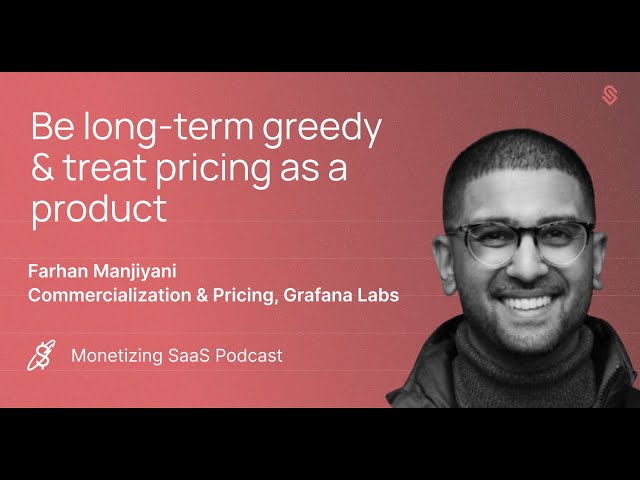
Farhan Manjiyani, senior manager of pricing at Grafana Labs, explains how the company applies value-based pricing across open-source, self-serve, and enterprise tiers. Grafana has 1.4K employees, $350M ARR, and invests in telemetry that reduces customer spend to drive renewals. Pricing is a continuous process, not a one-time exercise, and the best teams experiment with non-standard models early.
Chapters
Farhan, it's so good to be with you. We've gotten to know each other over the last few months in the world of pricing and packaging and monetization. You have an amazing role right now. You're the senior manager of pricing and commercialization at Grafana Labs, where you've been for, I think, roughly 3 years. Tell us about how you got to now. What is the career journey in your own words?
Yeah, thanks for the invitation. Excited to be here. The TL;DR on my career is I started my world in tech as an SDR. That was really fascinating experience learning the art of the cold call. More importantly, kind of demystifying a lot of the assumptions I had about sales. I was thinking of those annoying people that still ring my doorbell today trying to sell me on something that isn't super real. But I realized there are amazing platforms out there that can really help people do their jobs better and if you, you know, find a compelling reason to give a call to someone, they're happy to take that call and then you can continue that all the way down to a deal. So I did that for a little bit and during that process there are these people that would come in to lead these trainings for the SDRs and they knew all about the competition. They knew what was real, what was not. They knew everything about our personas and exactly like, you know, What are they measured on in performance reviews? What is the typical career ladder? They just knew everything. And I was always so amazed by those people. And one day, this is, you know, in-office days, I went up to someone and I was like, what the hell do you do here? Like, this is such a cool job. And that's when I found out about the world of product marketing. And long story short, I started spending more and more time with that team. And then I realized those little side projects I was doing with the product marketing team were actually way more fun for me. When I, you know, rolled out new messaging for a new persona and my team adopted it and they got better conversions on their calls, that made me a lot happier than hitting quota myself. And so that's when it became clear to me that, okay, this is the next path. So I did product marketing, always focused on developers and technical buyers for a couple of companies. And that's how I ended up finding Grafana Labs. And that was, like you mentioned, about 2.5 years ago now. And at that point it was, I had primarily done acquisitions or emerging products for companies. So you found product market fit in one, you wanna build a net new product or you wanna build a second product for the same or similar persona. Again, always focused on that technical buyer. And about 6 months into Grafana, I was asked to lead the competitive team. And then about last November, so another 6, 7 months ago, we ended up combining pricing and competitive into single team, and we actually ended up moving into finance. And so today I'm a blend of competitive and pricing together.
It's an amazing journey. So talk more about— kind of go deeper into what commercialization means as a function at Grafana Labs. Like, what's— what does it mean? What is the mandate of the team? What's the day-to-day work?
Yeah, great question. So I know this also differs from company to company. Even in our 2 and a half years, there's been some evolution. So today what it means is there's kind of 3 core functions. There is the deal strategy side. This is, you know, at some companies called deal operations, but all of the quote-to-close process, the actual operationalization of the pricing, the governing of the pricing, the approvals of the pricing, all that good stuff. There is the core pricing strategy. This is, you know, this is how much are we actually charging? Is this easily understandable? By our internal audience as well as our external audience? And then can we clearly articulate and defend that pricing to customers? And then there's our competitive strategy as the last component of that, which is what's happening in the market? How are we ensuring that is an input into both pricing and deal strategy? And at the same time, how do we choose where we should react and what is unnecessary to respond to, but we want to be aware of it?
Really cool. And so, and you get, you mentioned that you're reporting up to finance.
That's right. That's right. That's a change that we made somewhat recently, a couple of months ago. Ultimately, when we started this function, you know, we sat in product marketing and for us, we had always talked about our charter as we're agnostic to the function as long as we are in a neutral position, right? So we work very closely with R&D, we work very closely with go-to-market. As long as we didn't sit in one of those functions, we felt it made sense, right? So marketing was fine. Finance was another option. Some companies have like strategy function or something like that, operations, any of those, as long as we kind of remain neutral because we're both the recommenders as well as the approvers of the strategy. And so we just wanted to maintain that independence.
Yeah, it's really interesting to kind of understand the shift, see that shift because you're right, it is so different at every different company. And my understanding, correct me if this is wrong, is that The way Grafana approaches pricing strategy is largely by like, it's kind of value-based rather than here are 3 tiers and you can buy one of the 3 tiers. Is that correct? Yeah, that's right.
So we have a couple of different, as our number one ethos, that is like how we price is like, what is the intrinsic value that we can deliver for this bundle of things? The nuance there is we have 3 tiers. 3 different types of offerings. One is we're an open source company, and as an open source company, there is this natural, healthy, and also challenging friction to navigate that as a company, we need to do value creation, right? We need to put out better, more open source products into the world. We're seeing our community adopt them. Our community is our number one differentiator from a competitive standpoint, um, and our number one strength as a, as a company. Including from financial viability as well, right? Of like a percentage of those open-source customers do end up coming commercial customers later on. So capturing, you know, the right amount of that value, being demonized by the community, right? A lot of people have got this balance wrong. So that's something we're constantly thinking about. And then on the commercial side, we have both the self-serve offering as well as a contracted option for enterprise. And we kind of follow the standard good, better, best approach today in terms of our packages, but that kind of ethos is still based in value pricing. Got it.
Yeah. Super cool. Okay. So let's go deeper there. So if you were to explain maybe to like a new sales rep at Grafana Labs, like how monetization works, how pricing and packaging works, how would you sort of like give them the tutorial and sort of like a few bullet points? Like what would you want them to walk away with?
Yeah. One of the core challenging problems for both internal sales folks as well as customers is everyone in the space is constantly running experiments around pricing, which means at any given moment, every single vendor in the space has a slightly different pricing model in terms of what the unit of measure is, how that unit of measure is actually, uh, metered. And it, it's— it gets complex, unfortunately, which is candidly why, why people like me have a job at these various companies. But fundamentally, it comes down to we're dealing in a bunch of data for developers. As that data increases, most of the time, you know, outcomes increase. There is a threshold there where it just, it's no longer true, but for the most part, most people are monetizing on the storage of that data, right? So you have all this telemetry, we're storing that, and then there's supporting features and products around that that are your more traditional kind of seat-based licensing approach or usage-based approach. So most, most of the companies that have multiple products have one or all three of those types of models. And we're no different at Grafana. So we started in our portfolio, we had one company visualization. Our kind of TL;DR there was our claim to fame was you can visualize data without having to actually store it in the visualization. And so we as Grafana Labs, the vendor would take the burden of building out plugins to all these underlying data sources, right? And so now you could visualize without migration. And at that time, and even still today, no one else has been able to replicate that. Everyone else says, you want data in my tool? I can give you all these wonderful things, but you got to first migrate everything into my tool. And then we've kind of, we call that philosophy Big Tent, is that we're in a like virtual big tent with all of our competitors even. So we maintain plugins with our competitors and it's driven by, we've kind of crossed the chasm of just demand from our community and our customer base today. And then we have our own storage options as well, but we've kept that big tent philosophy and that composability, whereas like you can store your, you know, different types of data, have different storage. You can store some of the data with us, some of the data with competitors, and we still have that kind of unified visualization on top. And then there's a number of other supporting products that we're investing in, like I mentioned, are either on that storage-based, based on the amount of data, or on a, on a seat-based, or, or looking looking at some other usage metric.
You mentioned that there are sort of like 3 main pillars to commercial, the commercialization team's charter. There's deal ops, there's pricing strategy, and then there's competitive intelligence. Can you paint a picture of the work that goes into supporting each of those pillars? Like, for example, like, tell me a story about deal ops. Is this like you getting on a call with a rep late stage, they've sent the quote, and now you've got to work with the rep to help them really, you know, kind of like defend value. Paint a picture for us on each of the pillars.
Yeah, totally. So we work on all stages of opportunities. So I'll give you an example of maybe early and then a mid-stage, small and large. I'll give you a couple of things, but you have an opportunity, rep comes up, it is an emerging competitor that we know we're getting heavy pricing pressure from. So we join the call and we could be one or many of us from the deal deal side, competitive side, or the pricing side. And first step is the actual strategy and approach. Let's have an understanding of who are we going up against? What is the kind of situation? What are the volumes that we're talking about? How strategic is this customer that we're talking about, right? Is this a major logo in a, you know, new geo, or is this someone that is a small land that we expect to expand over time and how competitive do we actually want it to be? So given that context, deal strategy team is the one coming up with the actual framework of does this call for something standard or should we be creative and come up with something non-standard, right? Our lever that we want folks to pull is not just let's just drop our price, right? If nothing else, we'll just use, you know, discounting as our main differentiator. We want to be a little bit more creative than that, especially if it's someone we're getting pricing pressure from and we know that quote is going to be lower. How can we come up with a creative framework that makes sense for the business as Grafana to de-risk this over time and protect those unit economics, but at the same time make sure that we understand we're a growing company. We can't, you know, just fall on margins all day long. Like we have to be able to come up with something and actively defend it. And that's where, you know, if deal operations or deal strategy team is, is leading kind of the framework piece. Pricing and competitive are the inputs. All of us are spending time with, with customers. And so what have we done in previous competitive situations? What is this pricing relative to kind of the average that we've done deals at this size for similar types of, of customers? And does this make the most sense? And then combined, we make the recommendation back to the business on what they should be doing in, in those situations. And then if it's kind of our main competitor that we know where we're cost competitive, right? Because again, Competitive is doing the research on the competitive pricing side to understand before we even decide a price in the beginning, how competitive will it be? How is it going to affect our margins? A lot of the competitors in our space are public companies, so we have good understanding of where their margins sit and where kind of their innovation is being invested in. And so then, you know, the deals strategy team for kind of the incumbents is much more on the governance side. Of you actually don't need to do anything non-standard because we go against this competitor X, Y, and Z times, and we know that we win at these rates. So there's no need to think about anything outside of these rates. This is just kind of your— it should be your standard rate table. And if not, let us know, right? We'll engage pricing and competitive and, and we'll pressure test because obviously we could always be.
One thing that stands out to me about this is it just feels like it's sort of from an operational perspective, it's highly intentional and highly disciplined. And it sounds like this is like a, a, a core service that the business said should exist and should serve both the CRO and the CFO. The reason that stands out to me is because I could imagine CROs in some businesses, kind of depending on the context, saying this is a lot of admin. I'm curious if you'd reflect on that, if that feels true or false and like, how did this become a service that both the CRO and the CFO were really bullish on?
Yeah, great question. I think that's super astute observation. I think it starts with our CEO in one of the core kind of values that they've talked about for every employee at onboarding. And as well as like it, it shows up in our product strategy in like how we talk to customers, how we do competitive research is this concept of being long-term greedy. And what that means is we don't want to make short-term trade-offs if it means anything in the long run, whether that's a return on our investment or whatever it be, right? Like, don't focus so much on, on being short-sighted. Think about what happens in the long term if you make this short-term decision. And I would say that it's been rare that I've met revenue leaders as well as finance leaders who both really believe that. And so a lot of the, what that translates to is the recommendations that our team is making is almost always a discussion. Approvals, like the decision makers to be very clear, are the CRO and the CFO. If they agree to do, you know, whether it's what we recommended or something else, like they are the stewards of the business at the end of the day. But most of the time it is a discussion and it comes back to, yeah, we need this deal. Yes, this quarter is important, but it's also the realistic lens Well, historically, you know, how well do we do in this quarter in the year? Do we think we can make it up in future quarters? Do we want to walk away from this because this isn't, you know, a good thing for the business in the long term? And we can all have, like, in that way, all of our incentives are aligned, right? To be longer-term greedy. Of course, people have quotas, people have paychecks, people have boards to answer to. But I would say like, that's one thing very unique culturally here. It doesn't matter if you're responsible for product, sales, finance— like, everybody is thinking, you know, about how can we make sure this is the best decision for the business in the long term. And then your own function, your own needs, kind of secondary to that.
Long-term greedy is one of the best quotes I think I've ever heard. It's so compelling. Maybe we name the— this episode— that's the name of this episode. I'm want to kind of So you've been, you've been at Grafana Labs for close to 3 years. That's right. Tell, tell us a little bit about the scale of the business, what you can say about that so the audience understands that. And then what are the biggest surprises to you over the last few years? What's really surprised you? Great question.
So a couple of things. When I first started, so company started back in 2014. So we're about to just cross our 10-year, going on to 11 years now. We started with 1 product. Now we offer, I believe, like 7 products in total, with more coming. Revenue-wise, when I joined the company, I was an employee like 600-ish and some change. We just crossed 1,200 employees. Revenue-wise, I joined just as we were roughly $100 million, and now we're past $350 million. Now. So we're, you know, 1,400 employees globally distributed around 30 or so countries, fully remote from the beginning. We have over 2,000 paying customers today. And if you're looking at our open source adoption, we have a million active instances of Grafana on the community today. And so it's been really awesome to kind of see how, again, open source kind of fuels that innovation. Has fueled that growth. For the first, I would say, 5 to 7 years of the company, probably closer to 6 years, there were no dollars. It was like community the hard way, right? So it's just naturally going out to conferences, naturally going out to meetups, talking to people about Grafana, working with them to improve the product. And our first product was actually support for our open source offering, right? That was literally our first commercial offering. Then we offered services. Then we offered a true, like, commercially differentiated product for visualization. And then, you know, now we, we are doing our best on that balance, um, for, for each of those. A couple of things that have been surprising is one, the fact that you can still convince investors to have a strategy like that, right? To like, think about 2014 when you're raising VC dollars. And to be clear, like we've raised roughly $750 mil today, uh, across, uh, 5 rounds., and most of that thankfully is, is untouched. And that is also, you know, public. Our, our CFO and CEO have mentioned that, um, a couple of times that we've done really good on our burn rate. But the fact that you raise all these dollars, you clearly have this war chest. As a VC, you want a return on the investment, you want to see growth, et cetera, et cetera. But to say that, hey, we're gonna maintain being long-term greedy at number one, we're going to make sure that the growth that we have is like real and careful, right? Because we don't wanna lose the community. At any point, right? Like I've seen a lot of other companies have pressure to candidly release a shittier product, right, in the open source and save all the innovation, all the goodies behind a paywall, right? And there's really nothing in the open source. And that's not true for us today. One thing that really surprised me to learn is even today, the majority of our engineering resources are to open source commits. There are no performance holdbacks into the open source. There's not a lot of innovation that's saved for commercial, except for the things that actually make sense for enterprises. And there's some things that I'm sure people would like in the open source, but ultimately we have reserved for contracted customers. One example of that, of something else that surprised me is we've taken up as a company, and again, this is 2024, right? Of like, it's amazing that this has actually happened and it started 2 years ago, is this concept of adaptive telemetry. Where we as Grafana Labs, a vendor in the space, built a bunch of tools to help customers optimize their usage. And what that means is in the short term, all of our customers contracted, right? The amount of dollars that they were paying us, those contracts got smaller. Why do they get smaller? Because the tools that we build are making sure they're only paying for the data that they're actually using. What these tools are doing is saying, hey, You created this data point, but nobody's used it in the last whatever, however many days. Why don't you just get rid of it? Why is it just sitting around? Because we realize that, you know, we do this business of reliability ourselves. And like I was mentioning before, at a certain point, more data doesn't equal better outcomes. It actually equals worse because now there's more noise to sift through. So how can we help right-size these customers? But to me, that's huge. We did it with one product. It worked super well as a competitive differentiator. Again, being long-term greedy, that in the short term we'd see contraction, but over the long run we'll see more renewals and more customers, you know, feeling comfortable signing longer commits with us because of these tools. And now we've gone back and we've actually publicly committed to doing this for all of our products that are storage-based, right? We're going to continue investing in these tools that to make sure that as a customer, you're only paying for what you use. And I think about like literally any other industry that would never happen. Like you think about the banking industry as an example. If you look at JP Morgan Chase or Wells Fargo, whoever you want, look at the line item ATM fees alone. Look at the line item of the interest charged on credit cards for people who forgot to pay it. Like people are literally modeling out how, what percentage of the population they think will just forget to cancel their subscription or whatever and banking on that revenue happening. The fact that we can go out and pitch a vision to make sure we're doing the right thing for customers and still get dollars in return, still get the support in return, still see healthy growth. Like to me that is mind-blowing that you can build a business this way. And that's like honestly what really keeps me at Grafana.
I can see kind of like the, um, appreciation in your, your story there for the way the company is run. And it's very compelling to me because it's few and far between that you have like executive teams and CEOs that are just extremely long-termist, um, and that have created, you know, a culture that supports that both with the employee, the customer, and the capital and the investor. And it's very, very hard to do. I think it's very unique. In fact, I talked to several people this week who talked about how scary it is to be a seat-based SaaS company under a lot of pressure to go to usage-based, knowing that that will drive contraction and really not having board support or even executive support to do it. You know, kind of what do you do in that situation, right? Because like clearly the conditions have not been created where you can go like take the hit and be brave or whatever you want to call it, be customer-centric, long-termist. So what do you do? I mean, that is a really complex situation to maneuver because it's all about conditions that were created years ago. Yeah, 100%. There's no question here, but it's just something that I, you know, I'm compelled to think about given what you just described.
Yeah, it's, it's honestly crazy. Like my, my immediate thought was like I had to look up our investors one day and I was like, who the fuck are these people? Right? And then I was like, wait, this is Sequoia. Right. This is Lightspeed. This is like, this is not like, this isn't a random investor. Like these are people who, uh, some of them, right, sat on, uh, led the product strategy in competitors of ours. Right. And now they're no longer, you know, competitors. Now they're investors cuz they've done well, but like they also get it and they've been operators themselves. I think that goes like a really long way. But number 2, yeah, to your point, to like really make that bet. And, you know, granted, as a VC, it's all about risk, and I'm sure they did things to mitigate the risk that it wouldn't work out on their end in their portfolio. But I think it's clear that like this bet is, is paying off. And I'm very curious, to your point, to see how will others respond to that. And to me, again, that's something that really I didn't realize before, but that's actually super exciting to me of like, I look for companies that are changing the way the industry works. Usually that's the underdog in the industry, right? Trying to take out the incumbents much like yourself, right? So I like spending time with early-stage startups especially, but then seeing the ones that are actually successful and make everybody rethink, yo, what the hell are we doing here? Right? Like maybe we don't need to, you know, whatever, be so stingy about time off. Maybe we don't need to have a 4-year cliff on our stocks. Like maybe these norms aren't actually worth rethinking, like, I love that. It's so, so fun and exciting for me. And I try to keep that own philosophy in pricing as well. It's like, I'm very open to all of our pricing being wrong, right? Like, I treat this as one massive experiment. This is a hypothesis. And if I get enough data that tells me that we should change, I'm down. And thankfully I work at a company where our executive team is also down, right? Like we're constantly running. These, these experiments because of, like you mentioned, this isn't like just for pricing. Like, they are long-term greedy folks generally, so they're very okay with, you know, making these short-term changes even if it doesn't work out.
So you've seen pricing and packaging and commercialization scale, and I know you spend time with startup founders as well, helping them think through these types of things. Are there any misconceptions that you think are really prevalent in the world of monetization, or No, none come to mind.
Misconceptions. Couple of misconceptions and some mistakes, I think, as well. I'll start with the mistake and then we'll talk about misconceptions. The one mistake people make is in deciding their pricing, they don't realize that they're actually just debating their own opinion and nobody's actually talked to the customer that they're actually trying to target in that moment in time, right? Or maybe one person's talked to a customer and they're trying to tell everybody Hey, like, go look at this interview. And I've been in companies where someone, I literally said, hey, we can go, you know, line up 20, 25 customers. We can validate this with them. And the response was, that'll take too long. And I'm like, I'm sorry, you want to make a pricing decision without talking to customers? No way, dude. That's, that's not, you know, I can't work at that place. And, you know, at the time, unfortunately, I didn't have that clarity or the confidence to respond. And I was like, oh, okay, sure. Let's, let's just go with what we think.. But now looking back, I'm like, dude, that's ridiculous. Like you can't do that. And so, which is why today, like the mandate of our entire team is our number one priority is customer conversation. Like we will prioritize anything over that. There are, you know, even conversations with our exec team presenting on pricing, making recommendations. We will work those around our customer conversations. That is always, you know, number one. And thankfully, you know, I'm in a place that, that prioritizes that. The misconceptions, I would say pricing is a one-time exercise, right? You have a product, you're ready to launch it. You gotta figure out something to put on your website and then you're just done. Then you just, as long as you keep working on your product, like the monetization will just keep working. I think that's a, it's totally false. Like pricing is like a product in and of itself in that the first version you release, it may be good for some person, but the more people that touch it, the more you're going to realize it sucks for them, right? And it doesn't meet a bunch of edge cases for them. And so you also need to be constantly pressure testing, who am I building this for? What are their needs and how well am I meeting those needs? And then what can we do to better serve the needs, right? Or how can we serve this new customer better without alienating the first people that gave us, you know, dollars. And whether that means rethinking the unit of measure, whether that means kind of rethinking the price point, whatever it is, right? Like, you have to continuously experiment on that. At any given quarter, we're running 3 to 5 pricing changes, right? So by the end of the year, that's 20, 25. It's a lot. And I totally empathize with our entire go-to-market team. It's tough because our pricing is always changing, right? It doesn't matter if you've been here for 2, 3 years, like, you may not know all the nuances of our pricing, but then that goes back to why it's so important for us to be customer-facing, right? To make sure that, you know, it's always the latest that's going out into the field. The other thing I think is a misconception is it's all about the price point. And people spend a lot of time saying, well, what number should I land on? And what's the right number? Where I think what's actually, what's more important is the unit of measure, because the unit of measure is much harder to change, right? If you were to go to just from seat-based to usage-based, that is a massive change on the backend, on how you contract, on how you invoice, on how you report that revenue internally. All those backend systems that especially at scale start to become many, many different teams. That is not something that can easily be done. You should spend way more time debating what is the right unit of measure and then pressure testing that with customers and how they want to buy that product. Then the price point is something that I think can easily be changed, right? You can start low and go high. I generally don't recommend starting high and going low, but you know, you can experiment with lots of things, bundling, debundling, like all those things are very easy to do. It's mostly just change on the website, right? Or you can run a promotion., and it's just then how you articulate it. You don't need to worry about those backend systems, but yeah, really focus on the unit of measure and how those customers wanna buy. Pricing is like not just a, a one-time exercise. Um, and then like to not argue your own opinions, make sure everything you're saying should be based in, in customer reality. And then the only debate is, are we talking about the right target customer? Are we targeting the right customer in this moment? Right? It's not you're right, I'm right. This is what the CRO wants. None of that matters, right? It's just, is this the customer that we're trying to please? This is the right profile. Then here's the evidence, right? Let's just talk about that.
Really, really clear. Really good. I love that idea of pricing as product within your own business. And maybe that brings me to another question, which is, you know, given you've seen really mature, really intentional pricing monetization at Grafana, What best practices would you share with earlier stage companies, companies that are, have achieved some product market fit, are beginning to scale, some companies that are like firmly in that growth stage where they're doing $10 million in ARR and trying to push to $50? What, what does good look like at that stage if you're trying to build a really methodical, really disciplined monetization practice?
Don't push off monetization. That's kind of number one. I think there's conflicting advice here, but I've seen both sides of this. Like, I have good friends, early-stage founders. A lot of them believed in the ethos of like, build it and they will come. Um, they're— we're, we're still friends even though they believe that. Many times advised them that it's not a great piece, but you know, until they lived it, then we came back and, and we had a discussion, uh, 2 years later after that company didn't end up working out because it was too hard to monetize later on, right? Like, they had not had the muscle of figuring, they had not kind of built out the muscle of figuring out what are the things that are worth monetizing, right? That conversation for every product is slightly different, right? And just take some time to hone in on your customer base. So if you're just like, yeah, I'll give everything away for free and I'll figure it out later, like that doesn't often work. It's helpful to have some idea. And even if that means delaying the launch a little bit more, in my opinion, it's worth it, is figuring out what is the thing that we will eventually monetize. And maybe going back to Grafana's early example, it's okay if that's just services or support for your current product and that's your first paid offering. That's okay. But you should have a path to monetization from the beginning. And so really spend the time debating that and just get everyone on the team aligned that this is something that isn't a one-time exercise that we'll do at, at launch, right? Of like, Yeah, cool. We monetize, we got our pricing page on the website. It has a dollar on it, and then people are just going to swipe their credit card or sign our purchase orders all day. Like, it's not going to work that way. Like, it will work for some time, just like your product would. If you just launch on Hacker News, people will look at it. People will probably try it. Some people will end up buying it, but eventually that won't work either, right? And then you got to go find something else, or you got to go Reiterate, make sure you're thinking the same about your pricing and it doesn't have to be anything crazy, right? Like just because we're doing 5 every quarter at Grafana doesn't mean you need to be. We have full-time people like myself and others dedicated to thinking about this problem all day. If you're a founder doing 10 other things, it's okay, but dedicate, say, once a quarter or even twice a year, you're gonna get together with your whole team when you're doing your, your planning for your roadmap and other things. That you consider strategic, have, you know, 1 to 2 hours ready for debate on your pricing and pressure testing. Do we have the right pricing in place? Which brings me to, I guess, my next point, which is, do we have the right feedback loop in place? That's often also a missing component, which is like literally my job for the executive team is, hey, we made a recommendation, we debated the recommendation, then I went off and did the work. Did we actually revisit that at some point in the future? Hey, did this thing work? What did customers actually say? What were we correct in our assumptions and what were we wrong about? Those are super important learning opportunities for the next time we do this, right? Because we're gonna make a bunch of assumptions again, and we wanna make sure that we're not making the same mistakes over and over again.
To go even a little bit more tactical, like if, sure, if we're talking about a $10 million ARR business, it sounds like, yeah, certainly kind of these like periodic meetings. Meetings with cross-functional stakeholders, feedback loops. What can like founder CEOs do to go create the conditions that have been so compelling at Grafana? Like, is it, yeah, they're out doing willingness to pay exercises? Is it they are doing packaging interviews and pricing interviews and setting those aside and being like, what, what can companies at that stage do tactically to, to really be ahead of the curve? Yeah.
Explore non-standard pricing from the, from like the jump, right? So like you'll have this debate and you'll decide, whatever, we're gonna be seat-based and we're only gonna discount, you know, 20% at max on that seat-based for any deal. It doesn't matter. One customer is gonna come along and you're really gonna want this deal and your sales team and your customer success, everybody will advocate for it. And your gut reaction will say, no, we decided the pricing. You know, we need to stand behind that. I need to dig in my heels. My recommendation to you is if the pricing doesn't work for them, be open to creating a brand new model just for them. And if they want to, let's say, have unlimited seats, go and figure out how to make that happen, right? Do the math on your own, see what your costs are, what it would take, how high, you know, how much usage do you think they would actually have? Do you need to put guardrails in place?, but like be open to exploring those things, even if that means that you're maintaining multiple pricing models at once. One, that's okay. Two, it will teach you the pros and cons of all these different pricing models, right? Once you've actually put it in front of a customer, once you have to explain it, once you have to defend it, once they actually get an invoice and they're like, what the hell is this thing? Right? Like once you go through all those things, then you really start to learn. And can really help you inform, hey, our pricing model of seat-based, that actually is kind of weird. It doesn't make sense because of this customer and this customer and this customer. And actually those are the customers that we should be targeting. Now that I think about it, let's actually transition our, our entire model. So be open to doing those kind of non-standard things and then invest. That means you'll also have to invest in, in the tooling on the backend, right? To be able to support, these early use cases, but just like a product, right? Like if you don't do that, you will accumulate tech debt in your billing system, right? So then at scale, if you try to do that and you say, well, wait, we can get, you know, with seed-based, we can get to $50 million or $100 million and we'll deal with this problem then, then it's a very different conversation. It's not what does this customer need? It's gonna be a very different question, which is what can our billing system accommodate? And you never want to be stuck there, right? You want to have optionality. It's an incredibly interesting point.
And I did want to ask you about this because so much of what we've talked about is pricing and packaging and monetization through the lens of both the sales rep trying to establish value in the market, the product marketer trying to support the sales rep and their ability to establish that, that value. And competitive intelligence is maybe kind of like an addendum to that. What have you learned about the way pricing, packaging, monetization impacts product and engineering? Because often product and engineering are having to support the monetization strategy from the product. What have you learned about kind of the complexities that they face?
Yeah, that tech debt is so, is so real. And one of the things that I learned from my time as, as a product marketer that I still like use every day. Even as pricing, even though I'm not on the product marketing team anymore, but the philosophy is so helpful, which is that product marketers' number one challenge is you need to influence with zero authority. You need to influence the product roadmap, but you don't own the product roadmap, right? You need to influence what sales is saying and how they're pricing and how they're positioning, but you don't control them, right? Like you don't control their quotas, you don't control any of the behaviors that, you know, that control their incentives. Figuring out how to do that is, you know, a lot of conversations, admittedly, where you're setting context, right? And you're sharing the challenges that other teams are facing, right? Because you have a unique opportunity to see all the sides of like, what are the challenges with creating the product? What are the challenges with selling the product? What are the challenges with adopting the product? And then you get to get to go back. So making sure you're sharing that contextual knowledge because there are just natural silos and those get worse as the organization grows, as I only, you know, understand my problems. But at the same time, you lead with a lot of empathy and understand, you know, the team that you're talking to, understand their core challenges. Why are they saying no? Why are they saying it's gonna take 6 weeks when you want it to happen in 2 weeks? Like what are those challenges? And then going back to all those teams, right? And you're playing this role of connector to see if there is a, this is a happy medium somewhere, right? And then usually it's somebody's ask was unrealistic or like not based in some sort of reality, right? Of like they want it today because of usually short-term greediness, right? Of like it'll help them do XYZ in the short term. But the actual thing best for the business is, hey, let's solve this the right way, even if that takes a little bit longer., and we may lose this one deal or whatever, but, but that's okay because this is going to open up, you know, hundreds of deals that we will be able to do just like this. But I think, yeah, just, just practically understanding that product engineering is just as much of a stakeholder as go-to-market, right? And their challenges are very unique and they often don't understand the other side. When you're living in the tools, you don't understand that, you know, it's very hard to explain this thing to a customer. And if you don't ever have to do that yourself, it's very easy to say, well, you could just get better at that, right? Like you're just explaining it wrong. The customer will just understand if I explain it. And in those moments, I kindly always invite my technical stakeholders, say, okay, let's join the call together. You try explaining it and let's see if they understand, because maybe I am doing it incorrectly, right? I'm very open to that. You try and then let's, let's debrief together on kind of where they got stuck or what I could be doing better if that's truly the case and vice versa, right? Inviting your sales folks and go-to-market folks into those technical conversations about, you know, why your billing system can only accommodate 3 decimal places or 4 decimal places. And that's why we can't discount past this level, even though that, you know, you really want to. Just helping them, you know, both sides really empathize with each other.
The constraints that you've talked about on the billing side are like really interesting and really prevalent. Like you, you commonly hear companies say we can't change pricing and packaging because engineering doesn't have the bandwidth or like the billing system won't accommodate it. And that's a, like really unfortunate, right? Like you can't align monetization with necessary market value because of some systems problem or some architecture problem. I'm curious to kind of get your take on why that is. And I'll pause it. It seems to me that engineering and product teams are often reinventing the wheel when it comes to building out monetization in the application and building all the systems that govern it. They're just kind of figuring it out because, and they're kind of doing it organically. And it's always surrounded by a patchwork of tools and processes because usually they're responding to kind of the latest business need. And I wonder if you think that that's valid based on everything you've seen, or would you describe the world differently? That's invalid, or you would look at it Yeah, great question.
I think that's spot on. I think I would phrase it like slightly differently, but the same, same point at the end of the day, which is we talked a lot about this concept of being long-term greedy and how that's, that's drove driven alignment from kind of the finance and accountability side of the house and the revenue side of the house. But I think something that we eventually did, but it took us a while to, to do this. We should have done it from the beginning. Is also making sure we have discussions about how long-term greediness plays out on the technical side of the house, specifically around how we monetize our products, right? Because we also had to do a lot of education on, well, we're not a cost-based company, we are a value-based, right? And what does that actually mean practically in your day-to-day job is that, hey, we want to make sure that these pricing models, different people assign different values to the same product, right? So that means we want to have multiple plans that we are able to accommodate and choose from. And then the second thing there is this rapid experimentation works for the executive team. It works for the pricing team. It works for the go-to-market team, but we didn't talk enough about making the billing team and the supporting teams a first-class citizen in that conversation, right? It's like they're just getting these asks. And to your point, a lot of the initial owners of this, they were doing this as side hustles, right? Just like in early stage companies, it's like a product marketer that's doing 11 things. Pricing is just one of them. So they're going to find, you know, the shortest path to getting it done because they have 11 other things that are also due at the end of the week, right? Like they can't spend all the time in the world trying to understand the nuances and limitations of these systems. But if we had done a better job of bringing them into that conversation from the beginning and kind of aligned on those two things. It's like, hey, one, we want to be able to support, you know, do value-based pricing and translating that to them, which means that we want to be able to support multiple plans at once at any given moment and easily switch customers from one to the other as their kind of value definition changes. And number two, we don't know that we're going to get it right, right? And we're going to run a bunch of experiments, which means pricing is going to be constantly changing and we need to staff appropriately for that, right? So that means carving out a dedicated team to do this. If that means changing systems from now to be able to accommodate this, like whatever it is, we need to go do that now because we have alignment up and down that we want to do this. But unfortunately, like a lot of companies, including ourselves, like we didn't think enough about what does that mean practically on the execution side of the house.
Let's explore the systems for a second. So when I talk to let's say, kind of CFOs and COOs and kind of ask them to explain to me like what's complex about pricing, packaging, monetization, billing, like just supporting monetization in general. A pretty frequent refrain that I hear is, well, if you think about it, like you've basically got kind of a problem where if you make a change in one place, you have to make changes everywhere. And what I think they're describing is big complex B2B software companies end up with a lot of different sources of truth, right? There's the source of truth for finance. There's the source of truth for billing. There's the source of truth for sales. There's the source of truth for product. And pricing and packaging touches all these systems. So for example, you'll see like a product catalog in Stripe and NetSuite and Salesforce. And then you've got to figure out how to provision it in the application, right? And then when you go talk to CTOs and product leaders, what you often hear them say is they kind of speak less about the kind of the duplicative product catalogs and more about, well, a lot of this logic around pricing and packaging is actually hardcoded in the app. Like it lives in a config file somewhere. And so anytime you want to make a change, you have to go through engineering and you have to touch application code. Um, and I think my question that I'd love to explore a little bit is If we could wave a magic wand here on this episode, solve this systems problem, what would you say are sort of like the architectural sort of components or individual services that need to be able to work together flexibly to give a business a lot of agility around monetization? Is it the product catalog? Is it the metering system? Is it like, what are the core components that you've learned about that just off the hip come to mind when you think about this is kind of what you need in play as you build a serious SaaS business?
Yeah, and this is what interested me about Schematic, right? I think you, you already nailed it because there's a couple of things. Is one, we need to be able to have an independent layer from these various sources of truths with the optionality to update all of the source of truths or some of the source of truths at any given moment. Right? So that nothing messes up to downstream stakeholders, but folks who live cross-functionally across all of them, right? Like pricing and packaging is tool agnostic at the end of the day, but we work with billing, we have to work with product, we have to work with Salesforce and Stripe and all these NetSuite and all these different things. Like we have to understand, you know, the limitations of those. And so you can either constantly switch systems based on your need, or you can have an application layer extracted above that, right? That can push things as necessary to those downstream systems without messing anything up, right? Without buying extra professional services.
That idea of pricing and packaging as tool agnostic, I've never even heard it framed that way, but that is so compelling. I love that idea where like you can make changes and product changes, business system change. It's really a compelling idea.
Um, yeah, I could talk to you for like 3 more hours.
I could talk to you about 3 more hours about this and hopefully we do this again. I want to, I want, I don't. I want to spend a minute or two on the future from your perspective. Sure. If you zoom out and you think about building really important SaaS companies over the next 10 years, what are the big kind of sea changes in the world, the big inflections, the big trends that attract a lot of your curiosity, your personal curiosity?
I think there's a couple of things. I'm really excited about all of the experimentation away from kind of your standard good, better, best on the packaging side. I'm super intrigued in this idea of like getting more granular to the personas, or if you want to call it jobs to be done, or really like outcome-based pricing, right? We particularly say this and see this in AI. I'm like really interested in how that plays out. You are charged based on the true value that the product or service delivers for you, right? So Intercom's resolution-based pricing, is like very intriguing to me here. And there are a few other companies doing something similar. The open question in my mind is, well, how well does that map back to your actual cost? And where does that model break? Because it sounds great on the, I want to make sure it's easily explainable to my customers and defensible and all that good stuff. But the other part of it, the part that you need to sit down with finance and make sure this actually scales. And works for all different types of customers. Like, that to me is something I'm, I'm really interested in seeing how it, how it plays out. And then as things get commoditized, like in our space, this concept of storage on the backend data is getting commoditized. Like, over the last 3 years I've noticed, um, and I expect that to rapidly continue, it is very quickly a race to the bottom in terms of price. So then where does the differentiation come from? Is it as simple as a packaging decision? Is now, hey, telemetry is effectively free in our space, and then we're going to look at monetizing something else, right? Like, will the user model make a resurgence because of this, right? Because like, now it's like a little bit more aligned to how companies are making the decision of what the growth looks like. And that's somewhat predictable, more so than like, how much data am I going to generate? Well, I don't know. It's like pretty pretty tough, but like in general, that theme of predictability is super important in buying decisions, right? And so every company does that slightly differently, whereas they're thinking about, well, I want to do this capacity planning, right? I'm going to add XYZ people over the next 6 months. I expect, you know, one person to generate X amount of data and you charge me based on the data. So I want to get an average of that cost, you know, at that scale. And then I'm going to run a model to see not just if I can afford it now, 'But if I can afford this over the next 2 to 3 years, because that's what you're telling me is the best unit economics, right? You're going to give me a great discount if I can sign a 3-year contract, but how do I actually predict?' Or is it going to be more companies doing what we're doing, which is building tools as a vendor for your customers to make your own tool more predictable, even if that means, you know, short-term losses in the short term? And will it actually see long-term gains across industries? Those are a couple of things that I'm really interested to see. How these are going to play out.
I love that. I mean, there's, there's so much to kind of think about from the standpoint of like second order effects with the rise of AI and what that can mean to COGS and what that can mean to like real performance-based pricing in SaaS. It's really a fascinating surface area. This has been so much fun. One closing question I like to ask is, is there a moment that has been truly formative in your career? Like, and I'm looking for like a really specific moment.
Being asked to to take over the competitive team at, at Grafana. That, that was a very pivotal shift in my career. Up until then, I was a product marketer, which means I did a bucket of, of work. And I'd always played with the idea of what if I went all in on one of these buckets? Like, what would that look like? And I was always afraid that I would pigeonhole myself into that, right? I can never go back. And the optionality was what kept my job interesting because I did a little something different, you know, every day, but it was all part of the same title. And I had that same fear, but because I needed to make a decision, it forced me to come to a conclusion and talk to other people in competitive and just ultimately suss it out. And that was the best career decision I've ever made. Like, that's definitely when my career radically changed in the best way possible of like building out a competitive program for a global company at, you know, going from $100 million to multimillion dollars, I had to figure out how to enable folks who came from the industry, as well as someone who had no idea what metrics, logs, and traces were and nothing about the space. And I myself knew nothing about the space. I had to teach myself so that I could enable others. And it was super, super tough, but looking back, so rewarding, so, so, so rewarding. And that's what, what got me here. Today, even though I slightly shifted and now I have a new perspective. Like, I have a true appreciation that, like, I'm in the right lane. I'm doing the things that make me happy. Like, work is not just a paycheck for me. Work is a really fun learning experience that is like a core contributor to my overall happiness today.
Farhan, it's so compelling to speak with you about all of this, not simply because you've earned so much insight and so much expertise, but because You clearly have a deep curiosity for the subject matter from so many different angles, and I'm just really grateful for you sharing your time with us. Where can founders who might want to ping you with questions about monetization reach out and find you? And where can people learn more about Grafana Labs?
Yeah, LinkedIn is the best place to go. For Grafana Labs, just grafana.com. We have a free forever account, actually useful free forever, meaning that we were very intentional to make sure it can reasonably scale. And then if you ever wanna, yeah, brainstorm on anything, I'm always happy to have those conversations, especially with, with, uh, early stage founders. And you can, you can, uh, corroborate this that like, I love just reaching out and literally just talking shop. Like it's just so fun, uh, for me cuz it keeps me on my toes as well as hopefully can be helpful to founders and the challenge that, that they're currently facing. Yeah. If you wanna do something more formal, I'm also open to advising options or consulting options, or if you just wanna shoot the shit, always, always happy to. On LinkedIn. Fantastic.
Great to be with you. Thank you so much.
Thank you. Appreciate the offer. This is really fun conversation. So thank you.
More from Fynn

Schematic at Operators Guild Demo Day 2026: How to bill for AI credits without a surprise bill







Should you move to usage-based pricing because AI is compressing your margins?

Why raising prices every year backfires (a pricing leader on the Mastercard quota model)

