
Monetizing SaaS: Episode 42 with James D. Wilton, Founder & Managing Partner, Monevate
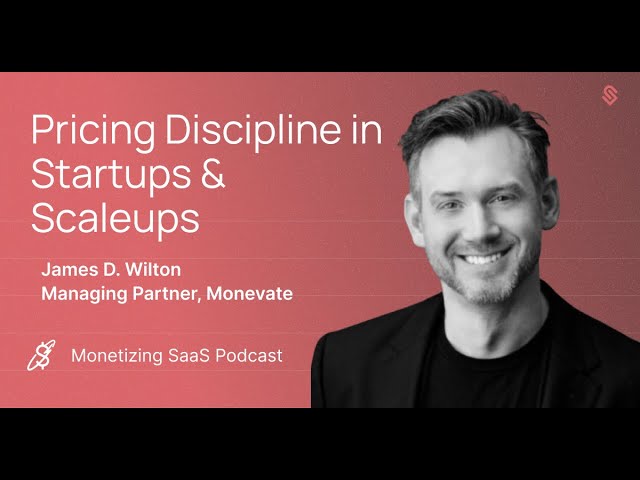
James D. Wilton, founder of Monovate, spent 20 years at McKinsey and other firms before starting a pricing consultancy for startups. He debunks three myths: that pricing is overly complex, that price level alone matters, and that one model fits every market. He uses Algolia's search-request metric to show how usage-based pricing works in practice.
Chapters
James, thank you so much for being on our podcast. I've gotten to know you over the last year. Um, we're going to talk about the community that you've built with The Cube and Monovate, but that's how I got to know you, and it's been so cool what you guys are building. But you have had really this incredible career in pricing and monetization with, you know, what, 20 years of experience. And I think you got your start in consulting with CS Associates. You ran pricing for— I'll butcher the name here— but Relex, and then SBI!, and then 3+ years at McKinsey, and then you kind of went into Monovate and you're the managing partner at Monovate. And for those who don't know, and I think everybody should know about Monovate, but it's a strategic pricing-focused management consulting firm. You're focused largely on tech startups, on scale-ups, and other kind of fast-growing, kind of high-innovation companies. Tell us your story in your own words.
Yeah, absolutely. Yeah, 20 years, God. Yeah, it always feels a little bit worse every time I say that, but yeah. Yeah, I guess, I mean, you called out most of the experiences really well, Fynn. I've been a consultant for pretty much my entire career. Right. And yeah, I had a few experiences, started off at ZS and business school and AT Kearney. I was very much in these kind of general consulting roles until that point. That's kind of thought, that's what I thought I would do for the rest of my career really. But I had something that kind of threw a spanner in the works around about 2011. I had my first kid, which was obviously great, but consulting at that time was very much like mandatory 4-day-a-week travel model. And so I got to see my first son at weekends really for the first like 6 months of his life. And I just kind of figured out very quickly that that was just, it was not sustainable and it wasn't what I wanted to do. But I was conflicted by that because I really liked being a consultant and I liked the way of working. I liked the variety and I kind of identified as a consultant by that point, right? So I was I wasn't really excited by the prospect of going to like a 9-to-5 operational job. So I said, you know, what am I going to do? And I ended up getting headhunted by this internal consulting team for RELX. And in case anybody doesn't know, RELX is a very big company, owns Elsevier and LexisNexis and a lot of these kind of these big old traditionally publishing companies, which were all moving into online and tech and SaaS models around that time. And this consulting team focused on pricing strategy. And, you know, every time one of these companies or business units within there needed a pricing change, the team would be called in to help with that. And I hadn't done any pricing strategy work up until that point. I took a very short course at business school, but that was really my only exposure to it. But I was brought to come in, really, they were looking for me to bring my experience working in big consulting firms to it. And they told me, you know, you'll get much better work-life balance. You won't have to travel as much. You'll be home a lot more. The hours will probably be better, and you'll probably really like pricing. So I just ultimately rolled the dice because it seemed like a good fit based on what I was looking for. And as it happens, I just found out pricing was kind of the area of business that I hadn't really found until that point that just got me really excited. And I loved the content more than anything else that I'd done, really. And I think it was probably because it was a lot broader and more strategic than I was expecting it to be, right? You know, when people talk about the art and science of pricing, right? I think it really does use your whole my brain, and I found that really, that really fun. So I got super into it. After a few years, I was leading that, that team, and I decided at that point that rather than going into one of the Radix businesses and go into a leadership role there, I wanted to just go back into external consulting, slightly different terms, but I wanted to just focus on, on pricing. And that's what I've done ever since, really. I've just got, I've got deeper and deeper into pricing and deeper into pricing for SaaS and tech companies. As you mentioned, I built a pricing practice for a boutique consulting firm called SBI. And then I went to McKinsey, which was really exciting. I got recruited by McKinsey to lead the pricing practice for Fuel. Fuel was the part of McKinsey that was set up to work with startups and scale-ups and these kind of fast-growing tech companies who are all generally thinking about pricing as a way to maximize revenue and revenue growth rather than just thinking about profit. So it's basically, you know, you get to do, you get to work with the companies that you're most excited about working with at this very well-known, very prestigious consulting firm with all the resources behind that. And it just sounded like an absolutely great opportunity to do it. So I took it. And it was great, honestly. I really liked it. I got a ton out of the McKinsey experience. Loved the people I was working with. I really liked the way we did the work. And we did do some really great work for some really actually well-known and very unicorny startups, which was a great experience. But I think the thing is that while we did have successes when we had them, McKinsey fees and startups don't naturally go well together. I think that we were always finding it difficult to just get the transaction to work, right? They were always really interested in our value proposition and wanted to work with us. But our fees would just be so high that like only the best funded and the largest startups could really make it work. So I was constantly meeting all these startups who I was excited about working with and we just couldn't make it work. So that's really what was the jumping off point for me to found Monovate. Because I thought, look, I want to be able to build a firm that keeps the quality of work and the rigor of what we're doing at the same level as it was when we were at McKinsey, if not even higher. But I want to be able to be more flexible so that I can serve a wider range of companies and put fees in front of them that make sense given their, given their size and scale and hopefully grow to be the go-to for these kinds of companies who want to do this kind of work.
It's such a cool story. Thank you for laying it out. And one thing that just stands out, because I've thought about this before, is like, it's so interesting that in modern MBAs, like pricing is a little bit of an afterthought, like this like side elective, given sort of the leverage that this discipline can provide for businesses. I mean, isn't that amazing?
It is. No, it is. It's like nobody even knows of pricing as a career. I think there's one school, right, that focuses a lot on pricing and the name's escaping me for a second. But I think other than that, that's really, it's the only school I've actually come across where they've even sort of considered laying out pricing strategy as a career that MBA graduates can get into. It's really something that just kind of finds you if it's going to find you, I think.
It does. And pricing, I have noticed, sort of finds people of so many diverse backgrounds. Like for example, you, You studied chemistry and physics, I think, in university.
I did. I did.
Are you still interested in those disciplines?
I am at a certain level, I guess.
Yeah.
I mean, when I was in high school, I was very much a scientist, right? Like, I did really well in the maths and chemistry and physics and decided that that's what I wanted to do in college. And, you know, in the UK, especially at that time, you have to really specialize when you went to college. You know, it's not like in the US when you can kind of take a broad set and then kind of decide what your major is going to be. It's like you have to decide basically at the age of 17 what you want to box yourself into. So I'd always thought that I was going to be an academic, really. I thought I would probably go and work in a lab or, you know, like aspirations of going to NASA or something. That sounded great. But I got to college and I very quickly found out that I didn't have the same sort of affinity for the sciences as I felt I did. It got kind of, it got more and more abstract as I got there and I just kind of just didn't like it as much. But I, so, you know, I kind of got to the point when I, I didn't really like what I was doing. Luckily, I did loads of other things at college, right? I got super into comedy and drama and stuff. And I spent a lot of my time doing that, all the extracurricular stuff. And I just kind of, you know, kind of the college equivalent of punched the clock, basically, with the other stuff. And so yeah, by the end of the time I was at college, I didn't know what I was going to do, because all that kind of stuff had gone away. But I did still like a lot of the kind of components of science, right? I still do like the sort of the formulaic way of thinking, the quant stuff, the math, algebra and stuff, I was super into. So when I did have to start going from scratch and think about what I wanted to do, I wanted to find something that valued that or that I could use that for. And I think that's really why I ended up in consulting because it's not the whole part of the job, but the quantitative side is pretty important and having those skills was helpful.
When you look back on the pre-Monovate part of your career, what are top 1, 2, or 3 most important learning experiences that you took away from some of those companies? Yeah, pre-Monovate.
I guess a few things across all of them, honestly. I really think that I'm kind of a product of all the companies that I work with to a certain extent, because I have moved around a bit. I think what Relix really taught me, first off, besides just introducing me to pricing in a whole, right, was really just that the communication of the answer, particularly in pricing strategy, is as or more important than the answer itself, right? I think like oftentimes when we were going through this, working in this team, trying to figure out what the pricing strategy should be for a company, I always hesitate the word easy. It was relatively easy to sort of oftentimes to figure out what the right pricing strategy was, especially when you're an expert and you've seen so much, but sort of laying out the case for why that is better than the other things that you might have considered and making sure it's all very neat and people know what they're doing and why and aren't going to suddenly go back and sort of try to do something else. That's much more difficult to do, right? It takes a lot of discipline in the communications and a lot of rigor to lay that out so that you have that full fact base. And I think the work that I did in Rolex was pretty formative and Understanding the importance of that is something that I've carried through.
That resonates very strongly for me. And in fact, maybe you— I'm sure you know her, but maybe you picked her up at McKinsey too, but Barbara Minto and what she did around the Pyramid Principle has been— honestly, I think it's— this is a personal aside, but I think it's been the most impactful tool in my own professional journey. I mean, when I saw that tool, I was like, this is unbelievable. This is the way to communicate in a way that's persuasive to executive audiences. And it was just a masterclass in How do you do this? And before, it felt so opaque. It felt like such a reinvention of the wheel every time you were trying to make a case.
It is. And it is so impactful. I mean, every time a sort of more junior consultant asks me, like, what they can do to improve their communication, it's the first thing I direct them to is the Pyramid Principle, right? Because we are, we're all sort of conditioned to tell these narratives, right? And then end up at the punchline. But, like, if you actually find yourself doing that, you know, people, they don't know where you're going. It's so difficult to absorb it. I mean, just, Switching the mentality around that and starting off with the punchline and then breaking it down, I mean, it makes a massive difference to how you're received.
Yeah.
I think. So that was a big one.
Yeah. Yeah, keep going.
I'm sorry, Ben. Yeah. SBI!, I think a big thing there was really that I really learned the importance of selling people on pricing. And, you know, in consulting, honestly, selling is kind of a dirty word in some cases. Like McKinsey, I remember McKinsey, their partners would never want you to say the word sales. It was, you know, we present our value proposition. And people decide to buy. But like, I think what I learned at SBI, right, it wasn't a pricing consulting firm, it was all sales and marketing. And the context they had with those kind of worlds, it wouldn't be obvious to them why pricing was something that they should have to think about, right? Or what the potential value could be. So if you just kind of did rock up and just communicate your value proposition, step away, like nobody was gonna be interested in that, right? You really had to sort of clarify for them like why this is valuable. How much value it can get, how you're able to do it, and really open their eyes to that. So it's not in like a sort of a secondhand car salesman type kind of way, but you do have to kind of evangelize the field a little bit and try to make people see the power of it. That's something that I really got from there. And then lastly, at McKinsey, I don't know if this was a brand new learning, but it was certainly something that was really sort of brought up to another level there is that really what makes great pricing strategy answers is really great problem solving, right? Like it's kind of, you do hear about clients sometimes who've worked with consultants who feel they've kind of been dropped in one end of the pricing machine and spat out the other end. And it kind of makes you feel like there's like a system of templates, right? And it's a very theoretical answer, whereas really, I mean, the way to get to something really good is to just be constantly problem solving and pressure testing and making it very practical and making sure that what you've got is robust and is going to work work in practice as well as in theory. And that's like something that McKinsey was incredibly disciplined about. And it's definitely something that I've tried to carry through in the work that we've been doing since I left.
The person who introduced me to Barbara Mento, I think he may have come from McKinsey, but he also introduced me to basically this concept of Drake's equation. And Drake's equation was this sort of equation around the solar system, but it could be applied to businesses to to effectively make the case that, hey, a business is a set of, it's an equation, it's a growth equation made up of a set of variables. And if you were thinking as a problem solver, you can isolate on variables that may not be working. And that's where the problem is. And that's where you can start to actually say, this is where the constraint on growth is. If we attack this problem, we can maybe remove that constraint. And for me, that was such a, again, such a clarifying mental model for thinking about business is like you could take all this complexity, this dynamic organization with all kinds of ways it grows or doesn't grow. And then you could actually focus on what mattered most. I just thought it was so powerful. Absolutely.
Yeah, completely agree.
You've founded your own firm and it sounds like one of the big drivers was McKinsey was inaccessible to a lot of startups and a lot of mid-market growth stage companies. What has been the biggest surprise since going out on your own and starting your own company?
I guess there have been a fair few surprises along the way. I guess the surprise for me first off was how quickly my kind of half-baked thesis that this would that this would be, there would be a market for what we were doing, basically, right? I mean, I ummed and ahhed about going off on my own for quite a long time, mainly because I wanted to do it and I thought it would be a good idea. But you know, you get the same as all entrepreneurs, right? It's like, you know, what if it doesn't work? What am I going to do? I have wife and kids at home. You know, we need to eat. We don't make any money. So it was, there were lots of risks around that. It took me a long time to do it. I ultimately got going through support of some of my people in my network. I knew some people who were ex- ex-SBIers at a firm called Cotado Group really helped me get going because they had a general sales and marketing consulting firm and they liked to offer pricing, but at that time they didn't have any experts in pricing in-house. And they were like, James, look, you know, I can't tell you that this is going to be a runaway success, but they will, you know, you will not starve. There's definitely going to be stuff that you can do from time to time. And that really gave me enough to take the plunge. And really from there, it was surprisingly quick how word got around and how, you know, we started getting introductions from prospective clients who I wouldn't of thought would have been able to find us that quickly. So like I very quickly got from the point of like, this is just something I'm going to try and figure out if it could possibly work to this is something that's really got legs to go somewhere. I feel like the level of consulting support that we're giving to this type of consult, to this type of client is not really something that really fully exists yet. And there's definitely a market for, and there's real traction here if we can do it properly. So that was eye-opening. I wasn't expecting that change to happen so quickly. I was very happy that it did. And I think the other big surprise, it probably wouldn't have been a surprise if I thought about it more, but you know, you really end up doing two jobs in the beginning, right? Because I realized, oh, you know, when I left McKinsey, I was playing a role that we call engagement director, right? Which is being the most senior person on the engagements and making sure everything goes well. You generally have two or three engagements at the same time. And I found out when I started doing Motivate, I was still having to do all of that, But probably even, you know, it's probably even an even bigger job because I'm also, you know, trying to bring on new people and so forth. But then you also have all the running the business thing, like the accounting and the marketing and all the other stuff that comes onto it. So you're just, you're wearing a couple of hats and needing a, you know, needing a couple of 24-hour periods within one day to make it all work. So that was a bit of a shock.
One thing that I think has been so impressive and notable about Monovate is the approach you all have taken to community. I think you call it the Cube, but you invite people from all over the place into these masterclasses. You make spaces for people to talk about what they've learned, to share expertise from a broad set of people. What have you learned about building community?
That it's quite challenging. I think it's like, I mean, like, it is. I mean, think about it. I've been advising clients on platform business models for years, right? And you know full well anybody who's worked in platforms that there is this chicken and the egg problem, right? Of like, you need enough people on the platform to attract the other people to the platform and so forth. But it becomes the situation where you haven't got that, then sort of getting it going is very difficult. And we found that. So building momentum and making sure that there's stuff in there that makes people want to come and stay and attract more people was the hardest thing, I think. And that meant it was an idea we had for quite a while. And we ended up taking a long time to launch it really just because we were constantly fighting this? Like, how are we going to get it going without the traction beforehand? I guess ultimately the thing was we just got to the point we said, you know what, let's just, let's just do it. And, um, and we'll, it'll kind of work itself out.
So I think it's like a time and market thing. It's like it just takes time.
Yeah, exactly, exactly.
Yeah.
And there's been some, I mean, there's been huge amounts of learnings as well. I mean, you know, remember also we, you know, building, building pricing models and packages and things for lots of clients all the time. So very seasoned in, in doing that. And we had hypotheses of of what would be the things about the community that people would want and like and come for and stay for before we started. And we've only been doing this for about 6 months now, but we've already learned that actually it's very different to what we were expecting coming forward. Right. We thought that, you know, we thought that, say, for example, having access to recordings of the masterclasses would not be super valuable and people would maybe not do that. And attending the live masterclasses would be where they really get the value because they can come and they can ask questions and so forth. And actually, when you speak to prospects, that is what they tell you they would like to do. But practically, when you get the calls going, they actually find that they don't want to ask too many questions. I think there's probably like a little bit of reticence to kind of to say something in case it doesn't come across very well. And actually, many people are consuming the recorded things quite frequently. So like we've had to change the way that we think about how to structure that and how to offer that. So yeah, we're evolving all the time. I think we're getting closer to something which is going to work steady state now, but it's stuff that we honestly probably couldn't have learned had we not launched it. So I'm glad that we just kind of got going and gave a chance for those insights to come earlier than they would have done had we just sat on it.
Yeah, it makes a ton of sense. I just got off of— I did a webinar this morning and I got a couple notes afterwards saying, you know, that was great, but I didn't want to ask any questions because I couldn't think of anything that, you know, felt not dumb. It was sort of like this sentiment. Let's, let's kind of talk, let's try to start going into sort of the state of pricing and packaging, especially in B2B SaaS. Um, many companies, I think my perception, I'm curious to know if you think this is true or false, is that increasingly there is more vocabulary or awareness that pricing and packaging sort of as a function or a discipline in a business is high leverage and important. But it doesn't quite feel to me that that awareness is sort of manifesting and sort of operationalizing pricing as a practice, pricing as a discipline, pricing as product, all these terms that you'll hear in the pricing community. Does this feel true to you? Does this feel false to you? Does it feel somewhere in the middle? How do you think about the state?
No, it does. I mean, I think overall, compared to when I started getting into pricing about 12 years ago, I think the level of awareness of the power that pricing can bring is higher now. I think companies on average are opening their eyes to it. But I also agree what you said, right? I think there's younger companies don't tend to think about it at the same level as larger companies. And yes, they, I think they do now, they do realize they need pricing, but I don't think they necessarily realize early on that it's, that it can be a strategic lever for them, right? I think they just realize, they realize they have to have something and they realize they don't want to shut themselves off to any potential that they could get later through building the wrong thing. But, you know, they're not, they're not thinking, given that I want to achieve this, given that the way that my product is likely to grow here, this is a sort of thoughtful way way of me to start off my pricing and phase it in. It's really far more of a case of what are our competitors doing, let's do something similar to them, or, you know, just the founder will make it up. Founder-based pricing is a term that we hear quite, quite frequently around. And then usually companies will reach this inflection point, varies company to company, but it's probably somewhere when they get into the, the region of, you know, I would say somewhere between sort of $15 million to about $50 million, depending on how fast they're growing. So when they kind of realize that actually The pricing strategy we built originally, A, probably wasn't set up properly from the first place, but also B, in that time now, you know, our market has changed, the products changed, we're far more complex now. There are things that aren't working that are kind of holding us back and we need to do something different, but we don't know what we should be doing. And of course, pricing's not really an area that a lot of people have experience or expertise in and it's very risky. So like that's when they that's when they get stuck. And they realize now that it's something they need to do. And they do realize now that it has the potential, but they're prevented from taking action because they haven't got the resources to go and do it.
When you interact with customers at this point, and when you interact with the market, I wonder if you're running into, I'm going to use this word purposely, but are you running into any misconceptions in the market around pricing and packaging? I imagine there are mistakes people make, but are there misconceptions?
Yeah, there are a few really. I think there's a couple I would think about. One is that people tend to think that pricing is incredibly difficult and cerebral to get right. And it's definitely a different way of thinking, and it definitely takes discipline and things, but I don't think it is something that is out of the reach of the vast majority of executives here, as long as you have the time and the ability to get yourself into that mindset. It just means embracing concepts that you maybe weren't aware of before, but most people would be able to do a really good job at it, I think. So I think that should be empowering, I think, for a lot of people. So we'd like to make sure that people understand that. And actually, I have a book that's coming out hopefully towards the end of this month called Capturing Value. And that's really trying to do that, really. It's trying to say, look, if you are somebody who needs to build a pricing strategy and you don't know how to do it, these are the things that you need to think about. These are the different components of the pricing. This is the background and the way of thinking that you need to build around that. And then therefore, here's all the options that you can consider. So it's trying to help help along with that misconception, really. I think a second thing is that, you know, even today, a lot of people think that pricing is all about price level. That's what it is. It's what do you put on the sticker. But of course, really, I actually think, you know, obviously price level is important. I'm not going to claim that it isn't. But I actually think in many cases, it is not as important as the way that you structure the pricing. Like, it's the how you price as opposed to the what you price that really makes a difference. You know, you you can set a price level and have real trouble getting it if you're pricing in a certain way. But then if you change your metric, you change your packaging, you change your messaging around it, you might have a lot more success getting that price level without really changing anything other than the price structure. So I think that's a misconception that we run into quite frequently. And I think the last one is that I still run into a lot of times people believe that there is an inherently like right or wrong way to price within a particular market segment, right? Like, you know, if I'm 'If I have a martech product and I'm selling to this group of customers, what is the right way for me to price?' And it's true that the market and the way the customers act in that market and so forth, it is going to have an influence on what the right pricing thing is. But it's not only, it's not the only thing to consider. Obviously, there's the specifics of your product are going to make a difference. But also the bit that everybody forgets about, and I talked about it earlier, is your objectives, right? Like if you, if you have two companies, who have the same product and the same market, everything is identical about them, except that Company A wants to drive a ton of volume growth, and Company B wants to make sure that every deal that they do is as profitable as it possibly can be. Like, the right pricing strategy for those two companies looks completely different. And everything else about them is identical. So it can't be that there is just, you know, one right way to do it. I think you do find that there are industry norms, and that does affect what people will accept, but you have to price for your specific situation and what you're trying to achieve.
I love that answer. It's so interesting. There is something so true, right? That like this pricing as a practice is just, it's hard to be, I mean, you can generalize pricing as a discipline, but it's always company specific.
Absolutely.
When you're working with clients, how do you like to balance the qualitative and the quantitative? I'm curious how you think about this, because in some ways, this feels like it comes back to a little bit of who you are as an individual.
Yeah, it is. It's something you come across on every engagement that you do, really. I mean, there's the numbers that you get from research and the analysis you get, and then there's the art side of things as well, right? Just the perceptions of how customers will react. It's kind of hard to answer the question of how do I balance them, other than the fact that we always try to get both sides of it in both cases, right? So, I think we you know, the data is really important to get it to get. And so most of the time when we're doing work at Monovate, we're always going out and trying to get data points on obviously on things like willingness to pay, but also on how valuable specific features are to, to how great a portion of customers and, you know, using that to inform what the packages will be, how important different attributes of the products are and what the value perception differences are between, there's like having that, that, that rigorous quantitative fact base is really important. But then you also, you can't get everything from just the quantitative stuff, right? You often get data and numbers, but you don't always get the context around it. And so being able to do interviews with sales reps, with customers, with prospects, you know, it gives you the chance to be able to get some of the data, not as much as you would get in a survey, for example, but you're able to ask why and like, what makes you think that? And it gets you to a sometimes a higher level understanding than you would have done if you just relied on the data at all. So I think you always need both. And I think where you prioritize, whether you sort of more heavily emphasize the quant or more heavily emphasize the qualitative components, is partially dictated by what kind of a pricing strategy that you're building, right? Like if you've got a product which is selling to enterprise customers, and these deals are sort of, you know, they're hundreds of thousands of dollars, if not millions, and the sales cycles are kind of 6 to 9 months and so forth, then getting the quantitative willingness to pay is actually not that valuable really, because there's going to be, you know, the list price doesn't really mean that much in that case. You're going to go with something and you're going to negotiate and things are going to move. And it's really far more about understanding how the customer thinks about value and how they want to buy it. Whereas if you have a consumer product or another PLG product, and you're just going to have thousands, again, if not millions of transactions on your website, and there's almost no negotiation, then it really is far more about understanding quantitatively at what price point is my volume, revenue, profit maximized than just solving for that. So it'll be shifted a little bit based on what you're trying to do.
Yeah. Yeah. That's terrific. What's the company that comes to mind for you whose pricing and packaging you most admire?
Yeah. Well, I spend all my time in pricing actually. So I'm kind of nitpicky.
Yeah. Yeah. I figured you would have a very high bar. I was curious to see who would rise to this.
Honestly, I've been asked that question before, and I always struggle to find someone who I like everything about their pricing, but I will call out one company that I really like the way that they did their metric, their price metric. In case any of the listeners aren't aware what a price metric is, right? Price metric is a metric, a unit that you pick to scale your price by. So the most commonly known one is users, right? I set a price per user, and the amount of users that you need is going to scale your price up and down. It's a way of price differentiating particularly in B2B. But Algolia is a company that provides search functionality that you can plug into websites or internal tools and so forth. It helps you search for things and find things. And it's very smart. It'll actually, it'll kind of read between the lines of what you're searching for and find other things that you might be interested in. So there's a lot of great stuff there. It's an interesting company. People would be, probably get a lot of from looking up. But they changed their pricing a few years ago. They clearly wanted to go to a usage base. Model, which a lot of companies were doing at the time, and of course still are today. And I guess the obvious metric that you would think of for them if they wanted to price in a usage-based way is number of searches, right? Because it's a search-based product. When you search for something, you get the value out of it, at least presumably that makes sense. However, if you think about searches, it falls into the same, a lot of the pitfalls that a lot of usage-based metrics fall into, right? Which is one, it's very difficult for you to be able to predict how many searches that you have. And it's actually not as value-aligned as you might think, because if you go on Google these days, right, and let's say you wanted to search for dog, right? You wanted to search for pictures of dogs or something. You type D and that's a search, and then you type O and that's another search, and then you type G and that's another search. So you've actually done 3 searches within that piece. So were all those were those 3 searches valuable to you, right? Was it, do you know like how many, how long the text string on average is gonna be of the things that you're gonna search for? Probably not. And those are both frictionful things when you're a customer trying to buy. Think, A, I don't know what my searches are gonna look like, and B, they're probably not all valuable, so I don't want to pay for them. And there's also issues with searching in that it's not a guarantee that the amount of searches that you do is gonna go up over time. You know, you'd usually want that within a price metric. You want it to increase. So that you can charge the customer more year over year as they get more value from it. But if your search algorithm gets better over time, then people might need fewer searches to get where they want to, right? Because most of the times when you're searching, you don't just do one search, you search for something, you don't quite find what you're looking for, you do something else and so on and so forth. Algolia came up with this really cool metric, which I think they call search requests. And the idea is it's not every single search is a search, it's every search within a certain sort of period of time. Time so that they're obviously connected counts as one search. It's like having a search session. So they kind of, they massage out all of that non-value-based stuff and just make it so that it just is the search. And that way, you know, that probably will go over time because it is just thinking about just those times that you're searching for something, not the sort of the number of searches that ultimately get you to what you want. So I thought that was a really clever way of getting to getting the thing that you want from your metric as opposed to just taking the sort of the strict technical definition and getting into a bad place with your pricing strategy.
It's a terrific example. And one question it draws for me too is like, clearly the customer of Algolia finds that intuitively their value is associated with the search, right? On the sort of extremity of that is I'm using, I'm in some ways disincentivized to use. And that's a, I think that's like one of the most interesting questions associated with usage-based, honestly, is how do I price on the price metric that is most intuitive to perceive value while also not disincentivizing usage? Do you know much about Algolia's sort of reconciliation of that?
I believe so. Well, I think what they did was they set a block of searches. So you can't, you don't pay granularly for every single search you do.
Gotcha.
You buy in kind of bands, right? Which is good because if you're second-guessing every single every single search that you do, you might get to this place of, well, I don't know if this search is going to be valuable. I don't want to pay more. But if you've already kind of done the transaction, you have a bunch that you've already paid for, that kind of goes away. You sort of disaggregate the activity from the payment to some extent. And oftentimes when we're building pricing strategies at Monovate for usage-based things that are very unpredictable and usage-based, we often do the same thing, right? Because you know that, look, as long as my searching is between here and here, which is probably gonna be a function of my scale, then the price I pay is not gonna really— it's only if my overall search activity just increases by a step level that I move on to the next band and then I have to do something else. Then the other thing as well is to make sure that the price per unit of the whatever metric it is that you're using is sufficiently small that it doesn't feel like a big deal to have to pay for every single one of those.
Yeah. While we're on usage-based, You know, I'm kind of curious to know what you think is the hardest part about usage-based for companies to operationalize. And is it, is it sort of figuring out the right, maybe kind of banding as you described? Is it forecasting? Is it something else? Like, what do you see companies running into operationally that makes moving towards usage-based challenging?
Difficult. Yeah. I think there's a lot of things, honestly. We always say that, you know, when you think about how long a pricing strategy is going to take to implement, I usually say the fastest you can do it is probably in about 3 months, unless you're moving from non-usage-based to usage-based, in which case you're looking at 6 months at a minimum, possibly even longer, right? Because there's so much stuff that you need to put in place for that. And I think that what I see, I mean, oftentimes companies don't have the tracking set up, right? They know they want to set price based on a certain usage metric, but they may not track track it right now. Or they may be able to get it at certain time periods, but they can't track it from an ongoing basis for an individual customer very readily. So they sort of need to be able to get to the point when they can see what the usage is for individual customers at any point in time. And that takes some infrastructure to get to. And then when they've got the tracking, then they also have to be able to do the reporting because if you're going to be charging your customers based on that, you have to be able to show them what their usage is and why they're why they're paying what they're paying. So that's another thing that you have to add on to that. And then you get the kind of related commercial things, which is if I'm a salesperson, I have to be able to somehow tell a customer what they're going to end up paying, right? Because if you don't have any usage history for them, you can't really tell what their usage is going to be. So you need some kind of a system for estimating what that usage is going to be. And oftentimes, You know, the answer to that is building some kind of usage-based calculator, which means, you know, you put in a few criteria of the customer that you know aligns with usage and you give them kind of an estimation around what that would look like. So I think all those things are quite difficult. The pricing model itself can be a challenge as well. I mean, if you're doing it, if you're charging very granularly and directly based on the usage, you're going to run into trouble. Model, which I think is why hybrid has become more on trend because there are hybrid models now that kind of take that element of usage but make it a bit flatter and predictable. I mean, oftentimes a very common model we've used for usage-based pricing isn't saying we're going to charge you for every unit of usage and you're going to pay it month to month. It's saying we think your usage level is going to start off probably being in this level. I'm going to charge you at that level for the rest of this year. We'll measure where you get to. And then at the end of that year, when you're up for renewal, we'll see where you start next year. So it's not jumping around the whole time.
Yeah, it seems like a really smart way to do it because then you're coming up to the negotiation for year 2 and you can say— they can say, hey, because I imagine too you've got procurement who's sitting there saying, hey, we, we negotiated that there's only a 5% lift in year 2 or something like that. And you can say, yeah, but you're using like the product like 40% more. Come on. And then you negotiate to the right sort of expansion so that the company is driving that dollar. That's cool. That's a smart way to do it. Okay, usage base is obviously a big topic. Hybrid is a big topic. Um, and And I'm now needing to be a little bit more selective in my questions because we're running into time. And I think I could ask you questions for another 2 hours. So hybrid, usage-based, in many ways, I believe those are sort of responses to a B2B SaaS customer that has become more empowered over the last decade and is demanding more flexibility from SaaS vendors. When you look at the next 5 years, I'm really interested to know sort of where your curiosity and your energy is getting pulled right now as you think about about the next 5 years, what might change?
Yeah, definitely. I mean, I think in the hybrid and where it sort of ends up, that's a big question for me. Because I think, you know, with— if you think of usage-based as one end of the spectrum, and then you think of like the very flat typical subscription ways of pricing, the two ends of the spectrum, I've seen the pendulum swing backwards and forwards between that like 2 or 3 times since I started getting into pricing. That's only about 12 years ago, right? Because you find that companies get frustrated with the fact that these flat subscriptions, that they're not flexible, and they're forced to buy things they don't to, and, you know, it's not really linked to value. So then all these very flexible usage models come in and they do all that. But then as we talked about, there are some disadvantages to that as well. There's the lack of predictability, and some companies just really want security in terms of what they're going to be paying and maybe don't want to be monitoring their usage all the time. There are different preferences, you know, different strokes for different folks. Then you get kind of a gut reaction and it swings back the other way again. And I think, I mean, Kyle Poirier has great content around this in his Growth Hinge newsletter, right? And that's shown that the last few years, you got more and more companies adopting adopting usage-based, but then I think in 2023, there was a pullback a little bit, and we moved more towards this hybrid model, which I think is the same kind of thing, right? People get— end up getting frustrated with the pure usage-based thing. So more of these elements of flat pricing has come in. So my curiosity really is, are we kind of getting to a place here when it's kind of about right in this level? Am I going to stay along that path, or is it going to swing back the usage way again, or are we going to get like an overreaction and they're going to end up getting more flat again, it's very difficult to predict what's going to happen. It kind of ties in.
Yeah, it is a very open question. Sorry to cut you off. I agree with you. I think it's a very open question.
Yeah, that is. It's hard to say. I mean, I think, and the other big trend in pricing at the moment is kind of a big trend everywhere, right, is AI and how is AI going to change things? Or in pricing's case, there's how is pricing going to adapt to AI, which has been an interesting thing to watch. And it's very similar to to the opportunities and the challenges of usage-based pricing as well, just with the added complexity that at the moment, GenAI is very expensive. All the compute that goes into those things has got a really high cost to it. And it's been interesting seeing the reactions that companies are doing to that. There's one school of thought that you're seeing, which is companies moving to a very highly usage-based way and saying, hey, look, you're gonna buy queries or transactions or whatever. I'm gonna sell you a block of these transactions and you can just use them them up, which completely covers your costs, right? Because that is how you're incurring costs. But then you get into the value alignment things again. Like anybody who's been on ChatGPT, for example, is, you know, the first time you ask ChatGPT something, it's probably not going to spit out something perfect. So you have to do it again and again and again before you get the thing that you want. So is it that every time you're pinging the system isn't necessarily the time when you get values? That might be the way your costs scale, but it's not necessarily the way your value scales. And then the other way you get is you get like the, like what Microsoft Copilot did originally when they did it, which is to say, we're just going to include all the usage and we're going to give you a user-based fee for this and you can use it all you want. But because the costs are so high, the usage-based price, the user-based price for the, for Copilot was incredibly high. It was more expensive to buy Copilot than it was to get a license for the whole of Microsoft Office. So like that's a, that's an adoption challenge there. You know, if you're pitching to the middle and making sure that you're always covered, whatever the usage is of these people, you're always going to end up having to set a really high price. So where do you marry the two there? And there are models that are in the middle and kind of combine a little bit of the user-based or the sort of more flat pricing, but are just scaled within usage. So that might be where we end up, but that's something I'm going to be watching quite closely in the next couple of years.
Me as well, because I mean, maybe one way I've thought about this is like, you hear people saying software is eating software now. Like that's sort of the description of AI, right? And well, the interesting thing is software was zero marginal cost. AI is not zero marginal cost.
No, exactly.
And so it's quite different. And then, and then the maybe kind of the at least current state irony is no early stage founder that has raised venture that I have met cares about the costs of the AI. Because they're not realizing them yet. The LLMs are kind of making it cheap enough and it just doesn't matter for now.
Right.
It's just a really fascinating space. I think it's got so much flux and I think it's an open question. I want to, I want to try to pack in the last few minutes questions about best practices. I'll see if I can bundle two questions. One is, let's say I am, I'm a B2B software company that is on the trajectory of growing from Series A through Series D. What are tactical things that companies can do do during that trajectory to build more discipline around pricing that you think are accessible, achievable, clearly effective? And then what does good really look like based on some of the best companies that you've worked with?
That's a great question. So I think tactical things at that level that I would think about would be probably the first thing is it sounds so basic, but just recording the deals that you have in a logical and clear way, right? So it says every time you sell a customer something, record what you sold it for, what was the price that it should have been, right? What was the list price? There's probably gonna be some discounting. What was the difference between there? What exactly are they buying? Like you'll often have different packages and number of users and things recording that and setting up your system so that as those things do change, you can see it. And the reason why that's so important is because at some point you're probably gonna wanna change your pricing or try to figure out what's working or not. And if you haven't got that sort of that good rigorous source of truth, it is very, very difficult to figure out what's happening and where you're leaking money and where you might be better able to serve customers and where you're less able to serve customers. And I will tell you, as somebody who spends his entire time working with clients and needing to change their pricing, the amount of times you run into a system where you just haven't got that source of truth, I mean, it happens more than you would probably expect that it would happen, given that it's so important and sounds so basic when you say it. Yes.
So simple deal hygiene is like one of the highest leverage things you can do.
Exactly. Exactly. That's it. So that's the first thing. I mean, that's huge. I also think you don't want to over-rotate on what I'm about to say, but I think having some basic discounting rules built into your sales force is really important, right? When companies are growing and they're in growth mode, they're obviously, they tend to be focused on revenue growth. And they have sales reps, and the sales reps are typically incentivized based on the amount of revenue that they bring in, right? It's usually actually just a flat percentage of the amount of revenue that they bring in. And when that is the case, salespeople are incentivized to price as low as they possibly can. And I think you don't think that's going to be the case because you assume if you price higher, they make more money. But the reality is that they only get like a little bit more money if they end up selling it 10% higher. But they assume that their chance of winning at that higher price point is much, much, much lower. So they will generally always go as low as they possibly can. And if you have a system when you don't really have any controls for what they can do regarding pricing, they can pretty much deal-make and do whatever they want. You're going to end up with situations when you charge way less than you should do for a lot of deals. And I'm not somebody who thinks that discounting is an inherently bad thing. We actually did a masterclass in the Cube about this just the other day, right? And talking about the fact that actually discounting is a really good tool. It does, it helps your salespeople empowered to deal make, and it helps you price differentiate as well. You know, sometimes you might have a really good reason for wanting to give a lower price to one customer versus another one, and discounting can do that. But if you have a system when there's no need for a rationale for giving a discount, you know, your salespeople can just give it whenever they feel like it in any situation, just because they think it's gonna get the deal done. It just breeds this culture of discounting, and your price levels are just gonna go down and down and down because people aren't gonna know what the product is worth. Worth anymore. And that can then make— it means, A, you're not going to get as much revenue as you should be getting, and you're going to be in a situation where you're going to want to correct that at some point. But it means it's going to be stepwise harder to ever get to, you know, to raise your price levels and get back to a point when you're getting something that you should be getting.
When it feels like you have two problems there, you have like all the change management and all the sales enablement and all the culture changing, but then you also have like you've created some degree of sort of anchor in the market or reputation in the market and customers talk.
Yep, exactly. Exactly. It signals, it can start to signal lack of quality and stuff, you know, and it does like discounting begets discounting in those, in those cases. So yeah, you, uh, you know, I would suggest that you can, can still be very entrepreneurial and deal make and be empowered to change prices for your different customers and have all the advantages of that on entrepreneurial sales, but still have enough structure to just make yourself not get into situations that you don't want to get into.
Yeah, like I said earlier, I could go much longer with you. I've learned so much from you. Thank you so much for this time. One closing question I always like to ask is, is there a moment in your career that stands out as probably like the single most formative moment, a specific moment?
Yeah, you know, the one that jumps into my mind is not a positive one, actually, but it kind of, it just sort of helped me, it helped me understand who I wanted to be as a consultant. I think I remember, I won't say the firm because I don't want to get, you know, I don't think this is actually reflective of the firm that it came from. I think it was an individual, but I was in one of my earlier roles and I was working for a client and we were, it was before I got into pricing. We were building this model for them and it was basically spitting out something that told them how big their sales force should be. And we'd been putting all the assumptions in and getting the data and it was coming out something which was wildly different from what the client was expecting, right? And we're just like, oh my God, they're not going to like this. So we took it to the partner in that case and said, 'Look, we've had this problem. This is what it's saying and clients are going to expect this. Do you have any thoughts? What might be happening? What can we do?' And the response was just, 'Well, can't we just tell them it says what they want it to be?' And I just, I mean, it just felt, I mean, I was like, I couldn't believe what I was hearing, right? I mean, I feel you. There are very few things that I think everybody should cling to and I think your integrity is one of them. So it just, it made me think at that moment, I really don't want to be the kind of consultant who just tells models, clients, whatever they want to hear because it's easy. I want to make sure that, you know, even if it's tough, we're giving, you know, the best possible advice that we can give. And if the model spits out something which isn't what they want to hear, we should tell them and then talk about like why that may be different from what they're seeing. And, you know, and they can make the decision as to what they do with it. But yeah, that really, really influenced how I felt about things for, I guess, the rest of my career.
It's a fantastic story. James, where can people learn more about you, learn more about Monovate, maybe even check out the book when it comes out?
Yeah, absolutely. Well, the book is called Capturing Value, and that should be out. We're hoping for the end of October, which will be coming out. Uh, there will be a website for that, capturingvalue.com, but you can also, uh, connect with me on Monovate. It's James D. Wilton on LinkedIn, and, uh, and our website is monovate.com where we have a lot of our information.
Thank you so much again.
Thank you, Fynn.
Thanks for having me.
More from Fynn

Schematic at Operators Guild Demo Day 2026: How to bill for AI credits without a surprise bill







Should you move to usage-based pricing because AI is compressing your margins?

Why raising prices every year backfires (a pricing leader on the Mastercard quota model)

