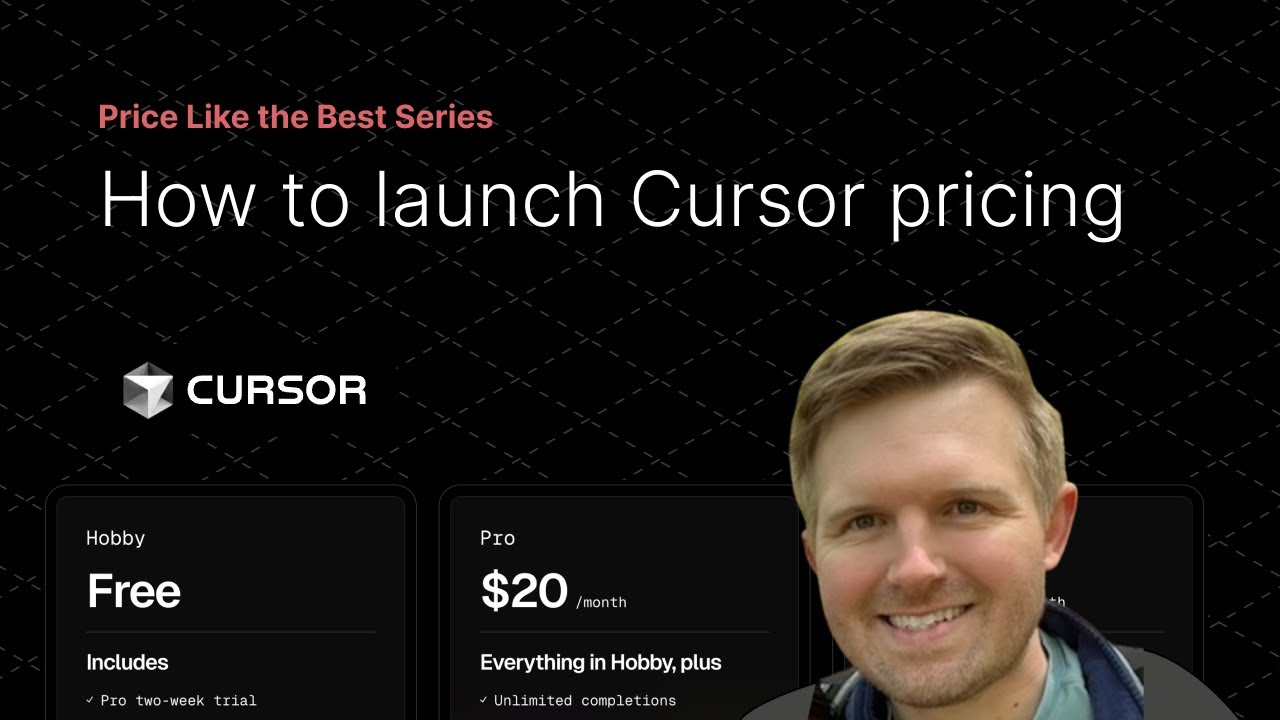
Ryan from Schematic breaks down Cursor's three-tier pricing for its AI-powered IDE. The free tier includes 2,000 completions monthly, while Pro offers unlimited completions with 500 fast requests and optional overage charges. Annual billing discounts lock in users, and power users can pay per extra request to signal high-value customers.
Chapters
Hi, I'm Ryan, a developer with Schematic, and I want to talk about Cursor and how they price. Cursor is a development environment that natively allows developers to access ChatGPT, Claude, and other LLMs so they can be more productive while coding. Cursor is a pretty standard pricing model, a free tier and then two paid tiers. On the free tier, you get access to, you know, a limited number of the AI features. At the middle tier where most, you know, individual users will start, You get full access to what the free tier has, as well as you get access to some of the more premium features and requests. And then they have a business tier, which, which includes everything in pro but has more of the organizational control and admin features that you'd expect at enterprise tier software. One of the things I really like though is that Cursor gives you the ability to buy annually and save. The savings are nice, but that also locks in your users for a longer period of time and gives them— it also gives them more time to learn to love your product before they have to think about paying for it month after month. I actually use Cursor at the pro level, and one of the things I like is that on top of the ability to get 500 fast requests a month, if I want, I'm able to enable usage-based pricing or overage pricing on top of that. So at the point that I've gone over 500 requests a month, I'm then able to pay per request to keep using the features. This is great both for me, because if I'm getting value, I want to keep getting value if I'm using over 500 a month, but also for Cursor, because it's a way to drive more revenue and identify who their power users are and then find ways to target them for upgrades or, you know, make sure they're happy and keep them locked into the product. A monetization strategy like this is really easy to set up in Schematic. So I went ahead and did that to show you what it would look like. Like Cursor has, they have a hobby level where you get 2,000 completions and 50 slow requests a month. And this is a free plan. We have a Pro level where you get unlimited completions, unlimited slow requests, just like they do, as well as the fast requests, 500 a month, and the ability to go over that. So you can keep charging if customers opt in to going over that 500 level. And then finally, they have the Business plan, right? And this is unlimited slow requests, unlimited fast requests, unlimited completions, and then those additional organizational features like SAML SSO and admin dashboards. And that's it. Uh, Cursr, despite being an extremely fast-growing company, has a really straightforward and easy-to-understand pricing. But those two key features of giving you the ability to lock in savings by paying annually, as well as letting power users go over their limits and pay for the difference, are some of the two things that really sets Cursr apart from a monetization strategy. Thanks.