
The AI Pricing Mistake Even a $50M CEO Almost Made | Marcos Rivera
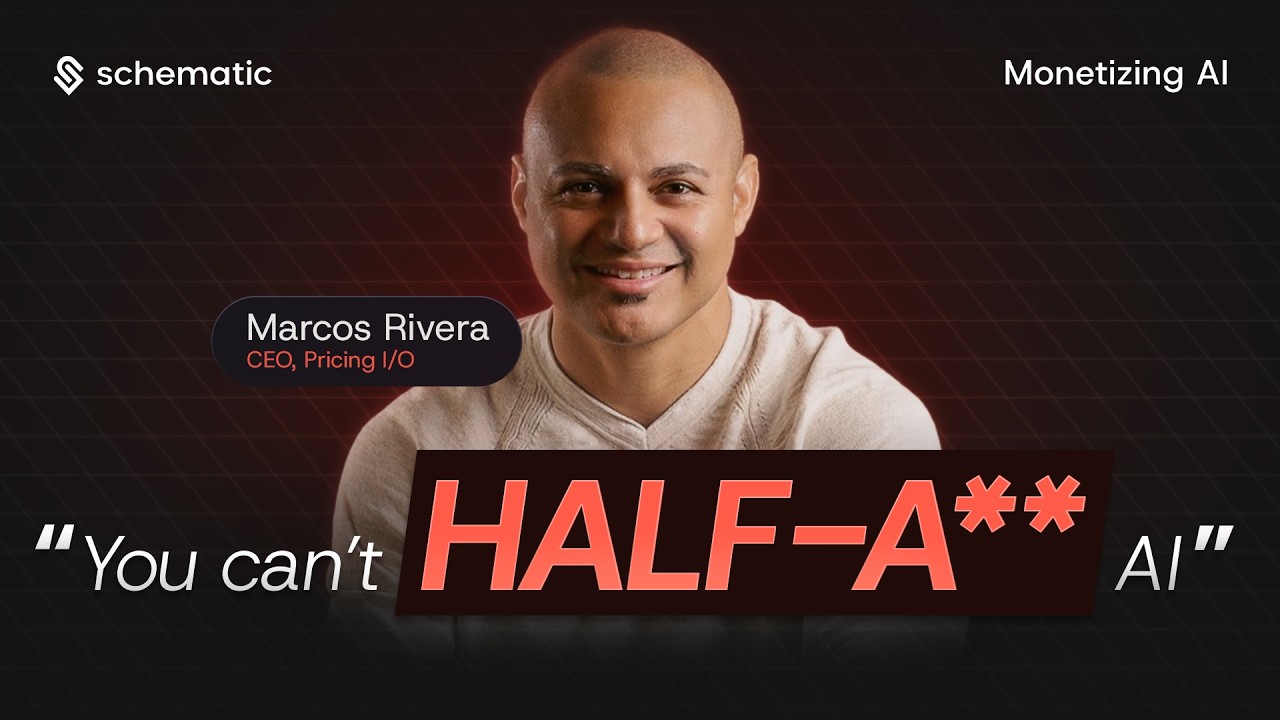
In this interview, host Fynn Glover talks with AI monetization expert Marcos Rivera about the challenges and opportunities B2B SaaS companies face when integrating AI into their products. Rivera stresses the need for a clear strategic vision that aligns AI capabilities with a company’s core value proposition, rather than chasing every possible use case. He illustrates common pricing pitfalls through a real‑world story of a $40‑50 M ARR SaaS CEO who rushed to price a new AI feature flat‑rate, mis‑aligned pricing with value, ignored usage data, and failed to consider cost dynamics and competitive pressure. The conversation then explores seat‑based versus usage‑ or credit‑based pricing, the importance of contribution margin over gross margin in AI‑heavy products, and how rapidly evolving model costs create a cyclical cost pressure. Rivera and Glover discuss the role of iteration speed versus the magnitude of product change, and how cultural factors (top‑down mandates vs bottom‑up experimentation) affect AI adoption. A major theme is data hygiene: many mid‑market firms have fragmented usage, billing, and product analytics, making it hard to tie usage to revenue and drive net‑dollar‑retention. They argue that AI and consumption models act as catalytic moments to force better telemetry, pricing transparency, and the use of limits as a lever for expansion. Finally, they consider the second‑order effects of a shift to consumption pricing—greater price transparency, the need for calculators, and the emergence of limits and credit systems—as well as the timeline for broader industry adoption.
Chapters
Markus, we, we talk a lot, so it's great to have you back on the show. Thank you for being here. I just want to jump right in. Like, I mean, in the last week I've been on the phone with, you know, at least a half dozen CEOs. They're having to kind of consider how their businesses adopt and launch AI, how, what that means for monetization, what that means for pricing. Maybe just kind of take us into kind of what you're seeing from kind of the world in terms of like how companies are building towards this AI future from a monetization perspective.
I'll tell you what, man, like there's no shortage of decisions and really critical, critical, I think strategic shifts that folks have to make out there. So if you feel like you're juggling and the moment you figure something out, shit's changing right after that and now you gotta shift again. There's a, um, uh, there's a lot of people who would feel your pain. So here's kind of what I'm seeing. A lot of folks that I'm talking to are really having a tough time articulating, clarifying how AI fits into the strategy. They're, they, they want to do it. They've, uh, and some of these folks I talked to, they responded to a survey that says, hey, I'm going to introduce AI as part of my strategy in the next 6 months. And I go, great. What are you going to do? And I was really surprised at some of the answers I got. We'll figure it out when we get there. We'll cross that bridge. I'm not sure. We'll experiment our way. Test, test, test. We don't know. And I, I'm, I'm a big fan of experimentation and testing, but I think having a vision or some clarity in terms of what you want and, and what you want to be, I think is, is gonna be, what defines, you know, some of the folks who kind of flail out there and don't really make a lot of progress and folks who do make tangible changes. Here's a, a big framework that I like to use, right? So If you're pretty clear on who you are as a company, who you serve, all those big things, right? There's a, there's these things that aren't gonna really change when it comes to, when it comes to the value you deliver today. AI comes in and unlocks a lot of stuff. All right? It allows you to do things you were not able to do 5, 10 years ago, even 2 years ago. So with that new value coming in, how does that fit and change and extend who you are, in your positioning and who you serve. And do you want to do that? Not can you do that? Do you want to do that? I think that's where I think a lot of 'em get hung up is like, oh shit, now I can go after the whole long tail of the TAM where before I couldn't do that. Do I want to do that?
Right?
And so there's this really, I guess, soul searching and inner reflection and alignment that you have to get to figure out, you know, not can we do it, Should we do it? And I think that's what's holding a lot of companies back. I don't know if you're seeing companies hesitating out there too, Fynn.
I think that's right. Like to me, when companies get to $20 million in ARR, usually, like let's, let's say that there's kind of like a standard deviation on either side of that, but it seems like that's when like there's this big question, which is like, what is product number 2? Or is product number 2 or 3? How might we go after that? Like, is the model here? Some hybrid of seat and usage, seat and credit? Do we try to cross sell this into the base or is it a new market? And it's like a, it's a new muscle to flex, especially for like a founding, like a founder who might've gotten the $20 million on this core product that had all this product market fit. And now you've got this new challenge. And so I think that's kind of often where I see like the moment again for these companies where it starts to be like, okay, Now how do we think about a multi-product world?
Yeah, a multi-product, and by the way, the, the thing about the AI element of this thing, and I'm talking about companies, B2B, some of them have, you know, mid or higher level ACVs, maybe more complex in sales and implementation, integrations, those kind of things. And they see, okay, now we have the shiny new AI thing. Some have stepped up and decided, okay, we're gonna introduce a very tangible, low-risk, light, sort of dipping the toe in the water, uh, AI feature, right? And it could be like summarizing something. Um, I'll give you a very concrete example in a minute. From there, deciding, okay, actually we don't want to do this anymore. We want to now infuse it into our core platform and just be, that's who we are. That's how we roll. And I've been noticing companies like, uh, Google and Shopify, ClickUp, there's a bunch of these that started out with this very, you know, hesitant, uh, tipping, you know, dipping their toe in the water and then moving to like, we're all in on this. And I think for those listening, um, I don't, I don't see a way to half-ass AI, like either you're in or you're not. Right. And from my perspective, you should be in, uh, cause that's kind of, this is the new way of the world and new rules of the game. And so for those that are halfway, I'm not sure, I think you need to make a call and push. I think that's going to also open up and make things clearer., but let me give you a real story of a CEO that I was talking to of a company. They're about $40 to $50 million ARR, uh, horizontal B2B SaaS productivity, you know, meetings, all that kind of stuff. And, uh, he and I were having lunch and he said to me, he goes, guess what, Marcos? I'm excited. We're finally going to release our first AI product. They've been around for years. Like they got a great core, a great market share. They're growing. And he goes, we're introducing this feature that's going to take something we do and 10x it, make it like that much faster. I said, all right, it's wonderful. Great. He goes, yeah. So what we did was we rolled it out and we tested it. And I told the sales guys, I want you to charge or ask for $5,000. I said, is that per user or for credit? Like, what are you doing here? He's like, no, no, no, Marcos, $5,000 flat for the whole year. And I was like, Okay. So you're just gonna throw it out here? Like, yeah. And so the sales guys did it and they actually sold some units and we got about an average of about $2,000, uh, people to pay for it. And I'm like, great. So what's your next move? He said, oh, I'm just gonna go out and sell it for $2,000 as an add-on to all my accounts. And I'm like, oh, okay. I'm like trying to, I'm biting my lip as I'm talking. I'm trying to eat my soup, right? So I'm like, all right, man. So, you know, what else? He goes, well, we have 4 more AI features coming behind it. So I'm gonna sell, what do you think of this, Marcos? I'm gonna sell this for $2,000 and then I'm gonna sell a bundle for all 5 for $5,000. Done. Pricing is done. And I'm like, I'm laughing at him, right? 'Cause, and he's chuckling too because he's, he knows what I do. He, but the thing is he was serious. He was trying to get a reaction outta me, but he was also serious, right? So let me give you a few of the big mistakes that he's making. I talked him off the ledge, by the way, but let me tell you the big mistakes he was making and what's going on here. First of all, Um, he's charging for value too quickly. The feature just got out. The other 4 features aren't even in beta yet. And with AI, you can deliver that value a ton faster. But, uh, but, but make no mistake, people need to feel that stuff and know and understand it before they're willing to pay for it. So whether there's a, a free trial or a way for folks to come in and test it or t— or taste it is gonna be key to help calibrate and set the value. Number 2, he was doing this, something I call willingness to sell versus willingness to pay. I don't know if you ever talked about this, right? But you know, sometimes you give sales, you know, a number, they go out and they'll sell it as long as it doesn't interfere with their main quota, what they're trying to do. They'll sell for whatever they can get. Then he takes that and takes the average, which by the way, anybody listening, the average of anything is typically wrong when you're doing pricing and then goes out there like that, right? So The number was just way off. And number 3, he wanted to go flat, one price for the whole year. Why? Because it's simple, Marcos. I said, all right, cool. How do you feel about costs? And he goes, well, no, no, it's gone down over time and it's pretty low, so I'm not too worried about it. I said, all right, but you're only testing it out. You don't have the power users yet. You don't have the, like, this stuff can creep up and bite you in the ass. Like the margins can disappear quickly. And here's the worst part of it, Fynn. The worst part of it is the competitive velocity around AI so intense that guess what you're going to do? You're going to have to adopt the newer model, the better model that's going to cost you more and is going to immediately impact your economics right away overnight. So he's like, oh, I didn't care about cost. I'm like, yeah, you don't care now, but you got to be very careful as things innovate and change how that's going to shift. So those are 3 big mistakes that he was making that I've seen others make. And what I'm, you know, just counseling and talking about AI and their strategies.
And when you walk him off the ledge, was he welcoming of that back and was he humble about it or isn't he?
No, this dude, I love it.
He's a good dude.
Not very humble, very smart, very ambitious dude. And he nodded, smiled, took my advice, but I think he's still gonna try to bundle everything in. My big thing was just to layer it into the base and and create some uplift opportunities in his higher tiers. That was it. But he was like, I'm all in, man. I'm like, yeah, all in doesn't mean reckless and throwing it all off the table, right? So I, you know, that's just real one I share 'cause it's fresh on my mind. But talking to a lot of CEOs, a lot of product leaders out there figuring out what they wanna do. You don't, by the way, have to worry about, how can I put this? The cost of getting it wrong in the software days of your end tier, you know, SaaS architecture, like that stuff cost you several sprints, several story points. It was kind of painful to develop something, get it wrong. These days, especially with vibe coding and the ability to use AI as a partner, you can recover pretty quickly and you can produce new value pretty quickly. So I think experimentation is good, confirmatory step forward experimentation. I think is good. I think you don't need to worry too much about getting it wrong as much as you used to because the price you pay is not as high.
That's an interesting point. Let's come back. One thing you said I wanted to come back to, which is, okay, one thing I very, very regularly hear is, yeah, we're not too worried about the cost because the costs are constantly declining. How do you respond to that? Do you hear a similar sentiment? And if so, how do you respond to that?
Yeah, I think you wanna be, so you don't wanna let cost completely dictate your pricing and packaging. You don't wanna let it drive, uh, your model. But at the same time, I do think that you have to, uh, pay enough attention to the costs, but it doesn't need to be the number one driver. I would never say that about just your, your traditional SaaS, right? Uh, most of your cost is fixed labor at the end of the day. The reason why I've, I've changed my tune on this one, but before I'm like, after Deepseek and after the big drop, I'm like, oh shit, yeah, this stuff's gonna keep going down. All the investments in data centers, all the investments, folks sharing chips and all that kind of stuff. Okay, we could probably see this curve come down. But then as I started watching how quick, how many freaking note-taking apps started coming out and the sort of competitive intensity in that cycle, I was like, wait a minute, folks are beginning to, quickly make up the gaps, right? So if you had a lead in a note-taking app, very, very quickly the competitor caught up with their app. And the moment OpenAI put out a new model, or Anthropic, or anybody, others were very quick to plug in. And I'm talking hours, Fynn Glover, like not weeks or days, like hours folks were plugging in and updating. And what's happening here is this innovation cycle is driving pressure. That pressure could have implications to costs because you want to jump to the newer model that has better reasoning, better capabilities than the other one. And guess what? That model is still going to cost you and going to cost you quite a bit. And so I would keep an eye on cost, but it would not be sort of the number one driver again, because you're going to have this cyclical, I think, cost phenomenon. I think it's going to come up, then it's going to come back down. It's like, oh shit, we got to renovate. And then you're going to get new models and it'll go up and it's going to come back down. And so there's something that I look at with AI that's a little different than SaaS, which is in SaaS, gross margin was a kind of big deal that I would watch very closely. In the AI world, I look at contribution margin. It's a little bit different, right? But it's sort of the incremental margin that you're getting. And it could be by different solution, by different capability, by model, because I think your economics are gonna get a little bit messier in this world versus in the pure, you know, steady eddy SaaS world.
That's super interesting. Another thing that you're talking a lot about that I've been thinking a lot about is the pace of iteration and see how you, see if you agree with this. I've started making the argument to founders and CEOs that competitiveness is a function of iteration speed.
I think competitiveness is a function of iterative or iteration speed. I partially agree with.
Yeah. Tell me where you agree and tell me where you challenge that.
Here's where I would agree with that, that I think I think com— I think speed is the main, one of the main factors in competitive intensity. When I feel like there's low competitive intensity, I think the speed to change and fill a gap or adopt is low. When I feel high in competitive intensity, I think the speed is high, right? So people catch up quick, right? And I think that's fine. But I think from my perspective that, uh, the amount of the change is actually just as important as how fast it comes out. Here's why. If you have the ability to react and introduce innovations that matches your competitors pretty quickly, I think there, there's a, there's an advantage to be built. But if you can react quickly to go ahead of the competitor, and by the way, quickly could mean, you know, you maybe are 2 weeks behind versus a week behind. I think that can add more meaningful competitive advantage. When you're able to move forward more, even if by, even again, if you're slowing down by a hair, it's okay. Speed works only when the change matters. And if the change doesn't matter, then speed, the value of speed, I think goes down. So that's where I would have a different view.
I like that. So one of the things that I've also been thinking about, so our customer base is sort of a combination of like, early stage, quickly growing seed stage AI companies, and then more mature, what I would describe as growth stage companies that are often built on like a legacy, legacy, a SaaS product, but now they're launching AI and they're trying to figure out how to like embed AI into that SaaS product. So there's kind of like an AI native camp and then sort of a SaaS native camp that is building AI on top of the SaaS. That's sort of how it started to feel to me in terms of our customer base. And one of the things that I've started asking the CEOs and the product leaders of that second group, when they think about monetizing their own AI products, product number 2, product number 3, is, well, how is the company buying AI products today? And to what extent is the company embracing AI operationally on a day-to-day basis? That's probably a really interesting thing for you guys to just pay attention to. As you think about monetizing your own AI products. And what's sort of notable is there's nothing very organized right now in those answers. You know, you see some teams that are like exceptionally ahead of the curve in terms of adoption and thoughtful around what they're building in and they're, they're starting to write about it internally and talk about it internally and building a maturation cycle., and then you've got others where it's like really concentrated and isolated in specific teams. And one team might be afraid and the other team might be totally on board and championing. React to that a little bit. You know, the extent to which it's a good idea for companies to really pay attention to how AI is impacting them organizationally, process-wise, culturally, to inform how they might monetize and launch their own AI products.
I think that last piece is where it comes for me, which is the cultural change and shift. Uh, there's, I've seen in all the companies I've been talking to, top-down approaches and bottom-up approaches. The top-down approaches, I can tell you, I can't count anymore how many freaking manifestos I've read that AI is the new and don't even work here if you don't even know AI and all that stuff, right? I've seen a lot of that, a little bit, you know, a little bit hitting over on the head on it, but it sort of, if you peel back a little bit, the point is like we need to change and adopt. Some cultures are much better at doing that than others, right? And we can get into that. That's a whole nother topic in and of itself. There's the bottom-up change. That was the top-down. The bottom-up change is someone, you know, grabbing Cursor, grabbing a tool, doing this and sort of experimenting their way in. And then folks sort of organically saying like, wow, this is actually better than what we did before. Let's do this. And then sort of start building momentum from the bottom up. I personally love a little bit of both, to be honest with you. But, uh, but those are the two major camps that I've been seeing. The, for those companies that are, that have a core, you know, uh, B2B SaaS products and they're introducing AI, lots of avenues for AIs to come its way in. I think that there is no way you're gonna make a meaningful change if leadership is not all on board, aligned, and bought in. And you ask, well, yeah, Marko, so they, they should be, right? Actually, in talking to some folks, I'll talk to the CEO, I'll talk to some of their C-suite execs as well, and not all of them are always on board. Some of them would rather wait and see. Some of them think that that's great, but not for my group just yet. I kind of, you know, we have it figured out. I've invested thousands of hours in this process. I'm not ready to rip it up just yet. Then you got the guy, you know, oh, let me just wait for the data and see what happens, right? So there's multiple appetites for risk and change. And that is where I think the leader needs to spend a lot of time in order to drive that alignment between their organizational leadership And then from there, be very strategic on where you wanna place your bets. The one thing that all boards that, when I talk to board members, the one thing that they're most worried about is disrupting and sort of, you know, cracking the golden goose egg here while still trying to get the AI off and running. They want to protect their base, protect their reputation and all of the inroads that they've made. While still introducing AI. But then if you get more aggressive, then you start to put in areas of risk in what you have today. The old-fashioned innovator's dilemma, right? Which you see. That is where I think folks are nervous about how do we balance the two? Because there's drive, there's focus, there's discipline, progress, and then there's sort of reckless abandonment and trying to figure shit out and throw stuff on the wall. I think you want to make sure that you're in the first camp, not the second.
Yeah, because I mean, if you were less conservative but not reckless, wouldn't you just be sitting here going, this is like an incredible moment of opportunity? Like we've got this cash cow, we can build all this new product far faster than we ever could. It's an opportunity to drive expansion and maybe more important than anything is like net dollar retention right now.
100%. And here's the thing, you have, as in the B2B side, the companies that already have a core product, I think have a really interesting advantage. Now you probably, in those two camps, you said AI native versus, uh, SaaS native with AI emerging. Um, which one has the advantage? I think it depends on the arena. And so when you think about who has more context right now, it's gonna be those B2B SaaS companies. They have the data, they have their, uh, context, and we can argue about how good that data actually is, but they have good information and context. The AI natives have the the sort of nimble ability to adjust and iterate very quickly, right? And so when it comes to, you know, speed of adoption and being able to get a low-friction sort of sample of value into someone's hands, I think they have a very quick advantage as well. So it's really on the two fronts. I see a great expansion advantage here and I see a very quick acquisition advantage on the other.
Makes sense.
That's why I see, yeah.
You know, it's, somebody asked me recently, like, if you could be any type of company right now in the world, what would you be like? Would you be like, you know, a multi-billion dollar enterprise? Would you be a growth stage mid-market company? Would you be a high-flying early stage startup? I don't really know what I would choose honestly, but like, I do think that that mid-market company is in a really fascinating position because they do have a customer base. Meaning they do have distribution, meaning they do have a real knowledge of the market, meaning they should have a relatively differentiated point of, point of view on how to go accelerate and expand the market, and they can potentially move faster than the large enterprises. I think that's a really interesting position to be. So if you're a CEO or CFO or a product leader at one of those companies, I just feel like it's like an exceptionally high opportunity moment.
How would I, how would I react to that? I think I would pick that $30 to $50 million high-growth stage as well. Maybe kind of similar to you, maybe slightly sooner. But the point is, is you have enough resources to invest and make decisions. You have enough customers, again, context and base reputation. Why do I care about these things is because I think that AI is, you're really in the trust game when it comes to AI, right? You're trying to introduce something that I think is scary for some people who may be, you know, excited about the opportunity, but also scared about the change. Building trust is a, is gonna be a big competitive advantage. And so for, if I'm in that $30 to $50 million stage and I'm B2B and I'm growing, I have a great foundation to build to,, you know, to lead from and build that trust. Uh, at the same time, I don't want to be $100 million, $500 million, a billion, then it gets really hard to turn that ship when it's that big and align across that, right? So that smaller $30-ish million stage, you're still nimble enough, but you're big enough and have resources. And I think that puts you in the best, uh, in the best seat to make a move.
And ironically, a lot of companies at that stage, to your earlier nod, for some reason still struggle a great deal with data around monetization. I think maybe the way I would describe it is like, I mean, every company I walk into, the data around product usage and how that maps to pricing or billing is exceptionally dirty and difficult to aggregate, difficult to pair together for like recency, frequency monetization analysis. Like Why is this the case? I know you see this problem. Like, why do companies struggle, struggle with this so much? What's the diagnosis?
Fynn Glover, don't get me started on this one, man. So I've been, no, I've been, I have cracked open and looked into the pricing and packaging model of like 500 companies in my career. This is going back to Vista and even before Vista. And no one has had perfect data. Nobody. There's always some gap somewhere, but some are dirtier than others or cleaner than others. Let me give you my perspective because one of the biggest things we did when I was back at the firm is we assessed their data quality and data hygiene, and then we implemented solutions on how to fix all that, you know, whether it's install a new CRM or, you know, what billing system or whatever it is. Here's the number one, um, the number one excuse, the number one, I guess, yeah, for lack of a better term, excuse that the CEOs were giving me on why their data was so poor., right? Because I look at it, I score it, and I'd be like, you're missing all this stuff. This doesn't even make sense. You have tons of null values here. Like, why do you have null values in your price? I don't, I don't get it. Why is it this bad? And the number one answer I always got was, Marcos, we just never invested in it. Right? That was, it's, it's a little bit anticlimactic because obviously, right? But the thing is, why then, why don't you invest in it? You know, it's important. And here's what they would say. They would say, well, Marcos, here's the thing. We charge on a flat fee. We charge by the seat. Didn't really need to track usage that much because you just paid by the seat, or it was just, you know, one flat fee for the year, or it was an enterprise deal and it was all in, and you just paid one fee per year. So there really wasn't a forcing function to drive them to track all that level of detail, that telemetry, all those things, because they would simply renew the deal and You know, hey, raise your price 4% and move on. And so because nothing was driving them there, in a SaaS company, any leader, operator, CEO listening to me right now knows there's a thousand things to do at any time. There's no shortage of a list of stuff you gotta get done. So if something's not burning and coming in front of you, then you're just not gonna pay much attention. And that's how you accumulate debt, right? Think about any debt. Money debt, technical debt, right? This is simply data debt. But the point is, is that the pain is not, is something you can defer. It's not forcing you to make the change and it slowly accumulates over time, the problem. And then you're facing this huge gap in your data. Now it's a bigger issue to solve, which takes resources, time, energy, people, which are busy doing other stuff. And therein lies the cycle, right?
Ethical diagnosis makes complete sense. Do you think that usage-based pricing and maybe sort of AI kind of represent catalytic moments for companies to care about this earlier?
100%. And, and I would even go as far as to say is that some of the usage-based pricing, um, modeling and, uh, and business strategies that we've seen— think of like the Snowflakes of the world and others— have really, I think, opened up and, and driven urgency to try to clean up and improve data, which by the way, has opened the doorway to guess what? Companies that can come in and help clean up your data, right? We've seen that. Talked to a few AI startups just 2 weeks ago that are, that's their thesis is like, we think we can clean up data with AI. And I'm like, yeah, more power to you, right? There's plenty out there. So I think it is a catalytic moment. I think it's driving the urgency. It started with usage. I don't think AI is starting it, but AI is pouring a ton of gasoline on top of it. And because you have to, have a good, just a good handle on your data and the quality, 'cause AI is still garbage in, garbage out, baby. Like nothing, nothing ever changes there. But I think from an urgency perspective, when companies are laying out their resources for the year and their bets, data cleaning and data hygiene is usually at the bottom. It doesn't make the cut. I think now it starts making the cut.
So one more question on data. Maybe I'll just tell you a story. So yesterday, but at least a dozen times in the last few months, I've been on calls where people will say to me, hey, you know, like we're tracking usage data. Like we're trying to kind of get like customer journey mapping. We're trying to kind of understand where their frustration moments, like that's kind of what we're looking for. Is that something you can help with or guys on? And one of the things that I have started to believe based on my operating experience before Schematic is a lot of the way we have come to treat product analytics and SaaS and AI is not that useful. I mean, like it's useful to understand like if a user is like, you know, frustrated clicking, like that's decent to understand from a UI perspective. But when you can't marry the usage of a product to what someone's paying and then start to analyze that behavior against a cohort of users and then against a broader, broader customer group, it's really difficult to understand ideal behavior and how that maps to value creation and leverage. And those to me feel like the key datasets that we would want. We want usage data, how that maps to pricing. That's the complete picture of the customer. If you've got the complete picture, you can operate more intelligently. That's way different than just like understanding, like, did somebody click on this button a bunch of times? And I wonder if, I wonder how you react to that because I find myself sort of trying to make that point in a number of conversations.
You know, I, I completely agree 100%. Here's what I'm seeing when, uh, when we work with a client, we ask for data, we ask for usage data, and the first thing they ask when we ask for usage data is like, oh yeah, we have analytics on what they click on and how long they've been on this page and all that stuff. And frankly, don't give a shit about any of that. I'm really more interested in integrations that they turn on. I'm interested in how many uploads that they do. I'm interested— there's a frequency and a quantity and a sequence that I'm really interested in understanding for core customer groups and personas. So that's what I really want to get because that shows me how they're getting value or on the opposite end, how they're not getting value. A couple key things I want to see, both lenses, the positive and the negative. So that way we can then apply that to monetization. How do we capture value? What do we monetize? What do we don't? What do we give away? What do we vent? What do we fence or limit? All those things come from the usage data. There's also correlations that can come out from that information of those people who use this tend to use that, people who do this tend to do that, and how that flows with the use cases you're solving. So you can create the right packages and the right experiences for those target audiences. That sounds like a bunch of gobbledygook what I just said, but the point is if you don't really see usage with a purpose, usage intention, I like to tie a sequence of usage from start to end of them trying to achieve something. It's a little bit harder lens, but it's much more valuable. And so I think that you're right. I think sometimes usage analytics, yep, they click this button. A bunch of times or they click this button and, or, or never click that one to me is, is very surface level and doesn't lead to real insight and impact.
It's amazing too. I mean, not to like, um, I don't wanna denigrate any platforms, but like you'll walk into, you know, mid-market SaaS companies and they'll be using like these big expensive CSM or CRM platforms and, you know, the CSMs operating in these tools, like have only one side of the picture. Like they might have some product analytics like pushed in from, you know, their data warehouse or like, you know, a tool that does product analytics, but they might be missing the billing state. Like finance might've said, we're not, we're not willing to pipe in the billing state to this, to this tool to marry it with usage. And so if you're a CSM, you're flying blind and I'm sitting there asking myself, Well, how does the business and the board expect the CSM team to go drive net dollar expansion if they've got this incomplete picture? They're going to rely on like a million-dollar data team and growth team to come and just tell them the answers every day. Like, is that really the way we're going to operate here?
Seems like a slow and expensive way to go if you ask me, right? I think that, you know, the not having the complete picture is, you is the norm right now in the way they're operating, right? Whether they have surface analytics, whether they have nothing, whether they use gut judgment, which I think can be very dangerous and not scalable. From my perspective, there's, how can I put this? There's a very strong inertia that you're fighting when you're doing this, right? And typically speaking, sales inertia, product inertia, marketing inertia. And so the ability to open things up and get that additional data insight to the CSM to maybe drive a more focused and effective way to increase NRR, increase activity, the right activities for the right customers, I think is going to be pretty challenging without, you know, some new tool or some change in how they're organized. I think there's natural barriers is what I'm saying to that CSM getting what they need.
Yeah. And maybe the reason I'm harping on it is 'cause it's just kind of surprising. Like when you live in a world where like you can use ChatGPT and it's like the most incredible technology ever, and then you turn around and like you can't figure out like what the customer used and how that kind of maps to what they're paying and how that might inform that. You kind of said that's, that shouldn't be a solved problem. This should be easier.
I think it's a $100 million problem we need solved if you ask me, right? There's a, again, I think that there's the natural barriers for those that can figure out how to work around those natural barriers. Of the silos of data, of what each group is using the data for and driving towards, what data they find valuable. Those are going to be, I think, some of the bigger hurdles. In my opinion though, I don't think it's impossible. Like I think there is a way to get that right data and tie those connections between what a customer's doing in the product, even more so now with AI coming in and how they're paying for it, and then using that as the insight to drive NRR. Like Cursr, I think has like a 250% NRR or something wacky like that. Last time I checked, it's probably higher now. I think they've, they're very, very clear on how people use their software and how that usage ties to how people pay.
And it creates expansion opportunity. That's your point. Back to usage-based pricing for a second. The CEO and founder of Stripe, Patrick Collison, recently went on Twitter and he said, Stripe Billing's platform is growing really fast, um, because we're in this major shift from seat-based pricing to consumption models. Um, and he then asks, what are the second-order effects of the shift from seat to usage? Uh, and, and I, I have my own thoughts. I'm, I'm curious what you would describe as the second-order effects.
I mean, first of all, I think the shift to seat pay, from seat to consumption has been going on for years. Yeah. It's just hasn't taken off as much as people thought it would. And with—
Do you feel like it is taking off now? Like it is a zeitgeist moment? How does it feel to you? Where do you feel like we are?
I'm gonna go against the grain here and say not quite yet, but I think it's coming. And, and, and here's why. I think that going back to our earlier conversation about infrastructure, silos, things like that, When I talk to companies about shifting to a consumption or usage-based model, the first thing they do is they say, shit, Marcos, that's a lot of work. Is that even gonna be worth it? Right? Because, and, and I'm talking companies that are a little more, you know, mature in the infrastructure and where they're at today. So the change of shifting from a seat-based, simple as a pimple model to a, a consumption model, it, there's a, there's a big gap there. I, no one knows that gap better than you. I know this, right?
Also never heard simple as a pimple before, and I like that.
The big thing here is that I think Patrick's right. I think that there's a shift happening. I, I, where I, what I would temper and maybe, you know, have a slightly more modest view is that the shift's already going on. I think that the, the ability to charge AI and, you know, you got all these models around credit-based systems and you got all these different usage-based, some even trying to do an outcome-based model per chargeback or per transaction or per personalized email or whatever that is. And I think that is driving up some usage base, but I think this is the, only the tip of the iceberg of that shift, the precipice. And I think there's gonna be a very big shift, I think in about a year or two from now. Why a year or two from now is because I think that's the natural cycle where I think some of these investments in cleaning up some of their old architecture, implementing new systems, all those key things usually takes around that time for folks to shift them and put 'em in, lift and shift, if you know what I mean. And I think once that starts getting in place, the adoption curve will start to go up. So it's usually not as linear as what folks are thinking. I think it comes up and then it skyrockets, you know, just like your standard adoption curve.
I agree with you. What do you think will be— so let's say that happens a year from now, it really starts to shift. It feels like a real inflection as opposed to something that's sort of been maybe kind of a little bit piecemeal. What are the second-order implications for operators?
I'll give you one right now. The first one that pops in my head is transparency on pricing, right? This is a topic that I get quite a bit. Should I publish my pricing?, you know, should we, should we give like a pricing calculator on the website, all those key things. Let me, let me give you my, my, my direct point of view on price transparency and publishing. So I think people don't like to feel like they're getting suckered and paying a higher price than they should. And I think people don't like talking to salespeople and feeling like they're getting sold. People like to understand, here's what I get. Here's what I pay and here's what this means. Now, I've, in the past, I've come out with, you ever heard of my landscaper versus my landscaper versus a lawnmower analogy, right? So the lawnmower, the outcome is very, very clear. The steps, everything very clear basis for comparison. You want price transparency with the lawnmower, but someone doing a landscaping project that can have so many different ways to customize your property, to change things, to add, all the elements that are unique to you, oftentimes it's harder to do transparency because of all the different context and changes that you need. So if you're a lawnmower product, then be transparent and don't hide anything. But if you're a landscaping type product, then you want to add, you want to be transparent, but the right level of transparent. And the way I see the right level of transparent is here's what drives our price. And, you know, here's where things are starting, you know, from price perspective. There's lots of ways to show at least give people a sense for what they would spend. Okay, so why do I say that? Because in the world of AI, in the world of driving more usage-based consumption, people need to understand what they're gonna pay and they're gonna, and have a sense for what that looks like. Consumption-based models naturally have less predictability factor than say a flat fee seat-based model. So you have to make up for that gap. How do you do that? You drive, Those calculators are great. I'll give you one example is, uh, Clay.
Okay.
Clay AI. Good tool. I use it like really slick. They have a credit-based model, 12,000 credits free, 24,000 credits, et cetera, et cetera. So when you click on the credit, there's a little link there. It takes you to the bottom and it shows you here's what a credit means. Enrich a contact, enrich this, enrich that, et cetera. And so even then I'm like, well, I don't know how many credits I'm going to use. And it says, don't know? Click here, clicks there, takes me down to the bottom. And what they show me is they ask me very simple, uh, human plain English questions. How many contacts you're going to reach out to? How many companies you reach out to? And then it has a little dropdown that says, what do you want to change? The name? You want the email? You want the telephone? Like, what do you want to enrich? And you hit click, and you kick the bottom, and it tells you exactly how many credits you need.
And just to cut you off for a second, I think that's like an incredibly interesting and important example because all the companies that we are kind of helping with credits, for example, they really don't know how to communicate to the end user what the credit is worth, meaning how fast they will burn down. And the great irony there is they wanted to go credits because that would be more predictable than traditional pay-as-you-go usage., but it was, you know, 'cause it's pay up front, right? But it wasn't actually more predictable 'cause the user didn't have a clue the speed at which they would burn down. And so I think you're, you're, you're really right to call that this example as maybe kind of a, a gold standard for people right now.
Yeah, they, they really put a lot of effort. Go to Clay, read it. They, they've really laid out exactly, again, plain English, what does this mean? Contact, what I'm changing. And that's, that's the big key there. But the second order effect is that transparency. Piece as well. Third order, I'll throw another effect at you, which is I think that wave of investment in data, in telemetry, in billing is gonna get a really nice push from all the, of this AI adoption. 'Cause it'll just, it's just self-serving right at the end of the day. And from my perspective, most companies don't make the change unless the pain is obvious or the benefit is obvious., right? And in those cases, when I see the usage base climbing, that's going to be a major shift, which then self-perpetuates. And I think a percentage of companies that are doing consumption usage base, I think will double in the next 2 years.
Yeah, I 100% agree with you. One thing that we started to see more, like, I remember 2 and a half years ago, this is before I founded Schematic, but I was starting to do discovery for the company. And I would ask people like, you know, to what extent do you care to enforce limits? You, to what extent do you care to enforce usage limits? And 2 and a half years ago, it was like, we never enforce anything. Like we're just trying to drive adoption. And now I think that like more and more I'm seeing people get limits are these really cool leverage points where, you know, value's been created and it creates moments of extending more value for free or capitalizing on the value via a product-led post-sale expansion, or hey, it's time to have a sales conversation, like you're way over the limit, or like I just have to like have a hard limit here to prevent abuse. Um, like limits have become this like really interesting dynamic to me over the last 2 and a half years, whereas 2 and a half years ago, like it really didn't feel like anybody cared.
I, I completely agree. I love limits. I think limits are some of the most underutilized web tools., in a pricing and packaging model today. I think it signals how much value, that you, you can get. It also helps you understand what customers are finding valuable and where you want to, either invest more or push. Some folks do it really wrong though. They either set the limit way too low before they're able to get some value, kind of just more frustrates folks and maybe gets this, nickel and diming sensation. And then on the other end, they'll set the limit too high where it doesn't even matter. They never get even close to it and it's just there and it's just a more of a, of a noise and a distraction than anything else. So when I think about limits, I think it's a, a fantastic weapon. I think you have to be very selective on where you put the limits and how you set that. One of the quickest things is understanding the sort of cycle in which they're using, you know, said, you know, quantity or limit, and then being able to set the limits such that they're able to build the habit., but not extend beyond it, right? So most humans take 2 months to build a habit. And so if you think about from a time basis, how much usage can get them there to build a habit? That's where you want to, and that plus maybe 10% more just to give a little bit of buffer. That's how you want to try to think about limits.
Agreed. Good point. I know we're coming up to time. Thank you so much for doing this. It's really always fun to talk to you about all this stuff.
Yeah, no, I could talk all day about this. It's, and then listen, you come at me in about 5 or 6 weeks, I'll probably have some different opinions. Based on all the things that are coming. But, but no, but I, I really love, love chopping it up and, and jamming in these things. I think these are areas and questions that are on the minds of all the top, you know, leaders and operators that are out there in SaaS. And I hope they can pick up a few pointers from, from this convo.
Cool. Let's do it again soon. Thank you again, Marcus.
Thanks for having me, man.
More from Fynn

Schematic at Operators Guild Demo Day 2026: How to bill for AI credits without a surprise bill







Should you move to usage-based pricing because AI is compressing your margins?

Why raising prices every year backfires (a pricing leader on the Mastercard quota model)

