
The Future of Hospitality Communication
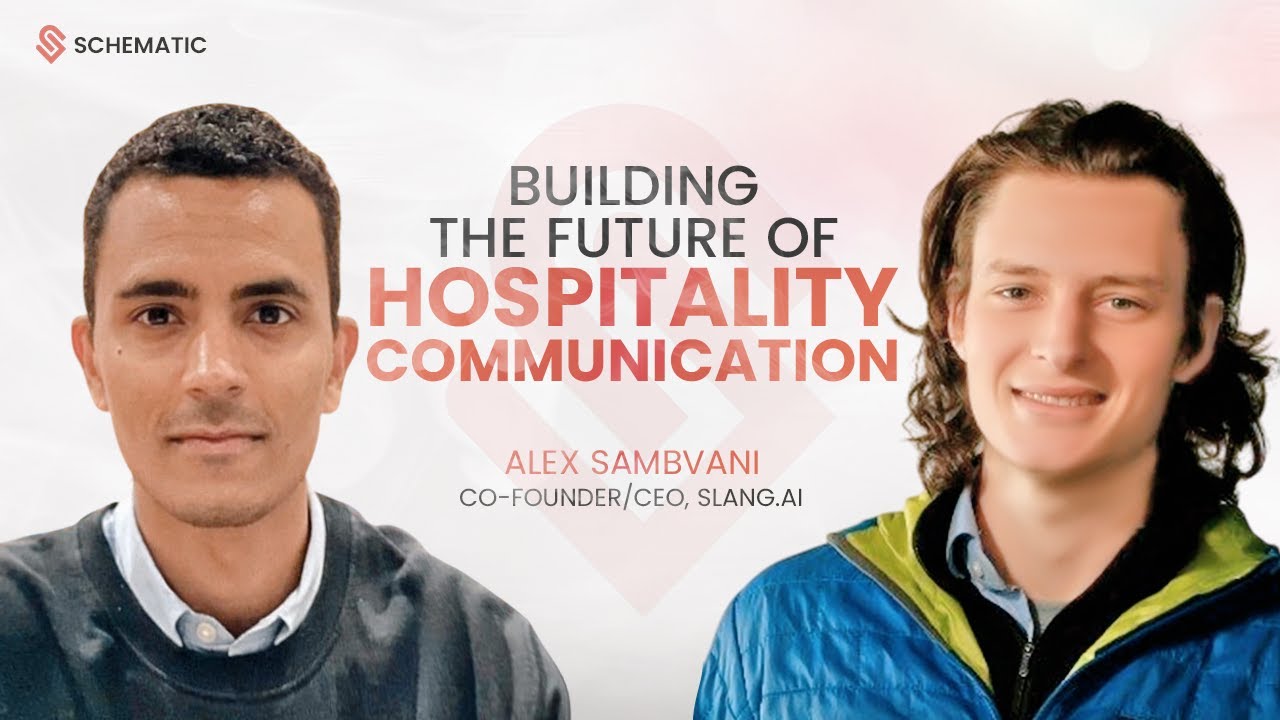
In this podcast‑style interview, host Fynn Glover talks with Alex, co‑founder and CEO of Slang, about his unconventional career path—from mechanical engineering and a stint in investment banking to a data‑science role at Spotify—and how those experiences shaped his approach to building a voice‑AI platform for restaurants. Alex explains how early exposure to entrepreneurship through his father, a retail importer, sparked his desire to start a company. He describes the technical and product lessons learned at Spotify, especially the importance of simplicity and the power of visual cues in user behavior. The conversation then shifts to the genesis of Slang: a systematic search for a high‑impact voice‑AI use case, leading to a focus on phone‑based reservation management for full‑service restaurants. Alex outlines the company’s vision of AI becoming the first touchpoint across phone, SMS, Instagram DMs, and email, delivering hyper‑personalized guest experiences. He walks through Slang’s pricing evolution—from an initial $99/month pilot to a $3.99 per‑location model—highlighting the challenges of pricing SaaS for the restaurant industry and the need for transparent, value‑based tiers. Operationally, Alex notes that product‑marketing owns pricing strategy while product, customer success, and leadership coordinate migrations and tier evolution. Finally, Alex reflects on his personal inflection point—leaving Spotify to launch Slang—and shares contact information for the company.
Chapters
Alex, so good to have you on the podcast. Thank you for joining us. You've had this really incredible career as a founder building AI. If we go way back, you studied mechanical engineering in college and then out of college, I believe you went into banking as a PE analyst with Credit Suisse. Several years later, I think you went back to school, got your MBA, moved into working in tech for Spotify initially as a data scientist. And then in 2019, you founded Slang. Which is helping thousands of restaurant operators use voice AI to handle phone calls more effectively than ever before. That's what I can tell from LinkedIn and talking to people on your team, but tell us your, your journey in your own words. How did we get to now?
For sure. Thanks for having me today, Fynn. Definitely excited to have this chat with you. So yeah, my, my career has been meandering, but it's all fallen under the umbrella of really getting to being a tech founder. I've wanted to be a tech founder from a young age. I've I don't know exactly where I got that idea, although one kernel that might have influenced me is that my dad is an entrepreneur, not in tech though. And so I grew up with this idea that founding your own thing is like the cool thing to do. I didn't grow up around a lot of corporate examples of folks, so I always just thought that I would start my own company and it was never even a question in my mind. In high school, I started to get interested in tech, so learned how to code in high school, got really into it, and then as you mentioned, went, went on and studied mechanical engineering in undergrad and then continued to take CS classes as well and also added some applied math and physics in there. I was just really interested in the technical side of things, but I also had interest in business. And so as, you know, having studied engineering, most of my undergrad was all math and science-y type classes. I didn't get to take a lot of other types of classes, and I was really dying to get to know more about the business side of things. And that's what led me to start my career in finance. So I did the banking thing for 3 years, moved, moved to New York and worked on Wall Street at Credit Suisse. Then from there, went and got my MBA. And, um, it was after I got my MBA, I was ready to go back to the tech side, get my hands dirty with, with more like technical building. And I also wanted to see what it was like inside of a quickly scaling company. And I was very fortunate to get to, to work at Spotify when it was in a, in a hypergrowth phase. I think there were around 2,000 employees when I joined and close to 6,000 when I left. Um, I got to see the company scale really quickly, go public. I got to learn all about AI and how to build personalized products leveraging AI at scale., and that's where, uh, I learned, uh, a lot about voice AI as well. And, and where in conjunction with my co-founder, we came up with the idea for Slang, and the rest is history.
It's an awesome story. You know, go take us a little bit back into early life with your dad. What type of business has he founded, and what's your relationship with him like in the context of you starting to realize that being an entrepreneur is something you want to pursue?
Yeah, um, it's funny because so, so in terms of what my dad does, so he works in the retail industry. So my dad's from Italy and he moved to the US when he was in his early— he's moved to LA, which is where I was born and where I lived for the first part of my life. He basically, he, he did like importing of high fashion goods from Italy, which he's from Milan, you know, very center of much a center of gravity for fashion. And so he had his own business in LA, he had his own boutique in Beverly Hills, and just would import a bunch of high fashion pieces and he also got into distribution and that sort of stuff. His business never got that large. So, you know, he was, I wouldn't say he's the most successful entrepreneur in the world, but a lot of his friends were, a lot of his friends were immigrants and entrepreneurs as well. And some of his, his friends were, did all sorts of different things, largely in the retail business, largely were retail entrepreneurs, but some did other things. And I just got exposure to his group of friends as a, as a young kid and some were really successful and I got to see that. I got to see some of them kind of become more successful over time and I just got obsessed with this idea of being able to control your own destiny and almost like it being, you know, there's no limit to what you can create and what you can achieve if you're an entrepreneur. And I got really excited about that. What I do today is very different from what my dad did or does as an entrepreneur and he's close to retiring now, but He really doesn't understand what, like, our business and, but he, but a lot of, you know, a lot of the entrepreneurial spirit resonates with him and he definitely, we definitely connect on that.
Where did your interest in the technical side of things come from? The mechanical engineering, the math, the physics, where did all that originate from?
Yeah, that actually started in high school. My high school had an engineering club where we would compete in this program called FIRST Robotics, which some folks might have heard of. It's a global organization with different competitions, and we would build a robot every year and compete with other high schools and took it very— we treat it like a sports team. Like, we would travel. At one point, like, we had cheerleaders come to one of our events, which was like actually really awkward. And yeah, so that's really where I got interested in, in tech. I got to do some really cool stuff at a young age.
That would have been roughly like late 2000s or early 2010s, right?
Yeah, so I graduated high school in 2008, and so This was from, you know, between 2004 and 2008. And through this robotics program, I got, you know, we got mentors who were like engineers that would mentor us and help us learn what we needed to learn, very much like experiential learning. So not only did I get to learn a lot and get my hands dirty building robots, but I also got to meet actual engineers who were practicing and learn more about their jobs. And that was awesome. So it just opened my eyes up to the whole engineering world, which I didn't know anything about. And that's really what pushed me over the edge and what convinced me that I wanted to study engineering in school.
As you got into school and got deeper and deeper into engineering, do you remember how aware you were at the time of sort of the times you were living in, just how interesting they were, how quickly moving they were? Were you cognizant of what was happening outside of school in the world of software and startups and venture capital, or would that awareness come later?
Well, I went to Stanford for undergrad, so there was definitely, I mean, everyone was always talking about tech and startups and all of that. So I was very plugged into what was happening in tech and venture capital and all of those things just because we would talk about it a lot. Yeah. I would say, interestingly enough, one thing that happened while I was in school was the financial crisis of 2008. I actually felt pretty disconnected from that because everyone was so focused on tech and innovation. The financial crisis stuff, which was obviously a huge crisis, I feel like didn't trickle down that much into, into the zeitgeist of the student body.
Yeah, super interesting. So, so take us to Credit Suisse. This is certainly kind of a little bit of a departure from tech to go pursue a real education in business and banking. What do you take away from that experience? What are the most important takeaways?
Yeah, I mean, it was an amazing learning experience and worked with a lot of really smart people. I would say my takeaways from that experience are very similar to what I would imagine the takeaways being from, you know, other roles in financial services or professional services like consulting. I learned how to be a professional, how to like present materials, how to create decks, how to do spreadsheets, create models. That those skills definitely carry over to what I do today. I mean, I have to create docs, decks, present to investors, like that sort of stuff is, is important to learn. You gotta learn that somewhere. I think I learned a lot about just different business models and how, and different industries. I got to work with companies in healthcare, industrials, real estate. Just got exposure to a lot of different industries and business models, which was definitely helpful and something that I use every day. And then I'd say another thing that got me interested in data in particular is inside the investment bank, there's a lot of data that we use to do our jobs, and I just felt that the way that data was maintained and utilized and all of that was really suboptimal. Um, And not because folks weren't smart or anything like that. It's just like, that's just the way that the bank operated. And I think a lot of companies operate with like data inefficiencies. And that got me just really interested in big data and data science and kind of laid the foundation for me becoming a data scientist a few years after that.
Because when you went to Spotify, that's the role that you had, right? Yes. Yeah, exactly. What do you take away from the Spotify experience?
Spotify was such a cool company to work for. I got, as I mentioned, I got to see it during its hypergrowth phase. I'd say the number one thing that I learned at Spotify is just what it looks like to do machine learning or AI at scale. Like, what does it actually take to deliver a product that leverages AI at the scale of like 100 million plus users. I learned a lot through that. It was— what was really cool about it is that the solutions that are really scalable and work again at a big scale aren't necessarily like the most complex ones. It's often like simpler, more elegant solutions that, that work at scale. And so I had this idea that in order to make a product work at a large scale or serve a bunch of users, it had to be like really complex under the hood. And what I found is actually the opposite is true. In order for it to work well, it needs to be as simple as possible conceptually and operationally.
Do you remember an example? Can you make that really visual for us?
Yeah, um, I think one example of that is like, is podcast recommendations. So I worked on podcast recommendations right when Spotify was getting into podcasts for the first time, and we tried all these different complex machine learning algorithms to try and suggest what new podcasts you should listen to. And our goal, because Spotify was new in podcasts, was just to try and get as many people to stream podcasts on Spotify, just to start building that habit. And what we realized was that, at least in the early days, I'm sure this has changed dramatically now, I'm sure, but in the early days, what we found was that, you know, showing you podcasts that you've already listened to, just like surfacing those podcasts, back to you on the homepage was like the most effective way to get you to stream podcasts again instead of trying to recommend new podcasts. So as much as we could build all these complicated machine learning algorithms and recommendations and all of that, like ultimately what was most powerful was not even a machine learning algorithm at that time. It was just like showing you what you've already listened to, which to me was kind of frustrating because I was like, there's gotta be some like really like tech forward way we can solve this problem. But no, at that time, the best thing was just surfacing what you've already listened to. Now it's evolved a ton since then, but that's just, just one example of what I'm talking about.
Did you take away from that that there's just some— bringing something top of mind visually is just really powerful psychologically to incentivize that behavior? Like, it's just a simple visual reminder and then you've incented the behavior correctly? Or did you have a different takeaway?
That's definitely one for sure. And one takeaway is, you know, if you just put whatever you put above the fold, whether it's a website or an app, is going to be what draws people's attention. And so you need to be extremely thoughtful about how you're optimizing that real estate. But the second was really about— the second takeaway was that in order to solve the problem or achieve the goal that we had in mind at the time, which was just to get people to stream more podcasts. It actually wasn't a machine learning algorithm that did it, even though we were like trying, like trying to use machine learning in every way possible. In that particular instance, a rules-based algorithm performed better. And that's what we ran with for, you know, for a period of time until like different machine learning experiments started to outperform the more simple algorithm. But to me, that was like, It was really cool to learn that and unexpected that just because— I think the broader point is just because really sophisticated technology exists, really what you need to be thinking about is what do you need to do to solve the problem? And you don't need to force fit complicated technology in all cases to solve this goal.
This may be a good segue into Slang and sort of the problem that you identified and how you thought about building a solution to the problem. But before we go there, can you take us into your psychology sort of in the kind of in the Spotify experience? Are you sitting there soaking up as much learning as possible while also daydreaming about the company that you might solve or searching for inefficiencies, paying attention to problems? Like what's going on for you in this chapter before you go and launch your own company?
Yeah, I would say it took about 2 years at Spotify for me to start to feel ready for my next thing. Spotify was an amazing company, is an amazing company, and I spent 2 years in a data scientist role. And after about 2 years, I started to feel like my learning was starting to plateau a little bit, which I think 2 years is kind of like the common benchmark that a lot of people have in mind for like when they want to move on to another role. So after a little over 2 years, I had crossroads. I could either try and do something different at Spotify, try and do another— join another team or learn a new focus area or something like that. Or I could start my own thing, which had been my goal for a very long time. And I opted to start my own thing. And a large part of that was my co-founder Gabe, who was a teammate of mine at Spotify. So we met there, we were on the same team, and we started talking about ideas in voice AI and just got so excited. We were just like, this is going to be a huge opportunity. This is going to be a transformational technology, and we just wanted to go build with it. And so we got a lot of conviction and ultimately left Spotify together in June 2019.
Talk to us about how you arrived at the conviction and talk about— you must have explored a variety of problem spaces for voice. You must have explored a variety of potential solutions, but talk about how you eventually arrived at conviction.
Yeah, so we, I think the two of us really hit it off and we were convinced that we were going to start something together. We just didn't know exactly what. So for, for a couple of months, we were kicking around ideas and we had a list of like 60 different business ideas that we were considering. Ultimately, we kept going back to this obsession around voice AI and how transformational the technology was going to be. So we, we felt very strongly that there was going to be a big opportunity bringing voice AI to smaller businesses. So we thought about the way that technology is typically adopted by businesses. It usually starts with like the hugest, the largest enterprises, huge enterprises, and trickles down once it's democratized and, you know, cheap enough for smaller businesses to deploy. So we thought about websites. We thought about mobile apps. Those technologies started with just the largest business being able to use those technologies. And then we had platforms like Squarespace and Shopify, now Webflow, like so many different tools that make it easier for smaller businesses to use the technology. And we thought that same thing would have to unfold in voice AI. So we got excited about that, but then we were really struggling about, struggling with the, there were like 3 dimensions that we were struggling with. One was use case, the second was industry, and then the third was medium. So there were very various different ways we could explore voice AI technology. And at the time when we started the business, there was still a lot of momentum behind voice speakers like Amazon Alexa, Google Home. Um, and we were just kind of like just starting to reach a point of like descent in, in terms of business interest in those technologies because like, you know, we don't really engage with like companies via our Alexas. We use Alexa to check the weather and do those simple— and play music, right? But at that time, there was a lot of buzz still around those technologies. And we were like, well, is it— is there a chance that these hardware devices could become a channel for businesses to engage with their customers on? So we were thinking about that. And then we also started thinking about the phone. So the phone is a huge channel for business. And large enterprises have been using AI in big call centers to streamline that, the, that traffic for a while, decades. And traditionally those experiences are very frustrating. Like if you call a bank or an airline, you know, you get that bot that doesn't forward you to a human when you ask it to, or doesn't understand you. So that's existed for a while. So then we also thought as a separate path, maybe there's going to be another wave of that technology that's like way better, way more useful, but also accessible. To smaller businesses. And so we got excited about that second path, and the way that we got conviction around that was just by talking to potential customers, which I think is always the best way. So we spoke to over 100 small business owners in different industries and found time and time again their business owners were really frustrated with their, with the solutions that exist specifically for the phone. Phone solutions don't connect to the other software that they're using. There's no self-serve automation. I mean, we serve restaurants today in our business at Slang, and 50% of restaurants still use landlines. If you think about that for a second, you know, restaurants have been— half of these restaurants are answering the phone the same exact way they did a century ago, right? And so there's been just like no change in the way that these communication are being handled. And we just felt like, you know, we did some prototyping with different types of businesses and we just got so much conviction. We were like, one day every business is going to be using AI to be the first touchpoint on their phone and probably be the first touchpoint on other channels as well. It just makes sense. But really the conviction came from just like actual conversations with business owners that validated some of our hypotheses.
So if I play it back, I mean, I think what's really interesting here is 2 things are really driving you at that time. One is, I'm really fascinated by this specific type of technology. I'm just really, really obsessed with it. Two, a person that I really respect and who balances my skill set is also equally obsessed with it. And then from there, it's the pursuit of what's the medium, what's the application, what's the industry, and where you sounds like relatively quickly land is small business restaurants. With phone calls, phone calls being the medium, I assume, or is that the application? Okay, correct.
Yep. And then use case, the use case that we decided to focus on specifically in restaurants, because even, even if you zoom in on one industry, restaurants, there's different types of restaurants. There's fast food restaurants like the McDonald's of the world. There's fast casual restaurants where you, you know, like where you might order and then sit down, um, in like an, like a more, you know, more of a sit-down environment, like a Chipotle or whatever. And then there's full-serve restaurants. And so, and these restaurants have different needs, right? And so what we decided to focus on is really the reservations management use case, which is full-serve restaurants. So restaurants where you can make a reservation. So that's, that's where we decided to, to focus, but it wasn't, you know, it wasn't an immediate decision. Experimented with lots of different types of businesses and, you know, ultimately what's guided us is we've always wanted to focus on use cases where we know that the end user experience can be pleasing, can be ideally delightful. Now, that's a decision because you can take on use cases where the AI is not going to be successful 100% of the time, but you still can create value for the business. But it's just, it's not the best end user experience because it might fail with, you know, 50% of the time or whatever. One example of that in restaurants right now is voice ordering. So there's a lot of companies attacking the voice ordering use case, and it is a very valuable use case to try and automate, but it's— no one has quite yet nailed it. Like, it, it's still very difficult to elegantly handle an AI order over voice from end to end with like near 100% reliability. It's just we're not there yet. And so we've stayed out of that for that reason. And part of why we do that is because we come from Spotify, we come from this consumer tech background, and we always, we like to think about what is the human experience of engaging with this technology and how do we make that amazing. And we also learned through our work at Spotify that end users lose trust with voice systems very quickly. If the system misunderstands you or, you know, just if you have a bad experience with it, you're very unlikely to try it again. So, but on the flip side, if, if the experience is positive and consistently positive, then consumers are highly likely to create a habit out of using voice because voice is so frictionless. And so if you find a workflow that you can successfully do with voice, you're very likely to continue to do that again. And so we took that in mind and we strategically decided to focus on use cases that we felt we can do really well with today's AI capabilities, with the understanding that we can expand our use case, use cases over time as AI becomes more performant and sophisticated.
You know, I guess the other thing that strikes me as really interesting is like entrepreneurs come at problems in so many different ways and opportunities in so many different ways. A lot of people want to go build vertical SaaS. I want to build vertical SaaS because, you know, it's total lock-in. I can really like dominate an industry. I can like get really excellent at serving this very specific customer across a very specific pain point. But you really came at it as like, I want to find a way to make this specific type of technology commercializable. Like it's the technology driving a lot of our effort and energy here.
For sure. Which is like the opposite way that you're supposed to start a company. We were definitely technology in search of a a problem and then narrowed in on the problem over time.
And found it via talking to users and eventually it seems like you continued to chisel it down, right? Like you chiseled it down to the point where like your TAM was just extremely clear.
Yeah, we have. And that's, that's a constant process. We're still narrowing our ICP, like, you know, even starting January 1st, we're going to make it even narrower. So like it's a, it's an ongoing exercise for us.
When did you start to believe rationally in the business's potential? Not irrationally, rationally.
I mean, I think the turning point was when we started having, when we, when we had real retention data and we started having customers proactively come to us asking to buy more. So we sell to restaurants. Many restaurant owners have more than one location and they're expanding, so they'll open new locations over time, right? And we started to see the behavior of these customers coming to us when they open new locations and saying, we need Slang, like, we're about to open this location, we want to make sure Slang is installed before this location opens. And to me, that was a very clear signal that we're doing something right. Right. And so, yeah. And so that was, that was the biggest signal. It's like retention and net revenue retention data, I think, is, is, is, is, is a good source of truth for your, your product market fit.
You're 5 years in, 5 years from now, what do you think, what do you hope the business has accomplished for customers?
So we are envisioning a platform that helps the hospitality industry deliver the best communications possible for guests. Right now, if you think about a hospitality experience, like booking a reservation for a restaurant, restaurants are getting these requests from multiple channels. There's obviously online booking like OpenTable, but restaurants get requests over the phone. They also get requests via email. Increasingly, they're getting requests via text message and social media as well. A lot of people are DMing restaurants and asking questions or trying to book reservations. And so it's just become untenable for restaurants to manage all of these communications simultaneously. And we believe that in the future, AI is going to be the first touchpoint on all of these channels and deliver amazing guest experiences on those channels. And if needed, forward or escalate to a human. But we, we believe that in the future, AI is actually going to be the preferred touchpoint. For guests. Like, the, the experience is going to be so good, and the AI is going to know you so much better than a human does, that folks are going to prefer to, to start the conversation with AI as opposed to with a human. So if we're able to, to achieve that in the next 5 years, actually shift consumer preferences because our conversations are so good, I think we'll, we'll have done a good job. That's what we think about.
So I find it to be a totally believable, incredible vision. And I'll just share a personal anecdote as to why. Like, you know, I have LLMs that I use on a daily basis to do my work, as I imagine most of us do. But of course they remember context. And so exactly, they are who I turn to for collaboration even before I'm turning to, you know, for example, like a co-founder. Because like for my individual work that I must do, it has all the context. And so I think it maybe is a an example of how I think it's very likely that you'll be successful there. What do you think the product must do to achieve the vision that it maybe doesn't do today or that you need to build into?
Yeah. So first of all, I love that and totally align there on the context piece. So we can preserve all the context of previous conversations. And not only that, we can also get your context of the previous transactions or interactions with the company, with the restaurant, for example, through integrations, right? And so in an instant, the AI can look at all of your previous reservations, for example, and know, do you prefer to have dinner at 6 PM or do you prefer to have dinner at 8 PM? Like, you could probably learn those patterns and not even— instead of giving you, um, 10 options of times, the AI can just give you one because it knows that you like to have dinner at 8. So that's just one tiny example, but there's probably millions of interactions that could be personalized more, personalized at a deeper level than a human ever could. So we're excited about that. To answer your question in terms of what the product needs to do that it's not doing today, I'd say one area is channel expansions. We started on voice over the phone, and that is our primary channel today, but we are expanding into new ones. So We have, we now have a social media concierge that can plug into Instagram and have direct conversations in your Instagram DMs. We also are expanding into SMS messaging and at some point we'll expand into email as well. What else? There's just, there's a lot of features around deeper personalization that we are working on. You know, if you're a VIP of a restaurant or a regular, we want to give you a special journey. We want to potentially allow you to override the inventory rules, for example, and allow restaurants to program that type of business logic into our product. So that could look like, you know, any guests that's spent over $10,000 with us over the past 10 years automatically gets a reservation when they call no matter what. Even if we're booked, we'll find a way to serve them. That sort of like kind of like built-in loyalty is something that's really exciting to explore. And that's definitely a focus area of ours for 2025.
That's awesome. So exciting. One really important piece of pursuing product market fit and building products that matter to people is getting pricing right. And pricing is hard to get right on first time, even fourth or fifth time. It's like this constantly evolving thing. So can you talk a little bit about Sling's journey with pricing and packaging?
Yeah, so pricing is one of those things that's never done. You're always visiting it and revisiting it. When we first started, we didn't really think about pricing at all. We just picked a really low price point that we felt was very underpriced based on the ROI of the product. So when we first started selling it, it was like $99 a month. And then we quickly started to have more data points in terms of what the perceived ROI of the product is, what the willingness to pay is.
Can you remember one of those data points, like what was starting to show up for you?
Yeah, it's, I mean, it's really interesting to tease out because while we were having those ROI conversations and willingness to pay conversations, we were also learning more about the way that ROI is even perceived and defined in that, and that changed over time too. Part of it because we just learned more and part of it as well because the industry changes and what's most important to the industry also changes at any given time in terms of what they, what they care about, what they want their software to do. So for us, there are really 3 main value pillars. So there's How much time are we saving you? So what, how much are we automating? Typically we can automate 55 to 60% or even more of the phone calls that come through. So that's, it's real cost savings. Then there's uplift, revenue uplift. How many transactions are we helping you capture that you otherwise would not capture? And then, uh, the third is guest experience. So in this industry, 50% of phone calls are missed. So for that 50% of guests that get voicemail, that's bad hospitality. That's not a good experience for those guests. And so if we can reduce the percentage of guests that are going to voicemail, we're also helping you elevate the guest experience, which, you know, helps brand and retention and all that. LTV, all that good stuff. So it gets complicated because you can't like, you can't really directly quantify all of those components. And then if you try, you get into like a, you get into a debate with the prospect about like what's really incremental, what's really going down to the bottom line. So for our product, we found the ROI math to be a little squishy. Like you can't just spit out a specific number, but you can talk about those different value pillars and get almost like an intuitive sense from prospects around like how much value they think we're driving. How much do they actually believe? For driving. So, um, we, we just had that conversation with dozens and dozens of prospects. Ultimately what we found is that folks felt the efficiency value driver to be like the most believable. And so we tend to lean into that when we're talking about ROI. And, um, so, so yeah, so, so we, we did experiments where we tested super high price points to try and find the upper limit. We felt like, you know, the upper limit that we could charge was probably like $1,000 or even more. And, but in this industry in restaurants, there are not very many technology solutions that actually price that high from like a fixed subscription fee. Most technology solutions have a very low subscription fee and then they have performance-based pricing above that base. And so there is sticker shock if you price too high in this industry. It's just going to, from a fixed SaaS fee, it's just going to like definitely cause some people to walk away.
You'll lose a lot of people at the top of funnel. You will.
Yeah. And so we decided to opt for simple, fair, transparent pricing at this stage because we're still growing and trying to, you know, reach as many restaurants as possible. And we're not at a phase where we're trying to over-optimize price. So our price right now is, you know, our core tier which the majority of our customers are joining today when they sign up for the first time, is $3.99 per month per location. And that price point has worked pretty well. We do have a very robust product roadmap for 2025. And so we are trying to think about how this pricing evolves as we ship more. We, you know, what goes on in existing tier. Do we want to, um, you know, enrich existing tiers and raise the prices of those tiers? Or do we want to create like carve-out modules? Or do we want to potentially package certain features as a completely net new product line? So we're thinking about all of those things. It's definitely art and science.
Curious how you've grown as a founder as it relates to pricing and packaging. And maybe the context I'll add to that is like, a lot of the founders I interview often feel like they are learning pricing and packaging on the fly. It's, you know, they're the muscles that are most developed are like market discovery, how to commercialize the product, how to bring it to market. But pricing and packaging is a muscle that they maybe have less sort of historical experience with. Is that true or false for you? And maybe to what extent have you invested in pricing and packaging becoming a muscle for you as you think about growing the business?
So it was definitely true for me, learned pricing and packaging on the fly. I was at a dinner recently with some other founders and we were talking about pricing and sales being two things that we wish we learned in college that we didn't, that we had to learn on the fly or even in business school. Like those were not focus areas.
By the way, I've heard that before. Isn't it? It is sort of amazing that like common education in a capitalistic society like the United States doesn't include pricing and how to run a sales call. Yeah, it's kind of incredible.
I think it's incredible too. I'm sure there might be a good reason for it, like why it's not in curriculum, curriculum, but I don't know it.
I don't know either. I mean, it feels like it creates a priesthood. Yeah. These are the things, you know, that only the experts know.
Mm-hmm. Yeah, I agree. And so for me, how did I learn? I'm still not a pricing and packaging expert. I think it's a lot of experimentation. That's required to really nail it. I don't think you can design perfect pricing in a vacuum. I think you can, just like product development, you can only hypothesize, prototype, test. But of course there are, you know, first principles that you can go learn. So tried and tried to do that. I read a bunch of pricing books, talked to some other founders that I felt like had a good handle on pricing. And honestly, my biggest takeaways. From that are just being very explicit about what the goal is for your pricing and packaging strategy at this phase in your business. You can't optimize on every dimension. You have to really focus on what you're, what you're trying to maximize. You're trying to maximize pricing or profit? Are you trying to maximize market share? What is it? And you kind of have to reverse engineer from there. That, that's the— to me, that's the, the most important takeaway because it's really easy to Once you start to get into it, like designing, pricing, and packaging, it's super easy to conflate multiple goals at the same time and it doesn't work. You need to really be sharp on what is the goal that you're trying to achieve with your pricing and packaging.
Yeah, I think that's such an important point. And for you guys, it's market share, it's adoption.
Correct.
Yeah. How will you, you know, operationally over the next year as the product evolves into these— I mean, the product sounds like it's effectively becoming multi-product. Mm-hmm. So you'll have things to consider like, how do we deal with legacy plans? How do we think through migrations? How do we think through the evolution of tiering or add-ons? How will you do that operationally? Will there be a tiger team that owns these questions? Will there be one team that owns this? How will you approach this?
Great question. This stuff can get very messy and we, uh, also, you know, we've, we've, we have operationally had to deal with some of this stuff recently already because we actually rolled out new pricing and packaging in September, which was not, you know, not that long ago. And the short answer there is, you know, we have an amazing director of product marketing and she owns like operationally and conceptually pricing and packaging. And so she's the one coming up with strategies on how do we convert people, which cohorts do we go after when, Do we need to incentivize or not? So she, she owns it. And then heavy stakeholders in that work are me, my VP of product, and as well as our head of customer success too.
Yeah, makes sense. This has been super instructive for people. The question I always like to close with is when you look back on your career, has there been a moment, like a really specific moment that you view as the real inflection for you personally in the context of your professional journey?
Hmm, it's a good question. I would say the biggest inflection point was starting this business. I think it's a huge leap of faith to leave a cushy, awesome tech company like Spotify to try and make something work on your own. And my co-founder and I probably wouldn't have done it without each other. I think we felt excited about the idea, we were excited about working together, and yeah, it takes a lot of conviction to take that leap of faith. And it's been such an amazing growth journey since then, just personal growth. Running a business is hard, shines a light on all of your In any leadership role, I think it shines a light on all of your weaknesses and you're getting lots of feedback and kind of forces you to grow as a person, which is awesome. So obviously now that I'm on the other side of the entrepreneurship, I don't know what metaphor I'm going for, but now that I jumped off the cliff, I feel like obviously much more comfortable in situations of ambiguity and wouldn't hesitate to start a company again if I had, you know, the right conviction around the idea.
Awesome. Alex, where can people learn more about Slang or reach out to you if they've got questions about the product?
For sure. So you can check us out at slang.ai, and you can also shoot me an email. I'm at alex@slang.ai.
Awesome. This has been so much fun. Thank you so much.
Thanks, Fynn.
More from Fynn

Schematic at Operators Guild Demo Day 2026: How to bill for AI credits without a surprise bill







Should you move to usage-based pricing because AI is compressing your margins?

Why raising prices every year backfires (a pricing leader on the Mastercard quota model)

