
The Pricing Mistake Most SaaS Founders Make (And How Xano Fixed It)
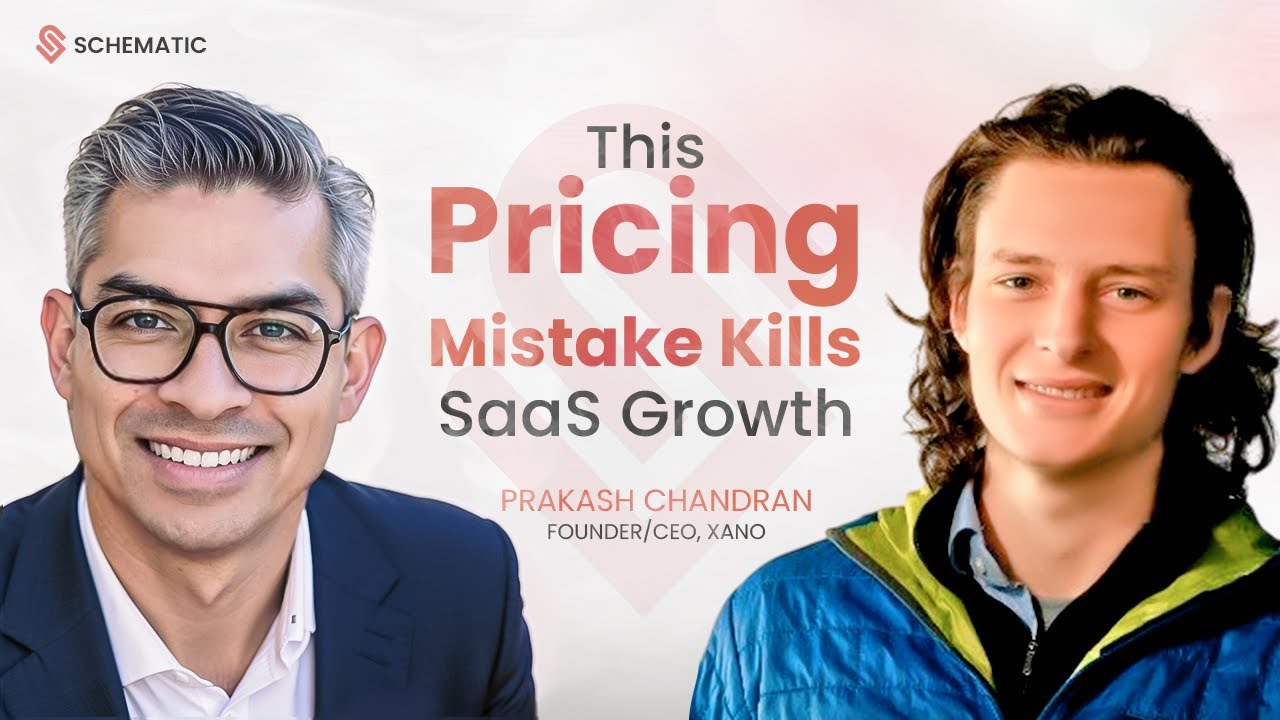
Prakash, CEO of Xano, explains why SaaS founders underprice their products and how his no-code platform evolved its tiered pricing strategy. He discusses balancing product-led growth with enterprise sales, using data to set prices, and the costly lesson from shutting down his first startup Zabanet.
Chapters
All right, well, thank you so much, Prakash, for being on the show. So good to be here with you. You know, you have played probably more than you know a really important role in Schematics, uh, journey because you were there for a really pivotal conversation that we had around which investors to work with. So it's, it's great to have you on the show and hear your story. You're a multi-time founder. You've got this great story. You studied technology and operations in college. You cut your teeth as a QA engineer for Citrix. In 2004, you joined Google. You were there for the next 8 years running enterprise UX. I imagine that was quite an experience, very formative. You then founded Zabanet, which I hope I pronounced that correctly, which you ran for a couple of years. And then you founded Xano in 2018 and you've been running Xano for about 7 years. It's become one of the fastest growing no-code platforms. How did this all happen? Can you tell us the story in your own words?
Yeah. So first of all, thank you for that generous introduction. I also was just excited to talk to you and your team just because I remember during that conversation when you were making your considerations around the right partner to go with, just being impressed with you all and kind of the mission that you're on. You know, I think the entrepreneurial journey for me started during my time at Google. I think, you know, being at Google, you're surrounded by so many brilliant and sharp people. And then that was a time, like I was there, I think 2004 time frame. Frame, like pre-IPO, where you had a lot of people leaving and starting amazing ventures. And at the time I was like, I want to do that as well. I want to be a startup founder. But I definitely kind of, I feel like I wanted to be a founder for the sake of being a founder. So I left in 2012 and after a little bit of time off, I started, as you mentioned, Xabinit. And I call Xabinit 3 and a half years of me getting the crap kicked out of myself because, you know, at Google I was used to launching, you know, products to millions of people whenever we pushed something. And then with Xabinit, I tried to get my first customer and then I couldn't get anyone to join me because I didn't have childcare and free lunch and all of those things. And so it was a very humbling experience, I think, trying to go from zero to one, which is just fundamentally different than what I had been doing at Google. But it was a formative couple of years and really taught me a lot around what to do, what not to do, and kind of how to think about starting a company. And so after I, I basically, I consider Xabinit in terms of like a failed startup, sold it for parts, and then I went into consulting as one does after a failed startup. And then, uh, that taught me a lot around my journey of like, okay, well, what marketable skills— like I did UX at Google and I became more of a horizontal product operator in my time being in the CEO seat. What value can I create and sell into organizations? And so I did that for a number of years until I kind of started with my two other co-founders at Xano. So that's like the high level before kind of the impetus of Xano. So maybe I'll pause there and, and have you ask whatever questions that you want there.
I love it. 3 years of getting the crap beat out of me. So I want to talk about that. Let's go back to, let's like go back to college. Like, why did you study technology and operations? What was, why was that kind of interesting to you? Why wasn't it English literature? Why was it technology and operations?
Yeah, so I actually grew up, you know, basically with the generation that was like building their computers before the internet existed and playing video games. And I actually started playing video games professionally, you know, Doom 2 specifically. And, you know, just connecting in because the internet didn't exist, we would connect to a local BBS and I would try to find like other people playing Doom. And that's, that's basically the generation in which I grew up. And then in that quest of becoming the best gamer, I actually met my now co-founder and CTO. We met playing video games, which is kind of crazy. So it was a very natural progression. And that was, by the way, during middle school, high school. So when I graduated, I was like, well, I like computers. There's this thing called computer science. Feels like I should go into that field. Again, lesson learned very quickly, realized my brain didn't operate that way in discrete structures and logic. I was more of kind of a right-brain creative thinker. And so my father said like, hey, you should do something in business and something maybe ancillary to technology. And that's why I chose operations management. And, you know, connecting the dots backwards, if you think about the degree that I got, technology and operations management is about making things streamlined and efficient. And the role of user experience designer is to make basically experiences like frictionless and seamless. So while I didn't know it back then, it was good training in terms of me being a systems thinker. And thinking about operational efficiency in school that then later led into kind of my career as I, as I grew with it.
How did Google happen? I mean, 2004 Google is early Google. Yeah.
So, yeah, after school, some— my best friend, Sean, at the time, he joined a company called Picasa. And Picasa, for those of you that don't know, it's basically a photo organizer for the PC. That then became Google Photos. And so right out of school, I joined as a designer for Picasa. And unbeknownst to me, within the first year, you know, they had offers from Yahoo and Apple and Google. So I very much side-doored my way into Google. I still went through 6 rounds of interviews, which was very nerve-wracking, but I was one of the ones that made the cut. And that began my journey from being a visual designer to becoming a user-centric, like, UX designer. And at the time, when I joined Google, it was only like 8 designers. We could all sit around a table, but they were, you know, the best and the best. And I really learned and grew up, uh, during my time at Google and learning from a lot of those, uh, UX designers.
It sounds like one of the major takeaways from Google was just the caliber of people that you were around. So it, it was just like really inspirational. There was a powerful network, there was an inspirational network. How did design and UX evolve for you as a practice during those 8 years?
Yeah, I think the thing for me is I had always thought about design as the way something looks and presents and like maybe a feeling that is evoked when you're looking at something. Just because, you know, hearkening back to the video game things, a reason why I learned design, web design, was I wanted to publish my strategies online. Like this thing called a website was becoming born. So I grew up in Photoshop and, you know, kind of using tools like that to basically present a certain way to people. I think at Google, it shifted my way of thinking to an experience, right? The experience that someone has with a given product, and design is a means to an end in order to get there. And so I think like a lot of the lessons that I learned were around that user orientation and product focus that I just didn't have before.
If we were to dig into that. Is that— is another way to talk about the evolution that you learned how to talk to customers in more effective ways, or would that be a poor representation of the evolution you're describing?
I think so, because in order to design a great experience, you have to know who you're designing that great experience for. And especially at Google, because you have many different types of users, you kind of have to design experiences that are accessible to many of those users, right? It can't be too esoteric or complex. And so I, uh, you know, I did a lot of user experience research going out with a research team. A lot, a big part of that was learning how to distill the feedback from customers into actionable designs and experiences. And so, um, and then also the discipline of like, you're making a hypothesis based on what they're telling you and then iterating, right? So it's like, okay, well, I think this is going to generally get at what they want, but then really kind of watching to see if that was actually the case. And back then, we didn't really have the analytics or data kind of rigor that exists today and is so accessible today. So a lot of it was kind of anecdotal. We did have some heat mapping software where we could see where people's eyes were and like where they were spending time. But it did definitely plant that seed early.
So 8 years after Google, working for Google, you decide that you want to be a founder largely because you're inspired by all these other kind of Google alumni that are going to go be founders. And you, you get beaten up for a few years. Tell us, tell us about the experience. Like when you look back on it, what do you think you got wrong as a founder for Zabanet?
Well, ironically, I don't think I talked to enough customers. It's, it's so interesting. I, it's so interesting because like even like listening to like some of the talks that I gave while I was at Google, I was saying all of the right things. But like when you're, it comes to practice, one of my friends called it, you have this founder blinders on where you somehow think that your solution is different. And that you know what's best. Despite all of my training, I was like, this thing needs to exist. So Zabinett, at a very high level, was basically a platform to help you keep the relationships with the things that you own and the things that you buy. So think of it like an online filing cabinet, and you would have like your warranties for the things that you buy. I could share like the stuff that I love. And so it was really a solution without a problem, and I didn't really do enough to validate. Instead, I kind of just tried to force it on the market, and, uh, it was very clear that there was lack or a lack of need for something like that. So the journey actually was trying to pivot the technology into something that I could actually sell. And what ended up happening is it became like— this is so such a divergence, but it was a referral tool for fitness studios because the main unlock that I had built in the software was like you had these receipt line items, right? That you could then extract and then each line item would have its own relationship. Well, for a fitness studio, the line items were the instructor. And it turns out that if you take the instructor, like, rather than saying, do you refer, like, Bliss Studio, it's like, do you, uh, refer Fynn Glover, the instructor from Bliss Studio, like or comment or refer this individual? Like, the referral rate went through the roof because the— if you think about it, the relationship is with the person that's teaching you. And so we repurposed it and found a little bit of a market there. But I mean, it certainly wasn't big enough. It was slow moving, and we were selling to small business fitness studios, which was ruling. Um, so, so yeah, taught me a lot.
Talk to customers, validate the problem, validate the solution, and be selective about the market because it's hard to sell SMB if you're doing like man-to-man sales.
Yes, for sure. Um, all of those things.
Um, okay, so take us into Xano. Like, how does this happen? What's the origin? What's the insight?
Yeah, so I think one of the things that's happened, you know, I raised just a little bit of money from friends and family, but the majority of the cost, which is not surprising, everything, it went into software development. And I felt like it, like while I was like, you know, kind of tactical, like I knew enough about like how, you know, applications were built, software development process was very opaque. So it's like a car mechanic that tells you it's going to be like 3 weeks and $15,000. You're like, okay, I guess that's what it's going to be. And software development was very much the same. So I remember feeling even after Zabonet had closed, like, God, if I could have just like had more time to iterate once I started figuring it out. And I didn't have to spend so much on software engineering, that would have been great. And of course, like no-code, low-code tools had existed at the time, but when you're building something that's kind of niche and like unique, you kind of need more control, which there were just not really many tools that existed at the time. So in parallel, Sean, my video game partner and my best friend and now the CTO of Xano, he went to start an agency with our third co-founder, Jack, also a good friend. And they built Xano as an internal tool, never meaning to productize it, to basically create software faster for their customers without having to grow the team. So after like a decade of them operating this and then me going through the startup and consulting, I'm like, wait a second. Like, I see this world where no-code, low-code is getting more traction and becoming more popular given like the engineering resource constraints. And I see this tool that you have that's like spinning up what is arguably the hardest part of software development, which is backend business logic. I think if we productize this, we might have something special. And so it, I never thought that it would be what it is today, but it was more of a, look, I'm consulting on the side. This thing seems like it might be cool. Why don't we like take some time in our spare time to like productize this and push it out and see what happens. So that was kind of how Xano was born.
Sorry, there's a dog barking. I'll have to edit that out. That is a very cool story. So there's a question that I'm always really interested in with founders, and it's when did you rationally begin to believe in the business?
I think rationally started to believe in it. I want to say it was like, so we launched in January of '21, probably I would say like January of '22. And the reason I say that is because when we launched, we had like been doing like loose beta testing, talking to customers. And January '21 is when we first like opened the door for like payments, taking payments. And I noticed that like many of the same customers were still around and still raving about what we had built a year later. And it was like, we were doing this like in this half-brained way. And then on top of that, without doing much marketing at all, we had this like climbing user base of people that were hearing about us just via word of mouth, which is how we get a lot of our traffic today, still the primary driver. And I was like, This is different. And what I'm hearing from them is not just like, oh, I'm able to like, you know, build software faster now. It's like, we're hearing things like, you're changing my life. And I now, I wasted, you know, $50,000, $100,000 and I built with Xano what they built in like 2 weeks or a month. Then I started to realize like, okay, there's something here and there's something special about, you know, so my just As an aside, my co-founder or CTO, Sean, he was the lead DevOps on Google Photos. It started with a server on his desk and he set the foundation for what is arguably one of the largest photo services in the world. And he worked on Borg before it was Kubernetes. So that was the initial intent of why, like how it got built. And I slowly realized like, okay, well, this automatic management of the DevOps piece and all the things that are hard. So people can focus on the business logic and their customers. There is something that we're addressing that is not being addressed in the market today. And so that's why, you know, within a couple months from January, we kind of talked about it together and said like, hey, like, I think this could change the way people actually build software. Let's swing for the fences.
It sounds like you, I mean, beyond word of mouth, beyond climbing user numbers, like you were watching the problem that you had had legitimately be solved. Customers were telling you that you were solving the problem that you had had. When you started the company?
Absolutely. Yeah, I think, and it enabled me to do so much more just as a, you know, when I was consulting at the time, one of the things that I was doing, I was like doing like product and product analytics consulting. I could build things that normally I would have had to hire an engineering team for just like in my own product on the side. So I'm like, okay, this is pretty cool. Like I can definitely see, you know, this is just a small subset and these small use cases, but I started using the tool and just falling in love with it and that ability. Like, I felt like it gave me superpower. So I really appreciated that.
And Zano, had you done, you know, all the customer research and validation that you hadn't done with Zabanet?
Or much more so? So we, I mean, meaning that we did start productizing it, but again, we didn't, I mean, this was a day or two a week. We all kind of had our primary, you know, consulting or agency gigs. You know, we launched the landing page with just messaging. And just saying like, hey, we're tinkering with this thing. Like we have a waiting list. If you're interested on like skipping the line, like hop on a Zoom call with me. So before we even released it, I had like, you know, 100+ conversations with people understanding the way, like how did they find us? What language were they searching? Like what were the problems they were solving? Like those types of things. And I think like in general, I knew like the TAM around like software development was very big. So I didn't worry about it as much as the problem I was trying to solve previously. It was more of just like our unique position, how people were talking about it, and is that something that I felt like could grow over time.
So you, in, in some ways, the way I would put that back is like you were using a lot of those early conversations for almost like establishing language market fit. How is the market talking about this problem or this initiative? Is that a good way to think about it?
Yeah, I think so. I think that, that definitely played into it. I think our language is and has and will be evolving, but at the time, 100%, I don't think that we anticipated Xano being used for all of the things it's used for today, but at the time it was like, we are a backend for your application, mobile or web application, period. And we are the scalable way that you do that. And so really landing on that value proposition and then, you know, doing, you know, surveys and really narrowing in on the language kind of got, got us to the point where we're like, okay, something is resonating here about our positioning.
Can you talk a little bit about how you think about the no-code market. How, for, for, for somebody listening who really wants to kind of walk away with a picture for what this market is and how it's evolving, the players in it, how would you kind of describe the landscape?
So the way I would think about it is there are, no-code's been around for a long time, like 20 years. And even if you think about a tool like Squarespace, it is a no-code tool for building websites. So there's a spectrum of no-code tools that achieve different things, and it empowers more people to build software without having to know how to code. The people that use no-code traditionally are called citizen developers. And you can think of a citizen developer as a non-coder product owner type. And they kind of exist on a spectrum. Some people are more citizen and some people are more, that are more technical, are on the developer end of it. So if you're more citizen, you'll use no-code tools like Zapier, right? Or like Airtable, like you just are like connecting Lego blocks together, pretty simple use cases and pretty simple things that you need to do. The further up you go in terms of complexity and use case and also skill level in that citizen developer spectrum, you'll start to use more advanced tools. So for example, if there's no Zap for that or Zap for the app, Well, the next phase might be something like a Make or a Parabola where you have higher fidelity around the workflows and then you can lift up the hood and even write custom code. And then beyond that, once you have scaling requirements or things around security, that's where you'll start to kind of bleed into like tools like us, right? Where we traditionally, at least right now, serve kind of a more advanced citizen developer that has more comprehensive use cases, scaling, or security requirements. So in the terms of the no-code space, it has matured quite a bit. And it used to be that no-code was only for MVPs. It always had a ceiling. You couldn't really build anything of consequence with it. That is why no-code, low-code traditionally has a stigma. Recently, as within the next last 3 to 5 years, there's a next generation of no-code, I would even say visual development tooling that allow you to do pretty much everything you're able to do with code except in a visual fashion. And we are a part of that next generation.
How does— well, everybody's talking about AI. I know you're thinking about AI. How do you think AI impacts Xano?
AI has fundamentally changed the way that people build software. And if you think about a lot of where the attention and energy is going. It's looking at tools like Bolt, like Lovable. You type in a little bit and you get a lot back. And I think it has been amazing to see what's possible and also expanded the aperture around people that now can create software. I think, however, that it's still in the phase where it's a little bit magic tricky in the sense that Sure, it builds a lot, right? You type in a little, you get a lot back, which is a great divergence, but then you start to need to converge to make it your own, right? And right now, really, there's two ways to do that. The first is, you know how to code, and you take the code that it generates and you edit it. The second is doing that with an AI copilot through something like a cursor. So the models will improve and the prompt-based way of developing software The software will also improve, but we believe that the visual way to trust but verify what the AI is outputting is the way that many people will prefer to start converging on making that software their own. So when we think about AI, even if you're starting with a prompt, you need a visual canvas to pick up where the AI leaves off. So we very much believe that XANA will be a great tool, and other visual development tools will be great tools for doing that.
Yeah, makes complete sense to me. Surprises. What has been the biggest surprise to you since you founded the company?
I mean, I think like AI in itself was a surprise. I think before there was a lot of heat and energy around no-code, low-code because it was the alternative to traditional software development. And then overnight it wasn't, it wasn't like where people wanted to look anymore. It was like, there's this new thing where you don't even have to consider no-code, low-code anymore. And I think it was—
Do you think AI represents a more impressive inflection than even the mid-'90s internet? Or do you think that the mid-'90s internet is a good comparison to how significant this has felt to you?
I think where I stand today is it does feel like the '90s internet. I think like it's both maybe overhyped, but also underestimated at the same time. I know how weird that is to say, but I think it's kind of true. Like when I look at, when I look at all of the possibilities and like what is now accessible to people that I would have never thought, like even with like visual development tools would get into like software creation or anything really. It's just changing, you know, like my dad uses Perplexity now and I think it's really cool to see, and I think it's just going to enable an acceleration that I just don't even know what's going to happen. So I think in terms of the biggest surprise, it's like, okay, it's kind of this existential, okay, well, where do we sit in this new world? And is there a place for us to play? And I, luckily, I genuinely believe that there is. But for sure, like to say that I wasn't surprised by that and how quickly that has taken off would be, would be a lie.
Appreciate the honesty. I feel the same exact way. You know, let's talk a little bit about pricing. So pricing is, in many ways I think about pricing as it's a form of communicating value. And maybe the question I'd like to start with is, you know, founders are great at so many things. You know, they create things from scratch. They do, they sell, they sell, they build, they recruit. Pricing is one of those muscles that feels like founders struggle with. And I wonder if you agree with that or disagree with that based on your own experience.
I tend to agree. And I think like one of our investors has said, like, you know, he's run his fund for a very long time and he said like almost 100% of the founders undervalue themselves. And I think, uh, and I'm not sure why that is. And I'm not saying, you know, obviously there's exceptions to that rule, but You kind of, especially initially, you're like, please, will you pay me money for this? Like any money? Like, can you give me $5 for it, please? Like, you're just trying to say like, do you like it enough for you to like put in like credit card and pay me? It's so desperate. It's so desperate. You just want to see some sign of life. And then over time you just kind of forget that like, that was like your posture when you set the initial price and then you kind of forget about it. And then all of a sudden a year goes by and you're like, wait a second, like there's a lot of people that are using us. We could probably increase our prices, maybe increase the way that we charge. And it's something where when you do it, you're so scared and you're so like, what will my— everyone is going to leave me. So I just think that there's this battle, this battle with yourself around like, what is the value that you're bringing to the world? How do you measure it? And I think that a lot of founders undervalue their product because to be honest, they don't really know, like they're trying to figure it out. They're trying to figure out what the value is. And there's two types of values, right? There's like the, the, I don't know you, you sign up with a credit card value. And then I do know you, or you're maybe a potential enterprise, like I'm charging you something different and how should I be charging you? And what does that mean for the person that's paying with the credit card? Where's that disparity? So there's this whole journey I think that founders go through in figuring that out. And it isn't easy. We're, we're still on that journey. You know, I think before we started recording, I was telling you this, but I think that's something that we align on that I think pricing will always be a journey and that you just have to kind of work through with your customers around where is that value and what is, what are you willing to pay for?
Yeah, pricing. I've had somebody on this show say to me that The only thing that is true of a successful startup is that its pricing and packaging will change. Like, that is the fundamental reality. You've got a really interesting business. And for anybody who's taking a look at your pricing page, you know, what immediately stands out is you have 4 tiers. You've got an agency tier, you've got an enterprise tier. I think you have a free tier. I think you're supporting, you know, effectively kind of a hybrid billing model where there's some combination of seats and usage. Correct any of this that's wrong. I think what is also evident just by cursory glance at your pricing page is that you have a product-led motion and you also have a sales motion. And so that is a lot of complexity to support from a pricing and packaging perspective. And I'd love it if you could just describe the journey with pricing and packaging. Maybe as you recall, what have been key milestones with pricing and packaging and how do you think about what those milestones might be over the next year or two?
When we started, um, I think understanding where we were uniquely different from other tools on the market. Scalability was one thing that kept coming up, like they could trust that they came to Xano and they could scale without limitation. And so with that, we changed our, both our positioning. We were the no-code scalable backend and that's evolving, which we can talk about later, but That was kind of one way to communicate. And the other, and you kind of mentioned this before, it's how you communicate value to your customers. We decided to go with this whole notion around build, launch, scale as our different SKUs. And then your scaling requirements will rise. And we always thought, look, the lever that we have is like, we give you a compute sandbox. And then when you outgrow that, you're ready to go to the next plan and then the next plan. And so that's really what we've been running with for quite a long time. I would say it's been almost 3 years that we've been running in this direction. And I think what we have, and I'm just talking about self-serve for now, we can talk about the enterprise sales motion in a little bit, but on the self-serve side, I think what we've learned is that there's actually more use case driven ways that I think we can be pricing. Because a certain amount of compute may, if everyone's building an app and the goal is basically to go from zero to many different users, that might be the right way to price. But as it turns out, like, people actually use Zano for different things because we're a horizontal development platform tool. And the more we understand about our users, the more we can communicate value by saying, look, we understand who you are. We understand what you're trying to build. We're going to give you the right amount of compute, even if you're doing an AI application, GPU, things that are more tailored to what you're trying to do versus kind of this holistic just sandbox for you to play in. So I think, um, the evolution that we've gone through right now is like, we've had Build, Launch, Scale for a long time. The changes we've made is to say, I think we can charge more. Let's try to charge more. So we did charge more. We didn't go over the $100 a month because we wanted still the plan to stay accessible. And I think the justification that, for right or for wrong, that we said to ourselves was we're basically man— we do two things well. One is we take care of like basically the DevOps for you. You can deploy a single tenant instance anywhere in the world where GCP is hosted. You know, we kind of manage all of the systems. When you hit your limits, we'll send you kind of the proper notifications. And then the second thing we do well is this visual API builder that can overcome some of the limitations of complexity that you felt in other tools. So that's kind of where we have tried to justify things. As we have grown and as more people discover Xano and these new AI builders and coding platforms become more accessible, I think what we're hearing is like customers want flexibility in the way that they deploy and they're also kind of much more use case oriented. So it's, that's where we are currently in the journey on our self-serve pricing.
It's super interesting. And it sounds like you're, you're learning this through customer feedback. I was going to ask you. Are you learning this through the data? Like the data is telling you there might be price optimization via use case, or are you learning this more from the market is voicing, hey, this price metric doesn't most intuitively align with the value because the value for me is just the use case here.
It's, it's a, it's a mixture of both. Like you'll see in the data, like the churn reason, like one of the number one reasons people leave us is the price point. And then the second thing is just having conversations with people. I just, Yesterday, found some, uh, someone on Twitter is like, my only complaint about Xano is like the buy-in price of that $100 a month. That's a, that's a really big jump, right? Like, for example, and that even from this perception standpoint, think about if you see a product and you have to make an investment of your time, even if we have a free plan to try to build something, just knowing like, hey, if I find success here, I now have to pay $100 a month, right? There's no in-between phase. And hopefully the free plan is going to be enough, but it might not be. Like maybe too much is gated. So maybe people actually paid just to try the, uh, the paid tiers, but then they didn't get enough value and they left us. So these are all the kinds of questions that are going through our minds in terms of like, okay, well, how do we lower that barrier? And how should we be pricing? Which is a great question.
How will you answer that question at this stage? Will you go hire a pricing consultant or will you run or you hire somebody in like FP&A or RevOps or product growth to go kind of like own this, own this question and own the answer?
I think there's a RevOps component. I think that there is a, um, like we also have to kind of like be mindful of our margin structure around like, hey, like if we're deploying this type of instance, like what are the implications of actually letting people have all of Xano like, and like for free, right? And what are the, because right now for the The benefit of having a single tenant instance is you can like go crazy. You can do what you can bring your server down. It doesn't affect anyone. Whereas our free plan is on a multi, multi-tenant solution. So there's considerations around like our margin and cost structure. There's considerations around like the data, what the data is telling us around like the different trigger points to get people to upgrade. And then there's just a lot of qualitative conversations to be had, uh, which all of which we're in the middle of.
For reference, correct this if I'm wrong, I can edit this out, but you guys are Series A, right? You've raised a Series A, you're in between Series A and Series B.
Correct.
How does, how have you thought about building pricing and packaging into a practice within the business? Is it, is it a function today or is it you and your co-founder talking about it?
It's largely the latter today. It hasn't been a thoughtful it hasn't been a thoughtful function or focus area of the business yet, but it is something that we are starting to pay much more attention to. So we have, for example, a head of, uh, revenue, uh, a head of finance and analytics who one of the focus areas for next year is to focus on like, what could the different SKU, the new SKUs look like? And what is the data that tell us like what might happen should certain scenarios play out? And kind of just assessing on like those different, uh, those different scenarios and SKUs. So I would say like we're just in the process of taking it more seriously, but it hadn't been something we focused on in the past. I would say that on the enterprise side, we're much more experimental and thoughtful about it, but on the PLG side, it's kind of remained fixed.
Makes complete sense. So maybe we could have just a couple more questions around pricing on the PLG side and the enterprise sales side. So on the PLG side, You know, as you go, it seems like you're kind of in this natural kind of moment in time where the business has achieved all this product market fit. Now the business has an opportunity to probably evolve pricing and packaging in a way that drives material impact from a growth perspective, from a net dollar retention perspective. You need to build a muscle around this in the business. You're going to start by having FP&A RevOps own a lot of the analysis because the folks in that org just have the analytical skill set to do the work. How do you see their work becoming a practice within the company? Will it be a pricing committee that consists of you and a few execs and that person meeting quarterly? How do you anticipate this starts to evolve as a function in the company?
The candid and honest answer is we don't have thoughts around that right now. I think that it's not that it's not a good idea, it's just that We are in the phase where we're like, hey, we think that like this is like a lever that we should be looking to pull, but we don't even know the shape of like what that would look like. So there was some investigation around our cost structure and what, like the art of what was possible, like in terms of what could we actually consider in giving our users at these different price points. And to your point, the RevOps and FP&A piece is like, okay, who has the most data and can tie that to revenue and revenue potential. But I think this discipline around the practice you're talking about is something that I personally am not aware of, like what is the best in class, good hygiene way to do that. And so that is something I would certainly be interested in, but I would say that it has just started with like a focus on being more intentional with how we price.
Makes complete sense. On the enterprise sales side, one way I often kind of think about pricing within, within the context of enterprise sales is this is really just about how do you deal with non-standard deals? Like these are going to be customers that maybe fit into one of your plans, but they've got a lot of exceptions. There's been a negotiation, there's been discounting. What have you learned about negotiating? Enterprise deals, negotiating non-standard deals?
I think there is one piece of it where we first and foremost needed to understand, like, what is the enterprise trigger for us specifically? Because I think the mistake I see a lot of founders and companies make, even like larger companies, is that I'm going to just charge you more because you're a bigger company for the exact same thing. And I'm sure you see this all the time. So we needed to find, figure out a way to say like, how do we not do that? What is the thing that people are willing to pay for that we can provide? And for us, what we have found is number one in the flexibility and the configuration of their deployment. And then the second piece is enterprise-grade features that only generally larger institutions actually care about and are willing to pay for so far. Right. I think. For us in terms of how we have priced that, it's really just like, let's try to just like, we basically price per instance and we have an instance, basically a server, and then workspaces that live in those instances are, you can consider them different applications. And so we're like, okay, well, if we know that it's a function of the flexibility in deployments, enterprise features, and then instances and workspaces, What do we charge for, for these things or some combination of them? And to be honest, it's a lot of finger to the wind. Like we want to kind of be, uh, and this has been uncomfortable for me being like, okay, well, I just told someone one price. I'm going to go into my next meeting and say it's 3 times more and just see what happens. Right. And I think that, uh, some of the contract values we've been able to get has been lucky in the sense of like, oh my gosh, they went for it. But I think over time that kind of comes, especially in like the market conditions now are very different than a couple years ago, like with more scrutiny and tightening, like you really have to be able to prove that value. It can't just be like, oh, finger to the wind pricing. So, uh, and I realize I'm just tangenting, but I'm just kind of telling you a little bit about the process. But it has been this combination of like, okay, number one, what are our levers? Number two, What should we be charging for those levers? And understanding that we usually underprice, how can we like actually go out and test this in our conversations? And then number 3 is understanding that not all organizations are created equal. So if an edu— a large educational institution wants your— almost the exact same thing as a bank, right? You probably can't charge them the same thing, right? So there may be different considerations around the additions that you have. There might be like commercial edition versus something where like there's an EDU consideration. And I think like understanding those nuances and dynamics has just been an exercise in lots of conversations trying to sell, trying to get through procurement and all of that. So I don't know if that was helpful, but I just kind of give you a sense of where we are.
I think it's very helpful because of how honest it is. I mean, non-standard deals are very, very hard because they are non-standard. Like there's, there's new context for every single negotiation. And I, I think one of the things that you're saying is like, part of what I've learned is that to do enterprise selling well requires a lot of reps.
Yes, 100%. It requires a lot of reps. And I think another thing is also understanding that there are very different personas, right? Like when you're doing enterprise sales, I think initially it was like, well, we are selling to this company and this is like, for example, the champion we're speaking to, but there's like, okay, well, there's the buyer, there's a non-economic buyer, right? There is like the individual users, the champion, like you have to like understand the dynamics of these different users, where you're going to see them within the deal and how you speak to them. And so this has been a muscle that we've been developing around understanding the dynamics of like, who do we need to be talking to and how do we need to be talking to them?
Are you at a point where you've begun to become really intentional around discounting and discounting governance or not there yet? And that's on the horizon.
Not there yet. I would say that's definitely on the horizon. I think it's just very tailored based on the situation that we're in for now, but we don't have any clear and cut guidelines around it.
Yeah. Thank you for all this. I want to— we're running out of time here. This has been such a fun conversation. I'm curious to know, like, how you feel like you've evolved as a founder when you compare who you've become as a founder operator at Zano to who you were when you had founded and run Zabanet. What do you think are the big differences?
I like to say that, like, think your first company, let's call it your training wheels company, or, you know, you're very bright-eyed, you have your head in the clouds because you're very excited. And, and this is obviously not everyone, but I can speak for myself and other founders that are kind of excited about, like, we're doing something new for the first time. And I think that head in the clouds piece kind of almost gives you this unreasonable superpower of like continually like running through walls and trying to figure things out. But I think I now, I'm much more of like, yes, head in the clouds. I want to think about the future. I want to be excited and excite the organization around what opportunity we have, but head in the clouds, feet on the ground, right? You always have to make sure that it is grounded in a sense of reality, right? And I think the notion of what is, what are the reality, like signs and metrics that tell you that you're running something efficiently, that you have, you're doing things in the right way, you've got quality revenue, you've got the right people in seat. All of those things are areas that I've evolved in and I am continuing to evolve in. So I would say I was like fueled on like, you know, excitement, enthusiasm, and a bright-eyed future before. And now I'm much more rooted in reality with a sprinkle of that enthusiasm and that vision as well.
Maybe the name of this episode is Head in the Clouds, Feet on the Ground.
There you go.
The Zanno story. One of the closing questions I always like to ask is, is there a moment that you look back on in your career, like a very specific moment, and you say that was an inflection for my professional experience, my professional journey?
I would probably say when I made the decision to wind down abandon it. Like, this isn't working anymore. Because I think, like, to what we were just talking about, there is this, like, very, like, existential, like, everything that I am is tied up in this thing that I've created. And especially at a time where you see your contemporaries doing well and raising money and selling their companies, you just assume that that's going to be the same outcome. And I think in making peace with the fact that, like, Hey, I'm going to, I'm going to put this down. And there's like really this sobering, like kind of depression that comes along with that decision. But then once you sit in it for a little bit, you realize that you are on this journey and that it's one piece or one brick of a foundation that will serve as support for whatever is next. And that's not clear at the time. But I remember exactly where I was in making this decision and the week that ensued afterwards where I kind of turned it from this like very like, I am a failure in life to like, hey, I have this a lot more experience and like, how do I pick myself up? I didn't know what was next, but I knew that it was going to help me. To now looking backwards and saying like, wow, I'm really glad that I went through that formidable experience., and it, I think, has informed the way that I operate this company today. Uh, and it would not be where it is were it not for that experience. So I would say that that was like a pretty big inflection point for me, kind of Phoenix-y, you know, rising from the ash type thing.
I sold my first company for parts too. And so I know what you're describing very intimately. And I think you described it perfectly and eloquently. It's, it's a real identity crisis for a period of time.
For sure.
Thank you so much for this time, for this exploration. Where can people reach out to you if they want to learn more about Xano and where can they learn more about Xano?
Yeah, for sure. So you can go to xano.com and check out our website and everything it has to offer. We're probably most active on LinkedIn and Twitter, and Twitter is @nocodebackend. And then if you want to follow me personally, I haven't been posting, but I'm starting to try to post more. It's @prakawesome, like my first name, just P-R-A-K awesome.
Perfect. That's a great handle. So much fun. Thank you again, Prakash.
Thank you, Fynn Glover.
More from Fynn

Schematic at Operators Guild Demo Day 2026: How to bill for AI credits without a surprise bill







Should you move to usage-based pricing because AI is compressing your margins?

Why raising prices every year backfires (a pricing leader on the Mastercard quota model)

