August 14, 2024 | Beyond the College Brochure
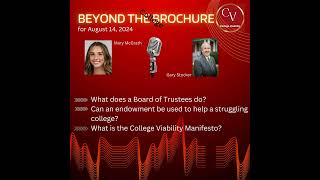
Dr. Gary Stocker breaks down the four types of college financial aid and explains why weak colleges often merge too late. He introduces the College Viability App, which tracks enrollment trends, graduation rates, endowment size, and tuition revenue to help families assess whether a college will survive.
Chapters
Hello and welcome to the Beyond the College Brochure podcast, where we provide you information and guidance about college financials and decisions. My name is Mary McGrath, and I'm a rising senior at Lindenwood University, and my co-host today is Dr. Gary Stocker, the founder of College Viability. Welcome to the podcast, Gary.
Mary, as always, good to have a look at the questions you've sent me, and I'm looking forward to answering those today.
Yep.
Yeah, so just to kick us off, obviously we know paying for college can kind of be a big ordeal and people can find themselves in many situations. So things like scholarships and grants can really come in handy. And there's many different kinds of scholarships. And one that I'm not sure if we have touched on it yet on the podcast, but can you explain what a need-based scholarship is?
And I think, Mary, the best way to look at this is to really look at the 4 basic kinds of—
I'm going to call them scholarship, but it's really financial aid.
And the first is need-based. I'm going to come back and talk about that. That's based on financial need, and I'll give you some examples and what that looks like.
The other is merit, M-E-R-I-T, which is based on academic and intellectual history and capacity.
There's loans, and there's loans that students can take out, both subsidized and unsubsidized, and the same thing for families. Your parents might, you know, any parent can take out a family loan as well. And then there is a fourth one that is work-study. And of course that is you get some amount of money, so really it's credit for working at a college in some relatively menial function that applies dollars to your tuition and fee revenue. So let's talk about the need-based. This is where the FAFSA debacle comes into play because need-based scholarships are based on financial need, obviously. And if you have a FAFSA, that's what tells the government in theory how much your family can afford. And I'm sure you heard this, Mary, rarely do families look at their capacity to pay and does it match what the government says they can pay. But nonetheless, that's what the starting point is. Examples of need-based scholarships are grants. So, Mary, here's $10,000 to use toward your scholarship at whatever university is.
There is—
there are discounts which are ubiquitous, and discounts can be in the form of merit aid, and I'll talk about that in a minute. They can be in the form of scholarships, and they can be in the form of something called Pell Grants. And those are government grants, again, based on financial need. And I think in 2024, somewhere in the vicinity of $7,000 per year for Pell Grants. And of course, merit aid, you know, we think of that, Mary, in the context of academics, and it really goes beyond just academics. Merit is merit. Your merit is being a strong D1 college basketball player, and it can be academics for sure, but it can really be any extracurricular. You could be a good piano player. I think I've teased you about this before. A good singer, good with computers, good with dancing, all that kind of stuff. Those are all opportunities that can result in merit-based scholarships. Now, when we talk about those merit or need-based scholarships, and I think we've talked about this before, keep in mind in almost all cases, not all cases, but almost all, it's a discount. Just like you and I get discounts for food and clothes and computers and cars and all that kind of stuff. There is no transfer of funds in almost all cases. From College Fund A into the Mary McGrath paying for college account. It's just a discount. So for example, you've got a question about— I'm gonna steal a question from later on. You ask, what is a president— presidential scholarship? All right, so skip that one when it comes up. Presidential scholarship is almost always a discount used to incent students and their families to choose that college. So the Presidential Scholarship is, send us your deposit by May 1st, and we'll award you the Presidential Scholarship. Or it even could be offered up front. We're offering you a Presidential Scholarship for $10,000 or $5,000, whatever the amount is. And that sometimes is based on, on the family's ability to pay, also based on the FAFSA. So those are really the basic ways to look at not just need-based scholarships, Mary, but really all of the scholarships across the board. The loan piece, let's talk about that for a second. You know, I took out loans 40 years ago when I went to college. I don't think my family did back then, but I'm not sure. And one of the pieces of advice I and many, many others will give to families, if you need loans for the student, those typically can be subsidized, but you wanna be very, very careful about getting, as a family, getting in over your heads and having parents— I think it's called Parent PLUS loans— on behalf of their child. Certainly welcome to do that. But Mary, there are countless horror stories about parents doing that for their child, and we love our children desperately, um, and, and having that debt hang around their neck for not months and years, but sometimes decades. So my advice, as many others share, is be very, very careful. Of taking out that Parent PLUS loan. If a college is too expensive, that mom and dad, aunt and uncle, grandpa and grandma need to do a Parent PLUS, look at other colleges that can be afforded without parent loans.
And for some of our listeners who might not know a bunch about diff— like different higher-ups in the college or education system and things like that, could you explain what a board of trustees does at different schools?
Yeah. And if you listen to my, my regular Monday podcast, This Week in College Viability, I'm not always a nice guy when I talk about boards of trustees. Both myself and again, many others in higher education look at too many boards as not having gotten, getting the job done. What is their job? Their job is really to look at the overall management of a college. Now we're not talking day to day. We're looking at that big picture to make sure the revenue and expenses are in the same area. They look out 3 to 5 years for coming trends for technology and building and fundraising and all that kind of stuff. But really the focal point that I want to share today is something called fiduciary. F-I-D-U-C-I-A-R-Y, fiduciary responsibility. And all leaders, whether in higher education or commercial enterprises across every industry, have a fiduciary responsibility. And the easy definition of that, a fiduciary responsibility is when you look out for an organization above and beyond what you're paid for. Right? I'll come back to that in a second. Well, let's kind of use parents for an example, right? Your parents kind of have a fiduciary responsibility to your family. They look out above and beyond what they're paid for as parents. I mean, kind of silly to make sure that you and your siblings are taken care of. That's kind of analogous to what boards of trustees and college leaders are paid to do. And there's nothing wrong with that. They have the legal and ethical mandate to look out for the best interest of the college. Some do a fine job. Way too many boards do a not so fine job. But let's digress for a second. Let's talk about the fiduciary in colleges for faculty. Let's talk about the fiduciary for students. I'm going to make the argument, Mary, that those listening to this, that the fiduciary responsibility for boards and presidents and CFOs does not extend to faculty and staff. I made the case in many of the media that I do and many of the postings that I do, probably some of the stuff you put on our Instagram account, that there, that as a student, you have no fiduciary. At your university. The faculty at your university has no fiduciary looking above and beyond for their best interests. I'm going to ramble on a little bit longer on this. Some college leaders will say, well, yeah, we have a fiduciary responsibility to students and to faculty. They may say that, Mary, but as more and more colleges close, you know, I've talked about this many times, as more and more colleges close, these boards of trustees, these, those with a fiduciary responsibility only look out for the college. And I can't remember an instance, there might be some, but I can't remember an instance where they looked out for the best interest above and beyond for faculty and staff.
And on our podcast, obviously we've talked a lot about different college closure, college closures, excuse me. And also with that college mergers. So how does a college come to the decision that it must merge with another institution rather than just close its own doors.
Yeah. And sadly, what's happening now and will continue to happen in the coming months, maybe even the next couple of years, is colleges in financial distress are waiting too long to say, hey, we need to merge or we need to combine operations or consolidate. With another college. And I know of many instances, and I won't share those, but I know many instances where colleges in poor financial health who are about to close their doors, who are about to lay off a lot of people, will call a college in better financial shape and say, hey, please take us. Now I'm being silly, but that's the essence of what's going on, because they wait too long and they bring no assets. They bring lots of debt. They bring lots of operating issues, operating issues. They bring no financial value to an organization. And so colleges in strong financial shape are saying to these weak financial colleges, no, you bring nothing to the table. Now the question is, how does a college come to a decision? They need to decide 5 or 10 years ago. They're looking at it today. They need to have looked at the trends 5 years ago, 10 years ago, and realize that small doesn't survive forever in American business. Take for example coffee shops.
That's the one that pops into mind.
If you and I ran our own coffee shop, we would probably be— might be able to run it for a couple years before Starbucks said, you know, let's kill the Gary and Mary coffee shop by making the price so low for coffee that they can't afford it. And that's effectively what will happen and should be happening in colleges because there's too many. And you know, I've talked about supply and demand. There are too many colleges, college seats, and not enough students looking, not enough students willing to pay for those college seats. And colleges need to merge not just the back office stuff, the IT, the admissions, the finance, all that kind of stuff.
They really need to seriously look at merging academic operations And maybe another day, Mary, we can talk about that in more detail for colleges and really the higher-level classes like you'll be taking this year in finance and marketing.
Yes, I will be taking those. Hopefully those go well. Yes. So I know in our last podcast, we kind of touched on endowments and kind of what that means and what they can do. So is it possible for an endowment— can they be used to help a struggling college?
Well, the easy answer is yes. The qualified answer is you got to be careful about using your endowment. And I'll give you some background on this about using the college endowment to do things like keep the lights on and meet payroll. And one of the other podcasts, it's not actually a podcast, it's a video show that I just started 2 weeks ago with another person is called the College Financial Health Show. It's a video where we show data and charts. On colleges. And one of the things we talked about yesterday was 4 private colleges in Pennsylvania, and of the 4, 3 were taking money from their endowment and effectively spending it to keep the lights on and to meet payroll. Again, I'm making a gross generalization, and they're welcome to do that. But here's the, here's the history, here's the story behind endowments. Endowments, for as long as I can remember, have always been available to make sure any given college can exist into perpetuity.
So those funds that, you know, that the McGrath family donated 20 years ago to some college, the principal of those funds, the $1,000, $10,000, $10 million, whatever it was, have grown. And the college that that donation would have been made to uses the interest on those earnings. What's happening now is colleges are taking that principal, that $10,000 or $10 million, whatever the number is, and using that to keep the lights on. And so the earnings go down and down and down.
It is a practice that is not sustainable.
We talked about that last— yesterday for the 4 private colleges, 3 private colleges in Pennsylvania. And a little bit last week, we had 5 colleges in Missouri and some of them were doing the same thing. So yes, an endowment can help a struggling college, but you can't use it like a piggy bank. You can't reach into the endowment every time you need to meet payroll, every time you need to pay the utility bill or anything else, because that's not what an endowment is for. An endowment is for— if it's a restricted endowment, it's the Mary McGrath Business Scholarship. It's dedicated just for students getting a business degree. Or it's unrestricted, which is effectively cash. Most colleges, if you look at their financial statements, most of their endowment is restricted. It's dedicated to a given purpose. Most of that's scholarships, sometimes buildings, sometimes that's endowed scholarships, endowed professorships, all that kind of stuff. So yeah, it can be used, but boy, we're in a time period now where too many colleges are using it for the wrong reason.
And another thing we touch on a lot on this podcast is obviously the 2024 College Viability App. So can you give us some of the IPEDS reports that are available on the app?
Yeah, and as you well know, there are both public and private versions of the app, public colleges and private colleges. And there's a version for college leaders, there's a version for faculty and staff, and there's a modest version for students and families. And that's what I'm going to talk about. For students and families, when you look at the College Viability App, and it's $29, invest $20, $29 to make sure that the college you're looking at, colleges you're looking at, can keep the lights on is look at enrollment. And you know, we look at the last 8 years of data, and if the enrollment has gone down, Mary, over 8 years, that's really, really, really not a good indicator. With anybody I talk to, you and all the others I do media with, look at the 4-year graduation rate. Again, I've talked about this before. I'm going to talk about it again. If a college can't graduate half its students, ask them why. Ask them what they're doing to make that number better. Because you're not going to your university to take courses. You're going to your university so this time next year, you've got a piece of paper that says Mary McGrath earned her Bachelor of Arts or Science, whatever it is, in those majors. And if your university is not graduating you, they have failed you. And if they can't graduate half of the Mary McGraths in 4 years, that's not good. That's not a good indicator. I think you want to look at the endowment as a third item. And the threshold that I use, listeners can use any number they want, but I use $50 million, $5-0 million. If you haven't, if a college hasn't raised $50 million over its entire existence, most are decades, many are centuries, then I make the case they don't have the donor base to do that, Mary. Or they don't have the systems and processes in place to approach those donors and say, hey, would you support the endowment for our college? And I guess the last one, uh, just the fourth one— again, this is available on the parent, student and parent version of the 2024 College Viability App— is look at the tuition and fees revenue. Now, this is kind of an inside baseball number, and it's kind of got a dichotomy here because as a student you don't want to have to pay too much in tuition, nor do any other students. But the college needs that tuition and fee revenue, typically that's room and board, to stay open. And if that tuition and fee revenue, and we track that on the student and parent version, if that tuition and fee revenue has gone down over the last 8 years, again, that's not good. You really have to worry if colleges like that, will be able to continue to keep the lights on, to be able to make payroll without dipping into that endowment that we talked about a couple of minutes ago.
And you just kind of touched on this as you were talking about the different reports available on the app, but what would you say are the 4 best comparisons to use when trying to compare different colleges?
Yeah, so the graduation rate will be a similar one, the 4-year graduation. We also track the 6-year version, not on the student and family version. Look at something called retention. You know, compare one college's retention to another. If one college is retaining 85% of its students from one year to the next and another is retaining 65%, well, draw your own conclusions, Mary, but one of them is doing better than the other in keeping students happy, keeping students focused, keeping students involved.
Just do a comparison.
If there's a big gap in retention, that should be a concern. That should help you rule out one college and maybe rule in another. And then there's something called admissions yield.
I can't remember if you and I have talked about this before. It's kind of a popularity indicator.
Uh, it's not in the family student and family version of the app.
It's in the higher-end versions. The admissions yield is a percentage of students who, once accepted to a college, actually pay tuition, show up, and attend classes. If that admissions yield is low, That means many of those students are saying, hey, I've got better choices. I can make the argument, Mary, that they're telling that college, hey, you're not my favorite. I'm not going to go on a date with you. I'm not going out with you. I found another person to go out. I found another college to date. That's kind of the analogy that you can draw.
And those would be the basic ones. If you can't keep students, if you can't get students to show up in the first place, those are big indicators.
And keep in mind, Colleges need students. Colleges need you, Mary, a lot more than you need any individual college, and students and their families should leverage that in every possible way in the coming years.
And can you share with myself and our listeners what the College Viability Manifesto is?
You found the College Viability Manifesto? Goodness gracious, Ms. McGrath, you are quite the searcher there. So since I've been doing this for 5 or 6 years now, and most of my message is one of concern, some folks will say, Gary, you're negative.
Well, I'm realistic.
I'm not particularly negative, and I try and couch my comments in as positive tone as I can. But I wrote the College Viability maybe 3 years ago, 4 years ago, and there's 8 or 9 bullets, and it's really my perspective on the value of college. I am first generation. I'm the oldest of 5. I went to a public university in Illinois. And Mary, that got me to have this conversation with you today. Now, a billion things happened between now and then, but I am, I wouldn't be here. Lord knows what I would be doing if I did not get that college education 40-some-odd years ago at a public college in Illinois. So college is good. Here's the first part of the manifesto. College is good.
Go, please go if you can.
Graduation is better than just going. You really, as an individual, want to say, I'm going to graduate no matter what it takes.
I understand life gets in the way.
It gets in the way for all of us in some form or fashion. But you got to find a way to graduate. The third item of the 9 or 10, I'm going to talk about 5. Some colleges will not survive. We have seen not quite one private college per week close this year. I have every reason to believe in the coming months that will be 2 to maybe 3 private colleges per week as the FAFSA debacle kicks in. But many, many, many colleges will survive. Some will survive better than others, but many, many will survive. And that's why you and I are talking about this College Viability App. It is kind of the Blue Book. You know, you can use this to compare the financial health. You would not go out and buy a car that the market thinks is poorly made. Why would you go to a college where the degree is essentially the same thing, poorly made, as a bad car? And obviously the next item, consider the financial health. Use the app, listen to our podcast, join our email list, all those kinds of things. And then finally, this is kind of the consequence. And we all know that, you know, our decisions in life or non-decisions in life all have consequences. And the fifth item in the College Viability Manifesto, a closed college will cost you a lot. And I've done some informal numbers, some soft numbers. And I would say if you have to go to a college 5 years instead of 4, it's gonna cost you somewhere in the vicinity of $50,000. A part of that is paying tuition to take classes you missed, courses you missed. And a big part of that is, say your first year's annual salary is $40,000. Well, if you can't get that in year 5, you have to wait till year 6 cuz you didn't get your degree done. You just walked away from $40,000 in lifetime earnings. And that $40,000 can have a long-term impact for lots of reasons. So a closed college will cost you. And I guess I should say, whether the college closes or you choose to transfer, if you don't get that college degree in 4 years, you're walking away from lost— there's a lost opportunity cost, is what it's called— that income from that first year. Whether it's $40,000 or $80,000, whatever that number would be, you've lost that money forever because you did not get that college degree in the 4 years. That ideally you would take to get the degree.
And with that, it'll be a wrap for myself and for Dr. Gary Stocker. Thank you for joining us on the Beyond the Brochure podcast, where we provide guidance on college decisions, financials, and much more. If you have any questions or concerns about the financial health of colleges, you can send them to marym@collegeviability.com. Thank you again for making the time to join us. We hope to see you next time.
More from Gary


What does it look like when a college increases both total revenue and total expenses?



College Financial Crisis? We look at the financial health of Bay Path U. (MA) and Coe College (IA)


Private College Financial Crisis? We look at the financial health of Hobart William Smith College


Financial Compass tutorial (Private college version.) Financial statements compiled 2016-2025.

