August 28, 2024 | Beyond the College Brochure
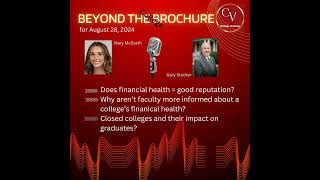
Gary Stocker, founder of College Viability, explains how colleges use tuition discounting algorithms to determine what each student pays, and which institutions are at real risk of closing. Endowments under $50 million, declining enrollment, and small rural private colleges with fewer than 1,000 students are major warning signs.
Chapters
Hello and welcome to the Beyond the College Brochure podcast, where we provide you information and guidance about college financials and decisions. My name is Mary McGrath and I'm a current senior at Lindenwood University, and my co-host today is Gary Stocker, who is the founder of College Viability. Gary, welcome to the podcast.
Mary, I understand I caught this. You're now no longer a rising senior, you're actually a senior at Lindenwood University. My congratulations.
Thank you. Yeah, it's definitely an adjustment taking out that word rising and putting in current. It's kind of scary, but you know, it's okay.
What kind of questions do you have for me this week?
Yeah, so to start us off, obviously when some colleges find themselves in financial troubles and things like that, different articles or social media postings can come out about that school. And obviously a lot of people have a lot of opinions about it. So I was just wondering if the financial instability of a certain college could have a negative effect on its reputation. Either through social media or anything like that?
Well, the easy answer is yes, but it's really a qualified yes, Mary, because the negative impact is usually after the fact, you know, after the news stories that you talked about or after a college lays off or does cutbacks or says, you know, there's accreditation agency, accreditation concerns, things like that. But it's really after the fact that folks look back and say, you know what, If my child is considering, you know, Mary McGrath University, I'm not going to because I saw I had some bad news in the media sometimes. So really it's after the fact. And again, that goes to what you and I've talked about many times in the podcast. There's now a tool and it's called the College Viability App. And there's one for students and their families that lets you look whether it's a public college or a private college, lets you look at the financial health and even the viability of colleges to see if you want to put that college on your initial list. Don't make it the last thing on your list is my guidance to students and their families. Make it the first thing on your list.
And to follow up with that, do you think it could have an effect on any recent alumni who have a degree from that university, um, when they're out looking for a job?
Yeah, probably not so much. Um, there is, from what I've talked to others, some mental anguish to because old State U is no longer in business, but you still earn the diploma, whether it's a bachelor's degree, a master's degree, or something else. And that's still your ticket to those conversations for jobs and career opportunities. So when folks say your college closes, that you've lost your academic abilities, well, that's stupid because you bring those skills, that intellect, that knowledge with you. So if your college closes, it's sad for the college, it's sad for the alumni, but it doesn't really impact anybody's career aspect for prospects or even their compensation, I don't think.
And we've talked quite a bit on here about college tuition and different financial aid options for students and families and how often that might— or reasons why that might increase or decrease depending on the situation. So how often would you say that these colleges revise their tuition and financial aid offerings?
Yeah, I've experienced that firsthand, Mary. And it's annual. I've sat in on college tuition pricing meetings with college leaders and with their boards. And it's not fair to say it's a dartboard exercise when they throw a dart against the dartboard, whatever comes up, that's the charge. They do look at the finances, but it's, say a college wants to increase their tuition 3% a year, right? 3%, 5%, something like that. They do, and they'll announce that we're announcing 3% increase for whatever reasons. But with the intense pressure on college tuition pricing, many times they give most, if not all of that or more, back in tuition discounting. So they may raise tuition from $10,000 a year up 3%, $10,300, but they may discount the tuition an additional 5%. So it goes down to $9,800. And what they actually net. So yeah, they raise the price, but they can't actually keep it there. And again, list price. Is what a college says it is. You know, Linnewood is something like $21,000, um, but that's not what Linnewood collects for any students, hardly any students at all, because of the tuition discounting. And let's not forget the, the FAFSA debacle, because when you ask also about financial aid, when you, when you or other students submit their application and their FAFSA document to a college, there's a whole army of consultants out there who've developed pretty fancy, pretty sophisticated algorithms that calculate for any given college the lowest, the smallest discount they can offer based on the FAFSA numbers for your family and the other families that they can get by with that shows that that student and academic history, college or high school, sports, even backgrounds are likely to accept. So if they can, if they can get Mary McGrath to attend statistically at a 20% discount, that's what they're going to offer. If it takes a 40% discount based on your— all those factors I talked about, that's what they're going to offer. But they try and find the lowest discount possible to get students to enroll.
And in the event of a sudden college closure, kind of in the situation where there's given no warning either to faculty or students, are there any specific support systems in place specifically for faculty and staff in the event of this happening?
No, no, not really. Many states, I think it's a state level, have 60 or 90-day notice requirements where if you're going to lay off employees, whether it's a college or manufacturing facility or retail outlet, fast food, whatever, you have to give the state or federal government, I can't remember which, 60 or 90 days notice. That's in effect, but here's, I think, you know, I've talked about this before, but there have been colleges closed this year. Give a weekend's notice or after the fact. There was one college that closed up by you, um, I can't remember the name of it, that announced its closure on Monday but had locked the doors on Friday, the Friday before. So there's a lot of short notice closures, and with the FAFSA debacle that took place earlier this year and really continues now, I think we're going to see a lot more of those. And at some point, Mary, the college market, the students and their families, even faculty and staff, are going to realize that There are colleges that aren't going to make it. And you and I are some of the data entrepreneurs out there trying to give folks a tool to say, hey, this college is financially healthy and this one not so much.
And you kind of just touched on this in your answer, but is there a specific amount of time that these schools are required to give specifically students before officially closing and also their families as an effect?
Yeah, there's that 60 or 90-day notice and you'll see, you'll see those news stories regularly with, with businesses that close. A manufacturing facility is going to close and they give— I think it's state level now that I think about it. And they notify the state of Missouri here where you and I are right now, um, that they're going to be closing their store, their stock, their store, their location in 60 days. That's the only requirement. I don't know what happens when, when businesses don't do that. I don't recall seeing any stories on that, but I know it's happened in colleges already this year. And I worry that's going to happen again in the coming coming months and coming year. And the other thing to think about is just the warning piece. And again, I'm going to talk about something, you know, I've shared before. I use the College Viability app to do this. One for students and family costs you $29. Look to see what the enrollment trends are. The college's enrollment has gone down significantly over the last 8 years that we show in the app. If their 4-year graduation rate is below 50%, if their tuition and fee revenue has decreased over the last 8 years, And if they have an endowment below $50 million, 5-0 million, be careful. Be careful. Those are the colleges at greatest risk. And even add, I would add to that, if you're looking at a private college, it's a rural private college and it has an enrollment of less than 1,000 students, give or take, they are particularly susceptible to the market pressures that all colleges are facing right now.
And I know on this podcast, we've talked a little bit more about private institutions rather than public, just because some in some cases those ones are a little bit more likely to close rather than public ones. So what would you say would be the biggest pro and also on the flip side, the biggest con to attending a private institution rather than a public one?
Yeah, I still think, I've had others ask me this in different media interviews, I still think it's a function of personal choice. At the end of the day, you're gonna get yours here in May. You're gonna get that piece of paper that says Mary McGrath has done all the work required to earn her Bachelor of Arts, Bachelor of Arts in in marketing and finance in the double major. I don't know that it matters that it was up from a private college or public college. There are arguments made that some private and public colleges have an alumni base that might help the Mary McGraths of the world find that first job or find subsequent jobs. There's probably some logic to that, but that's probably more related to the size of the college. If it has a million former graduates out there, you're more likely to find one that can help you than if it has 100,000. Graduates out there. So that's, that's something to think about in terms of size. But in terms of general private versus public, you know, if you like big-time college sports, more publics, a lot more publics have it than privates. That's something to think about.
And would you say that faculty and staff tend to be more informed about a college's financial situation more so than the students and families involved?
Yeah, not even close. No. No, sadly not at all. And think about this, you know, as a student, and that's the perspective you bring, and I know you're asking questions on behalf of students and their families. You know, you're not 18 anymore, but when you were 18, you had no idea what the colleges you were considering, what their financial health was. And that's still the case with almost everybody else. But faculty are living that. They see that their budget for conferences, for example, faculty love to travel to conferences, is being cut. They see that their budget for new textbooks or their cost of living or their contribution to health insurance or life insurance premiums, those are increasing. They see the signs. And yet, Mary, time after time after time, when a college announces either cutbacks or layoffs or even closings, almost without exception, the first voice of protest is from faculty. And they effectively say, hey, nobody told us it was that bad. You know, for students and families, I can understand that's just not part of the culture. But if you live something day after day, week after week, month after month, and you don't know it's financial health, I'm going to suggest there's some culpability on the part of faculty for just not making the effort to know. And one other minor point to that, college professors are good at whatever content they teach. And as, as a profession, they have long argued that the business part of a college is not their concern. That's also silly, Mary. If the college doesn't have enough money to meet payroll or to keep the lights on, that's certainly something they should be concerned about, especially now. You know, if there is— if a college lays off faculty, whether it's tenure or tenure-track or just instructors, it's really, really difficult to find another college teaching job anywhere these days. So if faculty members that are listening to this, you know, there's a faculty and staff version of the College Viability app. Go to collegeviability.com and click on College Viability Apps and grab either the public or private college version. It's a little bit more expensive than the student version, but know, know where your college rates. Remember the app compares, so you can look at your college and 5 of its competitors, whatever, whatever you want to look at. It's sad that so many faculty, they may have a gut feeling that things are not going well, but they don't really look at the data hardly ever at all.
And also on this podcast, we've talked a lot about different levels of institution, whether it be through academics or financial situations or anything like that. So what would you say are some of the primary characteristics that may distinguish, I say this in quotes, a higher level institution compared to a lower level one?
Yes, and this is audio only. Don't miss the fact that Mary just did air quotes for higher level. You know, a couple of things, endowment, you know, those colleges with a billion or more, close to a billion or more in endowments, they can be higher level. I'm doing air quotes now. The perception, you know, the market perceives some colleges better than others. Perception is in the eye of the beholder. So some are true that they are a higher level institution. And the rankings, you know, we're all familiar with US News and World Report and Princeton and Forbes and others do rankings. Those certainly have an impact on creating perception of higher level or not. But there's really most higher ed experts, and I will jump in that pool, think there's about 30 to 50 top higher level colleges. You know, it's the Ivy League colleges, it's Ohio States, University of Illinois, Michigan, Texas at Austin, USC, those kind of places. Remember something else we talked about. There's this concept of colleges that buy students and colleges that sell. And really those top 30, 50 are the only ones that sell. Here's my product, Harvard University. Here's my price, pay it or not. Every other college to different levels have to buy, has to buy students. And they buy students sometimes with amenities, but almost always it's with price. And it's in the form of tuition discounts. Sometimes it's in funded scholarships, but not very often. Um, and that's just, you know, it's a perception, just like, you know, the computer that you have in front of you, the phone that's used every day, you got those items because you perceive them to be a better value. Same thing for colleges.
And with that, it'll be a wrap for myself and for Dr. Gary Stocker. Thank you for joining us today on the Beyond the College Brochure podcast, where we provide you guidance on college decisions, financials, and much more. If you have any questions or concerns about the financial health of colleges, please send them to marym@collegeviability.com. Thank you again for making time to join us today. We hope to see you next time.
More from Gary


What does it look like when a college increases both total revenue and total expenses?



College Financial Crisis? We look at the financial health of Bay Path U. (MA) and Coe College (IA)


Private College Financial Crisis? We look at the financial health of Hobart William Smith College


Financial Compass tutorial (Private college version.) Financial statements compiled 2016-2025.

