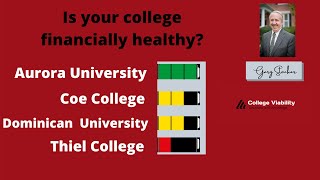
In this video, the presenters use the College Viability app to evaluate the financial and academic health of four private colleges—Aurora University (IL), Coe College (IA), Dominican University (IL), and Thiel College (PA). They examine six‑year trends (as reported by the National Center for Education Statistics) for enrollment, tuition‑and‑fee revenue, operating expenses, and endowment growth. Aurora shows strong enrollment growth (+1,000 students) and a green viability rating, while Coe and Dominican have flat enrollment and receive yellow ratings due to flat tuition revenue (Coe) or expense‑revenue gaps (Dominican). Thiel experiences declining enrollment (‑400), shrinking tuition revenue, a low endowment ($33 M), and a red rating. The presenters also discuss graduation rates, using a 70 % six‑year graduation benchmark, noting Aurora and Thiel hover around 50 % while Coe and Dominican are slightly higher but still below the benchmark. They explain their red/yellow/green “battery” indicator system, set a $50 M endowment threshold, and conclude with promotional calls to subscribe, enable notifications, comment on desired college comparisons, and consider purchasing the College Viability app ($47/year) for personal analysis.
Chapters
Today's college viability app comparisons are from a viewer who requested 4 different private colleges in 3 states. As you can see on the screen, we're going to take a look at Aurora University in Illinois, Coe College in Iowa, Dominican University in Illinois, and Thiel College in Pennsylvania. Let's take a look and we'll just start with the 6-year changes. And again, I'll remind you that this is the last, most recent 6-year period reported by the National Center for Education Statistics. It's lagging a little bit, but nonetheless, it provides us trends, both positive and negative, for colleges that we review. And as we look at these 4 colleges, we can see that Aurora has done a nice job at increasing enrollment in the 6— in the last 6 years reported, over 1,000 students. And really both Coe and Dominican, being generous, have had flat enrollment. While, as you'll see as we do our comparisons, Theo College, down not quite 400 students over 6 years, not a good pattern. Tuition and fee charges, this is the revenue that colleges collect from students. It's good to have a higher number for colleges, not so much for the students, but nonetheless, tuition revenue is a major source, the major source in most cases, of revenue for these colleges. And again, we can see that Coe has done a really strong job. Dominican, slightly less, but nonetheless driven about $1 million per year in increased revenue, not a bad job at all. We'll come back to the graduation rate in a minute. But what we do in large part on this 6-year comparison screen is we look at the combination of the change in expenses over 6 years and the change in revenue. And just to compare the 4, Aurora University has driven up expenses about $19 million, revenues up about $13.5 million.
So about a $5, $5.5 million gap there. For Coe College, expenses up not quite $3 million, revenues, not a good pattern here, down almost $4 million.
So about a $7 million change to the negative over the 6 years. And Dominican expenses have gone up $13 million and change and revenue not quite a million. So about a $12 million gap to the negative there. And then lastly, Theo College clearly has had some concerns the last 6 years. They have worked hard to drive their expenses down, not quite $2 million, but their revenue has fallen 5 or 6 times that at a little over $7 million in the 6-year reporting period.
And then lastly, we have the change in endowment. And we can see over the last 6 years which of these colleges has done the better job by comparison of driving up endowments. And we can see that in our case of these 4, Dominican has had the strongest growth. But it looks to go and look at the endowment tab on the College Viability app and look at the overall numbers. So let's just do that quickly. The standard, if you've watched other videos before, that I use and many others in higher education use is a minimum endowment of $50 million. And you can see really that 3 of the 4 colleges here, Aurora, Dominican, Thiel, not there. Coe College at $96 million is a comfortable endowment. If you look at a lot of other private colleges, their endowment is stronger.
But again, our threshold is $50 million.
You're gonna have concerns that those with endowments less than $50 million will have more difficulty than others surviving downtrends like the one we have had with the pandemic.
And then finally, let's look at graduation rates for these 4 colleges.
And I'm just going to focus on this last year.
In 2019, you can see the numbers: 54% for Aurora, 66% for Coe, 64% for Dominican, and 52% for Teal. Teal, excuse me. You can see the change over the last 6 years. Teal has made some progress, but I'll share with you the threshold that that I use in comparing private colleges, and that is 70%. And here's what that means. If your 6-year graduation rate is at 70%, that means that for every 100 undergrads that started at your college 6 years ago, 70 of them graduated with their bachelor's degree from your college in 6 years or less. So you can see with the numbers here, really Aurora and Thiel hovering around 50%, not good at all. The numbers at Coe and Dominican, you know, a little bit below average. By comparison, you can make that judgment clearly superior to Thiel and Aurora. But again, that 70% threshold is a good number to use for comparisons. We use a red, yellow, green battery indicator to provide you with kind of a resource to more easily compare these colleges. So let's look at what battery indicator we have for each of these four colleges. For Aurora University, it's easily a green indicator. They have had strong enrollment growth. They have been able to grow their tuition revenue. I don't see that a lot in private colleges these days, so easily a green battery indicator for Aurora College. When we look at Coe, really both Coe and Dominion, I'm going to provide them with yellow battery indicators. With, with Coe, it's a small college concerned that their tuition revenue has been flat over the last 6 years. Their endowment at $97 million is a slight positive. And then when we look at Dominion— excuse me, when we look at Dominican, it's a little bit larger. They have been able to grow their tuition revenue over $6 million over the years. There's still an expense-to-revenue gap. I have concerns about their $38 million endowment, but a hesitant yellow battery indicator for Thiel, a hesitant yellow battery indicator for Dominican University. Finally, Field is a red battery indicator. Their enrollment is down. They're a small college to start with. They have had a decrease in tuition revenue fees collected in the last 6 years. Their graduation rate is modest at best, and probably not even that, at 52%. Their endowment is low at $33 million. By comparison, easily, this is one of the colleges I would be concerned about, and thus the red battery indicator rating for this college. Of these four, they're the ones that I have the most concerns about. If you want to make sure you stay updated on these private college financial health and viability comparisons, make sure you click on the subscribe button down below.
If you'd like to be notified when we add new videos, you can click on that little bell and you'll get a notification. In addition, if you have 2 or 3 or 4 or 5 private colleges you would like us to compare side by side, you're welcome to put those colleges in the comment section below.
You're also encouraged to go to our website at collegeviability.com, one word, and there's a College Viability app that you can purchase to be able to do the comparisons yourself.
It's relatively inexpensive at $47 for an entire year. You can compare colleges across the country, and it is well worth the investment, because a decision on a college that might not survive could cost you a lot more than $47. It's important to finally note that we're always talking about comparisons. Is Aurora University a better college than Theo College? I would never offer that. I provide you yet another resource to compare these colleges.
You've already looked at the campuses and the professors, the majors, the programs, the athletics, the, the other things that go with the college. We're just adding financial health and viability to that checklist. At the end of the day, it's your decision on which private college you would choose for yourself, your children, or others.