Bankrupt U: Money Trap 4: Student loans are the ultimate Bankrupt U money trap
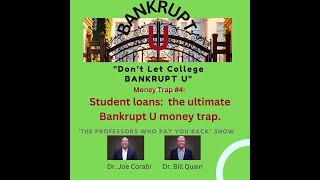
In this episode of the "Don't Let College Bankrupt You" podcast, host Gary Stocker sits down with college professors and co‑authors of the book Bankrupt U, Dr. Bill Quain and Dr. Joe Crabbe, to dissect why student loans constitute a predatory, high‑cost money trap. They argue that student loans differ from typical consumer credit because they are unsecured, frictionless, and tied to an intangible asset—a diploma—yet they carry punitive collection practices. The discussion covers the ease of borrowing for both students and parents (Parent PLUS and graduate PLUS loans), the massive debt burden shouldered disproportionately by people of color, women, and students in low‑earning majors, and how this fuels tuition inflation. They warn against loan consolidation, advocating instead for the debt‑snowball method, and debunk the myth that presidential loan forgiveness is a reliable solution. The hosts also critique colleges for failing to teach financial literacy and propose that institutional reforms—such as limiting PLUS loans and integrating real‑world financial education—are more effective than legislative fixes. Throughout, the tone is conversational with moments of sarcasm and anger, reflecting the guests’ frustration with a system that transfers wealth from borrowers to institutions.
Chapters
Welcome back to another episode of Don't Let College Bankrupt You. And that's U, the letter for university, and not the Y-O-U word. Hey, Gary Stocker back again. My guests, as usual, are two college professors, Drs. Bill Quain and Joe Crabbe, who pay you back. These are two professors who pay you back. With more knowledge that colleges really don't want you to know. During this series of shows, as we've done, we'll talk about what colleges don't want you to know and provide some guidance on how to keep your costs down and prepare for a more post-college, more successful post-college career. Today we're doing money trap number 4: student loans, the ultimate bankrupt-you money trap. The ultimate bankrupt-you money trap. Bill Quayn and Joe Crombie, thanks again as always for joining us. A lot of publicity about student loans through all sorts of media outlets. And Bill Quayn, in the book Bankrupt U, you suggest that borrowing money for college is kind of a predatory practice. What's up with that?
Well, it's true, Gary. You know, there are so many things going. And by the way, keep an eye on me in case I come up out of my chair and start banging the desk.
Okay.
And getting real close to the screen and pointing my finger because, you know, as you know, this, this really, really bugs Joe and I. But, uh, it is very true. You're, you're taking a, uh, a per— a kid who's never been out of the house before really on their own, right? And, uh, and their parents who are desperate to get their kid into a good school at whatever the cost. And maybe they can afford it, maybe they can't. But the only people that take student loans are the people who can't afford those student loans. I mean, otherwise they could just pay for the price of college and use it. Now, take the case of a senior in high school or even a person who just graduated. They might still be 17 years old. And most people don't know this, that one of the federal student loans are one of the few loans where the, they call it, I think they call it the infancy rule or something like that, where if you're less than 18 years old, you can't officially sign a contract to be held responsible for it, but you can for a student loan. Now that doesn't happen obviously in your sophomore year, but, But you're making that decision, you're committing for 4 years. So, there's all kinds of things. Joe and I'll be going through them. And Gary, we listen to you talk about them in your podcast this week in College Viability. And, you know, this is a topic that just gets— it is predatory. It is predatory.
So, Joe Crabbe, as we'll get into the details here in a second, yeah, you know, America was built on loans. We borrow things for— we borrow money for cars and homes and all sorts of things. Why is the college loan process different, sir?
Yeah. Well, you know what? That's a pretty interesting question, Gary. I'll tell you what, you know, we need a place to live. We need a car to drive and so on. But the thing that I think is the most or the starkest difference is that we often spend a whole lot more time considering the amount of money we're borrowing when we buy a home or buy a car, we just take it for granted that, okay, you know what, I want to go to college and we need to borrow money. And I don't think we put the thought process into it. My wife and I have had many conversations over the years about buying things. And, you know, she often says that, you know, we spend less time determining which refrigerator we want than many people spend on, you know, taking out these significant loans for college education.
And Gary and Joe, if I can add a little something to that too, you know, when you buy a home, it's an asset, right? And you got to qualify for that mortgage. So nobody's going to lend you money for a house that isn't there, that you say, "Someday I'm going to have a house. Give me the money for that house right now so I'll have it when I'm ready for it." Nobody lends you money for a car if you don't have a car. So, they can take your asset back if you don't pay for that. But almost anyone can get a student loan as long as you're enrolled in school. Or if you have a kid who's enrolled in a college, you know, and the thing is there's no asset to protect that. And it's just too easy, you know. And so, when, you know, since there is no asset for it, you're borrowing it on an idea. You know, you're borrowing on the idea of college because you get nothing of value from, nothing of asset value from college. You get a certificate or a diploma. After 4 to 6 years if you graduate. But all that time you can— And so there's also really, really punitive collection procedures and criteria for this. So it's just a whole system set up that meant to do some good. And what it pretty much has done is it has given colleges free ride to charge whatever they want. And students and parents to, to buy something that isn't there. And when they graduate, they still have no proof of it.
Gary, can I jump in also, too? You know, there's a thing called a cultural norm. And, you know, sometimes people fall into the trap that, all right, well, you know what, every kid's got to go to college and we need to borrow the money. It's going to work out in the long run. You know, they're going to get a good job, all those different types of things. There's no guarantee with that. You know, you might get out with a piece of paper, but that piece of paper might truly be worthless and certainly not worth the amount of money you're going to be spending for it.
So, Bill Quayle, I want to talk about the eligibility for a student loan. You write about this in the book Bankrupt U. Really, not only can students readily get loans, but this loan industry for higher education has now moved on to parents. You can get loans for their students. Talk about that.
Well, it's called the Parent PLUS Loan, and I think it's for parents, a parental loan for undergraduate students or something like that. Yeah, PLUS Loan. And so, so for federal loans, students are limited, and, and the, the newspapers and the colleges are always talking about this. I can't believe that the newspapers miss this. They really do. They say, okay, you— a student can only borrow from the federal government $5,500 for their freshman year and then $6,500 for their sophomore year, $7,500 for junior year and $7,500 for senior year. And then there's some money left over. There's a cap on that. And so they keep saying, oh, well, the average student only graduates with, I think it's $28,000 in debt. That's the average student who has a student loan. And so see that people say that's not so bad. But the thing is, the brunt of this is borne by parents with these PLUS loans. And again, the, I mean, unless you just have really terrible credit, you're going to get a PLUS loan as a parent. And a parent can borrow up to the amount of the cost of attendance at the school, which can be, you know, $95,000 a year. Now, you subtract from that any grants or need-based aid that student got and that sort of thing. But still, it's, you know, parents can borrow, you know, $50,000 a year as well as the, you know, the $5,000, the $7,500, whatever the students are borrowing. So, and that you never hear about that. And then there's a second category of loans, which a PLUS style loan is for graduate students. And there's almost no limit up to the, the total cost of attendance of the graduate students combined. And that's a real— I don't want to use the word that I was thinking of, but that's just not right. I mean, because a lot of these graduate degrees are simply moneymakers for the university and the students are a lot of them. So, they end up with tremendous amounts of debt.
And Joe, I'm going to kind of A different question here. I'm going to make you king of the mountain. You're going to speak from the mountaintop, and your audience is going to be those parents who are considering that Parent PLUS loan for their students. What kind of guidance would you give them from your mountaintop there? Go ahead.
Remember, you're going to have to pay it back. Uh, that would be, you know, that would kind of, you know, it's not free money. Um, oh man, you know, you know your kid, all right? So I mean, the reality is you're making an investment here I'm going to try to be diplomatic about this, but look, you know whether your kid's going to be able to achieve the end result that that loan is supposed to address. Look, parents want to help their kids. I mean, it's that simple. And you know what? I'm going to go back to the term I used earlier, cultural norm. I think there's a whole lot of pressure you know, within the whole parent community to send their kid to school. And I think you can't fall into that trap. You have to realize that this is money borrowed that has to be paid back and, just be cautious. Uh, I would actually, well, this is the time Bill and I have spoken about this, about having that conversation with your son or daughter about the return on investment, you know, uh, I'm not going to use any specific majors, but we all know that there are some majors that are going to, you know, yield a better return on investment. So, you know, certainly you need to have that conversation and be very, very, very careful on where that money's going.
So, so Bill, Joe just talked on this, and the main— we talked about majors in a previous show, in a previous episode, and you write in the book that some majors, some even groups of students are more at risk for student loans than others. Talk about that.
Yeah, this is pretty startling. This is pretty startling. The studies show, and I mean, these are facts, these have been in Wall Street Journal and Forbes and all that kind of stuff. I mean, this isn't just making this up, that the people who have the most loans are people of color, and particularly Black people. And another high group is women, you know, so, and they tend to, and these are again studies, the women and people of color tend to take majors that are less technical, less high-paying, that sort of thing. And so it's a double whammy. And then there are, as Joe says, we don't like to use specific majors, but there are majors you can take in college that focus on that sort of thing. And then you're more likely to be in debt and you're You're more likely to have a low-paying job on top of that. This again goes back to that predatory status that we think loans have. I want to throw in one thing from our book that we have. We have a chapter called Frictionless versus Friction More. And Joe and I coined these, well, frictionless was around for a long time. Joe and I coined friction war. And the problem with a student loan, whether it's for a parent or for the student themselves, it's just too easy. It's just frictionless. You never see the money. So, it's not like you— because the money goes to the school. So, it's not like you had the money in your hand and then you had to give it to the school. You know, you just sign a piece of paper for it. And this is really dangerous stuff.
Gary, you know what? And Bill, picking up on that too, you know, people have talked about the drastic increase in college tuition. And, you know, you can— you know, it's not too difficult to venture into a relationship here. The easier money gets, right, the easier it is for that college to raise tuition. Alrighty. And, and, uh, you know, that ease of borrowing, it just adds to the whole thing about the rise in college tuition. A college is not going to worry about it if you can pay and if you can get the money. We're going to— you have to remember this, all right? You know, I don't want to be callous here, but the college doesn't care how much money you borrow, all right? There's nobody on the college campus saying, oh, well, you know what, uh, Gary, you probably hit your limit for this year.
No.
What they're saying is, look, this is what you need to attend here. So, you know, there's that concern about the colleges are not concerned about how much money you borrow.
Colleges have convinced themselves that they're worth it. You know, no matter what outrageous amount they charge you and which, you know, really dumb major you may decide to take, college just looks at it as a seat. They don't care if they have— they've got to fill up seats and they've got to fill up seats in certain classes. So, they're happy to have you come and take a major that isn't possibly going to pay you back because they get the same amount of money for that as they get for the one that stands a good chance of paying you back. And You know, they're just unconcerned, but they're, you know, and it's not because they're morally bad, it's just because that they have convinced themselves that this is the way it should be, that what they're giving you is so valuable that it's worth almost any price.
Anyway, to be fair, in many cases it is valuable. In many majors, it is a valuable experience. But you're making the case in the book "Bankrupt You" that in too many instances, Bill, those majors make it a very, very poor financial decision. Is that a fair summary?
Well, you're welcomed with open arms to any college for whatever major you want. Like, if you qualify to be in that college, you're open, you're welcome with open arms because they still think that teaching you, you know, Joe and I, We talk about a mythical major called the Magic Bugs of Nicaragua. And there are some majors that aren't too far from that, but we use that because we're afraid to— We still want to have lunch with some of our colleagues in the cafeteria. So we said, "The Magic Bugs of Nicaragua. You major in the Magic Bugs of Nicaragua. The college is just as happy to have you there." Gary, you're right.
Gary, you are correct though in saying that, and that goes back to your question of me a little while ago, this is the time as a parent to sit down and kind of make sure that that choice of major, you know, is going to yield that kind of return on investment. Yeah, listen, there are tremendous majors in colleges and there are needs in society that those majors, you know, can address. But, uh, there are many out there that those majors are not going to address because there's no need.
Yeah, yeah.
Gary, let me just say one more thing on this before we get off this part of here.
Yeah, yeah, please.
You know, we, uh, we didn't write the first part of Bankrupt U. Remember, Bankrupt U has, has two major parts to it, okay? The first part is, is, you know, saving you money in college, okay? Uh, and the second part is how you make money and create wealth after college. And no college teaches you that. There's none. Joe, I'm just totaling them in my head. I got zero again. I don't know.
Yeah, I keep coming up with the same number, Bill.
So, the first part of the book though is what people don't know about college, what it really costs them. And here's the thing. If you're a person who's going to a college, where you're really qualified for that college. Okay? So, maybe you're getting merit, you're picking a good major that's really going to help you have a real chance at life in paying this back, not just paying debt back, but paying back the investment that was made there or making that investment worth it. That's not the people that the first half of this book is for. The first half of this book, that second half, you still need that because the colleges don't teach anything. But the first half of our book is for the people who just don't know this stuff and it's really costly.
And Joe Kroby, one of the co-authors of the book, Bankrupt U, and that's U for university, not Y-O-U, you write that students should never consolidate student loans. Give the analogy, give the example behind that and why they should not. Consolidate loans, Joe?
Yeah, well, you know, you have to remember this too, that, Gary, when you borrow money, normally you're borrowing it year to year. So you may have a loan during your freshman year, a loan during your sophomore year, and so on and so on and so on. And, you know, there's certainly many variables on that as far as the accruing of interest and so on. All right. So the one of the— I'll call it gimmicks or tricks that loan companies will use is you'll get this letter when you graduate. They'll say, look, you know, why don't you make it easier on yourself and consolidate these loans? And we're going to charge you, you know, an X percentage rate. And it might even be lower, by the way, than your yearly loans. But the problem is when you set that agreement, very often you might be setting an agreement that reaches out 20 years before you actually pay that back. Alrighty. So you can wind up actually paying more, uh, if you consolidate your loans. Now, Bill and I, we buy into the, the, the whole approach of Dave Ramsey, you know, the debt snowball, and it's in the book. And my goodness gracious, look at it because, you know, it's a systematic way of paying off your debt without consolidating your loans. It makes absolute sense. Does it require some sacrifice? Of course it does. But Bill and I strongly advocate do not consolidate your loans. The chances are you're going to wind up paying a significantly more amount of money over the period of time than you would if you, if you use the debt snowball.
And that is just a function of math because you're going to have more interest costs associated over a longer period of time even though the rate may be lower.
Exactly.
So, Bill, there's a heading in the book, bottom of page 62. I can't believe you guys wrote this. It says, Bill, my friend says she owes more money now than when she took out her student loans. How is that possible. Bill Coin, come on. What's going on there?
Well, it starts with the fact that, as Joe said, you're borrowing, actually, you get loans each semester sometimes, some of the ways you do it. It depends on how you're borrowing it, but at least you're doing it year by year at the minimum. And so your freshman year, you borrow some money and your parents borrow some money. Now the clock is ticking. It says the agreement you'll get with the loan company is you don't have to start making payments on your loan until 6 months after you graduate. And, you know, and remember that only 40% of the students graduate within 4 years. You know, 60% graduate in 6 years. So that interest could be accruing on that freshman loan for 6 years, 6.5 years before you even start making your first payment on it. The other thing is people get in a little, get in trouble sometimes and they'll get, you know, the loan suspended, you know, in payments for a little amount of time or whatever. The interest usually keeps accruing. There are payment plans that the government gives you and certainly the private lenders give you. Where you pay less in the beginning, you know, supposedly you'll— oh, this is a great deal for you because, well, first of all, let's consolidate your loan into one big loan and then let's, you know, let's make— you can make lower payments when you're not making as much money. But, you know, 10, 15 years from now when you're making more money, your payments will be higher, that sort of thing. Well, sometimes those early payments don't even cover the interest. So, now, you've got interest on the interest and a lot of students find themselves owing a lot more than they originally borrowed.
And if you think about that, Bill, just a follow-up question, there's some rather sophisticated math behind that. And unless you have a good sense of how interest works, how loans work, and this is when you're, like you said before, 17 or 18 years old, you have no idea in most situations what you're signing up for when you sign up for these loans.
Well, you know, the thing is, if you paid attention in your class at college where they talk about student loans and the interest— oh no, wait, no, wait, there is no class about that. I'm sorry, I lost my mind.
You've got some sarcasm dripping out of the side of your mouth there, Bill. We need to fix that.
Well, now, Gary, one of my favorite things in your This Week in College Viability is your Is your sarcasm alert?
That's right.
You should have given us a sarcasm alert because I was going along with you for a second. I thought you were being serious on this kind of stuff.
So I'm sorry, Gary, let's see. We may as well— let me just pick up on that too. Here's the thing to remember about colleges is that many, many, many of the people who are giving you advice, what to take, what major to select and so on, who work at the college also have college loans themselves and they're still paying them off. So, you know, once again, go back to the same cultural norm. You know, just because somebody says it's okay to borrow money to go to college because you're going to make more money in the long run, that's not necessarily true. All right, so don't just take it verbatim.
Right, right. So bottom of page 63 in the book Bankrupt You There's a heading that reads, Joe Krabi, that I really shouldn't worry about debt because the president is going to forgive my debt. Without exploding the microphone, talk about that.
Well, we can start— we could probably start off by, by saying, uh, we don't have to go any farther than, than, uh, what the courts said. You know, they said that they can't do that. Now, you know, we, we know that there are executive, uh, decisions made, but they still have to pass the judicial branch. You know, it's a nice way to buy votes. Well, excuse me, let me take a step back.
All right.
This microphone is getting hot down there.
Yeah.
You know, this is the kind of thing where Bill talked about earlier about raising his finger and pointing it at the, at the camera. All right. Look, here's the deal. There are ways, legitimate ways in which you can get loan forgiveness. All right. Years ago, you might have been a teacher in an impoverished area or you may have done medical work in an impoverished area and so on. Pretty worthwhile endeavors. But that's not what you're talking about. Basically, they're, well, I'll say with 3 or 4 years ago, the president at the time said he was going to, quote, forgive loans. It's not going to happen. Come on, let's get that off the table. It's not going to happen. And by the way, if it did happen, who do you think's gonna pay for it? It's gonna be the people, the people who didn't borrow the money who are still paying their taxes. This is, it's a dead-end street. It's not going anywhere. I know it makes people feel good, but it's a dead-end street. Do you want me to go on, Gary, or can you—
I'm turning you off, Joe.
I'm just turning you off the show.
You're outta here. So, you know, we've done quite a few shows together, gentlemen, and, We talked about this before we started recording today, and there's an element of anger, and I want to kind of qualify that. You are both long-term college professors. You are still active college professors, and you're taking a position with some degree of emotion, properly controlled. I tease you, I know, properly controlled about what's going on with higher education. Why is there that level of emotion, Bill Quinn?
Well, —general level of emotion among people who work at college. I mean, there are not many of us that get exercised about this, you know, as Joe and I do. But it makes us angry because we just see the, you know, the whole system set up to have a huge transfer of wealth from people who are desperate to have a better life, and they've been sold this idea that going to college in and of itself is all you need. And then we see the— we work with people who don't feel that this is out of line. And so it really does bother us. And it's really what started us with the Professors Who Pay You Back. They say that there's $1.7 trillion of outstanding student debt, but that doesn't count the money that was paid back. And that doesn't count the money that was paid to colleges out of people's pockets and out of parents' retirement funds and that sort of thing. So, it's really quite a problem and it started out as a good idea, but it's run amok now.
Yeah. And I want to talk about, and again, at the end of each chapter, you offer some guidance to the readers and how do you avoid or minimize the student loan money trap? And there's, read the book is the first one. And the second one we've talked about before, but I want to pound on this again. And Joe, I'll go to you on this one. Take a major that's going to pay you enough to create a reasonable cash flow is the term that you use, but a reasonable compensation. Joe? Yeah, Gary, I think that's the most reasonable approach.
I mean, know what you're getting into, know what your money is buying, and you have to calculate whether the risk of borrowing money and having to pay it back is going to yield the proper return. And I'm going to go back. Don't forget, one of the main audiences of what Bill and I do as parents. This is your time as a parent to continue to parent. Alrighty, you need to, you know, just because that kid's graduated from high school, you've got the experience. You've, you know, you've got to sit down and you've got to talk to your son or daughter about the return on investment. And we keep going back to that. Alrighty, we understand people's passions. We understand that. And that's a, you don't want to take somebody's passion away. But you have to couch that with, you know, with a reasonable rate of return.
Yeah. And so, Bill, the third one is effectively if someone at a college, someone at a college says, don't worry, be happy— I made that part up— don't worry, you can get a student loan and then pay it back with all the money you are going to make, you conclude don't blindly believe them. Summarize that for us.
Yeah, I always think it's ironic when I write the word don't blindly believe somebody because as many of our viewers know, I'm blind. So, you know, so, but here's the thing. You're going to be told a lot of things, but you're going to be told a lot of things by people who have a benefit coming to them if you believe them. And, you know, here, as we're talking about this, Gary, I'm thinking to myself, listen to Listen to the rhetoric we've used today, you know, Joe and I, and, you know, we're still living under our agreement that you made us sign before the podcast today, before the show today. But think about it, we should be talking about what college does for you. You know, it gives you a chance to grow, mature, build relationship, lifelong relationships with people. It gives you a chance to explore some great thinking and that sort of thing. There's all those things and we should be talking about that. But you know why we're not talking about that? Because it gets overshadowed by the frightful amount of money that colleges cost today and how little colleges teach you about how to handle your money and how to have a wealthier life. And so all the good things that colleges do get lost in this discussion because of one thing, because they just refuse to acknowledge the financial situation of most their students and the students' families and then do something about it, do something constructive about it. And that's all it would take. Listen, if colleges were doing that, we wouldn't be having this talk.
So we're going to wrap this episode up with going back to both of you to talk about the changes that we've started seeing being proposed since January 20th of this year. And Joe, I'll start with you. Talk about those changes and how they impact what's in the book and how they might impact students going forward. And then, Bill, I'll go to you with the same question. Joe?
Gary, yeah, Gary, I'm assuming you're really speaking about legislative, uh, legislative types of changes. And yes, there's a— look, there's an increasing focus on everything we've spoken about, not only this week but over the previous weeks. Okay, you've kidded me a little bit about my age over the years. All right, here's the bottom line. Here's what my wealth of experience says. After all is said and done, there is usually more said than done. So That's really good. I pretty much ignore just about everything that comes out of Washington. All righty. Look, there are lobbyists. We have to remember, it's like playing football. You know, you might be a really good player on one side of the line, but you got to remember there's somebody being paid on the other side of the line that's just as good as you are and is going to try to stop you. So no matter what you hear publicly, there are financial support being given to various legislators from a very, very powerful organization that doesn't, is not going to benefit if changes are made. So listen, you know what? Let it ride out. Let's see what happens. I'm not going to lose any sleep over it because I don't think anything's going to happen.
Interesting. Bill Quayn, what do you think?
Well, I mean, the two things that are kind of on the table right now, one thing I think has a chance of passing, I think. The two things that are on the table are to limit the amount of money for PLUS loans and for graduate PLUS loans. I think that's got a chance at it happening. But I think the colleges are going to fight it tooth and nail because that will really gut them financially if that happens. The other thing, of course, is colleges being held responsible. I just listened to your podcast this week on college viability, this week. And I heard you say, Gary, you don't think that's going to happen. I heard Joe just say, I don't think it's going to happen. I just can't imagine that that's going to happen. It's complicated. But I'll finish with this, that we don't even need that. The thing is we don't need legislative action to cure this whole problem in the next year and really mitigate it. We don't need any kind of legislation. All we need is for colleges to step up and just teach their students. Joe and I put some stuff together where we talk about preparing students for 3 things: money, independence, and real-world readiness. And if colleges would just let go of some of these really old-fashioned, out-of-date, you know, I don't know how to even describe it, but the courses that they make students take, you know, in the general studies program and replaced it with realistic, you know, training for people not to get a job, but to live, that would solve this problem right away. Now it's not gonna happen because again, that's not in the college's best interest. But that's all we would need. So I don't have much faith in the legislative process. I have even less faith in colleges, but we don't need the legislation if colleges would change.
So let's call that a wrap for this episode of Don't Let College Bankrupt You from the authors, Bill Quayle and Joe Crabbe, of the book Bankrupt You. And we talked about student loans, the ultimate bankrupt you. The New Money Trap. And this is part of a long series of shows we're doing to educate students and their families and maybe even other stakeholders in the higher education industry, higher education business, about college as it is today. So we'll continue our series of podcasts. To Bill Quain and Joe Kroby, thanks as always, and we'll be back with another episode soon.
More from Gary


What does it look like when a college increases both total revenue and total expenses?



College Financial Crisis? We look at the financial health of Bay Path U. (MA) and Coe College (IA)


Private College Financial Crisis? We look at the financial health of Hobart William Smith College


Financial Compass tutorial (Private college version.) Financial statements compiled 2016-2025.

