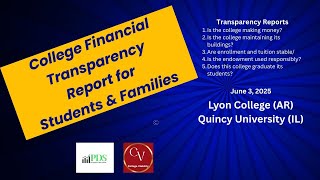
In this solo episode of the College Financial Health Show, Gary Stocker provides a rapid financial‑transparency review of two private nonprofit colleges—Lyon College in Arkansas and Quincy University in Illinois—targeted at prospective students and their families. He evaluates each institution across five core questions: (1) profitability (net income margin), (2) enrollment and net tuition revenue trends, (3) building maintenance (CapEx vs. depreciation ratio), (4) endowment usage (size and draw rate), and (5) student graduation outcomes (4‑year and 6‑year rates). Using audited financial statements, the Advanced Compass database (≈1,300 private colleges), and the College Viability App, Stocker shows that both schools have posted zero or negative profit margins for most of the past 8‑9 years, declining or flat enrollments that sit below the 25th percentile and near a red line representing recently closed colleges, and insufficient capital investment for facility upkeep. Lyon College’s 2020 endowment gift temporarily boosted its financial position, keeping its endowment draw near the median 4.5% benchmark, whereas Quincy University’s small endowment has been drawn at alarming rates (up to ~40% in 2024), signaling distress. Both colleges fall short of the 50% 4‑year graduation threshold, with six‑year rates also below that benchmark. Stocker advises families to treat these indicators as warning signs, encourages careful college selection, and invites requests for future reviews via gary@collegeviability.com.
Chapters
It's the College Financial Health Show with Matt Hendricks and Gary Stocker for Tuesday, June 3rd, 2025. While Matt is away with his family for a bit, I'm doing the show solo and with a slightly different focus. I'm going to do a college financial transparency report. That is for students and for their families. And it's important for colleges to be transparent about their financial health, good or bad. And this show, the specialized show for students and families, will help those students and families understand basic measures and comparisons of a college's financial health. Now I'm going to do 2 colleges each time that I do this, and it's going to be a relatively rapid review with only 5 points of emphasis. The first question I'm going to ask and answer for each of these 2 colleges: is the college making money or losing money? It's important for any business. The second will be: are enrollments and tuition revenues stable, declining, or growing? The third question: is the college maintaining its buildings? This is a safety question. I'll explain that during the course of the show. And number 4: is the endowment being used responsibly? We have a measure we'll show you on that. And finally, does the college graduate its students? In addition to that, we'll look at how much tuition discounting colleges do to get students in the door. The two colleges we're going to look at today are Lyon College in Arkansas and Quincy University in Illinois. And we start with just looking at that, that first question: is this college making money or losing money? And the first parameter we're going to look at— and this information comes from audited financial statements— so colleges, they're themselves have submitted and approved this. This net income margin, it's a profit margin. Private nonprofit colleges don't call it that, but that's what it is. It's how much money they have left over after they've paid all of their expenses. And we can see for our demo today that Lyon College will be the blue line in all of our slides that I'll show you, and Quincy University in Illinois will be our green line for our comparisons. And we can see when we start at— when we look at both of these colleges, that both have had issues. Now the one exception to that is Lyon College had an exceptional endowment donation back in 2020, and so their situation changed briefly for that one year. We can see both Lyon College and Quincy University have had net income margins of zero or less really for most of the last reported 8 or 9 years. That's not a good indication. Next, we're going to look at the enrollment and the tuition revenue, or net tuition revenue associated with that. And for the two colleges we're looking at, Lyon College and Quincy University, we'll look at the raw values first, and this is FTE, which stands for full-time equivalent undergraduates, enrollment number, and it kind of is a standardized enrollment number. And we can see that really for both colleges, they have had overall decreasing to flat trends. Lyon College has more of a decrease, Quincy University had a decrease in the first set of years, and is up just a little bit in the last 2 or 3 years. But more importantly, let's look at the, let's change the measure and let's get the percent change. And this is not good. And let me kind of go over the data marks for you. The top line is the 75th percentile. There's about 1,300 private colleges included in this database. This is from the Advanced Compass from Perspective Data Science. This is the 75th percentile. So all colleges below this are below the 75th percentile. All above it obviously are above it. The median line, which I'll talk about often, is, is the middle, the median value for all these 1,300 colleges. And the long dashed line is the 25th percentile. So we can see that really both of our colleges are at below that 25th percentile. They're shrinking. Both Lyon College and Quincy University have shrinking enrollments. That's pretty obvious here. Now the one line I didn't mention initially was this red line. And you'll see this red line in all the charts for most of the reports that we're going to do. This red line represents a set of 9 recently closed private colleges. You don't want to be anywhere near that red line, and you see that for the most part, our colleges are dangerously close to that same line as colleges that have recently closed. Both were below it significantly in the early 2000s, in the late 2010s, and both have gone a little bit closer to it in the, in the last 3 years. And then we wanna look at the revenue that comes from that tuition. So net tuition revenue, first let's look at the millions, and we can see that Lyon College is about $7 million in 2016 and down to $5.5 million in 2024. That's a small number. Quincy has inched up a little bit from $10 million up to about $17 million and change in 2024. But again, the percent change is what we want to look at. And let's start with Quincy. And Quincy indeed has been able to increase the net revenue that comes from tuition from its students. That's a good business thing. Your students may not like that, but they're getting value from that because the college is growing its revenue source. We can see that the percent change for, like, Lyon College has a negative downward trend. Not good overall for Lyon College because their net tuition revenue is going down The third question we ask in this financial transparency show is, is the college that we're talking about maintaining its buildings? Now, there's a little behind-baseball, inside-baseball behind this, and let me explain how this works. You can see the line, the line for Lyon College and the line for Quincy University. The minimum threshold statistically, numerically, for colleges to show that they're maintaining their buildings is a ratio of this CapEx depreciation— that's the inside-baseball number— of something greater than 1. All right, trust me, that's what the value is. And we can see that really since 2016 and up until 2024, neither of these colleges did a good job of maintaining and providing enough cash, providing enough reserves, provided enough resources to keep and maintain their buildings. You may have seen holes in the roof, you may have seen holes in the parking lot, mold on the walls, those kind of things. But if you're not investing in your buildings, that's reflected in this number, and both colleges can do better. Both of these colleges can do better. The fourth question we're going to look at is, is the endowment being used responsibly? Now, responsibly is a, is a word with emotion attached to it, and I'm going to show you two values for our colleges. And again, Lyon College is the blue line, Quincy University is the green line. This is the beginning of the year endowment value in millions of dollars from 2016 to 2024. You can see the 75th, 50th, and 25th percentile lines here. And as I shared earlier, in 2020 Lyon College received a significant gift, and it's definitely a significant endowment gift. I don't remember the number off the top, but the value went from $60 million in 2020 up to $97 million, so $30, almost $40 million in that one year. And they have kept that number pretty high, although they're drawing it down just a little bit in the last couple of years. The endowment at Quincy University has been much, much smaller. In 2016, it started at $17 million Now it's up in 2024 to $23, not quite $23 million. That's the value. But let's see how responsibly they're using this. This is something called endowment appropriation, more commonly called the endowment draw. How much money is a college drawing out of its endowment? An endowment is really, in essence, there to help this college live into perpetuity. So you don't want to take much of it. And the standard number is about 4.5%. And if you look at the median line here, it's right around that 4.5% value all the way across. It varies a little bit, and we can see from our chart here that the endowment utilization for Quincy University has been on the high side. This is 10% in 2018, 5%, uh, 5% still in 2021. But look what happened in 2023— 20%, almost 21%, and in 2024, almost 40%. This is a sign of college— of a college in, in distress and using the, the money from the endowment to do things like keep the lights on, to meet payroll, those kind of things. This is not a good indicator for Quincy University. On the other hand, because they had that large gift in 2020-2021, Lyon College is doing better. They've not had to draw such a large percentage because their endowment value is higher, which We saw that up here in 2024, it's almost $100 million. Quincy University is not even $23 million yet. So they've done a decent job, and in all honesty, probably the value of that endowment, as long as they don't consume it a lot— and I have some concerns about that— Lyon College is probably okay for a few more years. Quincy University, I have some concerns. I have some concerns because of this excessive utilization of their endowment just to keep the lights on. And finally, we wanna look at the 4-year graduation rate. This comes from the 2025 College Viability App, and I've got the 4-year graduation rate. You can see the numbers for Lyon College and for Quincy University from 2016 through 2023. That's the last reported data. The data from something called IPEDS usually lags about a year and a half or 2 years. And the minimum threshold we have here at college viability is a minimum of 50% of your students, your undergraduate students, graduate in 4 years. And you can see that neither of these colleges are graduating students at that rate. I can even take a look at a 6-year graduation rate for both these colleges, and we're going to see that not— that even after 6 years, neither Lyon College nor Quincy University graduated even half of their students. On occasion, they have hit that number, but overall, the average is below that 50% threshold. Threshold. So how do you use this data if you are a student or a family member? We looked at 5 key questions about a college's financial health—Lyons College and Quincy University—and this show is, is really part of a project that's being developed to provide more and better financial transparency, clarity, to students and their families about colleges they are considering. Be careful about choosing a college in comparatively poor financial health. And the tools we just showed you are good indicators of colleges that are in both poor, relatively poor financial health, and those that are in good, solid financial health. And during upcoming shows, I'll cover both the financially strong and the financially weak colleges for your consideration. If you have requests for colleges to be reviewed, drop me a note to gary@collegeviability— that's gary@collegeviability, one word— gary@collegeviability.com, and I'll be sure to add those colleges to future shows. Thanks for watching. For Matt Hendricks, I'm Gary Stocker.