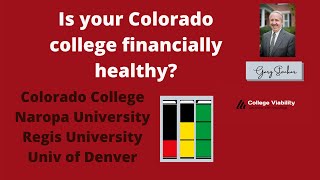
In this Financial Health and Viability episode, Gary Stocker evaluates the financial condition of four private Colorado colleges—Colorado College, Naropa University, Regis University, and the University of Denver—using data from the federal government (2014‑2019) displayed in his College Viability App. He walks through key financial indicators: full‑time enrollment trends, tuition‑and‑fees revenue, six‑year graduation rates, changes in expenses versus core revenues, and endowment size. For each school he notes whether the metric is improving, flat, or declining, compares them against informal thresholds (e.g., 70% graduation rate, $50 M endowment), and then assigns a color‑coded “battery” rating (green = financially strong, yellow = watch, red = serious concern). Colorado College and the University of Denver receive green batteries, Regis gets yellow, and Naropa receives red due to flat enrollment, shrinking tuition revenue, low graduation rate, and a sub‑$10 M endowment. Stocker cautions viewers that even green‑rated schools may have expense‑growth issues (as seen at Denver) and advises prospective students to ask admissions about potential program cuts. He invites viewers to suggest other colleges for comparison and emphasizes that the analysis is one factor among many when choosing a college.
Chapters
Today's Financial Health and Viability episode looks at 4 private colleges in Colorado. They are Colorado College, Naropa University, Regis University, and the University of Denver. 2 of the 4 looks financially strong. 1 of these 4 has some concerning trends that we'll share with you, and 1 is not in good financial health and probably is not viable in the long term. Hi, my name is Gary Stocker. For the past 5 years, I have been researching the financial health and viability of private colleges in the United States. In 2020, I created and released the College Viability App. As more private colleges succumb to the financial pressures, you'll want to be able to compare one against the other, just like you do for everything else—majors, tuition, faculty, campus, extracurriculars, and things like that. During this video, I'll share with you how to quickly and easily compare the financial health and viability of private colleges. Today's episode is on 4 colleges in Colorado. And we always start by looking at the summary screen, and you can see the 4 colleges we have in front of us. Let's just take a quick look at the data on the College Viability App, and this is the 2021 version, and all the changes are from 2014 to 2019. That's the latest data available from the federal government and in effect from the colleges themselves. It's a little slow, but nonetheless, it still provides us with both good trends and bad trends. And let's take a look at these 4 colleges and the change in full-time enrollment over the 6-year period. And we can quickly see that 3 of the 4 had decreases. Now both Colorado College and Naropa had modest decreases, not that big of a deal in the overall scheme of things. We'll take a closer look at Regis in a few minutes. And the University of Denver over the course of 6 years had an enrollment increase of not quite 300, so approaching 50 students per year. Not bad in the overall scheme of things. The next category that we look at is tuition and fees. And this is what the colleges collect in tuition and fees from the colleges. The higher the number, the better off for the colleges. Of course, that means students are paying more tuition. But there is that delicate balance that colleges try to match with revenue and the tuition fees themselves. And we can see that both Colorado College and University of Denver had growth in their tuition revenue. $23 million for Colorado College, not quite $40 million for the University of Denver. We start to develop concerns for both Naropa and Regis. Over the course of 6 years, their tuition revenue went down, decreased. That puts a lot of pressure on these colleges and universities. We'll come back to that in a minute. I'm going to show you the actual graduation rates. You can see some modest changes for each of the four. I want to show you the actual graduation rates. Two are good, one not so much, and one very bad. I'll show you those in a minute. And then the last thing that we do on this screen is we compare the six-year change in expenses with six-year change in core revenues. This is tuition and other sources of revenue that colleges, in this case private colleges and universities, have. And we can see that Colorado College had expenses go up $45 million and revenues go up $75 million. Really good. You're going to see we give Colorado College a high ranking here in a couple minutes. In this day and age, I don't see very many colleges over 6 years where their revenues, believe it or not, are greater than their expenses. Let's also drop down and look at the University of Denver. It's what I more typically see. We can see that their expenses have gone up about $130 million. Their revenue is not even $40 million. Now, as you'll see, the University of Denver has some other resources, but this is concerning. This is the kind of pattern where you might not ever see this college close, and they won't, but you might start to see them cut back on majors, on programs, on staffing to be able to better control the difference between revenues and expenses. And then let's look at Regis University. And again, we can see expenses up $1.5 million, revenues down $7 million. So again, over the course of 7 years, they had a decreased net income. That's not even fair, core revenues over those 6 years. And then lastly, we'll take a look at Naropa University. We can see expenses up about $1.6 million, revenue down a little over $2 million. The trends are not good. Let's take a quick look at enrollment. And we can see that of the 4, the University of Denver is by far the largest, followed by Regis, followed by Colorado College. And Naropa University has a, a very small enrollment in the overall scheme of things. We see the changes over those numbers, but really colleges like the University of Denver have some flexibility. With these many students, they can scale their costs across more students. Regis, while certainly a modest, medium-sized private college, you know, a loss of 1,500 students over 6 years suggests they're having trouble either with recruiting or maybe charging the tuition that they need to remain financially healthy. And then with Naropa University, they're just small, and you'll see some other concerns here in a second. Let's look at graduation rates. And I mentioned that on the first screen when we had that on the summary screen. And what I like to look at here is the actual number. And I wanna go over here to 2019. I wanna look at just the 6-year graduation rate for each of these 4 colleges for the period ending in 2019, fiscal year 2019, probably June 30th. And the threshold, if you've watched these episodes before, that I use and many others use is 70%. And a 70% 6-year graduation rate means that for every 100 students that started at a college 6 years ago, 70% of them, or 70 of them, graduated from that college in 6 years. Some may have taken 7 years, some students may have taken 8 years, many may have transferred and graduated elsewhere, but it provides us with a comparison. The higher the number, the higher that 6-year graduation rate, the more that we can assume that this college has the systems and processes to better prepare students, get students through their education to graduate. And we can see in our comparisons here, Colorado College, one of the tops. Very few get to that 80% threshold and higher. Very well done. They clearly have the systems and processes in place. University of Denver, almost as strong. Absolutely strong numbers. Regis, you know, a smidge below 70%. By comparison, you can make the case that their student population or their systems and processes, not as strong as Colorado College, not as strong as University of Denver. Which takes us to Naropa. And just looking at that 2019 number, 35% is not good. 35 out of every 100 who started there, only 35 out of every 100 who started there 6 years ago graduated. Not a good number either in the absolute or by comparison. And then finally, I want to look at the endowments for each of these colleges. And I want to look at the actual value, actual end-of-year value of the endowment in 2018 and '19, again the last available or most recent available data from the National Center for Education Statistics. And you know, when we look at the University of Denver and Colorado College, both have really, really strong endowments. The standard, the threshold that I use and many others looking at private colleges and others is anything above $50 million is okay. Anything below $50 million, you have to have some concerns, which takes us to Regis. And you can see that Regis has grown their endowment from $53 million in 2013-14 up to almost $70 million in 2018-19. You know, $70 million is an okay number. It's not a great number. By comparison, it doesn't even come close to the other two colleges, but it's above the threshold. At Naropa University, that's not the case. An endowment below $10 million is really weak. It gives this organization limited, if any, flexibility in the event of financial challenges. It questions, it brings into question their capacity to raise endowment funds. It's just a concerning number. And let me offer my final analysis of these 4 Colorado private colleges. And the indicators that we use are batteries. A red battery indicates concerns, serious concerns about the financial health and viability of a private college. A yellow battery is one that we're watching closely and we'll share some concerns that we have. And then the green battery is one that we are, as we look at this data, we're comfortable that this college is well positioned to compete in its market and to provide students the kind of education and graduation that they're looking for. And so let's start, and we'll just do this in alphabetical order. Colorado College is a green battery. Even though they are essentially flat in enrollment, they've generated more revenues over the last 6 years, their endowment is strong, their enrollment number is decent. Strong, strong green for Colorado College. For Naropa, I have concerns. I'm going to offer a red battery. They're running out of power, they're running out of juice. With which to provide the education and graduation that students, families, and community members may want from a college. Their enrollment is essentially flat. Their endowment is too small to be of any consequential material use. They have not been able to drive up revenues from tuition. A red battery for Naropa. Regis The 1,400, almost 1,500 students that they've lost is a concern. The fact that their tuition and fees have gone down over 6 years, have gone down almost $9 million, they're probably okay, but by comparison, we're going to give Regis University a yellow battery. There are some concerns. They need to drive more revenue. Their endowment is, while above the $50 million threshold, needs to be something that needs to be increased as well. And then lastly, the University of Denver, again easily a strong green battery. They're really strong across the board with that one exception that we showed earlier, and that is they really have an issue over the last 6 years of managing those expenses at $130 million and the revenue going up at only $40 million. Revenue's gone up, give them credit, but they haven't been able to manage the expense growth over that 6 period. But they haven't been able to manage expense growth over that period of 6 years. So something they have to watch. And again, that might be one of the colleges where you're talking to the admissions counselor, note this fact, ask them have they cut programs, have they cut degrees, are there plans to cut programs or degrees, and push a little bit. They may not be forthcoming with answers to some of those questions if they haven't done it for sure. But it's a fair question for you to ask. As more private colleges continue to succumb to financial pressures, you'll really want to be able to compare one private college against the other in terms of their financial health and even their long-term viability. We do these comparisons in sets of colleges in a given state. If there are some other colleges you would like me to compare, go ahead and just list those colleges in the comment section below. If you like this video, make sure to like it for me. It helps build the presence of these kind of videos for other users like yourself. And if you want notified when I post new videos, there's a little bell down there that you can ring to get some automatic notification. Keep in mind, I don't do predictions. In this case, it doesn't mean that Colorado College is a better college than Regis College. And Regis University, excuse me, I'm providing you with another resource with which to compare colleges. Like I said earlier, you compare the degrees and the majors and the faculty and the campus and the extracurriculars. This is just another factor to help you make the best possible decision for yourself, your children, your family, and your communities. Mm-hmm.