Compare Colleges -Will my college close? New York Private Colleges
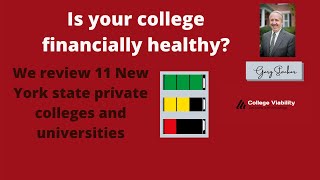
Gary Stocker rates eleven New York private colleges on financial health using six years of enrollment, revenue, and endowment data. Clarkson, Marist, and Union get green ratings. Bard and Wells show red flags for viability.
Chapters
Are you looking for more information about the financial health and viability of your private college? Are you concerned private colleges you are considering might be in danger of closing or might just be in financial trouble? Or maybe just struggling to provide a quality education. Hi, my name is Gary Stocker. For the past 5 years, I have been researching the financial health and viability of private colleges in the United States. In 2020, I created and released the College Viability App. During this video, I'll share with you how to quickly and easily compare the financial health and viability of some private colleges in the state of New York that you may be considering. I can also help you become more comfortable, more informed, and more confident in your final college decision. The 11 colleges we're going to look at in this episode are all from the state of New York. They are, of course, private colleges. The 10 colleges we're going to look at from New York State today are Bard College, Clarkson University, Niagara University, Marist College, Pace University, Roberts Wesleyan College, St. Lawrence University, Siena College, Union College, Wagner College, and Wells College. Let's look at these 10 private colleges in the state of New York. We'll just work our way down the list of 11 alphabetically. Let's take a look at Bard College. Their 6-year enrollment change has gone down over 800 students. Their tuition and fee revenue has gone down almost $2 million. Their expenses up $16.5 million, but their revenue only up $1.5 million. Their endowment has gone down $20 million. Not a good combination. I give Bard College a red battery indicator ranking. They're really running on low. You have to be concerned about their health and even concerned about their long-term financial viability. Let's next take a look at Clarkson University. Clarkson University shows good enrollment growth, almost 300 students over the course of 6 years. They have an issue with expenses and revenue, and we see this quite regularly across private colleges throughout most of the United States, and you'll see that through some of the other colleges here. But their expenses have grown almost $17 million over the course of 6 years. But their revenues have gone down almost $6 million. So that's about a $24 million gap over the 6 years reported. Having said that, when we look at the endowment for Clarkson University, it's strong at over $200 million in the last 6 reported years. It's, it's strong. When we look at their graduation rates, we can see good strong numbers. Anything above 70% I consider strong, and they have even managed to inch up their numbers in the 6 years reported from 2014 through 2019. And again, I'll remind you, that's the last 6 years of data reported by the federal government through their National Center for Education Statistics. I'm going to give Clarkson University a green battery indicator rating. They're in pretty good shape, especially when compared to other colleges. I think it's strong financially, strong with academics, as you can see reflected in the graduation rates. A good solid green battery rating for Clarkson. Marist College is next on our list. This is an easy one. This is a battery indicator of green. Marist is really strong everywhere from enrollment growth to increases in tuition and fees. Their endowment is strong. Their graduation— if we take a quick look at their graduation rates, Marist College is in the high 70s to low 80s. They've shown growth. Really green battery indicator across the board. The only item to watch, and we see this almost everywhere, is over the course of the 6-year reporting period, 2014 to 2019, expenses have grown about $48 million, revenue has only grown about $16 million. The only question you might ask if you are considering Marist College is ask what programs, what majors might be at risk because of that revenue and expense imbalance. We see many colleges in 2020 and '21 cutting back majors and programs to trim those expenses where they're not generating a lot of revenue. Otherwise, Marist, strong green battery indicator. Good choice, good college, good opportunity. For Niagara University, the concern is with the decrease over 6 years of over 130 students in their full-time enrollment. There are certainly private colleges with a lot stronger decrease, a lot bigger decrease than what we're seeing here. But we see among many of its competitors that they have grown their enrollment. Clarkson, Marist, even Roberts Wesleyan, Siena, and others have grown their enrollment. So there's a concern. And like we have seen with most of these private colleges, there's an imbalance between expenses over the last 7 years, up about $12 million, Revenue down about $2 million. And even taking a quick look at the endowment for Niagara University, we're looking at, you know, okay, an okay number. It's over $50 million for sure. It's gone down a little bit in the last couple of years, something to note, but not a big deal. We're going to give Niagara University a yellow battery indicator ranking. Just the concerns associated with over the course of 6 years not being able to grow this enrollment that's an indicator. The tuition and fee growth has been flat even though it's up a little bit over 6 years. There's just some concerns there for Niagara University. When we look at Pace University, we see good overall improvement. We see almost a 1,000-student increase in the 6-year reporting period. Their tuition and fee revenue is up over $30 million. Like we see many places, while the expenses have gone up about $50 million, the revenue has only gone up about half that much. It's worthy of concern. We'll take a quick look at the endowment for Pace University. It's at $190 million plus, not bad. I did note that looking at the graduation rate for Pace University, it's an average number. Anything 70% over 6 years and above is good. Anything below that, you've got to wonder if they can't improve the systems and processes needed to graduate a higher percentage of students that start at Pace University. They have similar issues with expenses and revenues that we see everywhere, but they've got good enrollment growth. I'm going to give Pace University a battery indicator of green. They appear to be overall in good shape, especially when compared to their competitors. Let's look at Roberts Wesleyan University. We're gonna look at slight enrollment growth. I'm gonna call this flat. Tuition and fees increase is modest at best. I'm gonna call that flat. We'll look at their graduation rate here in a second. Modest differences between their expense and revenue management. Let's take a quick look at their endowment. The endowment for Roberts Wesleyan is a small $29, $30 million number. Again, a standard that I use, that many use in evaluating higher education institutions, is $50 million or less in the endowment is a minimum. Roberts Wesleyan is way below that. I also wanted to look at graduation rates for Roberts Wesleyan. And again, in the group that we're talking about, they're all right. They're not great. They're below some of the higher performers here, but they're above organizations like Wells College. And Pace University. I think the overall evaluation of Roberts Wesleyan is really— I'm going to leave it at yellow. The graduation rates jump out at me, the small endowment jump out at me. I think that's the fairest evaluation given their competitive status with their— with other organizations in the region. For Siena College, I'm going to lead with the College Viability App screen on 6-year graduation rates because they're strong at 80%. They're one of the top 4 in this group of 11, and again, anything above 70% is strong. I'm also going to click over to the endowment link. Let's go back and look at the 6-year changes for Siena College. Enrollment is flat for the most part. They've taken a little bit of a hit on tuition and fees. I don't like to see that number go down, especially over that longer 6-year period of time. And expenses, you know, up about $4 million. Core revenues, tuition fees and other things, down $12 million. It's a concern. They took their endowment down a little bit over the 6 years, but it's so large, not a big, not a big item to be concerned about. I would keep an eye on their tuition and fees over the next couple of years. If it continues to go down, they may be forced to continue to discount tuition more than they would like to keep students enrolled in the college. I'm going to still give Siena College a green. Their endowment is so strong, and the losses that we're seeing, the decreases that we're seeing from expenses and revenues, are manageable, especially again compared to other private colleges. For St. Lawrence University, I'm going to again lead with 6-year graduation rates. Really strong number. For every 100 students who start as undergraduates at St. Lawrence University, 84 of every 100 end up graduating with that bachelor's degree from St. Lawrence University in 6 years. We just don't see that enough. We go to college to graduate. St. Lawrence, Siena, and others on this list do a good job. You'll see in many other areas of the country not nearly as good of a 6-year graduation rate as we see in this sample from New York State. We see similar issues that we've seen almost everywhere else, a big increase in expenses at about $16 million and about $5.5 million decrease in core revenues. They've gotta watch that. Again, the question you wanna ask admission reps when you see these numbers is, which of the programs are at risk of closing? Which of the majors are you gonna think about not holding onto because you have expense issues? We'll look at the enrollment, and for St. Lawrence University, it's strong enough to be able to survive some minor ups and downs. It's been essentially flat over the 6 years. The endowment is strong for St. Lawrence University at over a quarter of a billion dollars, way over. So, so easily I can give St. Lawrence University a battery indicator of green. They've earned it, they deserve it, and they're one of the few colleges that we will consistently see perform like this. For Union College, we're going to lead with the endowment. You can see I've highlighted it here, almost a half a billion dollars in endowment, the strongest in this group, one of a small set of colleges throughout the country with that strong of an endowment. I am going to go back and look at the 6-year changes, 6-year changes for Union College. They have struggled with enrollment, but even with that, they've been able to grow Their tuition and fee revenue over $7 million. There are the same issues we see everywhere else, around $40 million gap between the increase in expenses and the decrease in revenues. Union College is positioned to be able to handle this. We look at the graduation rates, and again, very, very strong. Easy to give Union College in New York a battery indicator of green, well-run college, very competitive. You can feel comfortable choosing that one because it's financially healthy and it's going to have long-term viability for sure. And before we look at Wagner College, this overall group of 11 New York State private colleges is a strong subset. I pull these from a variety of sources and resources, and overall it's a strong group, as you'll see by the battery indicators that I've shared. The only exceptions are Bard College and Wells that we'll talk about in a minute. But Wagner is strong. They have managed an increased enrollment over the 6 years. Nothing fabulous, but certainly strong enough. They've been able to grow tuition and fees. Their expense and revenue, same pattern we see elsewhere, but not as bad. A quick look at their enrollment data, and we see that Wagner College is about a 2,000-student school. Their enrollment is at about 2,000, medium-sized school. It's gone up about 9% over the course of the 6 years. Their endowment at Wagner is modest, but they have other indicators that makes them a stronger performer. We can look at their graduation rates, and again, right at the minimum that I use, so not exceptional. I'm going to go ahead and go with, with, with green with some hesitation on Wagner. The hesitation is really associated with the balance that I see here on their expenses and revenue. You just like to see some core revenue growth over those 6 years. And the final New York private college on our list today is Wells College. It's going to get a battery indicator of red, and let me tell you why. Enrollment is down. They've already announced publicly a lot of concerns about their financial health and viability. We can see that reflected in the numbers. Their tuition fees is down over the course of our 6-year tracking period. Expenses— they tried to get things under control, but the expenses didn't go down nearly as much as revenues. We can take a look at the enrollment, and compared to the other colleges on the list, it's small, much smaller than most. That's always an indicator. We can look at their endowment, and the endowment is way below $50 million, which is that minimum I've talked about before. Not a good indicator. And even when we look at graduation rates for Wells College they are in the mid-50s, and really they're all over the place for the last 6 years. So very inconsistent, but at best a mid-50s kind of number. It just, to me, doesn't indicate they have the systems and processes in place to graduate students in 6 years like many of the other colleges we've seen in this video. As more private colleges start to succumb to the financial pressures we see in today's higher education market, you want to be able to compare one against the other, and that's what we've done today. And you want to compare them in terms of their financial health and their long-term viability. And remember, we're looking at 6 years' worth of data. There's a pattern, good or bad, there's a trend, good or bad, in 6 years' worth of data. It's unfortunate that colleges and their government monitoring agencies don't get more recent data out, but nonetheless Data over a 6-year period indicates a trend. That's what to focus on as you compare colleges. While I have given red, yellow, green indicators, those are comparisons from one to the other. Can a private college with a red battery indicator provide a quality education? Certainly. Is it more likely to do so than one that's more financially secure? That's the decision that you have to make. If you want to make sure to stay updated on these private college financial health and viability videos, make sure you click on the subscribe button down below. If you want to be alerted when every new one is posted, make sure you click on the little bell to be notified. If there are colleges that you want to be compared, and increasingly I get these kind of requests, send me a list in the comment section of the private colleges you would like compared. I would do a video on the set you submit to me, and I'll let you know, and I'll post it for you to look at for yourself and to share with others. Keep in mind, it's the comparison. Just like you look at the college campus, the tuition, the college faculty, the majors offered, the programs offered, the financial health and viability of these colleges is an additional and important consideration for you to evaluate as you make your college choice. Mm-hmm.
More from Gary


What does it look like when a college increases both total revenue and total expenses?



College Financial Crisis? We look at the financial health of Bay Path U. (MA) and Coe College (IA)


Private College Financial Crisis? We look at the financial health of Hobart William Smith College


Financial Compass tutorial (Private college version.) Financial statements compiled 2016-2025.

