Judson College Closing. Compare it to other Alabama private colleges
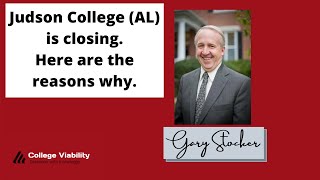
Gary Stocker analyzes why Judson College closed by comparing its finances to 11 other Alabama private colleges. Most schools saw enrollment drop, expenses rise, and graduation rates below 70%. Only Samford stood out with a $350 million endowment and strong growth.
Chapters
It was last week that Judson College in Alabama announced it is closing. It is one of an increasing number of smaller private colleges ending its operations. I took a look at their financial health and viability data from our College Viability App and the National Center for Education Statistics, and I compared Judson to 11 other private colleges in Alabama. Hi, my name is Gary Stocker. For the past 5 years, I have been researching the financial health and viability of small to medium-sized private colleges in the United States. In 2020, I created and released the College Viability App that lets users like you compare the financial health and viability of private colleges throughout the United States. During this video, I'll show you how to easily and quickly compare the financial health of some Alabama private colleges as it compares to Judson College. Maybe I can help you become more comfortable and informed and confident in making a private college choice in the coming years. Today we're going to compare Judson College, the one who is closing, with these 11 other colleges. Auburn University, Faulkner University, Huntingdon College, Miles College, Oakwood University, Samford University, Selma University, Spring Hill College, Stillman College, Talladega University, and the University of Mobile. All of these private colleges are in the state of Alabama. So let's set up how the College Viability app works, and it's the data from the National Center for Education Statistics It's from the time frame 2014 to 2019. It's a little bit dated here in 2021, but that's how slowly colleges post this stuff and how slowly the federal government makes it available to you and I. It still shows us trends and patterns, and as you'll see during this video, some of those trends and patterns for colleges, private colleges, are good and some not so good. Here are the 12 colleges I selected, Judson College plus 11 others, and you can see that they're all pretty much a similar size range from small to medium-sized the largest of the 12 is Samford University at about 5,000, almost 6,000 students in 2019. And it goes down to smaller colleges like Selma, which was just over 200 students. Let's go to the screen that compares 6 years worth of data for these colleges. And I sorted the 6-year change in enrollment for the 12 by lowest to largest. And what you'll see is most 7 of the 12 have had decreased enrollment for the 6-year reporting period, 2014 to 2019. And really 2 others, Spring Hill College and the University of Mobile, have essentially flat growth. So of the 12, really only 3 have shown significant growth: Stillman, Samford, and Talladega. Judson College was effectively flat, its enrollment, full-time equivalent enrollment, decreased about 40 students over 6 years. Anytime your business doesn't grow over such a long period of time, you have to have some concerns. But we see that pattern with others as well. Let's take it one step further, and I'm going to use Judson as our comparison. And over the course of 6 years, their actual amount of tuition and fees collected went down not quite a half a million dollars. This is over 6 years. You can see there's a variety of numbers in the 6-year changes, and really only Samford University which increased its tuition and fees about $23 million, showed any substantial growth. I'll talk about the graduation rates here in a couple minutes. But the biggest comparison is when we look at the 6-year total change in expenses compared to the 6-year change in core revenues. And again, let's go down to Judson College. And we can see that over the course of 6 years, expenses for Judson went up $400,000, not quite half a million. But its revenues went down $3 million. Not a good combination. Again, I have to reinforce it's over a 6-year period. This isn't an isolated event. But we see that pattern really with almost all of the colleges to varying degrees on this list. Let me quickly go down the list. Oakwood University, a little bit more in expenses than revenues. Selma University, $1.1 million in increased expenses, and lost revenue— that's not true— decreases in revenue of $500,000. Judson, we talked about. Miles College expenses went up $3 million, revenues up about $800,000. And you can see on and on throughout the list, the pattern holds. And even look at Samford University, which had some good student enrollment growth. Their expenses went up $30 million over the course of 6 years, and their revenue was effectively flat, down about $500,000. These are the kinds of patterns that we see on a regular basis and are one of the factors that raise concerns about the financial health and viability of small to medium-sized private colleges. Let's next take a look at graduation rates, the 6-year graduation rates. And by definition, a 6-year graduation rate is when a student graduates from a college they started at within 6 years. And so for example, we'll use Judson College as our example. And we can see that in 2019, Judson College graduated 37% of the students who started at Judson College in 2014. Now some of those may be continuing to take classes, they may have transferred elsewhere and graduated. Another way to look at it is for every 100 students who started at Judson in 2014, only 37 graduated by 2019. Now there's a threshold I use and many others use for that 6-year graduation rate. And I'll go back to the data and we'll— and that rate that we're looking at is 76%. So we're looking at, for example, Samford University has— Samford graduates 76 out of every 100 who started in 2014. The threshold is 70, and we can see that in our list of 12, only Samford meets that threshold. Meaning all the others have weaker numbers of graduating students. Here's what that tells us. Those with numbers in excess of 70% have better systems and processes in place, as the data shows us, to graduate students than those that don't. And when we look at the low numbers of places like Judson and Talladega, Faulkner, Stillman, Miles, Selma, and others not on this list, the graduation rates are really, really not good. Now Selma University, I'm looking at that, that's clearly not accurate. The federal data is not wrong, they don't have a graduation rate of 2%. So that's one of the cases where we'll just throw out that outlier. But it gives you a feel for how successful colleges are in getting students through to graduation. And the last comparison that we're going to use for Judson and the 11 other private colleges in Alabama is their endowment. And we're going to go to the last column, and we're going to see the value of their endowment at the end of their fiscal year, just to be consistent for all of those colleges. And we can see that Samford University is by far the top of the class, $350 million in endowment assets in 2019. But here's where the kicker lies. Here's where the challenges are. Again, talking about minimum thresholds, generally $50 million or more is considered a reasonably decent endowment amount. And we can see that Huntington has— is right at $50 million, but none of the other 10 colleges are anywhere close to that minimum endowment. Here's what it means. It's too much of a simplification, but it really suggests the lack of resources of a rainy day fund. Like we have had with the pandemic, like we're seeing with the pressure on colleges for tuition discounting. The colleges with endowments below $50 million are not as well positioned as their competitors to be able to survive downturns for whatever reason. So Judson being at $15 million, almost $15.5 million, not a good number. That's one of the reasons I can reasonably speculate that they chose not to continue their mission, to close their college. They just didn't have the resources. They didn't have the cash coming in, and it's reflected in all the data that I shared with you today. So how do you use this information? I'm not doing predictions here. I'm not doing guesses. I'm simply providing a tool, the College Viability App, and I'll provide a link to it down below for you to compare the private colleges you are considering. The financial comparisons need to be added to the other typical items you look at when choosing a college: the size, the tuition, the extracurricular activities, the campus, the majors, the faculty. All those things come into play, but in this day and age, it's important to add a look at the financial health and viability of these colleges, and the College Viability app does just that. Students deserve a quality college education. I want to give you information to help you make that college decision the best one possible. And it has to include the financial health of these colleges. The emotional and actual costs of having to change colleges when a college closes or you change for any other reason is substantial. Estimates have it in the vicinity of $50,000 or more for a single-year delay in completing a college degree. Granted, very few people have the skills or interest in analyzing a college's, a private college's finances. That's why I've made the College Viability App available to simply let you make your own comparisons. So far, I've only reviewed a small set of private colleges, almost all of them in the Midwest or northeastern part of the country where the greatest risk of college closures has been and will be in the coming months and years. If you have a set of private colleges that you would like me to review, go ahead and put that down in the comments and description down below. If you've liked what I've shared with you today, make sure to click on the like button. You can even subscribe to this channel to see all the updates that I do. And while you're at it, share with me the biggest concern you have about selecting a college, especially as we enter in the 2021 and 2022 college marketing enrollment period for students just now ending their junior year in high school.
More from Gary


What does it look like when a college increases both total revenue and total expenses?



College Financial Crisis? We look at the financial health of Bay Path U. (MA) and Coe College (IA)


Private College Financial Crisis? We look at the financial health of Hobart William Smith College


Financial Compass tutorial (Private college version.) Financial statements compiled 2016-2025.

