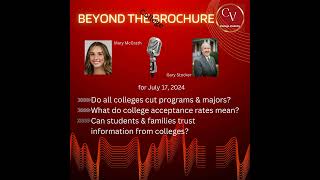
In this episode of the Beyond the Brochure podcast, host Mary McGrath interviews Dr. Gary Stocker, founder of College Viability, to discuss the financial distress facing many U.S. colleges and its consequences for students, faculty, and the higher‑education ecosystem. They explain how even financially stable institutions are cutting low‑enrollment programs such as foreign languages to preserve cash, and how closures affect graduates—degrees remain valid but alumni may experience emotional trauma from losing their alma mater. The conversation highlights that faculty and staff typically receive the same limited information as students, because college leaders avoid disclosing financial trouble to prevent a self‑fulfilling prophecy. Stocker notes a surge of private nonprofit college closures—about one per week in 2024—with many occurring on short notice, especially in the Northeast and Midwest (Pennsylvania, New York, Wisconsin, Minnesota, with Ohio, Michigan, Missouri, and Illinois also at risk). He describes “heartbeat admissions,” where colleges admit more than 90% of applicants to boost tuition revenue, leading to reduced selectivity, lower graduation rates, and heavy tuition discounting. Tuition and aid offers are constantly revised throughout the admission cycle, sometimes creating cash‑flow crises that precipitate closures. While colleges are reluctant to be transparent, Stocker promotes the College Viability app—framed as a “reverse FAFSA”—as a data‑driven tool for students, families, and faculty to assess institutional financial health and make informed decisions. The episode concludes with a call for greater data transparency and reliance on independent analytics to navigate the increasingly precarious higher‑education market.
Chapters
Hello and welcome to the Beyond the Brochure podcast, where we provide you with information and guidance about college financials and decisions. My name is Mary McGrath. I'm a rising senior at Lindenwood University, and my co-host is Dr. Gary Stocker, who is the founder of College Viability. Dr. Stocker, welcome to the podcast.
Mary, it's not as hot this week as it was last week, but it's always a pleasure to talk to you. Yep.
Yeah, I'm very grateful for that. The heat was starting to get to me a little, so It's been nice. But yes. So to jump right into it, obviously on this podcast we discuss a lot, mainly colleges that are in financial distress or on the verge of a college closure. So is it common for colleges that may not be in the situation, maybe they're a little bit more better off, are they at risk to cut certain majors or programs just depending on funding and things like that?
Oh, absolutely. And as you might guess and the listeners might guess, I follow all sorts of college, higher education topics, and almost daily, not quite daily, there, especially during the school year, not so much in the summer, Mary, there are both public and private colleges, both financially strong and financially weak colleges saying, hey, we're cutting back on these 5 majors. And they tend to be almost always low enrollment majors, low enrollment programs. Foreign languages, for example, are one of the more common ones. Liberal arts studies are one of the more common ones. So yeah, every college is cutting back. Because they have to be able to preserve their cash. So if they're paying you as an adjunct faculty member to teach a Spanish class and there's only 2 students enrolled, they're losing money. And so yeah, almost every college out there is cutting back in some form or fashion just to be able to make sure their cash they have is positive.
And to look at it from a perspective of a student who just recently graduated from a school that has unfortunately closed, would this have a negative effect on them, whether it be in like an area such as finding a job? Like, is that a negative thing on their resume?
There's no really practical impact. They've earned the degree. They fulfilled the requirements, both for the general education and the major. And they've earned that diploma, which is what you're working on right now that says, hey, I graduated with my bachelor's degree in whatever. The other part of that though is there, there is some logic and some argument that there's a traumatic impact, maybe not a practical impact, because like I said, they've earned the, they've earned the diploma, but now all of a sudden they have no alma mater. And if you spent 4 years or even more going to a college, it's been a big part of your life, especially if you're 22 years old. And even if you're 42, to look back and realize that the college that you spent all those years at no longer is in existence, there is some, some trauma, not for everybody by any stretch, but there is some trauma to recognize that name is no longer in existence, even though the academics you earned are 100% valid.
So with different college closures, obviously sometimes it can come as a surprise to different students and their families, whether they be prospective students or current students. In these situations, would you say that the faculty and staff are actually more informed about the state of the college financials, or are they kind of in the same boat as those students?
If only that were so. And to answer your question, absolutely not. The faculty and students are essentially in the same boat. They only know the information that their college leadership shares with them. And it's a sad commentary really for both parties. And I'm hard pressed to say which one is hurt more, the student or the faculty. The faculty, of course, it's their livelihood that's at risk. And the students, their ultimate livelihood is at risk, but they have some options even though it's traumatic. To move on from a closed college for lots of reasons. We can talk about that another time. But the, I can't say that college leaders have evil intention. I don't believe that they do. But they have this fiduciary responsibility, which is to look out above and beyond for the value, the safety in the organization, the continuing ongoing operations of the organization. And if they said to anybody in a public setting, 'Hey, we're running out of money,' or anything like that, Mary, it's gonna become a self-fulfilling prophecy. Word will get out, don't go to Mary University because their president said they're in financial distress. So what we're seeing, especially in 2024, and this is a sad development, is we're seeing about one private college, nonprofit private college, close per week. And more than half of those are with relatively short notice, like weeks. And when there was one last week in Chicago, it was Northwestern College in a suburb of Chicago announced their closure, Mary, on Monday, but they locked the doors the prior Saturday. And University of the Arts in Philadelphia and Wells College in New York and others, they're just not doing right by their students. And sadly, Mary, I worry that that pattern will continue. But on the other hand, here in St. Louis, there are some that do it well. Sad though it may be, Fontbonne University here in St. Louis announced their closure this past spring, but they won't be closing until about this time next year. Now, it's still traumatic for lots of reasons, but God bless them. They're doing the right thing by getting out in front of this and saying, guys, find a new job. Students, find a new college. And they're helping them find those colleges. So there are some that are doing it right, but I worry in the coming months as we see more closures, in particular because of the FAFSA debacle, that we'll see way, way, way too many colleges announce their closure on something like Friday and turn out the lights on Monday or something similar to that. And that's not good for so, so many reasons. And it's I wish that faculty would use the version of the app that we've created for them, the college and faculty version. And we have one, as you know, for both the public and private colleges. And I'll make sure to put a link in that in the show notes to spend a couple bucks to be able to look at not just their college, Mary, but to compare their college to their competitors regionally, nationally, statewide. It doesn't really matter what it is. Because otherwise they're depending on college leaders and boards who have, if not an defensible argument, at least a logical argument saying we can't tell you faculty how bad it is because of that self-fulfilling prophecy. And so faculty need to take it on their own to find something like the College Viability App and the ones specially designed for faculty and staff. Take a look at those 9 or 10 reports we've created for them. And then have an informed conversation with their bosses. Hey boss, our enrollment has been down for 8 consecutive years. Our tuition and fee revenue has been down 6 of the last 8 years. What's going on?
Yeah, so I know you mentioned that when a school is in financial distress, sometimes that demand or almost the want to go to that school obviously goes down because like you said, word gets around with that kind of thing.
Yeah. Yeah.
So does a school's acceptance rate or even their scholarships and grants that they offer also become less competitive since the demand hand is down to go to that school?
And there's, there's a few ways to look at that. And, and really the competitive piece is, is, is a term not commonly used. It's selective, right? And there are maybe 50 really selective colleges in the country. The Ivies, Ohio States, the Illinois, the Michigans, the USC, the Texas, and, and the rest are, are comparatively non-selective. And so what happens when a college is in financial trouble? Is they become even less selective. So let me give you an example, and this is for, for the listeners to be able to understand what percent admitted means. And if 100 students apply to Mary University and Mary accepts 5 of them, that's a really, really selective university. There are very few of those. But if Mary University accepts 75% of those They aren't, you know, the university is not very selective. And I can make a logical argument that they are as much accepting those students for the tuition and fee revenue as they are for their academic preparation. When that percent admitted gets above, let's say 90%, I'll be nice. So they admit 9 out of every 10 students. There's no way in the world they're anything close to selective. They're admitting students so they can pay the bills. That's harsh. It's logical. It's fair because what we're seeing is that's reflected then in the graduation rates. And you and I've talked about 4-year graduation rates before and they're abysmal, abysmal. I posted something on LinkedIn this week on my regular Top Bottom Report where I reported on the 4-year graduation rates, the 2022 4-year graduation rates for almost 1,300 private colleges in the country. More than half, Mary. And you've heard me say this before, more than half don't even graduate 50% of their students in 4 years. What a tragedy that is. And we've talked before about buyers and sellers, I think. And Jeff Salingo is the guy that coined this term. And the sellers are those top 50, the Yales, Harvards, and the other colleges that I referenced. Every other college is a buyer of some sort, and they're buying your enrollment. And they mostly do that through tuition discounts. It's mostly called merit aid. Most of them are called scholarships. It's really just discounts, just like you and I get when we go to a grocery store or clothing store or buy a car or something like that. And so it's, it's, they become less selective just to get the tuition dollars. And the consequences are not good. And I've coined a phrase for those that accept more than 90%, more than 90 out of every 100. And fair or not, I call them heartbeat admissions colleges because essentially you have a heartbeat, they're going to admit you.
Yeah. So I've never heard that phrase actually. That's pretty clever. I like that one.
Yeah.
I'll start using that. So are these college closures usually more common in a certain region of the country or is it just, that's not really a factor in this?
No, it, it's, it's a factor. And, and the, the most at-risk regions are in the Northeast and in the Midwest. And there's a logical reason for that because that's where the most private colleges, most colleges really per capita, per 1,000, 10,000, 100,000 students, 100,000 employ— 100,000 citizens, however you wanna look at that. That's where the biggest concentration is. So I've got a list of 4 high at-risk states. and I'm being nice, it should be a much larger number, but the 4 states at the greatest risk for college closures, private college closures, are Pennsylvania, the state of New York, Wisconsin, and Minnesota. I should probably add Michigan. I should probably add Ohio. But I haven't done that yet, in part because I haven't had the time. But those are high-risk states. Missouri and Illinois should be on that list in some form down the road as well because they have a lot of private colleges in those states. So yeah, it's geographical. There are college closures everywhere. This year they've been in Florida, they've been in California, they've been in the Northeast and Midwest, they've been in the South, but it's typically in the Midwest and Northeast.
Yes, so obviously when we're looking at, or when students and families, I should say, are looking at different colleges, obviously the tuition and different financial aid offerings is one of the most important things they look at, especially from the parent's point of view. So how often does this get revised by a college?
Good question. And during the admission year, constantly. And here's why. If you're applying to a college and they accept you and they make you a financial aid offer and these colleges are looking at the number of student butts— I'm sorry to be harsh— student butts they need in their seats at the start of the next school year. It's mid-July, so colleges across the country start in about a month from now, and this process probably started in April or May. If colleges are scared that they're not gonna make that student butts in seats number, they're gonna contact students and say, "Hey, you know that $20,000 scholarship we gave you? We'd like to make it $25,000." So like I talked before, they're buying your business. They're welcome to do that. There's nothing wrong with that. But at some point, the colleges then, they don't, they discount the tuition so much that they don't have the funds to make payroll. They don't have the funds to keep the lights on. They don't have the funds to make down, make payments on their debt. And that's one of the leading factors of colleges closing is they don't have cash because students are getting such monstrous discounts just to show up. Great for the students, absolutely fine for the students. And we should all get that kind of discount with everything that we do. But the colleges need some money to make payroll. The faculty and staff still demand to be paid. I mean, I'm being silly, but that's the heart of the matter. And so, yeah, they change it all the time because they want, they need, if they need 500 students, 500 new freshmen, and there are 400 in mid-July, They're scared to death that they're not going to get that number and have to do all sorts of cutbacks when the school year starts in August or September.
And although it's unfortunate and we have seen it happen in the past, would you say it's common for colleges to attempt to deceive students and families about its financial state in hopes of trying to get that number, reach that student enrollment number?
Yeah, I want to grow up to be a nice guy. And I'm hesitant to use the word deceive, but they certainly are not proactive. They certainly don't offer anything that somebody doesn't ask for. And again, it goes back to that self-fulfilling prophecy that we talked about. It's a tough gig. One of the toughest jobs in the world these days is a college president because they have so many different stakeholders, faculty and staff and students. Students' families and the community and bondholders and the list goes on and on and on. They're in a position where they're hesitant to say, hey, we're in trouble. And that's why College Viability, one of the main reasons why I had the passion behind College Viability is a private entity like College Viability needs to be out there and provide tools like we do with our app to say, hey, be careful about going to Mary University. Their enrollment has been down the last 8 years. Their tuition's been down. Their graduation rates are awful. There are better options because there are many, many financially strong and academically strong colleges. So you just have to look at the data. And I think I've shared with you before that one of the analogies that I make with the College Viability App— we've talked, we all know what the FAFSA is, of course. And I make the argument that the College Viability App is the reverse, the reverse FAFSA. Colleges know about your family's finances from the FAFSA. It's only fair, Mary, that you and your family and all the families in the country can learn about a college's finances. And the only resource without exceptional financial knowledge and looking at financial statements is to use the College Viability App. And that's why it's out there.
So how can students and families trust that the information they are getting directly from that college, that that information is accurate and correct?
The old Latin phrase caveat emptor, of course, means let the buyer beware, right? And that applies in higher education today more than ever before. And again, while colleges should be more forthcoming with their data, it's just not going to happen. And that's why, you know, there's a group of folks like me, and I was being interviewed by USA Today earlier today, and I introduced the phrase to them. There is a cadre of higher education data entrepreneurs like myself at College Viability who are taking the lead on exposing college— exposing is too harsh— publicizing, noting colleges' financial health or lack thereof. And that's the only way it's going to change is with folks using data. And it's the old Moneyball analogy like the Oakland Athletics started way back in the 1990s, I think. It is the Moneyball era in higher education. And data entrepreneurs like those of us at College Viability are leading the way to say, hey, look at the data. Don't trust colleges because they have a vested interest They're probably not evil, but they aren't sharing information that they should.
And with that, it'll be a wrap for myself and Dr. Gary Stocker. Thank you for joining us on the Beyond the Brochure podcast, where we provide guidance on college decisions, financials, and much more. Hope to see you next time.