July 24, 2024 | Beyond the College Brochure
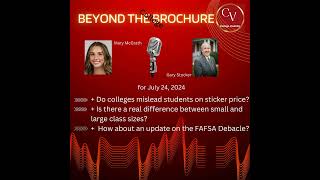
Mary McGrath talks with Dr. Gary Stocker about what college actually costs. Vanderbilt's $100,000 sticker price masks the real number: private colleges average a 56% discount in 2024. Parent PLUS loans aren't free money, and many colleges relying on heavy discounts are closing or cutting corners on facilities.
Chapters
Hello and welcome to the Beyond the College Brochure podcast, where we provide you information and guidance about college financials and decisions. My name is Mary McGrath, and I'm a rising senior at Lindenwood University, and my co-host today will be Gary Stocker, who is the founder of College Viability. Gary, welcome to the podcast.
Mary, I know you're back from your, from your summer basketball practices. Are you looking back, looking forward to coming back to St. Louis here in a few weeks?
Yes, I'm very excited to get going, especially with season. Doesn't seem like it's close, but it comes faster than you think. So I'm definitely excited to start playing again.
And I'm guessing this time next year you're out there. So you already started that first job, you're making all the big bucks, all that kind of stuff.
Yes, that's the goal. Let's hope.
So what do you have for me today?
Yeah, so I'm, as I'm sure you've seen in the news, Vanderbilt University has reached $100,000 in attendance costs, which when I saw that, I was pretty shocked because that's a pretty big number just for an attendance cost. Do you think this was really necessary for them to do, or are they just raising the price because they're able to?
Well, I mean, that's the easy answer. They're able to. And there's probably just one piece of advice I got from my mother-in-law over all the years that she was around us. And she says, you get what you pay for. And she was right. Might have been the only time she was right, but she was right there. And so if you go to Vanderbilt, you probably get $100,000 per year worth of stuff. It's environment, it's instructors, it's professors, it's ambiance, it's all those kinds of things go with it. But I think more importantly, it's, so yeah, if they can get $100,000, if they can get $200,000, somebody's paying it. You and I can't object if they can get that kind of price. Same thing for a Lamborghini, right? What's a Lamborghini cost? Lots of money. You and I don't need a Lamborghini. We probably spend a lot less money buying our cars than we would spend for a Lamborghini, but that's our choice. But I think we have to look at the other end of the college spectrum. And if you get what you pay for, Mary, you also don't get what you don't pay for. Now think about that for a second. So if you go to a college whose tuition is not $100,000 a year, but I'll make up a number, $10,000 a year, you're going to get the equivalent of what $10,000 a year will buy you, just like you would get if you bought a $10,000 a year car, a $10,000 car. Versus a $100,000 car. The analogy holds. So you're making that decision, first of all, what you can afford and what you're willing to give up for the lower college tuition price or the higher college tuition price. So Vanderbilt, and I'm sure other colleges will follow, they are simply getting what the market will bear. And not only that, most, in my understanding, most of the students that go to Vanderbilt, they pay, if not the full freight, very, very close to it with very little financial aid coming from Vanderbilt University. God bless Vanderbilt. If they can do it, go for it. But that's such a rare exception that most of us, a preponderance of us, Mary, need to worry about the other end of the spectrum. And do colleges— are they able— the commodity colleges, are they able to generate enough tuition revenue to pay faculty acceptably, to hire staff, to keep the ground safe, to keep the building safe? That's a fair question to ask.
So obviously with that $100,000 cost, that can kind of be seen as some might call it the sticker price of the institution. But some lucky students do kind of get a discount, whether it be through scholarships or grants. So would you say it's common for colleges to mislead some students and families with the so-called sticker price of the school?
Yeah, mislead is probably a strong word. I think what we have in the larger part, Mary, is an uninformed, an uninformed college-consuming public, but increasingly more informed. Let me tell you what I mean by that. So yes, you know, Lindenwood University, the sticker price is somewhere around $22,000, all right? Very few students who go to Lindenwood pay $22,000. They, that's the sticker price, $22,000. That's list price. If you're buying a car, it would be a $22,000 car at this price. They pay something less than that. And that comes from the form of, we'll talk about here in a minute, on the funded scholarships, you know, the Mary McGrath business scholarship that you gave a million dollars to the university to fund a scholarship. The unfunded scholarships, which are just simply discounts, again, kind of like you get with cars and clothes and computers and those kinds of things. And so the public is increasingly becoming aware that if the sticker price is $22,000 or $42,000, whatever it is, if you're an informed enough consumer, you can negotiate that down a lot. The average discount— this is, again, unfunded discount— in 2024 for private colleges was 56%. So a college with a sticker price of $40,000 The average student was paying somewhere in the vicinity of something less than $20,000. That's what students and families, Mary, need to know.
So with that tuition bill we see from different schools, are there different kind of components to that? Are there any hidden fees? Can you explain that part of it?
You know, again, hidden fees is probably a fair word to use here. And so what happens is you're accepted to a college or university. And you get a financial aid offer and you want to look— see, the students or parents, grandparents, whoever— you want to look at that financial aid offer. It's typically in the form of a letter for free money. All right, that's the term somebody else uses, I'm just stealing it. Free money would be grants, free money would be discounts, free money would be funded scholarships. Nothing comes out of the McGrath family pocket or any of those. But anything that has a loan descriptor attached to it, be it a subsidized loan, a lower discount, a lower interest rate, an unsubsidized loan at a higher interest rate, or God forbid, something called a Parent PLUS loan, which is, I think, one of the highest loan interest rates out there, that's not free money. That's something that you and your family are going to have to pay either on an ongoing basis or you can, even though it's more expensive, wait until after you finish your college education and then start paying it down then. That's when you hear the trillions of dollars in student debt. That's where that's coming from. These colleges accepted those financial aid offers and they had some relatively small amount of free money. And a lot of that, that financial aid, which really isn't aid, comes in the form of loans. And one bit of guidance that I will share for parents in particular. Yes, if you want your child to pay for their college in some form or fashion, there are subsidized loans and there are unsubsidized loans that are a little bit more expensive. That's reasonable. But I would encourage— and I'm not the only one— I would encourage parents to never, ever, ever engage in the Parent PLUS loan. And there's lots of financial reasons for that, Mary. We can talk about that another day. But as an adult, you know, when you're what, you've got a child in college or at least 40-some-odd years old, you can be burdened with that debt into your retirement years. And there's a lot more detail behind that. But please be very, very careful. And as a parent, we love our children dearly. I'm sure your parents love you dearly. But you really have to be careful about the financial commitment you make as a parent, no matter what your child wants. If it's going to involve you borrowing money and paying a a comparatively high interest rate to get the child their ideal college when really the college product, the college service, Mary, I make the case is a commodity. In about 9 months from now, 10 months from now, you're going to walk across the stage at Lindenwood University with a diploma that says, hey, I finished Lindenwood's stuff. That's a commodity. That's what you're going there for. That's what you've invested 4 years for. That's why you played basketball all 4 years. You want that piece of paper that says, hey, I completed these 120-some-odd credits. Everything else is just a minor detail to get you there. So parents, if your child really, really wants to go to University A and it's a lot more expensive than University B, really, really, really take a hard look at the financial difference. Because at the end of the day, yeah, the experience will be different. No question. The experience will be different, but that cost factor cannot only burden the child for a long time. But the parents as well.
And like you were mentioning, that cost factor, obviously depending on the family, students may find themselves in different financial situations, especially depending on the school they choose to go to. So are there different flexible payment plans depending on what situation they find themselves in?
This is one of those questions where I can give you a quick answer. Yes. Yes. Just like you can buy anything else on a payment plan. Colleges are very flexible. They will offer you and your family payment plans. Monthly payment plans is the most common one, so you can pay your tuition, either all your tuition or some form of your tuition, on a monthly basis. If you do the loans, I will— maybe it won't be the shortest answer— if you do the loans, the colleges actually then submit a loan request to the federal government on your behalf, and they actually get paid up front. And so what will happen this August, early September, Colleges will have their final enrollment number and they'll have all the loan data that students and their families have signed off on. They'll send that to the Department of Education, I think, and the Department of Education will send that college a check for millions of dollars, of which only a small portion will be for each student. But that's how the colleges get paid up front, as opposed to kind of the monthly payment plan.
And I know we were talking about Vanderbilt University. A little, a few minutes ago, but obviously that is kind of seen as a higher level institution. Some might say whether it be because of the academics or just even people look at the price like that and they assume it's just a higher level based on that. So what would you say are some of the primary characteristics that might distinguish a higher level institution from, I don't wanna say lower level, but comparatively, I guess I would say.
Yeah. And, and, and you're right. Your assumption is quite valid and We pay what is perceived value. Is the $100,000 tuition at a Vanderbilt, for example, can you document the value of that? No, but we perceive there's value in spending that kind of money and we can afford to spend that kind of money to go to the Vanderbilt Universities of the world. And probably there'll be, not probably, there will be many more that cross that $100,000 threshold soon enough. And it's reputation, and the price is part of that. Matter of fact, I've talked to college presidents who have shared with me that parents prefer a high tuition price, sticker price, and high discount model. For example, the college has a $50,000 sticker price, this price, but the college knowing they're never going to get or rarely get $50,000 for tuition, We'll give them, again, I'm going to tease you, a $25,000 Mary McGrath scholarship. It's a discount, but now mom and dad get to go and tell the family, friends, neighbors, or work colleagues, my child got a $25,000 scholarship to go to this university. It has a list price of $50,000. What a fine parent I am. Now I'm being silly a little bit, but that's really what's going on. Family is preferred. And we all love, again, like I said before, we all love our children desperately, but we also love to say our children have done fabulous things. And that's an example of how that happens. And I'll go back to something else you and I talked about in the last couple of weeks, and that's that buyer and seller model. Um, almost all colleges are buyers. There might be 50-ish sellers in the world and Vanderbilt is certainly going to be among those, the Ivies, Ohio States, the Illinois, the Michigans, uh, the UTexas, University of Texas, USEs, are all going to be seller institutions. All right, here's my price, pay it. You know, come here, pay it. It's a gross generalization, but that's effectively what's going on. Every single other private and public college out there is buying students. And they're typically buying them with those discounts that you and I have talked about, Mary, many, many, many times. Nothing wrong with that. Actually, it's a good deal for the families, for the students and families. Because they get a lower price. But one of the many reasons why we're looking at such a, a down higher education market with private colleges closing at the rate of, of about once per week in 2024, not quite once per week, close enough, is because they discount tuition. These colleges discount tuition so much that they hit a point where they can't meet payroll, when they can't pay down their debts, when they can't keep their lights on. And they either have to scramble with layoffs, cutbacks, program eliminations, all that kind of stuff, or they have to turn out the lights for good and say that we're closed.
And does the availability of resources differ between these different levels of colleges as you look through them?
Oh, absolutely. Night and day. And you get what you pay for. I'll go back to that earlier question that we have. There are monster differences. And one of the things I worry about is, and others besides me, is those colleges that are facing financial challenges. And there are hundreds, hundreds and hundreds of mostly private, but some public. As a matter of fact, I just posted right before you and I jumped on today. I posted on social media about Western Illinois University. And they, they are the epitome of how not to run a public college. And I've said that publicly before, and I'll say it again, because they do they're shrinking and shrinking and shrinking. They're laying off, cutting back. Nobody wants to go to Western Illinois University except for you when you play basketball there once a year. It's probably not going to close, but man, it is, they're trying hard to, they're trying hard to find a way to close because they do such a poor job of, well, first of all, they're in a bad location. You know that from your couple trips up there. And secondly, they don't, have the resources to be able to invest to get the kind of services that anything, anything close to what a Vanderbilt University may have. And the big concern— I digress there for a second— is these colleges like the Western Illinois and many private colleges, they meet payroll, they keep the lights on, they may make debt payments, but does the roof leak? Do the fire alarms work? Are the fire stairways clear? There are safety issues at hundreds, if not thousands, of both public and private colleges across the country. And they're based on a lack of resources, unlike what we talked about a couple of times with Vanderbilt, to just keep those colleges safe. I've shared this before, not with you, but with others. I worry that there is a calamity out there somewhere. For a college that has not done the preventative maintenance on stuff and at some point something terrible happens on that campus and if not loss of life, there are serious injuries. I'm not going to predict it's going to happen because I don't know that, but I worry about it all the time.
Yeah. And looking at it from more of a student perspective, like these different levels of colleges, does the class size— obviously we can see the class size changes. Obviously at some smaller schools there's going to be smaller class sizes. Obviously, bigger universities like Vanderbilt, there's going to be larger lecture-based classes. Would you say there's a large difference in the teaching style in these different types of classes as well?
You know, I'm going to throw out kind of— I'll answer your question for sure, but the, the smaller private colleges, the smaller colleges say we have smaller classes so you get more personal attention from the faculty. I think, Mary, that's a false flag. Maybe. And certainly the numbers suggest that's a possibility. But I'm going to make an argument that very few make. It depends on the professor. You've been now 3 years at a major regional university. You've had good professors, I presume. And you've had less than good professors, right? Is that fair? Yeah, definitely. And I think it's the case of the professor. Yeah. Okay. Yeah. It's the case of the talent behind the lectern. Be it in a classroom setting or even an online setting. I think it matters about the talent in the front of the room, the professor, not the size of the classroom.
Yeah, so as of right now, obviously it's late July, college is going to start in a few short weeks. So what would you say the impact of the FAFSA debacle is going to have this fall?
There's a FAFSA debacle? I didn't know that, Mary. Sarcasm big time. Thanks. Yeah. You just stunned me. That was funny. That was sarcasm on my part. It's going to be a mess. It's going to be a mess. And I think, you know, I've talked about this a couple of times on the podcast. What I'm hearing and reading in both the media and the college leaders that I talk to is something called prior year-to-date deposits. Which is students, whether they're freshmen or seniors like yourself, sending in their deposits, usually a couple hundred dollars, say, hey, I'm going to be there. And it's about, it's down about 10%, give or take, a little bit higher some places, a little bit lower some places. So the vision that I see on this is as colleges start to realize that their revenue for that fall semester or this fall semester is not where it needs to be, they're going to look ahead to December and say, this is it. Or maybe some might look ahead into the, into the first semester, the spring semester of 2025 and say, all right, we're out of here, but we can hold on until this, until May of 2025. As we talked about before, we're looking about one private college closure per week. Not quite. I'm thinking we're looking starting in October, November of this year, end of March, maybe April of next year, 2 to 3 private colleges closing per week. And that may not sound like much in the single case, but envision 2 colleges a week closing for 4 months. That's almost, that's more than 30 colleges closing in a short period of time. And, and I, there will be impacts to the industry. I'm not smart enough, Mary, to know what those will be. But I worry that many, many future college consumers will start to categorize private colleges as high risk and start to focus more on publics. That's not fair and that's not reasonable because like Lindenwood, there are many, many, many strong private colleges. But you need to use these, these students need to use tools like what you and I promote, which is the College Viability App. And again, I'll remind listeners that we have the 2024 Private College Viability App for Students and Families, and we also have a similar version for public colleges. There's some reasons why there's two different versions. It all has to do with accounting. But you have to be an informed consumer. Whether you're buying a car, a phone, or a computer, you have to know the financial health of the organization you're buying for. And, and we're not there yet with the culture among colleges because we all assume that whatever college we choose will be there in 4 years. And Mary, tens of thousands have experienced that not being the case the last few years. And I truly believe, sadly believe, that we'll see tens of thousands of more students experience that calamity in their education lives and in their personal lives in the coming weeks and months and years.
And with that, it'll be a wrap for myself and for Dr. Gary Stocker. Thank you for making time to join us on the Beyond the College Brochure podcast, where we provide guidance on college decisions, financials, and much more. Hope to see you next time.
More from Gary


What does it look like when a college increases both total revenue and total expenses?



College Financial Crisis? We look at the financial health of Bay Path U. (MA) and Coe College (IA)


Private College Financial Crisis? We look at the financial health of Hobart William Smith College


Financial Compass tutorial (Private college version.) Financial statements compiled 2016-2025.

