October 18, 2024 | Beyond the College Brochure
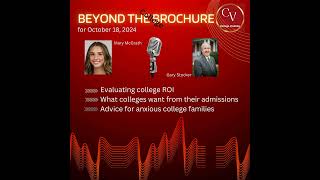
In this episode of the Beyond the College Brochure podcast, host Mary McGrath interviews Dr. Gary Stocker, founder of College Viability, about the escalating financial instability of U.S. colleges. Stocker highlights a 2024 trend of roughly one private nonprofit college closure per week, noting that many institutions are operating with weak endowments, heavy tuition discounting, and declining enrollments. He explains that admissions representatives rarely disclose financial health, urging families to ask about enrollment trends, endowment size, program cuts, and low‑volume majors. Stocker points listeners to Georgetown University’s Center on Education and the Workforce ROI rankings as a tool for comparing expected return on investment, and he promotes his own College Viability App, which provides multi‑college reports on enrollment trajectories, graduation rates, and financial metrics. The conversation also covers how deep tuition discounts (often >50%) strain cash flow, the buyer vs. seller college model, and the downstream effects on athletics and extracurricular resources. Stocker stresses the importance of examining multi‑year enrollment trends—ideally eight years—to identify negative trajectories that may signal future closures. He concludes with advice for anxious families: pursue college if feasible, aim to graduate, and use the outlined questions and tools to make informed decisions.
Chapters
Hello and welcome to the Beyond the College Brochure podcast, where we provide you information and guidance about college financials and decisions. My name is Mary McGrath, and I'm a current senior at Lindenwood University, and my co-host today is Dr. Gary Stocker, who's also the founder of College Viability. Gary, welcome back to the podcast.
Mary, always a pleasure to chat with you. Got a nice fall day here in the St. Charles area. You're taking advantage of that this weekend, going to go out and do some fun stuff.
Yes, I'm hoping to, especially since we have 2 days off, which is kind of a rare occasion, especially so close to season. So I'm going to try to get outside a little, you know, enjoy it.
No football this weekend, right?
No football. They're away this weekend.
Okay, very good. What kind of questions do you have for me this week, Mary?
Yeah, so to start us off, um, obviously you have a lot of knowledge about college closures and kind of financial instabilities of different colleges and things like that. So would you say you've seen a trend of college closures in recent Yeah, I think there's two ways to look at that.
Your question is, has there been a trend? Yes. You know, in 2024 alone, especially the first half of the year, there was about one private nonprofit college closure per week. That has slowed down over the summer months for obvious reasons. Nobody's in college campuses, most college campuses over the summer months. But that's not really the important question there. I think the more important question is, yeah, the trend of past college closures is there. I think we want to continue to focus on the colleges that will close, whether it's through the Beyond the College Brochure podcast or the many other medias that I do. There will be many, many more private colleges. And Mary, you and I want to get the word out to families to be careful about the colleges they're considering because way, way, way too many are not in financial— are not in good financial shape at all.
And in light of these trends that you were just talking about, what should students and families know about the college admissions process regarding this?
I think in this day and age, the one item I'm going to focus on is that the college admissions reps for any college you're looking at, or almost every college you're looking at, are not going to be upfront with you, because that's not their job, about a college's finances. Or any of the cutbacks that they might have in programs and majors. For obvious reasons, if you wanna be a journalism major and the admissions rep says, well, we're cutting back our journalism or just cut back our journalism, you're not gonna go to that college. So you and I and others that do this kind of work wanna really encourage parents to ask about enrollment trends, to ask about endowment values, to ask about what programs have been cut or to see a list of the bottom 20 programs, bottom 10 programs at a college because those are the ones that are at risk. And Mary, you know, you've got, you've got finance and marketing. You're about to finish that up here in a few months. You could have chosen a college that only has 4 or 5 finance graduates in their program per year. And you went to a college that has, I'm sure, dozens of that. So it's an important consideration. It's not just the college's financial health. That's important. But what programs are low volume? What are the lowest volume programs? And really, really, really, to those listening to this podcast, Be careful about selecting a college for whom a program or major has a really, really low enrollment.
And is there a way that students and families could evaluate their, um, the potential return on investment that they get for a certain college? Like how much they'll receive back for however much money, either that be through tuition or anything else that they're putting in?
Yeah. And when I saw that question coming my way just this week, somebody sent me a link. From Georgetown University and their Center on Education and the Workforce. Georgetown University Center on Education and the Workforce. They've actually created a ranking return on investment of more than 4,000 US colleges and universities. So if you're looking for comparing those, search on Georgetown University and that, and that title that I just gave you, and they've got a fabulous chart with every college, almost every college in the country that you can compare them. And they not only compare them, they rank them from 1 to 4,000 or whatever the number is. Great resource, great tool. And I've just begun investigating it to see how I might use that in the future, but it's a great resource for families. That's pretty easy to read. Unlike much of the data that's out there that's difficult to find and difficult to read and analyze, this one's pretty straightforward.
And how can students and families effectively compare multiple colleges at once in order to make an informed decision?
Mary, you know the answer to this one.
Gave you a layup on this one. Yeah.
Yeah. And of course the comparison is the first part and it's very, very important to do. And you do that with the College Viability App. There's a version for private colleges. There's a version for public colleges. And they're both designed for students and their families to give you 4 or 5 reports that let you see if a college's enrollment trend is headed in the right direction, if their graduation rates are acceptable to you, if they have enough endowment— money in the piggy bank, if you will— to be able to provide and support a college education for your student. You've got to use the comparison tool. There are others out there. There's nothing as concise and as useful and as thorough as as what you and I have with the College Viability App.
And can you give us a look into what the process looks like after a college application is submitted?
Oh, sure. And you've heard me say this before, Mary. Colleges want students, need students a lot more than any student needs any individual or single colleges. And that's an important consideration. Because it puts the students in the driver's seat in finding the college that best meets what they're looking for, both with content and with finances. So when the college gets your application, as long as you don't have an F average, maybe a D average, most colleges are going to accept you because they are anxious to have you join them, I'm sure. But they are anxious for— what do you think? Your tuition dollars and your tuition revenue. Now, there's a guy by the name of Jeff Selingo who has categorized colleges into two basic types. There are buyers, colleges that are buyers, and colleges that are sellers. The sellers are the colleges that are so good, the highly selective, the Harvards, the Yales, the Princetons, the Ohio States, Illinois, those kind of places that you can go there. But you have to pay them what they ask for the most part. There's exceptions to that for sure. Maybe 100 on the high side, probably closer to 50 colleges who are sellers. You have to take and buy what they're giving. Everyone else is a buyer and they typically buy you with a lot of marketing, but they also typically buy students with tuition discounts. And as you and I've talked about on the podcast before, Mary, they call them fancy names. They call them merit aid. They call them presidential scholarships, but these are effectively the same kind of unfunded discounts that you and I get when we go to buy a car and they say the car is $30,000, but today, Dr. Stocker, you can have it for only $28,000. Colleges are doing that very same thing, but college may have a list price tuition of $50,000 and the average tuition discount's about 50%, Mary, it's a little over that. The math is easier at 50%. So let's see, 50% of $50,000, sticking my fingers and toes out here, it's $25,000. And that's not a funded scholarship where somebody's transferring $25,000 from some bank account to, to Mary McGrath's or Gary Stocker's account. It's just revenue that a college foregoes, and they're welcome to do that. So we talked about closures, college closures, to open the podcast. And those, those, those really high tuition discounts right now and above 50% for freshmen are really one of the major things that is forcing colleges to say, no mas. We don't have the revenue. We don't have the cash to be able to meet payroll. We don't have cash to be able to keep the lights on.
And does this financial instability have any impact on a school's athletics or extracurricular programs?
That's a good question. Easy, the simple answer I guess would be yes, but it would really, hmm, I have to think about that for a second. In the content of do they have the resources to put in a new scoreboard, right? And I know at Lindwood they have a new scoreboard, I haven't seen it yet, a new scoreboard in the gym. And just a year, two years ago, three years ago, they put a brand new big massive screen on the football slash lacrosse slash soccer slash rugby field. And so because they have the resources to do it, or resources to do it, or they found folks to do it. You may see that in colleges that, you know, the scoreboard is probably not fair because you don't have to change that often. But in, in the, in how the floor looks, does it look dingy in a basketball court? Do the uniforms that the players are wearing look old, dated, not quite in style as they should be? You look for things that might show, suggest that a college doesn't have the revenue to keep their athletes in the best gear. It's probably functional gear, almost certainly, and probably safe gear, almost certainly. But is it what a student athlete like yourself would want in a college? Then we don't— doesn't have to be top of the line, but it certainly has to be stuff that is, is safe and comfortable for sure. So yeah, it probably does. It's just tough to tell how colleges are, are, are doing that without actually being on the inside of those colleges. They don't share their budgets with us, obviously. So we don't know.
And do declining enrollment numbers in a certain school affect their, affect its stability at all?
Well, sure, because a large, in most colleges, we talked about those buyers and sellers a moment ago. Since most, almost all colleges are buyers, yeah, they're heavily dependent, whether they're public, a little bit less so, or private, heavily so. They are looking, they need that enrollment. To be able to have students pay them tuition and fees for room and board and those kinds of things to pay faculty, to pay staff, to meet expenses, keep the lights on, all those euphemisms that we've used before. But it's, and I can't remember if you and I've talked about this before. I know I've talked about it on my other podcast, This Week in College Viability, but student enrollment is not what's called fungible. You're enrolled at Lindywood University. You can't enroll and go to a class tomorrow at Maryville University, which is another college in the area. It's not fungible. Cash is fungible. You can walk down the street, across the street to Arby's, or you can walk across the interstate to Chick-fil-A and buy something with your cash because it's fungible. If you had a Chick-fil-A sandwich in your hand, it's not fungible. You're stuck with that. And the same thing with enrollment. You know, if you, if a college university sends students to a bank's door and said, here's our payment, these 47 students for the loan we owe you, the banks could say, I don't want the students, I want cash. And that's really where the enrollment, all colleges and they have good enrollment, you say, we're great. Students come here because we're great. Well, maybe, but they're not taking the financial piece. Enrollment does not pay the bills. Yes, the tuition and fees do. But if you're discounting it so heavily, like we just talked about, there's, there's, there's obvious scenarios, many scenarios that I can cite where there's not enough cash to pay the bills, keep the lights on.
And just kind of a follow-up from that. Um, because I just found it interesting what you just said, what you just said, would you say that colleges sometimes advertise themselves at a certain enrollment rate in like kind of hopes of making it seem like they're doing better than they are, or like trying to show off that they're—
Yeah, yeah. And one of the things I use Google Alerts, and I have like a dozen or two dozen Google Alerts to bring up stuff that I want Google to tell me about when it comes up. And one of those is freshman— one of those alerts is towards freshman enrollment. And as summer, early summer turns into late summer, and colleges— and in the fall, and colleges start making their announcements on enrollment, I get dozens of these. And they're almost all, for this past year, it's been since mid-August until about now, they're almost all in some form or fashion, we're great, enrollment is fabulous. So because we're fabulous, well, whatever. But it's, you gotta be careful with that because sometimes they are so heavily qualified. Our enrollment is up because of graduate students. All right, well, that's fine. Or to be silly, our enrollment is up because we have the best set of Missouri-based piano players that are at least 7 feet tall in the whole country. Now, of course, I'm being silly, but they qualify them so heavily that it doesn't make any sense and it's not reasonable at all. So just be careful. Look at the enrollment trends. A year's data does not a trend make. But again, back to the College Viability App, we track 8 years worth of data. And Mary, you've heard me say this before, 8 years does a trend make. And if your enrollment is up for 8 years, great. That's a good trend. If your enrollment is down for 8 years, don't tell me, and college leaders try and do this, don't tell me you can turn it around tomorrow because you can't. It takes 4 years, 5 years, maybe 6 years to turn around an 8-year negative trend. And the reason for that, and I don't think we've talked about this, is if you bring a freshman class of 100 students and you wanted 120, you're stuck with those freshmen. That's not a proper word, but you have those freshmen, 100 freshmen for 4 years. You don't have 120 freshmen for 4 years. You have 100 freshmen. So it takes 4 years to just replace that below expectation class as a minimum. Until the next class comes in, and you hope that class is better than the one before. So it's important to look at freshman classes, at enrollment classes, for 4 years. And so that 8-year trend becomes more and more important. If it's gone down over 8 years, that's really just not good, a good trend at all. And be careful, students and families, be careful about choosing a college with a negative, a decreasing enrollment trend without asking a lot of serious questions. To that college. And if you need those questions, there'll be a note to my email address and Mary's in the show notes. And reach out to us with— reach out to us and we'll give you a list of questions to ask.
And to finish us off, what advice would you have for students and families who are anxious about the future of higher education?
Hmm. College is good. Absolutely good. You're experiencing that right now. I experienced it decades ago. Do it if you want to. Go to college if you can, financially or otherwise, because clearly it provides a set of learning and personal growth experiences that you can't— I don't think, and most don't think— you can get anywhere else. College is good, really good. Now, graduating is better than just taking courses, and I've said this in other media as well. If you can't graduate, and American 4-year college graduation rates are abysmal across the board, if you can't graduate, then you have paid for something that's not complete. And the silly analogy I use, you bought a car and you only got 3 wheels. So if you go to college and you only got 3 years out of 4, you don't get that piece of paper that says Mary McGrath graduated the Bachelor of whatever. In finance and marketing, you get 90 credits that mean nothing to the job market for the most part.
And with that, it'll be a wrap for myself and for Gary Stocker. Thank you for joining us today on the Beyond the College Brochure podcast, where we provide guidance on college decisions, financials, and much more. If you have any questions or concerns about the financial health of colleges, please send them to marym@collegeviability.com. Thank you again for making time to join us today, and we hope to see you next time.
More from Gary


What does it look like when a college increases both total revenue and total expenses?



College Financial Crisis? We look at the financial health of Bay Path U. (MA) and Coe College (IA)


Private College Financial Crisis? We look at the financial health of Hobart William Smith College


Financial Compass tutorial (Private college version.) Financial statements compiled 2016-2025.

