Requiem for a College (2nd Edition) Part 2/3
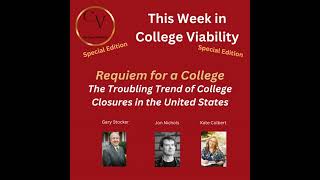
Jonathan Nichols and Kate Colbert discuss the second edition of Requiem for a College, examining why small colleges fail. They argue board trustees bear primary responsibility for financial collapse, that institutions hide trouble through PR, and that colleges need business-like planning. The book releases July 8, 2025.
Chapters
Welcome back to what, again, I'm going to call a very special episode of This Week in College Viability. My good friend and colleagues, John Nichols and Kate Colbert, are joining me to talk yet again about the next, the second edition of Requiem for a College that when it was first released a couple years ago, I think shook many, many college faculty members, many staff, many students, and many college leaders. and a second edition is coming out this week. John Nichols, always a pleasure.
Thank you, Gary. Great to be here.
And Kate Colbert, you know, you work with John on this second edition. Tell us about how that came to be and what's so important about this second edition.
Yeah, so great to be here. Thanks for having us. You know, so John and I actually, the way we met was really quite fun. I happened to be at an airport, I'm hanging out in a hangar, and I had been checking out some luxury jets, some Lear jets with some folks who were interested in hiring me to do some work for them. And I was chatting with a guy and I had just released my last book, Commencement: The Beginning of a New Era in Higher Education. And so I told this guy, his name was Brian, that I just released this book about higher ed. And he's like, oh my gosh, I know this guy who went to this college, St. Joseph's College in Indiana, and he wrote this book called Requiem for College and you've got to read it. And I was on the way out and I was thinking, don't forget that name, Requiem for College, Requiem for College. And I'm trying to, I'm thinking it all the way home so I could go to Amazon and buy it. And I did. And I read it and I was blown away. I don't know what I expected, but it was so much more and so profound and so brilliantly— I mean, come on, you know, John Nichols, English professor. So it's going to be literary, right? It's going to be good. It's going to be well written. And I was just so blown away by it. And so I thought, I got to hunt this guy down. And so I go to LinkedIn and I finally find a LinkedIn profile with no picture and like no updates. And I'm like, who is this dude? He's like international man of mystery. And And then I told you about him, Gary. I was like, you gotta read this book. And so you're like, I ordered a copy right now. And then we started sort of sharing notes about what we thought about the book. And eventually we hunted down John when he finally got around to checking his LinkedIn messages. And when I talked to John the first time, I just said, this book is phenomenal. And I think a lot of people who work at small colleges and universities still think it couldn't happen to them, think that their school couldn't close, right? As, you know, to steal a phrase from Requiem for a College, you know, that we're too beloved to fail. Um, and I said I would love to see you, if someday you ever have the energy to do this, to put this in bigger context and talk about more colleges that have closed or that are on the brink and what those trends are and why they close and what the heck we can do about it to prevent it, or at least to handle it more ethically when it comes to it. And so if you want to do that, I just happen to own a publishing company. I would love to be involved and publish the second edition of your book. And here we are in 2025, releasing that second edition.
So Jonathan Nichols, I'm going to start off with a compliment. There are two authors whose books I read from start to finish without hesitation. The first is Tom Clancy. And I have read 15 to 20 of his books, whatever he is, the guy of military fiction fame. And the other one is a guy by the name of Jonathan Nichols. When Kate referred me to Requiem for a College, I, sorry, I bought the electronic version. That's just how I live these days. But I read it. Straight through, straight through. And it just, like Kate says, it just reads well. And of course, that's my business, that's my industry, the focus on colleges and their financial health. But let's talk again, the second edition. And John, we know that St. Joseph's College came to an end in 2017, and there were decades of financial deterioration in advance of that. And there were many, you say, had culpability in some form or fashion for the demise of St. Joseph's College. You say, you say particularly 3 separate bodies of St. Joe Community passed votes of no confidence against the leadership team. But you go on to say this was an injustice. The vote should have been against the board of trustees. And now 8 years later, John, are boards still mostly culpable for colleges not adapting to the times?
As I conducted research on boards and how they operate, there was one trustee, not of St. Joe, but of another college, who was asserting that the board is the college. A lot of times, especially when contracts are up for renegotiation, faculty like to say, we are the university, or we are the college. And this board member said that's a medieval way of thinking, that responsibility for decisions particularly financial ones, rest on the board of trustees, so they are the college. Well, if I'm following that, then they are the ultimate decision makers, then yes, I still stick with the idea that if you're the ones who are where the buck stops for decisions, then that's where the responsibility ultimately belongs in saying yay or nay to policy.
And one of the more, I think, moving quotes that I've read in the second edition, I'm going to read it to you and bear with me, John, while I read through it. It would be, this is from Jonathan Nichols, it would be an understatement to say, I feel silly now as I look back on all my hellfire-fueled calls. Only an English professor would write that. Hellfire-fueled calls to battle and last stands back in February 2017. There was nothing left to fight for. I could not see it at the time, my mind clouded with emotion and the fog of war, but everything was already gone. You continue, I screamed to avenge wrongs and settle grudges that were in large parts imaginary or misconstrued. The revelation shocked me and humbled me, yet somehow I found it all the more saddening. John Nichols, is that still happening as colleges close now to faculty and staff?
I could speak to St. Joseph's, and when I speak with other faculty members and I speak with alums, there are several who say that time has been kind. And looking back, they admit much as I did, we all should have seen it. In fact, just the other day I was talking with a former faculty member, including Bill White, who is someone featured in the book, and he said that it really is a wonder we made it all the way to 2017. And I have to concur. I have to agree with that because when I was finally able to look at the research data, the finances, and just the record of decision-making that had taken place over, say, 20, 25 years or longer, this was not an overnight occurrence. This was cumulative and that it really should have been evident to me.
And you also note, I'm going to paraphrase this, it's been my observation in the last year, year and a half that when colleges close, more have been, John, on really short notice, some over a weekend, some over a week or two, some over a month or two. And you note in the book, in the second edition of Requiem for College, You ask a rhetorical question, how do business leaders and finance administrators, and then in quotes, suddenly realize an institution will be out of money within mere months? What's going on with that?
I think it is, and Kate and I have spoken about this before, what's going on really is management by PR, is that the administration on one level or another wants to keep broadcasting as long as they can this happy message of, we're fine, we're meeting 21st century challenges, we are streamlining ourselves or some such. As an example, there was a college I heard of recently whose bank had turned down their line of credit. And so they have framed it as we're between banks right now.
Oh, God.
We're seeking out someone else. So that, that's, that's management by PR. That's, that's spin. And it comes from the sense that you don't want to look bad. And so you're holding on to whatever you can to, to not do that. And Gary, you and I have spoken about those very cases where someone has suddenly announced they're closing that, and you know, we've done a couple specials here on your podcast. Somebody knew. Somebody had to have known at least 6 months out, probably longer. So there is no suddenly to any of this. Someone knows. Someone always knows, I'm willing to bet.
And Kate, bring you back into the conversation. You bring a diverse perspective, both the business side and the higher education experience and expertise. What's your perspective on these sudden closures and folks not knowing the financial health or lack thereof of these colleges?
Yeah, I mean, it's interesting. So, you know, I started my career in, in sort of higher education, and then I was sort of in corporate roles for a while, and then I was in higher education again for a long time, and then I became an entrepreneur. And so I, I've worn both hats, and I understand the cultures of sort of corporate life versus higher education life. And I remember working in a university where if I had referred to it as a business, I would have— people would have gasped. And if I had referred to our students as customers, I probably would have gotten fired. And yet— and listen, and, you know, Jon comes to this from the faculty side, and I've been a faculty member myself as well, but I'm more of a business person than an academic. And I know Jon doesn't really like thinking about colleges and universities as businesses, but I feel really strongly that If the folks running these institutions, the board members, the presidents, the VPs, if they had more business savvy, we wouldn't see these quote unquote sudden closures. And, and, and here's why. Like, let me just break this down to the simplest. Let me, like, they, this is like Business 101, like it's a little mini MBA for, you know, your podcast listeners. All organizations, whether you wanna call 'em a business or a university or whatever they are, for-profit or nonprofit, go through what is called a business life cycle. And it looks like a bell curve. So you think about an X-axis and a Y-axis and you've got You've got this curve that starts down at the bottom when a business is launched, and then it starts to sort of arc up really big and beautiful to that top of that bell curve during the sort of growth period. Near the top of that bell curve is sort of what the shakeout period where sales are, you know, and sort of money coming into the institution is sort of increasing more slowly due to market saturation or entry of new competitors in your market. And then all of a sudden that bell curve starts to come down, right? You hit business maturity. And then you hit decline, right? And this is— and people like to think that colleges and universities don't go through this, but they do. They are businesses. They are institutions with balance sheets. They bring money in, they try to create value for their stakeholders, they try to capture value back to the bottom line, and they need to create a continuous cycle of doing that. The only way for an institution to survive at the maturity stage for a long time without getting to decline is to do what's called a life cycle extension, is to go ahead and introduce a new product, do a new thing. Colleges and universities love to think that when sales start to decrease, so when enrollment starts to decrease, when their profit margins are getting thin, they're, they're discounting their tuition like crazy, they're having cash flow problems, they're stagnant, or they're in debt up to their ears, they love to think that somehow something will save them. Or if they're doing okay in that sort of stagnation, colleges and universities love to think that they could bide their time there for 150 years. You can't do that. You have to open a new college, innovate with some interesting new programs that are in high demand, figure out how to bring more money to the bottom line. Most institutions are not thinking about their college or university as having a business lifecycle. They all do. And they all act so frickin' surprised when their maturity curve drops them down into decline and they go out of business and they act like, oh no, we didn't see it coming. But I could literally take any institution founded in 1847 and draw their bell curve and show them how they've been in decline for the last 60 years. And so the problem is really that I think is this blinders of thinking, and especially if you're a nonprofit institution, somehow the money will keep coming in, some donor will write a million-dollar check. Somehow we are, and to quote some really great lines from John's book, somehow we are just too beloved to die. And that's just not true.
You know, just to reinforce that, I was doing an interview with a reporter a couple of days ago and I was showing her one of the tools I use. We can tell when a college is not going to make it. And I brought up a graph for this particular college, and I'm not going to share the name. And the line was, how shall we put this nicely, heading toward the basement. It was an obvious downward curve. And I said, downward line. And I said to this reporter, you don't even need me. You can look at this picture and say this college isn't going to make it. So the data's out there. And that's my business. I know which ones aren't going to make it. I know which ones are going to, even if they do make it, will not provide the kind of quality education that colleges want. Next question, Jonathan Nichols, author of Requiem for a College, with the second edition coming out later this year. You talk about freedom fighters at St. Joseph's College in Rensselaer, Indiana. And John, as you think back in the years since 2017, the same kind of stories are happening now. What kind of advice would you give to current faculty and staff or students or community freedom fighters, I guess, to use your words? What advice would you give them for today's version of freedom fighters for these colleges?
It's always difficult for me to answer that question for a couple of reasons. One, every case is different. So it depends on what kind of, let's say, currency those freedom fighters have? Who— ears do they have? Who's going to listen? Because one of the commonalities of any of these closures, suspensions of operations, what have you, is that people— there's often at least a small population of people who see it coming. They do recognize the danger signs. I just saw a documentary on OceanGate, the submersible that Titanic and there was an implosion. Plenty of people saw that disaster on the horizon. And when they brought up their concerns, they were met with, well, you just don't have a spirit of entrepreneurship. You don't have a spirit of innovation. And so they were ultimately asked to leave the business. So part of the problem is, do the people who recognize the signs and the dangers have the like I said, the currency to wield any sort of power or get anyone to listen to them. Because what may happen as these folks see is administration may circle the wagons and we head right back into that mindset we were just talking about, Gary, of managing by PR, saying there is no trouble here, there is no problem, everything's fine, thanks, how are you? And I— so it's difficult for me to advise. I think that if I had to give any advice, it would be know who your board members are. Find out as much as you can. How many of them are there? How often do they meet? What are their backgrounds? You could even try contacting them outside of official channels, whether it's their LinkedIn page, try to find their business email, something like that, and just contact them as a concerned citizen of the community. And I think it's taking that kind of interest, that kind of proaction that is, you know, when we start to count out what's under your control, well, those are among the things that are under your control. Also, it would help employees to understand what these signs are, if they have real concerns, it may be time to start considering where else you could go, what else you could do.
Yeah, yeah, good point.
And that's a tough, tough thing to consider, especially for most faculty who consider what they do to be a calling and who have grown so attached to their students, so attached to their colleagues. And it's a tough thing to consider, but Sometimes you sadly have to.
And for those listening to the podcast and have not, did not read the first edition of Requiem, I'm going to read another quote. And I'm going to read this second quote from John Nichols because it shows what an exceptional storyteller and writer he is for this second edition of Requiem. And here's what John says. It's personal. This is an inset in the text. This is my story. When I wrote the first edition of this book, I thought it might be one of the most unique tales in all American higher education. He goes on to write, I am sad to report, as I watch more and more colleges close with more and more lives being disrupted and even shattered, my story is not as unique as I had imagined. John Nichols, there are other John Nichols out there, I guess, with their own custom version of what happened to you and your colleagues at St. Joseph's College in Rensselaer, Indiana. What will it take for college leaders and board members to at least limit the amount of future closures, to limit the number of folks who had to go through the trauma that you, your friends, family, and colleagues went through in 2017?
I think that there's going to have to be a few things. It would be nice if there would be a form of accountability. I don't know what that would look like, but for when these sorts of collapses happen, for those involved at the upper echelons of administration to, to be held accountable so that others in similar cases will say, I don't want that happening to me. I just don't want that. And I think that it's just going to have to take a a greater awareness. It's going to take books like mine. It's going to take podcasts like yours, Jay Keene with his work. And I, I met someone else who is a former president of a college that recently had to close, and he wants to do his own book, but all about how to prevent these closures. So the more people we get talking about this, the more we inform, I think, the consumers. Yes, I'll call them customers, students, in this regard.
We won't fire you, John.
What's that?
We won't fire you.
Oh, thanks. Appreciate that. That people vote with their money ultimately. And when informed parents and informed students are asking questions about financial viability, then there's going to be a greater need for institutions to be held to account. And it's about what's going to motivate them. And it's either going to be something financial or something legislative. I don't know what that would look like, but probably the best bet is money. And to— if they're getting questioned, if their administrative, their admissions staff are getting questions about What's your endowment? What, how many do you graduate per year? Those things like that, then that's going to hopefully in conjunction with more people talking about it, keep the spotlight bright.
Yeah, if I can jump in, I mean, listen, I'm a Gary, you know, I'm in addition to being John's biggest fan, I'm your biggest fan. And, and when I talk to young people and their families, when they're looking at where to send their kid off to college, I give them a list of questions that come straight from the college College Viability app. And I tell them, go into your admissions interview and your tours, and you need to be asking these questions. If you can't find this information on their website, or you don't know how to find it through IPEDS or whatnot, you should be asking, how much money is in your endowment? And how does that compare to how much was there 5 years ago? Um, you know, what's your graduation rate? What's your 4-year graduation rate? Not just your 6-year graduation rate. What's your transfer out rate? You know, what, you know, what, what is your retention rate from first year to sort of rising sophomores? What does that look like? Um, you know, what is your overall enrollment trend look like? And not just this year and last year, but like for the last 8 years, what does that look like? And, and I think if we could get— I mean, I think you're absolutely right, John. You know, if we can get consumers to understand that it would be really catastrophic to invest in a college education and especially to move on to a residential campus and find out that it's not going to be around by the time you were planning on graduating. That is a huge risk. That is, that is worse. Like, right, we've got lemon laws for cars, right? That is worse than driving a car off a car lot and having it die with no warranty. Yeah, right. And yet we don't have consumers who understand that they should be concerned about this. So yeah, I agree 100%.
And John, can you give me 2 more questions?
Sure.
I have 2 more questions for you, and you and I talk— I've talked about this before, and And in your book, and I've noticed this also in the media that I do, colleges have for 30, 40 years tried to be everything to everybody. They added courses and programs and majors and minors. And I think you note that St. Joseph's was guilty of that back 20 years ago, even more than that. Did you get, as you prepared the second edition of Requiem, did you get any sense that college leaders or faculty were prepared to offer less, fewer colleges, fewer majors, fewer programs in order to survive today and maybe have the chance to thrive somewhere down the road?
Are you talking about St. Joe or colleges in general?
I'm talking about as you prepared the second edition. Did you have conversations with folks? Are they still trying to be everything to everybody or is there a sense they're trying to consolidate a little bit?
I think it's a mix, really. I think in the case of St. Joe, there were a lot of majors that needed to be rethought. For example, every college has a business degree that you can get. Well, what makes our business degree different? And there, there are humanities components to that that made it different. But I think for the prospective student, what if it was different in the sense of here you'll study entrepreneurship, for example, or everybody, almost everybody has an IT degree of one form or another. What if what you're offering is cybersecurity, something that is a little more focused, a little more defined? So I think that there, there are thoughts right now about how to about how to specialize, about how to be distinct. I'll say I'm worried though that we project this out 10 years, 15 years. It could happen that most places will offer just one of, say, 4 basic degrees: business, IT, engineering, medicine. I mean, I think the Ivy Leagues will always have all manner of majors and things like that. But once you go elsewhere, I think your choices could potentially become more limited. And there's going to be a real question of, well, not everybody is especially adept at any of those four. Will they be forced to make one of those choices? That's when I think higher ed will have to rethink itself all over again and decide, okay, what are we offering that, that is not only good for good for the student but good for our culture and our society.
Yeah. And before we recorded the podcast today, I was doing my weekly College Financial Health Show. And one of the things I showed was the college majors completion app. And I had a couple colleges up there who had a dozen majors that were 0 or 1 or 2 or 3. And it kind of reinforces what we're talking about. Colleges still haven't figured out if you have one chemistry major, what are you thinking about? What are you doing? Kate, I think I heard this from John in the book. I read about this in the book. It's a rhetorical question, but take it anywhere you want. Do colleges really want to survive? They do so many things that can arguably be said to be leading in a direction toward their demise. You got to wonder.
Yeah. Well, I mean, listen, a lot of people are walking around with a big giant TIAA account and they can sort of retire whenever they're ready. And I think a lot, again, a lot of people are really focused on their area of functional expertise, what they teach or what they do. And operationally, if they're staff versus faculty. And I do think a lot of people just have blinders on about what's going to happen. And I think a lot of people also think, well, if things go bump in the night at this institution, I'll go get a job at another one. I mean, we do have literally thousands of colleges and universities in the United States. So there are options, but I do think, I love John bringing up the OceanGate disaster, the submersible disaster, right? So to sort of extend from the metaphor of that, there were people who said, if you keep taking a submersible vessel down that low, the pressure that it creates on this, um, this vessel is literally breaking apart the metal. And every time you come up and down and up and down, it is not the same vessel the next time you take it down. It is breaking, right? And, and it could not withstand the pressure. And colleges and universities right now cannot withstand the pressures of changes for students who want different majors, who want, who want degrees that are— make them highly employable, where they're going to get ROI on what they spent on that tuition. And Listen, I have recently served for several years on the President's Leadership Council at Carthage College, which is one of my alma maters. And a few years ago, they took a look at their under-enrolled majors. Under-enrolled majors is a really interesting sort of buzz phrase, right? Sort of like deferred maintenance. It's one of those things that people love to like mention, but then ignore, right? Like, oh yeah, the building's falling apart. We're not going to fix it. Or, oh, we have all these under-enrolled majors, but what are we going to do? And they shrug their shoulders and they keep paying a lot of money to the faculty with full benefits. And, and what Carthage did, and a lot of colleges that are savvy have done this, is they said, listen, let's like, we don't need standalone departments for majors that have 20 students enrolled in it. So what if we took a bunch of these under-enrolled majors, maybe we get rid of some of them, merge a bunch of them into one department. So we don't have to have multiple deans and multiple chairs and multiple. And so they, they ended up letting go. I'm going to get it. It was like a dozen or 15 or 18. Faculty members, full-time tenured faculty members. And people freaked out about it. But if you looked at the numbers, how do you justify having 3 or 4 or 6 faculty members teaching the courses for a program that has 12 kids enrolled in it? And so, you know, there's a reason Carthage College, when, when you and Matthew Hendricks take a look at the numbers, say, hey, yeah, they're doing, they're doing fine financially, they're doing great, you know, that they're one of the small private liberal arts religiously affiliated schools that's currently doing well because they're willing to make tough choices. And I think at the end of the day, a lot of people are not willing to change. And in higher education for these small institutions, we are really truly at a change or die moment. And sadly, a lot of institutions would rather die than change.
And John, the last question kind of moves away from the book, but you've lived this world and I think you're more than qualified to answer this. Massachusetts and now the state of Ohio either have laws or proposed bills in those states to force private colleges to share financial information, either good or bad information, financial news. Yet in both cases, John, the states are hiding the bad information, the bad financial information from students, families, and communities. I want to make John Nichols the king of the world for a second.
That's scary talk. Okay.
Put it on your resume. If you could decree, from your perspective, if you could decree that states should share negative financial information about colleges, would you do so?
It's always a precarious position that I, for someone to advocate for more, I guess, government oversight or something like that. But here's what I will say, that with your sources such as your College Viability App, that information's already out there in one form or another. It's public. So the information itself, I'm not as concerned about as holding institutions to account in a sense that they be mandated to go through what Dr. Paul Langteau calls ethical shutdown. And that once a, the financial picture occurs to the state for an institution that is looking like it's not looking good for them in 5 years' time, then they either work with that institution, try to turn it around, or they say, you're done. We've caught it at a time where we can shut the place down with enough time. Enough money to treat the students correctly and to treat the employees correctly. They'll have a couple years in order to get an exit strategy together and move as, um, nothing seamless certainly, but have more time than just a couple months like it was in the case of St. Joseph's and or a couple of these other institutions that had the sudden announcements. That's the kind of thing that's got to come to an end. And by having provisions in place somehow to say that you just can't do that, have a managed— and that hopefully will lead to a managed ethical shutdown where people are treated as best as possible under the circumstances. That, I think, is what's really important. And were I king, that's what I would mandate.
So Kate, take us home. First of all, I'd like your comments on this. Should states provide the public with data? And then how do we get this book? When is it coming out? How do we get it?
Take it from there. Yeah. So I really love that you're asking about some of the states that are starting to try to put some oversight into this. So the laws in Massachusetts are really interesting. So they do an annual sort of screening of the financials of private institutions. And by the way, they protect that information. It's not subject to— in Massachusetts, you know, they're really clear with the presidents of these institutions. It's not it's not subject to public open records laws, that kind of stuff. But I'll quote you something straight from how this all sort of rolls out in Massachusetts. I said that if your annual screening indicates that an institution may be at risk of imminent closure, the Department of Higher Education will require risk mitigation planning and contingency planning for closure. And that's exactly it, right? I mean, you know, and this is where— this is exactly what John is talking about. So if they take a look at it and say this school has a 2-year horizon. They're not going to make it. As a higher education board at the state level, we're going to provide resources and we're going to oversight and hold them accountable to make sure that they call the Paula Langtos of the world and say, help us figure out how to shut this down ethically, because we know you know how to do that because you did that at Presentation College. And what does that look like? I don't see a downside to this. I do not see a downside to states coming in and saying, we understand that the industry is contracting. We understand that maybe you don't have the, the business savvy or financial savvy that you need. We want to help you do better for, on behalf of your students. And if it's going to come to an end, we want you to do it with your head held high and in a classy, ethical way, and in a way that is not so horribly painful for your employees and your students. I think that's wonderful. I hope we ultimately see all 50 states doing what Massachusetts Massachusetts and Ohio are doing. So I look forward to seeing how that plays out. In terms of the book, so yeah, A Requiem for a College: The Troubling Trend of College Closures in the United States is now available for preorder as we're having this conversation right now. So you can pick it up on Amazon at requiemforacollege.com. We'll take you right to Amazon to buy the book. And it releases wide in paperback, hardcover, and ebook edition on July 8th.
On July 8th, getting really, really close. John Nichols, can't tell you what a pleasure it is to chat with you each and every time. Kate, your perspective is always quite valuable for the podcast listeners. Requiem for College, second edition. Buy it, don't buy it. I prefer you buy it, but it is a commentary on today's higher education industry. It's written by someone who lived the trauma, the heartache, the challenges, and did the research to show what did happen and what continues to happen. Requiem for a College, Second Edition, out there on July 8th, pre-order available through Amazon. John, Kate, always a pleasure. Let's do this again soon.
Thanks for having us.
Thank you.
More from Gary


What does it look like when a college increases both total revenue and total expenses?



College Financial Crisis? We look at the financial health of Bay Path U. (MA) and Coe College (IA)


Private College Financial Crisis? We look at the financial health of Hobart William Smith College


Financial Compass tutorial (Private college version.) Financial statements compiled 2016-2025.

