The College Financial Health Show August 13, 2024
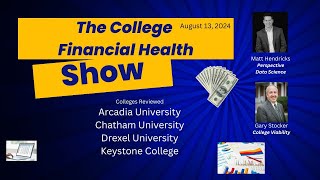
In this episode of the College Financial Health Show, Gary Stocker (founder of College Viability) and Matt Hendricks (founder of Perspective Data Science) evaluate the financial health and viability of four private Pennsylvania colleges—Drexel University, Arcadia University, Chatham University, and Keystone College. They draw on a newly compiled data set that combines audited financial statements, IRS Form 990s, and IPEDS data, alongside the College Viability App that relies solely on IPEDS. The discussion walks through key financial metrics for each institution: net income margin, cash flow, endowment draw percentages, endowment‑to‑expenses ratios, debt‑to‑income ratios, enrollment trends, graduation rates (4‑ and 6‑year), tuition‑and‑fee revenue, and total expenses/revenue. Drexel shows generally positive net income margins and cash flow but is drawing a higher‑than‑median endowment percentage (≈5.2% vs 4.2% median), which could erode its endowment over time. Arcadia runs persistent deficits despite large endowment draws, has a high debt‑to‑income ratio, and its endowment‑to‑expenses ratio is falling below the median, signaling unsustainability. Chatham has a long history of deficits, relied on COVID relief for a single positive year, and in 2023 liquidated most of its unrestricted endowment, leaving only about $2 M unrestricted assets. Its debt‑to‑revenue ratio is high, and cash‑flow deficits suggest limited options moving forward. Keystone possesses a tiny, fully restricted endowment ($6 M) with no unrestricted assets, has borrowed heavily against that endowment, and is missing its required Title IV audit filing—a major compliance red flag. Its cash flow is barely positive, leaving virtually no margin for error. The hosts compare the prospective data‑science visualizations (Matt) with the College Viability App (Gary), noting that enrollment declines, shrinking tuition‑and‑fee revenue, and rising expenses are common stressors. They discuss whether the observed surge in endowment draws across many colleges represents a sector‑wide “financial pandemic.” The episode concludes with recommendations for college leaders, emphasizing the need for balanced budgets, prudent endowment management, and transparent reporting. The content is aimed at college administrators, faculty, students, families, and other stakeholders who need data‑driven insight into institutional financial health.
Chapters
It's the College Financial Health Show with Matt Hendricks and Gary Stocker, and it is August 13th, 2024. Welcome. Thanks for making time to join us. Each video episode, we'll look at the financial health and viability of a set of private colleges. We share data from multiple sources that we'll talk about And we'll, of course, we'll offer our analysis and communications. This is useful information for college leaders, faculty, students, families, and other stakeholders. Hi, my name is Gary Stocker, founder of College Viability.
Thanks, Gary. Hi, I'm Matt Hendricks, founder of Perspective Data Science. Today we're looking at 4 colleges in Pennsylvania. Those colleges are Drexel University, Arcadia University, Chatham University, and Keystone College. I'm going to take us right into a, my app that dives into the financial benchmarking of all of these colleges. Okay, here's the app that we went through last time. Again, this is just benchmarking key financial metrics, ratios really across all private colleges in the country. This data is primarily drawn from audited financial statements, and it's a brand new data set that we have available that we're leveraging for this show. Alright, so the first college we're going to analyze is Drexel University, and I'll just give you the takeaway upfront so it's not like a scavenger hunt here. Drexel seems to be doing just fine in my view, but you can decide for yourself looking at this data. The reason I say Drexel looks fine is their net income margin. Again, that's— think of it like profit for a private university. Their net income margins are positive most of the time. They had plus 2. 3% here. And again, the percent comes from your dividing their net income or profit divided by their operating revenue. So that positive, positive 5%, one negative year in 2022 of 1%, and then positive 1.7%. Again, that's great. The cumulative number is what really matters. So this is fine. And again, the cash flow is usually positive, big positive numbers here and one negative here. This must just be a timing issue of when cash is coming in. Since their net income was positive. Okay, so that's good. I mean, that's bottom line. Those are the two most important numbers to check. And I don't see a problem there, although there can be some hidden things. And I'll show you one thing that is starting to become potentially an issue here at Drexel is that one of the ways it looks like they— so one way you can improve your operating revenue is to draw more money than normal from your endowment. Fund. Uh, it's pretty typical, typical draw. You can see here on the median is about 4.2% of the endowment's end-of-the-year value. And you can see Drexel used to be pretty normal back in about 2018-ish. Now they're on the high— I'd say the high edge of normal, 5.2% draw from the endowment. And so the, the risk there is that if you're drawing too much from the endowment, you're not getting sufficient gifts and your returns are sort of normal, your endowment will shrink relative to, your competitors. And that's exactly what's happening here with Drexel. You can see that their, ratio of— well, let me see the endowment value. Yeah, I'll do the endowment value. The ratio of endowment value to, their expenses, it was normal in 2022, almost like right at the median of all schools, and now it's below the median. And probably the main reason for that is this draw is getting really big, right? So that's the only thing to really watch for on this school, but everything looks fine. Um, again, I'm not going to complain if they're having positive net income. The next school we're looking at is Arcadia University, again in Pennsylvania. Okay, Arcadia, the takeaway here is, in my opinion, not operating sustainably. They have, again, similar to Drexel, massive draws from their endowment. And even with those big draws, unlike Drexel, the big draws are not sort of protecting them from negative net income. So that's a concern. Even with the big draws, they're still running deficits. So yeah, that's the key takeaway. And so again, unlike Drexel, they have mostly negative here, -9%. Net income, negative 7% net income, and a slight positive in 2022 of 3%. So you take the 3-year cumulative here, they're losing— I mean, they're losing net income or losing net assets, and that's not good. Although they're able to keep their cash flow positive here, and again, I think that's mostly because they're drawing a bunch of money from their endowments. It could be some other things that I didn't see, uh, looking closely at the audit. Okay, so again, same thing with Drexel. Uh, their endowment value is shrinking relative to their expenses, relative to what the norm is. Um, like 70% of their expenses is their endowment value. Um, and that's below the median now. And the main reason is you can see here this really high It started back in fiscal year 2020. They started drawing a lot from their endowment, and that money will flow right into the operating revenue. So that's how they're really keeping their balanced budget essentially, or trying to. It's still gone negative despite these big draws. So that's a big red flag. It's not sustainable to do that. You can see eventually their endowment's going to go to zero if they keep doing that, right? So not a sustainable operation at the moment. And but everything else, they also have a high debt-to-income ratio, another potential issue. So again, my overall take on Arcadia, not sustainable at the moment, too big of endowment draws. They probably to fix it are going to have to either increase revenue, cut costs, and put their endowment draws back to normal around that 4.5% draw. All right, next one, Chatham University, also in Pennsylvania. All right, so this one you can see a different story, very different from Drexel and Arcadia. This school's had deficits for a long time, all right, all the way back to when my data starts in 2016. Minus 6%, minus 13%, minus 11%. And so on. Right. Only one year where they had a positive net income. And you know why they had a positive net income in 2021? That's the year that they got COVID relief money. So really the only, the only reason they had one year of positive net income is because of the COVID relief money that came in in 2021. And how do you see that? You can see the median school did peak there, right? So everybody got a bump. So, yeah, really, really poor performance financially here. And this is a long time to be hemorrhaging net assets for 8 years, basically, with 1 year with a, a slight positive. And it's the same story for cash flow. Uh, again, if you remember our episode last time, if net cash from operating activities goes negative, that generally means that, uh, you're in an unsustainable situation where you have to— generally, not always, but most of the time— they'll have to pull an excessive amount of money out of the endowment or out of, or or raise money by issuing new debt, using a line of credit, selling buildings, that kind of stuff. And you see they've had to do that for a long time now. And so they're starting to get into a situation where they're running out of options. That's one way to look at it. And see, they had a massive endowment draw in 2023, almost 24% endowment draw here. And this is why I'm saying they're running out of options. Basically what they did in 2023, they had a $7.5 $14 million cash deficit from operating activities. And so you, like I said, you can sell endowment assets is what they did. They basically, they sold $14 million in their endowment assets, their unrestricted endowment assets. So they can definitely do that, right? That there's nothing restricting them from doing that. But the problem is they sold $14 million to cover this deficit and pay their debt service, right? You also still have to make your monthly payments on debt. And so basically they drew down their unrestricted endowment to only $2 million that's left at the end of fiscal year 2023. They don't— I think if I remember right, they only have $14 million in total unrestricted net assets. So they just don't have a lot of options left for assets to sell off. And so their other option now going into 2024 is, you know, you can use debt. To pay the bills. But again, their debt-to-revenue is also really high. So this is a school that, I mean, honestly, the time is running out. They need to balance their budget soon. They're just running out of options on covering these deficits every year. So it'll be really interesting to see what they do in 2024 with only $2 million left in unrestricted endowment assets. I saw a news article, looked like their deficit was still $6 million in fiscal year 2024. So there's a question about how they're going to get this done. It looked like they used— interesting thing I saw in the audit— they used the employee retention credit to pay down their line of credit. So that raises a bunch of questions. One is that that's not the intended use of those funds, right? That those— that ERC money was meant to retain employees, not pay down lines of credit. So that's one question I have, like, how can they use it for that? But supposing that they did, I mean, they did use it for that. So they do have a $5 million cushion where they paid down their line of credit with that. So they could use their line of credit and that $2 million in unrestricted funds to, in theory, cover their 2024 loss. But beyond that, it's hard to see how they can pay the bills beyond 2024. But I may be missing something. All right. So that's Chatham. Um, let's go to Keystone College, the final school that we're going to look at. Keystone College, interesting case. Uh, my impression on this school is they just don't have a lot of assets. They have very, very small room for error, right? So if you have a negative cash flow year, they just don't have any options. Just like I was talking about with Chatham, where they're getting to that point. Um, the reason they don't have options is this school I'll just show you right at the bottom here. They just don't have really much of an endowment at all. It's $6 million and it's all restricted. So they have zero unrestricted endowment funds and they've already in fiscal year 2022 borrowed almost half of that restricted endowment value. So they just don't have a lot of options to work with there in terms of selling assets to balance the budget, that kind of thing. Another is that their debt, is already sort of at where you expect banks to be comfortable beyond this. I can't imagine a bank giving them— they just don't have a lot of collateral. That's one of the problems that they're going to have borrowing. So, um, one, one thing you're seeing here is we, we don't have fiscal year 2023. This is a huge red flag. Um, as you probably know, every Every school that gets Title IV money from the federal government is required to submit an audit, and the deadline to submit that audit is either 1 month after you receive your finished audit or 6 months after your, um, end of fiscal year, whichever is sooner. Um, so that means their fiscal year ends at the end of May, so they should have submitted their audit to the federal government by at least the end of November. Of 2023, and I still don't see it in the Federal Audit Clearinghouse, and apparently they just produced it for their accreditor. So not giving an audit is a huge red flag. You're not in compliance with your Title IV requirements, as far as I understand it, by not doing that. So what I suspect may have happened here, and this is totally a guess, they may have had that incident happen that could be catastrophic for this school. You can see their cash flow is always positive here, and they have to keep it. They have no room for error here. As soon as cash flow goes negative, again, their options are really slim. They can't— they don't have any unrestricted assets to sell, really. They don't have a lot of borrowing capacity. So it's just hard to see how they would make ends meet. Again, could be missing something, but this school's in just a really tough spot with not having a lot of assets. Okay, Gary, what are your thoughts on this? I'll stop sharing and kick it back to you.
So, so Matt, thanks. A couple of questions. And, and 3 of the 4 colleges, Arcadia, Chatham, and Drexel, had really increased their endowment draws. Now you look at lots of data on this kind of stuff, and, and you shared in your presentation here that that's not a good thing. In— when you look at other colleges, is this endemic? Is this kind of our own financial pandemic, if you will, of colleges drawing down that endowment in hopes of— in, in pure hope of being able to survive?
Yeah, I mean, so it's totally a normal thing to do, I think, to draw more from your endowment when you— I mean, that's what it's part of what it's for, right? Mostly it's there to give you extra operating revenue, but you don't want to draw too much where you're pulling down the principal, right? You want it to continue to grow. That's why I have that ratio of endowment to expenses. Ideally, it would continue to grow faster than your expenses so that your draws are always a bigger part, you know, covering a higher proportion of your expenses over time. So you don't definitely want to, don't want to do it often, right? In emergency, do it. But so the problem I have is, and I think you see this, is the schools will draw, do that big draw and then not balance the budget. So not sure what the strategy is going to be there, right? You can't keep doing that forever. It's not sustainable. Sustainable. So if you're going to do that, it should also be accompanied by at least a plan to get back to a balanced budget within a year or two, not 6, 8 years, or having no plan. I guess that's my thought on it.
Interesting. And then the last thing I want to follow up before we take a look at these schools from the College Viability App is let's go to Keystone. And as you and I were preparing the pod, the, uh, show for today, um, I talked to you about our Inside Higher Education story from May of this year. That indicated Keystone, uh, the crediting agency Middle States had said closure of Keystone College was imminent and that even Keystone has submitted a closure plan. But then they argued back and forth that that really hadn't happened. When you look at the financial data of Keystone and others like that, is it reasonable to use the data to say this is a college that won't make it or is unlikely to make it? How would you characterize that?
Yeah, I guess I would never say that they won't. I mean, they've survived for a while with basically zero unrestricted assets, which is really— or at least zero unrestricted endowment assets— is really uncommon. You can see they have to keep their cash flow positive, unlike some schools that can run deficits for years. Yeah, I mean, it's just like they're in a really, really tricky spot. They have to make sure that they're really tight on their budget and that they meet it every year. There's no really not a lot of room for error for them. I mean, they're, they're so tight right now that just— so I did some calculations that just to meet their debt obligations, their monthly payments, it's about $800,000 that they have to pay per year to just meet their monthly payments on their current debt. And their net cash from operating activities was $1 million in fiscal year 2021 and $2.2— I mean, there's barely— $2.2 in 2022. So there's barely above like the minimum threshold of what they would need to just just pay their debt, right? Make their monthly payments. It's really a tight spot to be in. I mean, everybody understands this, right? If, if you barely have enough cash coming in every month to just make the minimum payments on your credit card debt, that's basically the situation that they're in.
Okay. Interesting. Well, let's go ahead and look at the College Viability app and these same 4. Now I got to give myself So let's take a couple of minutes to look at the 2024 Private College Viability App and look at the same 4 colleges that Matt looked at with his prospective data science visualizations. And remember, Matt's data includes drawing data from audited financial statements, from IRS Form 990s, and from the IPEDS database. Now, the College Viability App is based exclusively on the IPEDS database. And what's different about this is we're going to look at 8 years' worth of trends, 8 years' worth of data on each of these 4 colleges, all from data the colleges themselves submitted, to get a feel for where they have been and make the argument that that is suggestive of where they are headed. And I'll be honest, in most of the cases, this— it's not a good trend. So let's just start with enrollment, and we're going to start right here with the 8-year change. And we can see that of the 3— of the 4 colleges, 3 had substantial losses in FT enrollment. Chatham University was able to grow theirs about 15%. All right, of course, if your enrollment has gone down over the last 8 years, and you can look at the individual data here, if it's gone down over 8 years, Matt, that's not a positive trend.
Mm-hmm.
Right? So that's something to think about. And now Drexel, you know, is down 2,000 students, but it's only 10% because clearly Drexel is a larger university than the others. So we really look at the percent change as the best standardized comparison for these 4 colleges. So there's FTE enrollment. Let's take a look at graduation rates. And Matt, you know I always harp on graduation rates. And I'm going to look at both a 4- and 6-year. I don't always do that because there's an interesting pattern for one of the colleges. And the threshold I have at college viability for 4-year graduation rates, undergrad graduation rate, Matt's— Matt, great. 4-year undergraduate graduation rates. That's tough to say. Is 50%. I make the case if you can't graduate 50% of your students in 4 years, you're not much more than a coin toss college. And we can see by looking at the 8 years of data that Arcadia, up to 4 years, not bad. Averages somewhere around 60%. Chatham, similar, averages somewhere around 60%, well above the minimum threshold that I offer. Look at Drexel and look at Keystone. Now Keystone stays bad for forever. Drexel, as you're going to see in a second, has a big jump. We'll talk about that. But let's just focus on Keystone. They're graduating 3 out of every 10 students who started there, Matt. I don't even think that's a college. And I think I shared this in our premiere episode last week. If you can't graduate more than 30% of your college— your students, you're really not even a college, Matt. You're more of a collection— a tuition collection agency. And that's an insult with intent because you got to graduate students. That's why folks are going. But I do want to take a quick look at the 6-year graduation rate. I want to focus on Drexel. And, and as you and I talked in, in the, in the pre-show planning, Drexel goes in 6 years to almost 80%, well over 70% for 6 years. And my minimum threshold is 70%. Drexel exceeds that. And Matt, I'm guessing that Drexel has many 6-year programs, or they might have some, a lot of D1 athletes that take a few years to graduate. So I don't see that very often, but, but to Drexel's credit, they do a good job of getting almost 80% of their students graduated in, in 6 years. And trust me, with all of the graduation data that I look at, Matt, very few colleges come even close to that minimum 70% threshold, let alone the good job that Drexel is doing after 6 years. Not so much after 4. I assume they know what they're doing on that, but it's worthy of note for sure. Let's take a look then at endowment. And you talked about this quite a few times, and I even had a question for you, Matt. Um, about the endowment, uh, drawing against the endowment. And I just want to look at the absolute number, so I'm going to scroll over here to this bottom— actually, both of them. And to make it standardized, we've got endowment assets per student. FTE stands for full-time equivalent, full-time equivalent student. And we can see that Chatham has about $41,000 in endowment per student, uh, Drexel has $40,000, and you can see that Arcadia a little bit below that, and Keystone is just a pathetic— as you said, Matt, they have no assets in that endowment. And then the total number. Again, we have a minimum that we use at College Viability. Folks, pick whatever number that you want. My minimum, minimum is $50 million. I make the case if you haven't raised $50 million in your endowment over the existence of your organization, you don't have the donor base or the systems or the processes to get it done. And as you see here on the far right-hand side, 3 of the 4 are above that. Drexel, really strong, almost a billion in their endowment. Of course, that's a good thing. I'm going to go from endowment to another financial indicator over the last 8 years. I want to look at tuition and fee revenue. And let's look all the way over here on the right-hand column. Now, Matt, you don't actually follow this in the visualizations that you do. I presume you could. But tuition fees, especially for private colleges, as most of us know, are a big part of the revenue source. And again, we can see over 8 years, and again, the individual years are listed right here. Over the course of 8 years, 3 out of the 4 have decreased tuition and fee revenue over those last 8 years. Only Chatham, up about $4.6 million, has been able to increase their tuition fee revenue. Now draw whatever conclusions that you want. A big part of it is a market. A big part of it is the pressure on colleges to discount tuition. Um, we'll talk about that from time to time, but when your revenue source goes down, a lot over the course of 8 years, that's to be a concern. Matt, if you and I had a coffee shop and our revenue was down over 8 years, we probably wouldn't have a coffee shop anymore because we probably can't last more than 8 years without having more revenue from one year to the next. It's just another indicator that, number one, a college hasn't been able to increase its tuition and fee revenue. And more importantly, it's an indication of the market itself, which the tuition discounts and the market pressures to enroll students just don't allow for higher tuition, higher net tuition costs to be, to be charged to be billed. Let's look at expenses, and I'm just going to focus on total expenses. And we can see that over 7 years— the 6th— the 8th year data wasn't available for this field— Arcadia is down $22 million. And the other, um, so they've tried to get their costs under control. Matt, you were talking about them as somebody who had lots of issues. But the other 3, even though Keystone's not up much, the other 2, Chatham and Drexel, I can make the case have expense issues. Because their expenses have gone up over the last 7— over the last 7 or 8 years. Let's take a look at revenue, keeping in mind that Chatham and Drexel had increased their expenses. Let's take a look at total revenue as the last field to compare. And there's total revenue. Chatham and Drexel— scroll over here a little bit— Chatham and Drexel, the Arcadia was down $30 million, Chatham was down $4 million. Drexel was down $7 million, $71 million, excuse me. And yet 2 of those 3 also had increased expenses. Matt, I assume you'll agree that, agree that that's no way to run a business.
Yeah, so that was one of the key points I was going to mention here is that it seems like the batch we have this week, it's more of a spending problem than a revenue problem. Although, you know, there's things you can do on both sides usually. I'd say in particular Chatham, it's, I have a little bit more granular data on the revenue side. Their operating revenue since 2016 is actually up 13%. And you saw their NTR, net tuition revenue was up. That's a big part of that operating revenue. So their revenue's up 13% since 2016, which is good, right? I mean, but the problem is their expenses are up 28%. So, I mean, and they already had a deficit in 2016. 2016, what I'm basing that back to. So clearly they had an issue in 2016 and they just made it worse by spending more and more. I did produce a detailed dashboard, benchmarking dashboard for Chatham, so that they can get a handle on where that spending has come from. I will say I dug into it. It looks like they have some staffing, overstaffing problems. And like we saw with Eureka College a few weeks ago, they have a big surge in their contractor usage, not, not at all like what their peers are doing. So they need to ask some tough questions about whether they need all those contracts and start digging into, you know, job duties and things like that.
So let's wrap this up, Matt. So colleges spin information. We all spin information. There's nothing wrong with that. But one of the reasons you and I decided to put the College Financial Health Show together was to actually present data that colleges themselves provide and do comparisons. We each week will find one that's doing okay and probably more than one that's not doing okay. So this, as you and I have discussed, we've talked about this before on the show. This is the college Moneyball era. The data is out there. You've captured it. I've captured it. And this data is there, Matt, to make significant observations, do analysis as you and I have done, and even do predictions. Although we're never going to say a college will close, we will offer our assessment on the potential fate of colleges. So college leaders, if you're looking at this, it doesn't matter if you're a college president, a provost, a CFO, a board member, a community leader. If you're saying, hey, that's not right, the data that Matt and Gear are using is not right, well, it's your data. You're, you're the ones that have submitted it. We pull that data together. Matt in particular pulls that data together from financial statements, from Form 990s, from IPEDS data, and he presents his prospective data science visualizations. And I, of course, do use the 2024 Private College Viability App. Now, it's something, Matt, that we haven't seen accrediting agencies or even the Department of Education do. And if you're looking for a source to help you predict or get a handle on where the higher education market is doing, join us each week for the College Financial Health Show. For College Viability, I'm Gary Stocker.
I'm Matt Hendricks. Thanks for joining us this time. We'll be back next week with a similar analysis, pick a different state. But in the meantime, if you have any questions, concerns, please reach out. We'll post our contact info in the video description. All right, thanks. See you next time.
More from Gary


What does it look like when a college increases both total revenue and total expenses?



College Financial Crisis? We look at the financial health of Bay Path U. (MA) and Coe College (IA)


Private College Financial Crisis? We look at the financial health of Hobart William Smith College


Financial Compass tutorial (Private college version.) Financial statements compiled 2016-2025.

